Caramel reviews World War II Encyclopedia of Aircraft, Tanks, and Warships by Chris McNab

Today Caramel is reviewing World War II Encyclopedia of Aircraft, Tanks, and Warships by Chris McNab published in 2025. As usual, Sprinkles is taking notes and asking questions.
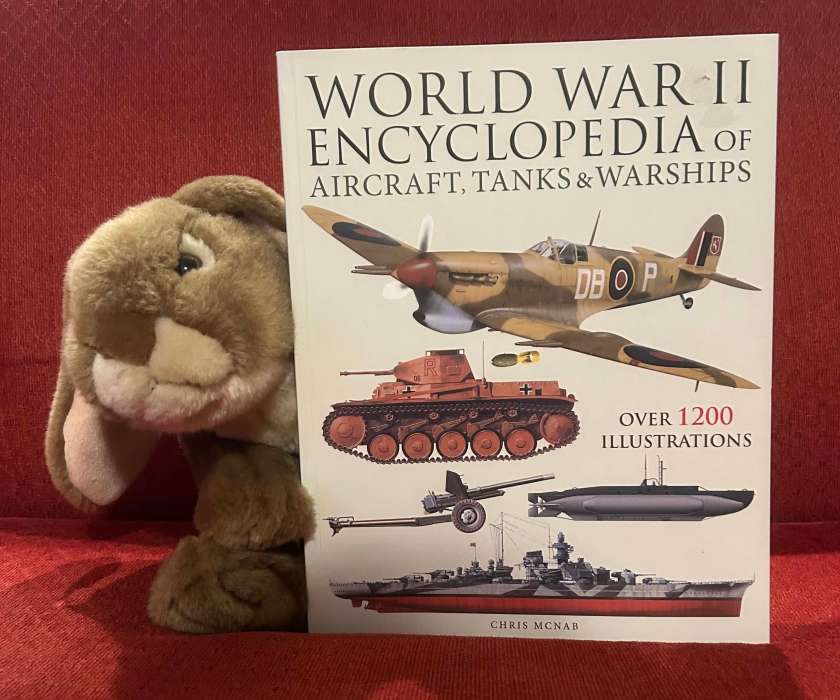
Caramel reviews World War II Encyclopedia of Aircraft, Tanks, and Warships by Chris McNab.

Sprinkles: So we are talking about a big book of facts again today.  

Caramel: Yes, yes we are. It’s about planes and tanks and ships, some of my favorite stuff, and I think this same guy wrote the encyclopedia of dinosaurs that I reviewed many many years ago, too, so I guess I should have known I would like the book. He just seems to write cool books. 

S: Well, it was clear you would like it because it is about World War II, aircrafts, tanks, and warships. 

C: Yes, that, too. 

S: Okay, so we know you liked the book. Then let us look into it together. Tell us about it. 

C: Well, it has a lot of illustrations. The cover says it has more than 1200! You know how I love my pictures, especially in a nonfiction book. There are three to five pictures on each page. Some are black and white photographs but many of them are in color and they are pretty detailed pictures of things. So I like them a lot! 

S: Sounds like just the right book for you. 

C: Yep.

S: So is it pages and pages of tanks and such?

C: Exactly. But first there are aircrafts. There is one type of aircraft on each page, and they go from page 10 till page 141, so there are more than a hundred and twenty planes! 

S: That is a lot of different types of planes. 

C: Yeah, a lot of different countries fought in World War II,  and each of them had many different types of aircraft. 

S: Okay, then after the aircraft what comes next? From the title of the book, I will guess: Tanks!

C: Almost. The next section is Tanks and Armored Fighting Vehicles. There are more than a hundred of these too. 

S: So let me guess. Is the next section warships?

C: Nope. There is a section on Artillery, Anti-Aircraft, and Anti-Tank Guns. It is a little shorter, but it also has a lot of examples, maybe forty to fifty different types. And then comes the section on Warships. 

S: Cool. 

C: Yes, very cool. There are over a hundred of those, too. 
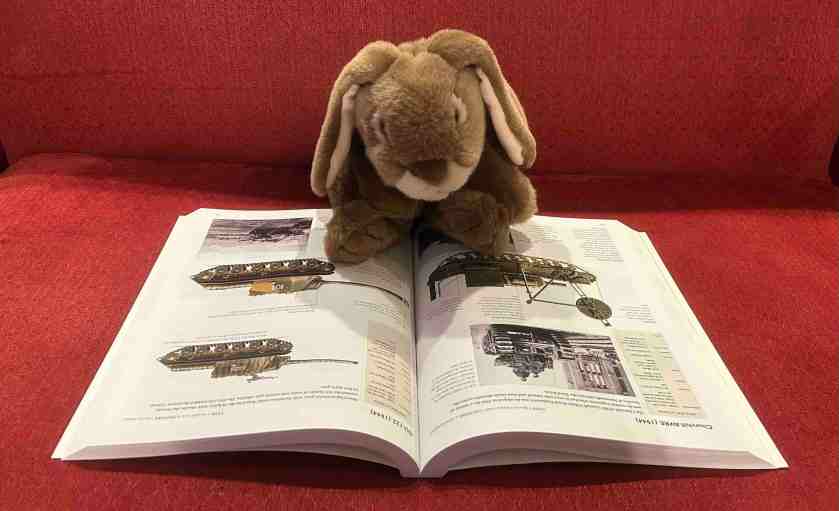
Caramel is reading World War II Encyclopedia of Aircraft, Tanks, and Warships by Chris McNab.

S: I can see why you liked this book. 

C: Yeah. I really like all of the pictures of planes and tanks and ships. They’re cool to look at, and I also like to see the stats, like what they weigh or what they carry. So for example I learned that a typical heavy warship is 11,000 tons of displacement. That is a lot of water! 

S: Oh my! That sounds really heavy!

C: Yep. 

S: So I think you particularly like planes and tanks. Tell me a bit about your favorites. 

C: The F4U Corsair is my favorite plane. It is on page 108, and it is really cool. It has folding wings! 

S: Wow! I didn’t know they made planes with folding wings; that is very cool. 

C: It is! And the T-34 is my favorite tank. It was built and used by the Soviets and it had a huge impact on the war. They were cheap and quick to make and they were very powerful. There are two versions in the book. There is a 1942 version, on page 216, and then there is a revised version from 1944 on page 260. But I like the 1942 version best. I even made a model of it!  

S: That is cool! 

C: There is another one I find interesting. It is called the Churchill Crocodile, on page 251. It is a revision of the Churchill tank from 1941, which is on page 159. Both of them were British. 

S: Why is the Crocodile interesting? 

C: It is interesting because it is like a flame thrower on a tank. 

S: That would be quite destructive. 

C: Yes, I think so. The war was very destructive. I really just want to read about these machines because they are interesting as machines. I never want to really see them in real life, in a war. 

S: Agreed, Caramel. But I do have one last question. 

C: What is it?

S: Why was the Crocodile called a crocodile? 

C: Because it had a tail, a fuel tanker at the back. And they thought it looked like a crocodile tail I suppose. 

S: Hmm, that is interesting. 

C: All of the book was very interesting. 

S: I can see that! But it is getting late. 

C: And it is once again a school night. 

S: So is it time to wrap this up?

C: Yep. 

S: So what do you want to tell our readers? 

C: Stay tuned for more book bunny reviews!
Caramel enjoyed reading World War II Encyclopedia of Aircraft, Tanks, and Warships by Chris McNab and learning so much more!

Marshmallow reviews Night by Elie Wiesel

Today Marshmallow reviews Night by Elie Wiesel, first published in Yiddish in 1956 and in English in 1960. Wiesel won the Nobel Peace Prize in 1986 “for being a messenger to mankind: his message is one of peace, atonement and dignity”.

A small caveat: The book as well as the review below involve historical events that depict harsh realities. They may not be appropriate for younger readers.

Marshmallow reviews Night by Elie Wiesel.

Marshmallow’s Quick Take: If you are a person of reasonable maturity and ability to process and handle important historical events, then this is the book for you.

Marshmallow’s Summary (with Spoilers): Elie Wiesel was a young Jewish boy in Romania during the Second World War. The book is more or less a memoir of his youth.

Elie is a young boy, extraordinarily devout at a remarkably young age, seeking out a religious mentor in Moishe the Beadle. It is from him that the town of Sighet—located in Transylvania—first hears of the Nazis’ proximity. Since Moishe is a foreign Jew, he is forced to leave first. But he luckily escapes the Nazis who leave him for dead due to his bleeding, shot leg. Moishe walks on foot an unbelievably long journey back to Sighet to warn the very people who look down on him of how dangerous the Nazis are. None of the residents believe him. Elie worries for his mentor, as many adults around him say the Beadle is mad.

Many of the Jews of Sighet do not believe that the Germans could reach them. Others believe that the war would end before Germany’s reach expanded far enough to affect them. It is heartbreaking to say that they are wrong. The Nazis show up on Sighet’s streets within a matter of days.

The Jews are first forced into ghettos, condemned to smaller slums as though they are not deserving of being able to choose where to live. Soon they are forced out of their homes, able to take only what they could carry. They are made to wait on scorching sidewalks and soon after chased towards cattle carts that take them to the concentration camps. Elie and his family, which includes his father Shloma, his mother Sarah, his two older sisters, and his seven-year-old younger sister Tzipora, are taken to Auschwitz. He loses his mother Sarah and Tzipora to the gas chambers and the Nazis on the first day, though he does not know it for certain until later. He and his father are forced into labor camps and the horror continues.

Wiesel’s suffering is conveyed through his own testimony in Night. He and so many others, millions of Jews, Gypsies, and other undesirables in the Nazis’ eyes, suffered so much as the hands of humans who were in all aspects but one the same. This story is one that everyone must read.

Marshmallow is reading Night by Elie Wiesel.

Marshmallow’s Review: This book is simply vital. I think everyone must read it once they are old enough to understand why we must remember. Elie Wiesel is one of the strongest humans to walk this Earth and he is also one of the wisest. Through this book, he passes on the story of the Nazi camps and their horrors designed to exterminate the Jews. He describes things that provoke a deep silence after reading, a deep silence that necessitates thought and great gratitude that one is not in such a situation. Wiesel is a hero by the virtue that he survived. But there are so many who did not and, for their sake and Wiesel’s, this story cannot be forgotten.

Night was assigned as reading in my English class and that is one of the best decisions a teacher can make. This story has impacted so many and Wiesel is truly one of the few people who can be described as a master of prose and a witness of humanity. In words, Wiesel has described the indescribable.

Thanks to Wiesel’s wife Marion who translated it into English for a larger audience, Night is written in simple and clear language, with few ornate embellishments. The horrific events make it seem so already, so Wiesel says things in a way that never makes the story seem unreal.

It is really remarkable and heartbreaking that Wiesel never viewed himself as exceptional. He wonders several times why he survived. He says he was never special or had any sort of skills or attributes that made him deserving of life. But everyone is deserving of life and yet so many were robbed of it. It is truly heartbreaking. Yet, his thoughts and perseverance, his selflessness and his determination (though these words have lost much of their weight and meaning through superfluous use) make him one of the most admirable human beings. He cared unwaveringly for his father though they were both suffering. He never stopped looking after him, even though Wiesel himself thought he failed in this. Wiesel was truly, indescribably a remarkable person with a profound impact. His book Night must be read.

Marshmallow’s Rating: 200%.

Marshmallow rates Night by Elie Wiesel 200%.

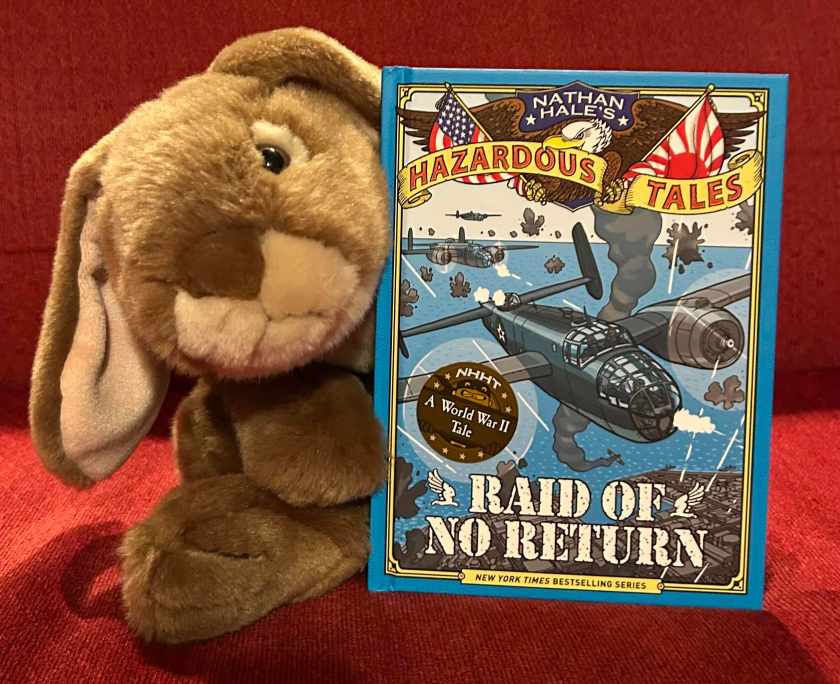
Caramel reviews Nathan Hale’s Hazardous Tales #7: Raid of No Return by Nathan Hale

Today Caramel is talking to Sprinkles about Raid of No Return by Nathan Hale, published first in 2017. This is the seventh book in Nathan Hale’s Hazardous Tales series.

For Caramel’s reviews of the six earlier books, please check out: One Dead Spy, Treaties, Trenches, Mud, and Blood, The Underground Abductor, Big Bad Ironclad, Donner Dinner Party, and Alamo All-Stars.

Caramel reviews Nathan Hale’s Hazardous Tales #7: Raid of No Return by Nathan Hale.

Sprinkles: So Caramel, you are back this week with a new Nathan Hale book!

Caramel: Yep! This one is a WW2 one.

S: It is about the second world war, you mean?

C: Yep, it is about the U.S. bombing campaign on Tokyo, which is apparently called the Doolittle Raid today. It starts with a summary of how the second world war began and then the Pearl Harbor attack

S: That is interesting. Most of the earlier books in the series were about earlier parts of American history. So this is getting a bit closer to today. 

C: Sprinkles, it is not that close! The Pearl Harbor attack was in 1941. That is still the last century. 

S: You are right of course. It is also the last millennium!

C: Yeah, see, I was right! It is still quite ancient history, especially for a little bunny like me. 

S: True, for older bunnies like me who were born in the last century, maybe it feels closer. Anyways, so the book is about the battle in the Pacific Ocean then. 

C: It is even more specific than that. There is a little bit about how people viewed the Pearl Harbor attack, from both sides (American and Japanese), and then the rest of the book, we focus on the experiences of the pilots who flew the U.S. bombers over Tokyo. 

S: I see. I had of course heard about the Pearl Harbor event, but I had not read about this retaliation. From the Wikipedia article it looks like this was a very outrageous plan, not terribly likely to succeed–

C: Yes, but it somehow worked. They did manage to bomb some important military targets, I think. 

S: And the war escalated from then on of course. 

C: Yes.

Caramel is reading Nathan Hale’s Hazardous Tales #7: Raid of No Return by Nathan Hale.

S: Okay, so I am guessing that you were excited to read this book. It has been a few months since you last read a new Nathan Hale book. 

C: Yeah! And this one came in a box of three, like the other books I read from this series, and I loved all three!

S: Hmm, maybe you will review the others in the coming weeks. 

C: Maybe. If I do that, can we get the next three books? These were really good!

S: Sounds like a good deal to me. 

C: Okay, good. I know what I will be reviewing next week then!

S: Alright. Let us get back to this week though. So this is the seventh book in the series. Does the same framing story continue? I mean, the other books are all narrated by Nathan Hale, that famous spy who is about to get hanged. Is this one continuing the same thing?

C: Yeah, it is. 

S: I am a bit curious about how they will finish the series. I mean Hale did get hanged in the end. But maybe since this is for young bunnies, and there are so many other interesting historical tales to tell, maybe we will not ever get to those bits. 

C: Yeah, I hope that it never ends.

S: I know you love graphic novels and you love history and you love facts. This is just the right book series for you!

C: Yep, it is.

S: So then is it fair to say that you would recommend it to other young bunnies?

C: Yes! Any bunny who loves books or history or graphic novels would like these too! And you know, they don’t have to read them in order, so they can just jump right into any of them after the first one.

S: Great! Maybe this is a good place to wrap up this review. What do you think?

C: Sure. Then I can go back to reading and rereading the next book!

S: Sounds good to me. What do you want to tell our readers then?

C: Stay tuned for more book bunny reviews!
Caramel enjoyed reading Nathan Hale’s Hazardous Tales #7: Raid of No Return by Nathan Hale and is eager to read the next book in the series.

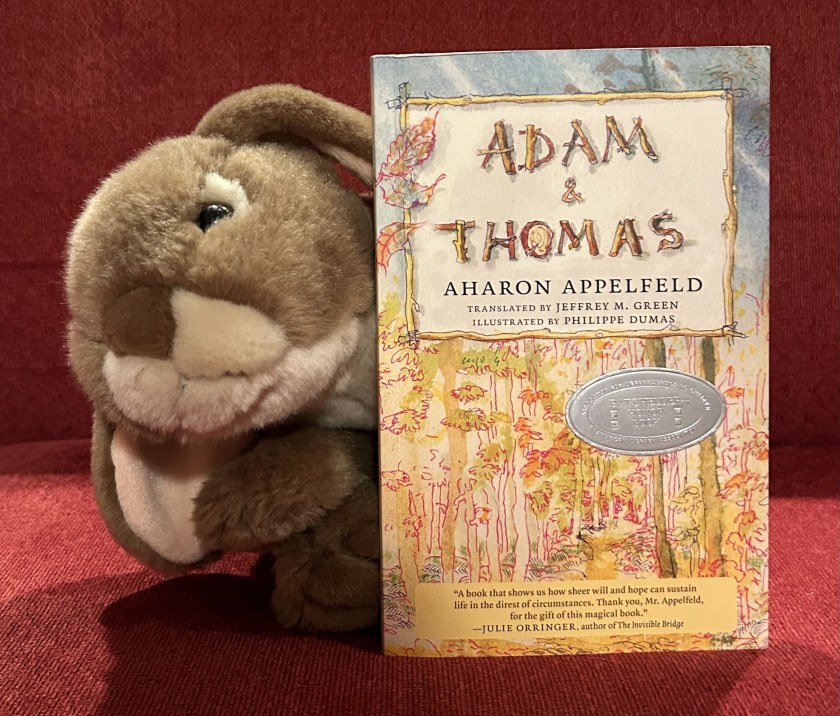
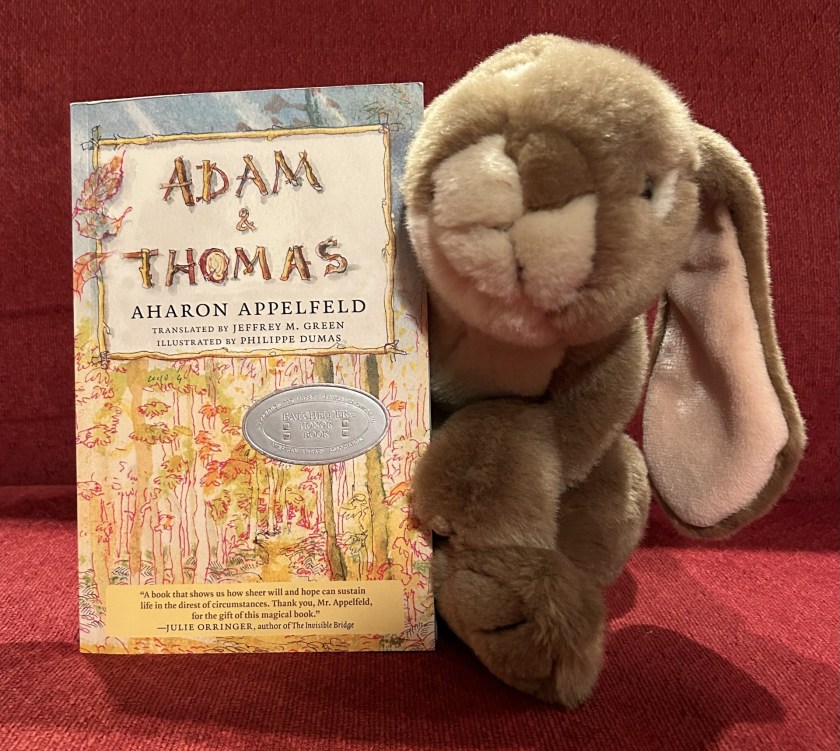
Caramel reviews Adam & Thomas by Aharon Appelfeld

Today Caramel is talking to Sprinkles about Adam & Thomas, a book written originally in Hebrew in 2013 by Aharon Appelfeld, translated into English by Jeffrey M. Green, and illustrated by Philippe Dumas.

Caramel reviews Adam & Thomas, written by Aharon Appelfeld, translated into English by Jeffrey M. Green, and illustrated by Philippe Dumas.

Sprinkles: Let us talk a bit about this book Caramel. Maybe first start by telling us what it is about.

Caramel: It’s about two nine-year-old boys who escape one of the darkest times in human history. I mean, maybe the darkest time in modern history.

S: You are of course talking about World War II and the Holocaust, when millions of European Jews were systematically murdered by Nazi Germany and their collaborators.

C: Yes. And you know I did not really want to read this book because I knew it would be sad once I saw it was about that time.

S: Yes, I know. But I thought it was a good book and that you should probably read about that event anyways. After all, you just read The Donner Dinner Party and that was also about pretty harsh truths.

C: Yup. But I knew about the Holocaust. I did read Maus, too, even though Marshmallow was the one who reviewed it. And I did not like it because it is really really sad.

S: I know. But at least this book ends up in a more positive place, no?

C: Yes. There is that, at least. Not only do they survive the war hiding in the forest for years, but they even find their mothers after all that time.

S: Well, I guess we gave away the ending, but at least readers will know that things will get better in the end even when they re reading the darkest parts of the story. That there is hope.

C: Yes.

Caramel is reading Adam & Thomas, written by Aharon Appelfeld, translated into English by Jeffrey M. Green, and illustrated by Philippe Dumas.

S: Did you know this was a translation?

C: Yup. It says it on the cover page. And I know how to read.

S: Yes, of course. but sometimes people or even bunnies do not notice these things, so I thought I’d ask. So the author wrote this book in Hebrew, a language he learned only as a teenager. And he was apparently a pretty well-known author in Hebrew, and in English translation, and Jeffrey Green who translated this book was his standard translator.

C: I did not know any of that. But I think the English works perfectly well. I mean I thought it was a good book for young bunnies.

S: Yes, you are right. The sentences are simple and short. I think it is just right for young bunnies, even though the topic is a bit sensitive, and some younger bunnies might not be able to handle it.

C: Yes, I think so too. But the book is also a little long for really young bunnies. It has almost 150 pages!

S: But there are illustrations on almost every other page!

C: True. And they are really neat too.

S: Tell me more.

C: The illustrations are relatively simple and yet very detailed too. They are in color, and I liked looking at them.

S: I liked them too Caramel! So are you still upset with me for making you start reading this book?

C: No, not really. I think this is a good book with an interesting storyline, and it makes you feel like it might have actually happened. Like the characters are real people.

S: Apparently the author himself ran from a camp and lived in similar circumstances when he was about that age. So that might be why you found it so realistic, because it was real, at least to an extent.

C: Yes.

S: So maybe this is a good time to wrap up this review then. What would you like to tell our readers?

C: Stay tuned for more book bunny reviews!
Caramel appreciated reading Adam & Thomas, written by Aharon Appelfeld, translated into English by Jeffrey M. Green, and illustrated by Philippe Dumas, and thinks it is a good story to teach little bunnies about what happened to some young children during World War II.