Marshmallow reviews The Tale of Despereaux by Kate DiCamillo

Marshmallow has always enjoyed the books of Kate DiCamillo. She has also reviewed a handful of them for the book bunnies blog. (See her posts about Flora and Ulysses, The Miraculous Journey of Edward Tulane, and The Magician’s Elephant.) Today she reviews The Tale of Despereaux: Being the Story of a Mouse, a Princess, Some Soup, and a Spool of Thread by DiCamillo. Originally published in 2003, The Tale of Despereaux won the 2004 Newbery Medal and it was the first book by DiCamillo that the book bunny household read–or more accurately listened to as an audio book.
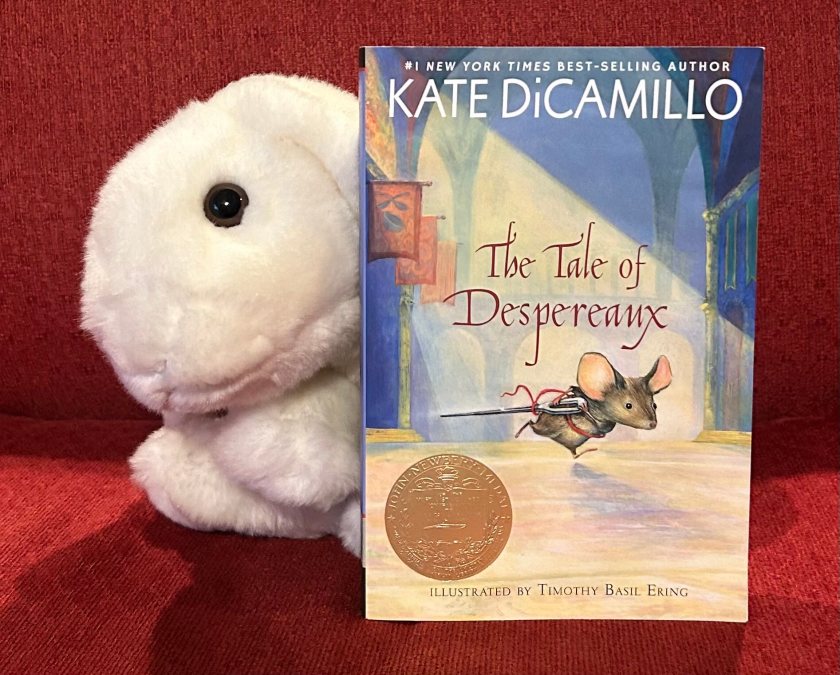
Marshmallow reviews The Tale of Despereaux by Kate DiCamillo.

Marshmallow’s Quick Take: If you like cute books that are akin to fairy tales in their rich, classical storytelling, then this is the book for you! 

Marshmallow’s Summary (with Spoilers): Despereaux was born to a French mouse whose favorite word was “disappointment.” Along with his family, he lives in the king’s castle in the land of Dor. Unfortunately, he is quite the disappointment both to his mother and the rest of his family. He is extraordinarily, peculiarly small but his ears are extremely large in proportion. On the first day of his life, his family was also shocked by how curious he was; they say he was born with his eyes open. This was just the start of his bizarre behavior–at least in the opinion of the other mice.

Despereaux also lacks the instinctual fear other mice believe is integral to the very essence of being a mouse. He doesn’t scurry, much to their dismay, and doesn’t realize the importance of scavenging for crumbs. Not only that, he does not eat books; he actually reads them. So Despereaux overall is a very big disappointment to his mother, father, and the general mouse community in the castle. They still love him, but they are simultaneously in a state of shock. They are even more shocked when they see him interacting with a human. Specifically, Princess Pea who is the only daughter of the king.

Drawn to her first by music, Despereaux eventually falls in love with the princess (which is definitely a little unusual given their vastly differing sizes). However, his love is true. The rest of the mice community doesn’t appreciate her understanding nature and believe human-mice interactions are a threat to all. They banish Despereaux to the dungeons which are infested with rats. Rats, unlike their more timid mouse counterparts, are violent and dangerous. Suffice it to say, Despereaux finds himself in some hot water.

At the same time, a rat named Roscuro is plotting revenge on Princess Pea. He convinces one of the castle maids–an abused young girl named Miggery Sow or “Mig”–to help him kidnap Princess Pea and promises her Pea’s crown. With Princess Pea in danger, Despereaux takes up the mantle of those he read about in fairy tales and becomes her knight in shining armor. He might be a mouse but his lionhearted fearlessness and unwavering love make him an unstoppable force!
Marshmallow is reading The Tale of Despereaux by Kate DiCamillo.

Marshmallow’s Review: The Tale of Despereaux is a beautiful, adorable book! I love reading DiCamillo’s writing. It is unbelievably comforting and descriptive. Her books, particularly this one, feel like a rich, home-cooked meal. They remind you of the fairy tales we’ve all grown up with but an even more heartwarming version.

I love how adventurous and suspenseful this book is while it maintains its child-friendly style. DiCamillo is a master of prose that balances action with heart and character building. The plot is nicely, neatly wrapped up.

As a whole, The Tale of Despereaux is a very entertaining and moving book that is excellent in a touching yet understated way. I would highly recommend reading it to everyone! The message of strength, love, understanding, forgiveness, and openmindedness is something everyone can appreciate and learn from, regardless of age!

Marshmallow’s Rating: 100%.

Marshmallow rates The Tale of Despereaux by Kate DiCamillo 100%.

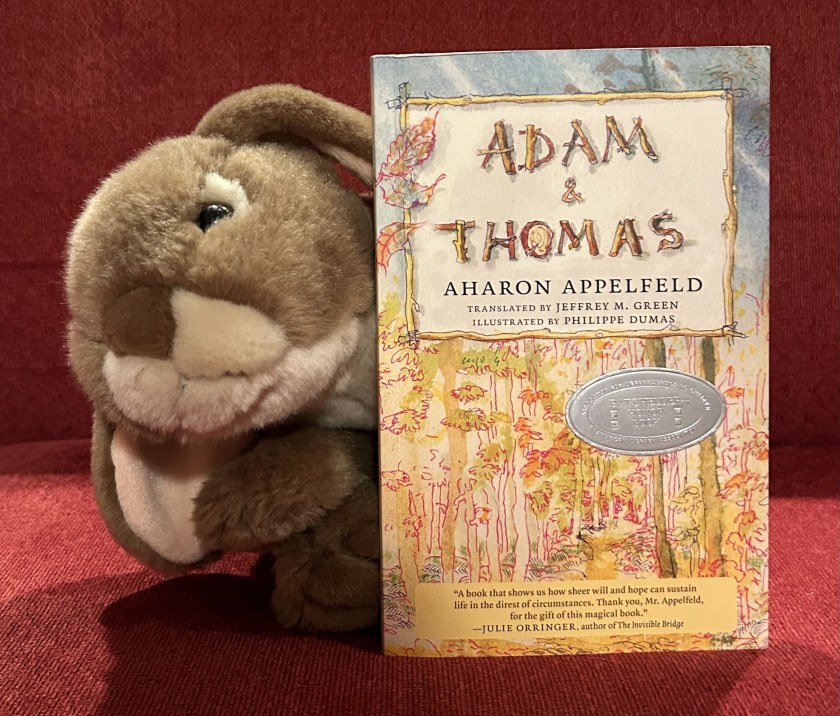
Caramel reviews Adam & Thomas by Aharon Appelfeld

Today Caramel is talking to Sprinkles about Adam & Thomas, a book written originally in Hebrew in 2013 by Aharon Appelfeld, translated into English by Jeffrey M. Green, and illustrated by Philippe Dumas.

Caramel reviews Adam & Thomas, written by Aharon Appelfeld, translated into English by Jeffrey M. Green, and illustrated by Philippe Dumas.

Sprinkles: Let us talk a bit about this book Caramel. Maybe first start by telling us what it is about.

Caramel: It’s about two nine-year-old boys who escape one of the darkest times in human history. I mean, maybe the darkest time in modern history.

S: You are of course talking about World War II and the Holocaust, when millions of European Jews were systematically murdered by Nazi Germany and their collaborators.

C: Yes. And you know I did not really want to read this book because I knew it would be sad once I saw it was about that time.

S: Yes, I know. But I thought it was a good book and that you should probably read about that event anyways. After all, you just read The Donner Dinner Party and that was also about pretty harsh truths.

C: Yup. But I knew about the Holocaust. I did read Maus, too, even though Marshmallow was the one who reviewed it. And I did not like it because it is really really sad.

S: I know. But at least this book ends up in a more positive place, no?

C: Yes. There is that, at least. Not only do they survive the war hiding in the forest for years, but they even find their mothers after all that time.

S: Well, I guess we gave away the ending, but at least readers will know that things will get better in the end even when they re reading the darkest parts of the story. That there is hope.

C: Yes.

Caramel is reading Adam & Thomas, written by Aharon Appelfeld, translated into English by Jeffrey M. Green, and illustrated by Philippe Dumas.

S: Did you know this was a translation?

C: Yup. It says it on the cover page. And I know how to read.

S: Yes, of course. but sometimes people or even bunnies do not notice these things, so I thought I’d ask. So the author wrote this book in Hebrew, a language he learned only as a teenager. And he was apparently a pretty well-known author in Hebrew, and in English translation, and Jeffrey Green who translated this book was his standard translator.

C: I did not know any of that. But I think the English works perfectly well. I mean I thought it was a good book for young bunnies.

S: Yes, you are right. The sentences are simple and short. I think it is just right for young bunnies, even though the topic is a bit sensitive, and some younger bunnies might not be able to handle it.

C: Yes, I think so too. But the book is also a little long for really young bunnies. It has almost 150 pages!

S: But there are illustrations on almost every other page!

C: True. And they are really neat too.

S: Tell me more.

C: The illustrations are relatively simple and yet very detailed too. They are in color, and I liked looking at them.

S: I liked them too Caramel! So are you still upset with me for making you start reading this book?

C: No, not really. I think this is a good book with an interesting storyline, and it makes you feel like it might have actually happened. Like the characters are real people.

S: Apparently the author himself ran from a camp and lived in similar circumstances when he was about that age. So that might be why you found it so realistic, because it was real, at least to an extent.

C: Yes.

S: So maybe this is a good time to wrap up this review then. What would you like to tell our readers?

C: Stay tuned for more book bunny reviews!

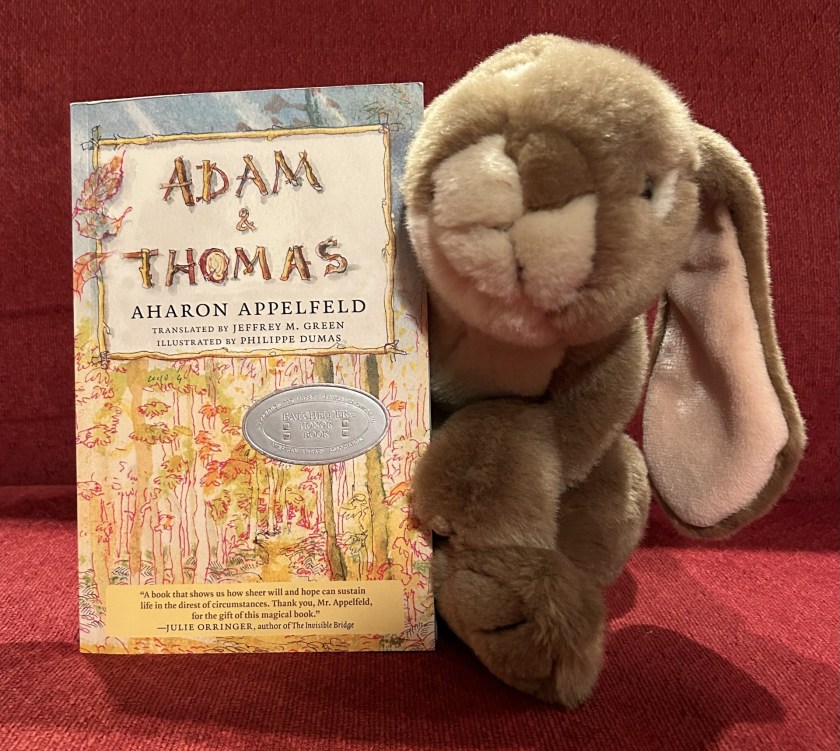
Caramel appreciated reading Adam & Thomas, written by Aharon Appelfeld, translated into English by Jeffrey M. Green, and illustrated by Philippe Dumas, and thinks it is a good story to teach little bunnies about what happened to some young children during World War II.

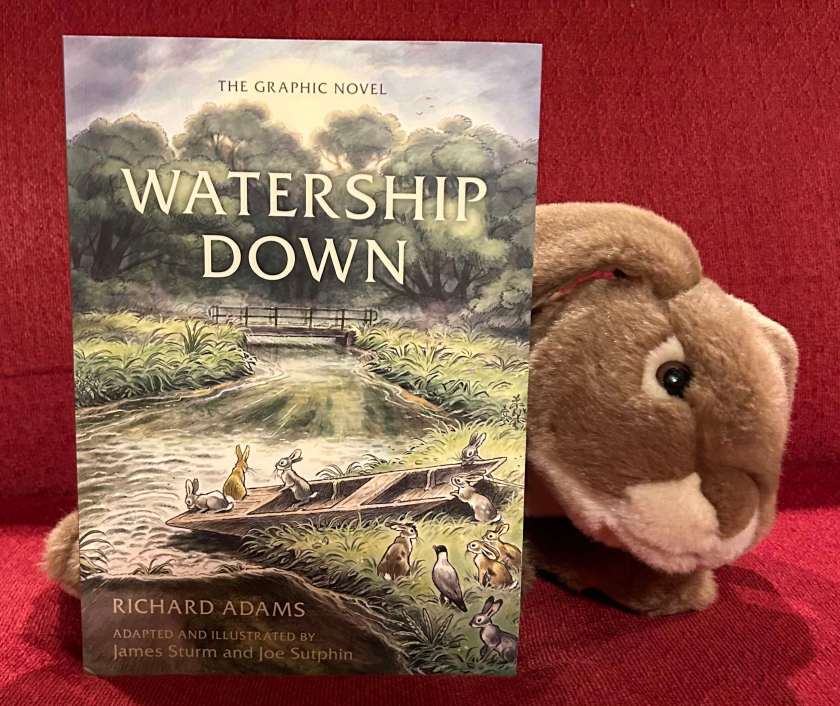
Caramel reviews Watership Down: The Graphic Novel by Richard Adams, James Sturm, and Joe Sutphin

Many years ago, over the course of a few days, the book bunnies listened all together as a family to an unabridged version of Watership Down, the 1972 classic by Richard Adams. Recently Caramel got his paws on a new (2023) graphic novel adaptation of the book by James Sturm and Joe Sutphin and read it over the course of a few hours. Today he is talking to Sprinkles about the book.

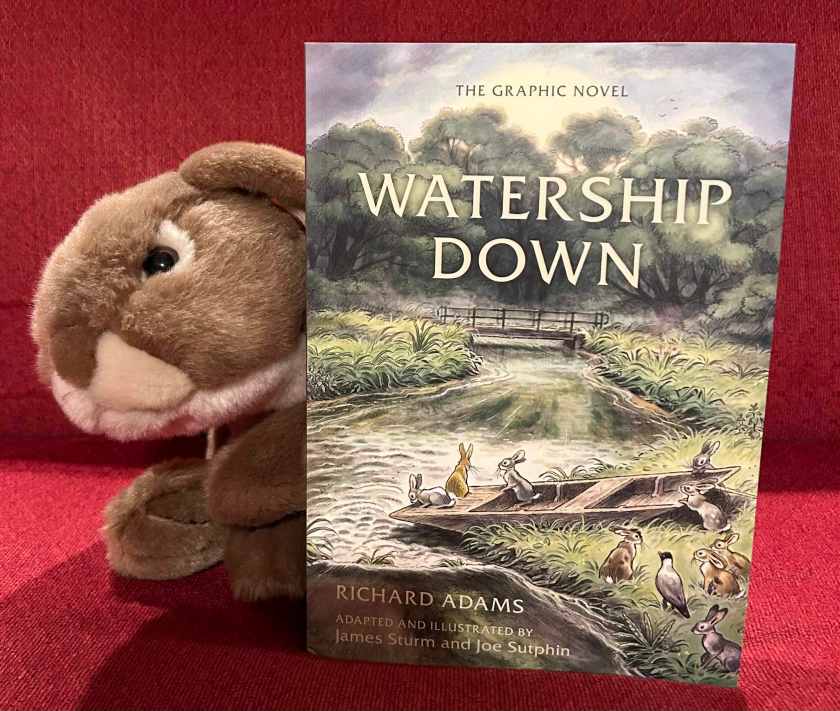
Caramel reviews Watership Down: The Graphic Novel, written by Richard Adams, adapted by James Sturm, and illustrated by Joe Sutphin.

Sprinkles: I remember how we listened to this whole story when you all were so much younger. So when I saw that there was a graphic novel adaptation, I knew you would want to read it. 

Caramel: Yes, I guess you were right! You know me well.

S: I think I do! Okay can you tell us a bit about the story?

C: Sure. In this book there are bunnies like us, but they are wild and are trying to escape from a great evil that was foretold by one of them named Fiver.

S: Oh, I think I remember Fiver. Isn’t he the dreamer one? Kind of like an oracle?

C: Yeah, kind of. He can see the future and warns the others of the dangers so they can survive.

S: Okay, so here is a group of rabbits living in a warren. That is, my dictionary tells me, a network of interconnecting rabbit burrows. And they are living a normal wild rabbit life. But then some great evil thing happens, is that it?

C: Yes, it is kind of like that. However not everyone believes Fiver, and so not all of them make it.

S: Well, I can see how not everyone would immediately believe some little bunny saying something terrible will happen, without evidence. But his brother believes him, right?

C: Yep, so Hazel, that is Fiver’s brother, gathers everyone who believes Fiver and they run. 

S: So they leave their warren and wander away, and try to find a new place to settle down at?

C: Yep. Along the way they find a different warren in which there are some not-so-nice bunnies who try to kill the main character bunnies, but thankfully the good bunnies make it out, and they get two new bunnies from that warren.

S: Cool! Okay, so Fiver is the dreamer, oracle bunny. Hazel is the main leader bunny. Are there other characters that you especially liked or remembered from when we listened to the book those many years ago?

C: Fiver is my favorite, I don’t know why but he is my favorite bunny in the book.

S: He is a gentle soul, as far as I remember. He is sensitive and kind. 

C: Yeah, but he can also see the future, and that is cool.

S: Yes, that is really cool, I agree. I do remember another character, Bigwig, I think. He is a fighter, and a good one too. 

C: Yeah, he is also really cool, but Fiver is still my favorite character. There is also a big bird who helps the bunnies occasionally, His name is Kehaar. 

S: That is cool! I liked that character, too. 

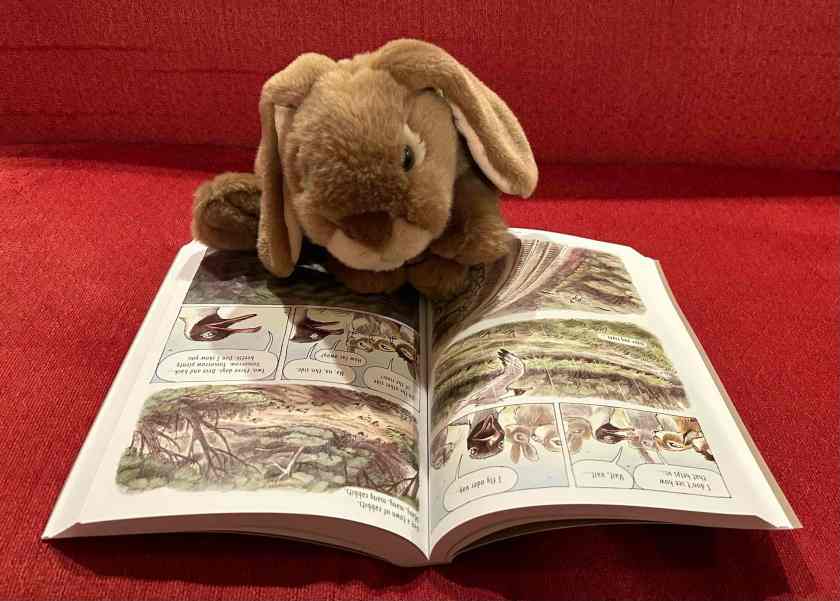
Caramel is reading Watership Down: The Graphic Novel, written by Richard Adams, adapted by James Sturm, and illustrated by Joe Sutphin.

S: Okay, so when we listened to this book many years ago, we had no images to attach to the main characters. But a graphic novel of course will have faces attached to each character. Did these work for you? Did you like the illustrations? Is the world of Fiver and Hazel how you had imagined it to be?

C: Yeah, it is a lot like what I thought. The bunnies are all very realistic looking, too, and exactly how I imagined them to be. 

S: That sounds great! I was just going to ask you if they were more cartoonish or more realistic. So this was perhaps the longest graphic novel you have ever read, right? 

C: Yep, it was 382 pages!

S: That is long for a graphic novel. But the original book is a very long one, too, so that makes sense. Anyways, did you know that the original book was banned in some places because it was too violent and there was a lot of brutality depicted explicitly? 

C: Oh no. I did not think it was too violent. 

S: Well, then again, you do like the Wings of Fire series and those are also kind of violent. So maybe your generation of bunnies is a bit more used to violence… 

C: No, I would hope not.

S: I see what you mean Caramel. Yes you are right, it is not a good thing to get used to violence. Maybe I should have said that you can handle some more violence. I think that especially when they made the animated movie in 1978, the movie started out looking like a typical Disney movie, with cute bunnies who speak and are living in this idyllic natural place, but then things get dark very fast, and terrible things happen, bunnies killing each other, getting killed by humans, and so on. So maybe it shocked people a lot more back then. 

C: Maybe. 

S: I also read that it was banned in China for a while because it depicted animals and humans as equals or at least somewhat on a similar level, and this was unacceptable. 

C: Hmm, they probably would not like Animal Farm either, then. Or us.

S: Yes, you have a point there Caramel. Bunnies talking about books would probably not be okay. Anyways, we are bunnies who love to read and talk about books. So let us get back to the book. So overall, did you enjoy this graphic novel?

C: Yes, greatly. And I recommend it to all young bunnies who like to read about other bunnies being heroic. 

S: Cool! Okay let us wrap this up then. What would you like to tell our readers?

C: Stay tuned for more book bunny reviews!

Caramel enjoyed reading Watership Down: The Graphic Novel, written by Richard Adams, adapted by James Sturm, and illustrated by Joe Sutphin, and recommends the book to all young bunnies who like to read about other bunnies being heroic.

Marshmallow reviews All-American Boys by Jason Reynolds and Brendan Kiely

Today Marshmallow reviews All-American Boys by Jason Reynolds and Brendan Kiely, first published in 2015.

Marshmallow reviews All-American Boys by Jason Reynolds and Brendan Kiely.

Marshmallow’s Quick Take: If you would like to read a book about social justice, friendship, bravery, and family, then this might be the book for you. 

Marshmallow’s Summary (with Spoilers): Rashad Butler has worked hard to be an All-American boy. His father believes that the military is the best option for a young Black man in America, so Rashad is in the ROTC drill team at Springfield Central High School. One Friday, Rashad is preparing to go to a party. While he is buying chips in a store, he leans down and reaches into his bag on the floor to get his phone to text his brother. A woman trips over him, and a police officer comes over to see what’s happening. He presumes that Rashad is trying to steal the chips. He drags him outside, handcuffs him, pushes him to the ground, and starts beating him. Rashad is arrested and sent to the hospital with a broken nose, several broken ribs, and internal bleeding. 

Quinn also goes to Rashad’s school. Quinn’s father died in Afghanistan and is viewed as a hero. Quinn feels constantly pressured to be a perfect All-American boy, living under his father’s shadow, even after his death. He’s doing a pretty good job, however, playing on the school’s basketball team competitively. Within a couple weeks, scouts from colleges and universities will be watching their games, and Quinn is determined to be seen.

That very Friday, Quinn and his friends are at the same store, waiting outside to find an adult who could buy them alcohol. Quinn is still there when the police officer beats Rashad viciously and remains there long enough to recognize the officer, Paul, who is like a father figure to him. After his father died, Quinn was taken care of, taught, and protected by Paul who filled the part of a family for Quinn that his mother and brother didn’t. Quinn and his friends flee the scene, and Quinn tells his friend Guzzo (Paul’s brother) what he saw. 

Soon, Rashad’s beating is covered by the news, so much so that Rashad sees this all over the TV while in the hospital. He is confused as to what to do next. His brother Spooney is enraged and helps organize a protest about police brutality. His mother is devastated and tries to stay strong. His father, on the other hand, is conflicted. His father, who was in the military and in the police force, believes that Black men should be disciplined and look like it, because that will prevent anything bad from happening to them. He doesn’t even believe Rashad in the beginning when he says he wasn’t stealing the chips. 

Quinn is also conflicted. He has known Paul for such a long time, and his mind cannot connect the violent officer he saw to the caring, protective figure he’s known for so long. As a family friend to Paul and Guzzo’s family, his “allegiance” to Paul is presumed, but inside he is unsure. He knows that Rashad didn’t deserve to be beaten. 

After that Friday, the city of Springfield is torn into chaos. Sides are taken and lines are drawn. “Loyalties” are put into question while citizens work to fight against social injustice and stereotypes. Meanwhile, Rashad and Quinn live in two different worlds, in two different situations, struggling to make sense of what just happened. 

Marshmallow is reading All-American Boys by Jason Reynolds and Brendan Kiely.

Marshmallow’s Review: I think All-American Boys is a very meaningful book. I have read and reviewed a book about police brutality from the perspective of a witness before (The Hate U Give). However, All-American Boys is unique because it is written in two different perspectives: the victim’s and the witness’s. So we see the narrative through the eyes of people with fundamentally different experiences. Rashad is Black and gets beaten by Paul, while Quinn is White and had been raised loving and respecting Paul. As expected, the two boys have a fundamentally different experience with racism. Each chapter is written from either Rashad’s or Quinn’s perspective, and they mostly alternate between the two narratives. Rashad’s chapters are written by Reynolds and Quinn’s are by Kiely, which adds depth and more detail to the storyline. The characters have a very realistic, down-to-earth feel (for example we get to connect with Rashad beyond his victimization as a young person who draws to express himself), as well as the school and small-town environment created by the authors. I find it impressive how the two authors wrote such a cohesive book together.

I have read another book by one of the authors (Jason Reynolds) before: Long Way Down. I have deeply enjoyed reading both, and I think this book, as well as that one, should be read by all. It is important for everyone to read and understand the perspectives of others, especially given how some situations are experienced in extremely different ways by different people based on their race.

All-American Boys might be more appropriate for bunnies older than ten because it has a lot of cursing, and the topic might be a bit heavy for younger ones. Otherwise, I would definitely recommend this book to all because of its well-written storyline, characters, and important message. 

Marshmallow’s Rating: 100%

Marshmallow rates All-American Boys by Jason Reynolds and Brendan Kiely 100%.