Caramel reviews The ABC Murders by Agatha Christie

Sprinkles is a huge Agatha Christie fan, so of course she was thrilled to see Caramel carrying around The ABC Murders, originally published in 1936. They are talking about the book today. As usual Sprinkles is taking notes and asking questions.
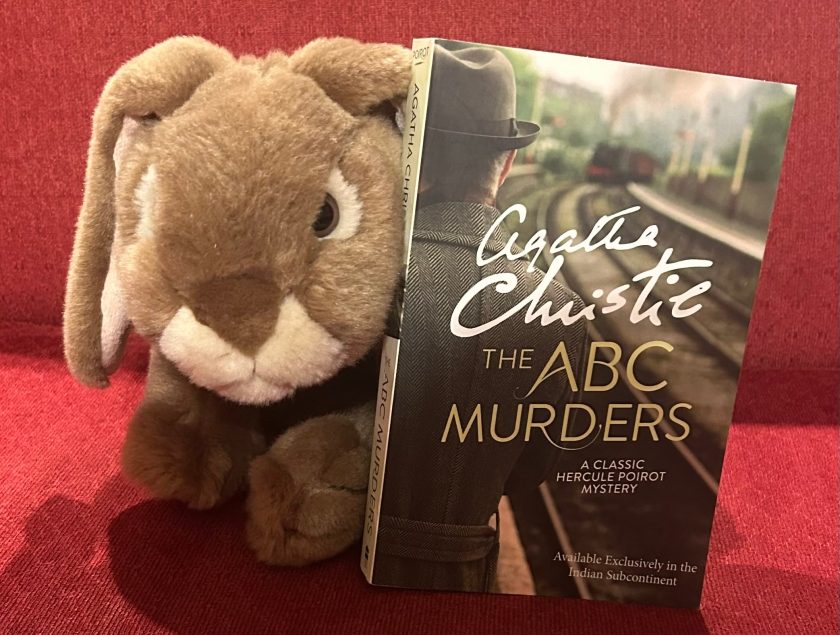
Caramel reviews The ABC Murders by Agatha Christie.

Sprinkles: I was so excited to see you reading an Agatha Christie book, Caramel! She is the best! 

Caramel: Yeah, I can see that point of view, she is a pretty good writer.

S: Yay! So you liked the book! I mean, I know there are a lot of folks who would not consider Christie a serious literary figure, but I always enjoy her books and I think she is great at what she does. 

C: Yup, she kept me guessing almost all the way to the end. 

S: Was this your first Agatha Christie novel?

C: Nope. I had also read And Then There Were None when Marshmallow was reviewing it. 

S: Ooh, that was a good one too. So, okay, back to The ABC Murders. I am sure I read this book but it must have been decades ago. And I do not remember much of the plot. Can you tell us a bit about it? 

C: So Hercule Poirot receives a suspicious letter signed by “ABC”.

S: Oh, so this has Poirot as the main detective! That is cool! Go on.

C: Yes, so this letter tells him that there will be a murder in Andover, and then someone actually dies there, so Poirot goes to Andover to figure things out. 

S: Poirot is Belgian, and often works with some British guy who writes about him, right? Kind of like Dr. Watson of Sherlock Holmes

C: Yes. The main narrator is Arthur Hastings, and the book is written like he is recounting the story rather than living through it. 

S: Apparently Hastings appears in quite a lot of Poirot mysteries. I suppose it is good to have a character like Hastings or Watson to tell us these stories about the genius detectives they are hanging out with and admire so much. This way the stories unfold naturally and we are in the dark about what is going on in the minds of these mysterious crime solvers until the very end. 

C: Yeah, it’s like that, ‘cept Hastings ole’ fellow has quite the thinker on emself-

S: Wait, what are you saying? Please speak normally. You are not a British gentleman from the nineteen twenties. 

C: Awww, ok, but that was fun! And I am only about a hundred years late! And not quite British… Anyways, the only difference is that Hastings is actually somewhat smart so he also figures some things out. Still it is clear to everyone including himself that he is not as smart as Poirot and is surprised when Poirot solves everything. 

S: Yup, that agrees with my previous understanding of their relationship.
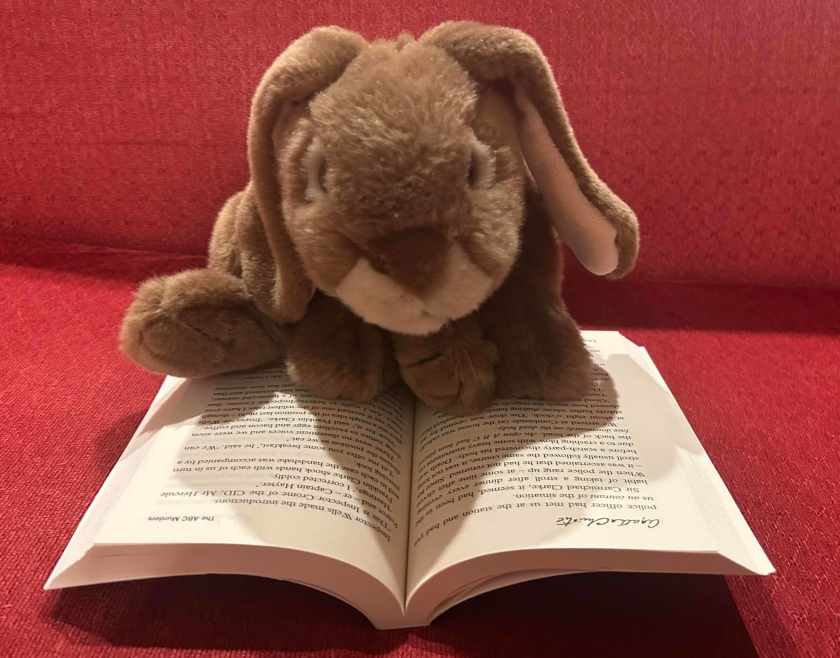
Caramel is reading The ABC Murders by Agatha Christie.

S: So tell me a bit more. Could you tell the book was almost a hundred years old?

C: Well, it is exactly ninety years old actually. The book read fine to me. I did not think they were using old fashioned words or anything. And it is supposed to be happening in between the two world wars, and I could not even tell that, really. 

S: Yes, I think Christie’s language is clean and simple enough for us to not even notice it. Every now and then she uses a phrase that is unfamiliar to me, or she mentions something historical to me but contemporary to the story characters, but most of the time, I cannot tell at all that she wrote these things such a long time ago. 

C: Yeah, that checks out. Though it seems that in these books the detective and other people sometimes use words that today’s people might not understand. Like some words or phrases that refer to the railway map in Britain at the time. Of course I didn’t know that till they explained what it was they were talking about. But most of the time, I could totally forget this was supposed to be happening in the 1920s. That was even before your time Sprinkles!

S: Yes, of course it was before my time. It was even before my parents’ time, Caramel. 

C: Oopsie, or is that what you want me to think?

S: Okay, let us put aside any implications that I might be undead or-

C: Or a lich?!

S: Okay, let us not go there. 

C: Sure, that’s what a lich would say.

S: Caramel! These seem like ideas more fit for Midnight’s reviews. 

C: Oh yes, Midnight does like his fantasy books. But I like them too. 

S: I know. You like playing Dungeons and Dragons, and various versions of it. 

C: Actually these days, I prefer Pathfinder, which is really just D&D 3.5 edition. 

S: True. But Agatha Christie tells stories that are in some sense a lot simpler. She manages to find evil in mainstream people living regular lives. Seems like she has no need to go fantastic. 

C: That may be true for the books she has already written. But maybe when she begins to write new books, from BEYOND THE GRAVE? 

S: Okay, I have a feeling it is getting too late for us to be talking about books sensibly. 

C: That’s lich talk! Okay, okay, don’t get mad, I am kidding. But yes, you are probably right, it is getting late and it is a school night… 

S: Yep. So let us wrap up this review. Do you think you might read other books by Christie at some point? 

C: Sure. They are fun to read, and I do love solving puzzles!

S: Sounds great to me. Okay then, Caramel. What would you like to tell our readers?

C: Stay tuned for more book bunny reviews!
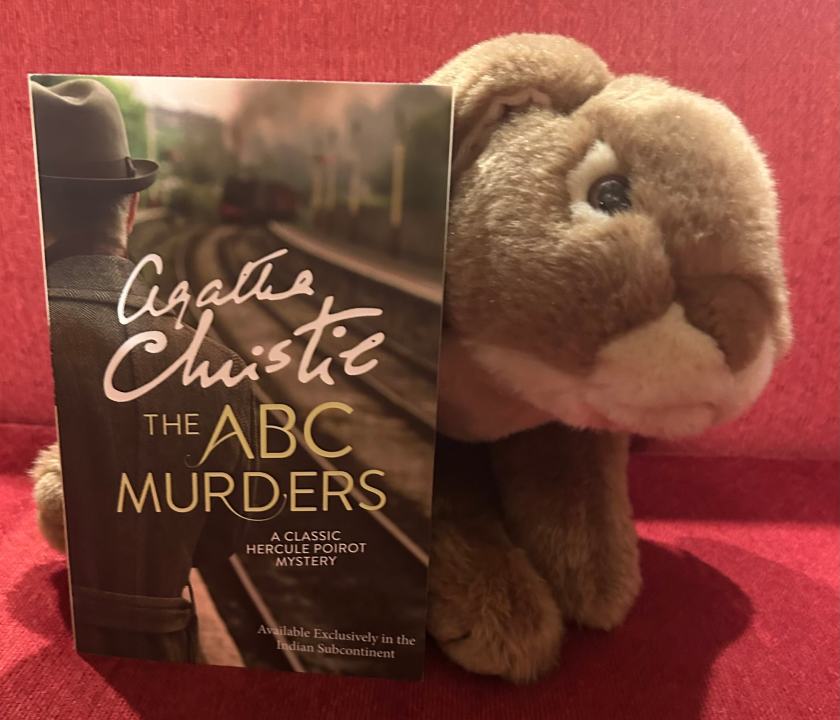
Caramel enjoyed reading The ABC Murders by Agatha Christie and recommends it to all bunnies who enjoy a little bit of detective mystery.

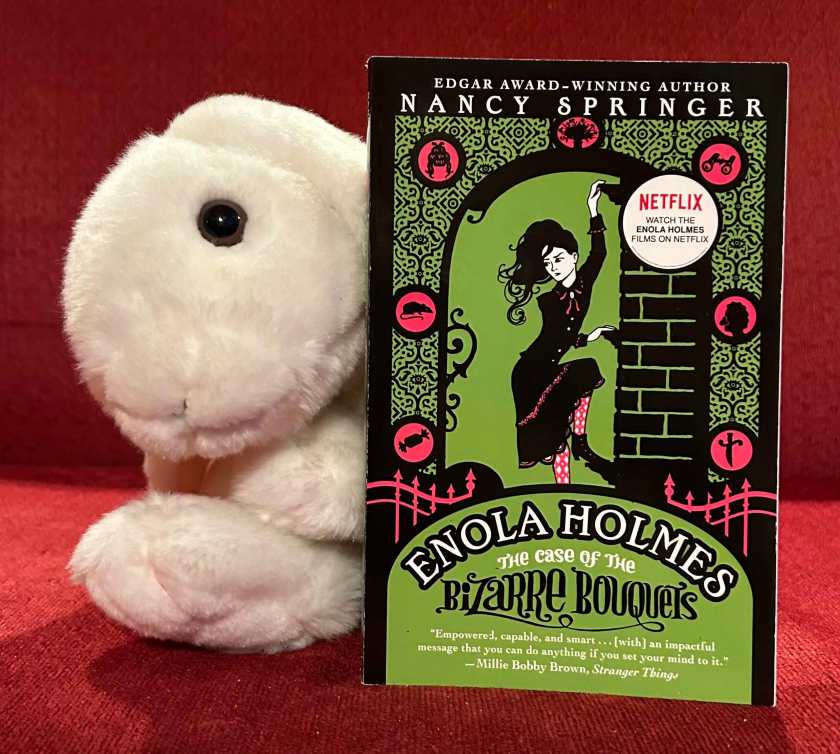
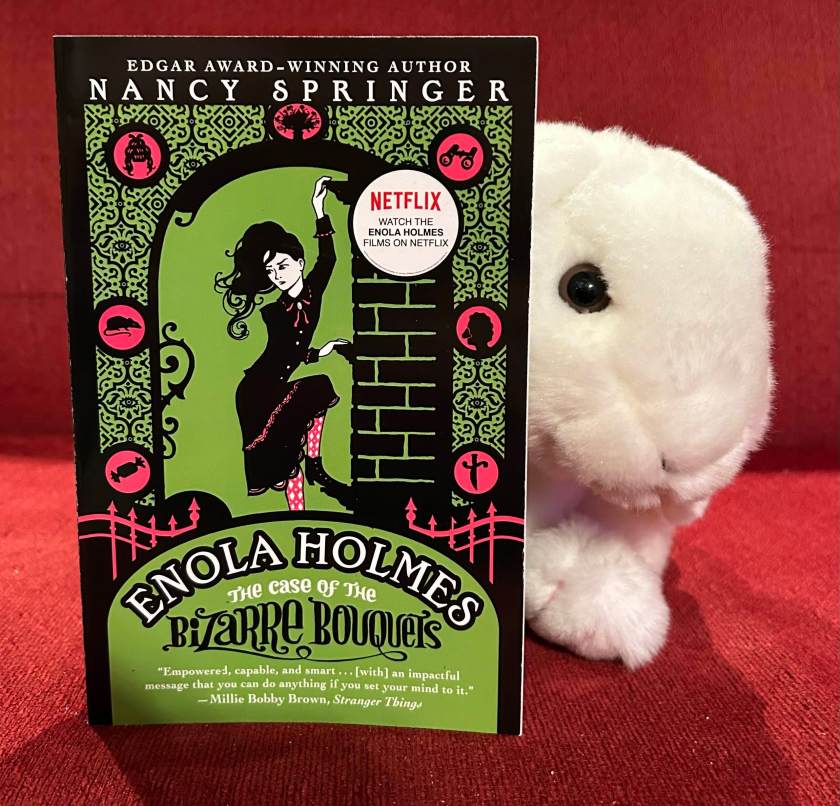
Marshmallow reviews Enola Holmes: The Case of the Bizarre Bouquets by Nancy Springer

Today Marshmallow reviews the third book in Nancy Springer’s Enola Holmes series: The Case of the Bizarre Bouquets, first published in 2008. (You might also like to see Marshmallow’s reviews of the first two books: The Case of the Missing Marquess and The Case of the Left-Handed Lady.)

Marshmallow reviews Enola Holmes: The Case of the Bizarre Bouquets by Nancy Springer.

Marshmallow’s Quick Take: If you’re a Sherlock Holmes fan or if you like mysteries with female protagonist detectives, then this is the book for you!

Marshmallow’s Summary (with Spoilers): Enola Holmes has been living on her own in nineteenth century London for a couple months now. Given the fact that she is fourteen years old, one might ask why. The reason for her self-inflicted solitude is the fact that, during this period, women have no autonomy in the social status quo. Enola’s mother ran away from this set-up in a previous book and left Enola the means to do the same. Enola (whose name spells “alone” backwards) examined her surroundings and the expectations she was going to be forced to fulfill (finishing school, marriage, childbirth, etc.) and followed her mother’s suit. In doing so, Enola escaped the control of her older brothers: Mycroft and Sherlock Holmes (the famous detective). But even the famous detective Sherlock Holmes cannot locate her and she (while lying low) becomes adept at disguising herself by altering her appearance through various methods. Drawn to mysteries and puzzles, she solves several cases on her own (see for example The Case of the Missing Marquess and The Case of the Left-Handed Lady) and decides to found her own business as the world’s first and only professional “perditorian” (see The Case of the Missing Marquess: “From the Latin perditus, meaning “lost.” Perditorian: one who divines that which is lost”.)

Unfortunately, because women have no autonomy, she creates the business under the name of a male doctor while she disguises herself as his “assistant” Ivy Meshle. However, if her brothers find her, she will be forced to return to them and begin training to be a perfect “ornament to genteel society.” After several close brushes of being discovered by Sherlock and / or Mycroft, Enola once again finds herself drawn to the case of a certain Dr. John Watson. The reticent Arthur Conan Doyle reader may notice that this is the same Dr. Watson who is Sherlock’s loyal companion on his cases. For the few times she met him, Enola felt a fatherly affection towards Dr. Watson, so she (after some introspection and inspection of the situation) decides to search for Dr. Watson, too.

Normal mysteries are dangerous on their own. But her brother’s close proximity to this case makes it also a gamble with the freedom and autonomy she has had so far. Will Enola be able to find the doctor before her brother finds her?

Marshmallow is reading Enola Holmes: The Case of the Bizarre Bouquets by Nancy Springer.

Marshmallow’s Review: I would really recommend reading the first couple books in this series before this one to get context. But on its own, the world-building is enough to immerse the reader entirely in this Victorian-era mystery. The author consistently writes fascinating mysteries that never fail to disappoint in intrigue and complexity; yet the reader is never left confused at the end.

These Enola Holmes books stand out among all other mysteries I’ve read so far because the setting is so wonderfully set up. People often say reading is like a passport to other worlds and times. I was pretty sure they were lying, until now. Once I started reading this book, I couldn’t put it down because I didn’t want to stop learning about the mystery and the fascinating world it is in. The descriptions of London (I am pretty sure) are all factually correct for that time and all the details create an immersive experience that I would fully recommend.

This book series is also unique because it depicts a girl who is fully independent. Enola is perhaps the only female protagonist I have ever read about who isn’t in love, interested in, dating, or married to a guy. She is truly alone (in that sense) and is perfectly fine with it. It is good for girls to see that they have the choice to be so and that it is fine to be fine with that. This book also has strong themes of feminism; Enola’s strength, competence, and wit are rebelliously scandalous for the time. She stands up to the patriarchical system and doesn’t care what it thinks of her. She games the system to use it to her advantage when she disguises herself. But she never forgets to help the less fortunate with her fortunes.

But Enola is also more distinctive among other female protagonists because, as the author explicitly makes sure to state, Enola is not traditionally beautiful. She has a large nose, no delicate, feminine features of particular value, and a body like a “beanpole.” It is Enola’s virtue, brains, and bravery that makes her such a compelling character and I, for one, am expectantly looking forward to reading the next book!

Marshmallow’s Rating: 100%.

Marshmallow rates Enola Holmes: The Case of the Bizarre Bouquets by Nancy Springer 100%.

Marshmallow reviews Enola Holmes: The Case of the Left-Handed Lady by Nancy Springer

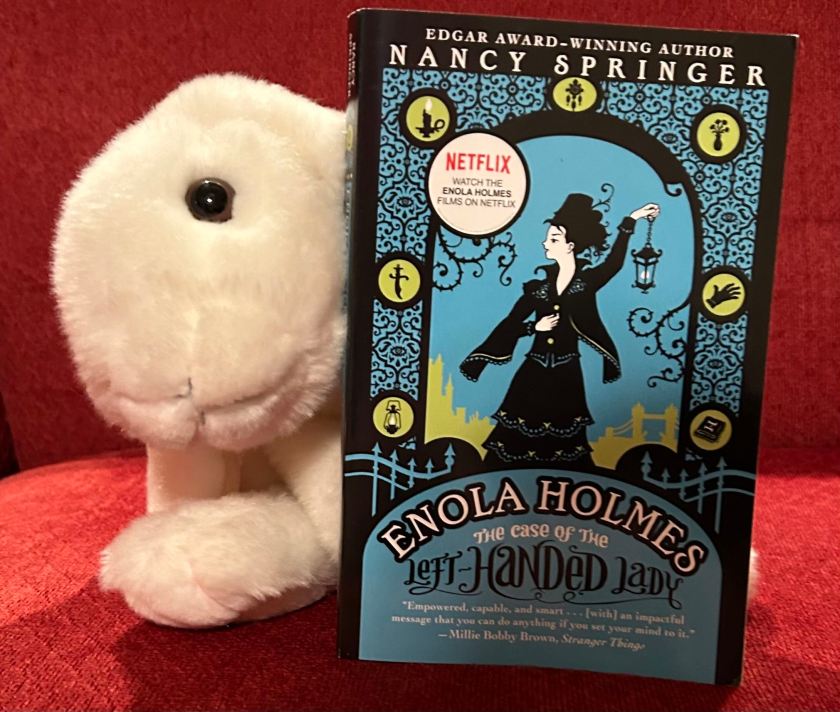
Today Marshmallow reviews the second book in Nancy Springer’s Enola Holmes series: The Case of the Left-Handed Lady, first published in 2007. Sprinkles, who loves detective stories and has already read the first book in the series, is asking questions and taking notes.

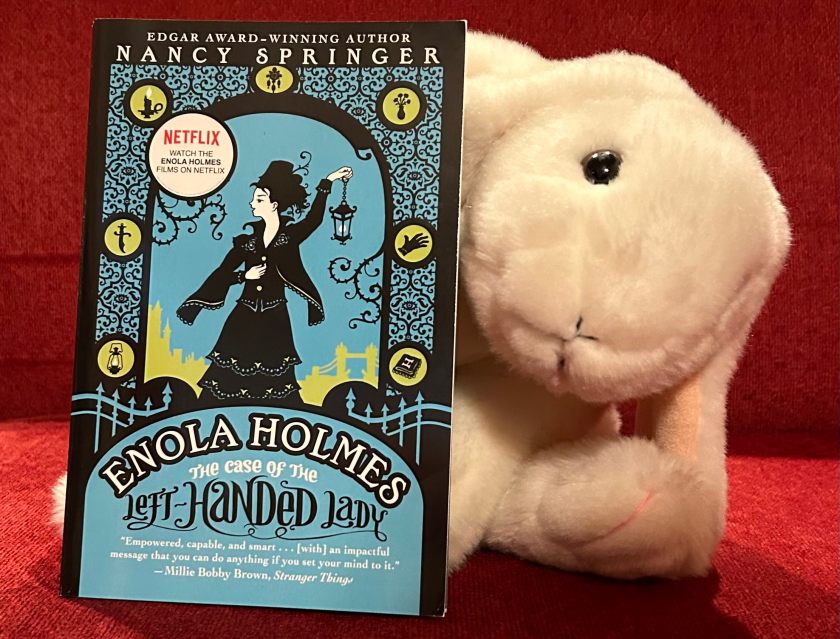
Marshmallow reviews Enola Holmes: The Case of the Left-Handed Lady by Nancy Springer.

Sprinkles: So Marshmallow, tell us about this second book.

Marshmallow: Well, it is another book with Enola Holmes as the main character. This time she is working in London as a detective, or rather a finder of things, under the name of a man. So the man is totally made up ,and she is acting as if she is his assistant because she knows that nobody will hire her if they know she is a woman.

S: I see. That makes sense.

M: Yes. And she uses all these disguises to get answers to questions she could not have gotten otherwise. I thought this was very clever. In fact the whole book is full of clever ideas like this, which made it a very satisfying read.

S: That sounds great Marshmallow! So tell us about the left-handed lady from the title.

M: So there is supposed to be a girl who is “kidnapped” and she is noble so she is a lady.

S: What do you mean by “kidnapped”?

M: Well, people think that she ran away with a guy. So the mystery is not publicized because the family is embarrassed.

S: So they discreetly hire Enola Holmes?

M: Yes, they hire her cover person. And Enola goes to examine the evidence as his assistant, because they would not take her seriously if she were not working for a man. Really annoying!

S: I can see that!

M: She discovers these paintings made by the girl who disappeared. And they lead her to realize that the girl is more interested in socioeconomic issues rather than a man.

Marshmallow is reading Enola Holmes: The Case of the Left-Handed Lady by Nancy Springer.

S: So that plot sounds nothing like the second Enola Holmes movie.

M: Yes, that is true. They are both about a lost girl but the girl in the movie is not a noblewoman.

S: I understand that the movie version is actually about a real person named Sarah Chapman, who led a women workers’ strike.

M: That sounds really cool! The book is totally fictional, as far as I can tell. But there are a lot of political issues that are mentioned.

S: That sounds neat. I found the first book really easy to read, and it kept my full attention the whole time. Is this second book like that, too?

M: Yes. I did feel the plot was a little bit more complicated however. The other felt more like a game set up, but this was wilder somehow… Still a lot of fun to read!

S: So does that mean you will go on to reading the next book?

M: Yes, I hope to read it and review it next.

S: Sounds great to me! In the meantime, I will happily take this off your hands and read it myself.

M: Sure, you do that, Sprinkles.

S: Okay, so as we wrap this up, how would you rate the book overall?

M: I’d rate it 100%. It is a neat mystery, and the social commentary is very much welcome, too.

S: Great! So what would you like to tell our readers?

M: Stay tuned for more amazing reviews from the book bunnies!

 Marshmallow rates Enola Holmes: The Case of the Left-Handed Lady by Nancy Springer 100%.
Marshmallow rates Enola Holmes: The Case of the Left-Handed Lady by Nancy Springer 100%.

Marshmallow reviews Enola Holmes: The Case of the Missing Marquess by Nancy Springer

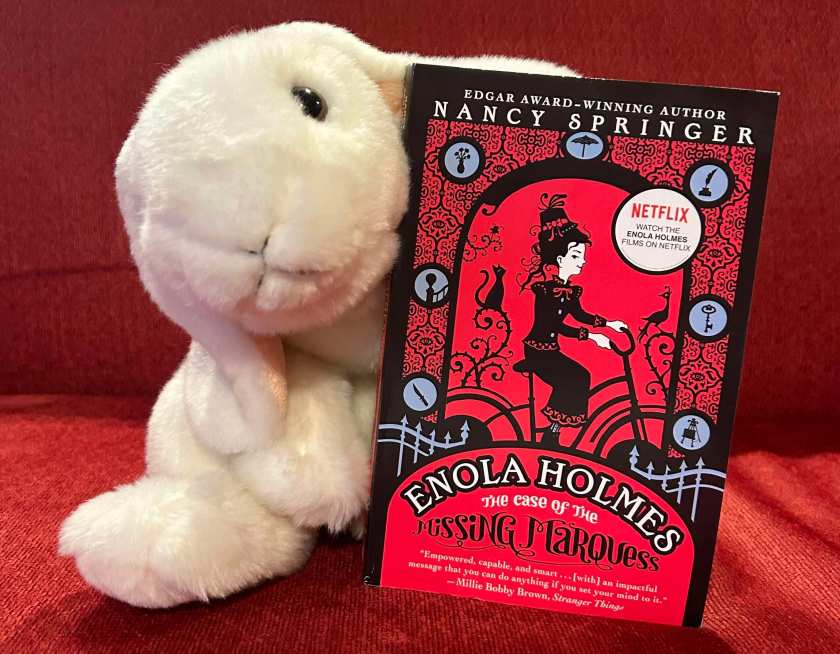
Today Marshmallow reviews the first book in Nancy Springer’s Enola Holmes series: The Case of the Missing Marquess, first published in 2006. Sprinkles, who loves detective stories, is asking questions and taking notes.

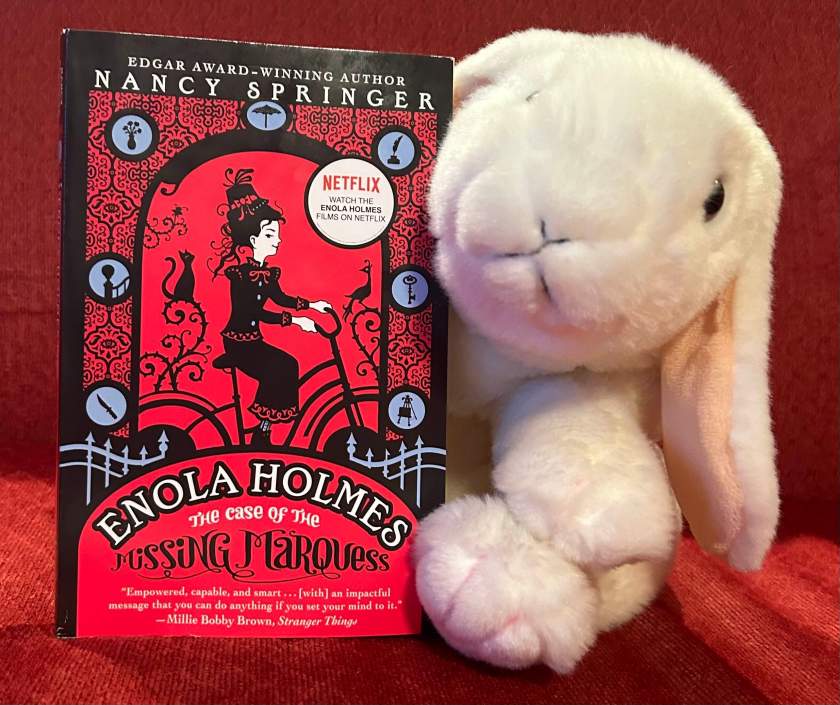
Marshmallow reviews Enola Holmes: The Case of the Missing Marquess by Nancy Springer.

Sprinkles: So Marshmallow, I am really eager to hear your thoughts about this book. I know that there is a TV movie made about Enola Holmes, the main character of this book series, who is supposed to be the teenage sister of the famed fictional detective Sherlock Holmes created by Arthur Conan Doyle. I have always enjoyed Sherlock Holmes and his many incarnations, especially a recent version depicted by Benedict Cumberbatch. So I really want to know what you thought of this book.

Marshmallow: I thought it was quite good!

S: Well, that’s a good start. Tell us what the book is about.

M: I saw the movie version first but reading the book, they are really very different.

S: Okay, I saw the trailer but did not see the movie myself. So let us start with the book then. What is it like? What is the story basically?

M: The story is about Enola, who is the younger sister of the famed detective Sherlock Holmes and Mycroft Holmes. Enola has been raised by her mother, who often leaves her alone, in a giant estate called Ferndell Hall. But one day, on her birthday actually, Enola wakes up to find that her mother is gone. She tries to get the older brothers to help her find their mother, but they instead dismiss her and say that she has “a limited cranial capacity”.

S: Ouch, so they are really saying she is stupid.

M: Yes, they are quite sexist. I mean, I guess it was the Victorian era and such, and women were not really thought to have been very smart back then, but these two brothers should have known better. But the book is pretty cool. She basically outsmarts them all!

S: I like that! Okay, so is the book basically about Enola’s search for her mom?

M: Well, it starts there, but along the way Enola gets involved with the kidnapping of the Marquess of Basilwether, who is a twelve-year-old boy. (In the movie, the marquess is a lot older and seems to even become a love interest, almost.) And of course she will solve the mystery, but she also has to keep evading her brothers who want to put her up in a boarding school for young ladies, which sounds like torture to her. Like they have to wear corsets which they progressively tighten so the ladies will have really tiny waists. And it is quite like physical torture. Enola hears that one girl even died from these!

Marshmallow is reading Enola Holmes: The Case of the Missing Marquess by Nancy Springer.

S: Okay, so the plot sounds quite captivating even though the story is supposed to be historical fiction. How is the language used?

M: I think the author wants Enola to sound like a real teenager from that era, and as she is the narrator, the language of the book is not really modern. But it works well and it is still perfectly understandable.

S: I understand that Enola is pretty smart. Is she also funny?

M: Not specifically. The book is really entertaining but the narrator does not try to be funny exactly.

S: Is it a good detective story? You are a fan of Nancy Drew and have read a lot of Agatha Christie.

M: Yes. I think it really is a neat detective novel too. I am quite intrigued and I want to read more from this series.

S: That sounds great! Maybe you can move on to the second book and I can read this one.

M: Sounds like a good plan to me!

S: Okay, so let us wrap up this review then. How would you rate the book overall?

M: I’d rate it 100%. It is fun and empowering and clever, too.

S: Great! I really want to read it now. So what would you like to tell our readers as we end this post?

M: Stay tuned for more amazing reviews from the book bunnies!

Marshmallow rates Enola Holmes: The Case of the Missing Marquess by Nancy Springer 100%.