Midnight reviews Augustus by John Williams

Today Midnight, the mysterious and reclusive black bunny of the family, decided that it was time for another appearance because he had read a good book and wanted to share his thoughts on it with the readers of the book bunnies blog. (Also Marshmallow is still working hard on her college applications.) Below is Midnight’s review of Augustus, a historical novel by John Williams, that was published originally in 1972 and that received the National Book Award for Fiction in 1973. Sprinkles is taking notes and asking questions.
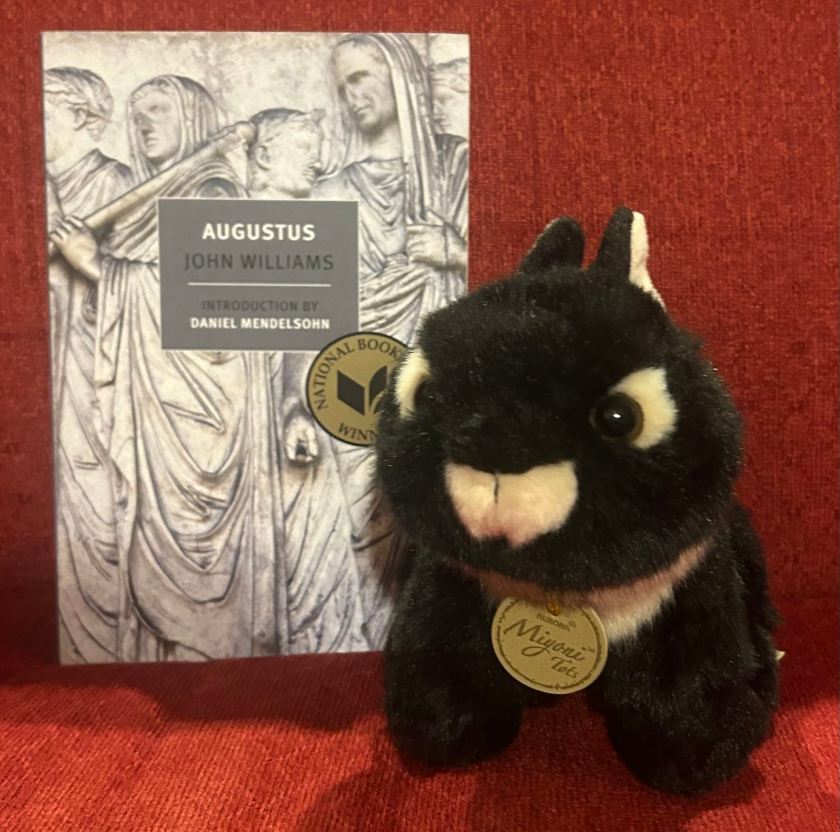
Midnight reviews Augustus by John Williams.

Sprinkles: It is so neat to have you join us today Midnight!

Midnight: I am filling in because Marshmallow is busy working on college applications.

S: But you also have a good book you want to talk to us about, yes?

M: Indeed. A friend of mine recommended several books to me recently and this is the first one I have completed.

S: That sounds great! You seem to have enjoyed this a lot. Hopefully you will appreciate the other ones too.

M: One may hope.

S: Okay, so tell us a bit about Augustus.

M: It’s historical fiction. But it is written not in third person but rather through letters written between many characters, of greater or lesser importance, at the end of the Roman Republic and the beginning of the Empire. The focus overall is on Octavius, later to be known as Augustus Caesar. We read letters from his friends, associates, and relatives, and toward the end, even from the man himself.

S: I didn’t know this was an epistolary novel, written in letters! That is really cool. And all of them are fictional, right? I know many of the main events should be historical, but the book has so many details, a lot should be the author’s creation.

M: That is my understanding. My memory of those events is hazy, since I was only a young rabbit at the time-

S: Wait, what do you mean? The events retold in the book are supposed to have happened at least two thousand years ago.

M: I can tell this makes you uncomfortable. Let’s move on.

S: Okay….
Midnight is reading Augustus by John Williams.

S: So tell us a bit more about the book. It is written in the form of a series of letters. But it is also split into three books, right?

M: Perhaps it is better to describe them as a series of letters, because we don’t get responses to letters. We read stories from one side sometimes. One of the great strengths of the book is that Williams gives each character their own distinct voice and style.

S: That is impressive.

M: And the letters are organized into three books, yes. The first book is about his childhood and his rise to power. The second is about him already an emperor, tackling the challenge of finding an appropriate successor. One issue that constantly arises is that Augustus lived so long that most of his friends passed away long before he did. His preferred successors predeceased him, leaving him to settle for Tiberius, whom he did not care for. The third book is really a single long letter, from Augustus to a friend, reflecting upon his life and his reign.

S: Then there is an epilogue.

M: Yes, that is supposedly written forty-one years later, by Philippus of Athens, Augustus’s last doctor, who was a young man back then. The letter is directed to Seneca. Philippus looks back on the long reign of Augustus, the subsequent harshness of Tiberius, the cruelty of his successor, Caligula, and the ineptness of Claudius. Having read Graves’s I Claudius and Claudius the God, I tend to have a softer view of Claudius than Williams’ Philippus.

S: Oh, maybe you will tell us about those books some day.

M: Maybe I will. In any case Philippus might not be the greatest judge of men, since he speaks hopefully about the newly crowned emperor Nero.

S: And we all know now that Nero did not turn out to be a great emperor!

M: Those were dark times. It is still difficult for me to talk about them.

S: Wait, are you implying that you were around during Nero’s time?

M: Let’s get back to the book, shall we?

S: Okay, sure. Whatever you say.

M: Much of the latter half of the book consists of journal entries of Julia, Augustus’s daughter, written in exile.

S: And Julia is a real person, right?

M: Yes, definitely. Let’s say he loved his daughter very much, but political realities in the circles that she frequented put him in a bad situation. I don’t want to spoil the book.

S: That is kind of interesting. All these people lived and died many centuries ago and their stories are actually all written down. But this book somehow manages to make them come alive so that you want to know what will happen next.

M: Right. But any student of history will know that Augustus’s story goes on for a long time and most of the people around at the start of the book are dead well before the end. While Augustus starts as a teenager, he ends up as an old man, who seems out of place, or maybe somebody whom time has passed by.

S: That is deep Midnight. I also noticed that the book has an introduction written by Daniel Mendelsohn. Did you read it too?

M: I have. It basically contextualizes the book, and says a bit about Williams and his other books.

S: But it seems one can definitely read the book without the introduction.

M: Sure.

S: So this was overall a good book and you seem to have enjoyed it. We can wrap up our review now, I think.

M: Yeah.

S: Okay, then. What would you like to tell our readers as we close this off?

M: I know that this little black bunny does not have quite the following that Marshmallow and Caramel do, and I’m sure their fans will be happy to know that Marshmallow will be back once she finishes some of her college applications.

S: Aw, we love having you over, too, Midnight!

M: To that, and to the readers, I say: Vale! as we used to say…
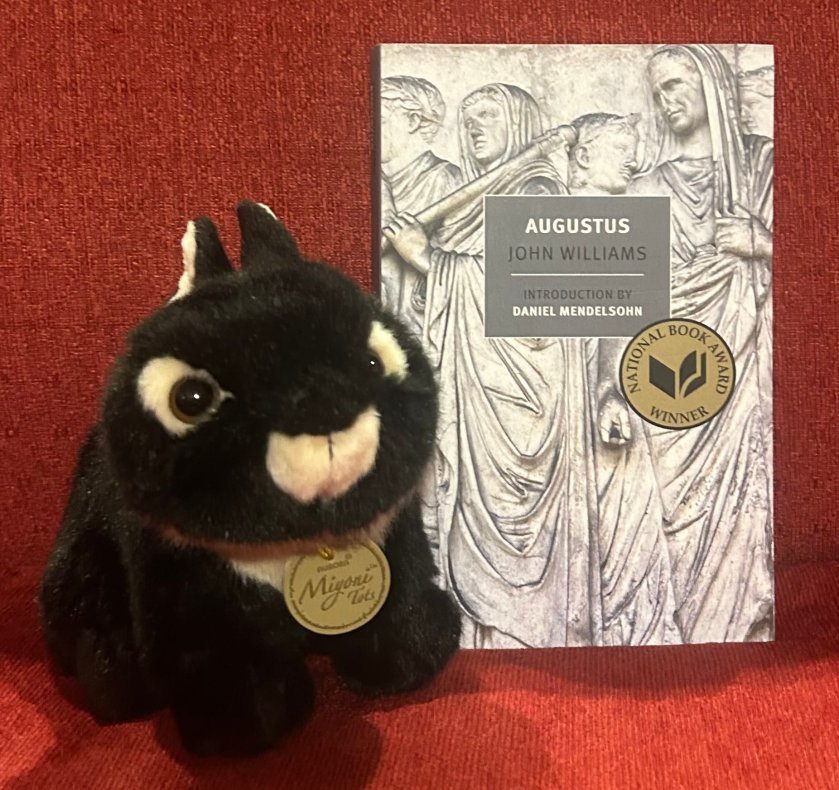
Midnight enjoyed reading Augustus by John Williams, and bids readers farewell, until such a time as he deems it fit to grace the world with his august presence.

Caramel reviews Nathan Hale’s Hazardous Tales #12: Above the Trenches by Nathan Hale

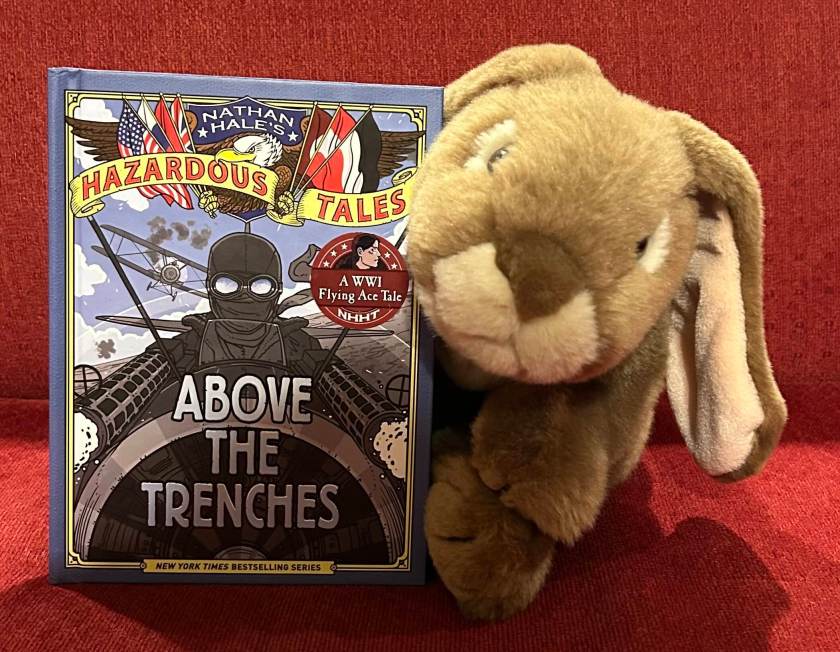
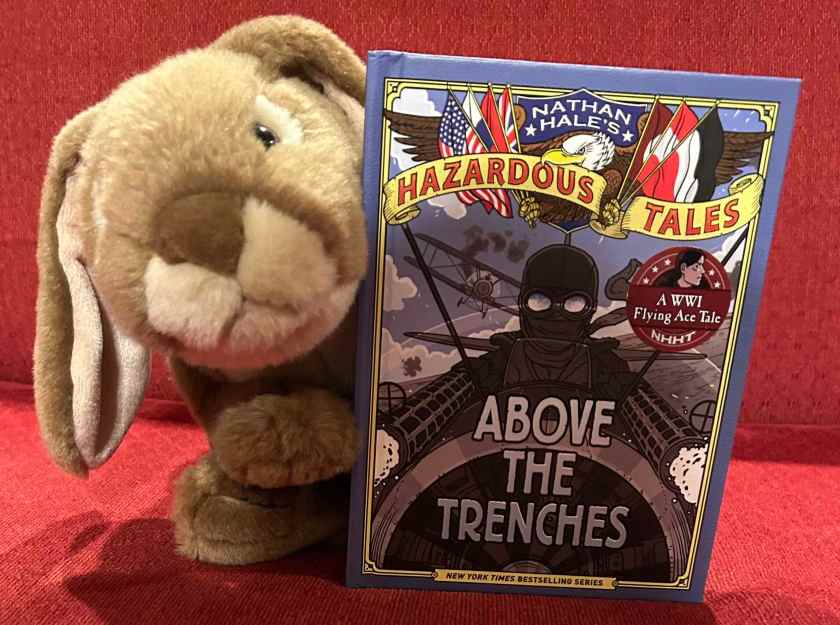
Caramel has read and reviewed several books in Nathan Hale’s Hazardous Tales, the historical graphic novel series by Nathan Hale. Today he is talking to Sprinkles about the twelfth book in the series, Above the Trenches, published first in 2023.

Caramel reviews Nathan Hale’s Hazardous Tales #12: Above the Trenches by Nathan Hale.

Sprinkles: Here we are, with another Nathan Hale book. This time we are back to World War I, I am assuming. 

Caramel: Yes. The other Nathan Hale book about WWI was Treaties, Trenches, Mud, and Blood. And I reviewed it a while back. 

S: So tell us a bit more then. The war lasted for four years. A lot happened. What is this particular book about?

C: The fights in the skies, the flying aces of WWI. 

S: So I am guessing then that the title is Above the Trenches because the book is about a different part of the war, different from the trench warfare that is associated so closely with WWI. 

C: Yup. 

S: And for anyone like me who did not know this before, according to Wikipedia, “a flying ace, fighter ace or air ace is a military aviator credited with shooting down a certain minimum number of enemy aircraft during aerial combat; the exact number of aerial victories required to officially qualify as an ace varies, but is usually considered to be five or more.” As far as I recall, WWI was the first war where airplanes were used, right? 

C: Yes.

S: So then I suppose it makes sense that the whole book would be about that. 

C: Yeah, it’s mostly about the Lafayette Escadrille, a French squadron of American pilots, and the German aces, and a man named Strange.

S: Hmm, the Wikipedia article talks about the first Ace, a Frenchman named Adolphe Pégoud. And some famous German ones listed are Max Immelmann, Oswald Boelcke, and Manfred von Richthofen. So do you remember these names? Do they all appear in the book?

C: Yes, almost all of them do, but I don’t remember if Max Immelmann was. But I do remember that Pégoud was killed by a German pilot he had trained. It is sad. 

S: Yes, it is, isn’t it? Then again almost everything about war is sad.

C: True.

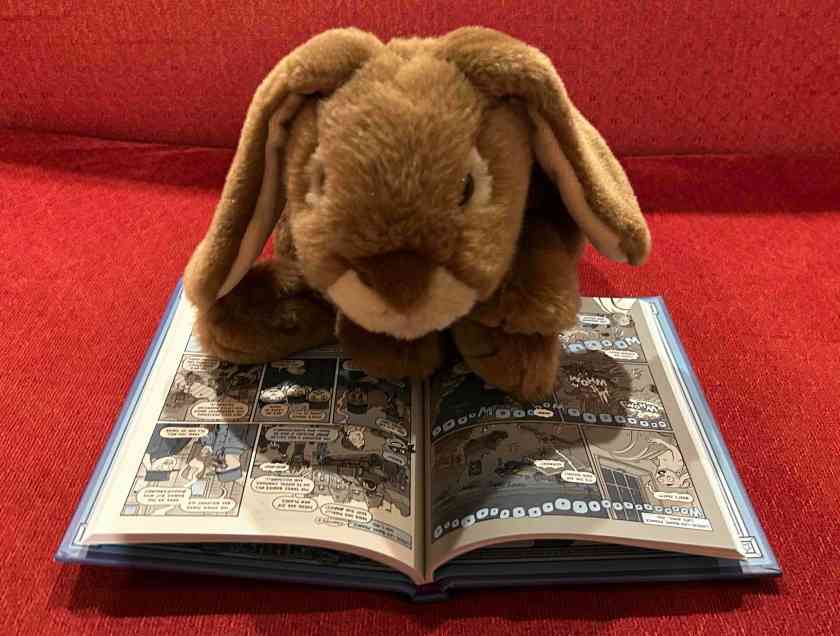
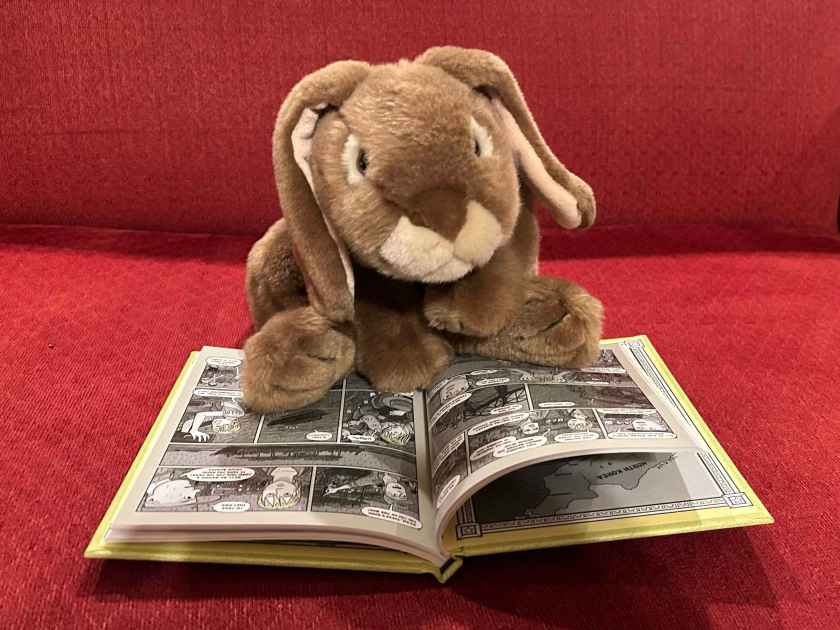
Caramel is reading Nathan Hale’s Hazardous Tales #12: Above the Trenches by Nathan Hale.

S: But in this book you read about some amazing feats that these pilots were able to accomplish. And they did all that, using aircraft which would be pretty primitive for our times, right? 

C: Yes. The most famous one today is probably the German von Richthofen. Even if you don’t know much about warfare in the air, you probably remember Snoopy, Charlie Brown’s dog, sitting on top of his doghouse and flying an airplane? 

S: Yes.. ?

C: Yes, and he was always flying against the Red Baron, remember? The Red Baron is von Richhofen. 

S: Oh, that makes a lot of sense now! 

C: By the way, the Red Baron is not even mentioned as a great ace, at first. The book first introduces him as a not-too-great pilot, then shows his later victories.

S: What do you mean? So he improves through the years? 

C: No, it’s more like he was good, but when he finally got into the flow of his plane, he became really good.

S: I guess that makes sense. He needed to learn and get used to the plane he was using. And why is he known as the Red Baron?

C: One of his planes was actually bright red, and that’s why. 

S: Cool, that is very interesting! Okay, so did you learn a lot from this book? I know you know a lot about warcraft and tanks and fighter planes. Was there anything new for you in this book?

C: Of course! I didn’t know all the names of the aces, and the existence of the Lafayette Escadrille was new to me. They were the very first American pilots to fight in WWI and they fought for the French. They were called the Lafayette Escadrille after the great Marquis de Lafayette, who was the main topic of Nathan Hale’s Hazardous Tales #8: Lafayette!

S: That is neat. I did not know any of that, either. So this might be your last Nathan Hale book for a while. I am not sure if there is a thirteenth book. 

C: Nooooooo! But you know, I waited and waited for all this time for a sixteenth Wings of Fire book, and it is coming out next week! So maybe if I wait and wait for it, there will be a thirteenth Nathan Hale book, too!

S: Yes, let us hope! In the meantime there are other books you can read. 

C:Yes, like the sixteenth Wings of Fire book!

S: Alright, let us not get this excited so late in the evening. It is soon going to be bedtime. 

C: Hmm, that is correct. 

S: So let us wrap this review up. What do you want to tell our readers?

C: Stay tuned for more book bunny reviews! Oh, and Nathan Hale, please please please write more Hazardous Tales!

Caramel enjoyed reading Nathan Hale’s Hazardous Tales #12: Above the Trenches by Nathan Hale and is wondering when he will get to read a new Nathan Hale book (hoping that it will be soon).

Caramel reviews Nathan Hale’s Hazardous Tales #11: Cold War Correspondent by Nathan Hale

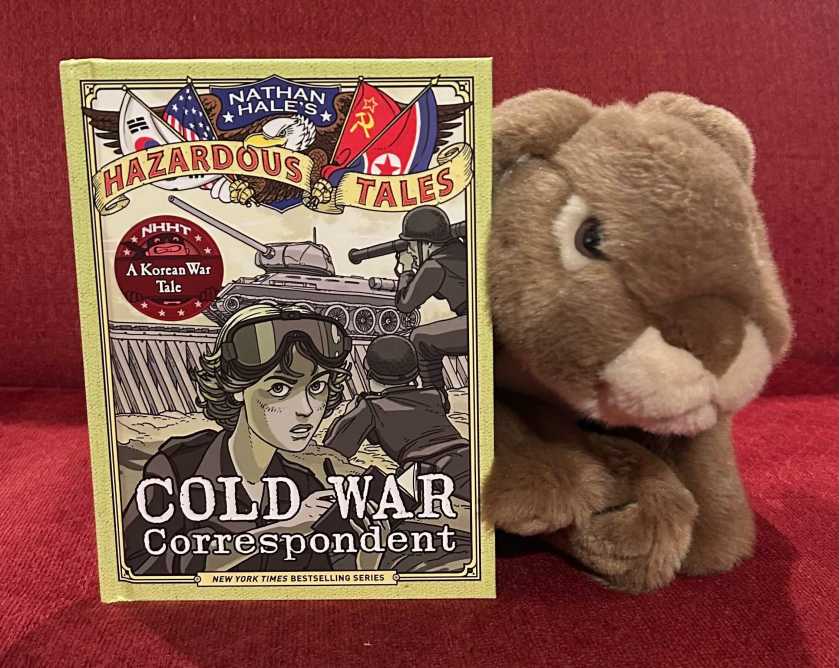
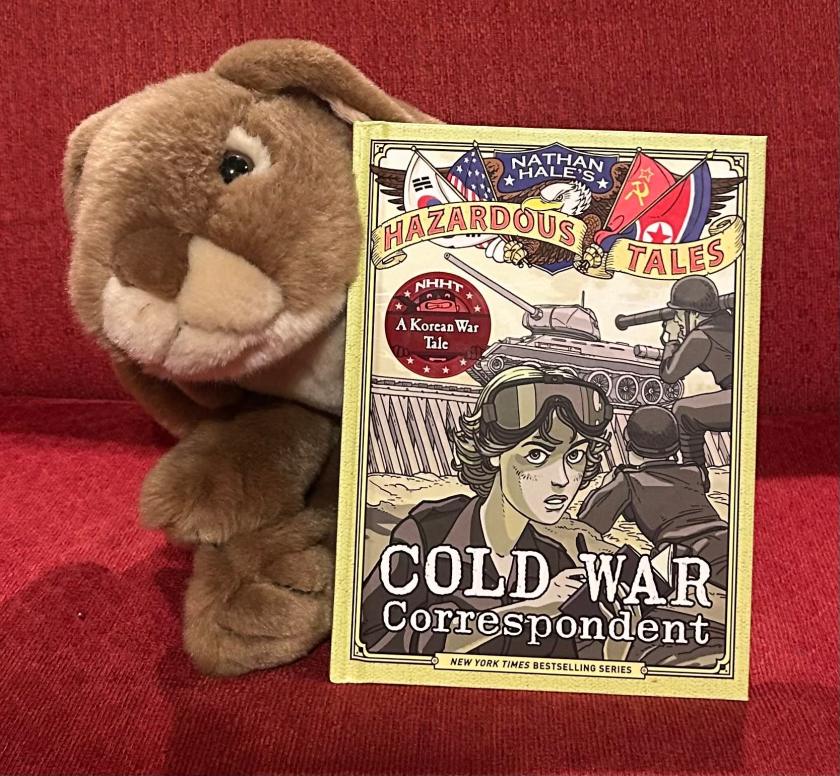
Caramel has read and reviewed several books in Nathan Hale’s Hazardous Tales, the historical graphic novel series by Nathan Hale. Today he is talking to Sprinkles about the eleventh book in the series, Cold War Correspondent, published first in 2021.

Caramel reviews Nathan Hale’s Hazardous Tales #11: Cold War Correspondent by Nathan Hale.

Sprinkles: Here we are, with another Nathan Hale book. 

Caramel: Yes, we are! And this one is about the Cold War, brr.

S: That’s funny! The Cold War is called the Cold War not because it is really cold temperature-wise though.

C: Well, I know of course. It is cold in the sense that it is not hot, like armies are not openly fighting, there is no open fire of one army attacking another. So no fire. So Cold.

S: You know so much Caramel! Here is how Wikipedia defines it:

The Cold War was a period of international geopolitical rivalry between the United States (US) and the Soviet Union (USSR) and their respective allies, the capitalist Western Bloc and communist Eastern Bloc, which began in the aftermath of the Second World War[A] and ended with the dissolution of the Soviet Union in 1991. The term cold war is used because there was no direct fighting between the two superpowers, though each supported opposing sides in regional conflicts known as proxy wars.

C: Actually the book is about a hot war which was a part of the Cold War. To be specific, the Korean War. One of those proxy wars I suppose, but the United States did have soldiers fighting in it, just not directly against the Soviet Union. 

S: Oh, that makes sense. And I am assuming there is a journalist involved somehow, the correspondent in the title. 

C: Yeah, the book is specifically about Marguerite Higgins. She was a war correspondent, a journalist who wrote about World War 2 and many other smaller wars, for the New York Herald Tribune. 

S: That is so interesting, Caramel. I of course know about the Korean War, but I had not heard of Higgins. She seems to have been a very brave woman. So the story in the book is the story of the Korean War through Higgins’ eyes? 

C: Yes, she is the narrator for this book, and she pops up from the hanging tree, or more so down from the tree.

S: The tree of Nathan Hale, you mean? So do we not see Nathan Hale in this one? 

C: No, we do, but he’s not the main narrator this time, more so of a commentary.

S: That is different from the other books, right?

C: Yes, it is. In most of the other books, he is not a commenter, he is the narrator, or at least the main narrator.

S: I guess it just worked best this way for this book then. Okay, so did you learn some new things from this book? Did you know about the Korean War or the Cold War or Marguerite Higgins before?

C: Yeah, of course, I knew about the Cold War, and I knew a bit about the Korean War, but not about Higgins. This was a good perspective change.

Caramel is reading Nathan Hale’s Hazardous Tales #11: Cold War Correspondent by Nathan Hale.

S: In what way?

C: This showed how badly prepared the South Koreans and the US were. They expected an attack and were preparing for it, but not effectively enough. They had no tanks, planes, artillery, or even armor-piercing bazooka rounds that worked, and among the things they had, many were duds. Meanwhile the North Koreans had almost a full air force and 150 Soviet T-34 tanks, the tanks that let the Soviets take Berlin in the Second World War.

S: I did not know any of these details either, Caramel. So of course the South would suffer dramatically given such a disparity. 

C: Yes, so the United States called for the United Nations to help. And about fifteen to twenty nations joined in with the United States to defend South Korea. And that war lasted a few years. 

S: And the book is about all that?

C: No, it’s mostly about Higgins and her experiences in Korea, not all of the war.

S: I guess the author decided to include a snapshot from the Cold War in his series. That makes sense to me. 

C: Yeah, this is the only book about the Cold War so far. The next one will be about World War 1. 

S: So you are all ready to move to the next one! But wait, wasn’t there another Nathan Hale book about World War 1?

C: Yes! It is the second book I reviewed from the series: Nathan Hale’s Hazardous Tales #2: Treaties, Trenches, Mud, and Blood. 

S: And you are ready for more?

C: Yup. 

S: Okay, so this is probably a good place to wrap this up then.

C: Sure.

S: What do you want to tell our readers?

C: Stay tuned for more book bunny reviews!

Caramel enjoyed reading Nathan Hale’s Hazardous Tales #11: Cold War Correspondent by Nathan Hale and talking about it too.

Caramel reviews Nathan Hale’s Hazardous Tales #10: Blades of Freedom by Nathan Hale

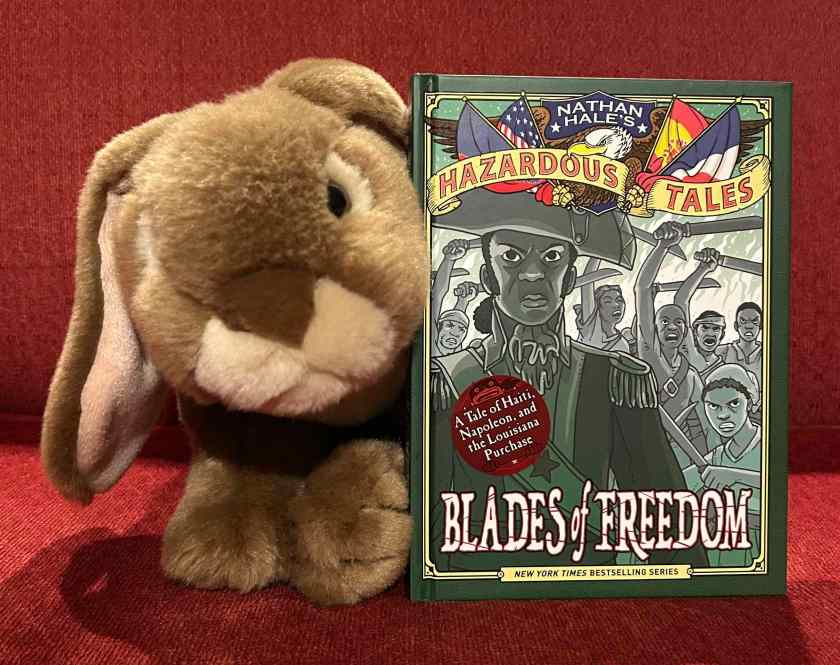
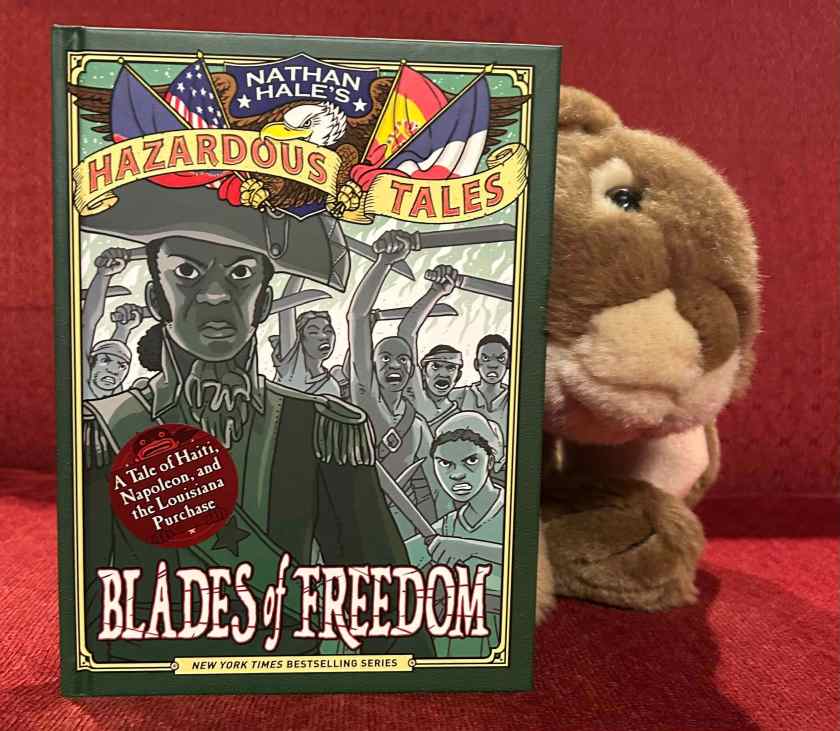
Caramel loves history and he loves graphic novels. So it is no surprise that he has enjoyed Nathan Hale’s Hazardous Tales, the historical graphic novel series by Nathan Hale. Today he is talking to Sprinkles about the tenth book in the series, Blades of Freedom, published first in 2020.

Caramel reviews Nathan Hale’s Hazardous Tales #10: Blades of Freedom by Nathan Hale.

Sprinkles: So Caramel, it has been a while since you reviewed a Nathan Hale book. 

Caramel: Yes it has. The last Nathan Hale book I reviewed was all the way back in May 2025!

S: But we finally were able to get a few more of them into your paws, and you immediately began to read them all.

C: Yes, I see a couple more Nathan Hale book reviews in our near future. 

S: I like that! So tell me what this one is about. 

C: This is about Napoleon’s rise, and the revolution in Haiti.

S: Wait! Those are all more or less French history, no? I thought the Nathan Hale books were mainly about the history of the United States. 

C: Well, think again, this one isn’t, except where Napoleon sold the Louisiana territory to the United States.

S: Hmm, I see. Also Haiti is in the Western hemisphere, so that also makes sense to me. And the revolution in Haiti was important for the whole Western hemisphere of course. 

C: And apparently it is more or less the reason why Napoleon ended up selling the whole Louisiana territory to the then-young United States. 

S: I guess this is again a story which informs a significant part of our understanding of the history of the United States. 

C: Yeah, sure. But it is definitely a lot more about Napoleon and the revolution in Haiti. That is where the title is coming from after all: blades of freedom is about the freedom of the enslaved in Haiti. 

S: Hmm, when you say it that way, the “Blades” part kind of sounds bloody. 

C: Well, we all know the French Revolution was very bloody. The Haitian one did not lack in bloodshed either. 

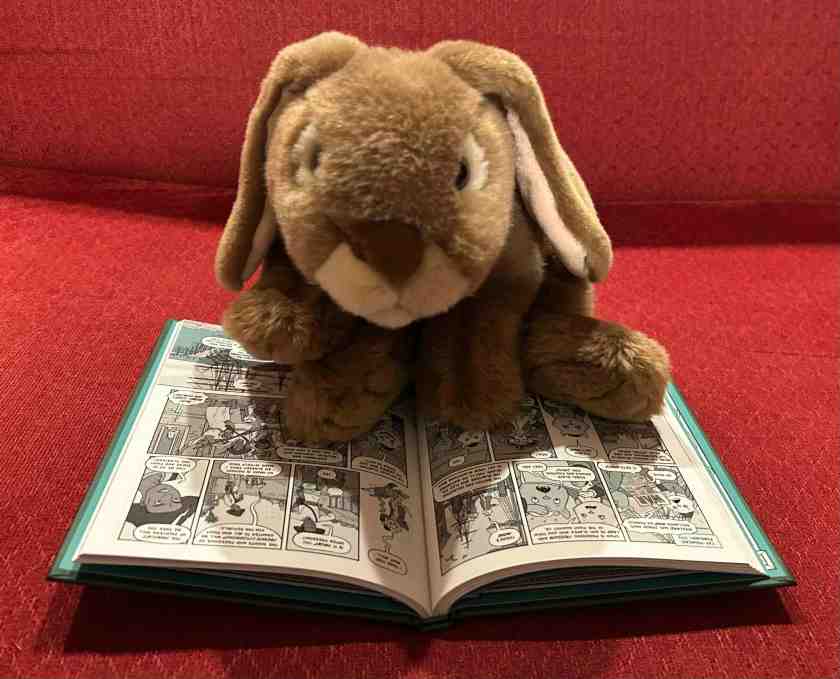
Caramel is reading Nathan Hale’s Hazardous Tales #10: Blades of Freedom by Nathan Hale.

S: I guess it is hard to have a revolution that is totally peaceful. But tell me more about the book. 

C: Sure. Just like the earlier Nathan Hale books, it has some great characters. It has Napoleon, two cats, and the leaders and catalysts of the Haiti revolution, Francois Mackandal, Dutty Boukman,, Jean-Jacques Dessalines, and Toussaint L’Ouverture.

S: Other than the two cats, those sound like real historical characters, Caramel. 

C: Yep, and the cats are not real but funny. 

S: And is Nathan Hale still narrating this story too? 

C: Yes, it’s one of Nathan Hale’s Hazardous Tales, so of course he is still narrating. You can see him on some of the pages. 

S: So I am assuming you have learned some good amount of history again. 

C: Yeah, I did. I had learned about the Louisiana purchase at school, but I didn’t know much about the reasons behind why France wanted to sell, other than they were at war, which was I guess true-ish. But they also did not have a good way to connect their European land to the North American territory once they lost Haiti, so in some very real sense, it seems like they wanted to cut their losses and leave. 

S: That makes sense to me. 

C: I also did not know that much about Napoleon Bonaparte before this. The book basically tells all his life story. 

S: That is great Caramel! So I am guessing you enjoyed this book and will want to read the eleventh book next.

C: Yep, I did and I will.

S: Great! I think this might be a good time to wrap up this review. 

C: Sure. 

S: What would you like to tell our readers?

C: Stay tuned for more book bunny reviews!

Caramel enjoyed reading Nathan Hale’s Hazardous Tales #10: Blades of Freedom by Nathan Hale and is excited to be reading more from Nathan Hale again.