Midnight reviews Augustus by John Williams

Today Midnight, the mysterious and reclusive black bunny of the family, decided that it was time for another appearance because he had read a good book and wanted to share his thoughts on it with the readers of the book bunnies blog. (Also Marshmallow is still working hard on her college applications.) Below is Midnight’s review of Augustus, a historical novel by John Williams, that was published originally in 1972 and that received the National Book Award for Fiction in 1973. Sprinkles is taking notes and asking questions.
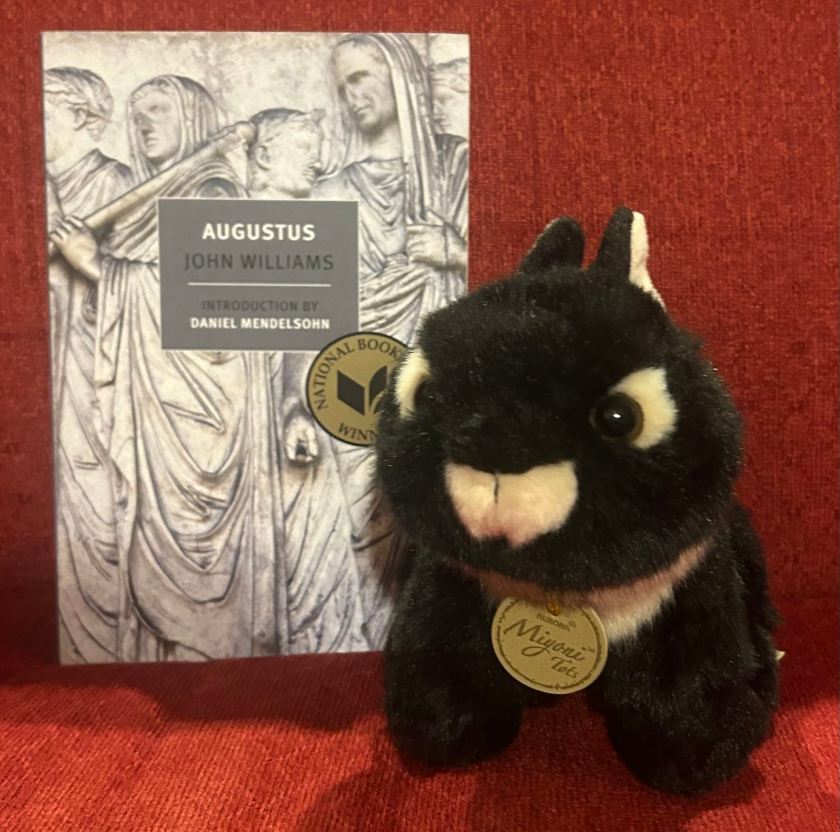
Midnight reviews Augustus by John Williams.

Sprinkles: It is so neat to have you join us today Midnight!

Midnight: I am filling in because Marshmallow is busy working on college applications.

S: But you also have a good book you want to talk to us about, yes?

M: Indeed. A friend of mine recommended several books to me recently and this is the first one I have completed.

S: That sounds great! You seem to have enjoyed this a lot. Hopefully you will appreciate the other ones too.

M: One may hope.

S: Okay, so tell us a bit about Augustus.

M: It’s historical fiction. But it is written not in third person but rather through letters written between many characters, of greater or lesser importance, at the end of the Roman Republic and the beginning of the Empire. The focus overall is on Octavius, later to be known as Augustus Caesar. We read letters from his friends, associates, and relatives, and toward the end, even from the man himself.

S: I didn’t know this was an epistolary novel, written in letters! That is really cool. And all of them are fictional, right? I know many of the main events should be historical, but the book has so many details, a lot should be the author’s creation.

M: That is my understanding. My memory of those events is hazy, since I was only a young rabbit at the time-

S: Wait, what do you mean? The events retold in the book are supposed to have happened at least two thousand years ago.

M: I can tell this makes you uncomfortable. Let’s move on.

S: Okay….
Midnight is reading Augustus by John Williams.

S: So tell us a bit more about the book. It is written in the form of a series of letters. But it is also split into three books, right?

M: Perhaps it is better to describe them as a series of letters, because we don’t get responses to letters. We read stories from one side sometimes. One of the great strengths of the book is that Williams gives each character their own distinct voice and style.

S: That is impressive.

M: And the letters are organized into three books, yes. The first book is about his childhood and his rise to power. The second is about him already an emperor, tackling the challenge of finding an appropriate successor. One issue that constantly arises is that Augustus lived so long that most of his friends passed away long before he did. His preferred successors predeceased him, leaving him to settle for Tiberius, whom he did not care for. The third book is really a single long letter, from Augustus to a friend, reflecting upon his life and his reign.

S: Then there is an epilogue.

M: Yes, that is supposedly written forty-one years later, by Philippus of Athens, Augustus’s last doctor, who was a young man back then. The letter is directed to Seneca. Philippus looks back on the long reign of Augustus, the subsequent harshness of Tiberius, the cruelty of his successor, Caligula, and the ineptness of Claudius. Having read Graves’s I Claudius and Claudius the God, I tend to have a softer view of Claudius than Williams’ Philippus.

S: Oh, maybe you will tell us about those books some day.

M: Maybe I will. In any case Philippus might not be the greatest judge of men, since he speaks hopefully about the newly crowned emperor Nero.

S: And we all know now that Nero did not turn out to be a great emperor!

M: Those were dark times. It is still difficult for me to talk about them.

S: Wait, are you implying that you were around during Nero’s time?

M: Let’s get back to the book, shall we?

S: Okay, sure. Whatever you say.

M: Much of the latter half of the book consists of journal entries of Julia, Augustus’s daughter, written in exile.

S: And Julia is a real person, right?

M: Yes, definitely. Let’s say he loved his daughter very much, but political realities in the circles that she frequented put him in a bad situation. I don’t want to spoil the book.

S: That is kind of interesting. All these people lived and died many centuries ago and their stories are actually all written down. But this book somehow manages to make them come alive so that you want to know what will happen next.

M: Right. But any student of history will know that Augustus’s story goes on for a long time and most of the people around at the start of the book are dead well before the end. While Augustus starts as a teenager, he ends up as an old man, who seems out of place, or maybe somebody whom time has passed by.

S: That is deep Midnight. I also noticed that the book has an introduction written by Daniel Mendelsohn. Did you read it too?

M: I have. It basically contextualizes the book, and says a bit about Williams and his other books.

S: But it seems one can definitely read the book without the introduction.

M: Sure.

S: So this was overall a good book and you seem to have enjoyed it. We can wrap up our review now, I think.

M: Yeah.

S: Okay, then. What would you like to tell our readers as we close this off?

M: I know that this little black bunny does not have quite the following that Marshmallow and Caramel do, and I’m sure their fans will be happy to know that Marshmallow will be back once she finishes some of her college applications.

S: Aw, we love having you over, too, Midnight!

M: To that, and to the readers, I say: Vale! as we used to say…
Midnight enjoyed reading Augustus by John Williams, and bids readers farewell, until such a time as he deems it fit to grace the world with his august presence.

Marshmallow reviews Ella Minnow Pea by Mark Dunn

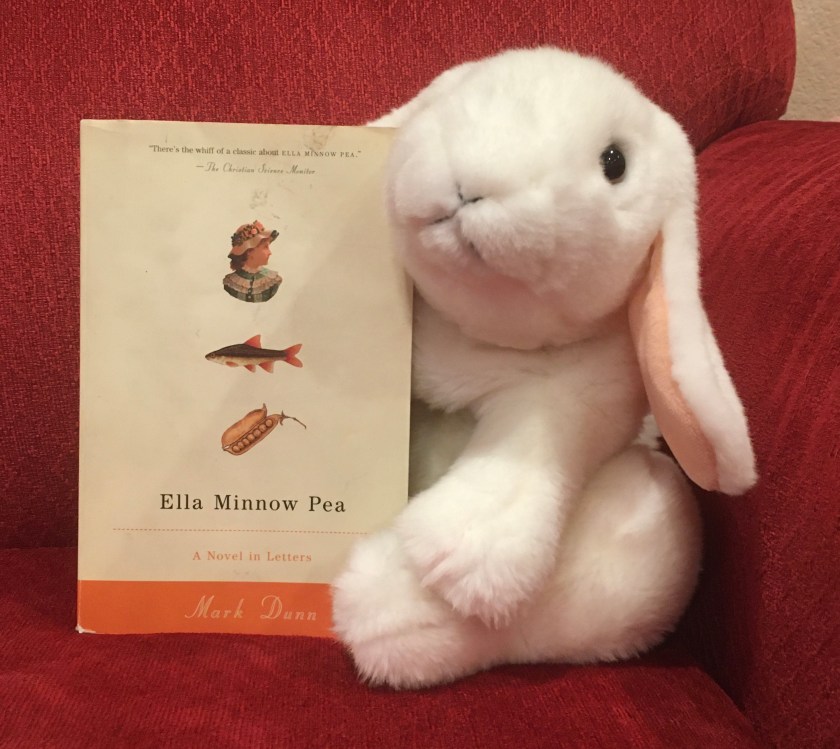
Today Marshmallow reviews the epistolary novel Ella Minnow Pea: A Novel of Letters by Mark Dunn, a book recommended to her by her school teacher.

Marshmallow reviews Ella Minnow Pea by Mark Dunn.

Marshmallow’s Quick Take: If you like books about free speech or books about fighting against suppression, or alternatively if you like playing with letters and thinking about language, then this might be the book for you. 

Marshmallow’s Summary (with Spoilers): Ella Minnow Pea lives on the fictional island of Nollop, which is home to Nevin Nollop, who is the supposed creator of the famous sentence, “The quick brown fox jumps over the lazy dog”, a sentence that contains all letters of the English alphabet. This sentence is on a memorial statue of Nevin Nollop in the island.

The people of Nollop think very highly of Mr. Nollop, so when the letters of the sentence on the memorial statue start to fall off, the Council says that it is Mr. Nollop who has spoken from beyond the grave. They claim that it is Mr. Nollop’s will that people stop using the letters that have fallen. So you can’t use words, or read books, or write words that have the letters that have fallen. Even if you use them by mistake, you are still punished. For the first offense, you are scolded publicly. For your second offense, you get lashing or stocks, the violator can choose. A third offense is punished by banishment, and if the violator refuses, death. You can see how this would make things difficult! As the story progresses, things get more and more complicated. 

Marshmallow is reading Ella Minnow Pea by Mark Dunn.

Marshmallow’s Review: I think that Ella Minnow Pea is a great book for kids eight and up because it has a well-written plot and developed characters. I say eight and up, because the plot is a bit complicated, so younger bunnies might have a harder time trying to understand what is happening.

This is especially true since Ella Minnow Pea is written in letters, like the book To Night Owl From Dogfish, which I reviewed before for this blog. It is interesting to read a book written in letters, because then you can see multiple people’s views, especially if they write in different styles.

Still if little bunnies want to read Ella Minnow Pea, they can read with their parents. This way if the younger ones don’t understand something, they can ask their parents. This can also help open up some of the important themes of the book.

The main theme in Ella Minnow Pea is freedom of speech because the Council is trying to have everyone stop using the words that fell from the statue. Once they lose the letter “D” they even change the names of the days, with Sunday becoming “Satto-gatto” for example. The book is about the importance of speech and language and how important it is for these to be free. In the end it is language (and people’s determination of course!) that saves the world.

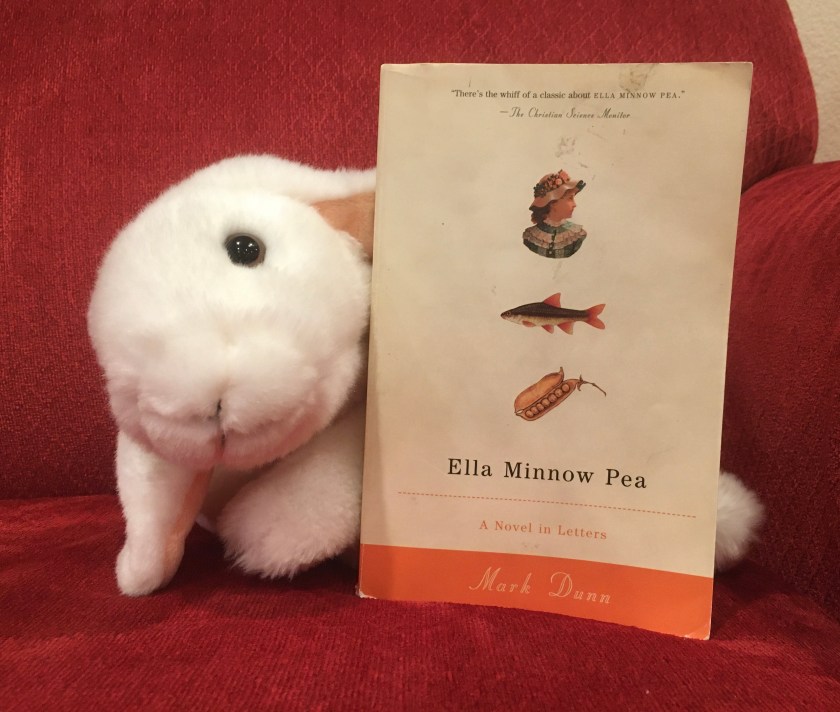
Marshmallow’s Rating: 100%.

Marshmallow rates Ella Minnow Pea by Mark Dunn 100%.

Marshmallow reviews To Night Owl From Dogfish by Holly Goldberg Sloan and Meg Wolitzer

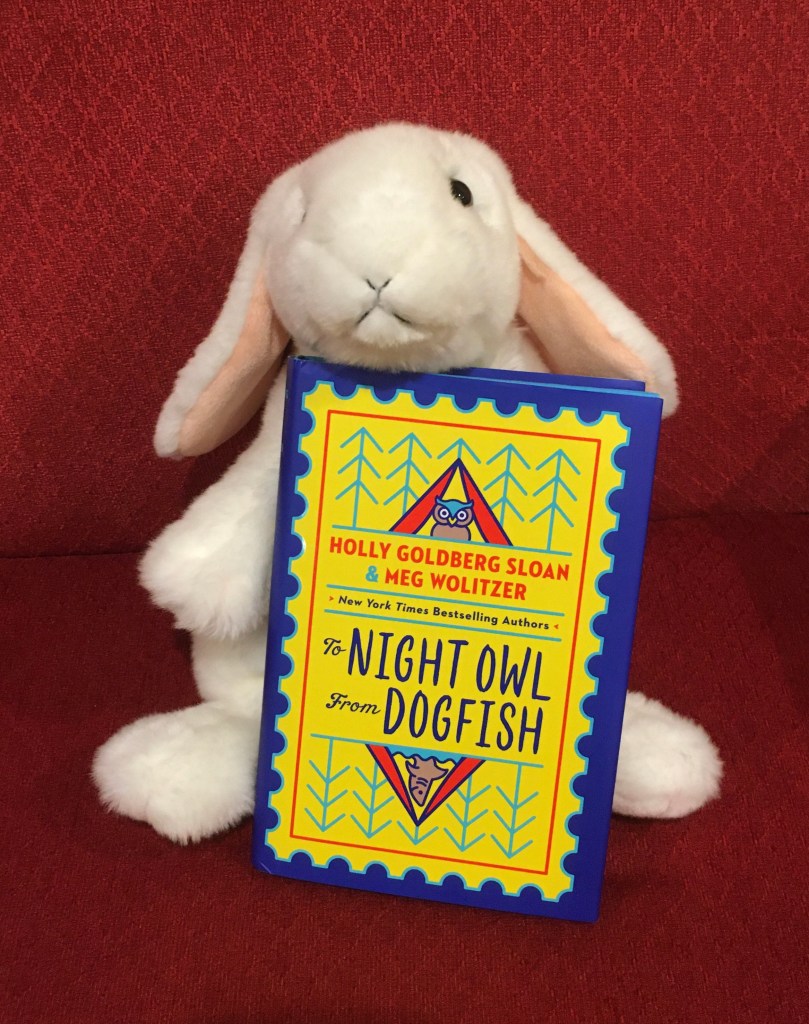
Marshmallow reviews To Night Owl From Dogfish by Holly Goldberg Sloan and Meg Wolitzer.

Marshmallow has begun to read To Night Owl From Dogfish a few weeks ago and finally today she is ready to share her thoughts about it with the readers of the Book Bunnies blog. Sprinkles is taking notes and asking followup questions.

Marshmallow reviews To Night Owl From Dogfish by Holly Goldberg Sloan and Meg Wolitzer.

Sprinkles: Can you tell us a bit about this book Marshmallow?

Marshmallow: Sure, let me give you a brief summary first.

One day, Avery Allenberry Bloom gets an email from a girl named Bett Garcia Devlin. The email says that she has a gay dad just like Avery and that their fathers are now in love.

Avery does not believe Bett at first and thinks that she is lying. Then Bett says that they are both supposed to be going to a sleepover camp called CIGI. And while they are at the camp, the fathers will be in China. Avery knows that she is going to that camp, and so she starts to believe Bett.

The girls are both alarmed because they do not want to one day be sisters. But at camp they meet face to face for the first time and they start to become friends and they actually start wanting their parents to get married. But then the two fathers break up and things get messy.

S: This sounds a lot like The Parent Trap, an old movie by Hayley Mills. You probably have not seen that movie, but in that movie too, there are two girls who want to get their parents together. Actually it turns out that the two girls are actually twins and the parents are both their parents. Bett and Avery aren’t twins though, of course, right?

M: No they’re not.

Marshmallow is reading To Night Owl From Dogfish by Holly Goldberg Sloan and Meg Wolitzer.

S: So what else happens in the book? Are the girls at the camp for the rest of the book?

M: No. Actually they get kicked out of the camp, and they go stay with Avery’s biological mom. Then Avery’s father gets mad at the mother and then decides to come back from China early.

S: Is that when the two fathers break up?

M: Yes. And the rest of the book is more or less all about the girls trying to set things right.

S: That sounds interesting.

M: They do go to a lot of other places in the book.

S: The whole book seems like it is a collection of letters and emails, right? There seem to be no standard narrative segments.

M: Yes, that’s true. It is an interesting feature of the book. The whole story is written as a series of letters, emails, and text messages.

S: That sounds unusual, right? Those kinds of novels are called epistolary. How did it work for you?

M: It was very interesting to read a book written like this.

S: Did it ever get confusing? Were you always aware of who was writing?

M: Yes because on the top corner of each letter, there was the sender and recipient information, and the subject line, like in an email.

S: That is neat! So who is the Night Owl and who is Dogfish?

M: Night Owl is Avery and Dogfish is Bett.

S: Why?

M: In one text, Bett asks Avery what animal she would be if she were an animal. Avery says she’d be a night owl because she reads a lot at night. And Bett responds that she would be Dogfish, because she loves swimming and she loves her dog.

S: So would you recommend this book to other bunnies?

M: Yes, this is a very good read. This would be a good book for people who like reading about friendship. An interesting thread in the book is about how the two girls don’t want their fathers to be a couple at first but eventually they start enjoying each other’s company and their opinions change.

S: This looks to me like a good place to wrap up this review. Is there anything you want to say to finish things off Marshmallow?

M: Yes! Happy reading! And stay tuned for more book bunnies adventures!

Marshmallow rates To Night Owl From Dogfish by Holly Goldberg Sloan and Meg Wolitzer 95%.