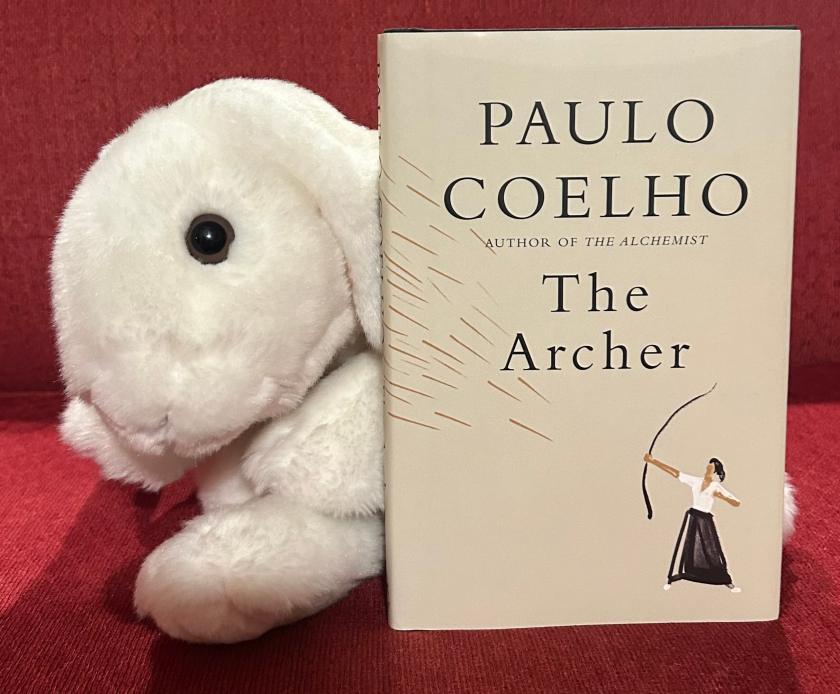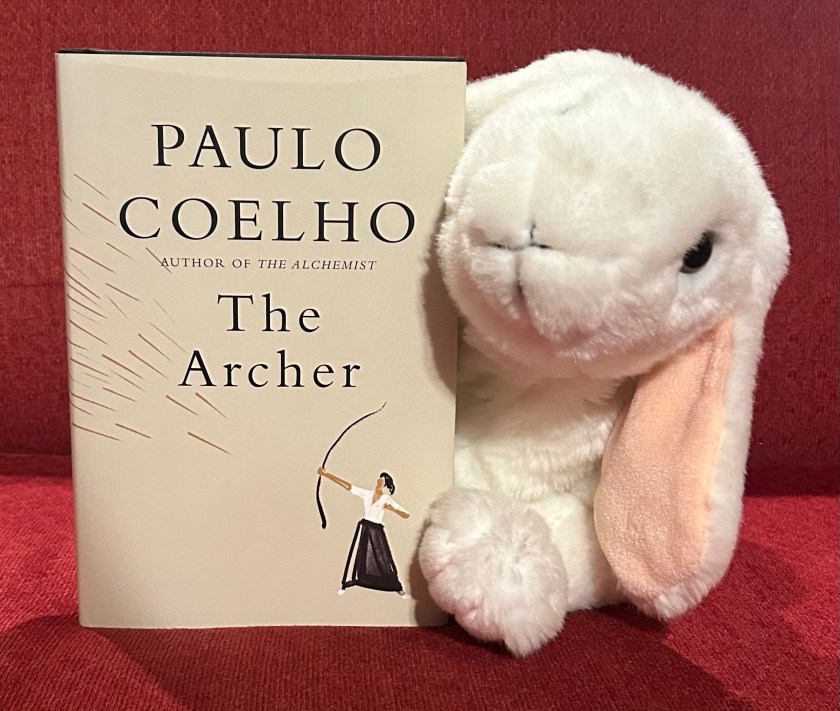
Today Marshmallow reviews The Archer, a short book originally written in 2003 by Paulo Coelho, illustrated by Christoph Niemann, and translated into English by Margaret Jull Costa.
Marshmallow reviews The Archer, written by Paulo Coelho, illustrated by Christoph Niemann, and translated into English by Margaret Jull Costa.
Marshmallow’s Quick Take: If you like simple yet somewhat profound books, then this is the book for you!
Marshmallow’s Summary (with Spoilers): At the beginning of this story, a stranger seeks out Tetsuya. Tetsuya is a humble carpenter now, but he used to be famous throughout the land for his prodigious gifts with a bow and arrow. His sudden retirement and disappearance were rather mysterious, but he is content to live in quiet and obscurity. The stranger searching for him is determined to find him though. He asks a boy from the town to take him to the carpenter and the two arrive at his shop. The stranger pleads Tetsuya to watch him shoot, saying he has mastered the way of the bow and merely wants Tetsuya’s approval to know that his training is complete. To show his worth, the stranger shoots a cherry off a cherry tree a certain distance away. Tetsuya calmly agrees and leads both the stranger and the boy up the mountain in silence. They arrive at a fraying bridge traversing a perilous river and Tetsuya walks to the middle. He shoots a peach off a tree only half the previous distance away from him. He asks the stranger to do the same, but the stranger fails. Tetsuya then tells him that he has mastered the bow but not his mind. With that lesson, he sends the stranger off, after having him promise to keep his identity secret.
The boy—who had been unaware of Tetsuya’s archery prowess till then—is awestruck and asks to be taught the way of the bow. As the master and young boy begin their long trek back to his shop, Tetsuya explains some of the founding ideals of the way of the bow and life as whole. After all, “the way of the bow is present in any human activity.”
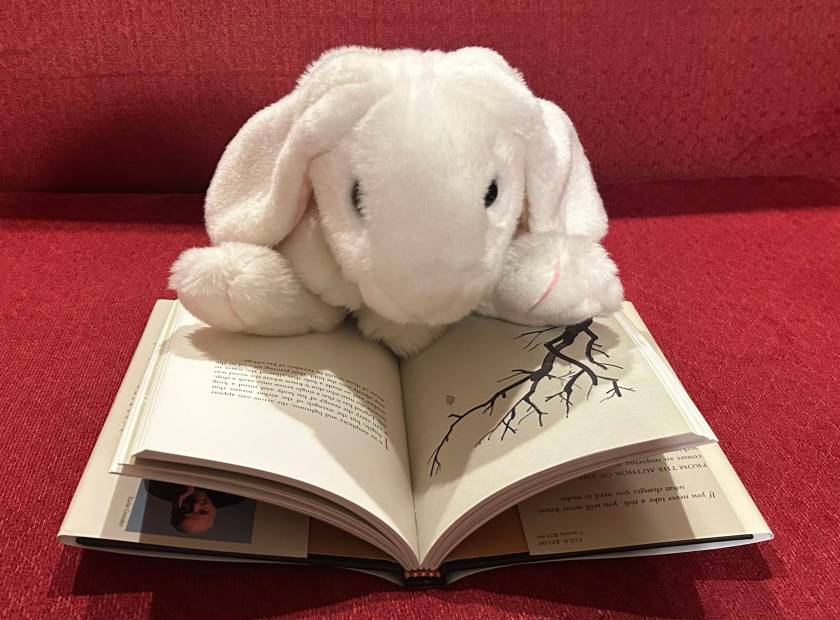
Marshmallow is reading The Archer, written by Paulo Coelho, illustrated by Christoph Niemann, and translated into English by Margaret Jull Costa.
Marshmallow’s Review:The Archer was an intriguing book. To be entirely honest, some of the advice is a little too vague and seemed slightly generic. I think a lot of what the author said has been said before, just in different ways.
The pictures by Christoph Niemann were very pretty though, and the minimalistic illustrative style was very calming to look at. They were, I thought, often unrelated to the text, but you can find connections between any two things if you look hard enough.
This goes for this entire book. The text is short and simple with only a couple words or a paragraph per page, making it very spread out. There are 130 or 131 pages but it does not take a lot of time to read at all. If one were to put all words into standard book pages, you would probably not need to go beyond 30-40 pages max.
The Archer is very calming to read. However, the advice and wisdom feels very simplistic and slightly obvious. I feel like this experience is very inspiring if you are willing to analyze every word, every page, every picture and infuse it with your own meaning. If you work hard to interpret everything in a new way, in a way besides the true simple meaning, then you might emerge with a new perspective on life. Without that kind of effort on the side of the reader, most of the text felt like a repetition of ideas that most people have already heard. That said, it was still nice to read. I just don’t know how truly novel this book is.
Marshmallow’s Rating: 94%.
Marshmallow rates The Archer, written by Paulo Coelho, illustrated by Christoph Niemann, and translated into English by Margaret Jull Costa, 94%.
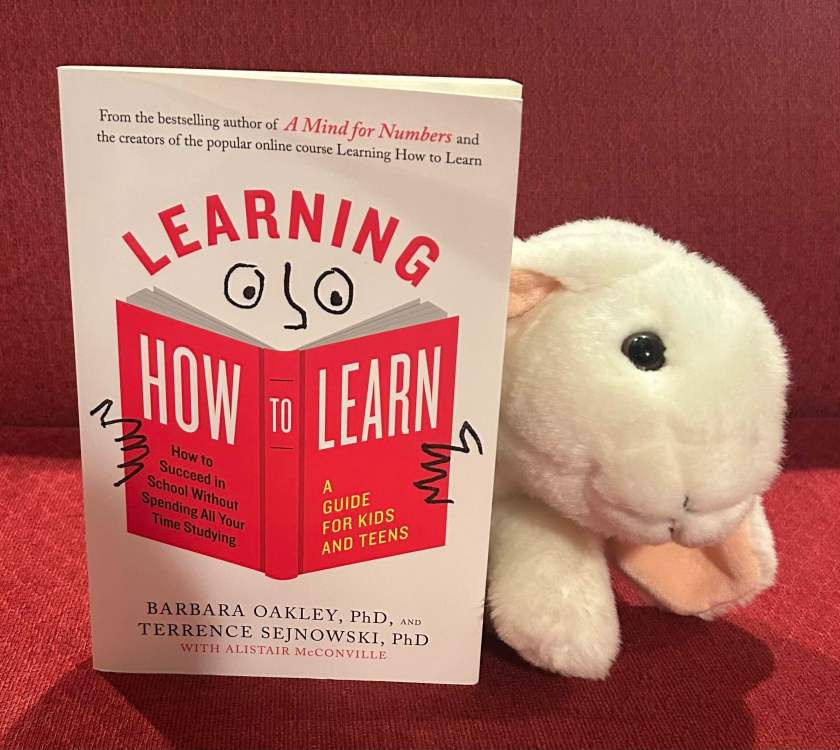
Marshmallow occasionally reads and reviews books about how to be a good student and today she is writing about one such book: Learning How to Learn: How to Succeed in School Without Spending All Your Time Studying (A Guide for Kids and Teens), a neat book by Barbara Oakley, Terrence Sejnowski, and Alistair McConville, published originally in 2018.
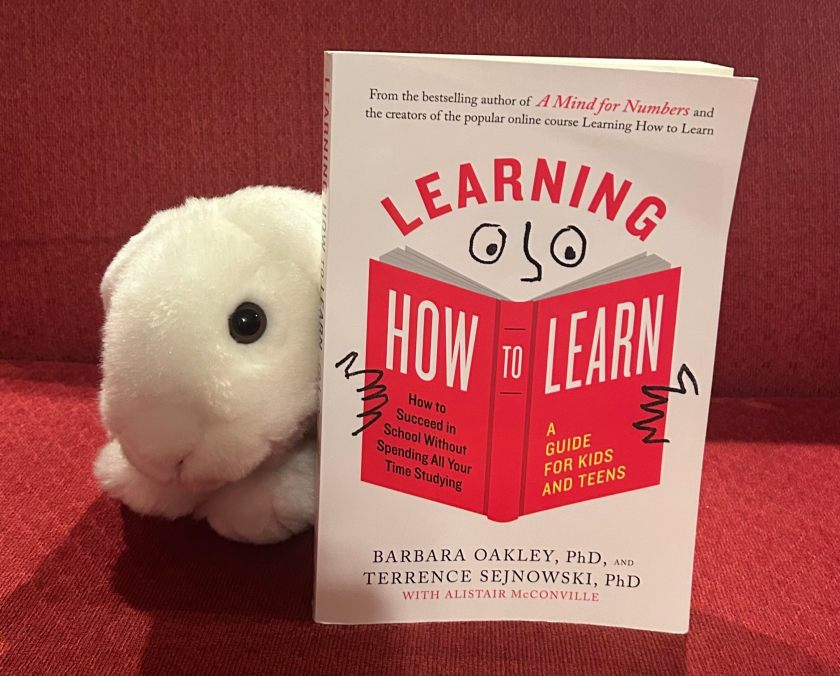
Marshmallow reviews Learning How to Learn: How to Succeed in School Without Spending All Your Time Studying (A Guide for Kids and Teens) by Barbara Oakley, Terrence Sejnowski, and Alistair McConville.
Marshmallow’s Quick Take: If you are a student, a teacher, or anyone who has felt lost in school, then this is the book for you!
Marshmallow’s Summary (with Spoilers): The book starts off with a note to parents and teachers who are reading the book to help a young student. The book officially starts with one of the authors, Oakley, introducing herself to the reader. She writes that she used to be a student who focused only on her liberal arts subjects, feeling that science and math (the subjects she struggled in) were not relevant to her because she was following her passions. However, I was a bit surprised to read the next sentence in which she reveals that she is now a professor of engineering—which requires a deep understanding of science and math as she admits. The enabling factor of this switch was her ability to learn how to learn. She next introduces her co-authors Sejnowski and McConville and then describes how her life changed and how she changed to adapt.
Most chapters in the book have case examples of somebody who, like Oakley, demonstrates the importance of knowing how to learn. Some of the chapter names are as follows: “The Problem with Passion,” “Easy Does It: Why Trying Too Hard Can Sometimes Be Part of the Problem,” “I’ll Do It Later, Honest! Using a Tomato to Beat Procrastination,” “Brain-Links and Fun with Space Aliens,” “Learning While You Sleep: How to Wake Up Smarter,” and “Learning Surprises: Pssst…Your Worst Traits Can Be Your Best Traits!”
One can probably tell that the book is full of interesting yet slightly silly-sounding topics. The authors talk about and teach a lot about fascinating neuroscience, but they explain everything with metaphors and cartoon drawings. There are a lot of pictures and the text of the book is large, so it is overall very comprehensible.
I liked how the authors synthesize the most relevant parts into tips at the end of the chapter. In order to teach the reader how to get better at learning, each chapter also has a list of questions to answer that help you do some active recall. I felt like these end-of-chapter activities make the book feel very interactive and energetic!
Overall, the authors provide a lot of intriguing information and shrewd advice. Some of the strategies were ones I had heard of before or have discovered on my own as a student, but a lot of them were also new to me. Each chapter focuses on a general theme or topic, expanding on the subject at hand throughout. This book is a great source for all students, teachers, and bunnies looking to get better at learning or just understand how the brain works better!
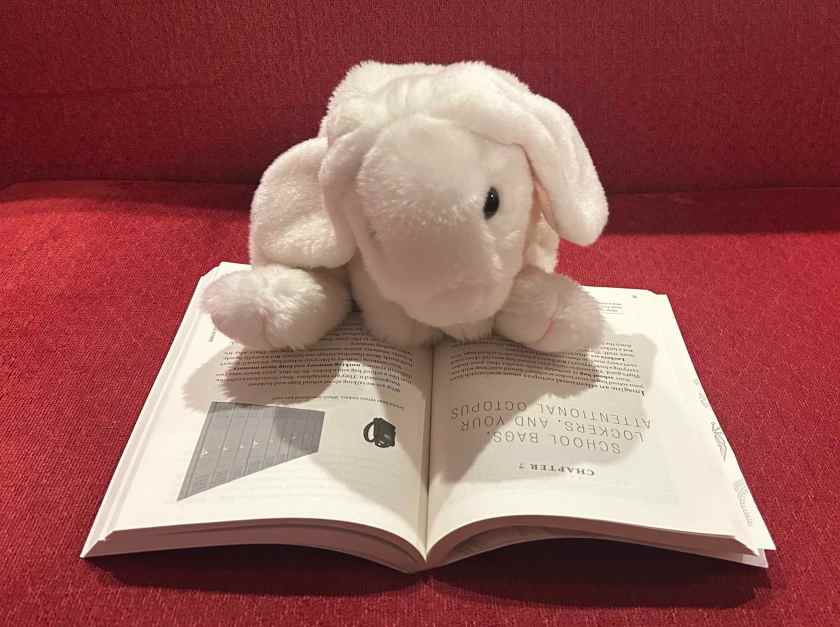
Marshmallow is reading Learning How to Learn: How to Succeed in School Without Spending All Your Time Studying (A Guide for Kids and Teens) by Barbara Oakley, Terrence Sejnowski, and Alistair McConville.
Marshmallow’s Review: I would highly recommend Learning How to Learn to everyone, especially students. I think (and I have heard some of my friends at school talk about this) that a lot of students feel as though they have never actually been taught how to learn. This is partially true, as most students are never told how to study or do their homework. When students are working on their own time, away from school and the direction of teachers, they are not always very good at knowing where to go or what to do. This book provides a lot of good instructions and helps steer the reader on a clearer, better path.
I regret not having read this book earlier. I will try to establish some of the habits suggested by this book and I hope that I will be better at learning and learning how to learn. I have already, on my own volition, focused a lot on how to learn and be a good student. For people also interested in this topic, I would also recommend looking at Cal Newport’s How to Be a High School Superstar and How to Become a Straight-A Student. This book is a lot more kid-friendly though, and a lot easier to read and understand. I really liked how interactive Learning How to Learn is and how it has a lot of images to break down the more complex ideas. I think the authors have done a very good thing by writing this book.
I would highly recommend that parents read Learning How to Learn with their children—the younger and earlier, the better. Too many bunnies fall behind in school because they feel like they simply aren’t smart enough to learn the material. This book shows that you don’t need to be smart, at least not in the way you think; you just need to try your best in a smarter way.
Marshmallow’s Rating: 100%.
Marshmallow rates Learning How to Learn: How to Succeed in School Without Spending All Your Time Studying (A Guide for Kids and Teens) by Barbara Oakley, Terrence Sejnowski, and Alistair McConville 100%.
The book bunnies are back! Today in her first review for the new 2025-2026 season, Marshmallow is writing about Pema Chödrön’s short but impactful book, Fail, Fail Again, Fail Better: Wise Advice for Leaning into the Unknown, published first in 2015.
Marshmallow reviews Fail, Fail Again, Fail Better: Wise Advice for Leaning into the Unknown by Pema Chödrön.
Marshmallow’s Quick Take: If you like books about self-improvement, contemplation, and dealing with challenges, then this is the book for you!
Marshmallow’s Summary (with Spoilers): The book starts with a foreword by Seth Godin, in which he introduces an interesting phrase from the author: “getting all the frogs in the bowl.” This essentially means that, despite all efforts, if you’re trying to get frogs to stay in a bowl, there will always be some that hop right out–which I presume is a metaphor for the occasional, unavoidable failure. He describes his own past with failure, citing the plethora of publishing rejections he experienced. But Chödrön, he says, teaches one how to dance while the frogs continue to jump. This piqued my interest.
Godin also mentions the “infinite game” (one you play not to win, but simply to play). He ties this into the jumping frogs, claiming that perhaps the jumping frogs are the point, rather than the orthodox objective of just getting them to sit still in the bowl. I found this point a little more difficult to tie into the objective of the book. Rather than focusing on how to grow from failure, it suggests that the entire purpose of existence is failure. I felt that this is a separate thesis that is harder to defend. But the foreword made me excited to start.
The central core of the book is derived from a speech Chödrön gave at her granddaughter’s college graduation. In it, she explains that she wasn’t sure her topic choice would be appropriate since preparation for failure (her topic choice) is superfluous–teachers and students hope–if one is taught to avoid mistakes in the first place. Yet, she says that the “fine art of failing” may be the most important lesson that these new graduates will learn in their entire lives.
Most of her speech centers on the topic of “welcoming the unwelcome.” Through this, Chödrön explains, one can turn towards their pain and their failures and learn from them by letting go.
Chödrön describes the two main responses we have towards failure: we often blame other people or other factors for it, and we almost always begin to experience some sort of self-identification with failure. The author describes how she hit rock bottom after leaving her second husband and found guidance with the founder of the college she is speaking at, Chögyam Trungpa Rinpoche. She also recounts an old story which I found fascinatingly eye-opening. The speech then ends, and rather abruptly, but she delivers her message effectively and really does not need to say much else.
The third and final part of this book is an interview with the author conducted by Tami Simon. This section really goes way deeper on all the ideas introduced more briefly in the speech (which was shorter and interspersed with little calming illustrations).
Marshmallow is reading Fail, Fail Again, Fail Better: Wise Advice for Leaning into the Unknown by Pema Chödrön.
Marshmallow’s Review: I found this to be a very engaging book. I agree with many of the ideas, and actually found that some of my own ideas appeared in this book. The author certainly has many novel, wise suggestions and is clearly trying to make the world and the reader better. I liked how the solution presented is more about addressing the pain of failure rather than how to prevent it because there are many amazing books about that too (see for example all the books by Cal Newport that I have already reviewed for our blog). But overall, the speech itself is like a calm, easy-to-read intro to the ideas that are expanded more in the interview.
I thought this was a very intellectually and emotionally engaging book. Overall, Fail, Fail Again, Fail Better: Wise Advice for Leaning into the Unknown is short, but engenders deep contemplation that will last for a long time.
Marshmallow’s Rating: 98%.
Marshmallow rates Fail, Fail Again, Fail Better: Wise Advice for Leaning into the Unknown by Pema Chödrön 98%.
Last year Marshmallow reviewed two advice books by cal Newport directed towards students: How to Become a Straight-A Student and How to Be a High School Superstar. This week she got into Newport’s most recent book Slow Productivity, published in March 2024. Sprinkles enjoyed reading this book immensely, so she wanted to join Marshmallow in this review.
Marshmallow reviews Slow Productivity by Cal Newport while a friendly but slightly annoying little duckling observes.
Sprinkles: So Marshmallow, this is your third book by Cal Newport, isn’t it?
Marshmallow: Yes. I find him to present very thought-provoking ideas.
S: I find his books interesting as well. So we both read this one. It is titled Slow Productivity. I think he was inspired by the slow food movement, where you emphasize slowness and quality and community and local ingredients instead of mass-produced generic fast food. I also read a book a while back about slow teaching; it was also cool. So can you tell us briefly what Newport means by slow productivity?
M: Slow productivity is the idea of decreasing your workload so you can increase the quality of your work to reach certain, specific goals all the while making sure you are living a sustainable life.
S: That sounds like a very appealing goal. Tell us more.
M: So his method, Newport promises, will decrease the familiar overwhelming anxiety and stress the modern knowledge worker experiences.
S: Wait, what is a knowledge worker?
M: According to IBM, a knowledge worker is “a professional who generates value for the organization with their expertise, critical thinking and interpersonal skills.” So someone who uses computers for accounting, writes code to solve specific business problems, works as a professor, or is a freelance writer, or stuff like that. So unlike the previous Cal Newport books I’ve reviewed (which were intended to help students), Slow Productivity is aimed at adults who have already begun their careers.
S: Yes, I think so too. So I was surprised when you picked it up. But you seem to have enjoyed it, seeing how you have finished it already.
M: Yes! I started reading it so that I could be prepared for when I grow up and have my own career. I think adults are always too stressed. I wanted to go into my career with ideas on how to be productive in a healthy manner that yields professional success. I also thought this book might still have principles and methods that could be helpful to me as a student.
S: That second part makes total sense, but the first part is really interesting and would probably be surprising for most folks. Especially if they do not know you well… I am sure you are one of only a few little bunnies your age who are thinking of reading about how to be a productive well-balanced adult! Okay so tell us a bit more about the book. How do we do this slow productivity thing?
M: Well, there are three principal ideas of slow productivity. And these are: do fewer things, work at a natural pace, and obsess over quality. The book utilizes a plethora of “case studies” (as Newport calls them) to prove the author’s suggestions and theories. From each of these examples, he synthesizes (or reiterates) the related slow productivity lesson.
S: I think these are good principles for almost anyone. I mean, they are definitely meaningful for me as a working adult and parent, but also for you. You are now a busy kid going to school and doing a lot of extracurricular activities. And these principles seem to agree with the advice he gives students. Do not cram too many activities just to impress. Do fewer things but do those at such a high level that you will be impressive that way.
M: Yes, I’ve recently seen this idea of his show up in the Atlantic under the name of a spike applicant (one who is exceptionally good at one thing.
Marshmallow is reading Slow Productivity by Cal Newport while the friendly but slightly annoying little duckling is joined by several others.
S: I remember a colleague who said, “Everyone talks about well-rounded students; what is wrong with a sharp knife?” I loved his analogy. I think this spike idea is similar. I mean not everyone is or needs to be a sharp knife, but we do need sharp knives, and they often find their niche. But I also think it makes sense for young bunnies to explore different types of activities to see what they enjoy and what they are good at. Those explorations provide a lot of insight and you can be surprised by what you end up liking and being good at.
M: Yes. In this book though, Cal Newport focuses on maintaining a low, easy workload so you can finish larger goals over long periods of time and build your expertise in your field.
S: That is a different life stage than the exploration stage I was talking about. Of course, his student advice is also about being selective with extracurricular activities, but one needs to figure out what they like and what they want to productively focus on. There is serendipity, some portion will always be about chance, but one also needs time to try out new things. At least that is what I think. But what do I know? I have not written any productivity books!
M: Well that’s okay! Cal Newport gives you the tips so you can focus on other things you like to do and how you can become a fuller person as a whole by managing your workload. In his book for high school students, he focuses on becoming a more interesting person for the sake of college applications (personal growth too I suppose, but primarily applications). In this book, he focuses more on the idea of growing yourself to be a more complete, content individual. I found his idea of pseudo-productivity being unnatural to be quite stimulating. Cal Newport’s books all have this underlying idea that the general consensus (whether in college apps or in careers) is bad because it has been unnaturally perverted towards pseudo-productivity, or doing things just to seem like you’re productive. His main mission is to convince you that this is not the correct way of things and that the situation can be improved by acting in a more natural, original way.
S: Yes, I think that is a good way to put his message in these three books together. I too find his books always give me good ideas. And I am glad you appreciated this book too.
M: Yes! I found his ideas to be very useful, even as a child bunny.
S: This is already quite a long post. Shall we wrap it up?
M: Sure! In summary, I would really recommend this book for all adults who work in the knowledge sector. Even as a bunny in school, I can see that the current work system is set up in a way that is not sustainable for individuals and society as a whole. I hope the situation improves before I join the workforce for my sake. But for the sake of others, I hope this book is more widely read so more people can enjoy full lives with more success.
S: That is a nice sentiment! So how would you rate this book?
M: I would rate this book at 100%. I really liked it and I found it to be very helpful. Cal Newport’s methods are quite logical.
S: That sounds just about right! Okay, what do you want to tell our readers as we wrap this up?
M: Stay tuned for more amazing reviews from the book bunnies!
Marshmallow rates Slow Productivity by Cal Newport 100% and hopes it will provide some cover, while the ducklings continue to amass.