Marshmallow reviews Almost Identical by Lin Oliver

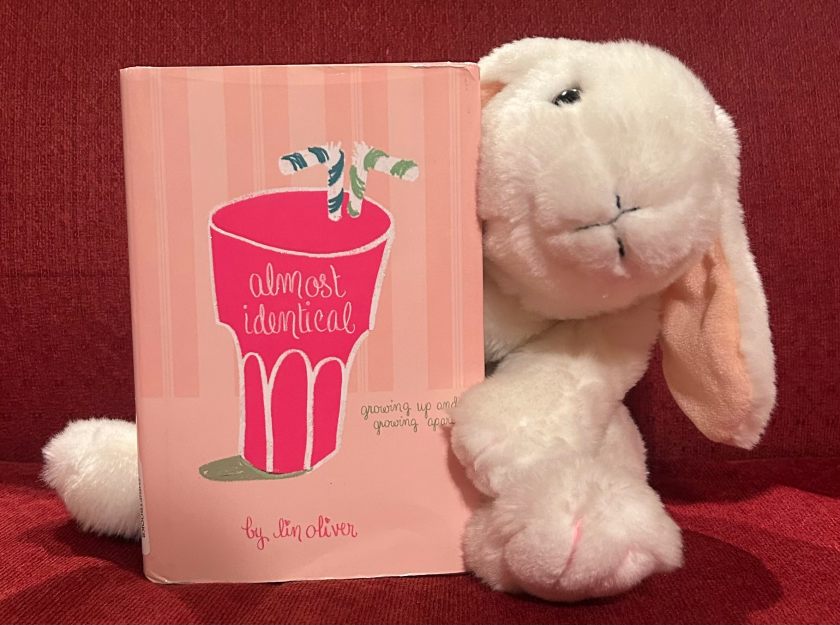
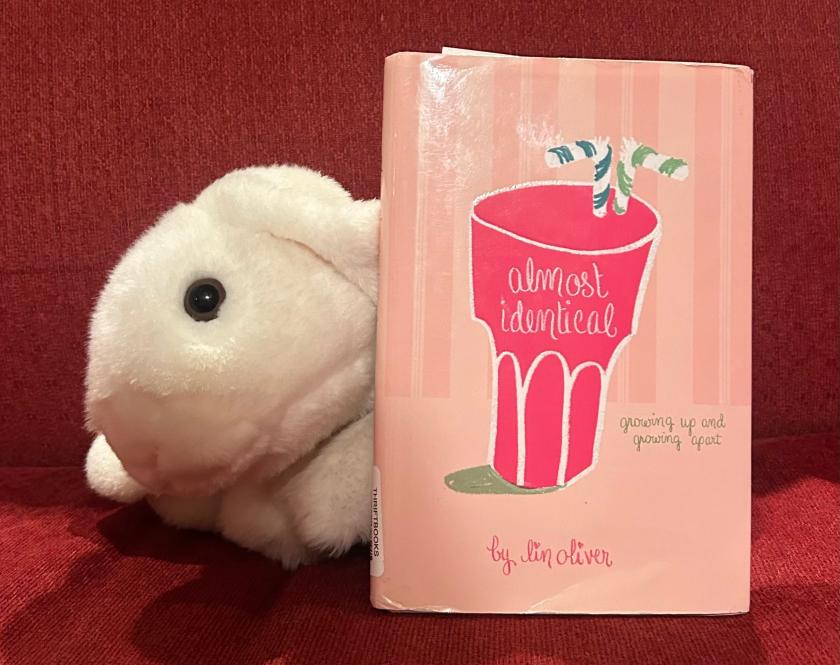
Today Marshmallow reviews Almost Identical, the 2012 book by Lin Oliver that starts the eponymous four-book series. This book series was recommended to the book bunnies by a reader of the blog: thank you, you-know-who-you-are!

Marshmallow reviews Almost Identical by Lin Oliver.

Marshmallow’s Quick Take: If you like sweet stories that surprise you with their depth and potential significance to your own life, then this is the book for you!

Marshmallow’s Summary (with Spoilers): Sammie and Charlie Diamond are identical twins. Though their names might not sound like it, they are both twelve year old girls (twelve years and three quarters to be exact!) Being identical twins, they’ve done everything together since birth. They are extremely good tennis players and compete constantly in doubles leagues. This is mostly due to their father’s desire to live somewhat vicariously through their success. He was set to become a professional player but was injured in a game and had to have a career-ending surgery. Now, he works as the athletic director at the Sporty Forty beach club in Santa Monica teaching tennis and supervising things in general.

Luckily, the family and GoGo (the girls’ grandmother) are allowed to live in the old caretaker’s beautiful bungalow for free by the beach. Unluckily, Sammie and Charlie’s mother is off in Boston at culinary school so she can start up a restaurant when she comes back. That means Sammie and Charlie are on their own to deal with their annoying older brother Ryan. They have plenty to worry about besides him though. Moving from Culver City Middle School to the more affluent Beachside Middle School is a bit of a jarring change.

One girl in particular–Lauren Wadsworth–is so rich and famous and smart and beautiful (allegedly) that they had heard about her before moving. The cool kids / jocks call themselves the SF2s because they are the second generation of the owners of the Sporty Forty (which is owned by several very wealthy families). Sammie and Charlie meet Lauren before school starts though as she is hosting her birthday party at the club; because she has a crush on Ryan, Lauren eventually invites all three of the Diamond children to the event.

This is the start of the end for Sammie. Before all of this, she was already being essentially attacked by her father and brother for being ‘too heavy.’ At the party, she is reminded yet again that she does not fit in as well as Charlie. Charlie is desperate to get in with the in-group and she does well, especially since Lauren can’t wait to get closer to the Diamond family (though she is mostly interested in a specific annoying eighth grade boy…cough, cough, Ryan).

Basically, Charlie fits in. Sammie, on the other hand, does not. She is uncomfortable around the girls and feels like she has to constantly be putting on a fake performance to hang around them. When she leaves to play Frisbee with the boys on the beach, she is quickly told that Charlie is “the hot version of you.” This feeling of growing alienation between Sammie and the SF2s and Charlie remains long after the party is over. Sammie feels most comfortable with the ‘weird’er kids, like Alicia whom she meets at the party. After immigrating from El Salvador at the age of three, Alicia’s family is integrated into the club in a different way from most of the party guests. Her mother works essentially as a maid while her father is the groundskeeper. She is similarly an outsider and the two girls click.

The only thing is that Sammie and Charlie no longer do. Like it says on the book’s cover, they are “growing up and growing apart.” Charlie is doing pretty well for herself in the cliquey SF2 group while Sammie is starting to embrace her more authentic, unique identity at a school club called the Truth Tellers (where students practice and perform stand-up speaking intended to reveal personal stories to the audience in a meaningful way). The two girls were always “two halves of a circle” but change is the only constant. Within three weeks, Sammie and Charlie slowly realize that they are more different than they thought; with new, growing identities, they are no longer almost identical.

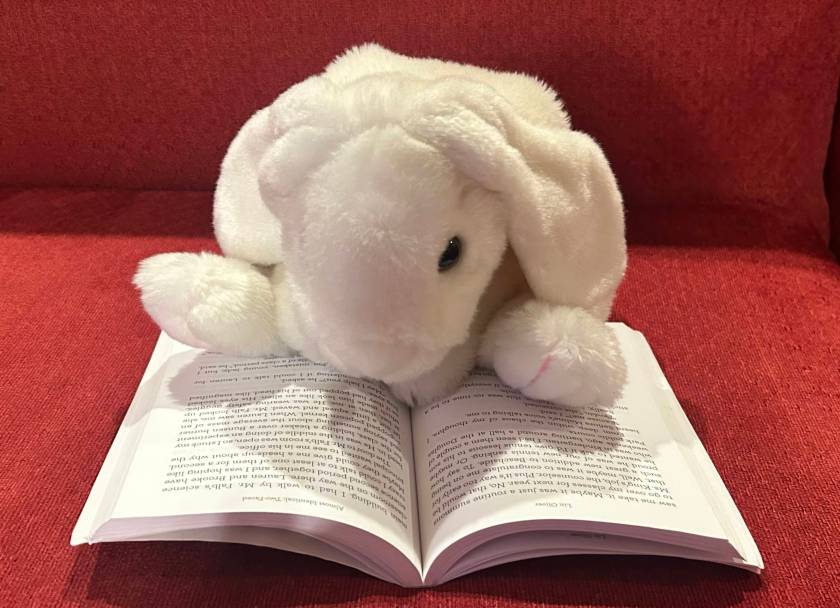
Marshmallow is reading Almost Identical by Lin Oliver.

Marshmallow’s Review: Almost Identical is so very well done! I think the author deserves a round of applause for handling a relatively overused trope with new nuance and depth. This was the first time I read a book about siblings or best friends growing apart in different directions and I felt like it was truly a detailed account of the storyline. Oftentimes, pre-teen books or teen books about growing up and change in middle school have to resort to the typical Mean Girls level of characterizing certain cliques. This book did also have the SF2s, which are somewhat similar. However, it felt a lot more realistic and less cartoonish. I really liked the Mean Girls movie, but Oliver’s novel is a lot more grounded in reality and speaks more to the true middle school experience than most other, more exaggerated accounts do.

Sammie is a very impressive young girl and seeing things from her lens is both heartbreaking and heartwarming. She definitely suffers a lot from body shaming as her father is determined to make her into the best possible tennis player. He believes she is too heavy and that her weight is slowing her down, despite the fact that she is not really overweight in the first place. Her brother joins in unhelpfully in the worst possible situations and his girlfriend-to-be a.k.a. Lauren soon follows suit. Within the first chapter, you develop a deep sympathy for Sammie and she is a very likeable protagonist.

I think the author was very smart to start the book the way she did as it curries favor with the reader to like Sammie almost instantly. This book–as it is told by her–portrays Sammie as the morally correct, wiser of the twins. However, Charlie’s growth is also portrayed in a relatively nonjudgmental light at the end. I really liked how the rapidly expanding rift between them is eventually accepted as separate paths that will define them as different people. This was handled in a very soft, beautiful way.

I feel like this story of struggling, navigating, and then willing letting yourself be taken by change is relevant to more than just middle schoolers. As a high schooler realizing that things are changing and will continue to change a lot more, I found this story very comforting. It gave me a sense of clarity that, despite continual change and occasional chaos, impermanence can lead to new places, perspectives, and people you had never considered before. That is a lesson I think we can all benefit from.

Given its accessible and entertaining prose, I think Almost Identical is a very sweet story that would be amazing for all bunnies. Of course, it is most important for pre-teens and teens to read about situations that most closely align with their own experiences. But adults shouldn’t scoff at the idea of reading this book either! Caramel and I aren’t twins, but I hope he reads this book too. Change is an undeniable, unyielding force in our universe, and reading these seemingly small works of human art can serve as a tether to what grounds us as the world seems to transform around us.

I would like to especially thank the reader who recommended that we read this book! Even though the author finishes this book in a satisfying manner, I look forward to reading the next book of this series!

Marshmallow’s Rating: 100%.

Marshmallow rates Almost Identical by Lin Oliver 100%.

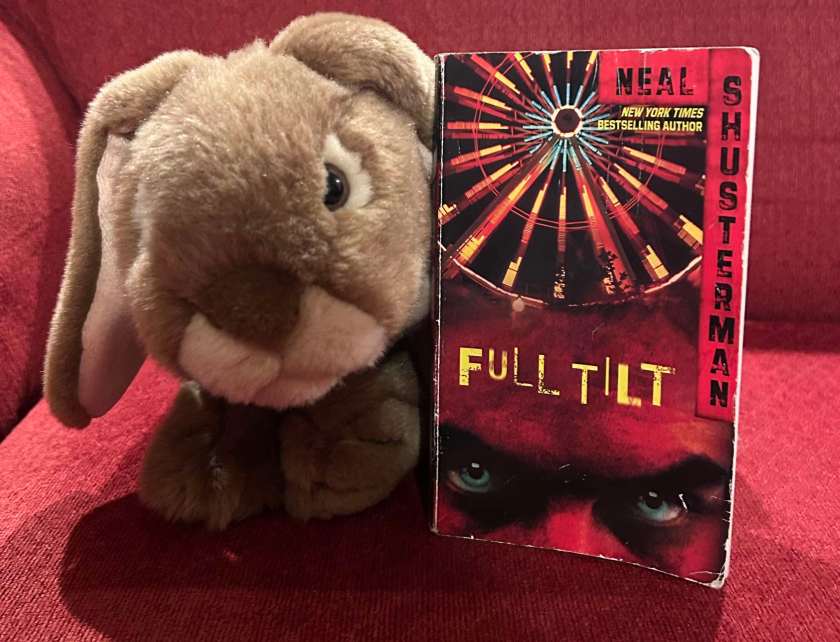
Caramel reviews Full Tilt by Neal Shusterman

Today Caramel is talking to Sprinkles about a book he has been reading for his English class: Full Tilt by Neal Shusterman, originally published in 2004.

.Caramel reviews Full Tilt by Neal Shusterman.

Sprinkles: So Caramel, can you start us off by telling us a bit about the book? 

Caramel: Okay, it’s about a kid named Blake, who’s going to college at 16, and he is sort of a scaredy cat, at least about roller coasters.

S: Well, roller coasters can be really terrifying. 

C: True, but this kid seems to be scared of all of them, while his little brother Quinn is not afraid of anything.

S: Hmm, okay, I am sensing that you kind of liked Quinn more. 

C: He sounds a lot more like a real kid, you know? But basically, he’s just not scared of many things. Anyways, the first thing that happens in the book is that Blake, Quinn, and Blake’s friends Russ and Maggie are at a theme park. Blake wins a game, and then he is given a teddy bear by a strange and mysterious girl named Cassandra. He takes the teddy bear home and inside is a ticket to another theme park.

S: That sounds curious. Then what happens?

C: When the two boys come home, they learn that their mom is engaged, and the two brothers get into a fight over the engagement. Quinn is not happy about the engagement but Blake is more accepting. 

S: It is a tough issue of course. 

C: Sure, I agree. Anyways, the brother then is found in a comatose state, and Blake sees carnival lights in Quinn’s open eyes.

S: That’s freaky! And kind of scary!

C: Yeah, Blake then takes his two friends and goes to the theme park that belonged to the ticket he had found in his teddy bear, and he finds a carnival.

S: This is getting weirder and scarier.

C: Yes. And did I mention that it is the middle of the night? 

S: No wonder Wikipedia describes this book as a “psychological thriller” and a “fast paced horror thriller”! I am already getting all tense here, and I have not even read the book.

C: Yep, the book is kind of tense, but it’s a kind of tense that makes you wanna keep reading.

S: I guess that is a good kind of tense. Okay, go on. 

C: At the carnival they witness some weird stuff. They have to go on some rides and each of them is weird. And real! I mean one can get really hurt.

S: Not like the holodeck on Star Trek?

C: Well, actually kind of exactly like the holodeck when the safety measures are offline. 

S: I see. So the kids have to ride several rides and they are in real danger?

C: Yes. Actually they have to ride seven rides before dawn and finish them without failing. And to add to it, Blake sees his brother Quinn is there, too, riding these dangerous rides and is not taking things seriously at all. 

S: And of course Blake is very worried, I can imagine. 

C: Yeah, and he learns that Cassandra is in charge of the carnival, but I shouldn’t spoil it any more.

Caramel is reading Full Tilt by Neal Shusterman.

S: Okay, that makes sense. You have already gotten us deep into the book and all tensed up. So let us talk a bit about the book in another way. It was good at making you feel the tension, I understood that. But tell us also about the characters. You liked Quinn and kind of found Blake a bit too much of a scaredy cat, but did they feel like real people? How about Russ and Maggie? 

C: Yeah, the story is told from Blake’s point of view, so you get a pretty good sense of him and his view of things. And the others are just his friends, and they all feel quite normal to me. 

S: What about Cassandra? I mean it seems she is kind of a mysterious character. Is that how she felt to you as you were reading the book?

C: Cassandra never seemed normal, but Blake knows why now. And I do too, but I cannot tell. I don’t want to spoil the whole thing. 

S: Okay, I won’t push then. All in all, this seems like a pretty neat book, and you got to read it for your English class. Did you have many discussions in class about it? 

C: Yeah, it was neat! 

S: Okay, cool. Would you then recommend this book to other bunnies?

C: Yes, but probably not the very young ones. It is really tense and younger bunnies can get scared. 

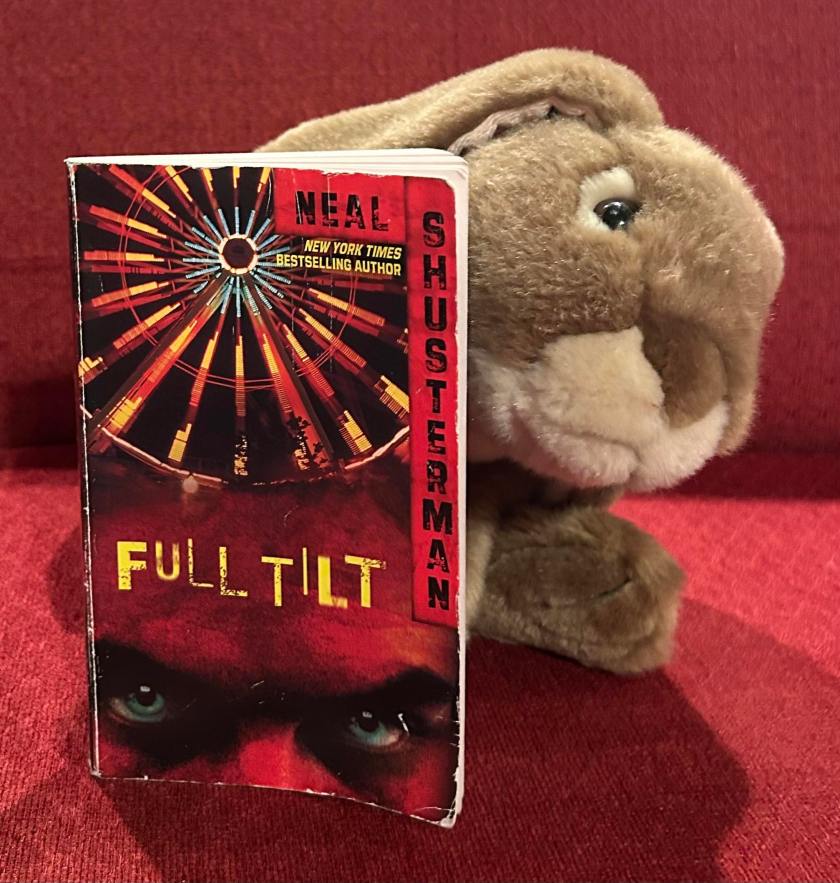
S: The picture on the cover is scary too!

C: Yeah, it is kind of how you can picture the characters in that weird carnival. Maybe it is good that it is scary because younger bunnies won’t want to read it. 

S: I agree. I found the cover picture quite scary myself. It makes sense a bit more now that you told me about the book. So okay, I think this is a good place to wrap up this review. 

C: Sure. Let’s do that. 

S: What do you wish to tell our readers then? 

C: Stay tuned for more book bunny reviews!

.Caramel enjoyed reading Full Tilt by Neal Shusterman though he warns that it is probably not appropriate for the youngest bunnies.

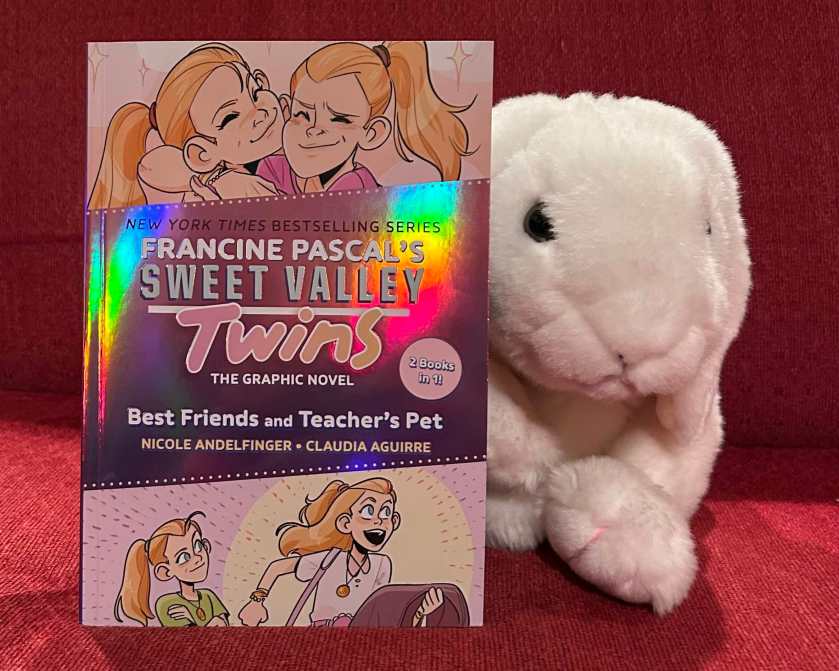
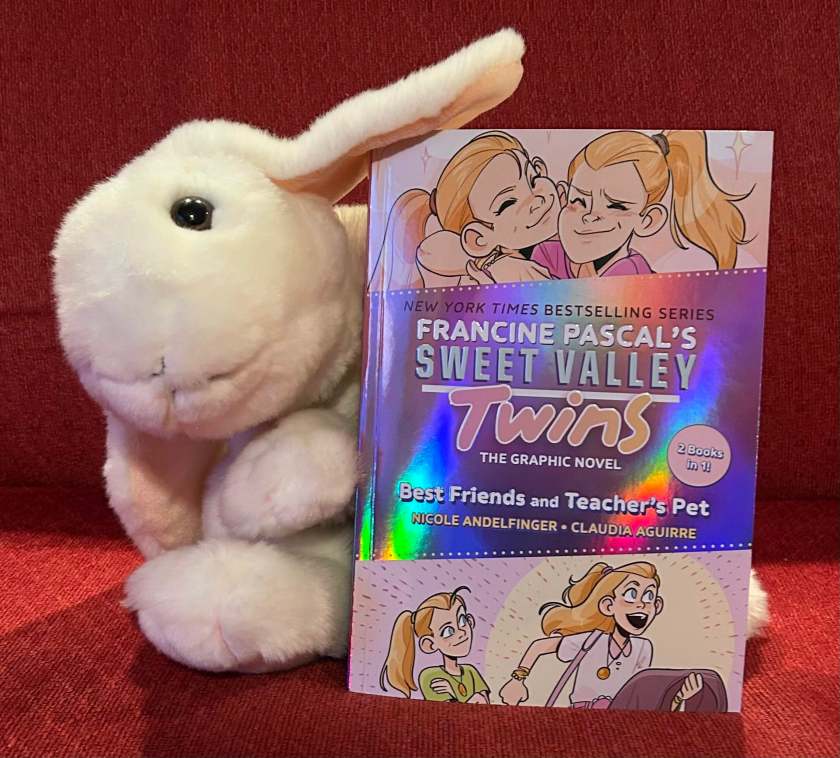
Marshmallow reviews Sweet Valley Twins: The Graphic Novel (Best Friends and Teacher’s Pet) by Nicole Andelfinger and Claudia Aguirre

A few years ago, Marshmallow read and reviewed Kristy’s Great Idea (The Baby-Sitters Club Graphic Novels #1) written by Ann M. Martin in the 1980s and 1990s and adapted into a graphic novel by Raina Telgemeier in 2006. Today she is reviewing Sweet Valley Twins: The Graphic Novel by Nicole Andelfinger and Claudia Aguirre, another book whose origins lie in a beloved book series from the 1980s written by Francine Pascal. The edition she is writing about combines the first two books, Best Friends and Teacher’s Pet, in one volume and was published just this year, in 2025. Other artists who contributed to the book include Sara Hagstrom, Andrea Bell, and Warren Montgomery.

Marshmallow reviews Sweet Valley Twins: The Graphic Novel (Best Friends and Teacher’s Pet) by Nicole Andelfinger and Claudia Aguirre.

Marshmallow’s Quick Take: If you like books about friendship, sisters, family, and drama, then this is the book for you!

Marshmallow’s Summary (with Spoilers): Elizabeth and Jessica Wakefield are identical twins. In Best Friends, they start off as each other’s best friend. But like all middle-school aged girls and all book characters of that age, the two have started changing. In my opinion though, the one who is changing more is Jessica. Jessica has become increasingly more interested in boys and popularity, which is natural to an extent. Unfortunately, she has been recruited to join the Unicorns (which is a lot like the Plastics from Mean Girls). In order to get in, Jessica has to prove herself by completing three dares. Elizabeth is more interested in the Sweet Valley Sixers, the school newspaper she founded with her other friends Amy Sutton and Julie Porter. Both Elizabeth and Jessica thought they would be closer than ever in middle school, but they are growing apart instead.

In Teacher’s Pet, the focus is on their shared ballet classes. Jessica dresses to impress the first day, only to discover that their strict teacher Madame André is not a fan of her style. It is on that day that Jessica decides the teacher hates her. On the other hand, Elizabeth has no problem with the teacher, who actually really likes her. Jessica—who believes she is the best ballet dancer in the class—decides that Madame André picks favorites and that Elizabeth is a teacher’s pet. So when Elizabeth gets the solo for the rehearsal, Jessica is pretty jealous. Can the sisters overcome their differences? (Spoiler: The answer is predictably yes, but in a way that I was not too pleased with.)

Marshmallow is reading Sweet Valley Twins: The Graphic Novel (Best Friends and Teacher’s Pet) by Nicole Andelfinger and Claudia Aguirre.

Marshmallow’s Review: I think these books are really good, especially for young girls in middle school who are noticing behavioral changes in themselves or others. This book is a graphic novel and has two of the Sweet Valley Twins books in one. The Sweet Valley Twins books were originally written in 1986. I think it’s worth noting that there are no discussions about changing bodies in these books so the focus is more on how people’s personalities and interests change. That said, I was a little unhappy with the dynamic between Elizabeth and Jessica. I’ll preface this by saying I liked Elizabeth more due to her sweet, smart personality. I think the way Jessica changes is definitely normal and understandable too. But Jessica also changes in ways that are less excusable: she bullies other girls, pulls pranks on others, and is extremely self-centered. Jessica literally says she is the best dancer to her sister’s face—several times. I think this shows that she is a worse person, or at least doesn’t care so much about others. Yet, at the end of the second book (SPOILER), Jessica is the one given the solo lead role because Elizabeth fakes being injured. Why does Elizabeth give Jessica the role? Because Jessica complains about how she deserves it more and how she is better at ballet than everyone else until Elizabeth gives in and starts thinking she doesn’t deserve it either. I think it’s really good to have an accurate representation of sibling relationships in books, but I don’t like how the authors had the book end in a way that shows one of the sisters giving something they really wanted to the other just because the other one is jealous. I think that was a pretty messed-up ending and I don’t find that fair. I think Jessica definitely needs support, especially since she is so desperate to be viewed as popular and get validation. But the fact that she consistently bullies others and tears her sister down to get that is not okay. I think Jessica is portrayed too well in the book. So I definitely think this book is good to read for young girls. But I think parents and the readers should have a discussion about what a healthy relationship should be like, because Jessica’s behavior is not what should be normalized or idealized.

After I wrote the paragraphs above, I read this review of the second book in its original, which seems to imply that Jessica is clearly the better dancer and the teacher is really playing favorites and has poor judgment. That is not quite the impression one gets in the graphic novel version. Even if Jessica is more naturally inclined, Elizabeth is just as good though possibly with more instruction and practice. So to me, the teacher choosing one over the other does not seem like a big unfair thing. Jessica on the other hand does not handle things well and really comes across as a spoiled brat.

The graphic novel is otherwise a lot of fun to read. The colors and the characters’ depictions work really well. I did keep thinking back to all my favorite books by Raina Telgemeier, especially Drama. If you are up for a solid couple hours of fun reading about middle school blues, this book can be a good choice.

Marshmallow’s Rating: 92%.

Marshmallow rates Sweet Valley Twins: The Graphic Novel (Best Friends and Teacher’s Pet) by Nicole Andelfinger and Claudia Aguirre 92%.

Marshmallow reviews The Hunger Games: The Illustrated Edition by Suzanne Collins and Nico Delort

Marshmallow has read and reviewed all three books making up the Hunger Games trilogy by Suzanne Collins. This week she was excited to get her paws on the new and illustrated edition of the first book: The Hunger Games: The Illustrated Edition. Sprinkles is taking notes and asking questions.

[You can check out Marshmallow’s reviews of the three Hunger Games books here: The Hunger Games, Catching Fire, Mockingjay.]

Marshmallow reviews The Hunger Games: The Illustrated Edition written by Suzanne Collins and illustrated by Nico Delort.

Sprinkles: So Marshmallow you read the original book and then watched the movie. How did this illustrated edition work for you?

Marshmallow: As far as I could tell, the text was the same as in the original book. But the illustrator added images every now and then, giving the book a fancy fairy tale feel.

S: I saw the illustrations. They look realistic but are all in black and white. I felt like maybe that matches the overall gloomy nature of the world the story is taking place in.

M: I think you might be right. The cover illustrations have other colors, too, but the illustrations inside the book are all in black and white, like you said. And the world of Katniss Everdeen is really gloomy.

S: Okay, maybe it makes sense for us to give our readers a quick recap of the main plot lines of the book. We cannot assume everyone has already read the original book or seen the movie version.

M: Well, I could just repeat what I said earlier: The book is set in a dystopian future, in North America. There are twelve districts and a Capitol city that make up a country named Panem. Katniss Everdeen, the main character, lives in District 12 with her mother and younger sister Prim. Everyone is very poor, except for the people of the Capitol, which hosts the Hunger Games every year. The Hunger Games are a big spectacle: Two children ages 12 to 18 are selected from each district. And they are brought to the Capitol and are to fight to the death in these Hunger Games. Katniss ends up being the girl representing her district in that year’s Games, along with a boy named Peeta. The book is about their trip to the Capitol and their time during the Games.

Marshmallow is reading The Hunger Games: The Illustrated Edition written by Suzanne Collins and illustrated by Nico Delort.

S: Okay, so the book is basically the same but there are illustrations in this version, right?

M: Yes. The format of the book is also bigger and the paper the pages are made of is much heavier, thicker paper. And there are a lot more words on a page. I think.

S: How many pages is it overall?

M: 357.

S: Comparing with the original paperback edition you read, which is 374 pages, do you think it is abridged?

M: I don’t think so. It seems that the large format allows more words on each page.

S: I see. So if the text is the same, then one could simply read this one instead of the original paperback you read.

M: Yes, and that could be a different kind of experience, I am sure. I mean, when you read the book, especially if you read it before having seen the movie, you completely are free when you are imagining Katniss and visualizing Panem. The illustrations would change that experience a bit. But I do not think it would be in a bad way.

S: So did you think the imagery was consistent with the book and how you imagined things to look like?

M: Yes. They match the movie images too. I mean Katniss is not Jennifer Lawrence in the illustrations, but the world and how every scene looks really resemble the movie images. But I am not saying the illustrations sort of simply copy the images form the movie. I thought the movie imagery was very faithful to the book, and only made the world seem richer and crisper. The illustrator of this book is very faithful to the book too, and the images just fit the mood of the book very well. Even, like you say, the fact that the illustrations are all in black and white adds to the general heaviness of the story.

S: Okay, that sounds like the illustrator did a really good job then.

M: Yes. I think if you want to read The Hunger Games series, this illustrated edition could be a good book to start your journey with.

S: So I am guessing you would rate this book rather highly?

M: Yes. Great story as before and very evocative imagery, so I’d rate it 100% for sure.

S: Thanks Marshmallow, this is all good to know. So maybe this would be a good time to wrap up this review. What would you like to tell our readers?

M: Stay tuned for more amazing reviews from the book bunnies!

Marshmallow rates The Hunger Games: The Illustrated Edition written by Suzanne Collins and illustrated by Nico Delort 100%.