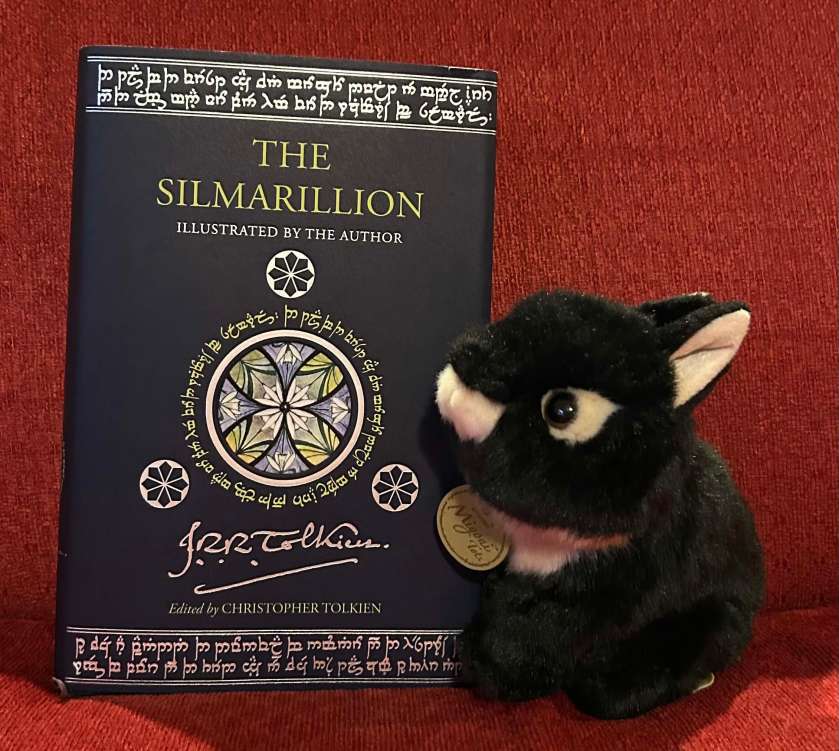
Midnight reviews The Silmarillion by J.R.R. Tolkien

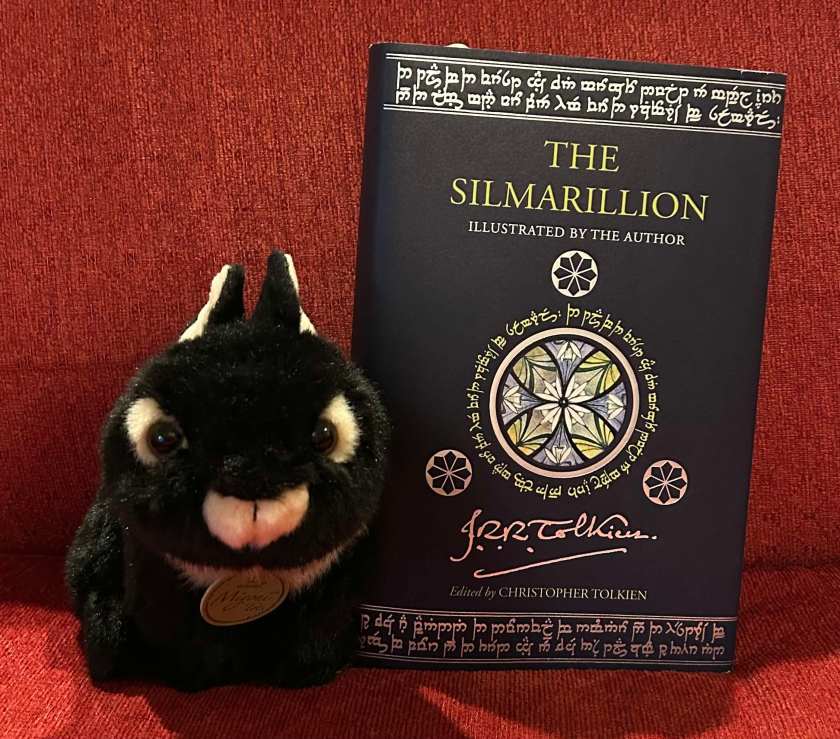
Three members of the book bunnies household have been reviewing books since 2019 (how time flies!) but it was only late last year when the fourth member of our family, the mysterious and reclusive black bunny Midnight, decided to join in the book fun. So far he has reviewed Foundation and Foundation and Empire, the first two books of the Foundation trilogy by Isaac Asimov. But it was clear to all who read those reviews that he was actually itching to talk about other books. So today he is doing just that! To be more specific, today Midnight is talking to Sprinkles about The Silmarillion, a collection of tales by J.R.R. Tolkien, published after his death in 1977.

Midnight reviews The Silmarillion by J.R.R. Tolkien.

Sprinkles: So Midnight, welcome back! I am hoping that you are excited to be talking about a book by Tolkien today.

Midnight:I am a bunny of few emotions; it is difficult for me to admit to feeling excited. But I must admit this is one of my favorite books.

Sprinkles: Cool! So tell us a bit about it then.

Midnight: The Silmarillion is not a novel or a single story, like Tolkien’s other well-known works like The Hobbit and The Lord of the Rings trilogy. It is a collection of tales mostly from the ancient days of Middle-Earth long before rings and hobbits. Although Tolkien was working on this at the time of his death, these tales have their origin in his very early work when he was a young man in World War I. His son Christopher Tolkien assembled and edited these various works from his unpublished works, into something resembling a coherent whole.

Sprinkles: Oh, that sounds cool! So if one has read one of those Tolkien books, or even just seen some of the movies, then they would recognize Middle-Earth as the world where all those stories took place. And you are saying this book basically gives us a lot of the backstory of that world.

Midnight: Not quite. The world changed drastically over the ages. For example, in the First Age, the world was flat. When Numenor was destroyed in the Second Age, the world was made round, and the Undying Lands were removed forever from the world, at least as far as mortals were concerned. The Elves could still find their way there.

Sprinkles: So Middle-Earth that we might be familiar with is only the world of the Third Age?

Midnight: Yes. Although I believe that the very end of the Lord of the Ring movies takes place in the beginning of the Fourth Age, after the final defeat of Sauron.

Sprinkles: Oh, this is a very long history!

Midnight: Yes. Stretching back many thousands of years. In fact The Silmarillion begins with the creation of the world, and a run-down of the various gods of the world, the Valar (who are mentioned even in the Peter Jackson films by Arwen but only in passing, so people could easily miss this if they were not aware of their existence).

Midnight is reading The Silmarillion by J.R.R. Tolkien.

Sprinkles: That sounds cool! So how many tales are we talking about here?

Midnight: Quite a few. I don’t know the exact number off the top of my head. Or rather there are two chapters devoted to the cosmology of Tolkien’s universe. Then the bulk of the book is “Quenta Silmarillion”, which is itself a collection of more than twenty tales from the First Age of the world (and a little bit slightly before that). Then there are two more standalone chapters, one is about the fall of Númenor (where we see Sauron as the master manipulator) and the other is an essay providing some background information about the rings and the Lord of the Rings as a historical account.

Sprinkles: That sounds pretty eclectic! Does it read as a coherent book on its own?

Midnight: The different parts have different flavors. It is almost biblical in scope. So the coherence is basically in the story, not quite in the style. And as a whole, it provides a lot of information that makes Tolkien’s universe much richer.

Sprinkles: I see. So it almost reads like a collection of eclectic historical documents written throughout history by different scribes and then put together by an editor. Which makes sense for a book that was indeed put together by someone other than the author himself, and the segments put together were written at different times. that’s pretty cool.

Midnight: It is.

Sprinkles: So what is a Silmarillion? Why is the book titled that way?

Midnight: The title refers to the three Silmarils, magical gems of great beauty crafted by the greatest of the Elven smiths. They were stolen by Morgoth, the original bad guy. For example in the movies we hear Sauron called the servant of Morgoth, and the Balrog as the Balrog of Morgoth, so Morgoth is the original evil deity.

Sprinkles: Okay. I do remember that. So Morgoth takes the Silmarils and then what happens?

Midnight: He flees Valinor (the Elven paradise) with the Silmarils and many of the elves vow to pursue him, a god, to the ends of the world to retrieve the gems. There is lots of tragedy, hubris, betrayal, and general elf-on-elf violence. We see elves not as the ethereal and noble creatures of the films but rather as flawed, arrogant, and sometimes hotheaded.

Sprinkles: Sounds pretty epic!

Midnight: Indeed, the stories are epic in scope and mythical in character. It reads more as mythology than a traditional novel.

Sprinkles: Okay, so is that why The Silmarillion is one of your favorite books?

Midnight: Maybe.

Sprinkles: Which tale is your favorite?

Midnight: My favorite is “Akallabêth: The Downfall of Númenor”. This is, as you can tell, the history of Númenor and the tale of its downfall. It is Tolkien’s take on the Atlantis myth. Amazon’s Rings of Power series draws heavily from the history of Númenor outlined in the appendix in the Lord of the Rings, but this chapter in The Silmarillion gives us so much more!

Sprinkles: Neat! Okay, Midnight, I think this is enough for a post. And you told me enough to get me all excited about reading the book myself.

Midnight: It’s not for everyone but it is for me.

Sprinkles: That’s fair. I have enjoyed the movies and find the world Tolkien created fascinating. So I will give The Silmarillion a try. So what will you say as your last words?

Midnight: Namárië, dear readers. That is, farewell, in Elvish.

Midnight ends by pointing out how much he enjoys reading and rereading The Silmarillion by J.R.R. Tolkien and bids readers farewell, until such a time as he sees fit to reappear.

Marshmallow reviews Gleanings by Neal Shusterman

Marshmallow has already read and reviewed Scythe, Thunderhead, and The Toll, the three books in Neal Shusterman’s Arc of a Scythe series. Today she is writing about Gleanings: Stories from the Arc of a Scythe, a collection of stories Shusterman published in 2022 that explores some of the lesser known features of the same story universe.

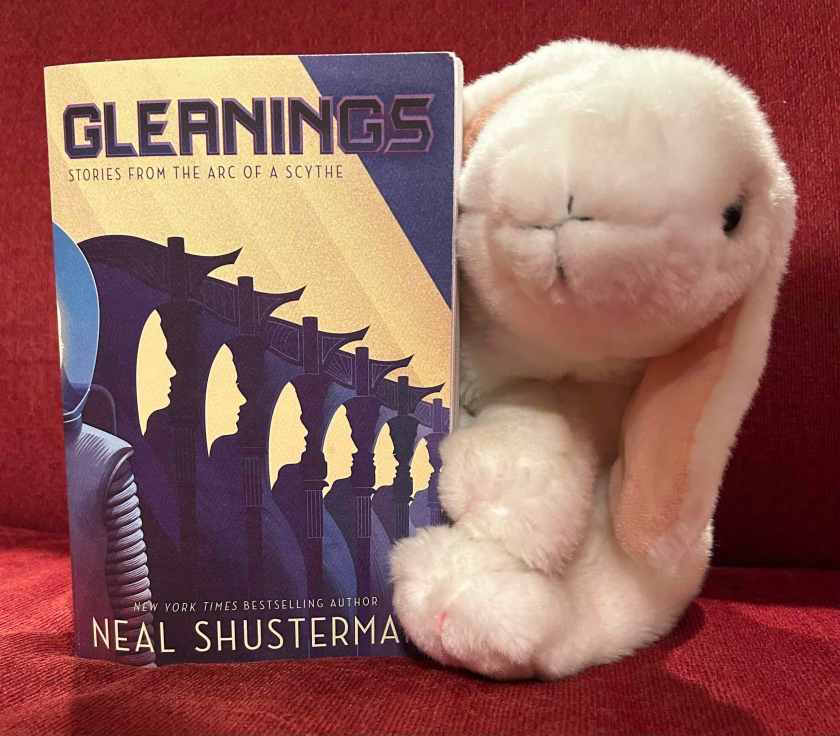
Marshmallow reviews Gleanings: Stories from the Arc of a Scythe by Neal Shusterman.

Marshmallow’s Quick Take: If you liked reading any of the books in the Arc of a Scythe trilogy, then this is the book for you!

Marshmallow’s Summary (with Spoilers): In the three original books about the world of scythes and the Thunderhead, Shusterman did an amazing job of creating an immersive story. But such tales have a tendency to leave the reader wanting more, which is exactly what happened to me at the end of the series. While the main plot lines were all resolved well, I still really wanted to read more about that world; the premise is simply intriguing (a post-mortality world full of fascinating technology and sheltered by a benevolent AI on the cusp of a new era of space expansion). Luckily, Shusterman was very nice and wrote this collection of stories, some in collaboration with other authors.

The first story–titled “Formidable”–goes to a period before the events in the Arc of a Scythe series took place. It elaborates on the rise of Scythe Marie Curie who is a major character with a past that is often mentioned with only sparing detail. In Gleanings, we finally learn more about her rise to fame as the scythe who set humanity free from its bureaucratic history. The next story is titled “Never Work with Animals” and introduces a new scythe, a new setting, and a new story but with one familiar face. “A Death of Many Colors” similarly shows another scythe and makes Shusterman’s fiction feel even more real by adding yet another thread to the tapestry he has been weaving.

By adding so many new stories about scythes, the Thunderhead, and their world, Shusterman creates an even more expansive setting. “Unsavory Row.” “The Mortal Canvas,” “The Persistence of Memory,” and “Perchance to Gleam” especially were stories that colored in so many new aspects of the sci-fi world and were so very detailed in that goal. “Unsavory Row” peeled back the word ‘unsavory’ and presented another perspective of what that label means to those labeled. My favorite story “The Mortal Canvas” teaches readers about the period right after immortality was achieved. “Perchance to Gleam” also explores another part of that world and its different culture (and thus the scythes’ different gleaning methods). In “A Martian Minute,” we learn what truly happened in Goddard’s mysterious past and “Cirri” and “A Dark Curtain Rises” reveal what happens after he is later defeated.

Questions you forgot you had are answered and the world of the Arc of a Scythe is broadened. Reading this book is a great way to continue the journey you started when you picked up the first book!

Marshmallow is reading Gleanings: Stories from the Arc of a Scythe by Neal Shusterman.

Marshmallow’s Review: I’d like to start by praising Shusterman’s fluid prose. I think part of what makes this book and the Arc of a Scythe books so good is his writing. I really only started appreciating it when I noticed some parts of some stories (the ones that were co-written with others) sounded a little different and sometimes a little less smooth. In general though, this book flows so clearly that you have no choice but to allow yourself to be swept forward with the story. All of the stories are fascinating and are deeply satisfying to read.

I find the world Shusterman describes to be extremely interesting and reading this book expanded my knowledge and understanding of it significantly. I particularly liked reading “The Mortal Canvas.” All of the stories are mostly related to the main series and are gratifying to read as an extension. They all make you think and compare between the texts. But “The Mortal Canvas” could also just be a stand alone story as well. I think you could read it without having read the previous books (though that might also go for all the others, just as long as you don’t mind having everything revealed to you). In this story, young students at an art school grapple with the disconnect between the only reality they’ve known (a world without death) and the past their teacher came from (a world where death took her husband and was a constant). This plot not only reveals more about that period of time, it also asks truly deep questions about mortality and what it means to us as creators, humans, and beings that exist at all. Reading “The Mortal Canvas” made me really think about life and what our purpose is. That sounds cliche, but it did. This ending line reveals just a fraction of the fascinating ideas inspired by this story:

‘She said her life was completed,’ […] ‘That’s something that none of us will ever experience. Even if we’re gleaned someday, it won’t be the same, because we weren’t born mortal. From this movement on, no one will ever know what it feels like to be complete’ […] she smiled through her tears–because they both knew that together they might just get one step closer to completion” (Shusterman 246-7).

I think this story has made me recognize how meaningful life is. While length is lovely, it is the depth of what you do with it that matters the most. Shusterman’s imaginary world offers opportunities to wrestle with what it means to be human when that length is luckily granted to all but that meaning is unluckily lost to most. In this aspect, I think this book and the series that came before it are truly masterpieces. These books are books that we should read alongside 1984 and Brave New World. While I would recommend waiting until you’re older than twelve, I would still suggest reading this book to all bunnies ready to recognize a literary jewel!

Marshmallow’s Rating: 100%.

Marshmallow rates Gleanings: Stories from the Arc of a Scythe by Neal Shusterman 100%.

Marshmallow reviews The Toll by Neal Shusterman

Marshmallow has already read and reviewed Scythe and Thunderhead, the first two books in Neal Shusterman’s Arc of a Scythe series. Today she reviews the third book, The Toll, first published in 2019.

Marshmallow reviews The Toll by Neal Shusterman.

Marshmallow’s Quick Take: If you liked the previous books in the Arc of a Scythe series, then this is the book for you! But if you haven’t read those yet, then Scythe and Thunderhead are the books for you!

Marshmallow’s Summary (with Spoilers): Ever since every human was marked as unsavory, the Thunderhead went silent. The Thunderhead is the benevolent, all-knowing AI consciousness that runs the world, serving as a parent to those without, a therapist to those in need, a friend to those lonely … the list goes on. Without the Thunderhead, humanity feels a bit lost. Of course, all the physical things (revival centers, publicars, etc.) directed by the Thunderhead continue to run smoothly, perfectly. But the question of why the Thunderhead went silent seems answered by the recent sinking of Endura, which was essentially the man-made island serving as the capital of the global Scythedom. Rowan Damisch (dubbed Scythe Lucifer), who ended several corrupt scythes to serve vigilante justice, is blamed and the general consensus is that the Thunderhead marked all of humanity as ‘unsavory’ (which means the Thunderhead no longer speaks to them) to collectively punish them for Rowan’s crimes.

Unfortunately, this is not the real reason. Rowan sank with Endura, along with Citra Terranova–who you may know better as Scythe Anastasia. The Thunderhead was mourning their loss, too, along with all others lost in Endura. Rowan and Citra were actually trying to stop the destruction caused by Scythe Goddard, but instead Goddard seizes power afterwards and appoints himself the Overblade of North Merica. Goddard also begins changing the way the entire Scythedom works, eliminating the gleaning quotas so that scythes can glean as much or as little as they want to; he encourages other regional Scythedoms to do the same and soon the world is divided between scythes who align themselves with Goddard and those who are brave enough to resist his growing influence.

The Tonists, the main (perhaps only) religious cult that remains in a time of immortality, are another group against Goddard’s reign and scythes in general. Their religion always foretold of the Great Resonance, and the Thunderhead did release a technical wail (it made all alarms, beeps, and other sounds in the world go off for a brief couple of seconds) before it went silent. This reinvigorates their faith and legitimizes them slightly, especially now that they have the Toll.

Grayson Tolliver was raised by the Thunderhead and, in the last book, he saved Scythe Anastasia and her mentor Scythe Curie. The Thunderhead’s coding forbids it from interfering with scythe business, and the murder attempt targeting Scythe Anastasia and Curie’s lives fit that category; thus the Thunderhead wasn’t allowed to intervene to save them, but it could tell Grayson and it could predict that he would likely try to save them himself. Due to this interference, the Thunderhead was forced to mark Grayson ‘unsavory’ for a while, but after the Great Resonance (and everyone else being marked ‘unsavory’) he is clean and the only human on the planet who is able to talk to the Thunderhead. Living amongst the Tonists, he becomes their leader and the third part of their holy trinity—the Toll (the other two are the Thunder and the Tone).

While this is all happening, Scythe Faraday (Scythe Anastasia and Lucifer’s mentor) begins searching for the mythical fail-safe left by the founding Scythes in case the scythedom ever went in the wrong direction. This is because, unfortunately, the scythedom has gone astray and it seems like there aren’t enough people left to stand in Goddard’s way. Little does he know though that secrets lost to the sea and to space are not so lost after all. 

Marshmallow is reading The Toll by Neal Shusterman.

Marshmallow’s Review: I really enjoyed The Toll! I was extremely excited to read another book in this series and this book did not disappoint. I had loved the first two books and felt that ending the series in a satisfying way would be a very difficult challenge. However, Shusterman did a very good job and I think he made the best decisions possible. The ways the characters developed were nuanced, and I think he avoided certain stereotypical, simplistic arcs. The breakdown of one of the strongest characters was heartbreaking to read about, yet it was much more realistic than the unrealistic continual suppression of his emotional struggles.

The way the characters in this series grapple with mortality and the idea of gleaning (the ceremonial taking of lives executed by scythes) makes these books all very advanced and philosophical. They point towards what might lie ahead for humanity and how humanity both strives for and self-sabotages its improvement. I also find Shusterman’s imaginary world a bit comforting. While there is undoubtedly trouble in The Toll, there is also significant advancement for humans. Seeing and reading about a world where humans are still struggling to advance yet have already come so far is very inspiring and thought-provoking.

Despite the stark differences between our world and the world of The Toll, the characters are all incredibly well-written and I thought the relationship between (SPOILER) Citra and Rowan was very cute. Shusterman’s execution of their romance was very mature, I thought, because it seems that they do have some sort of physical interactions but we luckily don’t have to read about them. This omission actually helps strengthen the emotional legitimacy of their connection as that is what the author chose to highlight, rather than raw attraction.

I also thought the plot was amazing! The Toll was, like the previous books, a story that was so enveloping and compelling that I did not feel the need to slow down and try to predict what would happen next. I would just have to keep reading. I loved the final scene and I am very excited to read the additional books that Shusterman has written about this same story universe and is writing currently.

I would highly recommend reading all three of the books in the Arc of a Scythe series because they really do make you think about how differences between our world and the world of the series reflect on humanity as a whole and how mortality truly affects us. They are also just very entertaining. I am very excited for any new books set in the world of this series; I hope you read about it too!

Marshmallow’s Rating: 110%.

Marshmallow rates The Toll by Neal Shusterman 110%.

Caramel reviews The Hybrid Prince (Book Sixteen of the Wings of Fire series) by Tui Sutherland

Caramel was delighted to finally get his paws on the sixteenth book of Tui Sutherland’s Wings of Fire series: The Hybrid Prince was published on March 3, 2026. Below you will find him discussing this long-awaited novel with Sprinkles who is taking notes and asking questions.

In case you are wondering, Caramel has read and reviewed almost every book in this series. Here are his reviews of the books of the original series: The Dragonet Prophecy (book 1), Moon Rising (book 6), Winter Turning (book 7), Escaping Peril (book 8), Talons of Power (book 9), Darkness of Dragons (book 10), The Lost Continent (book 11), The Hive Queen (book 12), The Poison Jungle (book 13), The Dangerous Gift (book 14), and The Flames of Hope (book 15).

He also reviewed the graphic novelizations of the first eight books: The Dragonet Prophecy (book 1), The Lost Heir (book 2), The Hidden Kingdom (book 3), The Dark Secret (book 4), The Brightest Night (book 5), Moon Rising (book 6), Winter Turning (book 7), and Escaping Peril (book 8).

He has also read and reviewed the two books in the Legends series (Darkstalker –also see its graphic novelization, and Dragonslayer) as well as the first book in the Winglets series (The Winglets Quartet: The First Four Stories).

Besides all these, he has also reviewed Wings of Fire: A Guide to the Dragon World.

Caramel reviews The Hybrid Prince (Book Sixteen of the Wings of Fire series) by Tui Sutherland.

Sprinkles: So Caramel, you are finally ready to talk about the sixteenth book of the Wings of Fire today, right? 

Caramel: Yes, yes we are! We finally got a new one.

S: I know you were so looking forward to this book. Was it worth the wait?

C: I mean I’d prefer to not have had to wait, but yes, it’s a great thing.

S: Okay, so is the story good? Tell us a bit about it. Do we know any of the main characters in it? 

C: Yes, Umber and Sora. Umber is the main character, and is the brother of Clay from the first trilogy. Sora is their sister. Remember we first met Clay in the Dragonet Prophecy?

S: Yes, I do remember Clay.

C: And we have seen both Umber and Sora before. They are mentioned in many of the earlier books. 

S: Hmm, that is neat. Alright, so then are we continuing any of the previous story lines? 

C: Not quite. This starts a new narrative arc. Umber and Sora are now refugees from Pyrrhia, as Sora is an attempted murderer.

S: Wait, so she tries to kill someone?

C: Yep, In Moon Rising, she tries to kill Icicle who was Winter’s older sister, because Sora believes that Icicle was the one who killed her sister. So she blows some stuff up, tries to impale Icicle, yada yada, and Sora and Umber have to run away. This book is where we learn about what has happened to them. 

S: I see. So tying some loose ends, kind of, but also starting something new?

C: Yeah, I do think there will be more books to follow. This one is a bit strange. They both find partners, and then they find dragon eggs, and they raise the dragonets. 

S: But you said they left Pyrrhia? Where are they?

C: In the middle of the ocean, in Dungeon Isle, which is kind of like a penal colony. There are dragons from all tribes there, and many hybrid ones as a result. There are some called the WildWings that are so mixed that you cannot tell the different tribe origins they might have. 

Caramel is reading The Hybrid Prince (Book Sixteen of the Wings of Fire series) by Tui Sutherland.

S: Okay, so the book is called The Hybrid Prince. But Umber is not hybrid, he is a MudWing, so who is the Hybrid Prince?

C: The hybrid prince is his new love interest.

S: Ooh, that is interesting. You did say they find partners. I see. Okay, then is the book more about partnering up and family troubles and so on? Any other adventures?

C: Yeah, Umber and Sora get trapped in this magical prison, then Umber finds this hybrid guy, and he develops a crush on him, and they are now sort of entangled in a mess involving betrayal, murder, more murder, and more attempted murder.

S: Okay, that sounds … lively?

C: Or deadly, we could say. 

S: Oh, I see what you did there! That’s funny. 

C: Well, yes, I am funny, but the story is not completely funny. Some people get un-alived, some are captured and exiled, though they’re all trapped in this prison island, so the exile is within the prison island. So it is complicated.

S: I see. It sounds like maybe this book had a slightly different feel than the other fifteen? Or maybe not?

C: It did feel a little different, but it’s still just as awesome. I have already read it a few times. 

S: That is cool! I know you were so excited to get your paws on this book after waiting for it for such a long time. For a while we did not even know if there would be a sixteenth book. Now that this is out, you can expect to get at least one more, probably. 

C: Yeah, I hope there’s way more than just one though.

S: I guess we will see. Okay, this might be a good place to wrap up this review.

C: Sure. Let’s do that so I can go back to rereading my book. 

S: Okay. What do you want to tell our readers?

C: Stay tuned for more book bunny reviews!

Caramel loved reading The Hybrid Prince (Book Sixteen of the Wings of Fire series) by Tui Sutherland and is thankful that it is finally out!