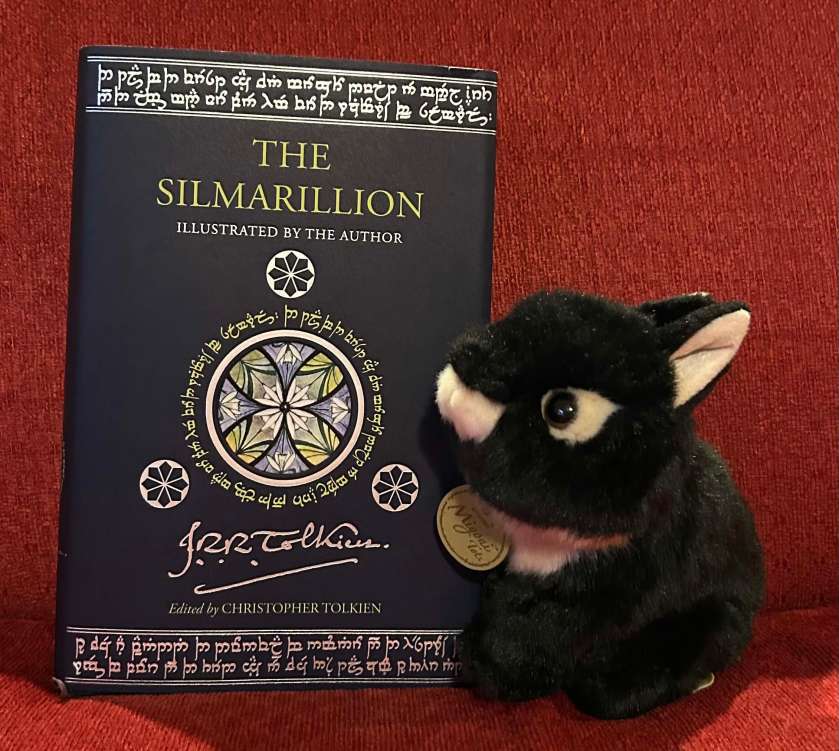
Three members of the book bunnies household have been reviewing books since 2019 (how time flies!) but it was only late last year when the fourth member of our family, the mysterious and reclusive black bunny Midnight, decided to join in the book fun. So far he has reviewed Foundation and Foundation and Empire, the first two books of the Foundation trilogy by Isaac Asimov. But it was clear to all who read those reviews that he was actually itching to talk about other books. So today he is doing just that! To be more specific, today Midnight is talking to Sprinkles about The Silmarillion, a collection of tales by J.R.R. Tolkien, published after his death in 1977.
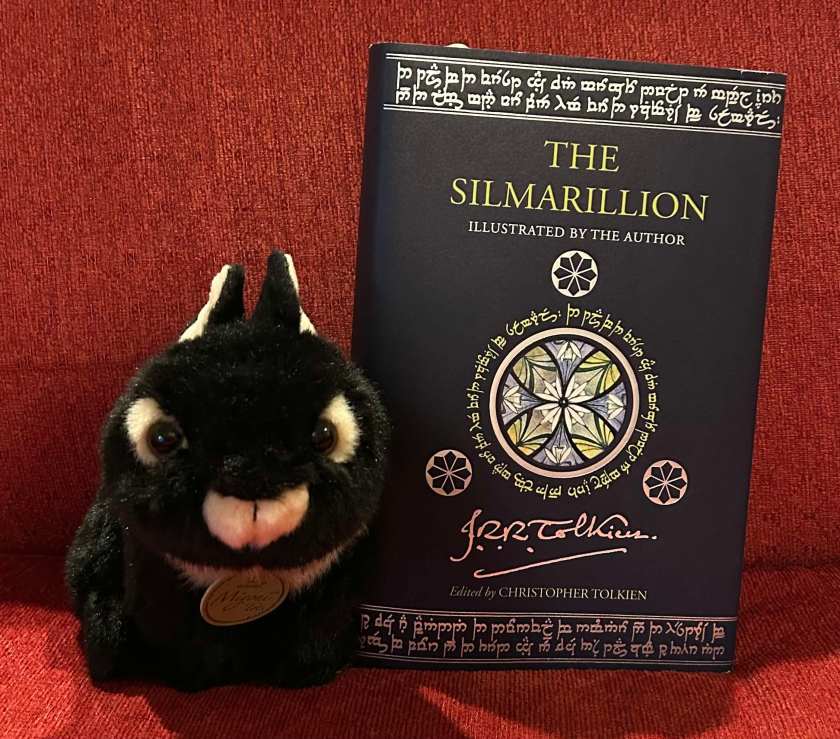
Sprinkles: So Midnight, welcome back! I am hoping that you are excited to be talking about a book by Tolkien today.
Midnight:I am a bunny of few emotions; it is difficult for me to admit to feeling excited. But I must admit this is one of my favorite books.
Sprinkles: Cool! So tell us a bit about it then.
Midnight: The Silmarillion is not a novel or a single story, like Tolkien’s other well-known works like The Hobbit and The Lord of the Rings trilogy. It is a collection of tales mostly from the ancient days of Middle-Earth long before rings and hobbits. Although Tolkien was working on this at the time of his death, these tales have their origin in his very early work when he was a young man in World War I. His son Christopher Tolkien assembled and edited these various works from his unpublished works, into something resembling a coherent whole.
Sprinkles: Oh, that sounds cool! So if one has read one of those Tolkien books, or even just seen some of the movies, then they would recognize Middle-Earth as the world where all those stories took place. And you are saying this book basically gives us a lot of the backstory of that world.
Midnight: Not quite. The world changed drastically over the ages. For example, in the First Age, the world was flat. When Numenor was destroyed in the Second Age, the world was made round, and the Undying Lands were removed forever from the world, at least as far as mortals were concerned. The Elves could still find their way there.
Sprinkles: So Middle-Earth that we might be familiar with is only the world of the Third Age?
Midnight: Yes. Although I believe that the very end of the Lord of the Ring movies takes place in the beginning of the Fourth Age, after the final defeat of Sauron.
Sprinkles: Oh, this is a very long history!
Midnight: Yes. Stretching back many thousands of years. In fact The Silmarillion begins with the creation of the world, and a run-down of the various gods of the world, the Valar (who are mentioned even in the Peter Jackson films by Arwen but only in passing, so people could easily miss this if they were not aware of their existence).
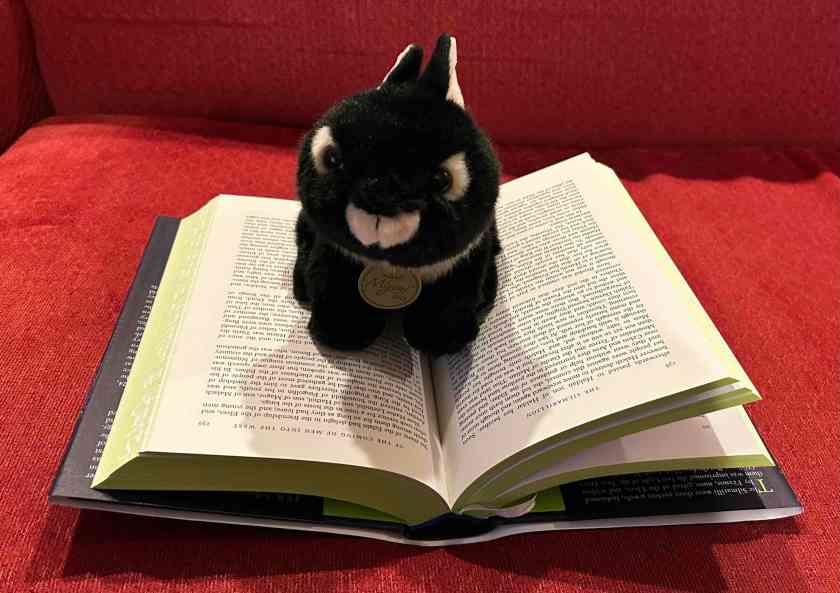
Sprinkles: That sounds cool! So how many tales are we talking about here?
Midnight: Quite a few. I don’t know the exact number off the top of my head. Or rather there are two chapters devoted to the cosmology of Tolkien’s universe. Then the bulk of the book is “Quenta Silmarillion”, which is itself a collection of more than twenty tales from the First Age of the world (and a little bit slightly before that). Then there are two more standalone chapters, one is about the fall of Númenor (where we see Sauron as the master manipulator) and the other is an essay providing some background information about the rings and the Lord of the Rings as a historical account.
Sprinkles: That sounds pretty eclectic! Does it read as a coherent book on its own?
Midnight: The different parts have different flavors. It is almost biblical in scope. So the coherence is basically in the story, not quite in the style. And as a whole, it provides a lot of information that makes Tolkien’s universe much richer.
Sprinkles: I see. So it almost reads like a collection of eclectic historical documents written throughout history by different scribes and then put together by an editor. Which makes sense for a book that was indeed put together by someone other than the author himself, and the segments put together were written at different times. that’s pretty cool.
Midnight: It is.
Sprinkles: So what is a Silmarillion? Why is the book titled that way?
Midnight: The title refers to the three Silmarils, magical gems of great beauty crafted by the greatest of the Elven smiths. They were stolen by Morgoth, the original bad guy. For example in the movies we hear Sauron called the servant of Morgoth, and the Balrog as the Balrog of Morgoth, so Morgoth is the original evil deity.
Sprinkles: Okay. I do remember that. So Morgoth takes the Silmarils and then what happens?
Midnight: He flees Valinor (the Elven paradise) with the Silmarils and many of the elves vow to pursue him, a god, to the ends of the world to retrieve the gems. There is lots of tragedy, hubris, betrayal, and general elf-on-elf violence. We see elves not as the ethereal and noble creatures of the films but rather as flawed, arrogant, and sometimes hotheaded.
Sprinkles: Sounds pretty epic!
Midnight: Indeed, the stories are epic in scope and mythical in character. It reads more as mythology than a traditional novel.
Sprinkles: Okay, so is that why The Silmarillion is one of your favorite books?
Midnight: Maybe.
Sprinkles: Which tale is your favorite?
Midnight: My favorite is “Akallabêth: The Downfall of Númenor”. This is, as you can tell, the history of Númenor and the tale of its downfall. It is Tolkien’s take on the Atlantis myth. Amazon’s Rings of Power series draws heavily from the history of Númenor outlined in the appendix in the Lord of the Rings, but this chapter in The Silmarillion gives us so much more!
Sprinkles: Neat! Okay, Midnight, I think this is enough for a post. And you told me enough to get me all excited about reading the book myself.
Midnight: It’s not for everyone but it is for me.
Sprinkles: That’s fair. I have enjoyed the movies and find the world Tolkien created fascinating. So I will give The Silmarillion a try. So what will you say as your last words?
Midnight: Namárië, dear readers. That is, farewell, in Elvish.