Caramel reviews Harold at the North Pole by Crockett Johnson

Many years ago, in the very early days of this blog Caramel reviewed a classic, Harold and the Purple Crayon, by Crockett Johnson. Today he is talking to Sprinkles about a sequel of sorts, Harold at the North Pole, published originally in 1957.
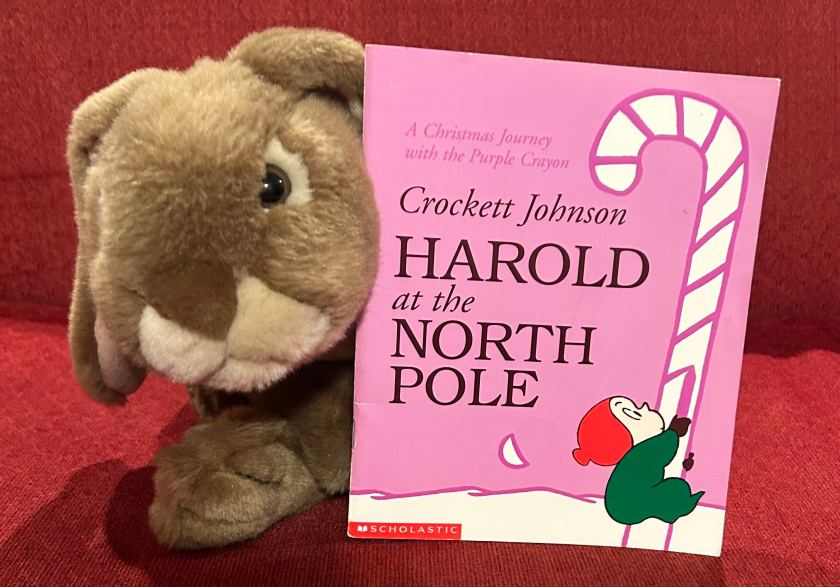
Caramel reviews Harold at the North Pole by Crockett Johnson.

Sprinkles: I was so excited to find this little book last week! So even though it is a Christmas book and we are nowhere close to Christmas, I thought it would be fun to talk about it today. 

Caramel: Yup. And I agreed. Because who doesn’t want to talk about Santa Claus and snow and Christmas gifts? 

S: I know, right? I mean we just couldn’t wait till December.. Anyways, our readers probably remember Harold, the little boy in blue overalls who creates the world around him with his ginormous purple crayon. 

C: Yeah, I would expect so. You and I talked about Harold and the Purple Crayon all the way back in 2020, so if they don’t remember, they can just read our old post. 

S: Yep. That was right around the time the pandemic really took off!

C: Yeah, the pandemic was around that time, which was pretty terrible. But the book was really good. And later, we also saw the live-action movie, which was actually pretty good.

S: Yeah, I remember watching it with you and liking it. It seems like the critics didn’t like it much, but we enjoyed it. 

C: Yup, we did. Maybe you can put a link to the trailer in the post?

S: Sure. Here is the trailer of the movie:

Harold and The Purple Crayon: official trailer, from YouTube.

C: Thanks. It was fun to watch. 

S: So let us get back to Harold at the North Pole

C: Sure. So this is about Harold, the very same little boy, But in the cover this time he is wearing green overalls, and a red hat. Very Christmas-y! 

S: Yeah, he is not in his blue overalls any more, but you are right, the red-green fits the holiday season very well. And the crayon is still purple, right?

C: Yup. So this time, Harold wants to find a Christmas tree before Santa can visit his home. So he goes out and tries to find a tree. Along the way he finds himself at the North Pole and ends up helping Santa. He also helps draw up Santa’s reindeer and a sleigh full of presents. And finally he gets back home and settles down near a fireplace to wait for Santa.

S: Yep. That sounds about right. 

C: Actually I think it kind of sounds a bit eerie. The boy is always alone, and there is nobody and nothing around him until he draws them. It is almost like a scary dream. 
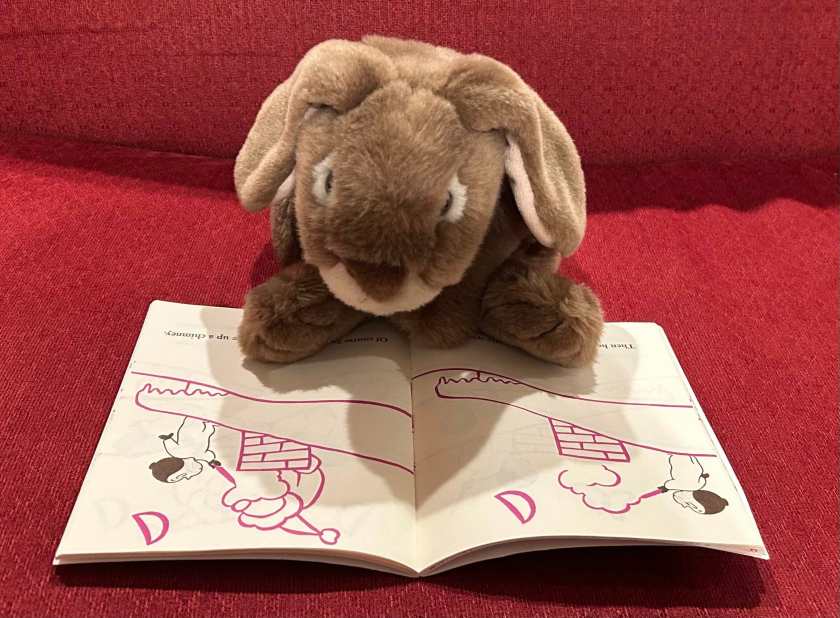
Caramel is reading Harold at the North Pole by Crockett Johnson.

S: Wait, if you read it like that, then it does not come across like a cute, warm, and fuzzy story. 

C: No, it doesn’t. And when you look back at the first book, that also could be the same, with Harold all alone, making stuff up as he goes around living all alone. Abandoned.  

S: Hmm, yes, I can see that. But it is not really the real world that he is in, is it? He is not all alone in a scary way really. I think maybe we are in Harold’s imaginary world, as he is recreating the world. The transitions from home, to the northern woods, to the North Pole, back home would be dizzying if real. But they are not. Harold just flows smoothly from one place to the other, as smoothly as he can draw something. 

C: Or actually he does not flow anywhere and the places just smoothly flow around him as he draws them. Yes, I know, it is not really about a little child all alone in a scary way, but I just wanted to say it would be kind of weird if this were real.

S: I guess that is why the movie version made the situation so weird. Nobody would believe the grown-up Harold. 

C: I wouldn’t. But you know, if the crayon were real, it would be really cool! And dangerous! All those bad people who were after the crayon in the movie, it totally makes sense, because the crayon is so powerful if you can create reality all by drawing something.  

S: Yes. 

C: So okay, the books are really sweet, they are not scary at all. I just wanted to say they are also a bit weird, but when read in their own story world, they are really sweet. And I think any little bunny would enjoy imagining themselves with a purple crayon and trying to figure out what they would draw with it and going into adventures with it and so on. 

S: Yeah, for sure. So what would you draw with it if you had the purple crayon?

C: I would draw the seventeenth book of Wings of Fire; lock in Sutherland! 

S: Not sure it works that way, Caramel… 

C: Dang it. Still, lock in Sutherland, I love those books, come out with more, please.

S: Okay, maybe she will some day. She has to go forth with the new story arc she started in the sixteenth book anyways. But so you wouldn’t draw anything else? I could draw an ice cream machine that makes ice cream for me, a bubble bath, a beautiful sunset, a comfy big chair, and lots of books and bookshelves around it where I could read.. I can go on forever! 

C: Well, Sprinkles, we do have lots of books and bookshelves in our house, and there is a comfy chair nearby too.

S: Yes, I know we are lucky. And maybe the things Harold draws are also kind of homelike, like a fireplace, and an armchair to sit on, and his home is also a regular home, just comfy. 

C: Like our home. Our home is comfy too. 

S: True… Okay, so overall what did you think of this book? 

C: It is cute. It would even make sense to a young person who has not read the original book, but if the young person liked that first book, they would definitely enjoy reading this around the holidays. It would make a good Christmas gift.

S: Yeah, it is kind of surreal, but young bunnies can get into surreal stories very quickly. 

C: Yeah, just ignore the probable psychological implications of why Harold has no parents, friends or any other people near him. Then it makes perfect sense.

S: You’re kidding, right? No young person would be worried reading this. Many picture books about young people don’t have other actors in them. 

C: Of course, yeah, it’s not scary, it’s a nice story. It is just that parents should probably be ready if their young bunny asks them these kinds of questions. It is about fun and imagination and not abandonment. Just in case, ya know.

S: Hmm, I think you have an overactive imagination sometimes Caramel.

C: Sometimes? I am offended. I have a perfectly normal imagination. And always. 

S: Okay, sorry, didn’t mean it that way. You do have a big imagination. 

C: The book is about Harold going north to find a Christmas tree, and then he finds himself at the north pole, and then he draws Santa and the whole Santa workshop, and then helps him make presents, then goes home, and realizes he forgot to find a tree, so he makes one. I think Crockett Johnson has an overactive imagination.

S: Yes I definitely agree. And it all makes the book suitably fun for the holidays. Which are about seven months away… 

C: But it is never too early to dream of Christmas! 

S: And it is actually time for some dreams. Bedtime, Caramel?

C: Yup. I think it is right about my bedtime. 

S: So then let us wrap this up. What would you like to tell our readers?

C: Stay tuned for more book bunny reviews!
Caramel loved revisiting Harold while reading Harold at the North Pole by Crockett Johnson and hopes that many others will enjoy it this next Christmas or any other time of the year.

Sprinkles reviews Flatland: A Journey of Many Dimensions – The Movie Edition by Edwin A. Abbott

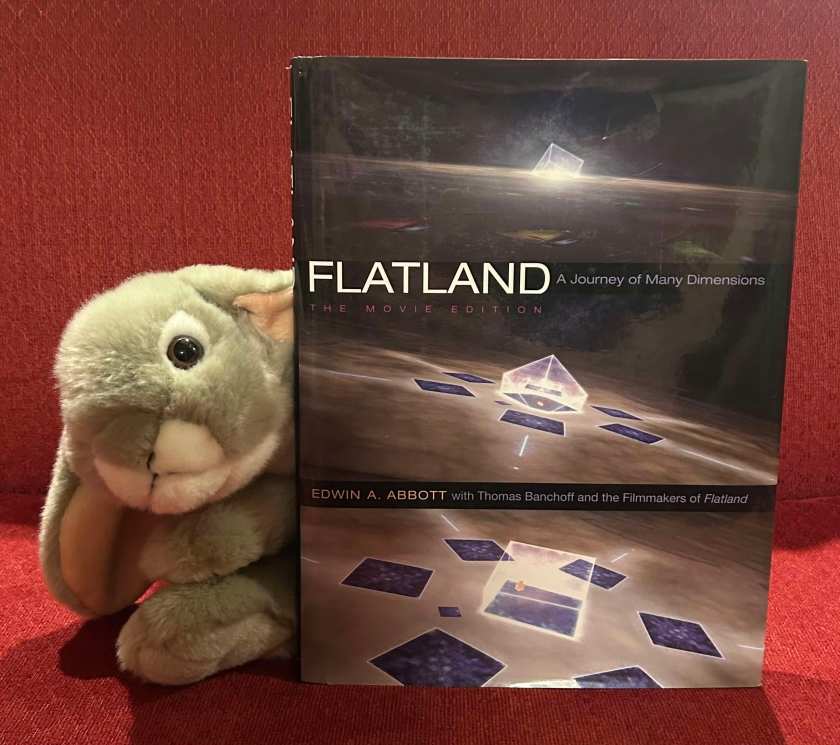
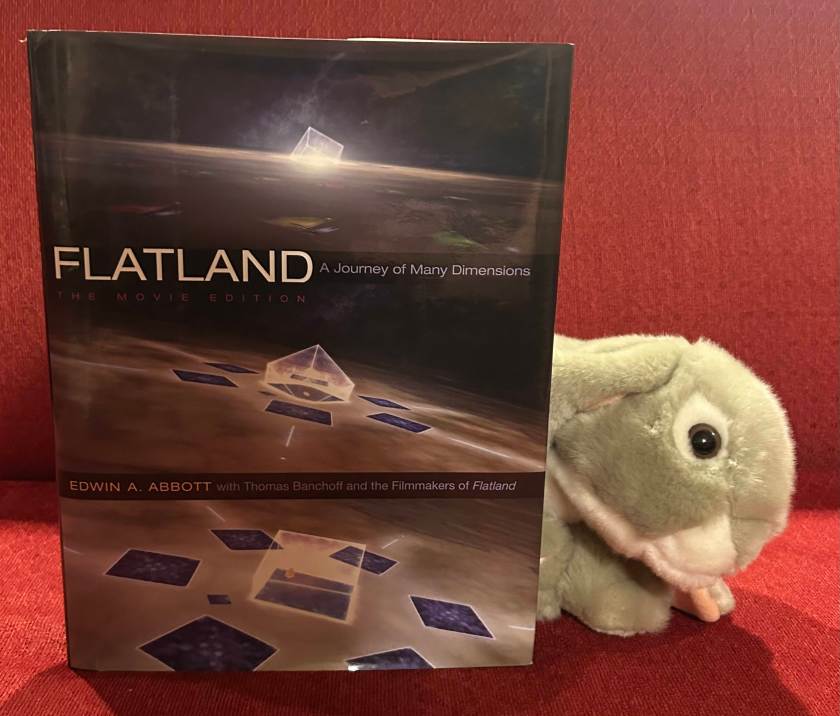
Today Sprinkles reviews a 2008 edition of a unique classic: Flatland: A Journey of Many Dimensions – The Movie Edition, credited to “Edwin A. Abbott, with Thomas Banchoff and the Filmmakers of Flatland“.

Today Sprinkles reviews Flatland: A Journey of Many Dimensions - The Movie Edition by Edwin A. Abbott, with Thomas Banchoff and the Filmmakers of Flatland.
Today Sprinkles reviews Flatland: A Journey of Many Dimensions – The Movie Edition by Edwin A. Abbott, with Thomas Banchoff and the Filmmakers of Flatland.

Flatland: A Romance of Many Dimensions by Edwin A. Abbott was originally published in 1884. As Wikipedia tells us, this was a novella written by “A Square” who lived in a two-dimensional world called Flatland. The main plot of the book involved the Square meeting a Sphere, coming into Flatland and teaching him about the third dimension. The Square, his consciousness now widened, began to stipulate the existence of fourth and higher dimensions, which in turn confused the Sphere.

The book’s story is amusing, and for many young minds it could be a welcome introduction to the mathematics and philosophy of higher dimensions. The adults reading the book together with their young one would also appreciate the satire underneath it all. Abbott’s pointed comments about the second class status of women in Victorian England, on the other hand, can be comprehended by some of the young crowd. (In Flatland, men are two-dimensional — they are polygons of various types — but women are one-dimensional; they are very very pointy and have no depth.)

The bottom of the Wikipedia article on Flatland lists several online places where one can access the full text of Flatland, as it is now in public domain. (Here, for example, is the Project Gutenberg version.) But I wanted to review this particular 2008 edition of the book because it not only contains the full text but also has some information about the 2007 movie made based on it. As such there are many colorful illustrations in the book, and this might make it even more fun for a young bunny to look through and read along.

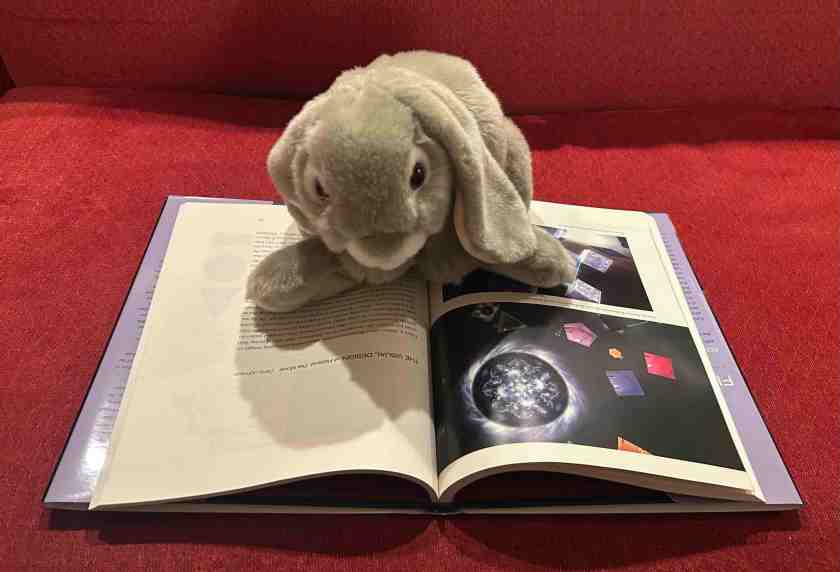
Sprinkles is reading Flatland: A Journey of Many Dimensions - The Movie Edition by Edwin A. Abbott, with Thomas Banchoff and the Filmmakers of Flatland.
Sprinkles is reading Flatland: A Journey of Many Dimensions – The Movie Edition by Edwin A. Abbott, with Thomas Banchoff and the Filmmakers of Flatland.

Abbott’s original novella is not too long, so it takes about half of this large-format book. The rest of the book is also worth reading however. There is a short introduction by the mathematician Thomas Banchoff at the beginning, which is worth reading to contextualize what is to come. Then the whole text of the classic Flatland follows. After that, the second part of the book starts. This section is titled “Flatland: The Movie” and includes three brief essays (“Finding Flatland” by producer Seth Caplan, “Imagining Flatland” by director Jeffrey Travis, and “The Visual Design of Flatland: the Movie” by director and animator Dano Johnson), lots of colorful images on high-quality paper, and then the screenplay of the whole film.

Trailer of Flatland: The Movie, from YouTube.

The movie is also worth watching, actually, and it seems to be available in a bunch of places, including YouTube. Apparently right around the same time, some other folks made a second movie based on Flatland, so sometimes people get confused, but the book I am talking about here and the trailer above are both related to the shorter movie voiced by actors like Martin SheenKristen Bell and Tony Hale.

All in all, I recommend Flatland very highly; you should read it and you should introduce all the bunnies around you to it. The 2008 edition here is a good place to start, but it is also fine if you choose the movie version first. I should note that the women are not one-dimensional in the movie: the Victorian satire tends to go on the back-burner there, and the math seems to come to the fore. Which is fine by me but your preferences might be different.

Sprinkles enjoyed reading Flatland: A Journey of Many Dimensions - The Movie Edition by Edwin A. Abbott, with Thomas Banchoff and the Filmmakers of Flatland, and recommends it to all bunnies young and old.
Sprinkles enjoyed reading Flatland: A Journey of Many Dimensions – The Movie Edition by Edwin A. Abbott, with Thomas Banchoff and the Filmmakers of Flatland, and recommends it to all bunnies young and old.

Caramel reviews The Red Balloon by Albert Lamorisse

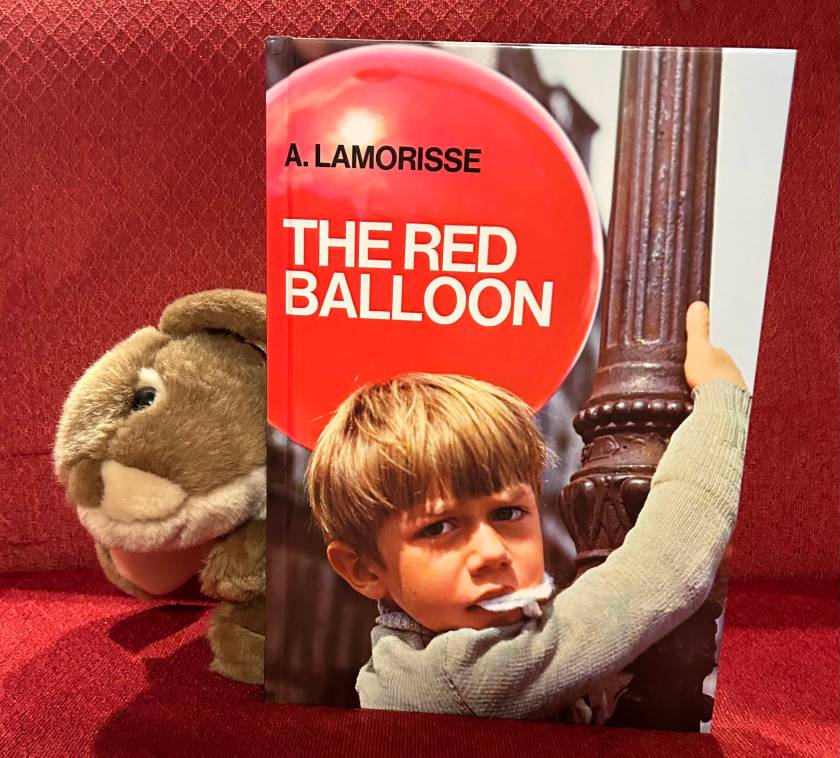
Today Caramel reviews The Red Balloon by Albert Lamorisse, first published in 1956. As usual, Sprinkles is taking notes and asking questions.

Caramel reviews The Red Balloon by Albert Lamorisse.

Sprinkles: So Caramel, tell us a bit about The Red Balloon.

Caramel: The Red Balloon is a friendly balloon and becomes friends with a boy named Pascal. Pascal is lonely. He does not have brothers or sisters, and his mom does not want him to have any pets. It also seems like he does not have friends at school. But the Red Balloon becomes his friend. They go to places together, and the Red Balloon waits for him when he has to go inside.

S: That sounds fantastical, but also very sweet.

C: I think so too. Pascal needs a friend, so the Red Balloon becomes his friend. But then there are some mean boys who try to take the Red Balloon from Pascal, and they chase him, and they try to blow it up. It is really sad, and I got really mad at those boys.

S: You are right, they are mean, and they are jealous I think. Pascal has a really magical friend, and they cannot have it so they want to destroy it. Pretty terrible.

C: But at least the end of the book is not unhappy.

S: I agree. The book has some sad moments, but there are lots of very happy and sweet parts, and the end is very sweet, too.

C: Yes.

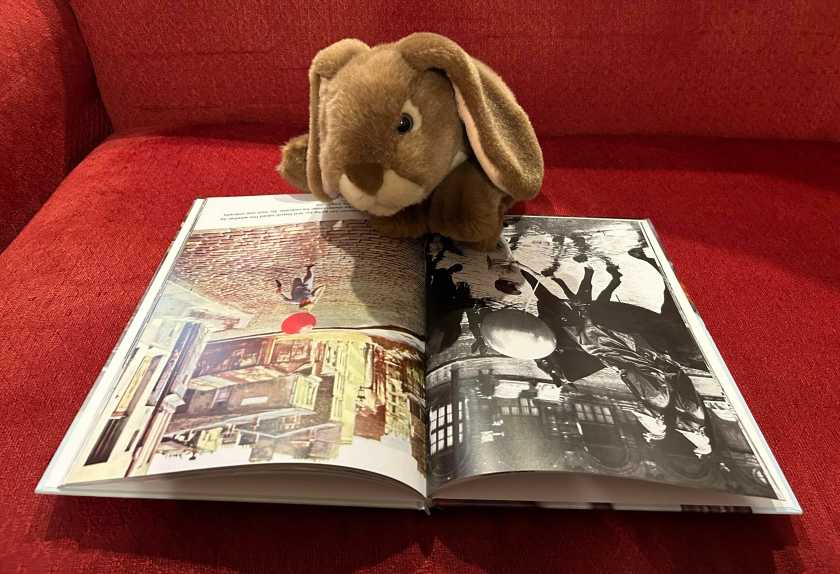
Caramel is reading The Red Balloon by Albert Lamorisse.

S: The book has lots of pictures, and they are almost all black and white, except the balloon, which is bright red. What did you think of that?

C: I liked it. It made the balloon even more special.

S: I agree. We also watched together the film the book is based on. What did you think of the film?

C: It was good. But watching it made me even angrier at the boys. They were so mean!

S: Yes. Pascal is so alone at the beginning and he is so happy when he makes friends with the Red Balloon, and then the boys come and try to take it away from him.

C: I guess, like you said, they were really jealous. I mean, I’d love to be friends with a balloon like that!

S: But you have real friends, too, Caramel. Pascal does not seem to have any. So he needs it so much more.

C: Good point. Hey, Sprinkles, do you think we could put a link to the movie here so our readers can watch it too, if they want?

S: Sure.

The Red Balloon – A boy makes friends with a seemingly sentient red balloon, and it begins to follow him. It follows him to the bus stop, to school, and to church. They play together in the streets of Paris and try to elude a gang of boys that wants to steal it. The Red Balloon (1956) Director: Albert Lamorisse. From YouTube.

C: Thank you. I think the movie is really nice too. It is not totally black and white, but the Red Balloon is the brightest thing in it, too.

S: Yes. I think it definitely adds to its magic. So all in all, did you like this book?

C: Yes. But now I am wondering what it would feel like to have my own balloon friends.

S: It would definitely be fun, I am sure. Especially if like in the end you had many many balloon friends!

C: Sprinkles, you are giving away the end!

S: Okay, you are right. I will not say more. Maybe this is a good time to wrap up this review anyways. What would you like to tell our readers?

C: Stay tuned for more book bunny reviews!
Caramel liked reading The Red Balloon by Albert Lamorisse and is now dreaming of traveling around the world hanging on a lot of friendly balloons.

Marshmallow reviews The Outsiders by S. E. Hinton

Marshmallow has been reading S. E. Hinton’s classic novel The Outsiders, first published in 1967. Today she shares some of her thoughts on the book with the blog readers. Sprinkles is taking notes and asking questions.

Marshmallow reviews The Outsiders by S. E. Hinton.

Sprinkles: So Marshmallow, can you introduce us to this book?

Marshmallow: If you like books about belonging, growing up, and facing challenges as a young person, you might like this book.

S: That’s a good start. So now let us move into the book. Can you tell us a bit about the plot?

M: There are two gangs, or maybe groups of friends, who hang out and occasionally clash, sometimes pretty violently. They call these things rumbles, they are basically fights.

S: Okay, so two groups. Made up of young people, and our main characters belong to one or the other. What are the names of the two groups?

M: One of them is made up of richer kids and they are called the Soc, short for “social”. The other group has poorer kids in it, and they are called the greasers, because they put grease in their hair. Mostly boys but there are girls that hang out with one or the other group.

S: Okay, that gives us a good idea of the setting. So tell us now about what happens in the book.

M: The main character is this boy named Ponyboy. And that is his real name. And his middle brother’s name is Sodapop.

S: Those are some creative names!

M: I know, right? The oldest brother has a much more typical name, Darrel, but people call him Darry.

S: Alright.

M: So these three boys’ parents are dead. And the oldest brother Darry is taking care of the younger ones. Ponyboy is the youngest of the greasers. The other greasers are Steve, Johnny, Dally, Two-Bit, and I think that is mainly it.

S: Okay.

M: One day Ponyboy, Dally, and Johnny go to the movies and meet two Soc girls named Cherry and Marcia. Dally is rude to the girls, but Ponyboy and Johnny become closer to them. Then some Soc boys come and there is some trouble. Eventually, another day, there is a fight, and Johnny ends up killing one of the Soc boys while trying to save Ponyboy from getting hurt. So Johnny and Ponyboy run away and hide, with the help of Dally, who has gotten into trouble with the law before.

S: That sounds kind of big, killing someone. These are still only kids, aren’t they?

M: Well, they are more or less. Ponyboy is 14 and Johnny is 16.

S: Alright, then what happens?

M: Well, I cannot tell you everything, but there is a big fire, and the boys try to help save some children who have been trapped in the fire, so they become heroes of some sort, but Johnny still has killed someone, so he needs to be punished. But he is also pretty injured during the fire. So I will stop here because we are already talking about stuff way into the book.

S: Alright, that makes total sense. We already got the gist of the story I think.

Marshmallow is reading The Outsiders by S. E. Hinton.

S: So you began reading this book because your class is reading it at school, right?

M: Yep. We are still reading and discussing it in class.

S: We read it at school, too, I think, but it was many many years ago. I do not remember the story very well. I also did not remember the author’s name.

M: Well, she is using only initials. It is because she was very young when she wrote the book, and they thought a book by a young woman who is a total unknown would not sell. There is an interview with the author at the back of the copy of the book I read where she says this.

S: I did not remember that at all, but the Wikipedia article about the book says that she was only 15 when she started writing the story and was 18 when it was published. That is pretty young!

M: Yes, it is impressive.

S: And maybe that really was the right thing to do, because the book did get really famous and they made a movie of it, too.

M: I know! In fact we are going to watch it at school. Can we put the trailer of the movie here?

S: Sure. Here it is:

The Outsiders (1983) Official Trailer, from YouTube.

S: I remember that we did watch this movie in class too, and it was all very exciting. A lot of the actors became really famous after this.

M: I’m excited to watch it too.

S: So maybe we should slowly wrap this up. Before that, would you mind telling me what you thought of the characters?

M: I thought they were good. Ponyboy narrates the story, and you get to really empathize with him. He does smoke a lot though. Still he is very thoughtful and cares about people.

S: Anything else?

M: I thought the book did a good job of pointing towards social economic inequalities. The rich kids all also have problems with their families and such, but when the poor kids get into trouble, their lives get so much more difficult. And these kinds of differences make it harder for people to empathize with others. Ponyboy thinks that he and the greasers are all outsiders and nobody else, none of the Socs, can ever understand their lives. And he does have a point, I think.

S: But after some of the events of the book, he realizes that Socs are also human, according to the book description in one of the versions of the book.

M: Yes, I guess so. But the class differences still remain, and that is also there till the end. The consequences are so much tougher for the greasers.

S: Thank you for this review Marshmallow. I think I might want to revisit this book, or at least the movie! You always rate the books you review. So what would you rate this one?

M: I’d rate it 100%.

S: Sounds like it! Okay, and to wrap up, what do you want to tell our readers?

M: Stay tuned for more amazing book reviews from the book bunnies!

Marshmallow rates The Outsiders by S. E. Hinton 100%.