Midnight reviews Dragonlance Legends by Margaret Weis and Tracy Hickman

Last week Midnight talked to Sprinkles about Dragonlance Chronicles by Margaret Weis and Tracy Hickman. Today he is excited to be talking about the sequel trilogy, Dragonlance Legends. The trilogy, consisting of three books (Time of the Twins, War of the Twins, and Test of the Twins) was originally published in 1986. The edition Midnight is posing with in the photos below is the fortieth anniversary edition, published in 2026.
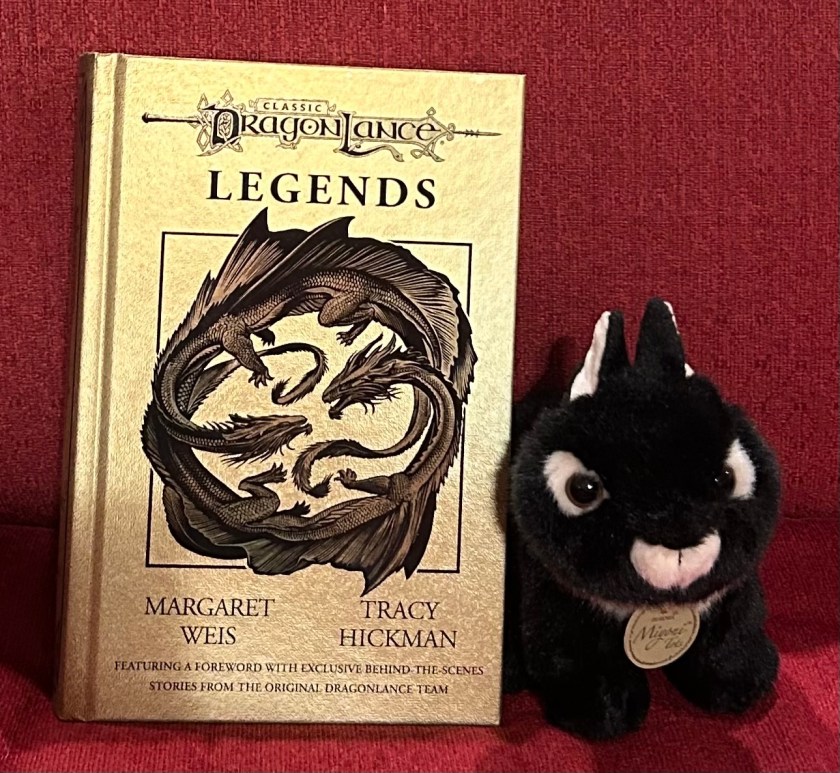
Midnight reviews Dragonlance Legends by Margaret Weis and Tracy Hickman.

Sprinkles: So here we are, Midnight, talking about the next trilogy in the Dragonlance universe.

Midnight: Yes. Marshmallow has had some very busy weeks and so I am filling in for the time being.

Sprinkles: And we are grateful for that. And this is another book you really like, right?

Midnight: Yes. I have many fond memories of this trilogy. I think I like it even better than the first one.

Sprinkles: Really? That is interesting. Can you explain why?

Midnight: It explores the relationship between the brothers Majere, the enigmatic wizard Raistlin and his good-natured and protective twin brother Caramon. Tagging along with them is Tasslehoff Burrfoot, a halfling of sorts who has a habit of borrowing things from others without asking.

Sprinkles: Some might call that stealing.

Midnight: Some might. Tasslehoff is a fun character, and he was often a source of comic relief in the first series. But here he often keeps the story moving, and inserts some occasional light-hearted moments in between periods of dark drama.

Sprinkles: What dark drama? Can you say something about that? You told us about evil dragons in your earlier review. Are they still causing trouble in this book?

Midnight: The dark queen has been prevented from conquering the world in the first trilogy. So this trilogy does not focus so much on the large-scale good-versus-evil, saving the world kind of plot. Instead, it focuses more on whether Raistlin can be rescued from the darkness himself.

Sprinkles: You almost make it sound like a psychological drama. Where one of the main characters is losing his soul and maybe his brother is trying to help him fight to keep it.

Midnight: I guess it is kind of like that, but with a lot more action and high fantasy. It is a lot more interesting than just a psychological drama”. Raistlin was always physically weak but smart and powerful with magic. Despite his frailty he had incredible ambition and confidence in his abilities. Let’s just say that throughout the first series, it’s not clear whether he will embrace the darker side of his ambitions.
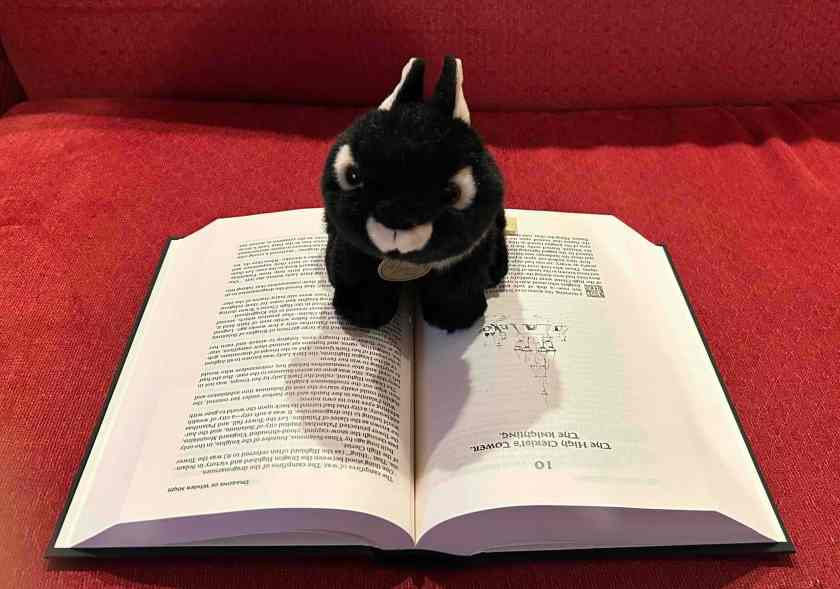
Midnight is reading The Dragonlance Legends by Margaret Weis and Tracy Hickman.

Sprinkles: That sounds intriguing. And also in the meantime, they are traveling all over the world, right?

Midnight: Well, it starts out in a familiar place, where we find that Caramon has not taken well to settling down after the war from the first series. He is in a bad place emotionally, after the conflicts with his brother in the first series. His old friend Tasslehoff visits him and finds him in a sorry state, a pitiful shell of his former self. They go on a quest that will not only restore Caramon to his former self but hopefully will also redeem his wayward brother.

Sprinkles: So that quest is what the traveling is all about?

Midnight: It is not so much traveling geographically but they travel through time. They go back three hundred years, to the time before the Cataclysm, a world-altering event that set the stage for everything to come.

Sprinkles: Wait, so there is time travel here. And this is not science fiction.

Midnight: Not science fiction. Definitely fantasy. What is fascinating is that they return to legendary times, spoken of only in terms of myths and legends in the first series. I should also mention that one of the new characters that travels with them is Crysania, a good priestess who is determined to save Raistlin’s soul.

Sprinkles: I am guessing there is a love triangle or something?

Midnight: Of sorts, but it is not mushy like that. I think it is clear from the start that Crysania is determined to prevent Raistlin from becoming the ultimate force of evil that he could become. But she is blinded by her naivete and optimism.

Sprinkles: Hmm, that is a pretty detailed plot setup Midnight. I hope it has intrigued some of our readers.

Midnight: Yes, if you make it to the end, you’ll know all about how important bunnies are to the plot.

Sprinkles: Oh now, they have to read the book! And they really should. I really enjoyed reading them myself. One after another. It was hard to stop in between the books; it was so engaging.

Midnight: Yep. It is a very addicting mix of high fantasy and drama, written in plain and accessible language.

Sprinkles: No Tolkien, we are saying.

Midnight: No. it is not Tolkien, but like all works of the high fantasy genre, it owes much to the professor.

Sprinkles: And of course you love Tolkien too. I know. Anyways, I think this might be a good place to wrap up this review. What do you think?

Midnight: I agree. I must go feed.

Sprinkles: Are we doing the creepy vampire thing again?

Midnight: Infer what you will, my dear Sprinkles.

Sprinkles: Okay. I will do that. Is there something you would like to tell our readers as we end this?

Midnight: A bunny such as myself does not do simple catch-phrases and sound bytes. But I will say this: Farewell, dear reader. Until such a time as the Black Bunny deems it fit to grace the world with his august presence.
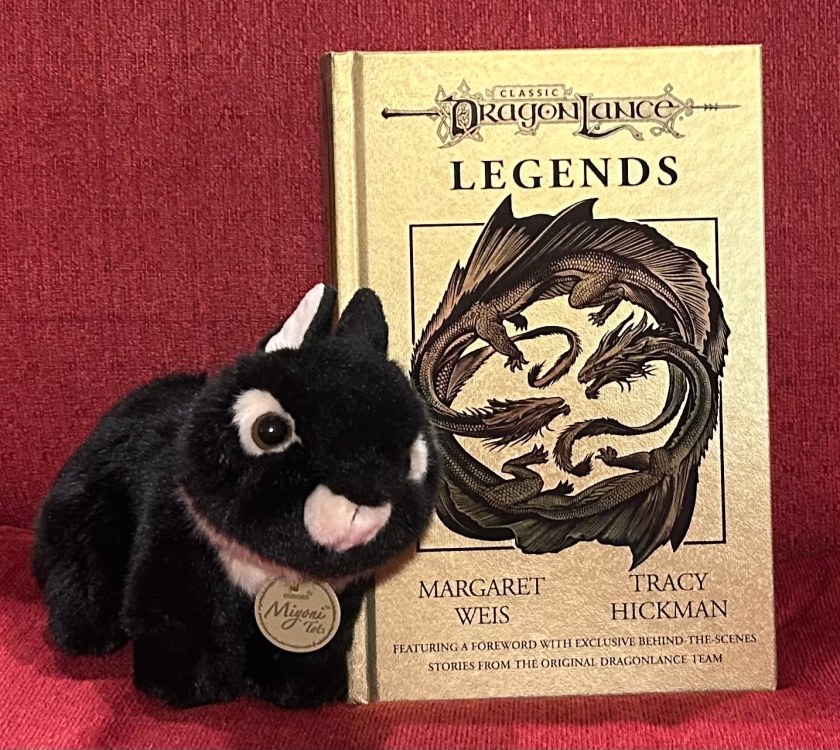
Midnight loves reading and rereading The Dragonlance Legends by Margaret Weis and Tracy Hickman, and bids readers farewell, until such a time as he deems it fit to grace the world with his august presence.
Midnight reviews Dragonlance Chronicles by Margaret Weis and Tracy Hickman

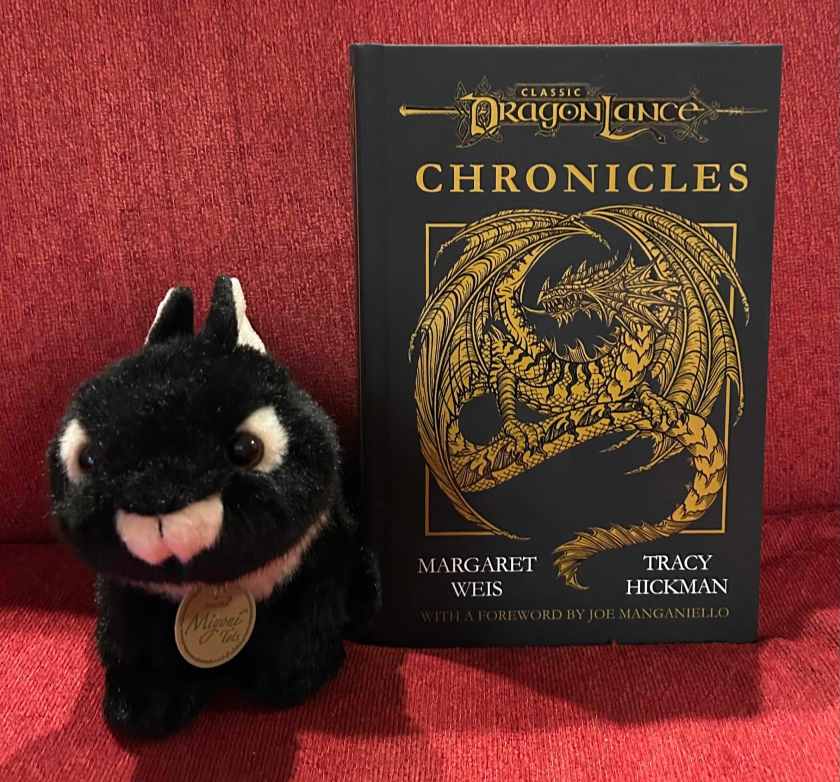
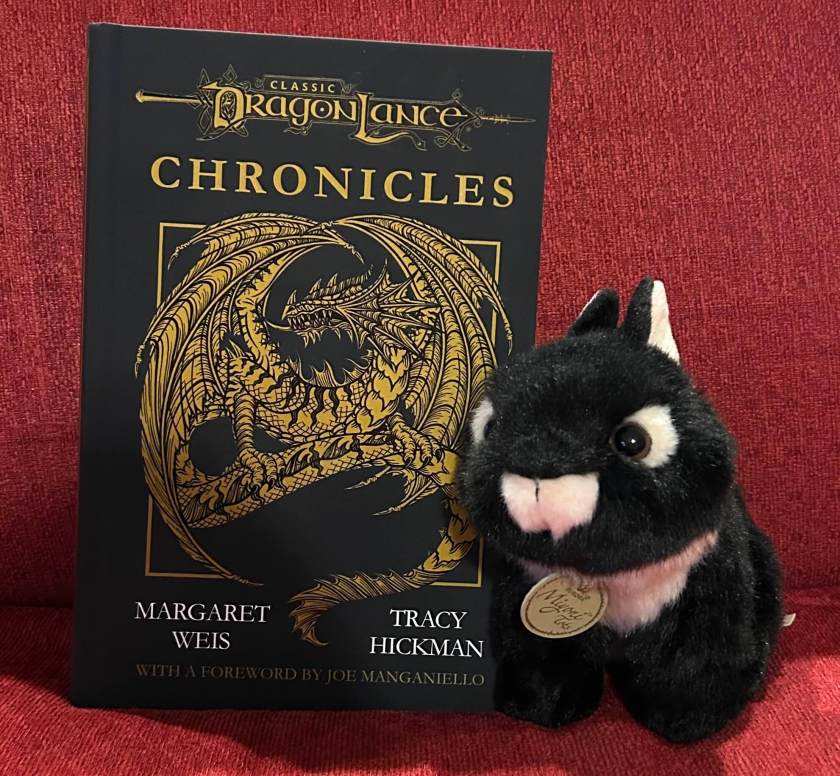
Today Midnight talks to Sprinkles about Dragonlance Chronicles, a classic fantasy trilogy from 1984-1985, written by Margaret Weis and Tracy Hickman. The copy he is posing with in the photos below is the fortieth anniversary edition, collecting all three books in one beautiful volume, published in 2025.

Midnight reviews The Dragonlance Chronicles by Margaret Weis and Tracy Hickman.

Sprinkles: So Midnight and I are here, talking about a giant classic of the fantasy genre.

Midnight: Actually, this giant book I am posing with is not as large as it looks. I am just very small. And it is a recent anniversary edition that brings together the three books of the Dragonlance Chronicles trilogy.

Sprinkles: Okay, tell us about the three books then.

Midnight: These books actually began as novelizations of pre-designed Dungeons and Dragons adventures (called modules). I believe that the series of modules and the whole promotional campaign was designed to recenter the Dungeons and Dragons experience around dragons.

Sprinkles: Ooh, we all love dragons in this family!

Midnight: Indeed, are not rabbits really dragons, just smaller and furrier?

Sprinkles: I am sure Caramel would love that!

Midnight: However the Dragonlance novels became very very popular, in large part due to the memorable characters and the dramatic story line. It does not have the literary aspirations of Tolkien, and as such, is a much easier read.

Sprinkles: I must agree. I read these books and loved them! With Tolkien I have not been as successful. Yet. I am going to read The Silmarillion, after your review last week.

Midnight: I will ensure that you do. It would be most unwise to disappoint the black rabbit.

Sprinkles: Okay, I think I am supposed to feel intimidated here. Let us say I am appropriately intimidated. And move on to the review.

Midnight: Sure. The Dragonlance Chronicles is what might be described as a straightforward good-versus-evil, save-the-world story line. To a large extent this is true. This is no Game of Thrones, filled with morally gray characters.

Sprinkles: I do not think I’d say Game of Thrones characters are morally gray, I’d say most of them are straight-out bad people. But anyway I think I get what you mean. In this series, there are bad people and there are good people trying to fight them.

Midnight. Yeah. The main plot revolves around a party of adventurers who are trying to prevent the ultimate triumph of the big bad goddess of evil dragons who wants to rule the world.

Midnight is reading The Dragonlance Chronicles by Margaret Weis and Tracy Hickman.

Sprinkles: So tell me about your favorite character in the series.

Midnight: Perhaps my favorite character is the only one of the main heroes who is morally gray. I am talking about the wizard Raistlin, a sickly and frail young man of great talent and aspirations. His twin brother Caramon is a powerful and good-natured warrior and they make an interesting pair.

Sprinkles: The Wikipedia article about him says that he is both a protagonist and an antagonist. I had not heard that said before about any other fictional character.

Midnight: As I said, he is morally gray. In fact Raistlin and Caramon proved so compelling that the authors wrote a second trilogy, Dragonlance Legends, centered around them and their complicated relationship.

Sprinkles: Oh, maybe you will review those books, too, some time.

Midnight: Most definitely.

Sprinkles: So tell me a bit more about this goddess of evil dragons.

Midnight: Her evil dragons have reawakened and are causing trouble in the world once more. The good dragons are nowhere to be seen, leaving the people of Krynn, the world of the books, at the mercy of the evil dragons and the Draconians, a race of dragon-like humanoids, who appeared with the rise of the evil dragons.

Sprinkles: No bunnies anywhere?

Midnight: In fact fans of the series will recognize the significance of the bunnies, or rather, of a particular “bunny”, to the relationship between the twins. But that will have to wait for the second trilogy. For this trilogy, bunnies might be lurking in the background. But they are never not there, of course. We often lurk in the darkness, with humans oblivious to our plans.

Sprinkles: Okay, Midnight. Thank you for that ominous reminder. But you know a lot of young humans read this blog, so we do not want to scare them.

Midnight: If they knew how big I was, they’d probably not be scared. But okay.

Sprinkles: What else would you like to tell us about Dragonlance Chronicles?

Midnight: I’ve read and reread this series many times since I was a young bunny. It is a good read, high adventure in a world of high fantasy. The characters are very colorful and concrete; you get to know them really well, at least as well as the authors want you to get to know them, of course.

Sprinkles: So all in all, we both agree that these are great books to read. I read them really fast even though they are quite long as a whole. The adventure is fascinating and captivating.

Midnight: Yes.

Sprinkles: Okay, midnight. Than you for coming out of your hiding place for this review. I think this will be a good place to wrap things up. Anything else you would like our readers to know?

Midnight: There is also an anniversary edition of Dragonlance Legends, and I look forward to reviewing that at some point in the future.

Sprinkles: That will be great, Midnight, thank you. I will look forward to it!

Midnight: Till then, I bid you all adieu.

Midnight loves reading and rereading The Dragonlance Chronicles by Margaret Weis and Tracy Hickman, and bids readers farewell, until such a time as he sees fit to reappear.

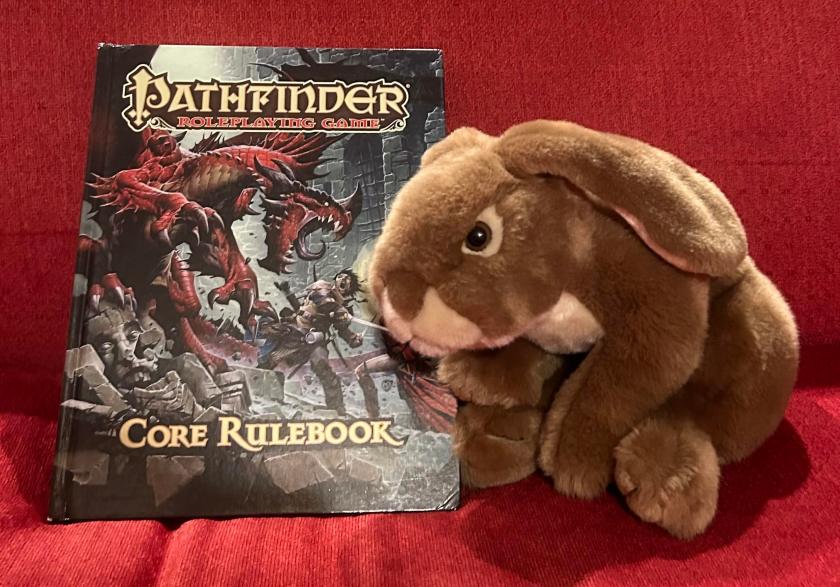
Caramel reviews Pathfinder Roleplaying Game: Core Rulebook

Last week Caramel reviewed Warhammer 40,000: Core Book, the core rule book for a tabletop game he is really keen on these days. Then he realized that he also could talk about his other favorite tabletop game, Dungeons & Dragons, and brought his rule book out. So today he is talking to Sprinkles about Pathfinder Roleplaying Game: Core Rulebook.

Caramel reviews Pathfinder Roleplaying Game: Core Rulebook.

Sprinkles: So, you found another rule book for another tabletop game. This one is about Pathfinder. And I am not sure everyone knows what that is. So why don’t you start by telling us something about the game?

Caramel: Sure, I suppose everyone knows about Dungeons & Dragons (D&D) but Pathfinder is a bit different from D&D. It is actually very similar to D&D version 3.5. However there are some slight differences in the character types, and I think there are some changes in the rules.

S: Okay, wait. So let us go back a bit. First there is the famous tabletop game Dungeons & Dragons. For any bunnies who might not know what that is, can we start by talking briefly about what that is?

C: Sure, good idea. D&D is also a role playing game, like Warhammer 40,000, which I talked about last week. However, instead of controlling an army, in D&D you control one person. And it is the same in Pathfinder.

S: Okay, so I looked them all up on Wikipedia, and it seems that both Warhammer and D&D are relatively old actually. D&D was first published in 1974, and Warhammer, the original game, was published in 1983. Pathfinder was first published in 2009 as a kind of a spinoff of the original D&D, or rather, the third edition of it. 

C: I had an idea that the Warhammer game was that old! I knew for example that the first Warhammer 40K miniatures were made out of metal because, according to Google, at the time “plastic molding technology was not advanced enough to produce the intricate details and durability needed for tabletop miniatures.”

S: That makes sense! So anyways, last time you talked about the general setting for the game when you were telling us about Warhammer 40K. Now is there a general setting for D&D or Pathfinder?

C: Kind of. It is kind of in a fairy tale time period, where they have firearms, but getting them is very hard. Most people have simpler weapons, like swords, slings, bows and arrows, and … war hammers! 

S: I see what you did there! Anyways, so this sounds like maybe the late middle ages, but there is more, right? I do hope there is indoor plumbing, because that I think is one of the most important benefits of modernity. 

C: I don’t think there is indoor plumbing; they use outhouses and chamber pots mostly.  

S: Hmm, not sure I’d like to live that way… But there is more, right? There is sorcery, and there are different kinds of beasts and types of humanoid characters?

C: Yes! There are elves, and sorcerers, and wizards, and bards, and so on. And there are all sorts of beasts. And as you can tell from the original name, there are dragons!

S: So it is a fantastical world, kind of like our own medieval times, but with some interesting extras! 

C: Yes. But actually there is a lot of freedom in the game. You can set up your own game to be in a world with more magic or less. You can have elves in your particular story or not. 

S: No wonder people do not get bored, and generations of bunnies have been playing it without running out of ideas. It sounds very versatile.

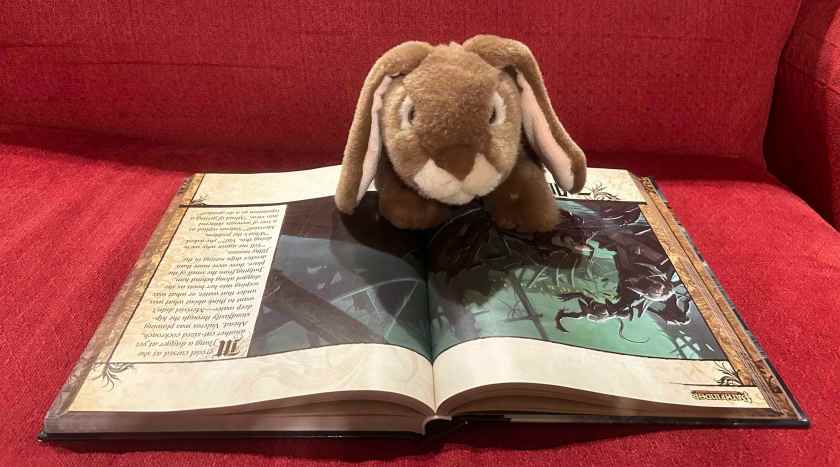
Caramel is reading Pathfinder Roleplaying Game: Core Rulebook.

S: Okay so now let us get back to the book. This is the standard book with rules of the game then?

C: Yes, it is.

S: So tell me what kinds of things there are in the book. 

C: There are parts on creating a character. Then there is a part on choosing a class, then skills, then feats, then equipment. Next is extra rules, combat, magic, spells, special classes. Then there is a section on how to be a GM, making NPCs, magic items, and a ton of appendices.

S: That is a lot! 

C: Well there are over five hundred pages!

S: And what is a GM?

C: A Game Master. It is the person who develops the main story and the setting, and acts out all the NPCs. And before you ask, those are the characters that are not played by any of the main players. NPC stands for Non-Player Character. So the PCs are the characters the players play. 

S: I see. So the GM is the main story teller in some sense.

C: Yes, but the players can and do make choices that change the GM’s original goals, I know from experience.

S: Well, that sounds more fun actually. And kind of like real life, where big and important people might have all these grand schemes, but then a little bunny comes along and does something differently, and the whole world is changed. 

C: Yeah, I suppose. When I play as a GM, sometimes my players can be frustrating when they choose to do totally off-the-wall things. But I have also been a frustrating character to my own GMs so I guess it can go both ways!

S: Yes, kind of like free will. You get to choose; within all the constraints, you still have a choice. I like that. And I bet that is one of the reasons why the game works so well. There might be standard storylines and GMs might have some creative ideas, but each game turns out to be totally different because the players decide to do some things differently and the world changes. Like the butterfly effect, like in chaos theory.

C: What is chaos theory?

S: Okay, we are veering off topic a bit but chaos theory is a field of mathematics where people study systems which are extremely sensitive to small changes and seem to behave chaotically but can still be described and explained mathematically. And the butterfly effect captures that idea: “the flap of a butterfly’s wings in Brazil can set off a tornado in Texas.” A while ago, I reviewed a couple books about famous mathematicians who worked in chaos theory for our blog. Maybe you can check those books out… 

C: Cool, maybe I will.

S: Okay, so the book seems chock-full of ideas and basic rules of playing this game. I think you have read it from beginning to end several times. I also saw you often opening a random page to read. And I have a feeling that you will keep using it for the foreseeable future. 

C: Yup. I like reading this book. I also really like looking at the pictures. They are pretty well drawn. 

S: Yes, I can see that. Maybe this is a good time to end the review. What would you like to tell our readers?

C: Stay tuned for more book bunny reviews!

Caramel expects he will continue reading Pathfinder Roleplaying Game: Core Rulebook for many years to come!