Caramel reviews Tetris: The Games People Play by Brian “Box” Brown

Today Caramel reviews Tetris: The Games People Play by Brian “Box” Brown, first published in 2016. As usual, Sprinkles is taking notes and asking questions.
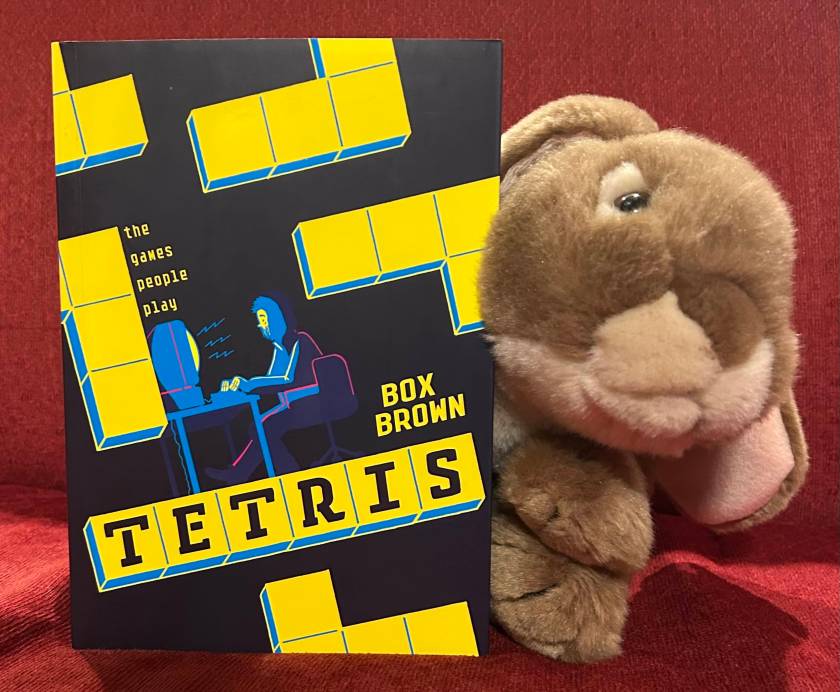
Caramel reviews Tetris: The Games People Play by Brian "Box" Brown.
Caramel reviews Tetris: The Games People Play by Brian “Box” Brown.

Sprinkles: Today we are talking about a graphic novel about my favorite computer game, the one and only, the classic: Tetris!

Caramel: Yay! This is, as you said, a comic book about Tetris and how it rose to popularity.

S: So it is not quite fiction then, right?

C: No, it’s more so a fictionalization of a real event, like the movie Oppenheimer.

S: That makes sense. I am very excited that you read this book because I really like Tetris. But I also am curious about the whole phenomenon it became. It was everywhere and people were almost addicted to it for a while.  

C: Yeah, this comic book explains all of that. It is interesting to me because, you know, there are a lot of games today. It seems like when Tetris came out, it was a huge deal partially because there weren’t as many big games. 

S: Now that’s not quite true, there were other video games, but I think it is probably true that Tetris is a class of its own. It was so popular and it just took over. 

C: And it is such a simple idea. Blocks falling down and you are trying to place them in empty spaces just the right way so the pile won’t get too big. 

S: Isn’t it interesting that my favorite computer game and yours both have blocks?

C: True, but my favorite game may have slightly better resolution.

S: Well, Tetris did not really need much resolution really. But you are right of course, Minecraft is so much more visually detailed, and of course you can build so many different things with blocks in Minecraft. It is a lot more sophisticated. But you know, that was part of the appeal of Tetris. It is so basic, so simple, but it is also very challenging. 

C: True. It can get really hard. Especially when it gets faster and faster. 

S: Yup. So tell me a bit more about the book.

C: The book starts with a strange scene about humans and play and art and entertainment. And about why people play. There are many pages about early games people played, and art about games and how games might be related to art too. Then there are a few pages about the founding of the Japanese company Nintendo. And we get into computer games eventually. But we do meet the coder who built Tetris very early on. It was a Russian programmer named Alexey Pajitnov. He thought about how when he was a little kid, he used to play with pentominoes, which are shapes made of five squares, and how it was difficult to place them in a box when he was done playing with them. Then eventually we get back to him, and we follow him through his life, as he develops and shares Tetris with the rest of the world. He moves to the United States and the game gets even more popular. 

S: That sounds interesting! Quite a crash course in the history of games!
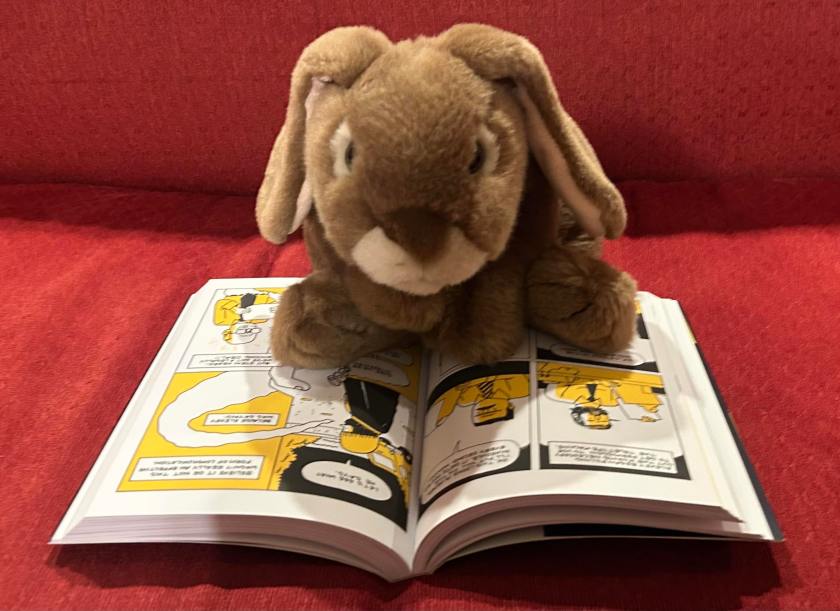
Caramel is reading Tetris: The Games People Play by Brian "Box" Brown.
Caramel is reading Tetris: The Games People Play by Brian “Box” Brown.

S: Did you learn anything new from the book then?

C: Well, basically everything! I knew about the game, I have seen you play it even, but I didn’t know much else about it. I also did not know that other people liked the game as much as you do. It apparently became a really big deal. People started seeing Tetris tiles everywhere even when they were not playing and so on. 

S: But I bet you can sympathize. Have you ever looked around you after playing Minecraft for a while and seeing cubic blocky things? 

C: No! Because I am a normal bunny. 

S: Well, hmm, that is interesting. Maybe the blocks in Minecraft are too different, there are too many different distinct shapes to make your brain go wacky like that. 

C: Or … maybe I have never played Minecraft for too long. Maybe I should play more to see if I get to see things as Minecraft blocks? 

S: Hmm, I don’t like that idea. 

C: Oh, too bad. Because I really did like it. 

S: Sure you did. Okay, let’s get back to the book. What did you think of the color scheme of the book? 

C: It’s all black and white and yellow, yet the art is still detailed. It is really interesting. The game itself has a lot of color, though they are the main primary colors, but the author chose only these colors. I wonder why. 

S: Yeah, that is an interesting observation, Caramel. The yellow adds color but also is not distracting. Maybe the Tetris colors would be a bit too distracting. 

C: Maybe. The story was interesting though I was not expecting to learn about the games ancient Egyptians played when I began reading. I thought it would be only about Tetris.

S: But the book also has a subtitle.

C: True. The subtitle is “The Games People Play”. So I guess it makes sense that there could be more general stuff about games. 

S: That part reminds me a bit of another book I read recently called Around the World in Eighty Games. I even reviewed it for a math journal

C: That book looks interesting too. I bet it has a lot of games I don’t know about. 

S: Well, you can borrow it whenever you like. I still have a copy. 

C: Maybe I will.

S: Okay, Caramel, this seems to me like a good place to wrap up this review. It is after all a school night, again. 

C: Yep. 

S: What do you want to tell our readers?

C: Stay tuned for more book bunny reviews!
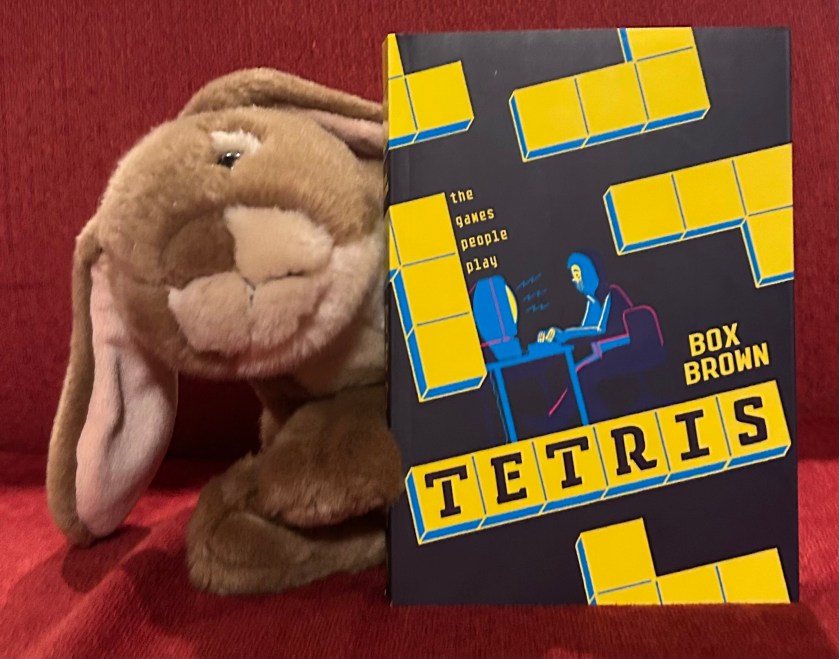
Caramel enjoyed reading Tetris: The Games People Play by Brian "Box" Brown and continues to wonder if it can provide him with any justification for more Minecraft time.
Caramel enjoyed reading Tetris: The Games People Play by Brian “Box” Brown and continues to wonder if it can provide him with any justification for more Minecraft time.

Caramel reviews Warhammer – The Horus Heresy: Age of Darkness Rulebook

As his first review for the new year, Caramel wanted to talk about Warhammer – The Horus Heresy: Age of Darkness Rulebook from 2022. As usual, Sprinkles is taking notes and asking questions.

Caramel reviews Warhammer – The Horus Heresy: Age of Darkness Rulebook.

Sprinkles: So Caramel, You had already reviewed the core ​​book for Warhammer 40000. What are the differences between the two?

Caramel::Well, in Warhammer lore the Horus Heresy is 10000 years earlier. So the time is around 30000, not 40000.

S: And why does this difference matter?

C: Well, now in this time, there is a civil war between humans and humans, mostly space marines versus more space marines, but they have cool armor, and best of all, tanks, and mechs.

S: Ahh, I understand why you like this now.

C: Yes, I’m a simple bunny.

S: But Caramel, in 40K, too, there was perpetual war. 

C: Yes, but in 40K, there are aliens too. In The Horus Heresy, it’s mostly between humans and humans. This is the background they give in the web page for the book:

The Imperium stretches across countless worlds, a newborn empire on the brink of ultimate victory. Yet at the peak of this golden age of conquest, the galaxy has been plunged into an Age of Darkness. Horus Lupercal, Warmaster of the Emperor’s armies, has turned against his gene-father, and the eighteen Space Marine Legions, once united in a Great Crusade to consolidate all Humanity beneath the Emperor’s banner, are riven by betrayal. This is the Horus Heresy – the bloodiest conflict Humanity has ever known. Civil war on a galactic scale, in which superhuman soldiers clad in advanced armour turn devastating weapons upon those they called brothers. Where do your loyalties lie?

S: So the Imperium is powerful but maybe not yet as spread around the universe, and the story is more about an internal struggle? 

C: Yes, basically, and the political issues with the God Emperor of Mankind being betrayed by his sons, like a certain Greek titan.

S: Ooh, I see, you are referring to Kronos and his sons, right?

C: Yeah, I am. I’m a smart bunny, too.

S: I never doubted that Caramel! But in your review of the 40K book, you told us that humans still worship the God Emperor. So does this mean that he will prevail?

C: Well, he doesn’t actually like religions, he is apparently old enough to have seen what it does. But he is a perpetual, or a being that is reborn, so, yeah, he was apparently also, I think Caesar, or something.

S: Again, this is very depressing. To have an autocratic leader who hangs around for ten thousand years of perpetual war. 

C: No comment. Except a tiny one: he isn’t there after the Heresy; he sort of dies, but doesn’t.

Caramel is reading Warhammer – The Horus Heresy: Age of Darkness Rulebook.

S: Hmm. I think you have been reading those other books about the Horus Heresy, right? 

C: No comment. I plead the fifth.

S: I have a sneaking suspicion we will be ending up with reviews of some of those books, too. 

C: Maybe, I plead the fifth again.

S: Okay, let us not go too far into speculation of that sort. Let us get back to this rulebook. So then the main types of warriors you can play with in this Horus Heresy world are different then, right? You do not have the same kind of warriors, I am assuming.

C: Yes, and no, some chapters of space marines still use the same types of armor and weapons, but have primaris versions, so larger and faster, but not really.

S: So, what are the chapters of this book about? I’m guessing there are rules in it.

C: Oh, yeah, so, the book starts off with a quote by Horus Lupercal to set the stage:

I never wanted this. I never wanted to unleash my legions. Together we banished the ignorance of Old Night, but you betrayed me. You betrayed us all. You stole power from the Gods and lied to your sons. Mankind has only one chance to prosper. If you will not seize it, then I will. So let it be war, from the skies of Terra to the Galactic Rim. Let the seas boil. Let the stars fall. Even if it takes the last drop of my blood, I will see the galaxy freed once more. And if I cannot save it from your failure, Father, then let the galaxy burn!

Then the book explains what the Horus Heresy game is, and then explains the types of space marine armor one might see during the Horus Heresy, but it is missing most of the terminator plates, or any of the tanks or dreadnoughts, but should I tell you what armors types it does talk about?

S: No, I think I had my daily dose of Warhammer today. 

C: Aw, one can never have too much Warhammer! 

S: I know you think so. 

C: Me and many other bunnies around the world! 

S: Okay, that is true. So now you have some figures that are from this world and some from the 40K era, right?

C: I have some space marines, but they work for both games; it all depends on whether or not my friends let me.

S: I see. And I also noticed that you have been reading the lore like it is real history basically. You have a solid grasp of the timelines and what happens when and you know so many details… 

C: Yep. I know it’s fiction, but it’s cool fiction.

S: Reminds me of the Foundation series Midnight started to review. That, too, envisions a whole future history of a galactic empire. 

C: Huh, maybe, but Warhammer sort of also changes the perspective of ancient beings, like necrons, aeldar and orks, who are all older than most of the universe. Then there are the old ones: frog men who are older than the entire galaxy.

S: Hmm, so it is more mixed in with fantasy than pure sci-fi, maybe? 

C: Yeah, I can see that.

S: Okay, cool. I am glad we talked about all this. I was wondering about The Horus Heresy, and this helps me get up to speed a bit about all that. So let us wrap up this review. 

C: Sure. I think I should probably go to sleep. 

S: Yes, I think that is a great idea. As we wrap it up, what would you like to tell our readers?

C: Stay tuned for more book bunny reviews!
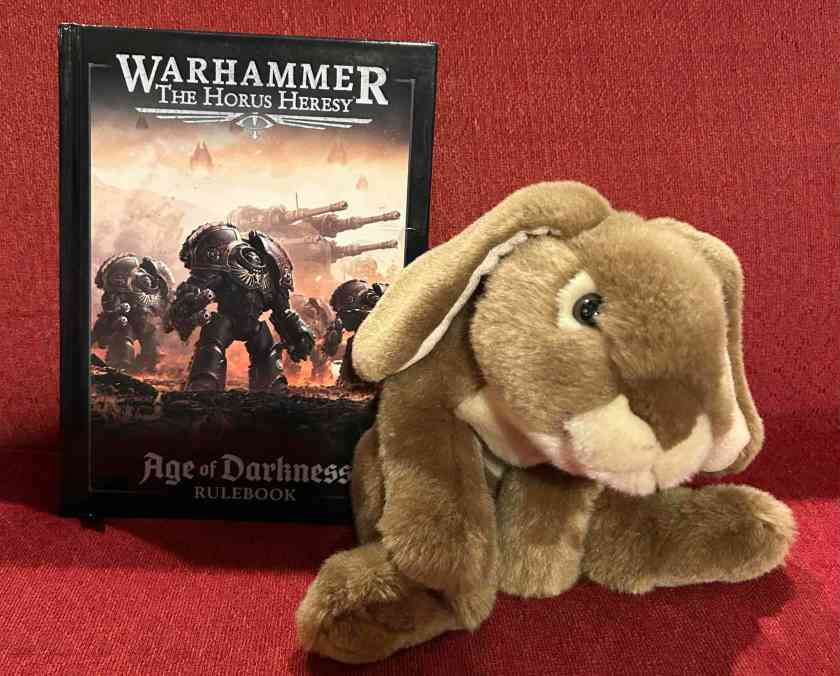
Caramel has been enjoying reading Warhammer – The Horus Heresy: Age of Darkness Rulebook and will likely leaf through it for many more months (or even years) to come.

Caramel reviews Pathfinder Roleplaying Game: Core Rulebook

Last week Caramel reviewed Warhammer 40,000: Core Book, the core rule book for a tabletop game he is really keen on these days. Then he realized that he also could talk about his other favorite tabletop game, Dungeons & Dragons, and brought his rule book out. So today he is talking to Sprinkles about Pathfinder Roleplaying Game: Core Rulebook.

Caramel reviews Pathfinder Roleplaying Game: Core Rulebook.

Sprinkles: So, you found another rule book for another tabletop game. This one is about Pathfinder. And I am not sure everyone knows what that is. So why don’t you start by telling us something about the game?

Caramel: Sure, I suppose everyone knows about Dungeons & Dragons (D&D) but Pathfinder is a bit different from D&D. It is actually very similar to D&D version 3.5. However there are some slight differences in the character types, and I think there are some changes in the rules.

S: Okay, wait. So let us go back a bit. First there is the famous tabletop game Dungeons & Dragons. For any bunnies who might not know what that is, can we start by talking briefly about what that is?

C: Sure, good idea. D&D is also a role playing game, like Warhammer 40,000, which I talked about last week. However, instead of controlling an army, in D&D you control one person. And it is the same in Pathfinder.

S: Okay, so I looked them all up on Wikipedia, and it seems that both Warhammer and D&D are relatively old actually. D&D was first published in 1974, and Warhammer, the original game, was published in 1983. Pathfinder was first published in 2009 as a kind of a spinoff of the original D&D, or rather, the third edition of it. 

C: I had an idea that the Warhammer game was that old! I knew for example that the first Warhammer 40K miniatures were made out of metal because, according to Google, at the time “plastic molding technology was not advanced enough to produce the intricate details and durability needed for tabletop miniatures.”

S: That makes sense! So anyways, last time you talked about the general setting for the game when you were telling us about Warhammer 40K. Now is there a general setting for D&D or Pathfinder?

C: Kind of. It is kind of in a fairy tale time period, where they have firearms, but getting them is very hard. Most people have simpler weapons, like swords, slings, bows and arrows, and … war hammers! 

S: I see what you did there! Anyways, so this sounds like maybe the late middle ages, but there is more, right? I do hope there is indoor plumbing, because that I think is one of the most important benefits of modernity. 

C: I don’t think there is indoor plumbing; they use outhouses and chamber pots mostly.  

S: Hmm, not sure I’d like to live that way… But there is more, right? There is sorcery, and there are different kinds of beasts and types of humanoid characters?

C: Yes! There are elves, and sorcerers, and wizards, and bards, and so on. And there are all sorts of beasts. And as you can tell from the original name, there are dragons!

S: So it is a fantastical world, kind of like our own medieval times, but with some interesting extras! 

C: Yes. But actually there is a lot of freedom in the game. You can set up your own game to be in a world with more magic or less. You can have elves in your particular story or not. 

S: No wonder people do not get bored, and generations of bunnies have been playing it without running out of ideas. It sounds very versatile.

Caramel is reading Pathfinder Roleplaying Game: Core Rulebook.

S: Okay so now let us get back to the book. This is the standard book with rules of the game then?

C: Yes, it is.

S: So tell me what kinds of things there are in the book. 

C: There are parts on creating a character. Then there is a part on choosing a class, then skills, then feats, then equipment. Next is extra rules, combat, magic, spells, special classes. Then there is a section on how to be a GM, making NPCs, magic items, and a ton of appendices.

S: That is a lot! 

C: Well there are over five hundred pages!

S: And what is a GM?

C: A Game Master. It is the person who develops the main story and the setting, and acts out all the NPCs. And before you ask, those are the characters that are not played by any of the main players. NPC stands for Non-Player Character. So the PCs are the characters the players play. 

S: I see. So the GM is the main story teller in some sense.

C: Yes, but the players can and do make choices that change the GM’s original goals, I know from experience.

S: Well, that sounds more fun actually. And kind of like real life, where big and important people might have all these grand schemes, but then a little bunny comes along and does something differently, and the whole world is changed. 

C: Yeah, I suppose. When I play as a GM, sometimes my players can be frustrating when they choose to do totally off-the-wall things. But I have also been a frustrating character to my own GMs so I guess it can go both ways!

S: Yes, kind of like free will. You get to choose; within all the constraints, you still have a choice. I like that. And I bet that is one of the reasons why the game works so well. There might be standard storylines and GMs might have some creative ideas, but each game turns out to be totally different because the players decide to do some things differently and the world changes. Like the butterfly effect, like in chaos theory.

C: What is chaos theory?

S: Okay, we are veering off topic a bit but chaos theory is a field of mathematics where people study systems which are extremely sensitive to small changes and seem to behave chaotically but can still be described and explained mathematically. And the butterfly effect captures that idea: “the flap of a butterfly’s wings in Brazil can set off a tornado in Texas.” A while ago, I reviewed a couple books about famous mathematicians who worked in chaos theory for our blog. Maybe you can check those books out… 

C: Cool, maybe I will.

S: Okay, so the book seems chock-full of ideas and basic rules of playing this game. I think you have read it from beginning to end several times. I also saw you often opening a random page to read. And I have a feeling that you will keep using it for the foreseeable future. 

C: Yup. I like reading this book. I also really like looking at the pictures. They are pretty well drawn. 

S: Yes, I can see that. Maybe this is a good time to end the review. What would you like to tell our readers?

C: Stay tuned for more book bunny reviews!
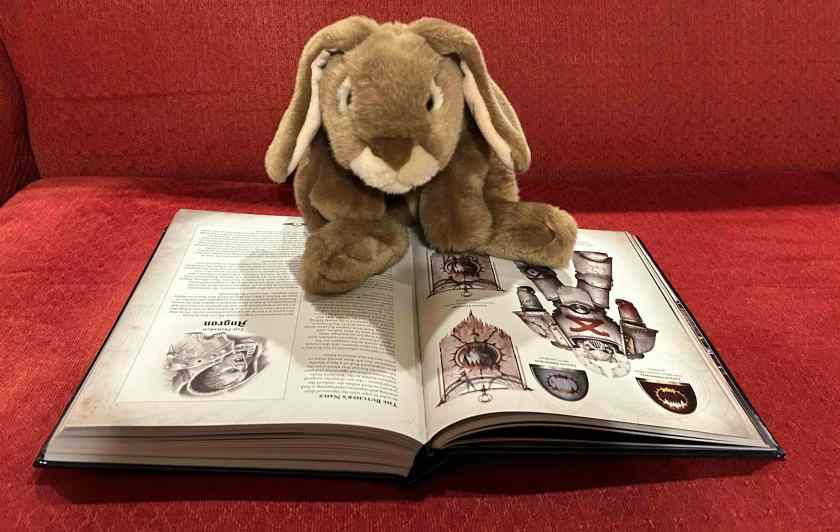
Caramel expects he will continue reading Pathfinder Roleplaying Game: Core Rulebook for many years to come!

Caramel reviews Warhammer 40000: Core Book

Today Caramel is talking to Sprinkles about his new Warhammer 40,000: Core Book.

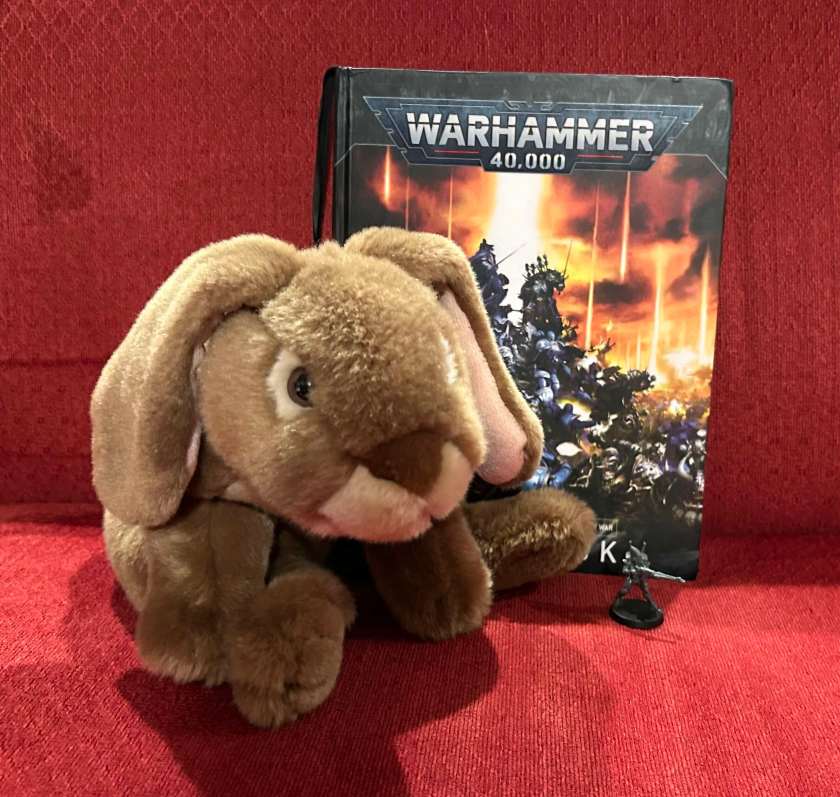
Caramel reviews Warhammer 40000: Core Book as his Aeldari friend watches.

Sprinkles: So Caramel, today we are talking about your new Warhammer 40000: Core Book. So maybe start by telling us a bit about it?

Caramel: Sure, this book is a rule book for the Warhammer 40,000 game. It includes a description for every army in the game and tells you about some of the units in the army.

S: Wait, let us start a bit slower. I know you like this game but honestly I do not know much about it. On the book website I read “In the grim darkness of the far future, there is only war.” That sounds utterly terrifying. 

C: Yeah, I suppose.

In the grim darkness of the far future, there is only war.

In the 41st Millennium, warring factions from ancient civilisations and upstart empires fight endless battles across innumerable worlds. Humanity stands alone, beset on all sides by the heretic, the mutant, and the alien. There is no mercy. There is no respite. Prepare yourself for battle.

https://warhammer40000.com

S: So this is supposed to be the future of our universe, right?

C: Yes, we are in the 41st century 

S: And there are no humans or bunnies, I presume?

C: No, there are humans, but they mainly worship the God Emperor of Mankind. 

S: Hmm, not loving that at the moment, but okay. And are they based on Planet Earth or is the main scene elsewhere in the universe? And are they the main heroes or villains or just one among many other races? 

C: They are somewhere in between, not too evil, but not great people, either. And they do inhabit thousands of planets but their civilization has stagnated. Not terribly optimistic.

S: I see. So the game you play takes place about forty thousand years in the future when there is constant war in the universe. So what is the game like? Do you role play individual heroes? Do you lead armies or nations or planets? 

C: You lead a single army, and the size of the army is determined by a point system. You usually have 1000 points, but in some game rounds, you can have more or less.

S: And do you cooperate with friends when you are playing with them? Or are you usually battling one another? 

C: Both. Occasionally you have allies. At other times, it is just you and your army against all the other players’ armies. 

S: I see. So are the battles random battles for power over a resource or a planet? Or is there an overarching goal, like beating the main baddies of the galaxy or pushing back invaders and reestablishing the dominion of an empire? 

C: I think usually it is a battle over resources or knowledge that causes battles.

S: So why do you like this game? Because it is a neat strategy game? 

C: Yes, I like the strategy needed to win.. 

S: And you like having an excuse to hang out with friends for an extended period of time?

C: Yes.

Caramel and Aeldari friend are reading and enjoying Warhammer 40000: Core Book.

S: Alright, let us get back to the book. So the book is the rule book for the game then, right? But you were playing the game without it, so it is not only a rule book, is it?

C: Oh, it is a rule book. The way I was playing was by asking my friends about the rules. 

S: So this is more like the Dungeons and Dragons type of thing, where the rules are quite complex and there is a wide range of things you can do or types of beings you can be. 

C: Yes, kind of, but in Warhammer you control an army, In D&D, you control one person.

S: I understand that, I think. Okay, so tell me more about the book. It is a large-format and full-color book, printed on rather nice paper and with solid binding. I am assuming you look a lot at the pictures.

C: Yes, that is what I do a lot, but I also read the rules and the descriptions.

S: So do you think you will keep it as a reference book as you continue to play the game with your friends? 

C: Yes, I think I will. 

S: But you have already read this whole book from cover to cover? How long is it? How many pages does it have? It does look pretty thick.

C: It has 220 pages.

S: Hmm, so not too thick, you have read much thicker books before. So maybe it is the high quality paper that makes it so thick. Okay. But you have not yet answered all my questions. Maybe I should have asked them one at a time. So I will ask again. Have you read the whole book from cover to cover yet? 

C: Yes, many, many times.

S: Well, that sounds very much like a strong endorsement! So I am guessing you like the book then. 

C: Yes, greatly.

S: Here is the hard question though: would you have enjoyed this book at all if you did not know about Warhammer or did not like to play it already?

C: Well, I probably wouldn’t have gotten the book if I didn’t like the game, but I think maybe, the pictures and stories might have drawn me in if i just got to look at the book a bit. 

S: Yeah, I can see that. You already like space-related things, you like Star Wars, you enjoy reading and learning about wars more generally, and you like fiction with aliens and spaceships. You also like role-playing games. I am guessing this has a lot of the things that you would like.

C: Yes, that is true. This Warhammer book has almost everything that I like: spaceships, robots, elves, and to top it all off, PICTURES!!!

S: There are elves?! That is awesome!

C: Well, technically they are called the Aeldari, but they are basically space elves with guns and cool armor, but I might be biased.

S: That does sound cool! But I think I know why you said almost everything though. There are no dragons!

C: Well, they have these things called heldrakes, which are robot dragons, but they are kind of sadistic.

S: I see. You probably prefer the dragons in Wings of Fire or How to Train Your Dragon. The ones who have different kinds of personalities, but can be kind and friendly and generous as well, right?

C: Yes, I do. 

S: Okay, Caramel, I think this is already a very long post. So let us wrap things up. What would you like to tell our readers?

C: Stay tuned for more book bunny reviews!
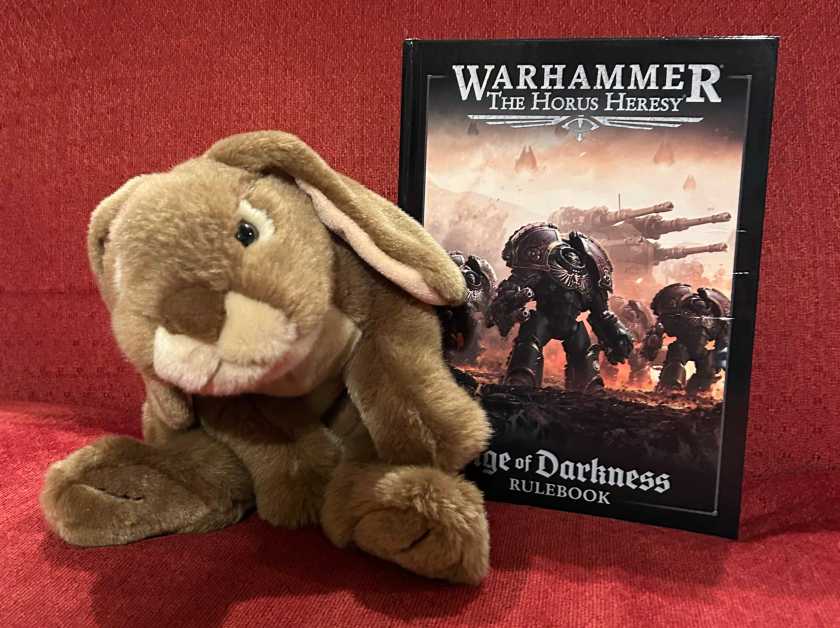
Caramel and Aeldari friend will continue to read and enjoy Warhammer 40000: Core Book for many months and years to come.