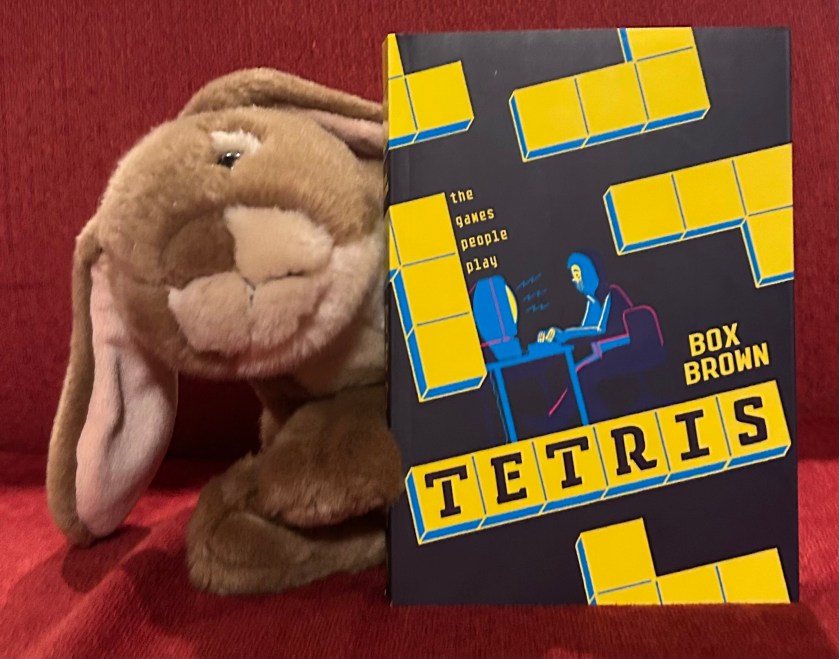
Today Caramel reviews Tetris: The Games People Play by Brian “Box” Brown, first published in 2016. As usual, Sprinkles is taking notes and asking questions.
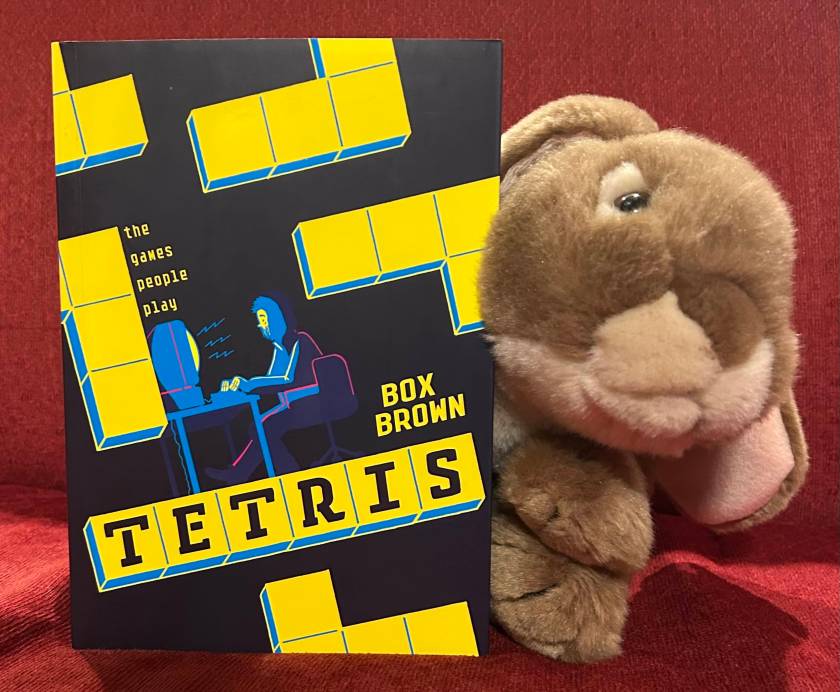
Sprinkles: Today we are talking about a graphic novel about my favorite computer game, the one and only, the classic: Tetris!
Caramel: Yay! This is, as you said, a comic book about Tetris and how it rose to popularity.
S: So it is not quite fiction then, right?
C: No, it’s more so a fictionalization of a real event, like the movie Oppenheimer.
S: That makes sense. I am very excited that you read this book because I really like Tetris. But I also am curious about the whole phenomenon it became. It was everywhere and people were almost addicted to it for a while.
C: Yeah, this comic book explains all of that. It is interesting to me because, you know, there are a lot of games today. It seems like when Tetris came out, it was a huge deal partially because there weren’t as many big games.
S: Now that’s not quite true, there were other video games, but I think it is probably true that Tetris is a class of its own. It was so popular and it just took over.
C: And it is such a simple idea. Blocks falling down and you are trying to place them in empty spaces just the right way so the pile won’t get too big.
S: Isn’t it interesting that my favorite computer game and yours both have blocks?
C: True, but my favorite game may have slightly better resolution.
S: Well, Tetris did not really need much resolution really. But you are right of course, Minecraft is so much more visually detailed, and of course you can build so many different things with blocks in Minecraft. It is a lot more sophisticated. But you know, that was part of the appeal of Tetris. It is so basic, so simple, but it is also very challenging.
C: True. It can get really hard. Especially when it gets faster and faster.
S: Yup. So tell me a bit more about the book.
C: The book starts with a strange scene about humans and play and art and entertainment. And about why people play. There are many pages about early games people played, and art about games and how games might be related to art too. Then there are a few pages about the founding of the Japanese company Nintendo. And we get into computer games eventually. But we do meet the coder who built Tetris very early on. It was a Russian programmer named Alexey Pajitnov. He thought about how when he was a little kid, he used to play with pentominoes, which are shapes made of five squares, and how it was difficult to place them in a box when he was done playing with them. Then eventually we get back to him, and we follow him through his life, as he develops and shares Tetris with the rest of the world. He moves to the United States and the game gets even more popular.
S: That sounds interesting! Quite a crash course in the history of games!

S: Did you learn anything new from the book then?
C: Well, basically everything! I knew about the game, I have seen you play it even, but I didn’t know much else about it. I also did not know that other people liked the game as much as you do. It apparently became a really big deal. People started seeing Tetris tiles everywhere even when they were not playing and so on.
S: But I bet you can sympathize. Have you ever looked around you after playing Minecraft for a while and seeing cubic blocky things?
C: No! Because I am a normal bunny.
S: Well, hmm, that is interesting. Maybe the blocks in Minecraft are too different, there are too many different distinct shapes to make your brain go wacky like that.
C: Or … maybe I have never played Minecraft for too long. Maybe I should play more to see if I get to see things as Minecraft blocks?
S: Hmm, I don’t like that idea.
C: Oh, too bad. Because I really did like it.
S: Sure you did. Okay, let’s get back to the book. What did you think of the color scheme of the book?
C: It’s all black and white and yellow, yet the art is still detailed. It is really interesting. The game itself has a lot of color, though they are the main primary colors, but the author chose only these colors. I wonder why.
S: Yeah, that is an interesting observation, Caramel. The yellow adds color but also is not distracting. Maybe the Tetris colors would be a bit too distracting.
C: Maybe. The story was interesting though I was not expecting to learn about the games ancient Egyptians played when I began reading. I thought it would be only about Tetris.
S: But the book also has a subtitle.
C: True. The subtitle is “The Games People Play”. So I guess it makes sense that there could be more general stuff about games.
S: That part reminds me a bit of another book I read recently called Around the World in Eighty Games. I even reviewed it for a math journal.
C: That book looks interesting too. I bet it has a lot of games I don’t know about.
S: Well, you can borrow it whenever you like. I still have a copy.
C: Maybe I will.
S: Okay, Caramel, this seems to me like a good place to wrap up this review. It is after all a school night, again.
C: Yep.
S: What do you want to tell our readers?
C: Stay tuned for more book bunny reviews!