Midnight reviews Augustus by John Williams

Today Midnight, the mysterious and reclusive black bunny of the family, decided that it was time for another appearance because he had read a good book and wanted to share his thoughts on it with the readers of the book bunnies blog. (Also Marshmallow is still working hard on her college applications.) Below is Midnight’s review of Augustus, a historical novel by John Williams, that was published originally in 1972 and that received the National Book Award for Fiction in 1973. Sprinkles is taking notes and asking questions.
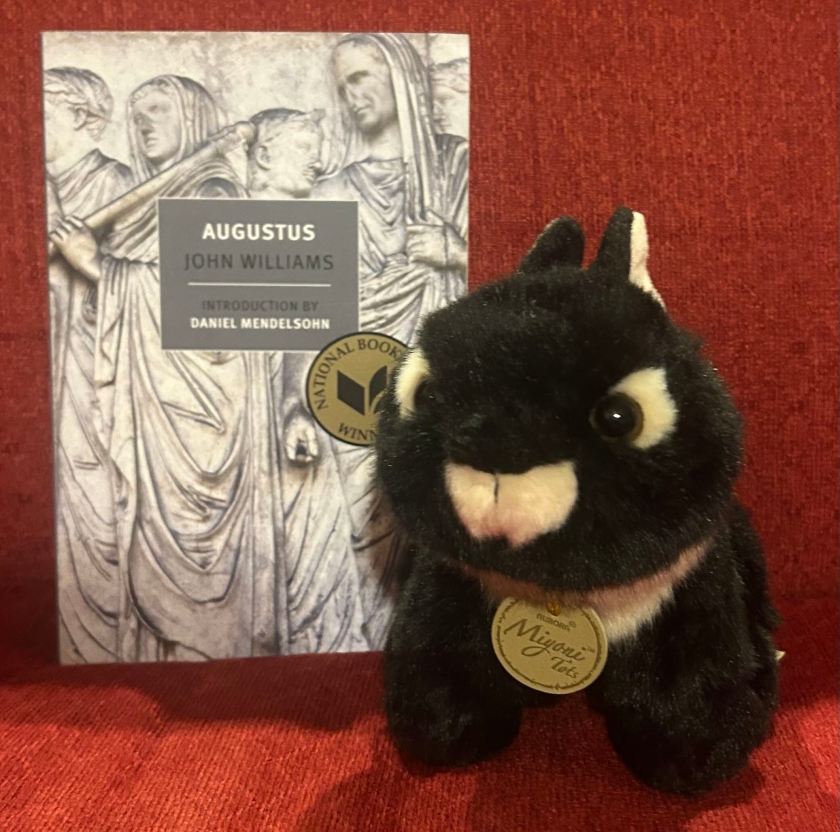
Midnight reviews Augustus by John Williams.

Sprinkles: It is so neat to have you join us today Midnight!

Midnight: I am filling in because Marshmallow is busy working on college applications.

S: But you also have a good book you want to talk to us about, yes?

M: Indeed. A friend of mine recommended several books to me recently and this is the first one I have completed.

S: That sounds great! You seem to have enjoyed this a lot. Hopefully you will appreciate the other ones too.

M: One may hope.

S: Okay, so tell us a bit about Augustus.

M: It’s historical fiction. But it is written not in third person but rather through letters written between many characters, of greater or lesser importance, at the end of the Roman Republic and the beginning of the Empire. The focus overall is on Octavius, later to be known as Augustus Caesar. We read letters from his friends, associates, and relatives, and toward the end, even from the man himself.

S: I didn’t know this was an epistolary novel, written in letters! That is really cool. And all of them are fictional, right? I know many of the main events should be historical, but the book has so many details, a lot should be the author’s creation.

M: That is my understanding. My memory of those events is hazy, since I was only a young rabbit at the time-

S: Wait, what do you mean? The events retold in the book are supposed to have happened at least two thousand years ago.

M: I can tell this makes you uncomfortable. Let’s move on.

S: Okay….
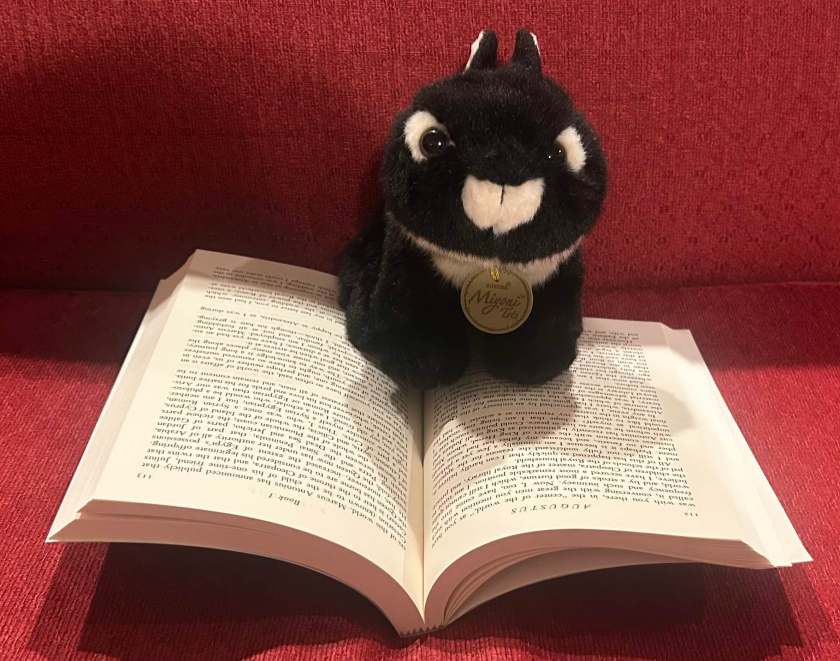
Midnight is reading Augustus by John Williams.

S: So tell us a bit more about the book. It is written in the form of a series of letters. But it is also split into three books, right?

M: Perhaps it is better to describe them as a series of letters, because we don’t get responses to letters. We read stories from one side sometimes. One of the great strengths of the book is that Williams gives each character their own distinct voice and style.

S: That is impressive.

M: And the letters are organized into three books, yes. The first book is about his childhood and his rise to power. The second is about him already an emperor, tackling the challenge of finding an appropriate successor. One issue that constantly arises is that Augustus lived so long that most of his friends passed away long before he did. His preferred successors predeceased him, leaving him to settle for Tiberius, whom he did not care for. The third book is really a single long letter, from Augustus to a friend, reflecting upon his life and his reign.

S: Then there is an epilogue.

M: Yes, that is supposedly written forty-one years later, by Philippus of Athens, Augustus’s last doctor, who was a young man back then. The letter is directed to Seneca. Philippus looks back on the long reign of Augustus, the subsequent harshness of Tiberius, the cruelty of his successor, Caligula, and the ineptness of Claudius. Having read Graves’s I Claudius and Claudius the God, I tend to have a softer view of Claudius than Williams’ Philippus.

S: Oh, maybe you will tell us about those books some day.

M: Maybe I will. In any case Philippus might not be the greatest judge of men, since he speaks hopefully about the newly crowned emperor Nero.

S: And we all know now that Nero did not turn out to be a great emperor!

M: Those were dark times. It is still difficult for me to talk about them.

S: Wait, are you implying that you were around during Nero’s time?

M: Let’s get back to the book, shall we?

S: Okay, sure. Whatever you say.

M: Much of the latter half of the book consists of journal entries of Julia, Augustus’s daughter, written in exile.

S: And Julia is a real person, right?

M: Yes, definitely. Let’s say he loved his daughter very much, but political realities in the circles that she frequented put him in a bad situation. I don’t want to spoil the book.

S: That is kind of interesting. All these people lived and died many centuries ago and their stories are actually all written down. But this book somehow manages to make them come alive so that you want to know what will happen next.

M: Right. But any student of history will know that Augustus’s story goes on for a long time and most of the people around at the start of the book are dead well before the end. While Augustus starts as a teenager, he ends up as an old man, who seems out of place, or maybe somebody whom time has passed by.

S: That is deep Midnight. I also noticed that the book has an introduction written by Daniel Mendelsohn. Did you read it too?

M: I have. It basically contextualizes the book, and says a bit about Williams and his other books.

S: But it seems one can definitely read the book without the introduction.

M: Sure.

S: So this was overall a good book and you seem to have enjoyed it. We can wrap up our review now, I think.

M: Yeah.

S: Okay, then. What would you like to tell our readers as we close this off?

M: I know that this little black bunny does not have quite the following that Marshmallow and Caramel do, and I’m sure their fans will be happy to know that Marshmallow will be back once she finishes some of her college applications.

S: Aw, we love having you over, too, Midnight!

M: To that, and to the readers, I say: Vale! as we used to say…
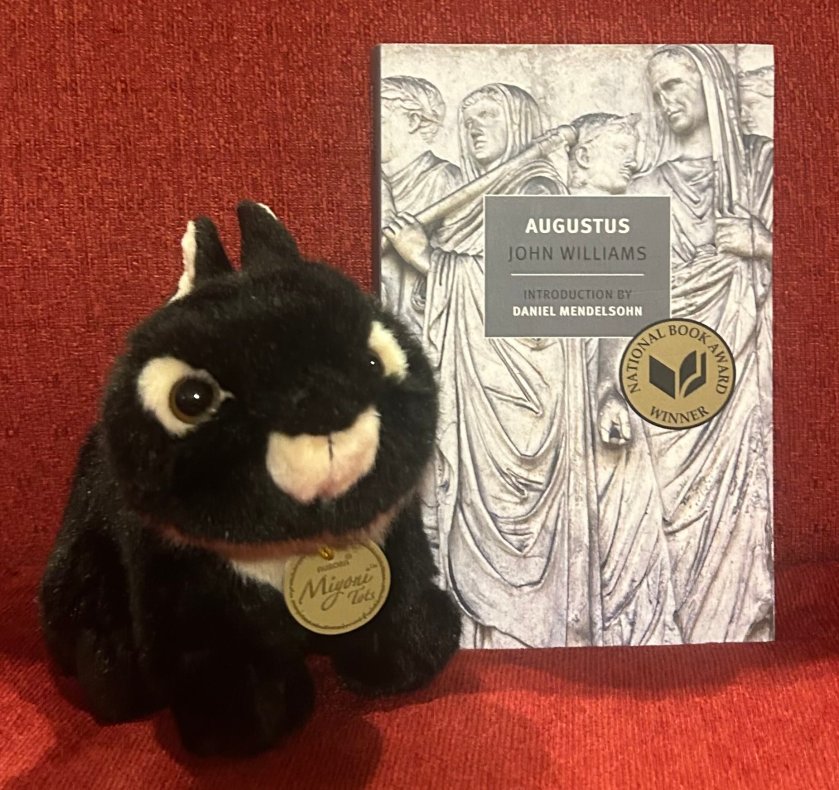
Midnight enjoyed reading Augustus by John Williams, and bids readers farewell, until such a time as he deems it fit to grace the world with his august presence.

Marshmallow reviews The Tower of Nero (Book 5 of the Trials of Apollo Series) by Rick Riordan

Marshmallow has already reviewed the first four books in Rick Riordan’s Trials of Apollo series for the book bunnies blog. This week she reviews the fifth and final book, The Tower of Nero. Below she shares her thoughts on this epic end of Rick Riordan’s fifteen-book series about Greco-Roman gods and their children who live among us. 

For reference, Marshmallow has already reviewed:

You might also enjoy reading Caramel’s reviews of the graphic novel versions of the first two books of the first series: The Lightning Thief: The Graphic Novel and The Sea of Monsters: The Graphic Novel.

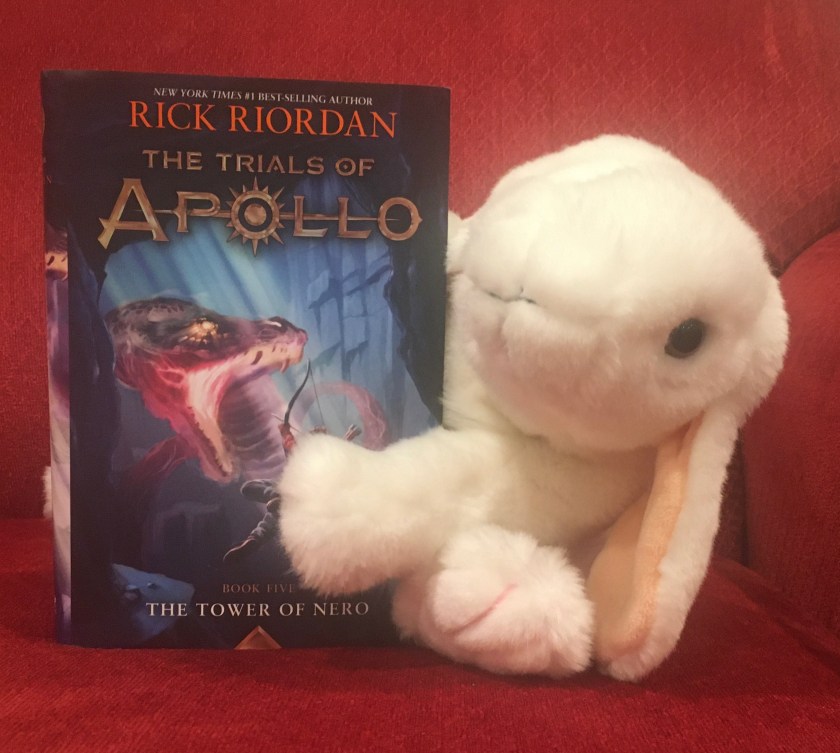
Marshmallow reviews The Tower of Nero (Book 5 of the Trials of Apollo Series) by Rick Riordan.

Marshmallow’s Quick Take: If you enjoyed reading the first four books of Rick Riordan’s Trials Of Apollo series, then this might be the book for you.

Marshmallow’s Summary (with Spoilers): Apollo has been stuck as a mortal for the last four books, and now he is coming to the end of his adventures on Earth. But he has a long list of enemies. He has been fighting the Triumvirate, three evil emperors from Rome’s past who have been trying to all become gods, as well as his archenemy Python. Python is a large and evil snake who has been Apollo’s enemy even when Apollo was a god.

The book starts with Apollo and his demigod master Meg returning to New York. You might recall that Meg is a daughter of Demeter, but she is a particularly strong one. She has unusual powers, even for a half-blood. She is able to summon a karpos, which apparently means “fruit” in Greek, but in this universe, it is a fruit or grain spirit. She names this karpos Peaches, because he is always saying “Peaches”. She can transport using plants and can make them grow faster.

On their way into New York, Apollo and Meg are attacked by Nero’s henchmen. We already know from the earlier books in the series that Nero is one of the main antagonists of the story, so you can guess that his people are not coming to greet Apollo. However, one of them, a Gaul woman named Luguselwa, turns out to be Meg’s trainer. Meg was one of the demigods that Nero had “adopted” and raised to be his minions. Luguselwa, Lu as Meg calls her, had been a role model for Meg.

Even though in the beginning it seems like Lu is on Nero’s side, she has a plan to help Apollo because she really cares for Meg. But they first need rest, so they stop by Percy Jackson’s home. (For Percy’s adventures, click here.) But Percy is not there. (However, his new baby sister is.) After staying with the Blofis-Jacksons for a little bit, Apollo, Meg, and Lu leave to go to Camp Half-Blood. At the camp, Apollo sees his half-brother Dionysus and his children. But they have to leave soon, and when they do, they go to find Rachel, who currently embodies the Oracle of Delphi. When they meet Rachel, they are faced by Tauri Sylvestre, which are basically monster cows.

Apollo and his friends will have to face the monster cows and more before they can finally hope to defeat Nero and Apollo’s archenemy Python.

Marshmallow is reading The Tower of Nero (Book 5 of the Trials of Apollo Series) by Rick Riordan.

Marshmallow’s Review: I really enjoyed reading The Tower Of Nero. I think that the plot of this book is very well-written, and it is a great finale for the whole series. The new characters are all amazing, they are realistic and relatable. As always, Apollo is a hilarious narrator, and he gets more and more likeable through the series.

This particular book of the series might be slightly scarier than the earlier books. There are some moments where the reader will probably get scared or grossed out, like Lu’s punishment. I’d say that most of Rick Riordan’s books are for ages 8 and up, so this one might be for 9 (or 10) and up.

The Tower of Nero can be a great read if you are reading it alone, but it is also great if you read it to someone else or someone reads it to you. I recommend it as a perfect ending for this fifteen-book saga.

Marshmallow’s Rating: 100%.

Marshmallow rates The Tower of Nero (Book 5 of the Trials of Apollo Series) by Rick Riordan 100%.

Marshmallow reviews The Tyrant’s Tomb (Book 4 of the Trials of Apollo Series) by Rick Riordan

Marshmallow has already reviewed the first three books in Rick Riordan’s Trials of Apollo series for the book bunnies blog. This week she got her paws on the fourth book, The Tyrant’s Tomb, and read it in lightning speed. Below she shares her thoughts on this 400+-page book, published in paperback only this month.

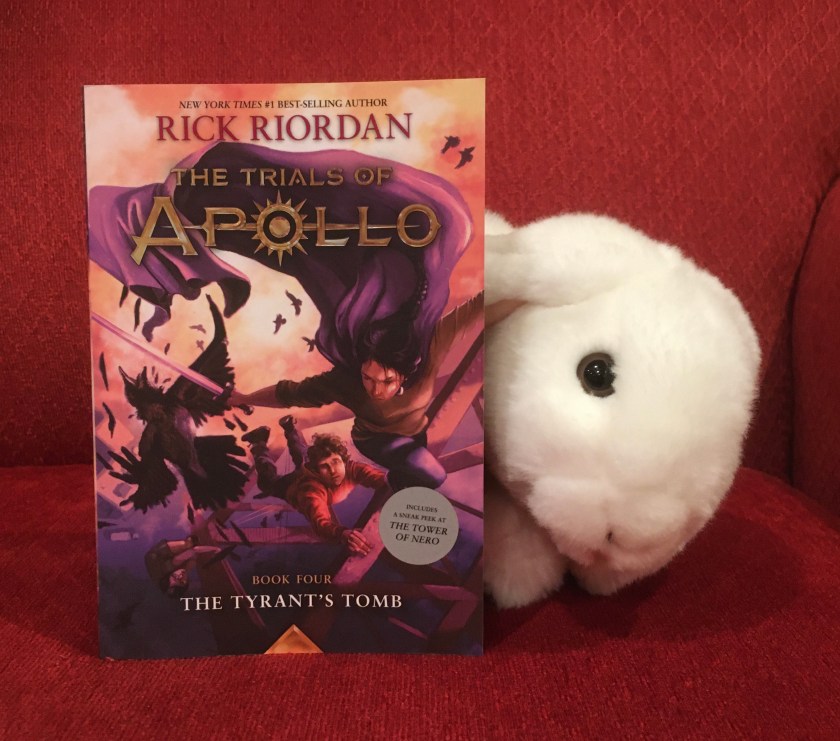
Marshmallow reviews The Tyrant's Tomb (Book 4 of the Trials of Apollo series) by Rick Riordan.
Marshmallow reviews The Tyrant’s Tomb (Book 4 of the Trials of Apollo series) by Rick Riordan.

Marshmallow’s Quick Take: If you have enjoyed reading Rick Riordan’s other books or if you like mythology, then this might be the book for you. 

Marshmallow’s Summary (with Spoilers): In the first book of the Trials of Apollo series, Apollo, the god of music, prophecy, and archery, was transformed into Lester, who is described as the “most worthless of teens,” by a mutual friend in one of the past books. Now he is carrying the body of a deceased friend who was killed in the last book. (I will not say who died. I am not spoiling that much!)

While on the road to Camp Jupiter, a training camp for Roman demigods, or half-bloods as they are also called, Lester and his master Meg McCaffrey are attacked by ghouls. They are rescued by a group of campers from Camp Jupiter, led by a pink-haired girl named Lavinia. They are taken to Camp Jupiter, where they are welcomed by the praetors Frank and Reyna. Lester sees in a dream that an evil Roman emperor is now working with the Triumvirate. (We learned about the Triumvirate earlier. It is made up of Caligula, Commodus, and Nero, three evil Roman emperors who are enemies of Apollo/Lester and his friends.) Now the Triumvirate is working with a new ally, and Apollo has a new deadline: in four days an evil army of undead will be unleashed upon the Camp. 

Marshmallow is reading  The Tyrant's Tomb (Book 4 of the Trials of Apollo series) by Rick Riordan.
Marshmallow is reading The Tyrant’s Tomb (Book 4 of the Trials of Apollo series) by Rick Riordan.

Marshmallow’s Review: The Tyrant’s Tomb is a good book. However, I think that if you want to read The Tyrant’s Tomb, you need to have read the first three books in the Trials of Apollo series. I would also highly recommend reading Riordan’s earlier books in the Heroes of Olympus series and the Percy Jackson and the Olympians series to give you the full context of the story and the backstories of the characters.

Rick Riordan does a good job of “interacting” with the reader and being funny. Lester is a hilarious narrator. His haikus are funny and it is always amusing to try to guess what they mean: they are sneak peeks of the chapter they start. Here is a favorite, from page 114:

I now have a plan
To make a plan concerning 
The plan for my plan 

I think that The Tyrant’s Tomb is a good book for almost everyone, though it might be too complicated or scary for younger readers. (It is not really horror. It is scary more around the level of the Harry Potter books, possibly less than the later books of Harry Potter which turn quite dark.) The plot is well thought-out and everything is all tied up at the end, though the next book, The Tower of Nero, is the true end of the series and I can’t wait to read it.

Marshmallow’s Rating: 95%.

Marshmallow rates The Tyrant's Tomb (Book 4 of the Trials of Apollo series) by Rick Riordan 95%.
Marshmallow rates The Tyrant’s Tomb (Book 4 of the Trials of Apollo series) by Rick Riordan 95%.

Marshmallow reviews The Burning Maze (Book 3 of the Trials of Apollo Series) by Rick Riordan

This week Marshmallow continues with Rick Riordan’s Trials of Apollo series and reviews the third book: The Burning Maze.

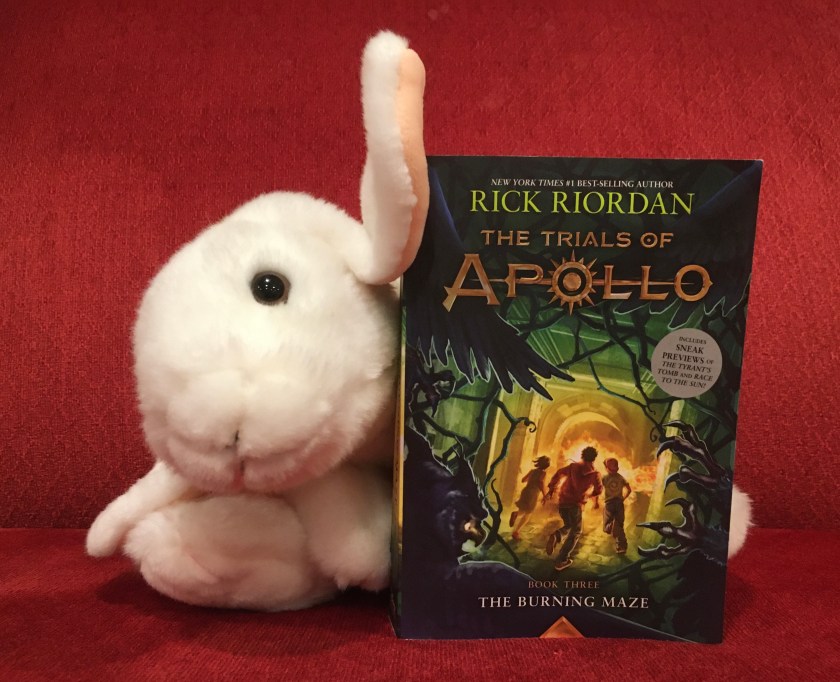
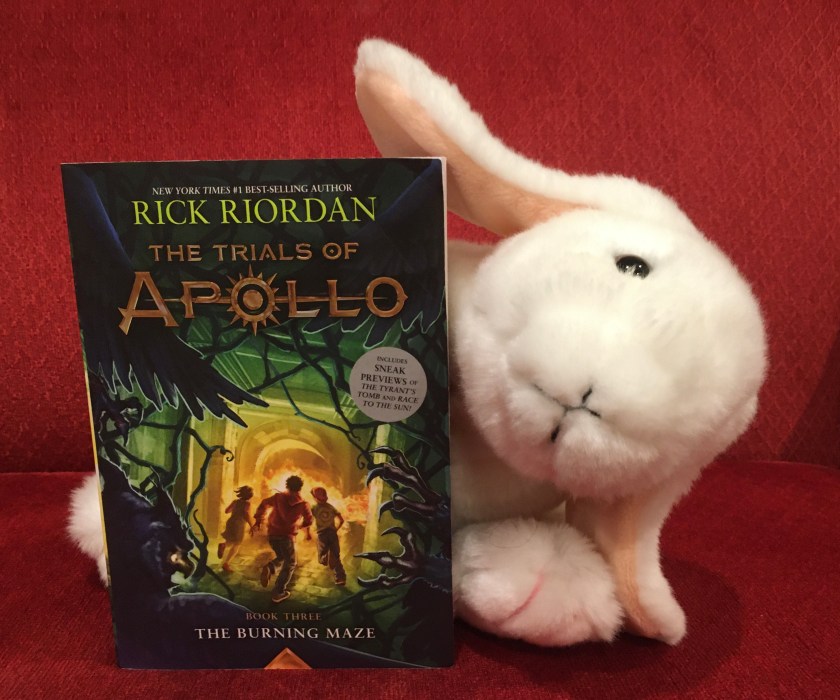
Marshmallow reviews The Burning Maze (Book 3 of the Trials of Apollo Series) by Rick Riordan.

Marshmallow’s Quick Take: If you like books about Greek and Roman mythology, then this might be the book for you. But I will add my usual warning again: if you have not read the earlier books in the Trials of Apollo series, I think you should go back and read those before you dive into this one.

Marshmallow’s Summary (with Spoilers): Zeus has turned Apollo into an average teenager and now he has a twelve-year-old master, a satyr guide, and an assignment to restore all Oracles.  This time he has to help find the Oracle of Erythaea. He reaches California and meets some old friends and makes some new ones. Apollo and his friends learn more about the identity of the third emperor in Triumvirate Holdings, a company who is behind many of the assets that previous enemies used. Apollo and his friends learn that the third emperor is set on trying to become the new Apollo and wants to have an old enemy boil the current Apollo with Helios so then the emperor can eat them and become the new sun god. This will mean that Apollo and Helios will cease to exist. It seems that Zeus will allow this, and Apollo will die. The stakes couldn’t be higher for Apollo (and also for California, because the book has an interesting explanation of what is going on with California wildfires…)

Marshmallow is reading The Burning Maze (Book 3 of the Trials of Apollo Series) by Rick Riordan.

Marshmallow’s Review: I think that The Burning Maze is a great book because the author, Rick Riordan, adds jokes and, basically, comic relief to his books. Of course if you read some of his other books, from his Percy Jackson and the Olympians or Heroes of Olympus series, and more, then you would know that. Also another interesting thing in this book is that as the book and the series progresses, so does the character of Apollo/Lester Papadopoulos. He basically grows, though also quite physically, more down-to-Earth. 

This book does talk somewhat about history, but you don’t really need to know anything about it, though knowing some Roman history would mean that you might be able to find out who the bad guys are faster. At the end of this book the heroes receive a prophecy of a sort, and it links to a character I really like.

Though this is a great book for everyone, I think that people (and bunnies) of age 9 and up might like it especially. 

I really enjoyed reading The Burning Maze. I think that it’s funny, especially Apollo/Lester’s conversations with the Arrow of Dodona are very well-written. The plot is very well thought out and the clues are great. The characters are well developed, too; each character has flaws and skills that make them more realistic and more relatable.

Marshmallow’s Rating: 100%.

Marshmallow rates The Burning Maze (Book 3 of the Trials of Apollo Series) by Rick Riordan 100%.