Marshmallow reviews Mr. Distinctive by Olga Tokarczuk

Today Marshmallow is reviewing a neat book which looks like a standard picture book for young readers but should likely be classified as something different: maybe a picture book for not-so-young readers. Mr. Distinctive was originally written in Polish by Olga Tokarczuk, illustrated by Joanna Concejo, and published in 2023. The English translation by Antonia Lloyd-Jones was published in 2025.
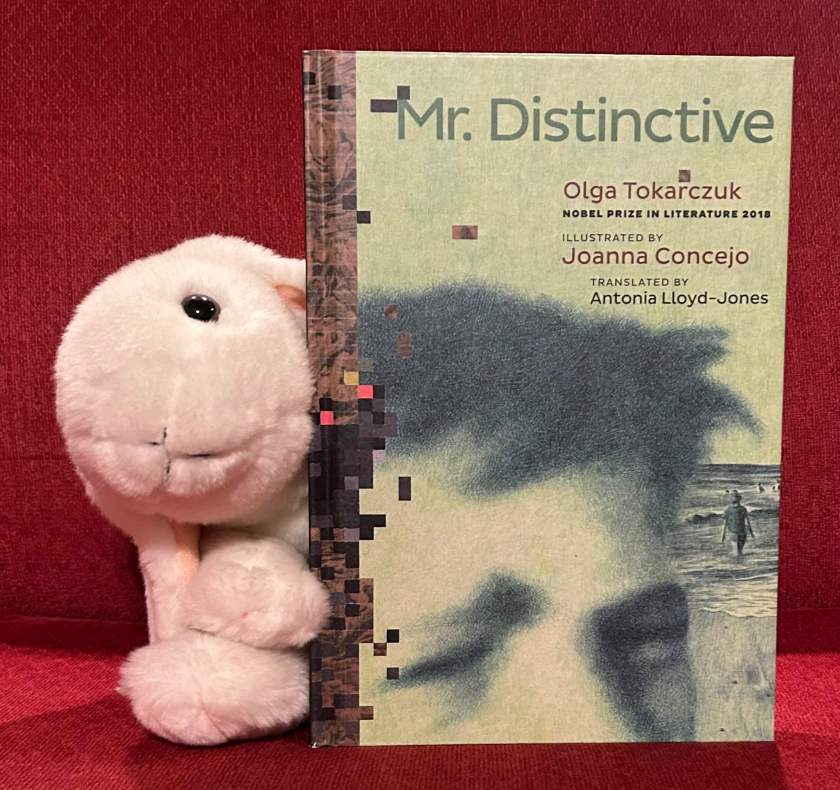
Marshmallow reviews Mr. Distinctive, written in Polish by Olga Tokarczuk, illustrated by Joanna Concejo, and translated into English by Antonia Lloyd-Jones.

Marshmallow’s Quick Take: If you like books with beautiful artwork or books that make you reevaluate the way all of society is set up, then this is the book for you!

Marshmallow’s Summary (with Spoilers): Mr. Distinctive is a rather beautiful individual. His facial features are all unique and striking such that his smile instantly wins over any individual who sees it. He is gregarious, sociable, and one of the most popular people in his neighborhood.

Unfortunately, he is a little bit narcissistic. This mainly manifests itself through his tendency of taking an excessive number of selfies. Once he gets his first phone as an adult (it is to be presumed that he grew up in a time without them), he snaps photos everywhere—of course, with himself in the center of the screen.

Eventually, he notices that his features begin to blur more and more every time he takes and posts another photo. Eventually, things get to the point where his entire face is nothing more than a smudge of what used to be his perfect, distinctive face. Seeking to restore his beauty and uniqueness, he purchases a new face from a shady dealer for an extraordinary price he can barely afford. With his new face, he is once again perfect, yet the ending is still heartbreaking.
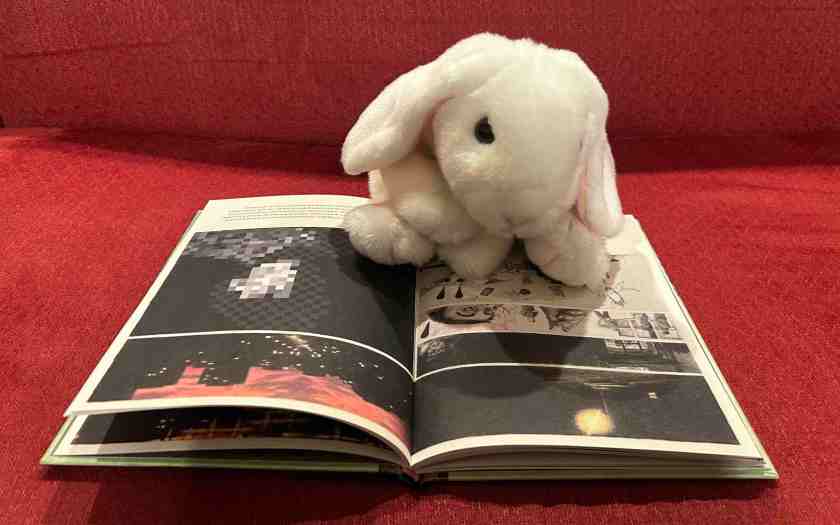
Marshmallow is reading Mr. Distinctive, written in Polish by Olga Tokarczuk, illustrated by Joanna Concejo, and translated into English by Antonia Lloyd-Jones.

Marshmallow’s Review: The book begins with a series of pages filled with highly-detailed drawings of photos (presumably from Mr. Distinctive’s childhood). The book then begins, with some sparse text sprinkled throughout. Each page has beautiful illustrations that show a window into Mr. Distinctive’s world. In almost every aspect, it is the same as ours. Except that you can literally purchase a new face. I suppose plastic surgery achieves the same effect though.

To me, this book conveyed a very poignant, relevant message about the death of individuality in the modern world. Photo after photo, post after post, Mr. Distinctive showcases himself to the world online but loses himself in the process, forgetting to be distinctive in the real world.

SPOILER ALERT: At the end, he finds out that the new face he purchased in desperation is the same as everyone else around him. I believe this represents the idea that—as a result of social media—everyone begins to lose their own distinctiveness in favor of the creation of a duplication of everyone else. I found this to be deeply saddening, but I think the message is unfortunately true.

The photos (mostly Polaroids and physical photographs) from before the start of the text show what his life was when it was untouched by digital influences like social media. They show his youth in bright colors, each frame filled with bright smiles. Afterwards, the photos are much darker and more mature in a muted way which shows the transition from his previous, unedited life to a more manipulated, artificial world.

I think this message is relevant to many given the expansive effects of social media on almost every person in the world. Reading this book makes you reconsider the value of social media and losing your authentic self and your authentic life versus the superficial validation to be gained from posting picture after picture to get “likes”.

Marshmallow’s Rating: 100%.
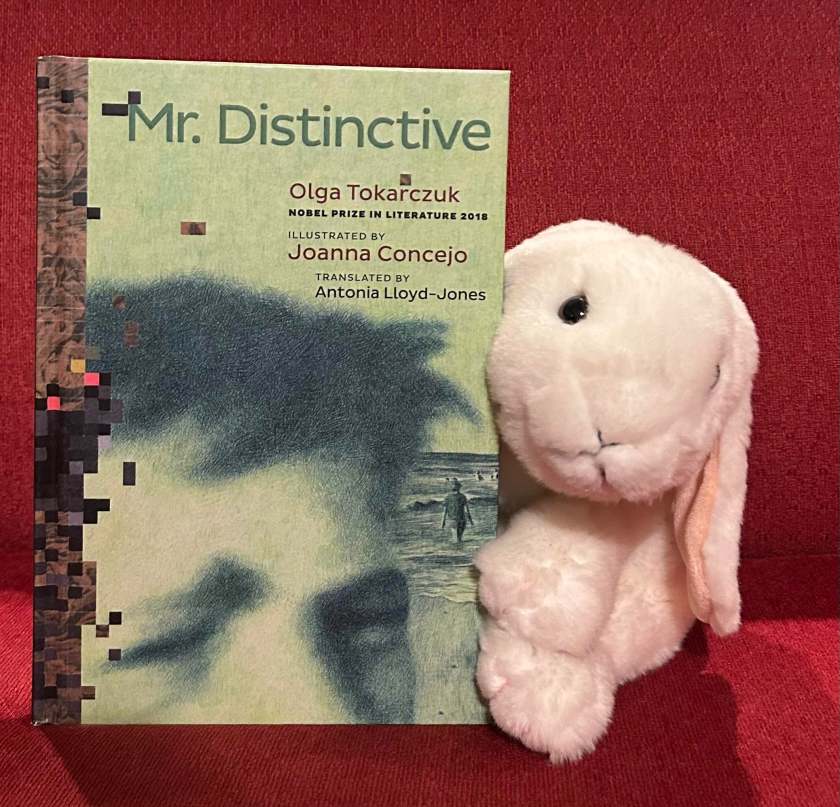
Marshmallow rates Mr. Distinctive, written in Polish by Olga Tokarczuk, illustrated by Joanna Concejo, and translated into English by Antonia Lloyd-Jones 100%.

Caramel reviews Adam & Thomas by Aharon Appelfeld

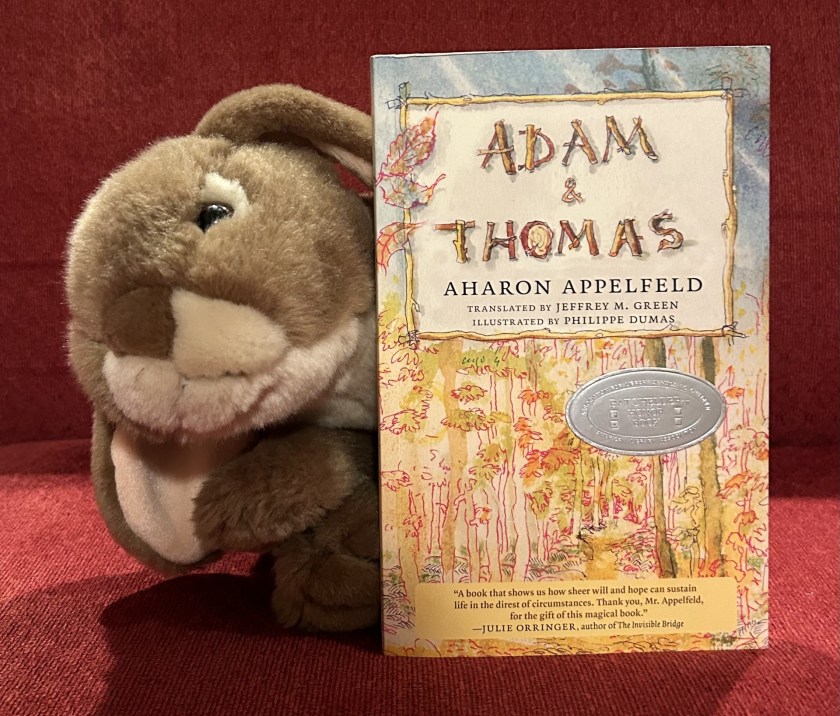
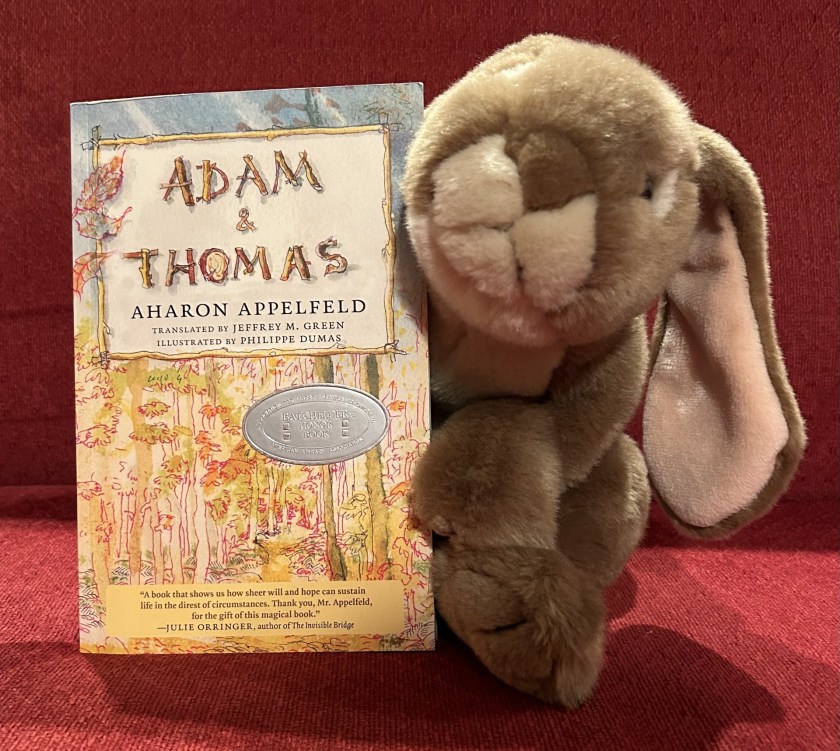
Today Caramel is talking to Sprinkles about Adam & Thomas, a book written originally in Hebrew in 2013 by Aharon Appelfeld, translated into English by Jeffrey M. Green, and illustrated by Philippe Dumas.

Caramel reviews Adam & Thomas, written by Aharon Appelfeld, translated into English by Jeffrey M. Green, and illustrated by Philippe Dumas.

Sprinkles: Let us talk a bit about this book Caramel. Maybe first start by telling us what it is about.

Caramel: It’s about two nine-year-old boys who escape one of the darkest times in human history. I mean, maybe the darkest time in modern history.

S: You are of course talking about World War II and the Holocaust, when millions of European Jews were systematically murdered by Nazi Germany and their collaborators.

C: Yes. And you know I did not really want to read this book because I knew it would be sad once I saw it was about that time.

S: Yes, I know. But I thought it was a good book and that you should probably read about that event anyways. After all, you just read The Donner Dinner Party and that was also about pretty harsh truths.

C: Yup. But I knew about the Holocaust. I did read Maus, too, even though Marshmallow was the one who reviewed it. And I did not like it because it is really really sad.

S: I know. But at least this book ends up in a more positive place, no?

C: Yes. There is that, at least. Not only do they survive the war hiding in the forest for years, but they even find their mothers after all that time.

S: Well, I guess we gave away the ending, but at least readers will know that things will get better in the end even when they re reading the darkest parts of the story. That there is hope.

C: Yes.

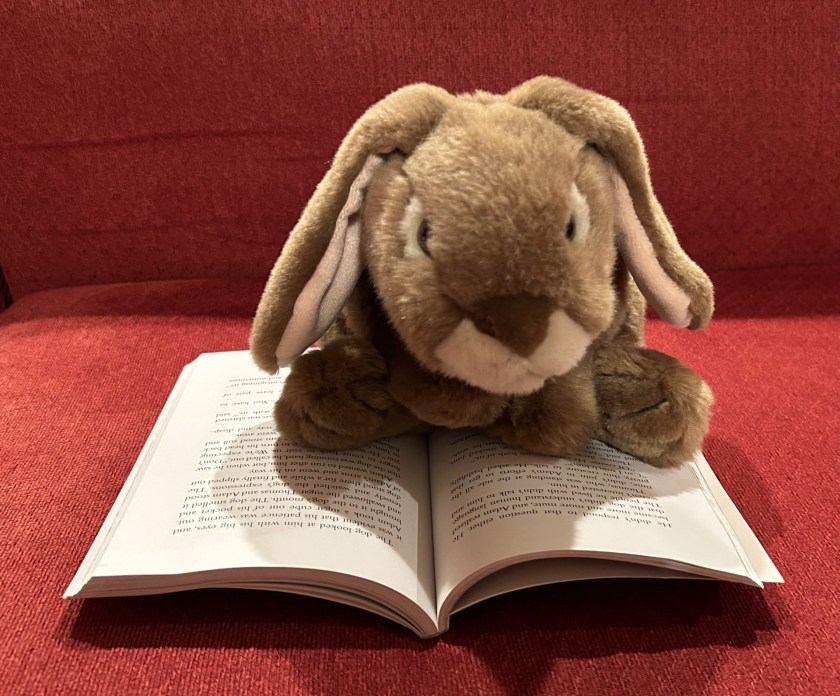
Caramel is reading Adam & Thomas, written by Aharon Appelfeld, translated into English by Jeffrey M. Green, and illustrated by Philippe Dumas.

S: Did you know this was a translation?

C: Yup. It says it on the cover page. And I know how to read.

S: Yes, of course. but sometimes people or even bunnies do not notice these things, so I thought I’d ask. So the author wrote this book in Hebrew, a language he learned only as a teenager. And he was apparently a pretty well-known author in Hebrew, and in English translation, and Jeffrey Green who translated this book was his standard translator.

C: I did not know any of that. But I think the English works perfectly well. I mean I thought it was a good book for young bunnies.

S: Yes, you are right. The sentences are simple and short. I think it is just right for young bunnies, even though the topic is a bit sensitive, and some younger bunnies might not be able to handle it.

C: Yes, I think so too. But the book is also a little long for really young bunnies. It has almost 150 pages!

S: But there are illustrations on almost every other page!

C: True. And they are really neat too.

S: Tell me more.

C: The illustrations are relatively simple and yet very detailed too. They are in color, and I liked looking at them.

S: I liked them too Caramel! So are you still upset with me for making you start reading this book?

C: No, not really. I think this is a good book with an interesting storyline, and it makes you feel like it might have actually happened. Like the characters are real people.

S: Apparently the author himself ran from a camp and lived in similar circumstances when he was about that age. So that might be why you found it so realistic, because it was real, at least to an extent.

C: Yes.

S: So maybe this is a good time to wrap up this review then. What would you like to tell our readers?

C: Stay tuned for more book bunny reviews!

Caramel appreciated reading Adam & Thomas, written by Aharon Appelfeld, translated into English by Jeffrey M. Green, and illustrated by Philippe Dumas, and thinks it is a good story to teach little bunnies about what happened to some young children during World War II.

Caramel reviews This is a Poem That Heals Fish by Jean-Pierre Siméon and Olivier Tallec

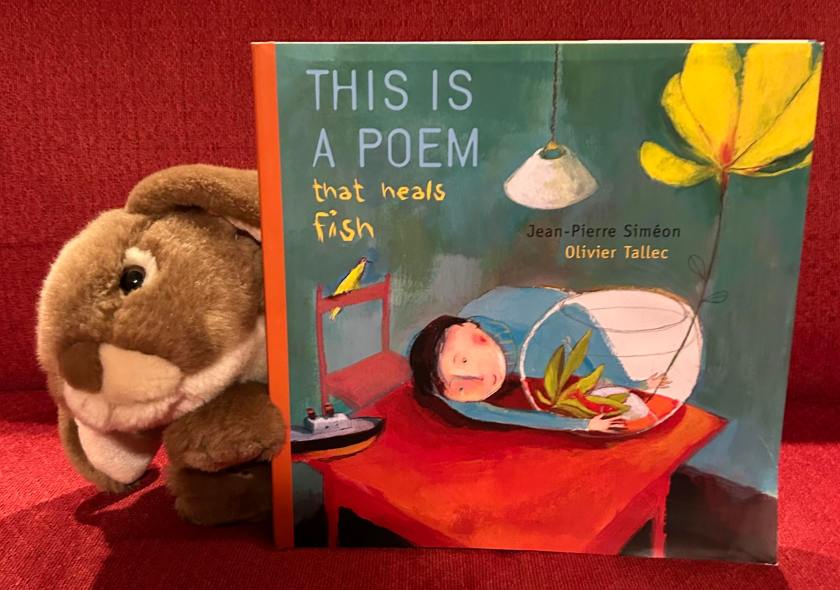
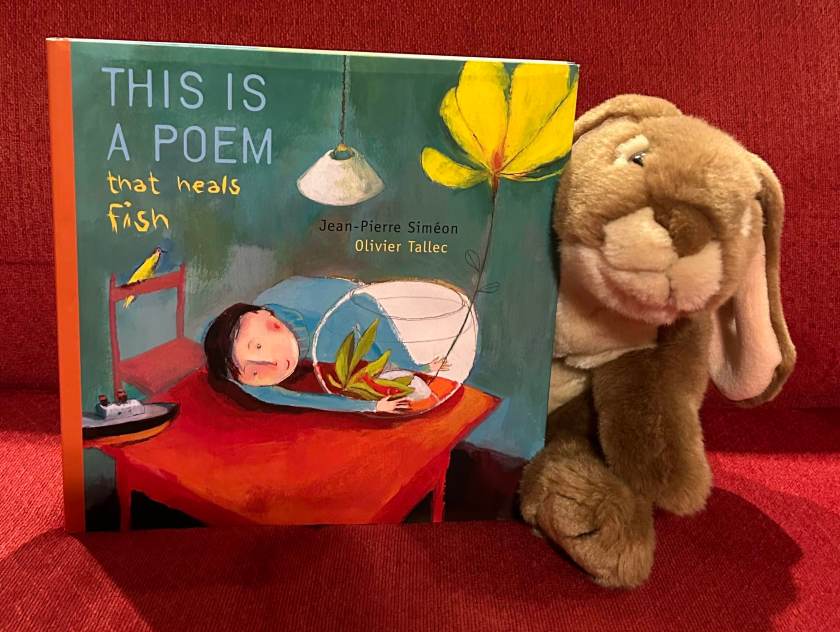
Today Caramel talks to Sprinkles about a neat picture book about poems: This is a Poem that Heals Fish, originally written in French by Jean-Pierre Siméon and illustrated by Olivier Tallec. The version Caramel read was translated into English by Claudia Zoe Bedrick and originally published in 2007.

Caramel reviews This is a Poem That Heals Fish written by Jean-Pierre Siméon, illustrated by Olivier Tallec and translated by Claudia Zoe Bedrick.
Caramel reviews This is a Poem That Heals Fish, written by Jean-Pierre Siméon, illustrated by Olivier Tallec and translated by Claudia Zoe Bedrick.

Sprinkles: So, Caramel, you know that I will be reviewing a poetry book this weekend. Is that why you picked this book to review today?

Caramel: No, actually, I just thought it might be cool to review it.

S: That makes sense. I do think this is a really cool book. Also very pretty. 

C: Yep, that is what caught my attention.

S: So why don’t we begin at the beginning? Can you tell us what this book is about?

C: This book is about a kid named Arthur whose fish Leon is sick. Or maybe bored actually. Anyways Arthur asks his mom what to do and she tells him to give him a poem. 

S: And then off she goes to play tuba, right?

C: Yep, how did you know?

S:You know I read this book too Caramel! I actually first read about this book in a blog post about it and had to get one for us. The pictures and the words, they were all so beautiful. I am so glad you liked the pictures too. 

C: Oh, I had no idea, but yes, I do like the pictures a lot! 

S: So happy to hear that! Okay maybe we can get back to the story of Arthur and Leon. So does Arthur know what to do when his mom tells him to give the fish a poem?

C: Not really. So he asks everyone he knows what a poem is. And everyone tells him something different. 

S: Can you give an example or two of the kinds of answers he gets?

C: One of them says that it is when you are in love and have the sky in your mouth. And another says that a poem is words turned upside down and suddenly the world is new. And another person says it is the heartbeat of a stone. And so on.

S: Which one of them is your favorite? 

C: I have no idea. It is hard to pick one. They are all slightly different and all together make up a really good definition.  

Caramel is reading This is a Poem That Heals Fish, written by Jean-Pierre Siméon, illustrated by Olivier Tallec and translated by Claudia Zoe Bedrick.

S: So how would you define a poem Caramel?

C: Hmm, I think it is a song of the heart. 

S: That is beautiful, Caramel! I love it! 

C: Why, thank you, I would like to think that that was very good of me.

S: Yes, I thought so. Anyways, I think this is the first poetry book you have reviewed for our blog. 

C: Not really. I know Marshmallow reviewed more books about poetry than me, but i also reviewed a poetry book. Remember Change Sings: A Children’s Anthem by Amanda Gorman and Loren Long? That was a good book to read and review, too.

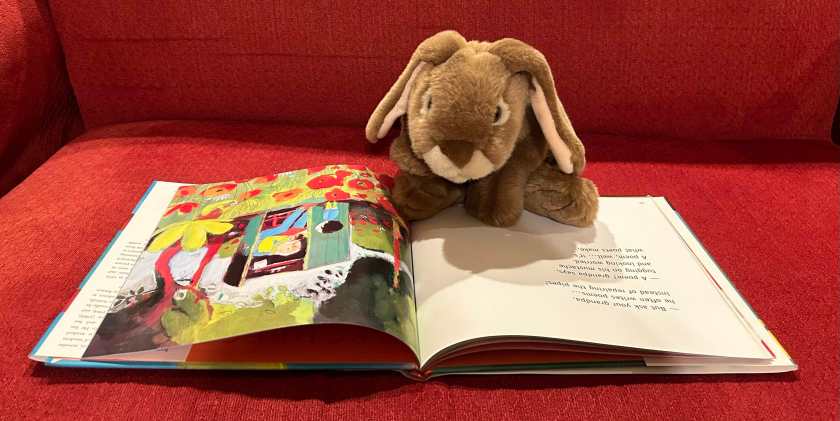
S: Oh yes. That is true. And this weekend I hope to review a few more poetry books. But I am glad you chose to talk about this book today. And I love that you posed with one of my favorite pages in the book with the grandpa and the red poppies!

C: I am always gracious like that! 

S: Yes, you are! Okay, so before we wrap things up, tell us if Leon the fish gets to feel better at the end.

C: Yes! He does!  Arthur tells his fish Leon all that he learned about poetry. And Leon is no longer bored. He says his silence is his poetry. 

S: That is kind of cryptic but also beautiful. 

C: Yup, creepy, too, a bit though. 

S: I guess one could think that. In his silence there is a lot going on, lots of meanings in words unsaid. I choose to think of it as beautiful. 

C: Yeah, I suppose that is a better way of seeing it. And more poetic!

S: Yep! So okay, maybe it is time to wrap up this review. What would you like to tell our readers?

C: Stay tuned for more book bunny reviews!

Caramel loved reading This is a Poem That Heals Fish, written by Jean-Pierre Siméon, illustrated by Olivier Tallec and translated by Claudia Zoe Bedrick, and sharing it with the readers of the book bunnies blog!