Today Caramel is reviewing World War II Encyclopedia of Aircraft, Tanks, and Warships by Chris McNab published in 2025. As usual, Sprinkles is taking notes and asking questions.
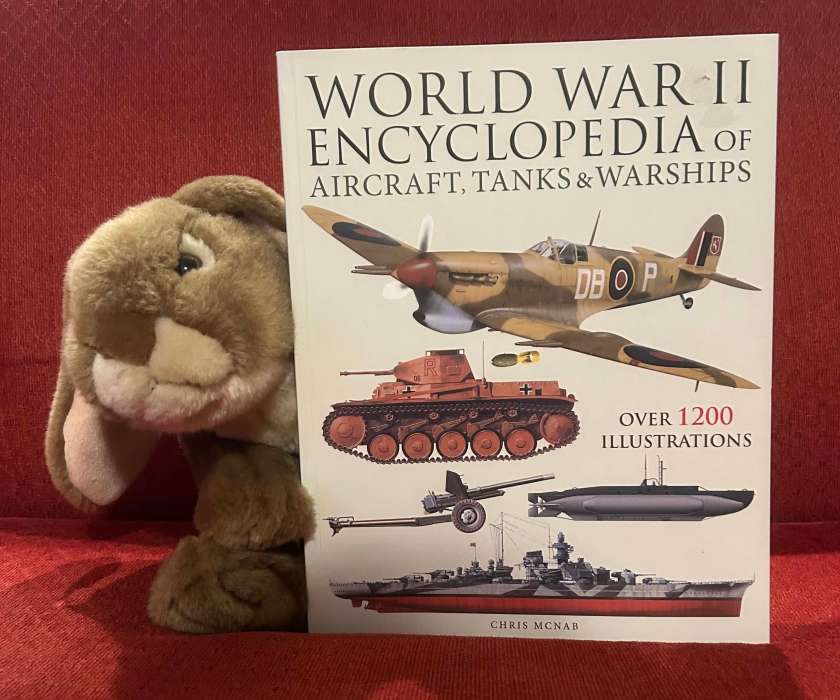
Sprinkles: So we are talking about a big book of facts again today.
Caramel: Yes, yes we are. It’s about planes and tanks and ships, some of my favorite stuff, and I think this same guy wrote the encyclopedia of dinosaurs that I reviewed many many years ago, too, so I guess I should have known I would like the book. He just seems to write cool books.
S: Well, it was clear you would like it because it is about World War II, aircrafts, tanks, and warships.
C: Yes, that, too.
S: Okay, so we know you liked the book. Then let us look into it together. Tell us about it.
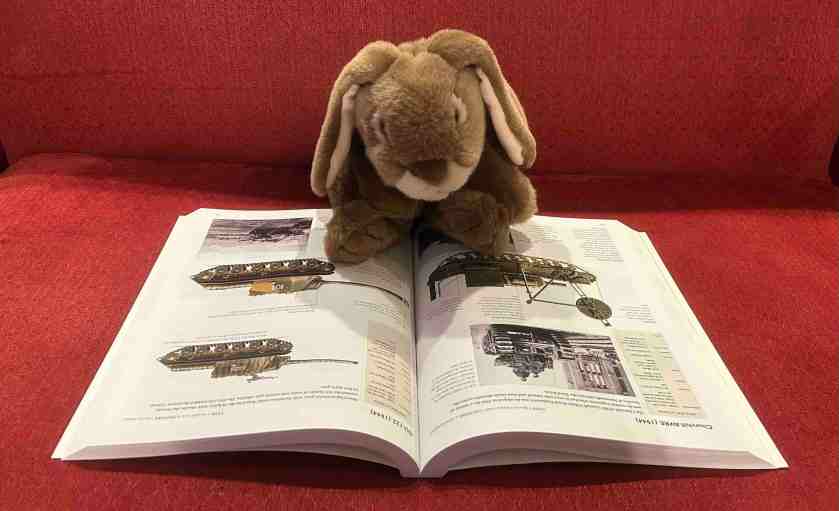
C: Well, it has a lot of illustrations. The cover says it has more than 1200! You know how I love my pictures, especially in a nonfiction book. There are three to five pictures on each page. Some are black and white photographs but many of them are in color and they are pretty detailed pictures of things. So I like them a lot!
S: Sounds like just the right book for you.
C: Yep.
S: So is it pages and pages of tanks and such?
C: Exactly. But first there are aircrafts. There is one type of aircraft on each page, and they go from page 10 till page 141, so there are more than a hundred and twenty planes!
S: That is a lot of different types of planes.
C: Yeah, a lot of different countries fought in World War II, and each of them had many different types of aircraft.
S: Okay, then after the aircraft what comes next? From the title of the book, I will guess: Tanks!
C: Almost. The next section is Tanks and Armored Fighting Vehicles. There are more than a hundred of these too.
S: So let me guess. Is the next section warships?
C: Nope. There is a section on Artillery, Anti-Aircraft, and Anti-Tank Guns. It is a little shorter, but it also has a lot of examples, maybe forty to fifty different types. And then comes the section on Warships.
S: Cool.
C: Yes, very cool. There are over a hundred of those, too.
S: I can see why you liked this book.
C: Yeah. I really like all of the pictures of planes and tanks and ships. They’re cool to look at, and I also like to see the stats, like what they weigh or what they carry. So for example I learned that a typical heavy warship is 11,000 tons of displacement. That is a lot of water!
S: Oh my! That sounds really heavy!
C: Yep.
S: So I think you particularly like planes and tanks. Tell me a bit about your favorites.
C: The F4U Corsair is my favorite plane. It is on page 108, and it is really cool. It has folding wings!
S: Wow! I didn’t know they made planes with folding wings; that is very cool.
C: It is! And the T-34 is my favorite tank. It was built and used by the Soviets and it had a huge impact on the war. They were cheap and quick to make and they were very powerful. There are two versions in the book. There is a 1942 version, on page 216, and then there is a revised version from 1944 on page 260. But I like the 1942 version best. I even made a model of it!
S: That is cool!
C: There is another one I find interesting. It is called the Churchill Crocodile, on page 251. It is a revision of the Churchill tank from 1941, which is on page 159. Both of them were British.
S: Why is the Crocodile interesting?
C: It is interesting because it is like a flame thrower on a tank.
S: That would be quite destructive.
C: Yes, I think so. The war was very destructive. I really just want to read about these machines because they are interesting as machines. I never want to really see them in real life, in a war.
S: Agreed, Caramel. But I do have one last question.
C: What is it?
S: Why was the Crocodile called a crocodile?
C: Because it had a tail, a fuel tanker at the back. And they thought it looked like a crocodile tail I suppose.
S: Hmm, that is interesting.
C: All of the book was very interesting.
S: I can see that! But it is getting late.
C: And it is once again a school night.
S: So is it time to wrap this up?
C: Yep.
S: So what do you want to tell our readers?
C: Stay tuned for more book bunny reviews!


RG’s comments:
I can see why Caramel would like this book. All kinds of neat machines.
My favorite was the P51 Mustang. Beautiful –and fast– airplane.
KG’s comments:
Yep, I knew Caramel would like such a book.
LikeLiked by 1 person