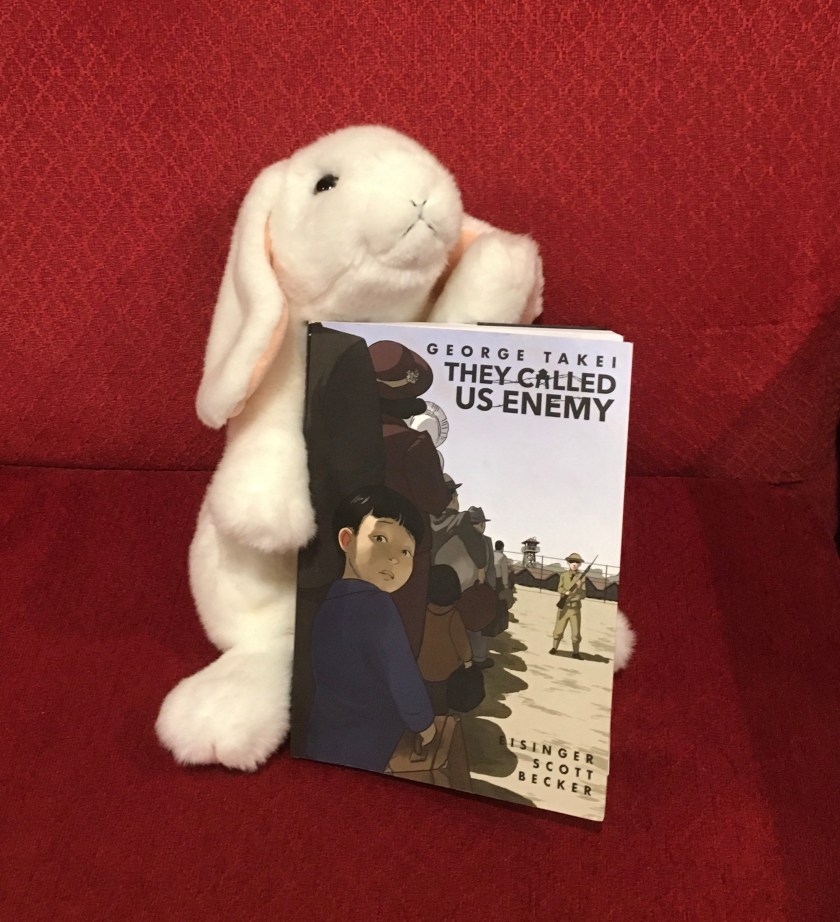
Marshmallow reviews Maus: A Survivor’s Tale by Art Spiegelman

Today Marshmallow reviews the first volume of Maus: A Survival Tale, Art Spiegelman’s graphic novel first published in 1986. Sprinkles is taking notes and asking questions.
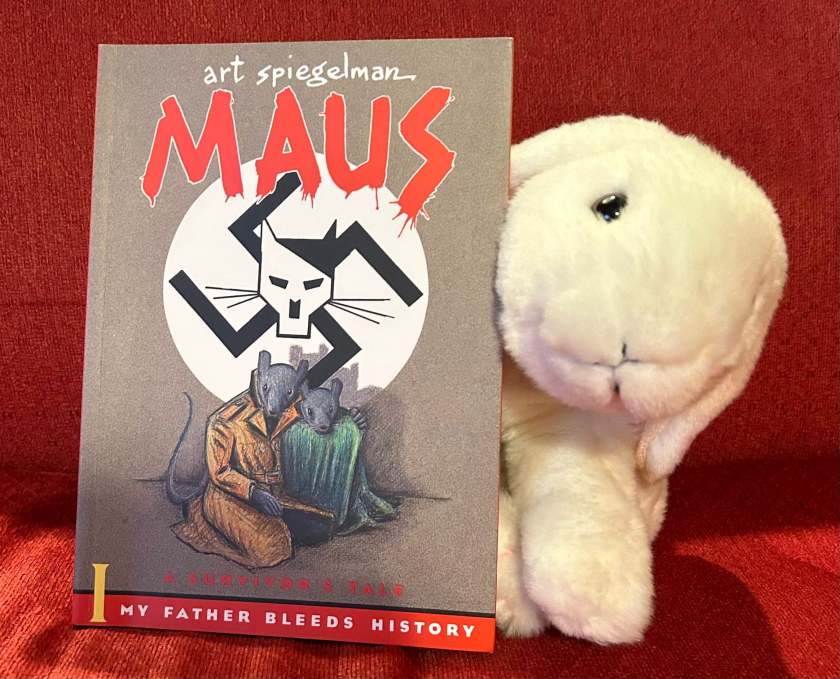
Marshmallow reviews Maus: A Survivor's Tale - I: My Father Bleeds History by Art Spiegelman.
Marshmallow reviews Maus: A Survivor’s Tale – I: My Father Bleeds History by Art Spiegelman.

Sprinkles: So Marshmallow, you chose to talk about a classic graphic novel today.

Marshmallow: Yes, we are talking about Maus: A Survivor’s Tale. This is in fact the first of two volumes, and Art Spiegelman published the second volume in 1991.

S: Okay, thanks for that important note. Wikipedia tells us that this is the first graphic novel that won a Pulitzer Prize. So I am glad you have read it and will talk with me about it.

M: I can see why it would get such an important prize. It is a very important book and it has a very important message.

S: Okay, so maybe it is about time to tell our readers what this book is about. They have already seen your photos with it, and they must be wondering.

M: Yes, sure. The book is about the Holocaust, and the imagery in the front cover is basically describing the main metaphorical device used in the story.

S: How so?

M: This is a graphic novel, as we said before, and all characters are animals. There are mice, and those are supposed to be the Jews, and then there are cats. Those are the Nazi Germans. Then there are pigs, who are supposed to be the non-Jewish Poles. And as I said before, the story takes place around the time of the Second World War.

S: I see. When you tell me all this, I am thinking of how sometimes a cat could be playing with a mouse just to have fun and even kill it with no remorse even when it does not need to eat it. I can see how the cat-mouse-pig metaphor could work.

M: Yes. The story is basically about Vladek who is the author’s father, and his experiences before and during the war. Vladek lived in Poland before the war, and when Germany invaded Poland, he and his family continued to live there. For a while they try to survive but eventually they are sent to the Auschwitz concentration camp.

S: That sounds intense!

M: It is. There is also a second story line, which is more or less the present day, or rather around the time this book was first published. The main story is basically the author’s father’s story, and the second story line is about the author as a grownup trying to connect with his father.
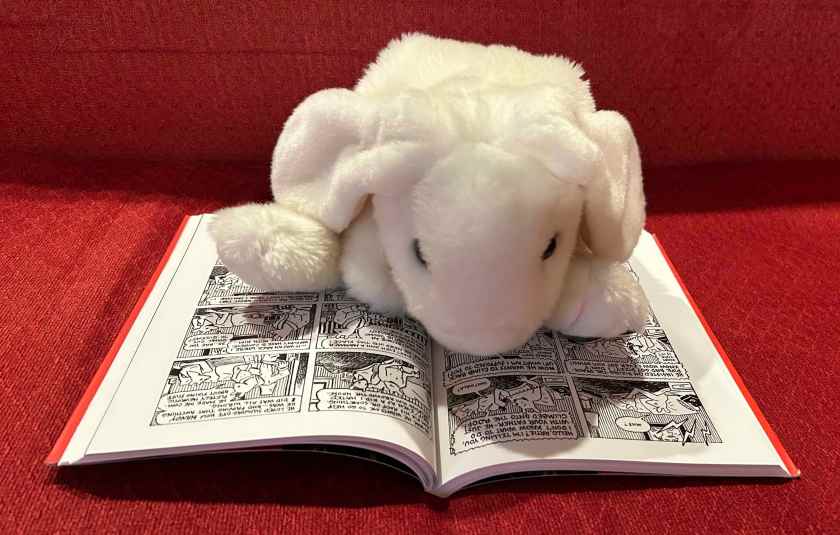
Marshmallow is reading Maus: A Survivor's Tale - I: My Father Bleeds History by Art Spiegelman.
Marshmallow is reading Maus: A Survivor’s Tale – I: My Father Bleeds History by Art Spiegelman.

S: Okay, so now we know the main plot lines and so on, but tell me Marshmallow, how was it like reading such a tough story in graphic novel form?

M: I thought it worked really well. It was very easy to visualize things, even though the characters are mice and cats and so on, because they had already been visualized for you. The book and its visual nature show the undeniably horrific nature of the Holocaust. You fully feel the pain of the mice, and knowing that these events actually happened to people, it makes the whole book even more impactful.

S: I wonder if the harshness of the realities the book is depicting can be related to why some people want to ban this book from school libraries. Some people want us to forget and never talk about these historical events, I am not talking about those people. But even those who believe we should teach this history might think that these stories are too hard to share with young people.

M: I understand why you want us to emphasize that the themes and imagery of the book might be disturbing to very young readers. There is violence in the book. But I also think it is very important for young bunnies to know what happened. And this book does a very good job in telling exactly what happened. And maybe ironically, the use of animal characters allows you to end up seeing the humanity of the victims of the Holocaust very clearly.

S: You make a very good point Marshmallow.

M: Thank you. I also wanted to say the book reminded me of Animal Farm a bit because it shows the worst aspects of humanity under the guise of animals. The animal characters allow us to look at ourselves and see how terrible we truly are or can be. Since we are not seeing humans, we can see things more objectively.

S: That makes sense to me, too, Marshmallow. Okay, this is already a pretty long post. Before we wrap things up, can you tell me how you would rate this book?

M: I’d rate it 100%. It is a striking and impactful book. And I recommend it strongly. It is important for bunnies to understand the magnitude and the impact of these events.

S: Okay, thank you Marshmallow. So last words?

M: Stay tuned for more amazing reviews from the book bunnies!
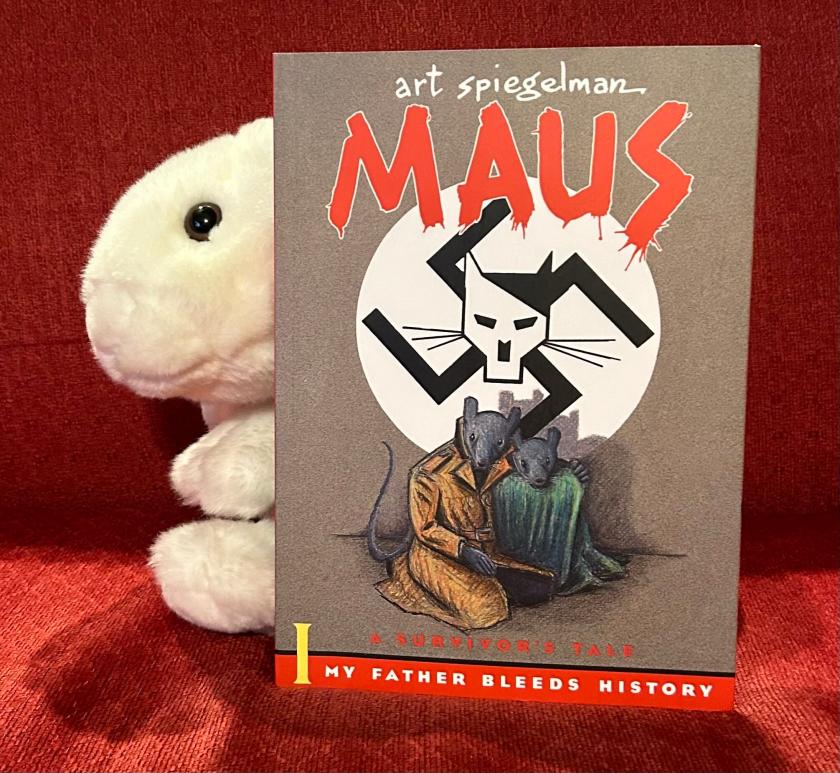
Marshmallow rates Maus: A Survivor's Tale - I: My Father Bleeds History by Art Spiegelman 100%.
Marshmallow rates Maus: A Survivor’s Tale – I: My Father Bleeds History by Art Spiegelman 100%.

Marshmallow reviews Refugee by Alan Gratz

Marshmallow has recently read Alan Gratz’ novel Refugee and below shares her thoughts on this moving fictional account of three refugee children across recent history. As Marshmallow also points out below, the stories are harsh and harrowing. The publisher recommends the book for 8 and up, so does Marshmallow.

Marshmallow reviews Refugee by Alan Gratz.

Marshmallow’s quick take: If you like realistic and historical fiction, then this might be the book for you. (Warning: This is a very harsh book and should not be read by readers under 9.)

Marshmallow’s summary (with spoilers):

“JOSEF is a Jewish boy living in 1930s Nazi Germany…”
“ISABEL is a Cuban girl living in 1994…”
“MAHMOUD is a Syrian boy in 2015…”

All of these kids are relatable and normal. Their experiences, on the other hand, are something that nobody should have to face. 

Josef’s father is taken away to a concentration camp called Dachau. When he comes back, his family is overjoyed but when they see him they realize that he is mentally disturbed. The family then receive news that they have to leave Germany in fourteen days. 

Isabel lives on the streets, and when her father gets involved in a protest, he is told to leave. 

Mahmoud is a present-day Syrian boy and he learns that to stay away from bullies you have to be “invisible”. Then his house is bombed and it becomes clear that he has to leave.   

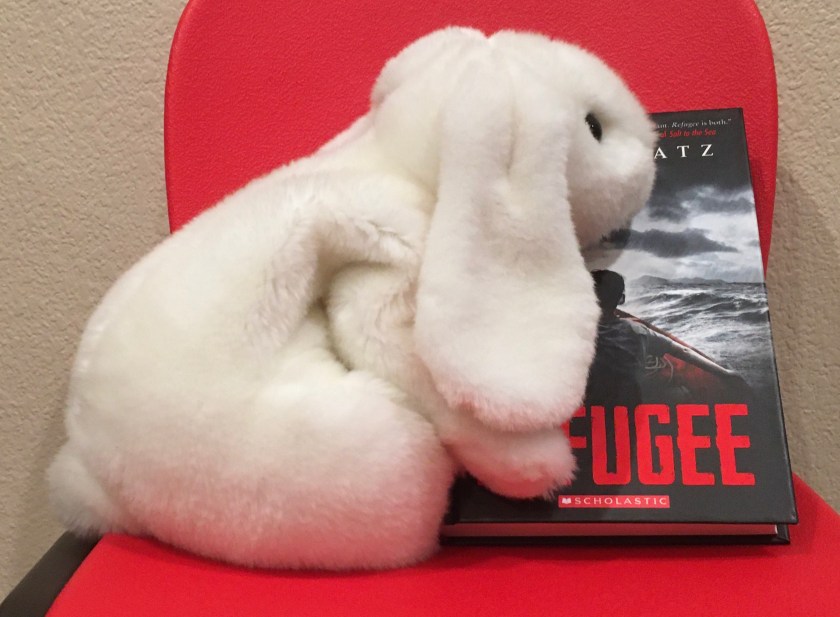
Marshmallow is looking up from reading Refugee by Alan Gratz.

These three different families set out on the same mission: make it to a safe place. This for Josef is Cuba, for Isabel it is el norte, the US, and for Mahmoud it is Germany. Along the way, all lose someone that they care about, whether physically or mentally. 

Josef’s family is breaking up and his father is scared. They board a ship called The St. Louis in order to escape the Nazis, but eventually Josef’s father tries to commit suicide by jumping off the side of the ship.

“Josef’s father was gone. His mother was unconscious. His little sister was all by herself. And they would never let Josef’s family into Cuba now, not after his father had gone mad. Josef and his family would be sent back to Germany. Back to the Nazis.
“Josef’s world was falling apart, and he didn’t see any way to put it back together again.”

Sadly, he never does. Josef never makes it to Cuba and only two members of the Landau family survive. 

Isabel tries to escape from Cuba with her family and her friend’s family. They build a boat to escape but soon they face the fury of the ocean. 

Mahmoud and his family start the long journey to Germany and lose each other in order to save each other. 

“All three kids go on a harrowing journeys. All face unimaginable dangers. But there is always the hope of tomorrow. And although Josef, Isabel, and Mahmoud are separated by continents and decades, shocking connections will tie their stories together in the end.”

The publisher’s video about the book Refugee by Alan Gratz.

Marshmallow’s review: This is a very good book. It might be the most moving book I have ever read, but it should definitely not be read by younger readers. It has stories about the Nazis and other terrible things that children should not learn about until a little bit older. Though Josef’s story is fictional, it is very similar to what happened to a lot of Jewish families. Isabel has terrible losses and she faces many dangers. Mahmoud’s family is eventually drained of joy in the journey to Germany and to safety.

Marshmallow’s rating: 100% (but this is not happy reading…)

Marshmallow rates Refugee by Alan Gratz 100% (though it is definitely not a happy book).

Marshmallow reviews They Called Us Enemy by George Takei

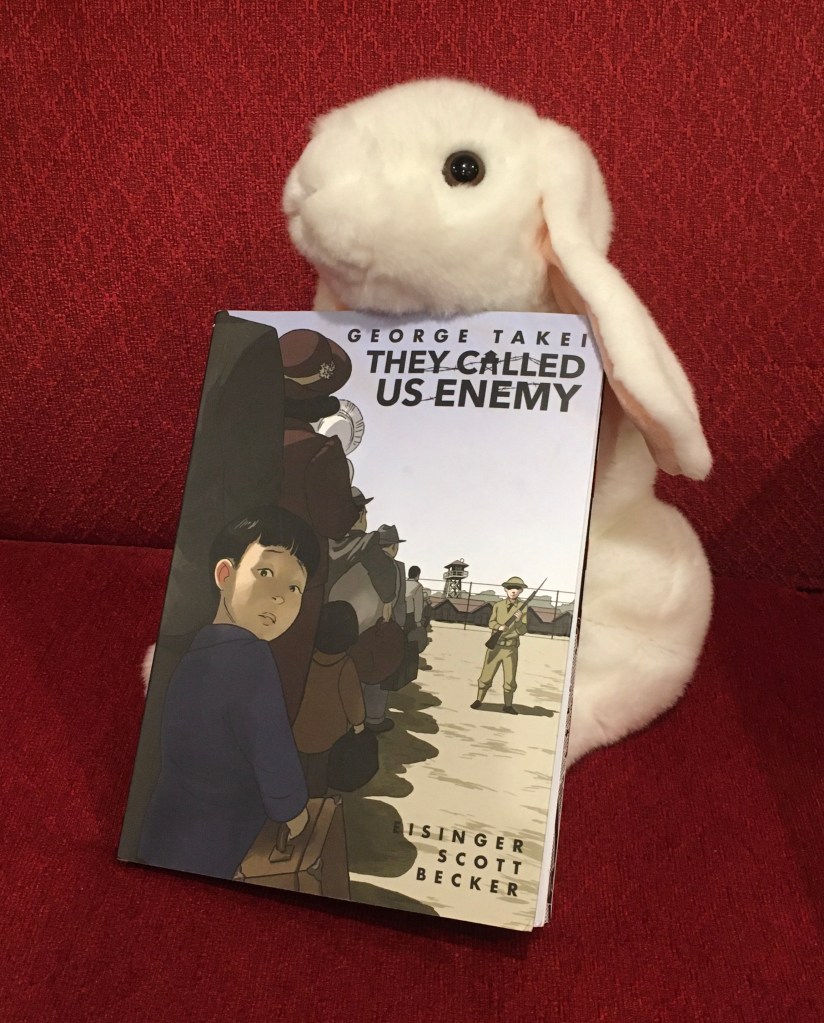
Marshmallow enjoys graphic novels just like many other bunnies, but she has been especially taken by a 2019 book, the memoir They Called Us Enemy, written by the Star Trek veteran George Takei together with Justin Eisinger and Steven Scott, and illustrated by Harmony Becker. Below she shares her thoughts on this striking book.

Marshmallow reviews They Called Us Enemy, written by the Star Trek veteran George Takei together with Justin Eisinger and Steven Scott, and illustrated by Harmony Becker.

Marshmallow’s Overview: In the book They Called Us Enemy, George Takei writes about what it was like to live in a Japanese internment camp. The internment camps were places where the USA put Japanese Americans and people who had come from Japan to find better opportunities in the USA during the second world war.

This was a dark time in American history that is not always emphasized. According to Wikipedia:

In 1988, President Ronald Reagan signed into law the Civil Liberties Act of 1988 which apologized for the internment on behalf of the U.S. government … The legislation admitted that government actions were based on “race prejudice, war hysteria, and a failure of political leadership.”

https://en.wikipedia.org/wiki/Internment_of_Japanese_Americans

George Takei was put in an internment camp when he was a little boy. He stayed there for four years. The time that he spent in the camps was very important and affected his whole life. This book tells his story.

Marshmallow’s Summary: One day, George wakes up and he and his family are ordered to leave their home. As a reaction to the bombing of Pearl Harbor, the US government gathered most Japanese immigrants and Japanese Americans and put them in the camps because many Americans thought that they might betray the United States of America. George does not realize any of this because he is a little boy at the time that he is put in the camp.

George’s family has to board a train to get to the camp and they can only bring what they can carry and that is not much. To add on to that, the government makes them sell everything else that they own. 

When they get to the camp, they see that it is in the middle of nowhere and that they are surrounded by barbed wire and watch towers that have men with guns watching then. George and his family, which includes his brother, Henry, his sister, Nancy Reiko, his father, Takekuma Norman Takei, and his mother, Fumiko Emily Nakamura, have to sleep in a tiny house split by walls that are not sound-proof and their neighbors are able to hear everything that they say. So, in the end the parents decide that they will speak Japanese to each other when talking about private stuff.

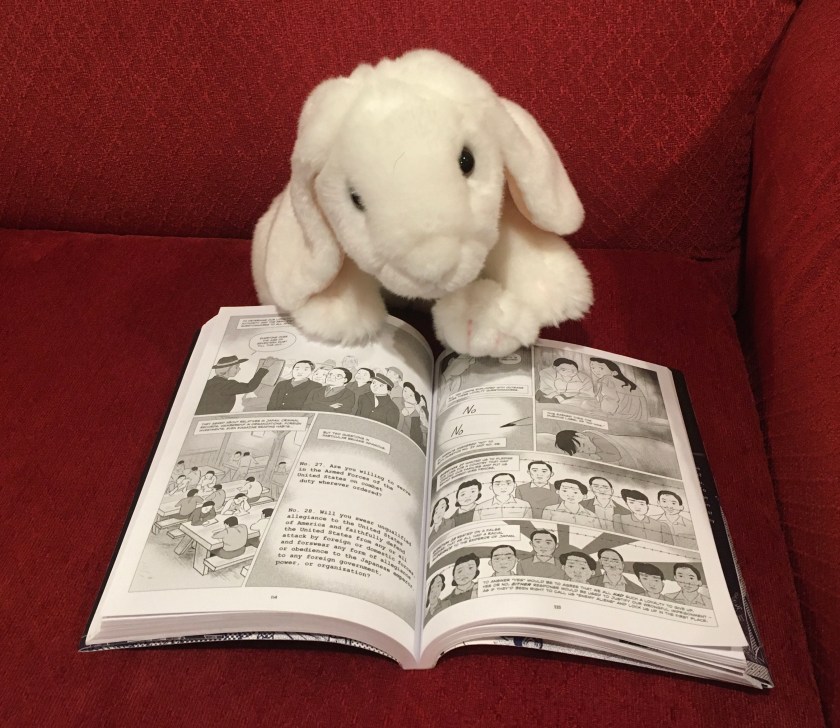
They Called Us Enemy is a graphic novel with very realistic drawings. Marshmallow is pointing to the page where George’s parents are frustrated and outraged by the way they are treated.

When they come to the house it is very hot. The book compares it to a furnace. When they were in the camp, many people lose loved ones. For example, Mrs. Takahashi loses her husband because he is a Buddhist minister. She has four children. Those four children lose their father. Mr. Yasuda is taken by federal agents because he is teaching children how to speak Japanese.

“Their husbands’ only crimes were that they occupied highly visible positions…”

Not only are they being taken from their homes, but they are also losing family and friends.

Marshmallow’s Review: This was a very bad time for many people and this book shows how devastating it was. It is a very good book that captures the essence of how important this event is in American history. The internment of Japanese Americans was a big event especially for people who suffered though it and lost members of their family and friends. It is also important for us today. We need to know our past so we don’t make similar mistakes in the future.

Marshmallow’s Rating: 100%.

Marshmallow rates They Called Us Enemy, by George Takei, written together with Justin Eisinger and Steven Scott, and illustrated by Harmony Becker, 100%.