Marshmallow reviews Fiske Guide To Colleges 2026 (42nd Edition) by Edward B. Fiske

For her last review before the book bunnies take off for the month of July, Marshmallow picked a book she has spent a lot of time with these past few weeks: The Fiske Guide To Colleges 2026 (42nd Edition) by Edward B. Fiske.

Marshmallow reviews Fiske Guide To Colleges 2026 (42nd Edition) by Edward B. Fiske.

Marshmallow’s Quick Take: If you are a high school student approaching the college application season, or if you are related to one, then this is the book for you!

Marshmallow’s Summary (with Spoilers): The Fiske Guide To Colleges 2026 is organized very well! It has a comprehensive table of contents at the start to lay out every opportunity for exploration it will give you in the pages to come. There is an Index by State and Country, an Index by Price, an Index by Average Debt, and The Best Buys of 2026. Those first couple pages contain enough valuable information alone to justify obtaining a copy of this book. But what really makes this more valuable than just lists alone is what lies below those lists.

The Introduction and the “Sizing Yourself Up” section remind you of what the college search is supposed to be about. Instead of hunting for the lowest sticker price or the greatest name recognition, the reader is encouraged to remember that there are infinitely more factors to take into account in what should be a search for the educational nursery that will hopefully prepare you for a successful future later on in life.

There is a handy-dandy survey you can take which helps you evaluate what it is you want in a college; this is very useful, and I am not just saying that because I love taking Buzzfeed quizzes! While taking that test, I realized that there are many more aspects to the admissions process to consider while making your list. If half of the schools on your list are not places you would actually like to be in, then you are likely making a mistake.

For those who are certain in their choices and the path they want, there is a section titled “A Guide for Preprofessionals.” There is also a page listing the schools with the strongest support for students with disabilities; this could be life changing for many. The next part is also similarly crucial. Each school has two to three pages describing what life is like for students on campus, from architectural style to weather to culture to food to average political affiliations.

Personally, I have found that finding a good fit has been very difficult for me. When most colleges are in different states and you can’t really visit most of the places on your list, getting a feel for the “vibe” of a place is pretty hard. But with this book, you can get a much better sense of what life could look like for you in different places. There is no doubt that the college applications process is a truly stressful time, but with this book you will definitely feel much more comfortable and informed as you look ahead into an uncertain future. 

Marshmallow is reading Fiske Guide To Colleges 2026 (42nd Edition) by Edward B. Fiske.

Marshmallow’s Review: I really, really appreciate Mr. Fiske and his team. I am very glad they took the time to write beautifully detailed entries for each school, not to mention the little information bars that go with each. Each entry has a box with the school’s website, location type, private / public designation, total enrollment, undergraduate count, male to female ratio, financial aid stats, Pell Grant stats, expense, student loan stats, average debt, applicant pool size, acceptance rate, enrollment rate, graduation rate, returning freshman rate, academics assessment, social life assessment, quality of life assessment, admissions info, and strong programs. I think this is the best way to learn more about schools besides visiting a place physically. Helpful indexes also help you break down how the book analyzes and ranks different parts to consider. I specifically, especially liked how the book emphasizes the social life and quality of life of different schools. Personally, I do not want to go to a school with too much of a Greek life focus and this has been one of the clearest ways for me to get a sense of different opportunities at different schools. There is also a box at the end of each entry for each school that tells you the details of how to apply to each individual school (such as their testing policy with the SAT and ACT).

Overall, The Fiske Guide To Colleges 2026 has been a really, really helpful resource for me. It has actually opened my eyes substantially to all the different opportunities and futures there are. I used to be a lot more narrow-minded in where I was going to apply, but I’ve definitely crossed off certain places and added new ones because I realized that I simply had not known enough about each school. Every place is uniquely perfect for someone and, with this book, you can feel much safer and much more confident while you search for your place in college.

A quick note for those looking into earlier editions of the book: I also had the chance to peruse the 2024 edition, and I did not see too many differences in coverage and content. So I was happy to get my paws on the latest edition, but other recent editions can also do the job if they are easier to access.

Marshmallow’s Rating: 100%.

Marshmallow rates Fiske Guide To Colleges 2026 (42nd Edition) by Edward B. Fiske 100%.

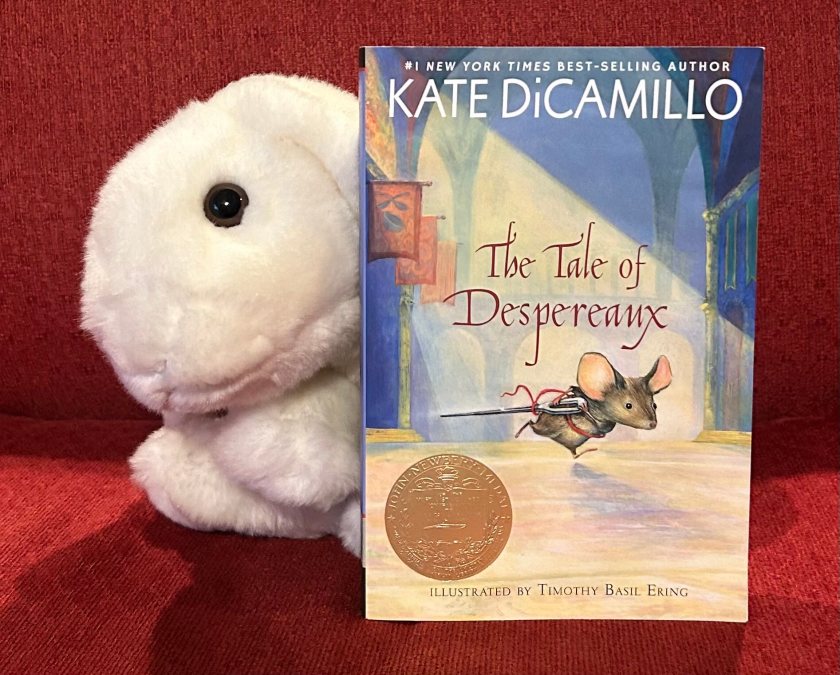
Marshmallow reviews The Tale of Despereaux by Kate DiCamillo

Marshmallow has always enjoyed the books of Kate DiCamillo. She has also reviewed a handful of them for the book bunnies blog. (See her posts about Flora and Ulysses, The Miraculous Journey of Edward Tulane, and The Magician’s Elephant.) Today she reviews The Tale of Despereaux: Being the Story of a Mouse, a Princess, Some Soup, and a Spool of Thread by DiCamillo. Originally published in 2003, The Tale of Despereaux won the 2004 Newbery Medal and it was the first book by DiCamillo that the book bunny household read–or more accurately listened to as an audio book.

Marshmallow reviews The Tale of Despereaux by Kate DiCamillo.

Marshmallow’s Quick Take: If you like cute books that are akin to fairy tales in their rich, classical storytelling, then this is the book for you! 

Marshmallow’s Summary (with Spoilers): Despereaux was born to a French mouse whose favorite word was “disappointment.” Along with his family, he lives in the king’s castle in the land of Dor. Unfortunately, he is quite the disappointment both to his mother and the rest of his family. He is extraordinarily, peculiarly small but his ears are extremely large in proportion. On the first day of his life, his family was also shocked by how curious he was; they say he was born with his eyes open. This was just the start of his bizarre behavior–at least in the opinion of the other mice.

Despereaux also lacks the instinctual fear other mice believe is integral to the very essence of being a mouse. He doesn’t scurry, much to their dismay, and doesn’t realize the importance of scavenging for crumbs. Not only that, he does not eat books; he actually reads them. So Despereaux overall is a very big disappointment to his mother, father, and the general mouse community in the castle. They still love him, but they are simultaneously in a state of shock. They are even more shocked when they see him interacting with a human. Specifically, Princess Pea who is the only daughter of the king.

Drawn to her first by music, Despereaux eventually falls in love with the princess (which is definitely a little unusual given their vastly differing sizes). However, his love is true. The rest of the mice community doesn’t appreciate her understanding nature and believe human-mice interactions are a threat to all. They banish Despereaux to the dungeons which are infested with rats. Rats, unlike their more timid mouse counterparts, are violent and dangerous. Suffice it to say, Despereaux finds himself in some hot water.

At the same time, a rat named Roscuro is plotting revenge on Princess Pea. He convinces one of the castle maids–an abused young girl named Miggery Sow or “Mig”–to help him kidnap Princess Pea and promises her Pea’s crown. With Princess Pea in danger, Despereaux takes up the mantle of those he read about in fairy tales and becomes her knight in shining armor. He might be a mouse but his lionhearted fearlessness and unwavering love make him an unstoppable force!

Marshmallow is reading The Tale of Despereaux by Kate DiCamillo.

Marshmallow’s Review: The Tale of Despereaux is a beautiful, adorable book! I love reading DiCamillo’s writing. It is unbelievably comforting and descriptive. Her books, particularly this one, feel like a rich, home-cooked meal. They remind you of the fairy tales we’ve all grown up with but an even more heartwarming version.

I love how adventurous and suspenseful this book is while it maintains its child-friendly style. DiCamillo is a master of prose that balances action with heart and character building. The plot is nicely, neatly wrapped up.

As a whole, The Tale of Despereaux is a very entertaining and moving book that is excellent in a touching yet understated way. I would highly recommend reading it to everyone! The message of strength, love, understanding, forgiveness, and openmindedness is something everyone can appreciate and learn from, regardless of age!

Marshmallow’s Rating: 100%.

Marshmallow rates The Tale of Despereaux by Kate DiCamillo 100%.

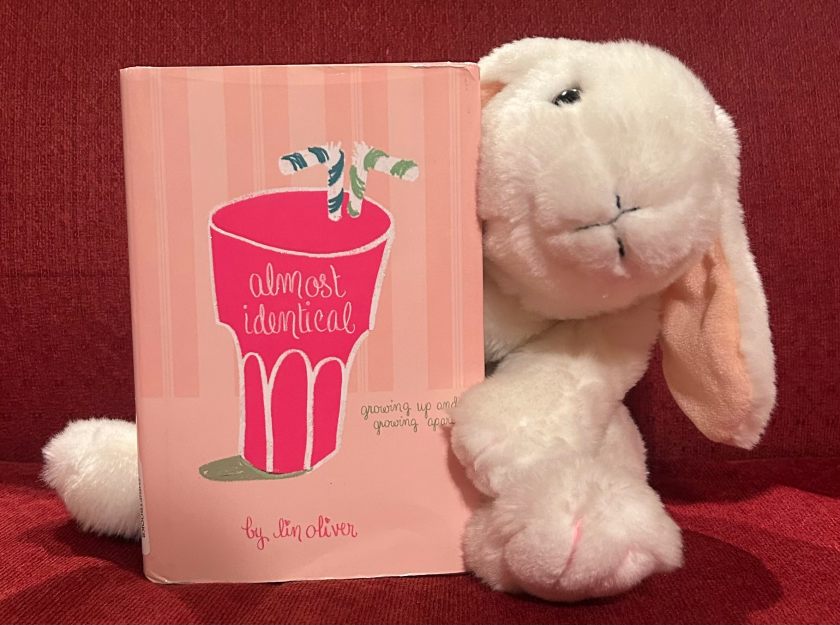
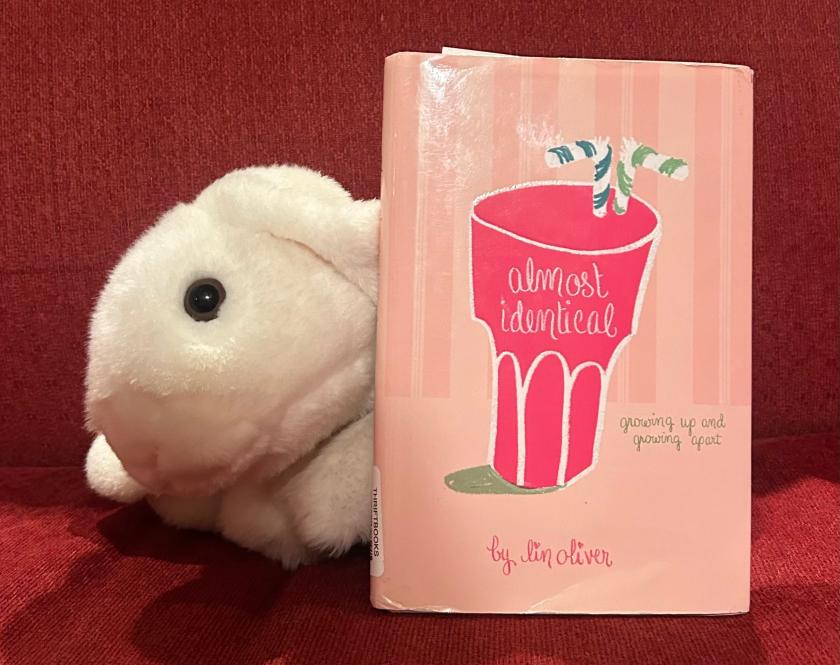
Marshmallow reviews Almost Identical by Lin Oliver

Today Marshmallow reviews Almost Identical, the 2012 book by Lin Oliver that starts the eponymous four-book series. This book series was recommended to the book bunnies by a reader of the blog: thank you, you-know-who-you-are!

Marshmallow reviews Almost Identical by Lin Oliver.

Marshmallow’s Quick Take: If you like sweet stories that surprise you with their depth and potential significance to your own life, then this is the book for you!

Marshmallow’s Summary (with Spoilers): Sammie and Charlie Diamond are identical twins. Though their names might not sound like it, they are both twelve year old girls (twelve years and three quarters to be exact!) Being identical twins, they’ve done everything together since birth. They are extremely good tennis players and compete constantly in doubles leagues. This is mostly due to their father’s desire to live somewhat vicariously through their success. He was set to become a professional player but was injured in a game and had to have a career-ending surgery. Now, he works as the athletic director at the Sporty Forty beach club in Santa Monica teaching tennis and supervising things in general.

Luckily, the family and GoGo (the girls’ grandmother) are allowed to live in the old caretaker’s beautiful bungalow for free by the beach. Unluckily, Sammie and Charlie’s mother is off in Boston at culinary school so she can start up a restaurant when she comes back. That means Sammie and Charlie are on their own to deal with their annoying older brother Ryan. They have plenty to worry about besides him though. Moving from Culver City Middle School to the more affluent Beachside Middle School is a bit of a jarring change.

One girl in particular–Lauren Wadsworth–is so rich and famous and smart and beautiful (allegedly) that they had heard about her before moving. The cool kids / jocks call themselves the SF2s because they are the second generation of the owners of the Sporty Forty (which is owned by several very wealthy families). Sammie and Charlie meet Lauren before school starts though as she is hosting her birthday party at the club; because she has a crush on Ryan, Lauren eventually invites all three of the Diamond children to the event.

This is the start of the end for Sammie. Before all of this, she was already being essentially attacked by her father and brother for being ‘too heavy.’ At the party, she is reminded yet again that she does not fit in as well as Charlie. Charlie is desperate to get in with the in-group and she does well, especially since Lauren can’t wait to get closer to the Diamond family (though she is mostly interested in a specific annoying eighth grade boy…cough, cough, Ryan).

Basically, Charlie fits in. Sammie, on the other hand, does not. She is uncomfortable around the girls and feels like she has to constantly be putting on a fake performance to hang around them. When she leaves to play Frisbee with the boys on the beach, she is quickly told that Charlie is “the hot version of you.” This feeling of growing alienation between Sammie and the SF2s and Charlie remains long after the party is over. Sammie feels most comfortable with the ‘weird’er kids, like Alicia whom she meets at the party. After immigrating from El Salvador at the age of three, Alicia’s family is integrated into the club in a different way from most of the party guests. Her mother works essentially as a maid while her father is the groundskeeper. She is similarly an outsider and the two girls click.

The only thing is that Sammie and Charlie no longer do. Like it says on the book’s cover, they are “growing up and growing apart.” Charlie is doing pretty well for herself in the cliquey SF2 group while Sammie is starting to embrace her more authentic, unique identity at a school club called the Truth Tellers (where students practice and perform stand-up speaking intended to reveal personal stories to the audience in a meaningful way). The two girls were always “two halves of a circle” but change is the only constant. Within three weeks, Sammie and Charlie slowly realize that they are more different than they thought; with new, growing identities, they are no longer almost identical.

Marshmallow is reading Almost Identical by Lin Oliver.

Marshmallow’s Review: Almost Identical is so very well done! I think the author deserves a round of applause for handling a relatively overused trope with new nuance and depth. This was the first time I read a book about siblings or best friends growing apart in different directions and I felt like it was truly a detailed account of the storyline. Oftentimes, pre-teen books or teen books about growing up and change in middle school have to resort to the typical Mean Girls level of characterizing certain cliques. This book did also have the SF2s, which are somewhat similar. However, it felt a lot more realistic and less cartoonish. I really liked the Mean Girls movie, but Oliver’s novel is a lot more grounded in reality and speaks more to the true middle school experience than most other, more exaggerated accounts do.

Sammie is a very impressive young girl and seeing things from her lens is both heartbreaking and heartwarming. She definitely suffers a lot from body shaming as her father is determined to make her into the best possible tennis player. He believes she is too heavy and that her weight is slowing her down, despite the fact that she is not really overweight in the first place. Her brother joins in unhelpfully in the worst possible situations and his girlfriend-to-be a.k.a. Lauren soon follows suit. Within the first chapter, you develop a deep sympathy for Sammie and she is a very likeable protagonist.

I think the author was very smart to start the book the way she did as it curries favor with the reader to like Sammie almost instantly. This book–as it is told by her–portrays Sammie as the morally correct, wiser of the twins. However, Charlie’s growth is also portrayed in a relatively nonjudgmental light at the end. I really liked how the rapidly expanding rift between them is eventually accepted as separate paths that will define them as different people. This was handled in a very soft, beautiful way.

I feel like this story of struggling, navigating, and then willing letting yourself be taken by change is relevant to more than just middle schoolers. As a high schooler realizing that things are changing and will continue to change a lot more, I found this story very comforting. It gave me a sense of clarity that, despite continual change and occasional chaos, impermanence can lead to new places, perspectives, and people you had never considered before. That is a lesson I think we can all benefit from.

Given its accessible and entertaining prose, I think Almost Identical is a very sweet story that would be amazing for all bunnies. Of course, it is most important for pre-teens and teens to read about situations that most closely align with their own experiences. But adults shouldn’t scoff at the idea of reading this book either! Caramel and I aren’t twins, but I hope he reads this book too. Change is an undeniable, unyielding force in our universe, and reading these seemingly small works of human art can serve as a tether to what grounds us as the world seems to transform around us.

I would like to especially thank the reader who recommended that we read this book! Even though the author finishes this book in a satisfying manner, I look forward to reading the next book of this series!

Marshmallow’s Rating: 100%.

Marshmallow rates Almost Identical by Lin Oliver 100%.

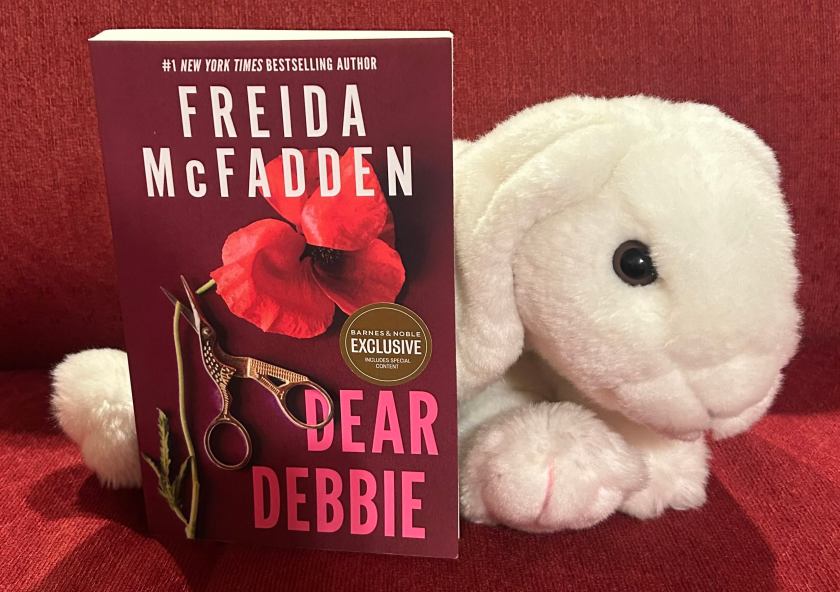
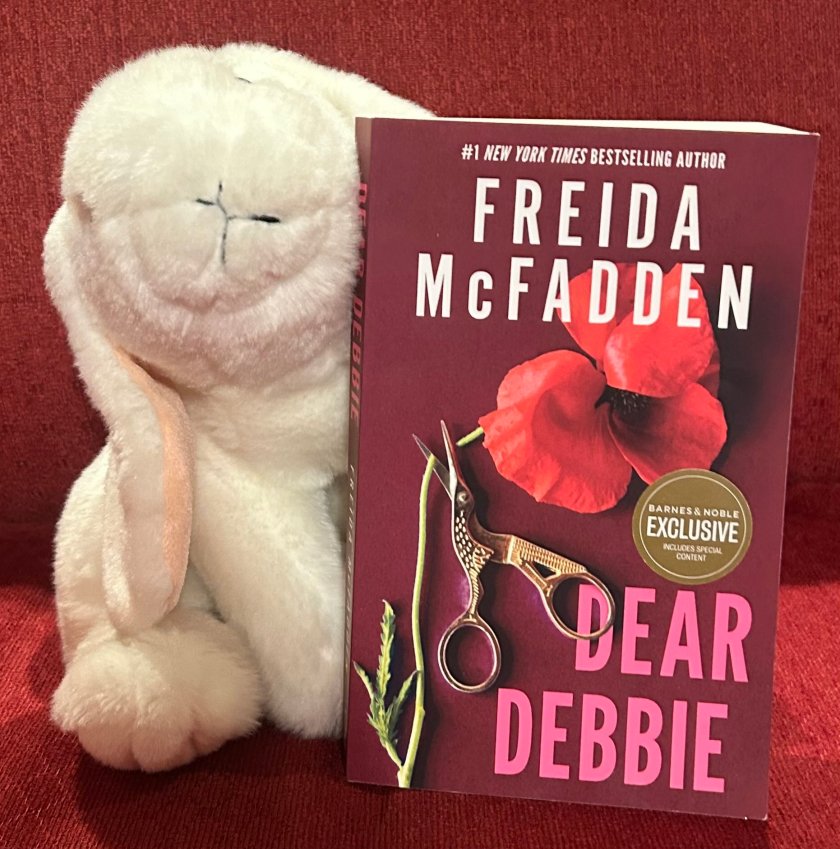
Marshmallow reviews Dear Debbie by Freida McFadden

Today Marshmallow reviews Dear Debbie, a psychological thriller by Frieda McFadden published in 2026.

Marshmallow reviews Dear Debbie by Freida McFadden.

Marshmallow’s Quick Take: If you like books about murder, revenge, and vigilante justice, then this is the book for you! 

Marshmallow’s Summary (with Spoilers): Debbie Mullen might seem like a happy, contented housewife, but she has secrets far beyond what meets the eye. Like most mothers of teenagers, she is struggling to keep communication open with her two daughters, Lexi and Izzy. Lexi is a brilliant honors student senior but her boyfriend Zane is basically a stereotypical jerk. He is exactly the type of person that every parent hopes their child stays away from. So that is a bit of an issue for Debbie, as Lexi is determined to keep on seeing Zane and keep Debbie out of her life. Izzy is not as stereotypically rebellious, but she is silently hiding her problems from her parents too. Since she started playing soccer at a young age and she loves the sport with all her heart, Izzy has become one of the best players on her school’s team. Naturally, it is a bit of a shock for Debbie to learn that Izzy was kicked off the team (or possibly quit, though Izzy won’t tell her which). All of this chaos coincides with Debbie being fired from her part-time job at the local newspaper where she runs an advice column called ‘Dear Debbie’ (hence the name of the book!) Frankly, she is not having a good time.

This was not the life Debbie had imagined for herself when she was younger. With an IQ of 178 and an acceptance to MIT, she was told she would be the next Bill Gates. Unfortunately, she dropped out around halfway through for reasons she keeps hidden from everyone around her. Now, Debbie loves her family but feels under stimulated and underestimated. She keeps herself busy by maintaining an immaculate house and a lush garden, building apps every now and then, and keeping her family safe. She developed one app named Findly that allows her to track her family members (with their consent, of course, and in turn they can track her whereabouts at all times). That is how she learns that her husband is acting strange, “driving” around at night and turning off his location sharing for long periods of time. This is a cause for concern, but she also has other things to worry about, specifically, other people who she feels need to be brought to justice.

Debbie keeps a file on her laptop of secret Dear Debbie responses she wrote but never sent because they all ended with her advising the reader to take matters into their own hands in often violent ways. She decides to take her own advice and becomes somewhat of a housewife from hell. You’ll be surprised by how layered her plans are because nothing she does is unintentional.  

Marshmallow is reading Dear Debbie by Freida McFadden.

Marshmallow’s Review: Whatever you think about Dear Debbie, it is definitely a very impressive storytelling job. I did not see the main plot twist coming at all. I saw some of the others, but not the main one! I was shocked by how everything ended up being neatly tied together. Some of it felt a tiny bit like a stretch, but it was overall extremely impressive. Frieda McFadden seems to write a lot of this type of book, with “shocking central plot twists”, and I can tell that she has gotten very very good at it.

I enjoyed reading Dear Debbie and found its plot to be stimulating; it kept you constantly guessing at what was to come. I also liked how the story was told from several different perspectives and how that style ended up concealing certain key parts that were revealed at the end in a rather fantastic manner. Debbie is a bit of a psychological case study though. She is extremely good at managing her emotions on the surface but creates karma in secret in ways that are definitely illegal.

I would like to suggest that thrillers like this may have normalized murder a bit. And this is the first book I have read written from a murderer’s perspective, so I found it very disturbing. I did not like how simply and matter-of-factly she pulled the trigger(s). I don’t think bunnies younger than fourteen should be exposed to such a blase take on death. That said, it was a good book though. The writing is very fresh and entertaining, and the characters are all created in a very well thought out way. Some are very clearly designed to be hated and they definitely do make you feel as such. All others are made to be understood as three dimensional individuals with deep nuance.

Debbie herself has a story that is slowly peeled open to show her deep seated trauma and pain. It is revealed towards the end of the book (SPOILER!!!) that she was sexually assaulted as a college student, leading to her festering anger and eventual exit from MIT. This makes Dear Debbie suddenly hold much more weight than the average psychological thriller because she represents the extremes of what can happen when a mostly normal person is pushed to the limits of what is humanly endurable.

Reading Dear Debbie is entertaining of course. But I would also recommend reading this book as a way to think about and discover the darker parts of human nature and self control. When you read about Debbie’s own sense of justice, it makes you investigate your own with more focus. I don’t think everyone she punished deserved exactly what they got, but it was definitely a book that makes you understand why hurt people hurt people. The cycle of pain is one of the most tragic parts (if not the most tragic part) of the human experience and condition. Reading books like this one makes you realize just how ingrained that process is. Only when we read and recognize such a pattern can we acknowledge its existence and work to make a truer, better form of justice based on rehabilitation and the prevention of pain in the first place. In an imperfect world like our own, Debbie’s definition of karma is naturally understandable. I just hope that one day the cycle of pain and ‘justice’ becomes something we only read about in books like this. 

Marshmallow’s Rating: 98%.

Marshmallow rates Dear Debbie by Freida McFadden 98%.