Marshmallow reviews If Cats Disappeared from the World by Genki Kawamura

Today Marshmallow reviews If Cats Disappeared from the World by Genki Kawamura, originally published in Japanese in 2012; the English translation that Marshmallow read, by Eric Selland, is dated 2019.
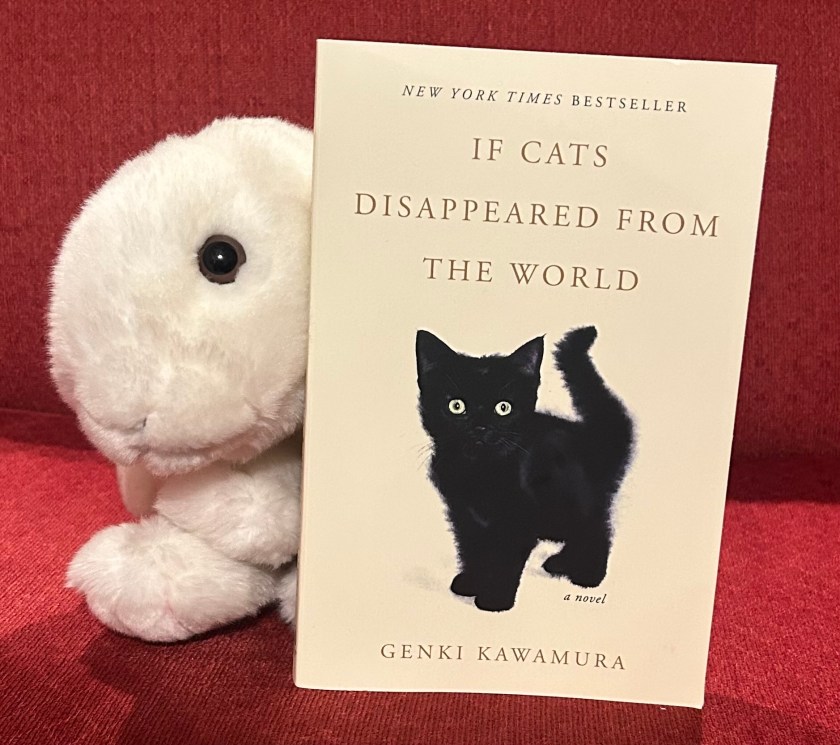
Marshmallow reviews If Cats Disappeared from the World by Genki Kawamura.

Marshmallow’s Quick Take: If you like books that make you truly think about life or if you just like cats, then this is the book for you!

Marshmallow’s Summary (with Spoilers): The narrator is never named in this book, but we know that he lives in a small town in rural Japan and that he works as a mailman. He tells you in the first page everything you need to know about him to understand how the story starts. After being diagnosed with a Stage 4 brain tumor, he is informed by his doctor that he has – at most – six months to live. He imagines responding in outrageous ways (running out of the office, screaming his head off, etc), but ends up thinking immediately about very superficial things: he was only one stamp away from getting a free massage at the local spa, he stocked up on too much toilet paper, he shouldn’t have bought so much laundry detergent last time. He leaves in somewhat of a stupor, his emotions rather suspended for a man who just received a death sentence. While he waits at the train station, he hears a small band singing a song about living in the moment and silently scoffs at their cliched idiocy. When the train takes too long, he decides to walk home instead and makes it to his door. Unfortunately, the reality of his situation sets in right as he stands in the doorway of his small, modest house and he collapses from overwhelm. 

When he wakes up, he is met by his doppelganger who somehow appeared in his home. It / He introduces itself / himself as the “angel of death” or, his more widely known name, the Devil. The narrator is not impressed by his apparel. After all, he expected the Devil himself to be more intimidating; rather, he is the narrator’s twin in physical appearance but with a horrific fashion sense. Dressed in bright Hawaiian t-shirts that the narrator strongly disapproves of, the Devil gives the dying man an offer. If the narrator agrees, the Devil will make one thing disappear from the world forever each day the man’s life is extended. It’s a rather simple deal. But, obviously, there is a catch–otherwise there would be no plot. The Devil gets to choose the object that will vanish and the object (and every object like it in existence in the world) will be erased and no one will ever remember it existed at all. Only the narrator will know.

Initially, the narrator is hesitant to agree, but the Devil reveals to him that he is set to die tomorrow. He is thus forced to decide today. With the inevitability of death staring him in the face (physically and temporally), only inches away, the man agrees.

The Devil’s first choice is the phone. He allows the narrator one last phone call before they disappear and so he calls a mystery someone to meet with them tomorrow one last time. The man wakes up the next day, alive and breathing, to a world without cellphones. At first, this is not a horrible horrible change. Everyone is reading or talking on the train when they used to just stare at screens the whole ride. His meeting with a mystery someone goes somewhat well, but but his past mistakes are slowly revealed. He’s lived a simple life but relationships are rather complex regardless. His family gently broke apart until – after his mother’s death – he stopped speaking to his father entirely. He and his girlfriend similarly separated after another tragedy, exposing a pattern of poor communication.

With each day, he gains new understanding of what his life was like and what it could have been. Of course, with each added day, he also loses something. The world loses telephones completely, movies, clocks… Each day, the narrator has to grapple with the fact that he is sacrificing something that belongs to everyone to save himself. He is forced to weigh his worth and the worth of a single life and how it compares with objects no one notices until they’re gone. 
Marshmallow is reading If Cats Disappeared from the World by Genki Kawamura.

Marshmallow’s Review: If Cats Disappeared from the World is such a good book that is so truly simple. I will admit, the premise might feel a little cliche at the start. There have been a lot of books, movies, and thought experiments throughout human history centered on a character who is given an unavoidable death sentence. The journey of facing and having to accept one’s mortality is a naturally fascinating thing to mortal beings. But, while this book has a rather simple premise, it still makes you think in ways you might not expect. The plot is based on a much calmer and more common scenario than most books about mortality (e.g. often the characters live in mythical lands and face death on a day-to-day basis on their swashbuckling adventures). Here, the character is a more ordinary person than most, living in a quiet town in rural Japan where everything he has done is pretty much normal. But I think the frank simplicity and the seeming normal-ness of the setting serve to make this an even more potent experience.

I think reading If Cats Disappeared from the World is somewhat like meditating. It takes the most simple things and makes you re-examine them through the eyes of a dying man, enlightening you with a greater appreciation of the quieter, lesser seen parts of life. The writing is very clear throughout the entire book and only what is necessary is included. I read the translated version of this book (the original is in Japanese) so I cannot really speak to what it would have been like in the original language. However, the book’s simple nature of overwhelming the reader through highlighting the underwhelming was very impressive.

Each chapter represents another day and is labeled with the day of the week and a related title. It helps keep things in order and makes the plot make sense. This is a very not complicated book to read so I think anyone can easily read and understand it. I think it might be worth reading it slower though so each day sinks in a little more and you have time to interpret everything and think about how it relates or applies to your own life. It can also just be read in a day as it is less than 170 pages. But I think, just like the simple things mentioned in this book, this simple book matters more than one might think and it can and should completely change your perspective on life.

I think this book has truly made me value my relationships and the simple beauties in life on a level I did not before. I think reading books that make you think deeper and feel more grateful truly increases the quality of your life. Because, while you never know how long it will be, you can determine how rich your life is by how much you appreciate it and every moment, every breath, and every memory. 

Marshmallow’s Rating: 1,000%.
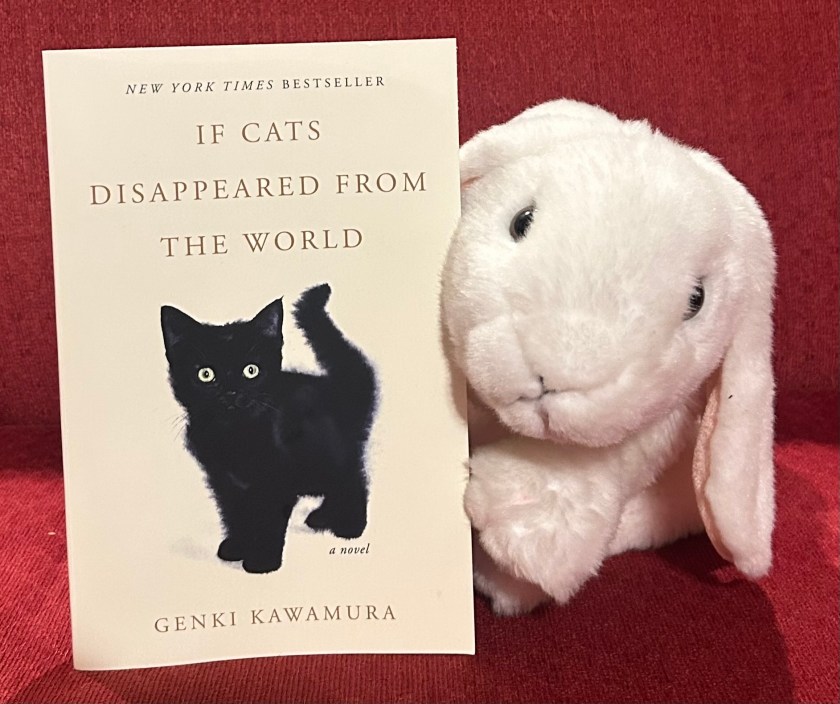
Marshmallow rates If Cats Disappeared from the World by Genki Kawamura 1,000%.

Marshmallow reviews Everything Here is Mine by Nicole Hollander

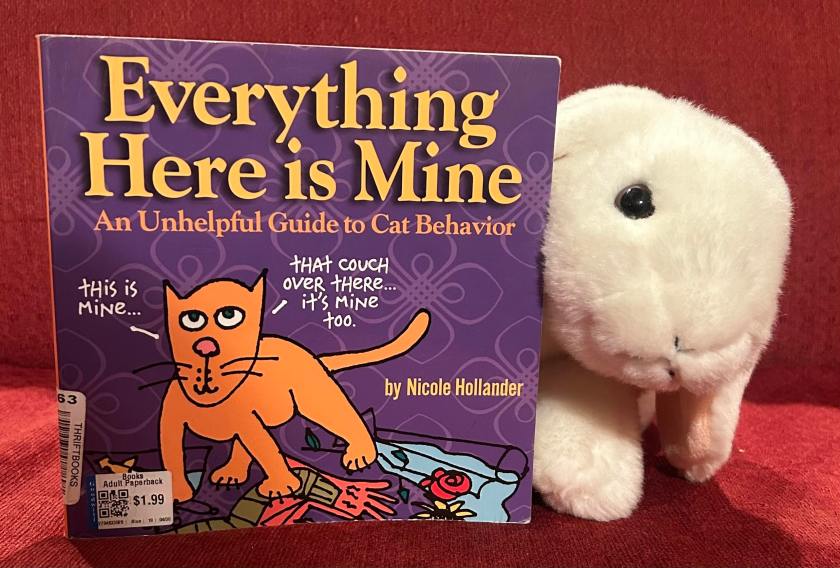
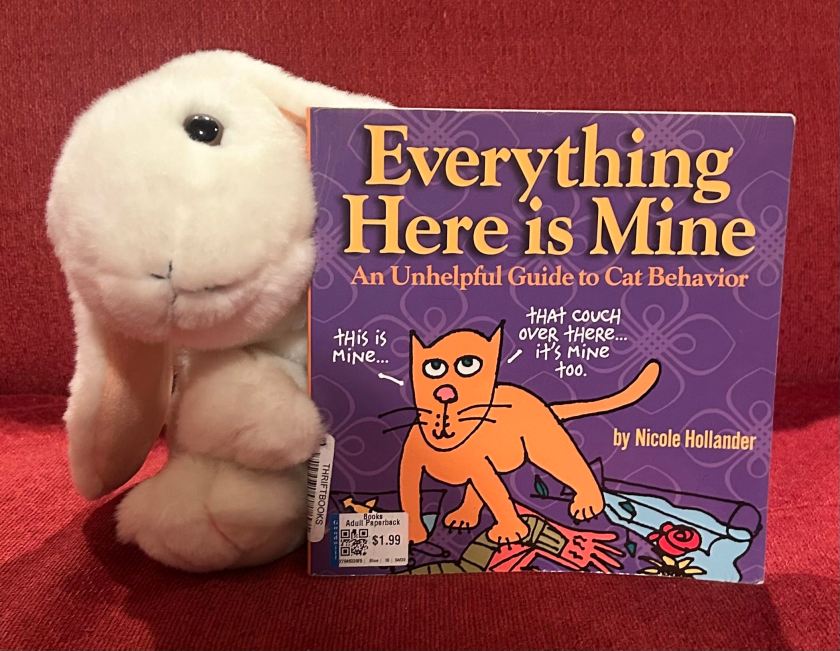
Today Marshmallow reviews Everything Here is Mine: An Unhelpful Guide to Cat Behavior. Originally published in 1992, this is a book of comic strips by the amazing cartoonist Nicole Hollander, whose daily comic strip Sylvia was enjoyed by many; she passed away in April 2026.

Marshmallow reviews Everything Here is Mine: An Unhelpful Guide to Cat Behavior by Nicole Hollander.

Marshmallow’s Quick Take: If you like cats and / or cartoons, then this is the book for you!

Marshmallow’s Summary (with Spoilers): Cats are from space. Specifically, according to Hollander, they are from the planet Hsif. Originally, they arrived during the time of the pyramids and began investigating Earth. Unfortunately, due to a civil war on their home planet, the main cat force had to leave behind several individuals. Budget cats later on prevented return missions so some of the cats were left stranded on our world. This is why cats spit up hairballs; it is an S.O.S. signal. This is merely the beginning of numerous new revelations and lessons about the cat species that you can find in Nicole Hollander’s Everything Here is Mine: An Unhelpful Guide to Cat Behavior.

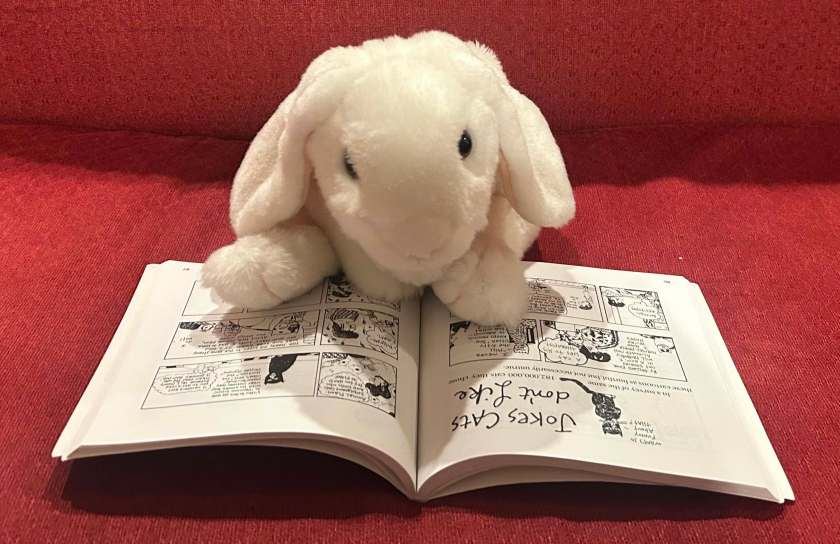
As you can tell from the title, this book does honestly show how cats dominate their households. In sections labeled by related topics, Hollander gives us insight into what cats like and do not like. The sections are as follows: Cats in Space; Give Me That Wet Food, Baby; Fly Me to the Moon; Cats Who Dress Up; Don’t Lick That Cat; Oh, De Toilette; Slow Dancing With Your Cat; In the Heat of the Night; Vetnophobia; Cats and the Law; After You’re Gone; and more. In each, there are plenty of cartoons like the “Dear Cat Lady,” and “Misconceptions About Cats” columns. These provide some extra humor in what is already a very entertaining book!

Marshmallow is reading Everything Here is Mine: An Unhelpful Guide to Cat Behavior by Nicole Hollander.

Marshmallow’s Review: I thought Everything Here is Mine: An Unhelpful Guide to Cat Behavior was a very funny book. I do not know any cats very well myself, but this definitely furthers a lot of general cultural stereotypes for cats. On the back of the book we meet a cat saying “We rule, but we’re fair…unless you serve us the wrong kind of food.” For many cat owners (or rather cat servants), this might strike a familiar chord. The cartoons are definitely amusing to any and all animals and animal lovers though. I particularly liked the “Heartbreaking Complaints of Cats” section that showed up every now and then. In those, a cat describes its issues to a disembodied voice outside of the panel–which I presume is meant to represent a therapist.

Overall, Everything Here is Mine: An Unhelpful Guide to Cat Behavior is a very fun book that is relatively lighthearted and light to read. It is not very long (less than 140 pages) and has plenty of funny pictures. All bunnies of all ages would enjoy this book, so I would highly recommend reading it if you have the time! It will make you smile even if you might not (yet) be a cat person. 

Marshmallow’s Rating: 100%.

Marshmallow rates Everything Here is Mine: An Unhelpful Guide to Cat Behavior by Nicole Hollander 100%.

Sprinkles reviews Old Possum’s Book of Practical Cats by T.S. Eliot

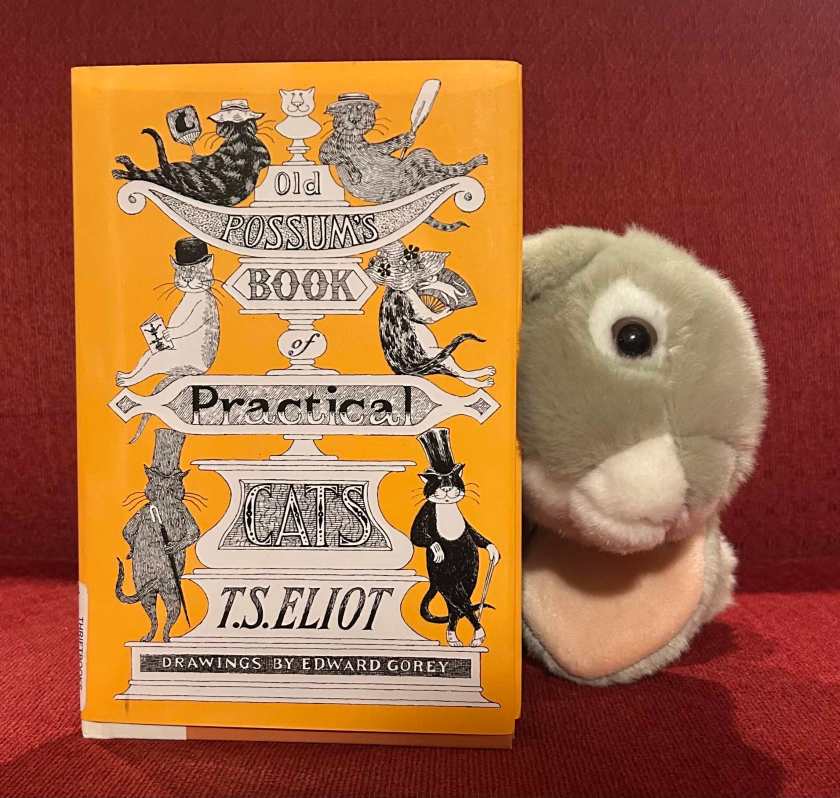
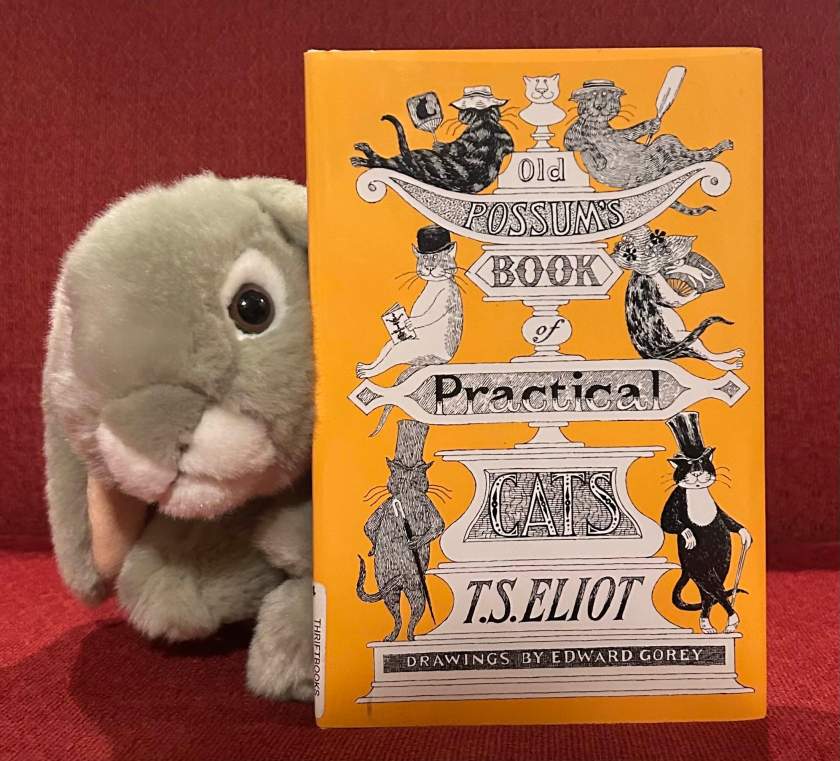
Today Sprinkles reviews a classic book of poems about cats, Old Possum’s Book of Practical Cats by T.S. Eliot, originally published in 1939. The edition reviewed here was illustrated by Edward Gorey and published in 1982.

Sprinkles reviews Old Possum's Book of Practical Cats by T.S. Eliot.
Sprinkles reviews Old Possum’s Book of Practical Cats by T.S. Eliot.

After chatting with Marshmallow about s most interesting book written by a cat, I decided to see if I could read more books about or by cats. This is how I first laid my paws on Old Possum’s Book of Practical Cats. This book was not claiming to be written by a cat but rather an old possum, but of course the possum was none other than the famed poet T.S. Eliot. Having reviewed a poetry book about dogs, I thought it would be fun to review a poetry book about cats as a way to balance the issue.

Old Possum’s Book of Practical Cats is a small book, with a total of fifteen poems spread over less than sixty pages. Every poem is accompanied by at least one full-page illustration, drawn expertly by Edward Gorey. Most of the poems have relatively simple and standard rhyme structures, so that they can be read out loud to a little one with much pleasure for all involved.

I should warn the reader that the book does include a poem, “Growltiger’s Last Stand“, that has a serious racist slur. This particular poem is about a dangerous cat named Growltiger, a bad bully of a cat, who hates Siamese cats because he was beaten by one and lost an ear to it. So it is within reason that he could be hateful towards all Siamese cats, but the poet himself did not need to use a racial slur to describe the latter. [It is honestly jarring to see this word in an otherwise perfectly enjoyable poetry collection. I’d recommend parents reading poems out loud to their little ones to consider skipping this poem, or perhaps rephrasing the line with the problematic word.]

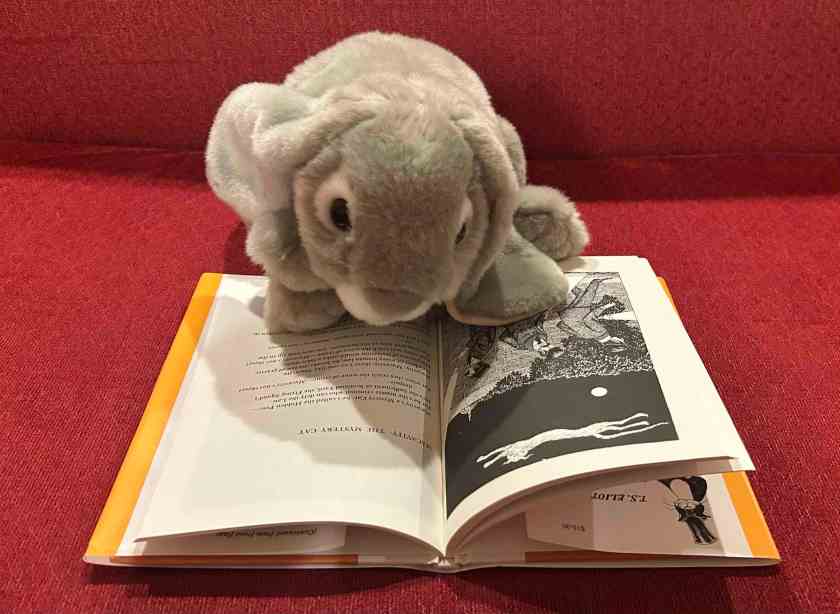
Sprinkles is reading "Macavity: The Mystery Cat" in Old Possum's Book of Practical Cats by T.S. Eliot.
Sprinkles is reading “Macavity: The Mystery Cat” in Old Possum’s Book of Practical Cats by T.S. Eliot.

When I started reading Old Possum’s Book of Practical Cats, I had no idea that it was the main inspiration for the outrageously successful Andrew Lloyd Webber musical Cats, which premiered in 1981. I had seen the musical itself way back in the last millennium, when I was about Marshmallow’s age. At the time, I had been overwhelmed by the sounds and the lights and knew that I was probably missing more than half of the plot. (I was seeing it performed in German, a language that I admire but am not terribly fluent in, so maybe you will give me some grace.) Now reading about it in more contemporary outlets, I can see that I did miss a lot. In particular the musical can apparently be viewed at a lot more adult, sensual level, and this totally evaded me back then. However, I am not at all upset about having missed all that. The cats were so fascinating, and they were so alien, and yet so irresistibly alive, I vividly remember leaving the performance hall excited and full of curiosity. Reading T.S. Eliot’s little book that started it all completes the circle for me, bringing me back to the joy and humor, to the simple appreciation of the many feline characters introduced so playfully by the poet in his letters to his godchildren.

While writing this review I also learned of a relatively recent movie production of the same content. Apparently it was a big flop, but looking at the trailer, I have to wonder how much of the failure was due to the uncanny valley effect, the discomfort humans tend to feel when a character in a book or a movie is almost too humanlike but not quite. As a bunny of course, this would not affect me as much, so I might end up trying to watch the movie some day.

Coming back to Old Possum’s Book of Practical Cats, I would like to suggest that readers should take a look at it for sure, especially if they are cat parents, of course, but even if one is not especially fond of cats, the book can offer some pleasure and fun.

Sprinkles loved reading Old Possum's Book of Practical Cats by T.S. Eliot and recommends it to all bunnies, young and old, who love cats, musicals, and whimsical poetry.
Sprinkles loved reading Old Possum’s Book of Practical Cats by T.S. Eliot and recommends it to all bunnies, young and old, who love cats, musicals, and whimsical poetry.

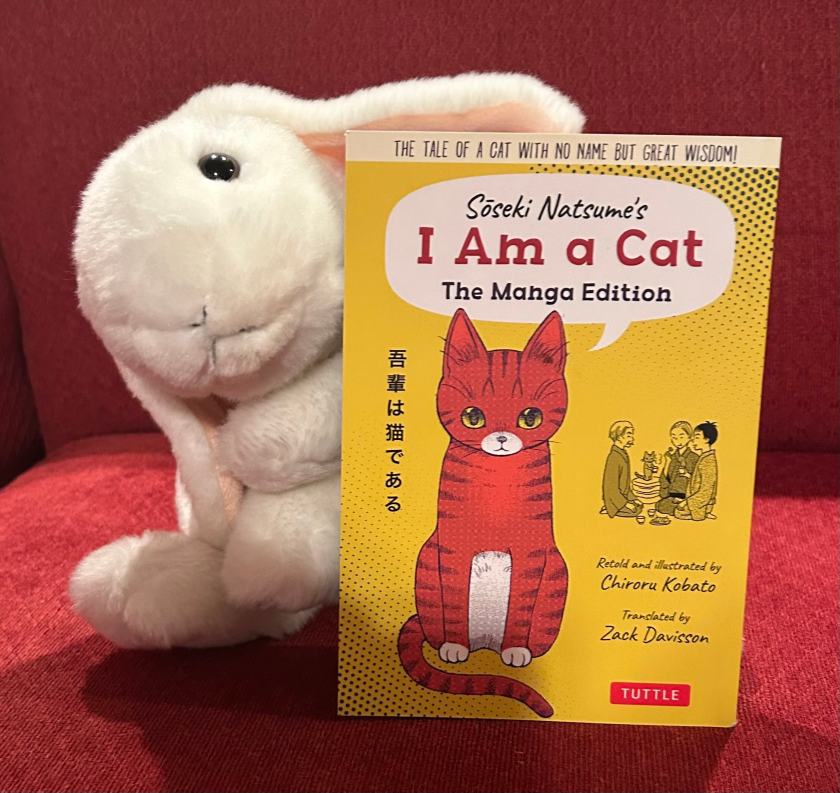
Marshmallow reviews Soseki Natsume’s I Am A Cat: The Manga Edition

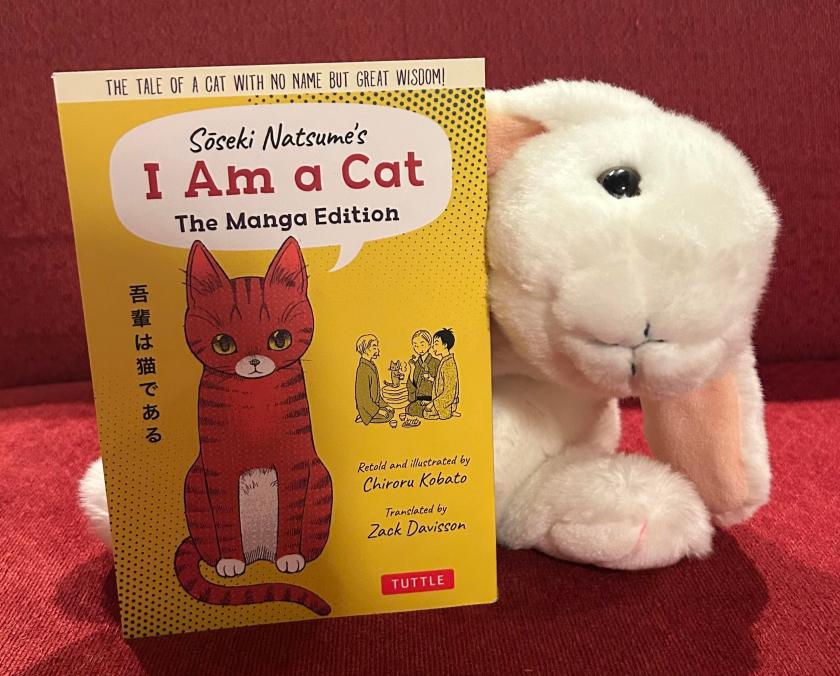
Today Marshmallow reviews Soseki Natsume’s I Am A Cat: The Manga Edition, the graphic novelization of the Japanese classic I Am A Cat, originally written by Soeki Natsume in 1905-1906. This “manga edition” was retold and illustrated by Chiroru Kobato, translated into English by Zack Davisson, and published in 2021. Sprinkles is taking notes and asking questions.

[In this post, we mention suicide as it relates to the content of the book, so if this is a sensitive topic for you, please consider not reading further.]

Marshmallow reviews Soseki Natsume's I Am A Cat: The Manga Edition, retold and illustrated by Chiroru Kobato, and translated into English by Zack Davisson.
Marshmallow reviews Soseki Natsume’s I Am A Cat: The Manga Edition, retold and illustrated by Chiroru Kobato, and translated into English by Zack Davisson.

Sprinkles: I am so excited we are finally talking about this book! I am very curious about it. So let us start with your standard overview. 

Marshmallow: Sure! If you like thought-provoking and eye-opening books from other cultures and other time periods, then this is the book for you!

S: That is a great start. Okay, now please do tell us a bit about what this book is about.. Since the title is “I am a cat”, I am guessing it is probably about a cat.

M: Yes, actually the main character is a cat who narrates the whole story (which takes place in early twentieth century Japan). He was separated from his family at a young age and was taken in—reluctantly—by the family of an English teacher named Sensei Kushami. He describes his life with them and the silly human occurrences / things they experience. 

S: So what kinds of things does he talk about? 

M: Early on, he describes his near-death experience with mochi. He also watches the humans gossip a lot about a rich woman named Ms. Kaneda and her nose (which I thought was very insensitive). The woman, whom the cat calls Lady Nose, has a very ungrateful yet beautiful daughter who may marry one of Sensei Kushami’s friends. There is a lot of confusion that surrounds this affair though and a lot of false rumors and accusations get thrown around. 

S: So the cat witnesses and talks about a whole lot of silly, trivial, petty things humans worry about. 

M: Yes. In the original version of the book, according to this neat recap we found online, this makes him feel pretty superior. In this manga version, he also seems a little amused by their behavior; however, he seems a little less judgemental.

S: In that recap and also on the Wikipedia article for the book, we also learn that the Japanese version of the title “I Am A Cat” also has sort of this formal feel to it because it uses a particular version of the first person pronoun “I” that is “a very high-register phrasing more appropriate to a nobleman, conveying grandiloquence and self-importance”. I am guessing that also makes the book funny to begin with, the cat is kind of pretty full of himself. 

M: I presume it does in Japanese, but of course, I didn’t quite catch that joke myself in English. 

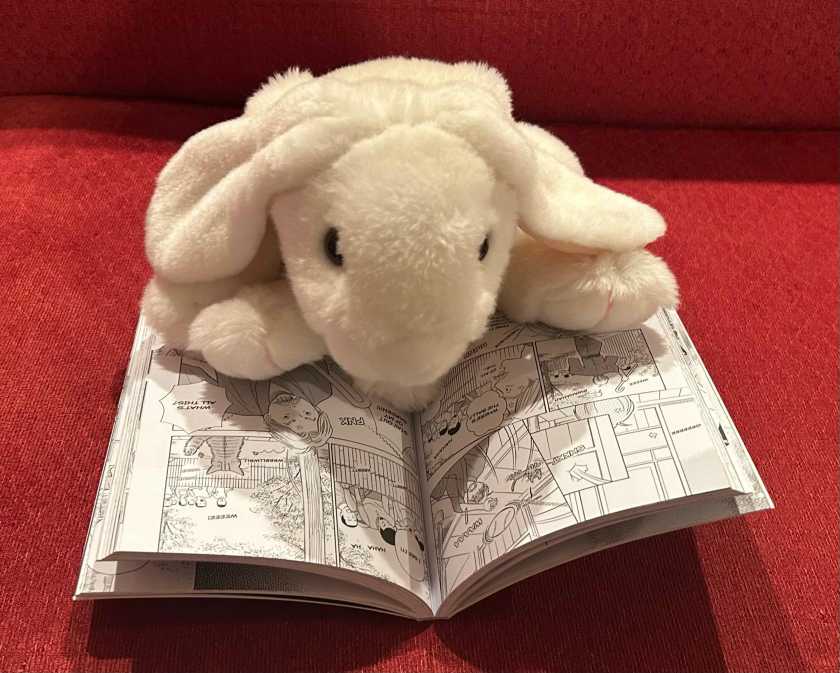
Marshmallow is reading Soseki Natsume's I Am A Cat: The Manga Edition, retold and illustrated by Chiroru Kobato, and translated into English by Zack Davisson.
Marshmallow is reading Soseki Natsume’s I Am A Cat: The Manga Edition, retold and illustrated by Chiroru Kobato, and translated into English by Zack Davisson.

S: English has a single first-person pronoun which makes it a lot easier to learn or speak it, but you also lose a lot of nuance in this way, I suppose. Anyways, so this cat is observing his humans, kind of like Garfield. Garfield is kind of self-important in a way, but maybe a bit less interested in the humans.

M: Yes. I felt like the main character here did seem to care about his human family, but they did not really seem to always care about him too much (Sensei Kushani originally did not want him in the house at all). 

S: Hmm, that is interesting. So I know that when you first read this book, you were a bit disturbed by it. Can you tell us a bit about that? 

M: I felt that the book made too many references to suicide too lightly. Several characters consider hanging themselves on a pine called the Hanging Tree. None of the main characters ends up killing themselves, but it felt like it was mentioned too many times in the course of such a short book. 

S: I can see how that made the feel of the book kind of dark and uncomfortable for you. I am sorry about that. I had thought that this book is supposed to be satirical and philosophical, so I suggested that you read it. 

M: It’s okay! It was a little dark and unexpected, but the rest of the book was amusing to read. I can see why people find it both satirical and philosophical. It is pretty amusing to read a cat pontificating about the silly ways of humans. Like we bunnies do sometimes. People-watching is one of my favorite hobbies. 

S: I know, right? People-watching is fun! Okay, so tell us a bit about the satire or the philosophy then. 

M: Okay, the philosophy part was also pretty dark and depressing though. Sensei Kushani and his friends in academia and one in business discuss the integration of Western ideals into traditional Japanese culture. They also say some very sexist things about women to their friend who just got engaged. Meanwhile, the cat narrating the book ponders about life and whether it is worth it. At some point, he reaches the conclusion (which I disagree with) that life is only suffering and that death is the only peace. 

S: Okay, I can see that maybe these ideas are a bit too heavy for a “manga edition”. Maybe the original book deals with them with more nuance. So maybe let us now talk about the manga nature of the book. I know both you and Caramel have read a lot of graphic novels. But is this your very first manga?

M: I think so. I have never read a book that was meant to be read backwards which was a little difficult to adjust to.

S: Backwards for us of course, not for many other people around the world who read from right to left. 

M: Yes, but  I am still not sure whether I was supposed to start from the top of the page or somewhere else. 

S: I can imagine that can be disorienting. I have read only one manga-style book and that was disorienting for me, too. But I am honestly disoriented by all graphic novels, so maybe it was also that. Anyways, so let us wrap up this review then. All in all, did you enjoy reading this book? Did you find it interesting?

M: This book was definitely interesting. It helped me understand a little bit more about Japan’s culture and its understated, natural aesthetics and style. I also liked how this version simplified a classic book into a format that was somewhat easy to understand and definitely a lot easier to read for people who can’t read Japanese. I liked how this made one of the great Japanese novels accessible to others! I would rate this book around 95%. 

S: That is wonderful, Marshmallow. Then I am also glad you read it. What would you like to tell our readers as we end the post?

M: Stay tuned for more amazing book reviews from the book bunnies!

Marshmallow rates Soseki Natsume's I Am A Cat: The Manga Edition, retold and illustrated by Chiroru Kobato, and translated into English by Zack Davisson, 95%.
Marshmallow rates Soseki Natsume’s I Am A Cat: The Manga Edition, retold and illustrated by Chiroru Kobato, and translated into English by Zack Davisson, 95%.