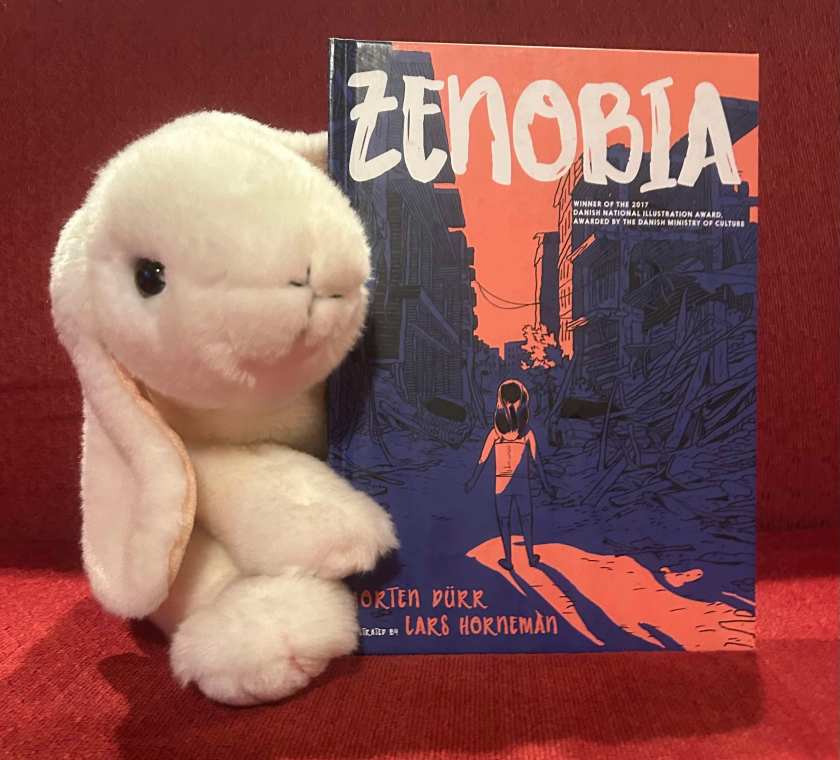
Today Marshmallow reviews a graphic novel with very few words, Zenobia, written by Morten Dürr, illustrated by Lars Horneman, and published in English for the first time in 2018.
Marshmallow reviews Zenobia, written by Morten Dürr and illustrated by Lars Horneman.
Marshmallow’s Quick Take: If you like reading books that have a deep meaning and require thoughtful discussion, then this is the book for you.
Marshmallow’s Summary (with Spoilers):Zenobia was the queen of Syria long ago. She was regarded as the world’s most beautiful woman and led like a man. She was powerful. Now, Amina—a young Syrian girl fleeing her country—uses that image to stay strong.
The story starts on a boat full of refugees all escaping Syria. The boat is small and stuffy and dangerous. When the boat is hit by waves, Amina is thrown overboard, off the boat and into the cold sea. As she sinks slowly, she thinks of her family and the last few days before the present day.
Amina and her mother used to play hide and seek. But on the day the mother had to leave her home, the two had been making dolmas. They had only salt and rice to use though. Her parents left to go to town to get more ingredients but never returned. Amina’s uncle came to the door, where she was sitting waiting, and told her they had to leave. They crossed a Syria devastated by war. The buildings and homes were demolished, while tanks proudly paraded around the ruined streets. Amina and her uncle found a man who would take them to a place “without soldiers,” but could only pay for one passenger. Her uncle selflessly gave Amina the seat, the only way out of Syria. She boarded the boat, and we come to understand that this is the one she is thrown off of by the merciless waves.
As Amina sinks to the bottom of the sea, she sees a sunken boat, overtaken by the ocean and covered in sea life: its name is Zenobia.
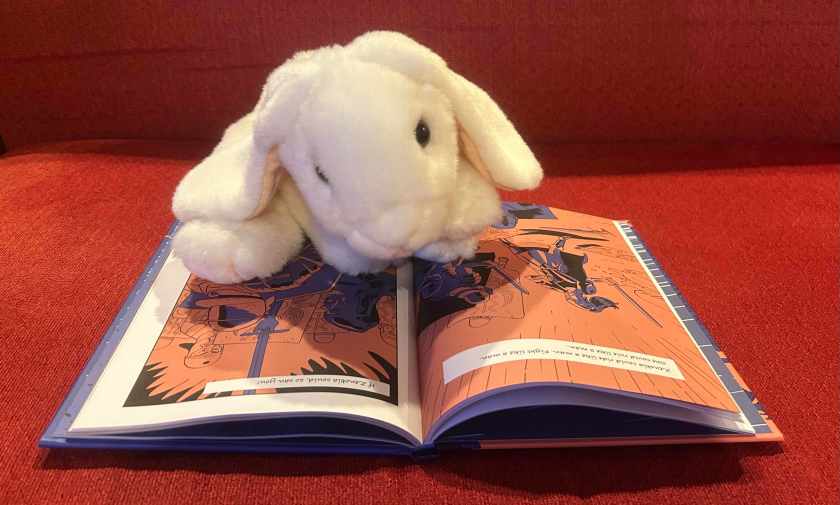
Marshmallow is reading Zenobia, written by Morten Dürr and illustrated by Lars Horneman.
Marshmallow’s Review: This was a heartbreaking story. I am not sure if it was inspired by a specific person’s story, but it is heartbreaking that many people have undoubtedly suffered similar fates. Zenobia is a book every person should read. There is no reason not to; it is easy to understand, quick to skim, and has a message that should not be missed. I read it and was not expecting a graphic novel or—is it even a graphic novel?—to be so moving. The ending seemed to be surreal since I didn’t think such a short book would be so heartbreaking.
Exposure to these kinds of stories makes it hard to hold onto hope. The world can be a terrifying, terrible place. Books like Zenobia and Refugee (another book that needs to be read by all) show what so many people are going through, all to reach a foreign country that is their only hope. Seeing what refugees are forced through just to try to get the normal, safe life they deserve is an experience we all need in the un-empathetic world we have made.
But there is undeniably hope. This book is a lesson that we all need. But we all need to also hold onto hope and do something to make our world better. In trying times, as cliche as this sounds, empathy and sympathy, love and compassion, understanding and action are what we need. It’s clear we are divided today, but we can come together and make beautiful things; we can make this world beautiful. At least, that’s what this bunny thinks.
Marshmallow’s Rating: 100%.
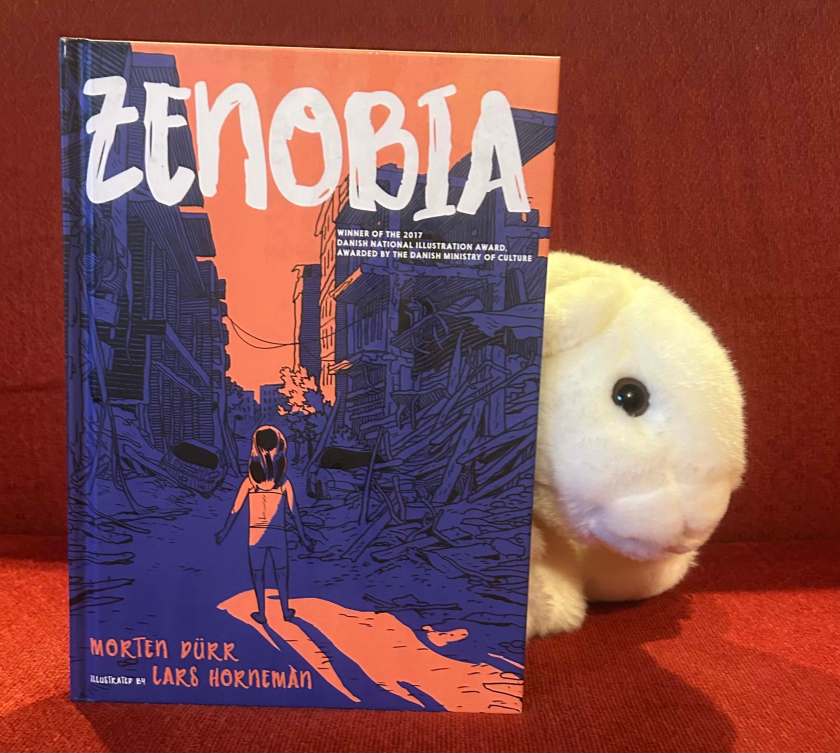
Marshmallow rates Zenobia, written by Morten Dürr and illustrated by Lars Horneman 100%.
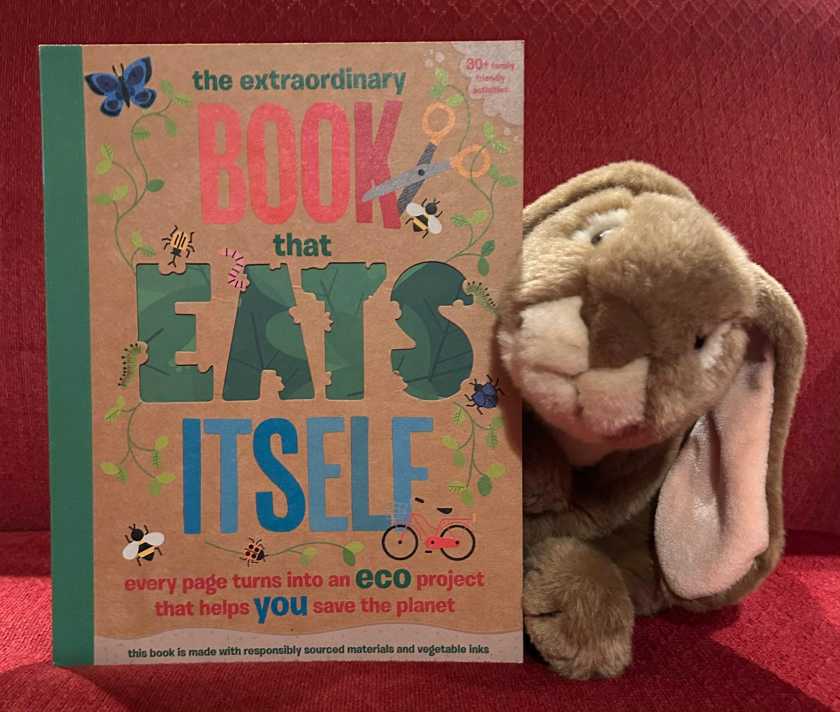
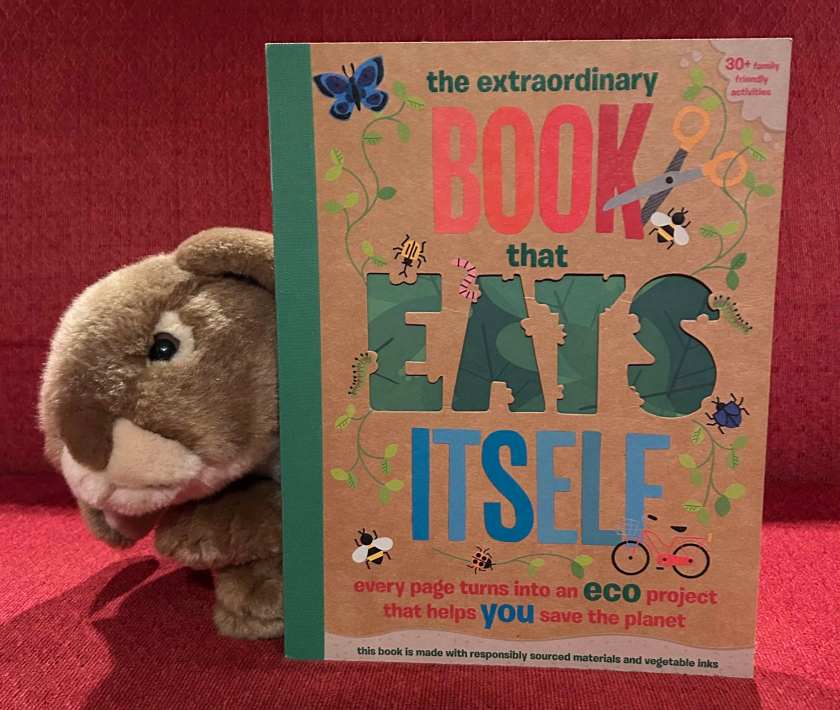
Caramel reviews The Extraordinary Book That Eats Itself, a book of eco-friendly activities that encourage environmental conservation through creative projects.
Today Caramel is talking to Sprinkles about a fun activity book first published in 2021: The Extraordinary Book That Eats Itself: Every Page Turns Into An Eco Project That Helps You Save The Planet, written by Susan Hayes and Penny Arlon and illustrated by Pintachan.
Caramel reviews The Extraordinary Book That Eats Itself, written by Susan Hayes and Penny Arlon, and illustrated by Pintachan.
Sprinkles: So Caramel, today you have another activity book for us.
Caramel: Yep, I really like the activities in this book.
S: That is great! I hope we can talk about some of them in a bit. But let us start with the title. Why is this book called The Extraordinary Book That Eats Itself?
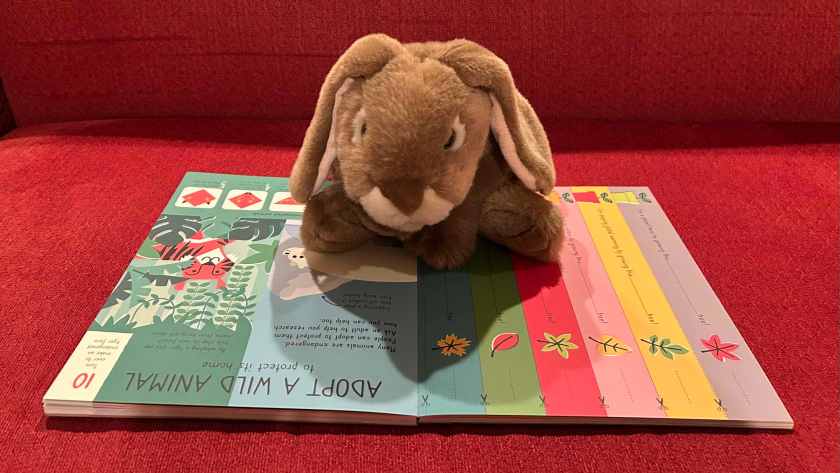
C: It is because the book has an activity on each page that allows you to use that page to create something that benefits the environment. You are supposed to use each of the pages, and even the cover pages, so in the end, when you are done with the book, the book has eaten itself up!
S: I see! That’s clever!
C: Yes it is. And I want us to finish this review so I can get started with the activities!
S: Alright, we will hurry then. When I hold the book I can feel that the cover is hard card stock, and the pages are also relatively thick and very colorful. So they could make good material for crafts and such.
C: Yeah, they suggest that you use all of them for a project. As I said, each page introduces a project and you are supposed to use that page, and sometimes some of the cover pages, for the activity.
S: I understand. So tell me about the activities then.
C: Well, there are sixty pages and an activity on every two pages, so there are a total of thirty activities. There is a handy table of contents at the beginning and they list all the things.
S: Okay, have you tried any of them yet?
C: No!! I am trying to finish this review so I can start pulling apart the pages and actually do the activities!
S: Okay, sorry, yes, let us get on with the review then, so you can get to help the book eat itself soon.
Caramel is reading The Extraordinary Book That Eats Itself, written by Susan Hayes and Penny Arlon, and illustrated by Pintachan.
S: Once we are done, which activity are you going to start with? Are you going to go page by page from the beginning to the end? Is there some kind of an order to the activities?
C: I think they mean it that way, but I am not sure if I want to go in the order they put the book together.
S: Which activity will you start with then?
C: I don’t know.
S: Well, then why don’t you begin at the beginning? That is the advice the King gave to Alice in Alice in Wonderland.
C: Yeah, that might be the right train of thought there.
S: So what does that mean? What is the very first activity?
C: To build a worm bin and to throw food into it like a composting bin.
S: Hmm, I like the idea in theory, but when we tried composting, we just got a lot of little flies in the house. But maybe we can try again. We probably did not do it right the first time.
C: I remember the flies! But yes, maybe we should try again.
S: Okay, that is an interesting idea and we will talk about it. What is the next project?
C: To just share things.
S: Instead of buying things new and so on?
C: Yep.
S: Hmm, so I can see why the book has the subtitle “Every Page Turns Into An Eco Project That Helps You Save The Planet”. They are trying to have you do things that will help you with environmental conservation, by encouraging you to try recycling, composting, and so on.
C: Yep, remember you are supposed to recycle every scrap left over from the projects, so the book won’t create any trash. So it is truly a book that eats itself. Everything will be used up!
S: Okay, what other projects seem especially enticing to you?
C: I guess the first, the worm bin, is my favorite. But I also liked the twelfth one, which is about planting a tree. I also want to make my own pizza, which is the twenty-sixth activity.
S: Hmm, pizza sounds yummy! And I love trees, and that sounds wonderful, too, Caramel. So maybe we should wrap this review up so you can get started!
C: Yep!
S: What do you want to tell our readers?
C: Stay tuned for more book bunnies reviews!
Caramel is excited to have finished reading and reviewing The Extraordinary Book That Eats Itself, written by Susan Hayes and Penny Arlon, and illustrated by Pintachan, so now he can get started with the activities!
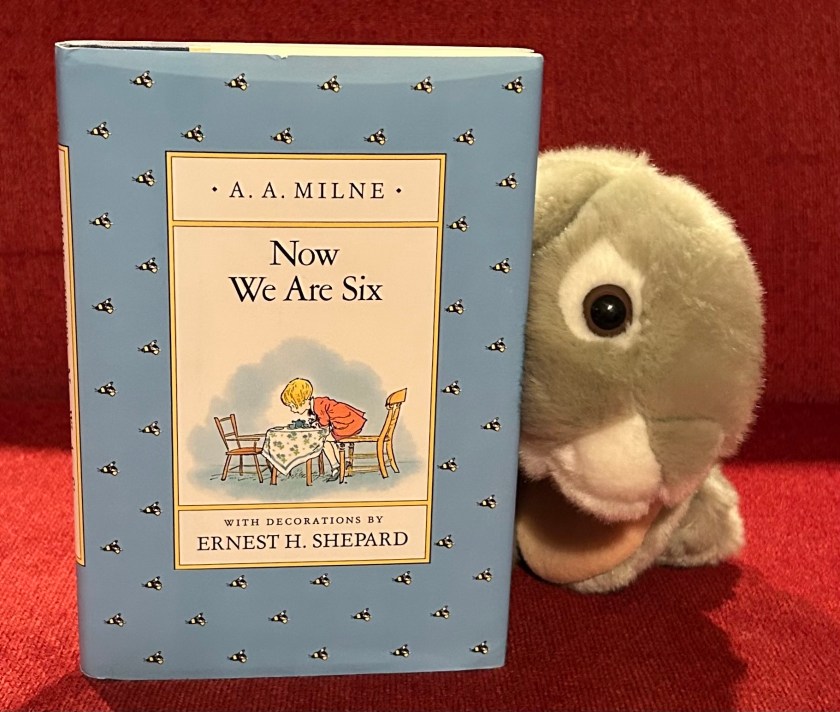
Last week Sprinkles reviewed a sweet little poetry book written by A.A. Milne: When We Were Very Young. Today she reviews Now We Are Six, a sequel if there could be one for a poetry book. First published in 1927, this book was also illustrated by Ernest H. Shepard.
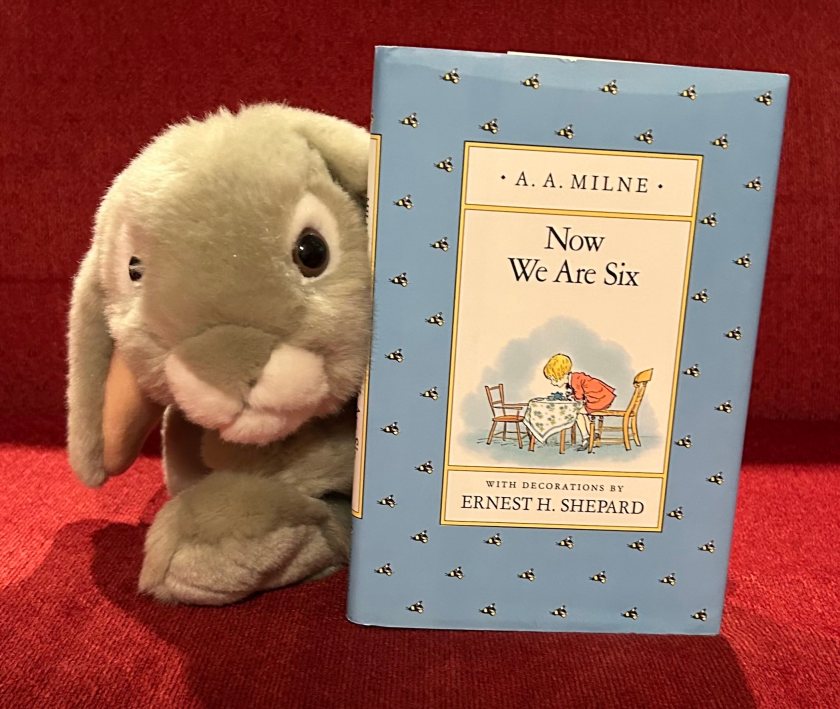
Sprinkles reviews Now We Are Six, written by A.A. Milne and illustrated by Ernest H. Shepard.
Last week I reviewed When We Were Very Young, written over a hundred years ago by A.A. Milne. Today I share with you some thoughts on another little poetry book by Milne that is almost a century old: Now We Are Six.
Now We Are Six is a perfect sequel to When We Were Very Young, and young bunnies who have enjoyed that book would definitely enjoy this book, too. In fact both Marshmallow and Caramel were gifted this book for their sixth birthdays. (Yes it was the same copy, which I think is fine. After all, Marshmallow had already graduated from being six years old when Caramel entered that age…) If you want to see what the book is like, you can see the contents in the Project Gutenberg page for the book here. But once again, I will say that the experience of holding a real copy of the book in your own hands (or paws!) is a lot more pleasant.
Before diving into the poems in the book, let me tell you that Milne’s introductions are really interesting. I am not sure the younger readers would appreciate them, but the adults reading the books definitely will. So please do not skip these; they are so fun to read!) In this introduction, we are also warned that Winnie the Pooh shows up in several of the poems. It is really neat to see Pooh’s evolution from the germ of an idea in one little poem in When We Were Very Little to a fully developed independent character who “walked through [the book] one day, looking for his friend Piglet, and sat down on some of the pages by mistake.”
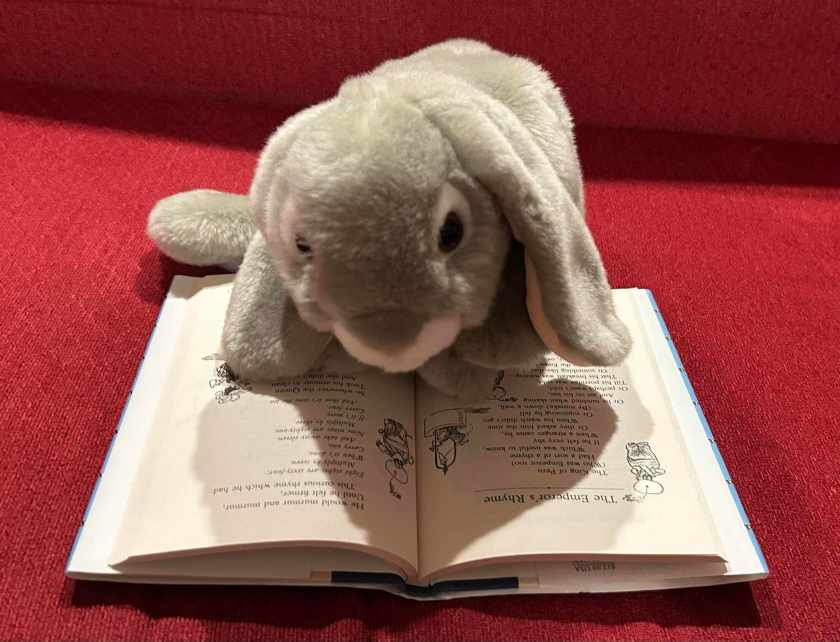
Sprinkles is reading Now We Are Six, written by A.A. Milne and illustrated by Ernest H. Shepard.
Now the poems! There are thirty five in total. And some are indeed about Winnie the Pooh, or at least they include Pooh as one of the main actors. For example, the poem “Us Two” is about a little boy narrating his adventures and conversations with Pooh. But pooh also just happens to show up in the illustrations of poems that do not explicitly mention his name. For example “The Engineer” is about a train the narrator is trying to play with, and Pooh shows up in the illustrations waiting for a ticket and then the train itself. The little bear makes a similar appearance, that is, only in the illustrations, for the last poem of the book, “The End”, where the narrating child is excited to be six years old:
But now I am Six, I'm as clever as clever
So I think I'll be six now for ever and ever.
Another one of my favorite poems in this book is “Explained” where a little girl named Elizabeth Ann goes around trying to find out just “how God began”. the question remains unanswered for all those who are reading the poem, even though in the end Elizabeth Ann gets an answer that satisfies her.
Unlike When We Were Very Young, which seemed to be almost exclusively written for a little boy, there are quite a few little girls in this book, or possibly a single little girl, who is sometimes named Elizabeth Ann and sometimes Anne. This makes a lot of sense if you read that the book is dedicated to Anne Darlington, who was a friend of Christopher Robin, Milne’s son. The Darlingtons and the Milnes were family friends, and they seem to have hoped that their two children would perhaps eventually marry each another. But in any case, I believe that the book does benefit from having a little girl in it.
The poems are once more about play and daily life and friendship and big questions. There is also room for big feelings. For example, the very first poem, “Solitude”, reminds the reader that all children are persons of their own rights, and sometimes they too will need some space. And there are a handful of poems which are more fantastical. For example “The Knight Whose Armour Didn’t Squeak” tells the story of a knight, you guessed it, whose armor did not squeak. One day, this knight spots another one whose armor does not squeak and figures out a way to eliminate him from this competition.
The illustrations in the book are once more by Ernest Shepard and complement the book’s quirky and fun feel. All in all, this book is a joy to behold and a joy to read. I recommend it with much enthusiasm to anyone looking to find a poetry book to read or share with a young bunny!
Sprinkles recommends Now We Are Six, written by A.A. Milne and illustrated by Ernest H. Shepard, to anyone looking for a little poetry in their lives.
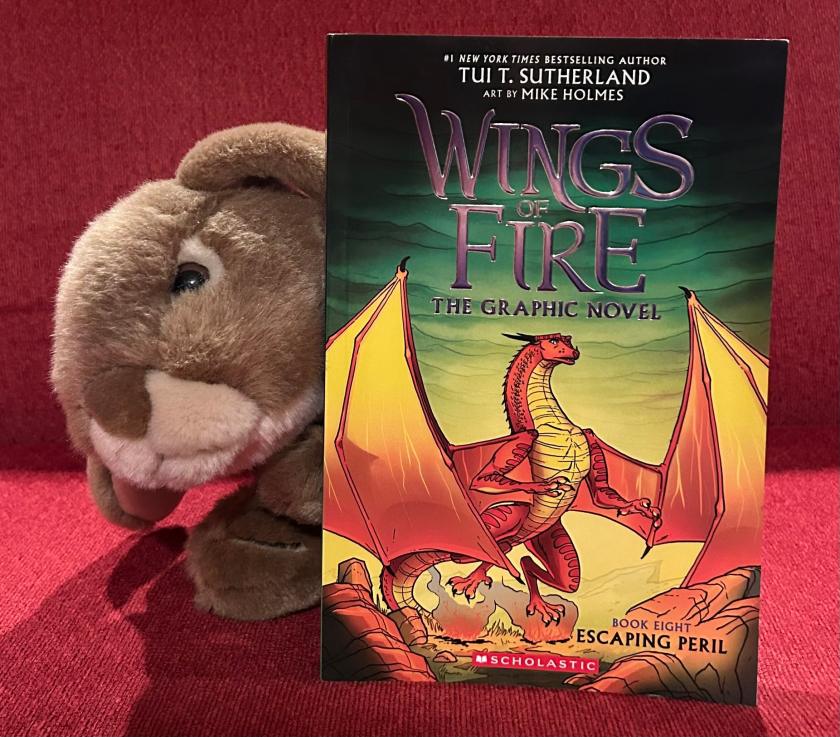
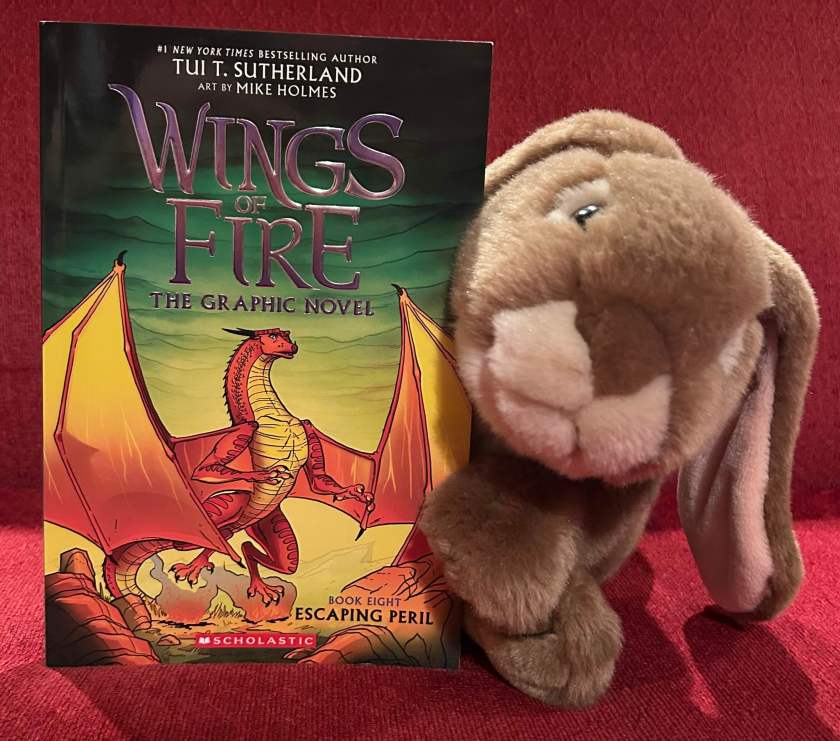
Caramel reviews the graphic novel version of Escaping Peril (Book Eight of Wings of Fire) by Tui Sutherland (with art work by Mike Holmes).
Anyone who has perused any of our content here knows that Caramel loves dragons and by extension, Tui T. Sutherland’s Wings of Fire series. In the past few years he has read and reviewed quite a lot of the books in and related to the series. Today he reviews Escaping Peril: The Graphic Novel, the graphic novel version of the eighth book of the main series, written by Tui Sutherland, illustrated by Mike Holmes, and published in December 2024. As usual, Sprinkles is taking notes and asking questions.
Here are Caramel’s reviews for the five books that make up the second story arc (the Jade Mountain): Moon Rising, Winter Turning, Escaping Peril, Talons of Power, and Darkness of Dragons. And here are his reviews of the graphic novel versions of the first two books in the series: Moon Rising and Winter Turning. The current post contains his review of the eighth book, the third in this story arc.
C: This is about Peril, a Skywing with a weird mutation, called fire scales, where the scales are very hot and capable of burning almost anything.
S: Okay, you dove right into the world of Wings of Fire. So let us start slow. We are in this land of dragons, where there are a few different clans or tribes of dragons, each with their own special powers and strengths. And Skywings are one of those tribes.
C: Sure Sprinkles, but the readers already know all that. Or they should. After all, this is the eighth book of the series!
S: You have a point Caramel. I guess if anyone is reading our blog, even sporadically, they would know that! You have already reviewed so many books in this world.
C: Yes, I am not sure I can list them all. I mean there are fifteen books in the series, five books each for three different series, making up the main fifteen books. I reviewed most of those books. Then there are the graphic novel versions of them, but they are not all out yet. This is the eighth book, so I have reviewed seven of those so far. And then I reviewed a few other books about the dragons of the Wings of Fire universe.
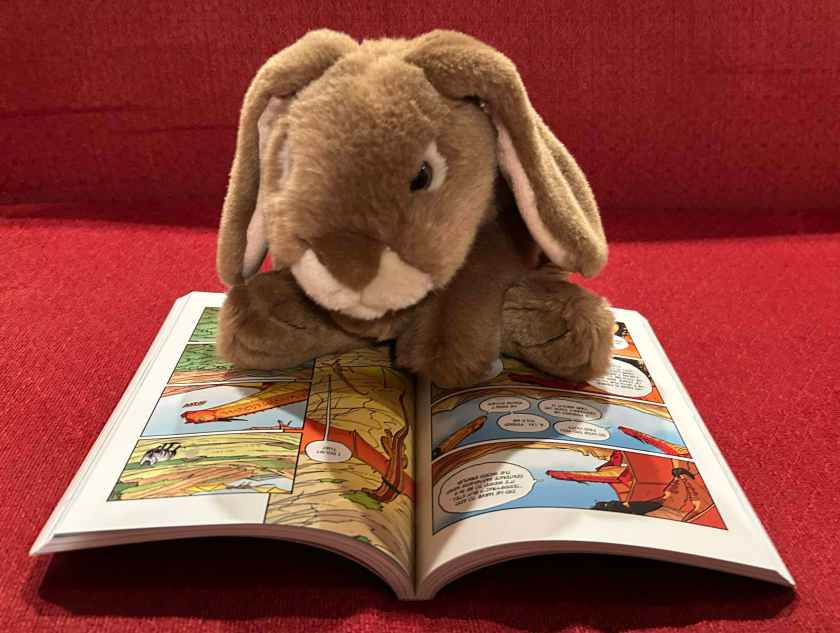
Caramel is reading Escaping Peril: The Graphic Novel (Book Eight of Wings of Fire), written by Tui Sutherland and illustrated by Mike Holmes.
S: So okay, let us go back to Peril. So Escaping Peril is not about escaping danger, but escaping from this dragon named Peril, then?
C: You could read it like that, because Peril is dangerous, but also you could read it as Peril is the one escaping. Because the book is really about Peril discovering herself and saving herself from her queen.
S: That is a cool play on words then!
C: Yeah, it is. See why I love Wings of Fire?
S: Yeah, I can see that it is only about the wordplay. Not about the amazing dragons, not at all.
C: No, of course it is not only about the wordplay! It is the whole thing.
S: I know. I’m just teasing you, Caramel. I do know how much you have enjoyed reading these books.
C: Good. Glad we made that clear.
S: So Caramel, this is the eighth book in the series. But each of these books is about an individual dragon, and so perhaps one could read them out of order. What do you think?
C: Sure they could, but it makes a lot more sense if you read them in order.
S: So they are chronologically ordered, then?
C: Yes, definitely. So knowing what happened in the earlier books explains a lot of what is going on in the later books. But you are also right, that one could simply dive into this book, for example, and get a good sense of the world.
S: But it is clear to me that you think readers should start from the beginning and read every single book in order.
C: Yes. And then reread them. Over and over and over again. Like I have been doing all this time.
S: I know! Your copies of some of the books have really worn out…
C: I prefer to call them “well read” or even “well loved”.
S: I love that Caramel! I love that you love books!
C: Only some books!
S: Okay, that is right, but it is also perfectly fine! Anyways, back to Escaping Peril. I know you have already read the graphic novel versions of the first seven books and the illustrations are done by the same artist. So maybe there was nothing surprising about the illustrations this time?
C: That’s right, nothing surprising. Except of course these dragons are awesome and the illustrations all do a great job in helping me visualize them!
S: That is wonderful, Caramel. It seems like the author and the illustrator really made this work. Anyways, maybe this is a good time to wrap up our review. So tell me what you are most excited about, having read this book.
C: Well, now I am ready for the graphic novel version of the ninth book!
S: That will be released this year, I think.
C: Really? So happy to hear that! And I also heard that there might be a totally new sixteenth book! So I have a lot to look forward to.
S: I am so happy for you! And in the meantime we will read a lot of other books.
C: Of course!
S: So then, what do you want to tell our readers?
C: Stay tuned for more book bunny reviews!
Caramel is excited to have read Escaping Peril: The Graphic Novel (Book Eight of Wings of Fire), written by Tui Sutherland and illustrated by Mike Holmes, and looks forward to rereading it many more times in the coming weeks and months.