Marshmallow reviews The Ministry for the Future by Kim Stanley Robinson

Today Marshmallow is writing about The Ministry for the Future by Kim Stanley Robinson, a climate future novel originally published in 2020.
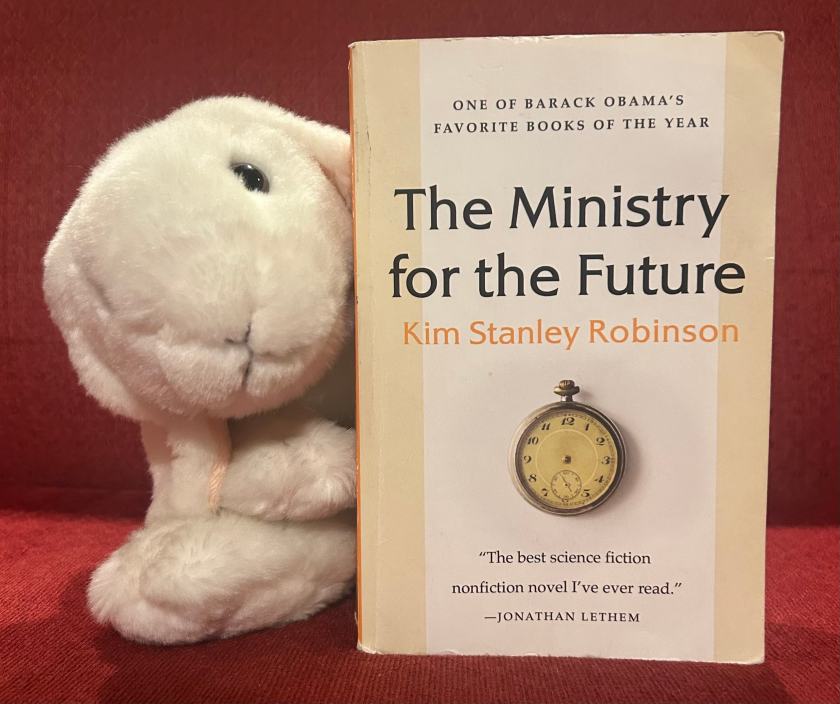
Marshmallow reviews The Ministry for the Future by Kim Stanley Robinson.

Marshmallow’s Quick Take: If you care about the environment and enjoy science fiction, then this is the book for you!

Marshmallow’s Summary (with Spoilers): The book starts in 2025 (five years after the book publication date) with a horrific heat wave in India. Frank May, an American volunteer helping support the locals in rural towns, witnesses one of the worst atrocities of the century and barely survives the fatal conditions. Afterwards, he is left permanently haunted with the memories of burning bodies in a boiling lake.

The great Indian heat wave is just the first of many natural disasters to come. To protect the world from the dangers of climate change, a new UN body is chartered to help fulfill the Paris Agreement: the newly dubbed Ministry for the Future. It serves to represent the peoples of tomorrow and all the unborn generations that will have to contend with the repercussions of climate change today and onwards.

Unfortunately, they were too late to save India from the heat wave. So India takes matters into its own hands. Spraying sulfur dioxide into the skies, India mimics the aftermath of a volcanic eruption to block the sun’s rays from reaching its people again. This helps lower temperatures by a bit but not enough. The truth is undeniable. Time is running out.

Mary Murphy is the head of the Ministry for the Future and is thus tasked with the impossible task of fixing climate change. Together with her international team of scientists, economists, lawyers, and advisors, she must develop strategies to combat and prevent the worst effects of global warming – both latent and potent. They start with the glaciers and the Arctic. Dyeing the sea water yellow, scientists speculate that the heat from the sun will be reflected back into space and decrease the rate of warming. Soon, the entire Arctic sea is a repulsive yellow; yet, it works and more time is bought for the world. Researchers struggle to get funding for a glacier-saving project and eventually figure out that they can slow the rate of disappearance by sucking out the meltwater from underneath the ice.

There are so many intricate details and fascinating theories presented in this book that force you to reckon with the sheer scale of our climate situation. Throughout the book, Mary and Frank take action into their own hands in different ways in different places. Woven throughout the book are the narratives of other characters that weave into a larger epic. In The Ministry for the Future, you will learn just how terrified you should be of what is to come so you understand how critical it is for us to start acting now. 
Marshmallow is reading The Ministry for the Future by Kim Stanley Robinson.

Marshmallow’s Review: I think Vox Magazine’s Ezra Klein summed up this book best, “If I could get policymakers, and citizens, everywhere to read just one book this year, it would be Kim Stanley Robinson’s The Ministry for the Future… Robinson is one of the greatest living science fiction writers.” I wholeheartedly agree. While I cannot attest to the scientific soundness of his proposed methodologies, I believe he offers us a wider view of the creativity we will need in order to survive this climate catastrophe as a species and as a planet.

You start this book and are immediately shell-shocked by how terrifying things are likely to get. The first couple of chapters leave their mark and I do not think younger bunnies would be able to get through them. (Caramel was curious but the first chapter stopped him in his tracks.) As such, I think this is an excellent book, but probably only for bunnies older than 14.

In the rest of the book, you see the realistic struggle of policymakers and researchers working to fix the environmental damage humans have caused. It was very frustrating to see up close how slow action is being taken. However, it is also very disturbing that Robinson seems to believe that change will only truly come if there is rampant ecoterrorism! More realistically, he proposes that there is no silver bullet; we will need an entire spray of arsenals aimed at the plethora of problems before us.

The Ministry for the Future does a fantastic job of showing us just what situation we have gotten ourselves into and the possible ways out. That said, this is not a book that is very easy to read. There are one hundred and six chapters and the whole book is around 563 pages. This is not necessarily a problem until you realize that his writing style is something you need to adjust to. Once in the rhythm of reading it, his prose is very enjoyable and envelops your entire focus, giving your senses exactly what is necessary to paint the perfect picture in your mind. He has little excerpts of poetry-like paragraphs describing the perspective of things like sun rays, carbon, caribou, history – inanimate things or creatures we normally do not consider the emotions or thoughts of. I found this fascinating. He also writes certain chapters like they are the minutes from a meeting or inserts random experiences from unnamed characters whose stories tie into something mentioned before or after the chapter. I adjusted to his style and deeply enjoyed it but that does not mean it was easy. On the contrary, this might have been the hardest book I’ve ever read. It is long and the style can be a bit arduous at times. Not to mention, the vocabulary is advanced, to say the least, and references to obscure economic and historical terms are ever-present. Expect to reach for your phone or a nearby dictionary every few paragraphs.

I really do think The Ministry for the Future is excellent. But I would have really liked to see him write another version that is more accessible. Perhaps one day he will consider writing an easier-to-read version of the book that younger children and teens could comprehend quicker. So many wonderful and inspiring ideas and concepts and stories are told here that could help encourage the change we need. But, because of the caliber of literary prose here, it is almost completely inaccessible to anyone who isn’t a dedicated reader or already an environmentalist. I love the environment and reading, and even I almost couldn’t make it to the end. This is coming from someone who has regularly read books over 500 pages and found this to be a very enlightening book.

I think the quality and message and ideals portrayed in it make The Ministry for the Future a book that everyone should read. I just hope he makes a more accessible version so that everyone can truly absorb his ideas and embrace his message. Right now, I worry that those invaluable stories are kept hidden within the pages of this book.  

Marshmallow’s Rating: 99%.
Marshmallow rates The Ministry for the Future by Kim Stanley Robinson 99%.

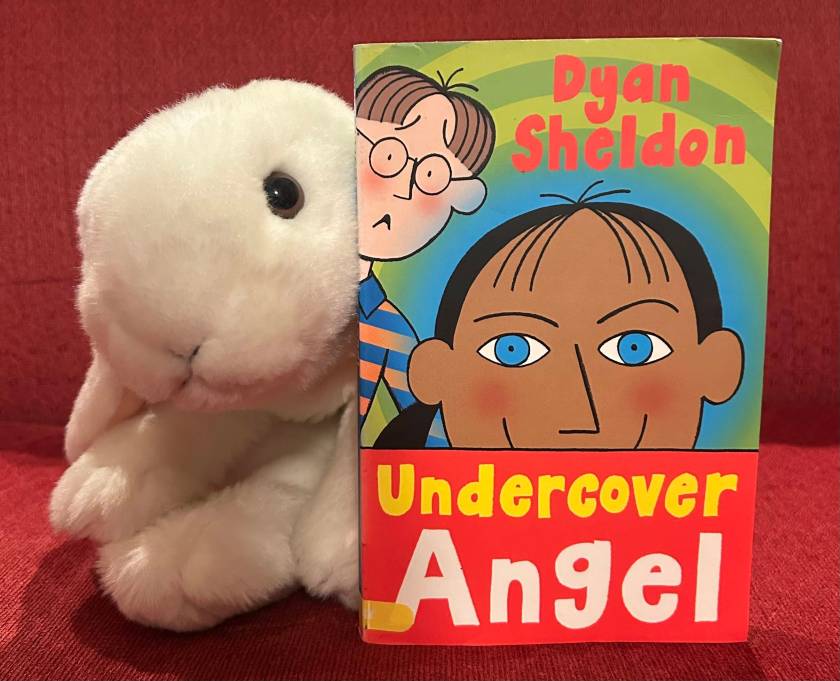
Marshmallow reviews Undercover Angel by Dyan Sheldon

The book bunnies are back! Today in her first review after summer break, Marshmallow is writing about Undercover Angel by Dyan Sheldon, a book published originally in 2000. The book bunnies first discovered a translation of the book and had to dig up the English original, but it was worth it!

Marshmallow reviews Undercover Angel by Dyan Sheldon.

Marshmallow’s Quick Take: If you like reading books about the environment or kids with a surprisingly good sense of humor, then this is the book for you!

Marshmallow’s Summary (with Spoilers): Elmo Blue is not very pleased with his family – and for reasons that go beyond his unfortunate name (his words, not mine). His mother specifically is the main issue; Grace Blue is one of the leading members of the Keep Our Planet Green group in Campton, a small town in England. She and the other Greeners (as Elmo calls them) do horrifically embarrassing things, at least in his perspective. For example, she drives a milk float instead of a car.

Meanwhile, the Blues’ fancy neighbors Mr. and Ms. Bamber drive around in a Porsche all day. Mr. Bamber is a wealthy landowner and developer who is essentially his mother’s arch nemesis. He plans on converting a large swathe of beautiful land in the neighborhood into a resort / golf course. As an environmentalist who had handcuffed herself to stop bulldozers from destroying nature, Grace views her neighbors as disgusting devils; in Elmo’s eyes, they are admirable. At least their house is clean, tidy, and orderly in his eyes. Naively, he believes that Mr. Bamber is an honorable businessman who is far more respectable than his own messy family.

So, in summary, Elmo couldn’t really care less about his mother’s petition problems and her struggle to get the city council to stop Mr. Bamber’s development plans. After all, she barely registers that he wants attention after falling off the roof. For context, he fell off while trying to spy on the Bambers’ new adopted son (who Elmo views as a perfect candidate for a new best friend). Miraculously, he isn’t a teensy bit hurt. Grace is too busy to pay attention though.

After returning to his room, Elmo finds the new adopted child sitting at his desk. The child turns out to be a very tall, intimidating girl named Kuba who claims to be an angel. She does have a faint blue halo but Elmo refuses to buy unscientifically-backed claims. But the evidence piles up eventually. Kuba is an undercover angel in Campton, come to help Grace and the Greeners stop Mr. Bamber. The only catch is that she is not allowed to be involved in anything, meaning Elmo has to do something. He doesn’t want to, but there’s not much you can do when an undercover angel tells you to save the environment. 

Marshmallow is reading Undercover Angel by Dyan Sheldon.

Marshmallow’s Review: Undercover Angel is a very niche-like book but it is also extremely funny. I was very surprised by how witty this book is. Elmo is a twelve year old but the story is still amusing if you are older. His journey from aspiring Warren Buffet to cautious environmental activist is fascinating to watch, even if his transformation is not complete at the end of the book. It does end with hints that the story continues (and apparently there is a second book with Elmo and Kuba in it), but it is still a satisfying ending.

Undercover Angel is very quick to read – only around 137 pages with large font – and very entertaining so it’s a great choice for kids or teenagers who are interested in the environment but still looking for something lighthearted. Most books about environmental issues are a lot heavier so this is a great option to introduce those larger concepts to younger audiences. I think this would be particularly perfect for elementary school students in a classroom or bedtime setting.

Undercover Angel is written in British English so some of the words may require a quick search; context also matters (for example, mentions to the IRA and SAS may be unfamiliar for bunnies of different nationalities). But these side references are not at all substantial. They are occasional and raise brief questions you may or may not investigate into (reading books that make you have to look something up is a bit more work but is more rewarding because you receive more than just a narrative; you also learn little pieces of information you wouldn’t have otherwise).

The message overall is clearly globally relevant. While Undercover Angel is set in a small town surrounded by woods and lakes, the message of environmental protection applies to all people – whether nature looks the same or strikingly different in your community. I really liked how this book also focused on environmental action within a local circle. I truly enjoy books that look at larger scale action, but it is refreshing to see what environmentalism can look like in a sense you can directly, easily imagine. 

While there are some references to a God, it is not really specified which God it is and the topic of religion is not really mentioned. Yet, one of the main characters being an angel adds a different dimension to the narrative that was interesting to me. Generally, books about environmental protection are more focused on nature itself, scientific fact, and tangible action. Much of this book is focused on the people wreaking havoc, the families trying to stop it, and the strange and mystical ways their undercover angel directs action.

I was a bit surprised that very little of the book focused on time spent in nature itself. This is a result, I suppose, of the main character’s resistance to environmentalism as a whole. It is interesting to see how even reluctant Elmo begins to recognize the importance of environmental protection at the end. As such, Undercover Angel can be a great story for parents or teachers looking to introduce or explore environmentalism with their children. It definitely has some examples of the stereotypical environmentalist (the mom is basically a walking stereotype), but, with thought, care, and an open mind, this book is the perfect book to make classroom and bedtime reading more eco-friendly!

Marshmallow’s Rating: 100%.

Marshmallow rates Undercover Angel by Dyan Sheldon 100%.

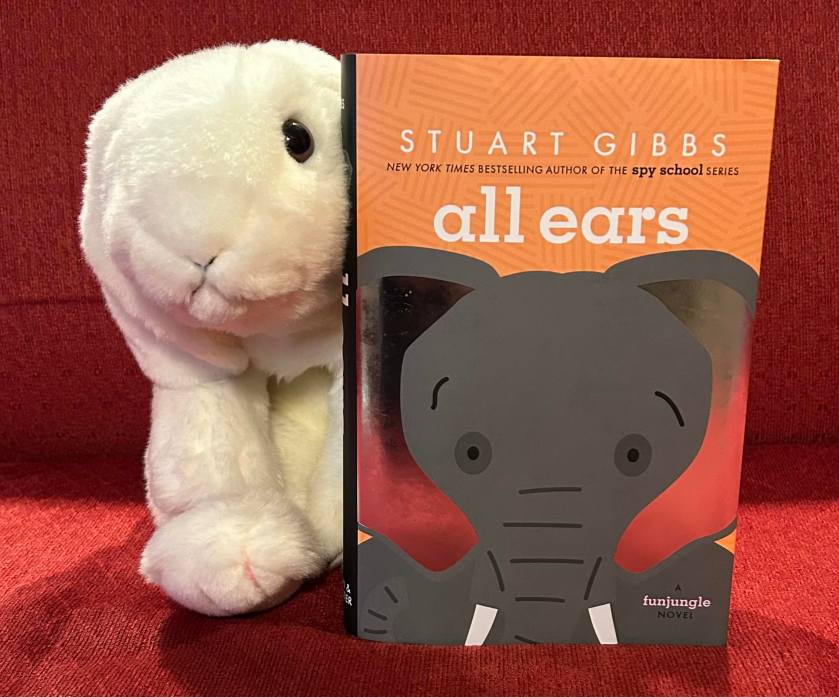
Marshmallow reviews All Ears by Stuart Gibbs

It must be obvious to the book bunnies blog readers that the book bunnies are huge fans of Stuart Gibbs and his books. While Caramel has read and reviewed all his Spy School books, Marshmallow has mostly read and reviewed his FunJungle books. Gibbs is a prolific author, and the most recent FunJungle book, All Ears, just came out a couple weeks ago on May 13. This week, Marshmallow was finally able to read this ninth book in the series and is ready to share her thoughts with our readers today.

Before starting reading this review, you might like to check out Marshmallow’s reviews of the first eight books of FunJungle: Belly Up, Poached, Big Game, Panda-monium, Lion Down, Tyrannosaurus Wrecks, Bear Bottom, and Whale Done.

Marshmallow reviews All Ears by Stuart Gibbs.

Marshmallow’s Quick Take: If you liked the previous FunJungle books, like animals, reading about mysteries, or want to read a really entertaining novel, then this is the book for you!

Marshmallow’s Summary (with Spoilers): Teddy Fitzroy has proven himself as a remarkable detective. His parents both work at FunJungle, the largest zoo in America (if not the world). During his time living next to it, he has solved several high-profile and low-profile cases regarding the zoo or related to the surrounding Texan area. Since the first book in the series, Teddy has been good friends with Summer McCracken—the daughter of billionaire J.J. McCracken who owns FunJungle—and the two recently started dating . Teddy is also good friends with Xavier Gonzalez, a fellow animal-lover and student at his high school.

Sadly, Xavier gets arrested! He normally likes to look around for reptiles he can capture and examine (ethically and caringly, of course) but is found at a crime scene under suspicious circumstances. Being an ardent advocate for the environment, him being in an area that seemingly was vandalized by “eco-warriors” makes him look pretty guilty. So Xavier’s best course of action is to call in Teddy to prove him innocent.

Unfortunately, the call comes at a very inconvenient time. Teddy has been hired to solve another crime regarding a lost elephant. In Texas (and many other places), some ranch owners have taken to raising exotic animals either with the purpose of sheltering them or creating an area in which hunters can kill unusual creatures for an extravagant price. The Sinclairs have created a sanctuary for elephants that they aptly named The Sanctuary. But during a massive power outage in Texas, their herd escapes or is led out of their ranch. This causes some mayhem on a football field later, but eventually Tanzy, the sole African elephant (the rest are Asian), is discovered to be missing. Aside from the fact that rural Texas is not the native habitat of an African elephant, Tanzy could also be under threat from whomever took her.

Teddy now faces two mysteries to solve: where is Tanzy and who took her, and who really committed the crime Xavier’s accused of? Can he find the answer before time runs out … for Tanzy and Xavier?

Marshmallow is reading All Ears by Stuart Gibbs.

Marshmallow’s Review: All Ears is a really good book! I’ve been waiting for the new FunJungle book to come out and for Stuart Gibbs to continue this series! I really, really, really love this series! All of the books have fascinating, interesting, and most importantly confounding mysteries that are perfect for readers of all ages. The characters are lively, intelligent, funny, and lovable—and the lack of cursing (except possibly in Tyrannosaurus Wrecks) makes them appropriate for everyone. And this book is no exception!

I really like how the FunJungle books tackle environmental issues and address the nuance of every topic. Even though he clearly finds these issues very important and harshly critiques greedy corporations, Gibbs never portrays them as completely evil. In particular, we often learn about a CEO’s perspective through a more human lens via J.J.’s character. Gibbs also doesn’t make the activists seem like saints. He explains how many hunters are good people too and really humanizes everyone. However, he does show the facts, many of which are truly disturbing. Gibbs doesn’t omit nuance; rather, he conveys a wide range of conflicting perspectives in a way that is palatable, comprehensive, and comprehensible to a wide audience, while still sending the message that action must be taken to protect the environment. All this makes All Ears worth reading: its message and its explanation and dialogue about the environment and the battle about how we should treat it.

But you should also read this book for fun! It is really funny and entertaining; there are so many twists and turns! Once I picked up this book, I could not put it down—literally. The emotional tension is also really well done throughout, and one can really feel the realness in Teddy’s situation, in which he is caught between a rock and a hard place as he tries to solve two mysteries at the same time.

I love the FunJungle series, the characters and the plot and the writing and everything about these books! They are really special to me! But I think they can be great for many new readers too! I would recommend reading the first couple of books in the series first, but honestly, one could just start here with All Ears, too. Whatever your age or background knowledge though, this book is definitely an amazing one to read for its message, style, and content! I can’t recommend it enough!

Marshmallow’s Rating: 101%. 

Marshmallow rates All Ears by Stuart Gibbs 101%.

Caramel reviews The Extraordinary Book That Eats Itself by Susan Hayes, Penny Arlon, and Pintachan

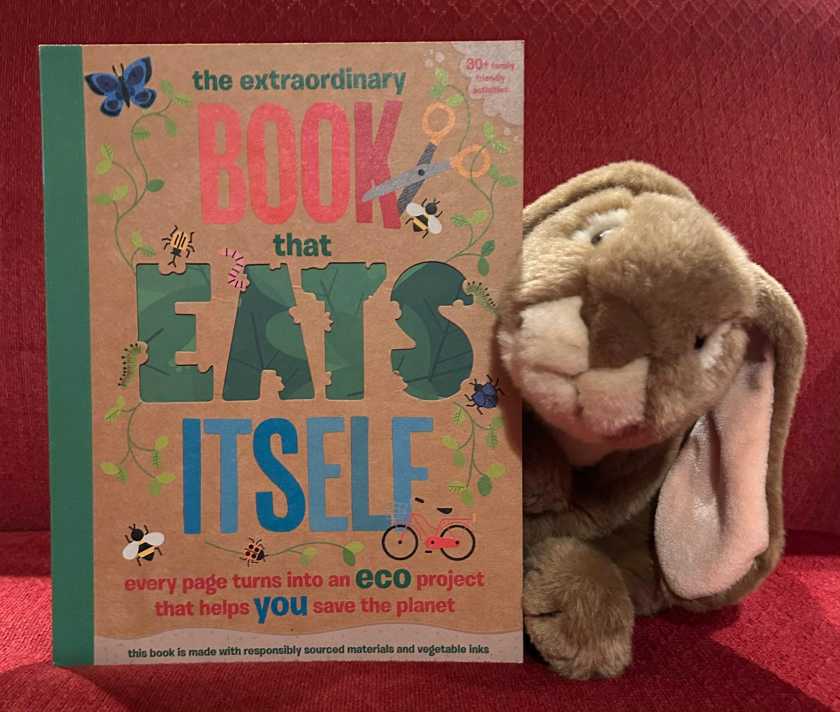
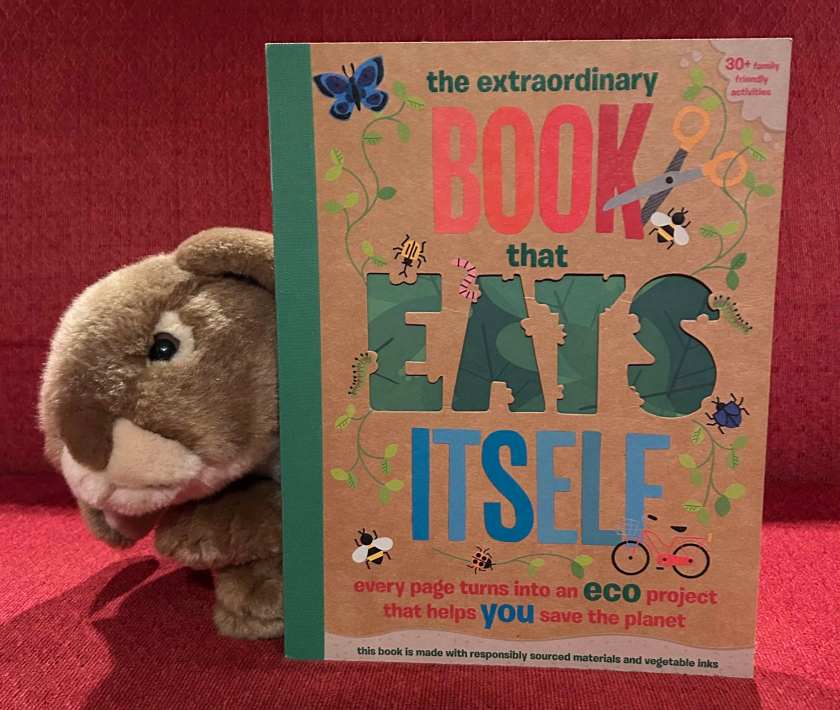
Caramel reviews The Extraordinary Book That Eats Itself, a book of eco-friendly activities that encourage environmental conservation through creative projects.

Today Caramel is talking to Sprinkles about a fun activity book first published in 2021: The Extraordinary Book That Eats Itself: Every Page Turns Into An Eco Project That Helps You Save The Planet, written by Susan Hayes and Penny Arlon and illustrated by Pintachan.

Caramel reviews The Extraordinary Book That Eats Itself, written by Susan Hayes and Penny Arlon, and illustrated by Pintachan.

Sprinkles: So Caramel, today you have another activity book for us. 

Caramel: Yep, I really like the activities in this book.

S: That is great! I hope we can talk about some of them in a bit. But let us start with the title. Why is this book called The Extraordinary Book That Eats Itself?

C: It is because the book has an activity on each page that allows you to use that page to create something that benefits the environment. You are supposed to use each of the pages, and even the cover pages, so in the end, when you are done with the book, the book has eaten itself up!

S: I see! That’s clever! 

C: Yes it is. And I want us to finish this review so I can get started with the activities!

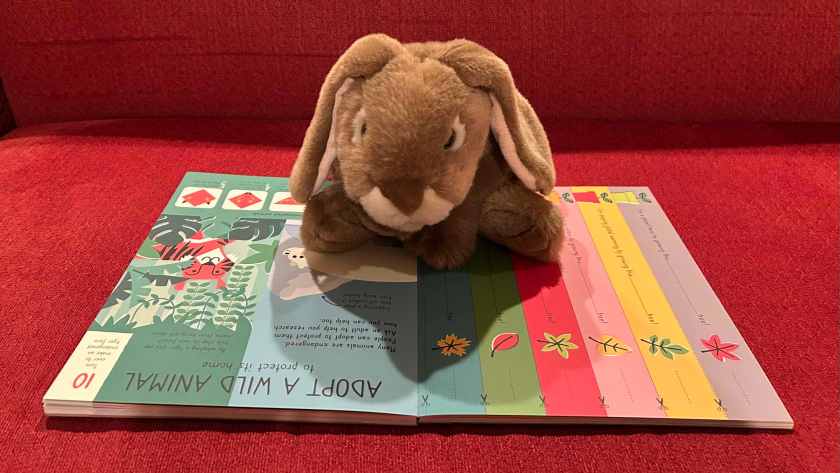
S: Alright, we will hurry then. When I hold the book I can feel that the cover is hard card stock, and the pages are also relatively thick and very colorful. So they could make good material for crafts and such. 

C: Yeah, they suggest that you use all of them for a project. As I said, each page introduces a project and you are supposed to use that page, and sometimes some of the cover pages, for the activity.

S: I understand. So tell me about the activities then. 

C: Well, there are sixty pages and an activity on every two pages, so there are a total of thirty activities. There is a handy table of contents at the beginning and they list all the things. 

S: Okay, have you tried any of them yet?

C: No!! I am trying to finish this review so I can start pulling apart the pages and actually do the activities!

S: Okay, sorry, yes, let us get on with the review then, so you can get to help the book eat itself soon.

Caramel is reading The Extraordinary Book That Eats Itself, written by Susan Hayes and Penny Arlon, and illustrated by Pintachan.

S: Once we are done, which activity are you going to start with? Are you going to go page by page from the beginning to the end? Is there some kind of an order to the activities?

C: I think they mean it that way, but I am not sure if I want to go in the order they put the book together. 

S: Which activity will you start with then? 

C: I don’t know.

S: Well, then why don’t you begin at the beginning? That is the advice the King gave to Alice in Alice in Wonderland. 

C: Yeah, that might be the right train of thought there.

S: So what does that mean? What is the very first activity? 

C: To build a worm bin and to throw food into it like a composting bin.

S: Hmm, I like the idea in theory, but when we tried composting, we just got a lot of little flies in the house. But maybe we can try again. We probably did not do it right the first time. 

C: I remember the flies! But yes, maybe we should try again.

S: Okay, that is an interesting idea and we will talk about it. What is the next project?

C: To just share things. 

S: Instead of buying things new and so on?

C: Yep.

S: Hmm, so I can see why the book has the subtitle “Every Page Turns Into An Eco Project That Helps You Save The Planet”. They are trying to have you do things that will help you with environmental conservation, by encouraging you to try recycling, composting, and so on. 

C: Yep, remember you are supposed to recycle every scrap left over from the projects, so the book won’t create any trash. So it is truly a book that eats itself. Everything will be used up!

S: Like they say: ““Reduce, reuse, and recycle”.

C: Yes, that’s the spirit! 

S: Okay, what other projects seem especially enticing to you? 

C: I guess the first, the worm bin, is my favorite. But I also liked the twelfth one, which is about planting a tree. I also want to make my own pizza, which is the twenty-sixth activity. 

S: Hmm, pizza sounds yummy! And I love trees, and that sounds wonderful, too, Caramel. So maybe we should wrap this review up so you can get started!

C: Yep!

S: What do you want to tell our readers?

C: Stay tuned for more book bunnies reviews!

Caramel is excited to have finished reading and reviewing The Extraordinary Book That Eats Itself, written by Susan Hayes and Penny Arlon, and illustrated by Pintachan, so now he can get started with the activities!