Marshmallow reviews Wabi-Sabi for Artists, Designers, Poets & Philosophers by Leonard Koren

Today Marshmallow is reviewing Wabi-Sabi for Artists, Designers, Poets & Philosophers by Leonard Koren. Originally published in 1994, this book is widely viewed as the first publication that introduced Western audiences to the Japanese wabi-sabi aesthetic. Marshmallow read the revised 2008 edition.
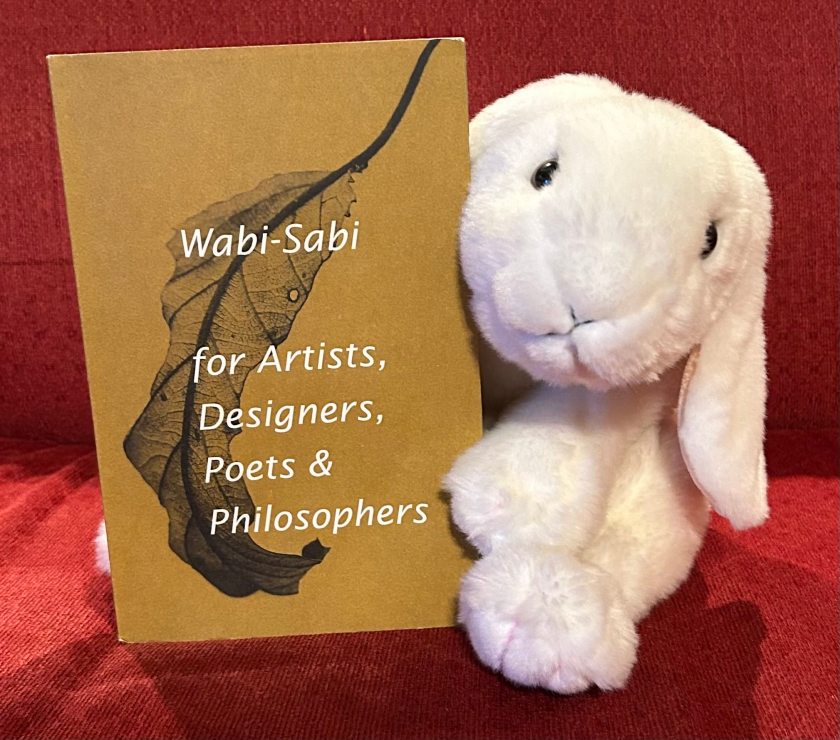
Marshmallow reviews Wabi-Sabi for Artists, Designers, Poets & Philosophers by Leonard Koren.

Marshmallow’s Quick Take: If you like books about Japanese culture, Zen philosophy, or art in general, then this is the book for you! 

Marshmallow’s Summary (without Spoilers): This book serves as Koren’s definition for the wabi-sabi aesthetic, something he believes should never be defined. For context, he even says this explicitly at the start of the book. He states that the aesthetic has an intentional “History of Obfuscation” because of its Zen Buddhism roots, the iemoto system of Japanese trade, and aesthetic obscurantism (which is the practice of obscuring the full details of something to hide its nature). These big words make sense to the reader eventually though as he provides a paragraph of explanation for each cause. Overall, these three factors have long left wabi-sabi as a nebulous feeling, a set of aesthetic ideals that Japanese people have struggled to put to words or have purposefully not done so. Koren argues that this is for the best or it was in the past. However, wabi-sabi is an endangered way that he believes now requires a more rigid definition. After all, if people – artists, designers, poets, philosophers, and even ordinary people in general – cannot identify what makes something wabi-sabi, it is surely doomed to be lost.

Koren traces the history of the aesthetic back to the sacred ceremonies of the famed and wise tea master Rikyu. He allegedly began using homely, imperfect pieces in his tea-making process, something that was an oddity at the time. In the pre-Rikyu period, the ceremonies were filled with elaborate, ornate pieces of the Chinese aesthetic. In contrast, Rikyu created a uniquely Japanese style that focused on “the rustic, the simple, the artless, the unsophisticated.” Eventually, though, these pieces became viewed as even more valuable. But, as Koren explains, they then lost their wabi-sabi qualities.

This exemplifies what the wabi-sabi aesthetic really values. It is the “most conspicuous and characteristic feature of what we think of as traditional Japanese beauty” despite being very focused on “the idea of not being conspicuous at all.”

Tracing the origins and meanings of the words ‘wabi’ and ‘sabi,’ Koren defines wabi-sabi to be the aesthetic that focuses on three fundamental truths: nothing lasts, nothing is complete, and nothing is perfect. In some way, this also means that everything is in a state between the creation and destruction of something or, in another way of reasoning, everything is in the process of becoming something or becoming nothing. Nothing in itself is viewed as an opportunity for something and something is an opportunity for nothing.

It is all very complicated sounding, but Koren does a good job of spelling it out for all readers. With some quiet time and contemplation, this book offers us a way to prevent “the extinction of a beauty” that Koren’s work seeks to preserve. 
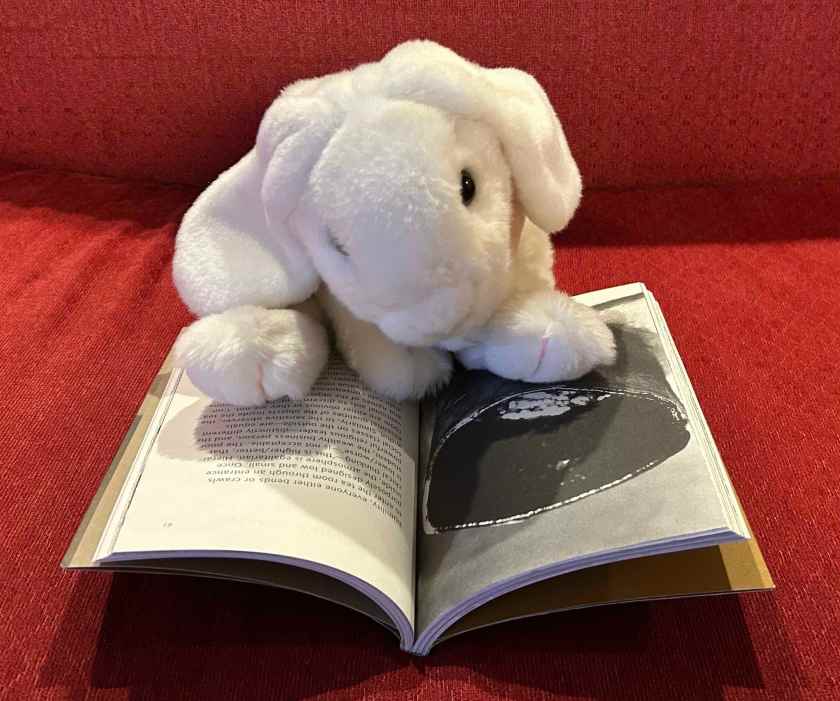
Marshmallow is reading Wabi-Sabi for Artists, Designers, Poets & Philosophers by Leonard Koren.

Marshmallow’s Review: I found Wabi-Sabi for Artists, Designers, Poets & Philosophers to be a fascinating analysis of this Japanese aesthetic. Wabi-sabi became somewhat of a trend online a little while ago and this book is a really good way to embrace and deepen one’s understanding of what wabi-sabi actually means. The internet trend associated with it is adorable and really meaningful! This book is a perfect way to explore the cultural significance it holds in Japan though. Koren analyzes the historical origins, how it developed over time, and how it is still somewhat present today.

I think reading Wabi-Sabi for Artists, Designers, Poets & Philosophers not only gave me an understanding of the aesthetic itself. It also showed me more about what the ideals and beliefs behind much of Japanese and Zen culture are. This is a really good experience to have for all bunnies because it really gives you good time to think about the thoughts of the tea masters from millennia ago and provides a moment of peace where you can think about quieter, natural philosophies that are so distant and distinct from much of the media we consume today. Finding that moment of calm in this book was a really valuable time and I would highly recommend reading this book – if not to learn about the aesthetic – to take some time to think about philosophy, life, and nature deeper.

Images are placed throughout the pages in black and white stills that hint at what wabi-sabi looks like. They are rather ordinary yet strange looking things but they give you a sense of the aesthetics meaning. I found that the book’s brevity and its accompanying images do a really good job of leaving you with a feeling of calm and a greater appreciation for the wabi-sabi things in life. While I’m not going to change my entire aesthetic, I think it is worth thinking about imperfections and the sometimes boringly simple as beautiful. In such a complicated world, books like this one give us time to return to another world when tea ceremonies and wabi-sabi were new, reopening our imaginations to see a whole new perspective. 

Marshmallow’s Rating: 100%.
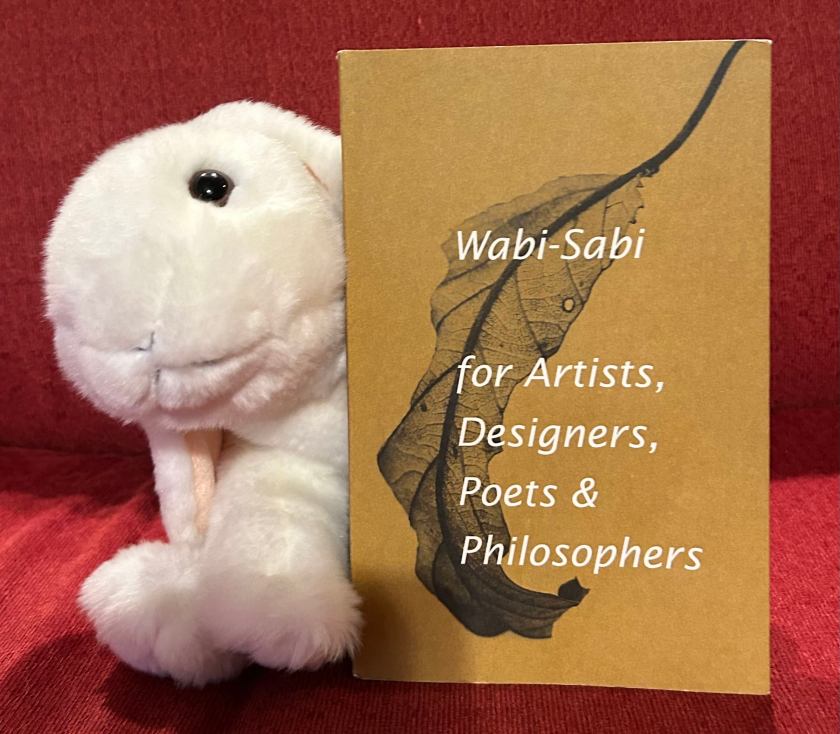
Marshmallow rates Wabi-Sabi for Artists, Designers, Poets & Philosophers by Leonard Koren 100%.

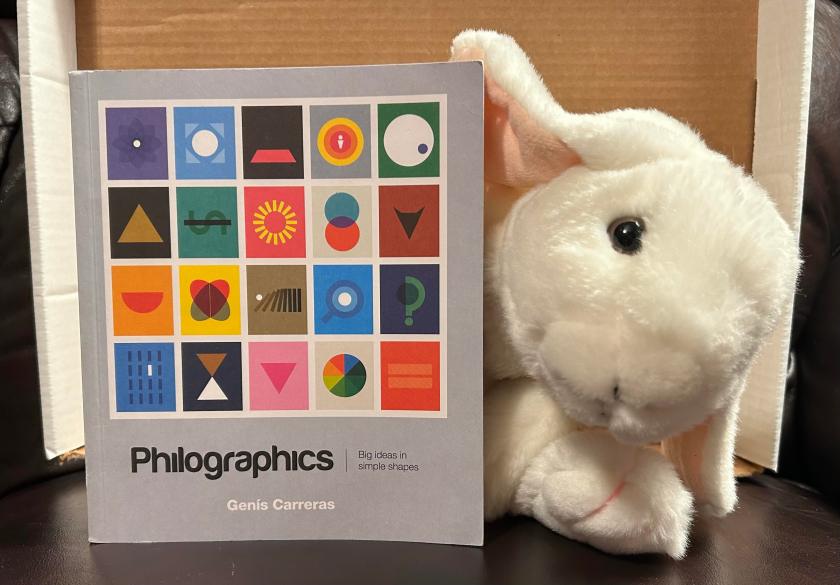
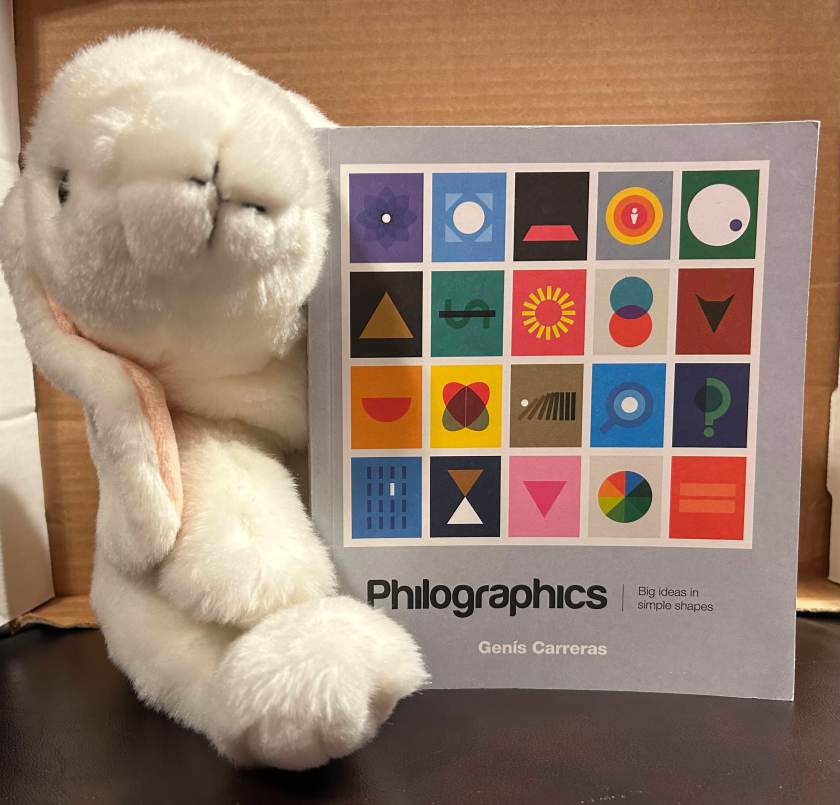
Marshmallow reviews Philographics: Big Ideas in Simple Shapes by Genís Carreras

As she is getting older, Marshmallow has been getting more and more interested in philosophical ideas. Today she reviews Philographics: Big Ideas in Simple Shapes, written by Genís Carreras and published in 2013. Sprinkles, who is also interested in the book, is asking questions and taking notes.

Marshmallow reviews Philographics: Big Ideas in Simple Shapes by Genís Carreras.

Sprinkles: So Marshmallow, I am so excited you wanted to review this book!

Marshmallow: Always happy to make you happy!

S: Thank you! Okay, so can you tell us a bit about what this book is about?

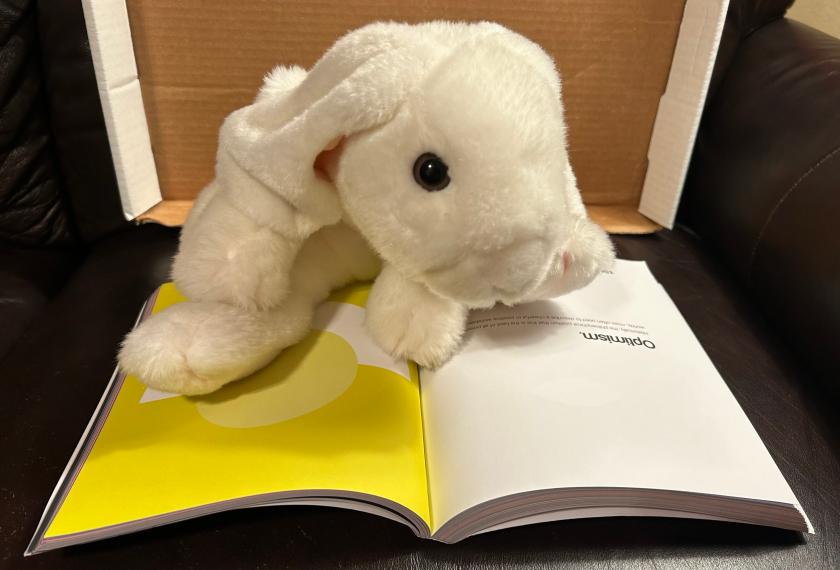
M: Well, the title is kind of self-explanatory. The book is about philosophy, more specifically about a hundred or so philosophical terms. The author of the book, or rather the artist Genís Carreras, uses two pages, side by side, for each term. Sort of reminded me of the book I recently reviewed about logical fallacies (An Illustrated Book of Bad Arguments by Ali Almossawi) in terms of the format.

S: I can definitely see that. So on each two-page spread, what do you see?

M: On the left page, there is a short, one-sentence definition of the term, apparently written by Chris Thomas, a friend of Carreras. And on the right side, there is a graphic depiction of the term, created by Carreras himself.

S: Oh, that kind of reminds me of a book Caramel reviewed way back: Opposites Abstract by Mo Willems.

M: Yes, you are right! But in that book there was no explanation, just a term on one side and a graphic on the other.

S: I guess that is why the Mo Willems book is more of a children’s book and this is not.

M: Yes, also this one has a lot of big ideas. The terms are all ordered in alphabetical order, and most of them are -isms. I mean, they are terms like feminism, optimism, realism, capitalism, nihilism, aestheticism, spiritualism, atomism, historicism, and so on.

S: Yes, this could be a really good dictionary of -isms.

M: Yes. But there are also some terms that don’t end with -ism that belong to philosophy. Like free will, extropy, dogma, and utopia.

Marshmallow is reading Philographics: Big Ideas in Simple Shapes by Genís Carreras.

S: I think maybe the definition of realism (“the philosophical view that asserts that reality is fundamentally based on, and is shaped by, ideas and mental experience, rather than material forces”) is not quite accurate, but one mistake in such a neat book is not a big deal.

M: Yes, I can see how the book’s definition of realism is not quite in line with what Wikipedia or the Stanford Encyclopedia of Philosophy say. But other than that, I think we did not find anything else that sounded off.

S: Yes, the project is an awesome idea. And I think it is carried out quite superbly.

M: Yes, I totally think so. The graphics are so simple, and yet, they are most evocative. And I really like the use of bright colors in most of them.

S: Did you know that Carreras has a website where one can see many of the graphics from the book?

M: No! But we should definitely put a link to it!

S: Of course. Here it is: https://studiocarreras.com/philographics

M: All in all, I think this is a really neat book and it would be a great starting point if you are interested in big ideas. Carreras offers us a great way to get introduced to these big -isms and the connections between them.

S: How so?

M: At the bottom of most pages, there are some symbols that tell you what philosophical field the term belongs to. Like politics, religion, metaphysics, and ethics. And sometimes there are page numbers to send you to ideas that are directly related to the term on the page.

S: I see. That is really neat! And I agree that this book can be a neat guide to getting into philosophy.

M: Yep!

S: So how would you rate this book?

M: I’d rate it 100%.

S: Sounds good! So let us wrap this review up. What would you like to tell our readers?

M: Stay tuned for more amazing reviews from the book bunnies!

Marshmallow rates Philographics: Big Ideas in Simple Shapes by Genís Carreras 100%.

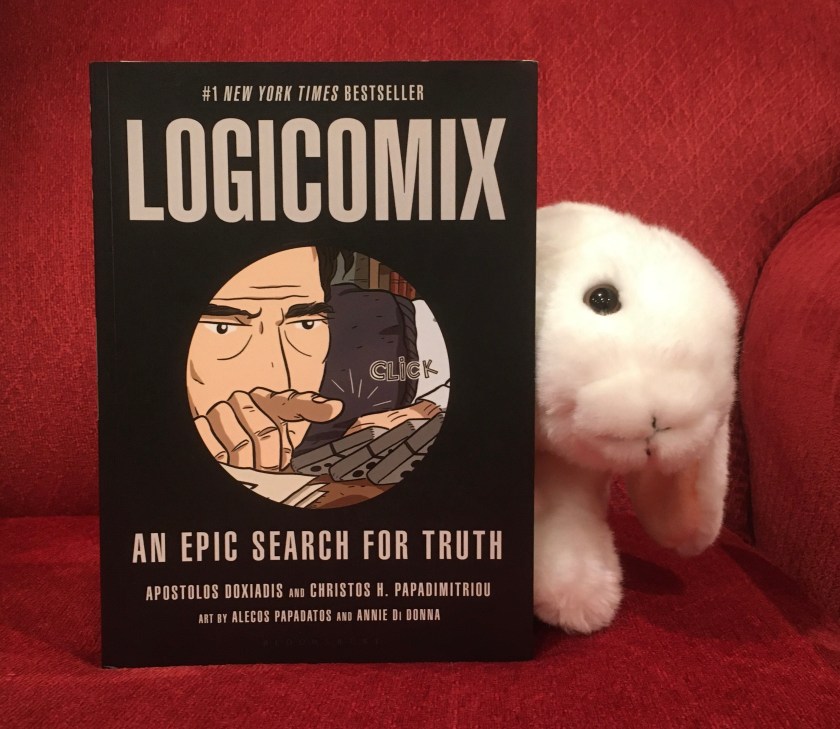
Marshmallow reviews Logicomix by Apostolos Doxiadis, Christos H. Papadimitriou, Alecos Papadatos, and Annie di Donna

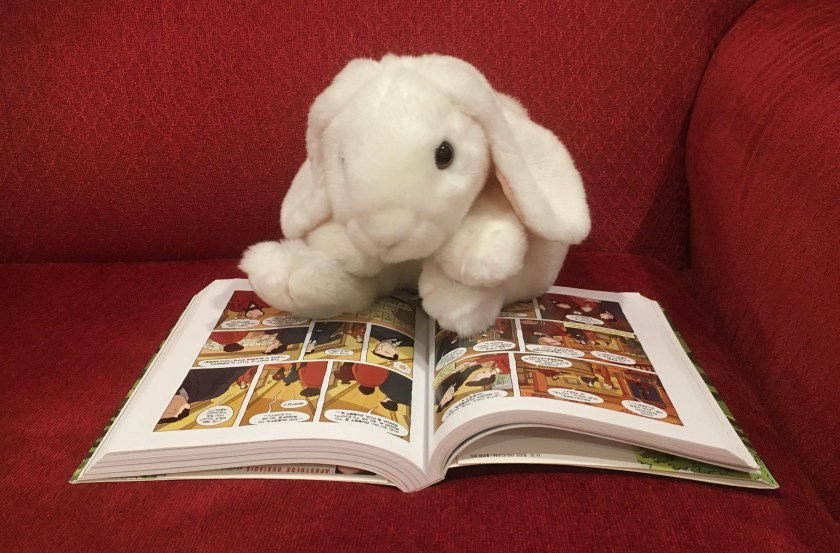
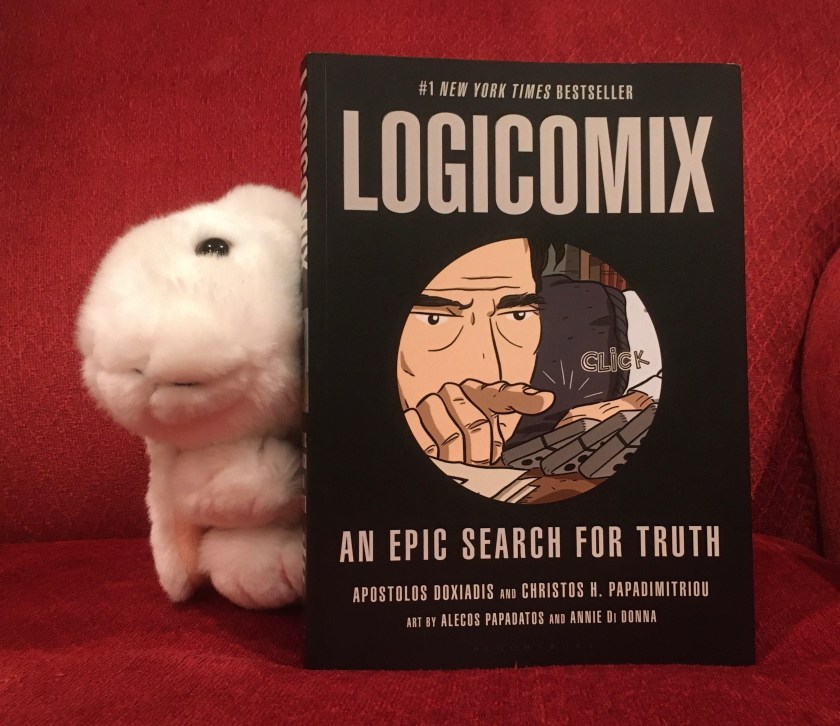
Marshmallow recently got her paws on Logicomix, a graphic novel telling of the first two-thirds of philosopher-mathematician Bertrand Russell‘s life, as it is intertwined with the story of the stormy events related to the philosophical foundations of mathematics that occurred in the early twentieth century. The book is most likely not intended for young readers, but Marshmallow found it interesting and wanted to review it for the book bunnies blog. Below is her conversation with Sprinkles about this book, written by Apostolos Doxiadis and Christos H. Papadimitriou, and illustrated by Alecos Papadatos and Annie di Donna.

Marshmallow reviews Logicomix, written by Apostolos Doxiadis and Christos H. Papadimitriou, and illustrated by Alecos Papadatos and Annie di Donna.

Sprinkles: So Marshmallow, tell us a little about this book.

Marshmallow: The first thing I want to say is that this is not a children’s book. It’s not necessarily inappropriate for children, but some concepts might be confusing for young bunnies.

S: Why did you read it?

M: It looked interesting. It is a graphic novel and I like those.

S: I see. So tell us what it is about.

M: It’s about Bertrand Russell. He is a philosopher. Basically it is about his life.

S: And the book has a really intriguing subtitle: “An Epic Search for Truth”. How is that related to Russell?

M: I think it’s because he spent a lot of time thinking about what truth means, the true meaning of “true”.

S: Yes, Russell is a foundational figure for modern mathematical logic today. I find his story fascinating and I really liked this book myself when I read it. So what else do you want to tell us?

M: There are parts of the book where the two authors, the illustrators, and a researcher who is helping them with the project are talking among themselves. And there are the other parts where we basically follow Bertrand Russell give a speech about his life and his work in logic. The speech is supposed to be about “the role of logic in human affairs” and apparently Russell did not give any such speech.

S: But it probably makes a good plot device to tell us about his life, I guess.

M: Yes, I think it works.

Marshmallow is reading Logicomix, written by Apostolos Doxiadis and Christos H. Papadimitriou, and illustrated by Alecos Papadatos and Annie di Donna.

S: So did you know about Bertrand Russell before reading this book?

M: No.

S: What do you think about him now, after having read it?

M: I think he is an interesting person. But according to this book review you showed me, not everything in the book is accurate.

S: Yes, I think the authors themselves say they took some artistic license with some of the facts. And that book review is a careful scholarly overview of the book that readers who might be curious about the accuracy of the text might check out. But let us get back to your reading of the book. What appealed to you most about this book?

M: Well, I liked the switch between the creators of the book and the subject of the book. It made things interesting. I also did not know about Russell and Wittgenstein and Gödel, and any of those philosophers, so I learned a lot.

S: And the book does cover a lot of ground in terms of the foundational debates of the early twentieth century. How did all that work out for you?

M: What do you mean by foundational debates?

S: I mean, the questions about the foundations of mathematics, of logic, of truth. How these folks were trying to understand why mathematics was true, how it worked, and so on.

M: I think some of that went over my head. But I did find it cool that people were thinking so hard about why math is true.

S: I know you find philosophical questions intriguing. The ones in this book are quite specific to math, it seems at first, but then if you think about it, we all want to know what is true, what makes something true, as opposed to false, fake news, or disinformation, or misinformation.

M: Yes. I did a project on all those this year. I used this website which talks about all the dangers of dihydrogen monoxide, and how it is everywhere, and how you should be very very afraid. But of course dihydrogen monoxide is just H2O, which is water!

S: Yes, I really liked your project! So we know it is sometimes hard to know what is true and what is not. And this book is about some philosophers who are trying to think about these questions very carefully and trying to see how to connect them to math.

M: Yes, I think that makes sense.

S: So I know you were not looking for philosophy or math when you started. Did all that overwhelm you when you were reading it?

M: No. I think they explained things in ways people could understand. I guess some things are a bit confusing, and I probably did miss some things, and maybe younger bunnies might not get any of the philosophical stuff, but it was interesting for me.

S: That’s great Marshmallow! And maybe you will come back to this book in a few years’ time if you are curious to dig deeper into the philosophical questions in it. I’m glad you read it!

M: Me too.

S: So as we wrap up this review, I’ll ask how you rate the book…

M: I rate this book 95%.

S: Sounds good! I know you always like to end our chats the way Caramel ends his reviews. So go ahead!

M: Stay tuned for more book bunny reviews!

Marshmallow has enjoyed reading Logicomix, written by Apostolos Doxiadis and Christos H. Papadimitriou, and illustrated by Alecos Papadatos and Annie di Donna and rates it 95%.