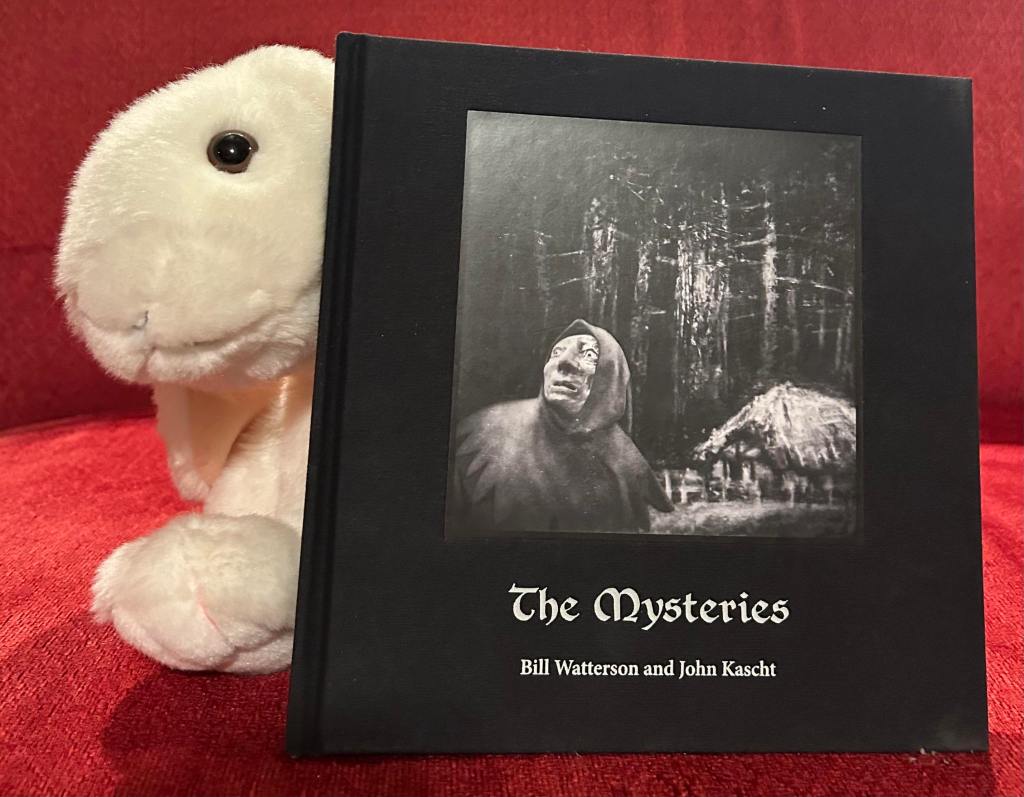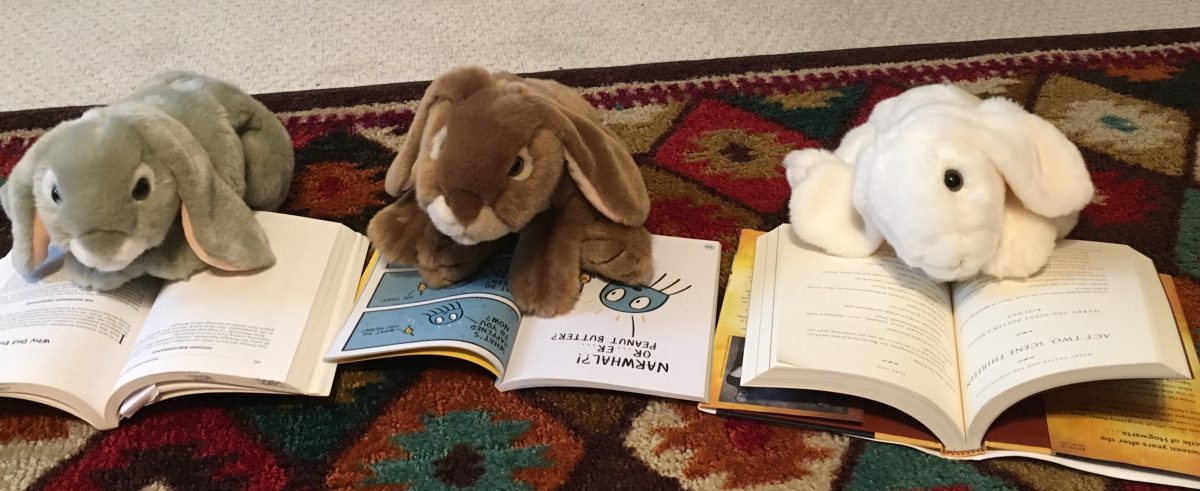
Marshmallow reviews The Mysteries by Bill Watterson and John Kascht

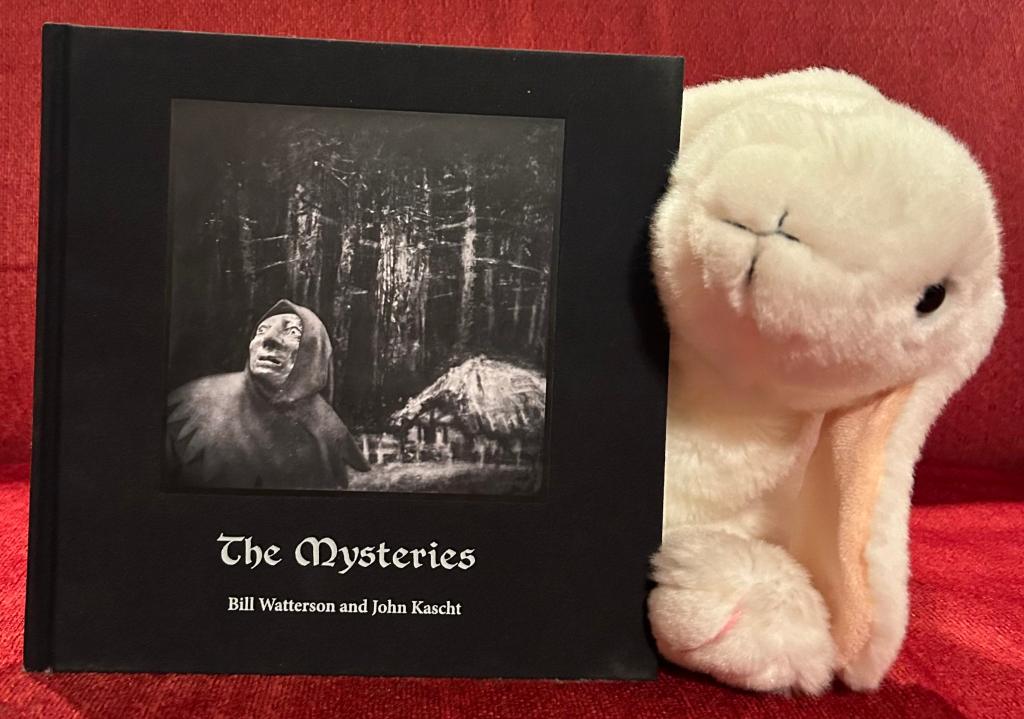
Marshmallow is a big fan of Calvin and Hobbes, the comic strip about the often obnoxiously cynical but extremely curious six-year-old Calvin and his stuffed tiger Hobbes who comes alive only when nobody else but Calvin is looking. Early during the COVID-19 pandemic, she reviewed The Authoritative Calvin and Hobbes: A Calvin and Hobbes Treasury by Bill Watterson for the book bunnies blog. So she was very excited to hear that Watterson teamed up with the illustrator John Kascht in a new book project. Today Marshmallow talks to Sprinkles about this book, The Mysteries, which was published in October 2023.

Marshmallow reviews The Mysteries by Bill Watterson and John Kascht.

Sprinkles: So Marshmallow this book was not quite what we expected, was it?

Marshmallow: No.

S: We were kind of hoping to see something of Calvin and Hobbes, at least perhaps some humor, right?

M: I was.

S: But before we dig in any further, can you tell our readers what the book is about?

M: Sure. This is a fable about a small village or country in some faraway place which was near a big forest. And in the forest were scary things, things the people did not understand.

S: And maybe they were scared because they did not understand.

M: Actually that is probably one of the points of the story. Because they tried very hard to capture one of these scary things, they called them the Mysteries, and then when they caught one, they were not very impressed.

S: Hmm, so what do you think that means?

M: I am not sure. But maybe it refers to things like thunder and lightning and solar eclipses and earthquakes, which were very very scary things, until we figured out what they were really all about.

S: Hmm, so once we had scientific explanations for them, their power to inspire fear and awe diminished.

M: Yes, but I think it is more than that. I think the Mysteries represent the mysteries of the universe. They go beyond thunder and lightning. And maybe the people got a bit too arrogant once they figured out how thunder worked that there was no mystery left that they should be scared of. But lightning still starts fires. Earthquakes still cause lots of damage to life and property. So in some sense, we will never be able to completely tame and understand nature, let alone the whole universe.

S: I think you might be on to something Marshmallow.

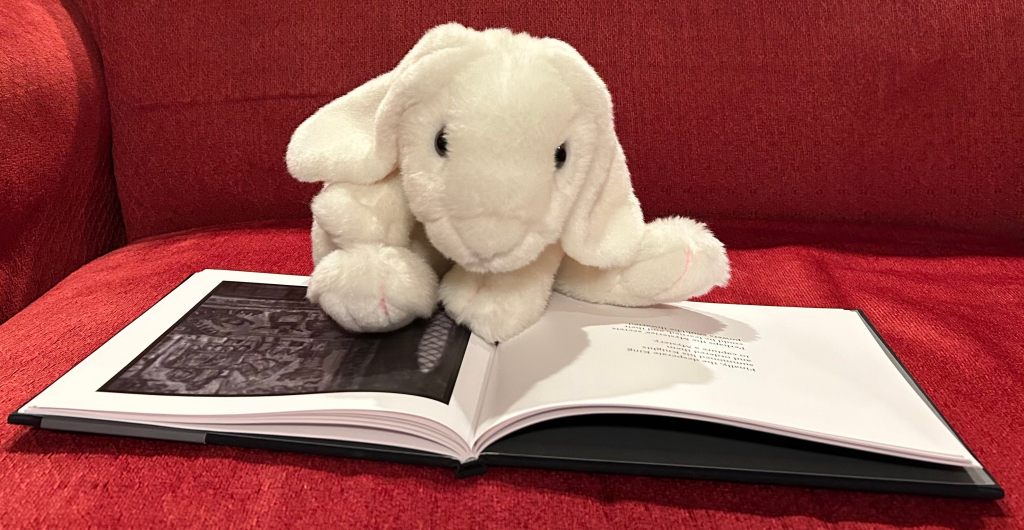
Marshmallow is reading The Mysteries by Bill Watterson and John Kascht.

S: Coming back to our original expectations about this book, maybe I am going to say, we actually should not have been too surprised.

M: What do you mean Sprinkles?

S: Maybe the end especially is pretty fitting for a fable coming from the creator of Calvin, the youngest and toughest misanthrope of all time.

M: What do you mean by that?

S: I feel like there is some pessimism about humans in the book. And I think there is some of that cynicism in Calvin, too.

M: Well, I did not notice that, but then again, when I read Calvin and Hobbes, I just laugh at his ridiculous plans and hilarious excuses for not doing what he is supposed to do.

S: Sure, there is definitely that level of hilarity to Calvin and Hobbes, but I’d say there is a lot of questioning of mainstream beliefs and assumptions, too, and some of the questioning does not leave much space for optimism. At least that is how I read it sometimes.

M: I guess I will need to reread Calvin and Hobbes, this time with that perspective, to see what you mean.

S: But coming back to The Mysteries, why do you think it is a fable?

M: Well, the space and time are not very clearly set, and it could be anywhere anytime, almost. And the kingdom seems to be all there is. And the authors are trying to give us a moral message.

S: Ooh, I like that! Can you tell me what that moral message is?

M: If we lose our awe of the mysteries of life and the universe just because we think we understand some of them, we might lose our respect for life and the universe, which can only end in disaster.

S: That is deep. Marshmallow!

M: But there is more. I think the fable is also telling us that there is always more mystery. That we will never run out of them, that there is always some magic and something to be in awe of when it comes to life and this universe.

S: I see. And the book says all this in so few words!

M: Yes. Each two-page spread has only a handful of words, and at least one of the two pages is a full page-picture.

S: Can you tell me a bit about the illustrations?

M: I think the only word that comes to my mind is “haunting”. Everything looks kind of deformed. The people look like they are made out of clay. It is almost like we are seeing our world but through some kind of a magic lens which shows us only the darker, more arrogant side of humanity.

S: In some sense though, I think one could read the ending as a hopeful message.

M: No!

S: I do! No matter what, life and the universe just go on.

M: I am not sure I agree with you on that, Sprinkles. But I guess we will just agree to disagree.

S: Sure, I am okay with that. But at least I think we agree that the core message is a warning.

M: Yes. We do agree. The core message is to warn people not to be too arrogant. As a species, humans should not get too arrogant. I think that is what the authors are saying. And they are telling us that we are like boats; a boat can cross the ocean but it can never conquer the waves.

S: That is a beautiful way to put it Marshmallow. Did you just come up with that yourself?

M: Yep.

S: I will definitely use that sentence again, Marshmallow, and I will cite you.

M: Thank you!

S: Okay, so let us wrap up this review then. What would you like to tell our readers?

M: Stay tuned for more amazing reviews from the book bunnies!

Marshmallow appreciated reading The Mysteries by Bill Watterson and John Kascht and talking about it with Sprinkles.

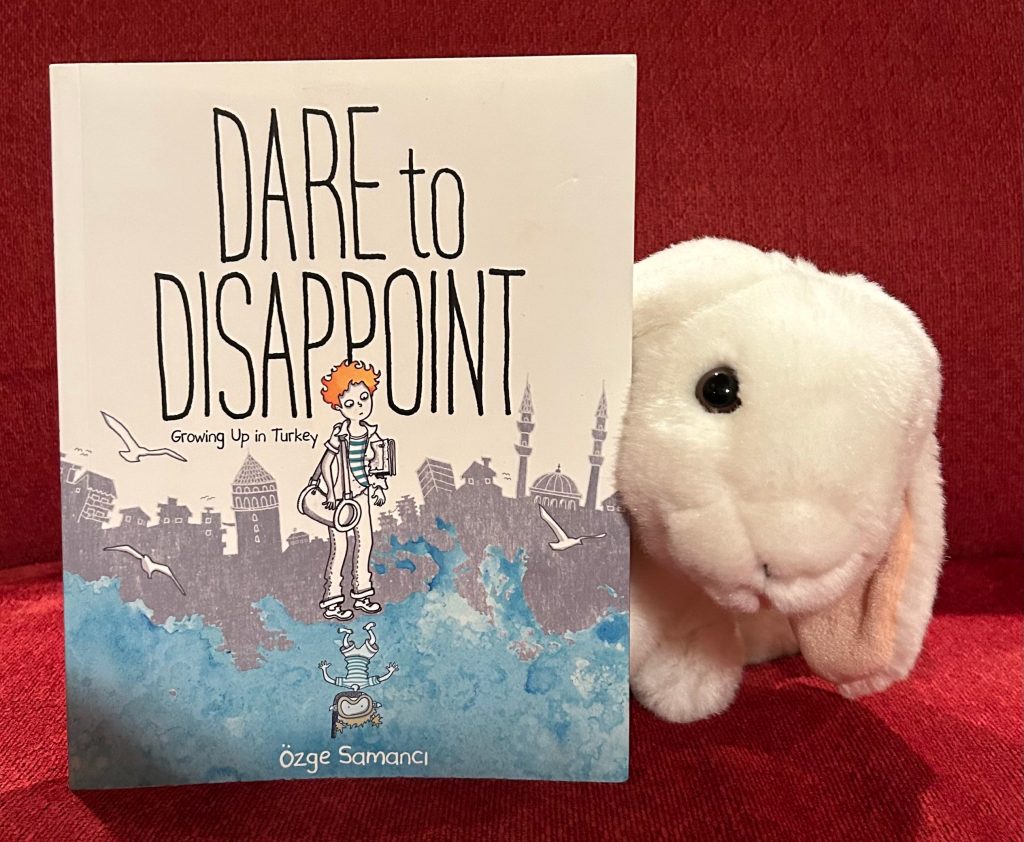
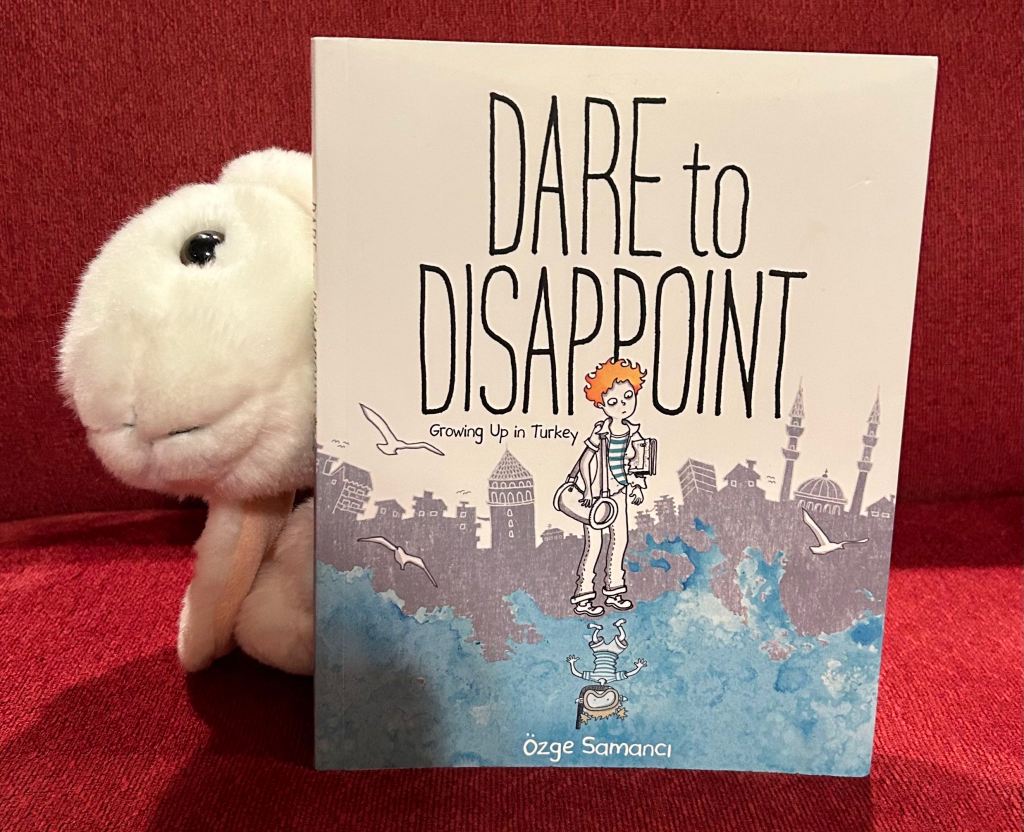
Marshmallow reviews Dare to Disappoint by Özge Samancı

Today Marshmallow reviews the autobiographical graphic novel Dare to Disappoint by Özge Samancı, first published in 2015.

Marshmallow reviews Dare to Disappoint by Özge Samancı.

Marshmallow’s Quick Take: If you like graphic novels or if you enjoy reading books about growing up in general, then this might be the book for you. 

Marshmallow’s Summary (with Spoilers): Özge Samancı grew up in Izmir, Turkey (in late 1970s and early 1980s). Ever since she was very young, she was obsessed with the idea of going to school and loved the school uniforms. Her family’s house was across the street from her older sister’s elementary school, and everyday, Özge and her mother would wave at the sister who was at school. Özge longed to be on the other side, waving back home from behind the school fence. Finally, when she started to go to elementary school, she idolized her first-grade teacher (Turkey did not have a kindergarten grade at the time). But one day, after talking about a bizarre incident on the television, Özge was beaten by her teacher with her pink ruler. Her entire class was punished as well. Özge was confused as to what she or any of her other classmates had done.

As Özge grew older, the political tension in Turkey increasingly impacted her family and her family’s life and lifestyle. Knowing that education was a way for her to gain a steady, stable life, Özge set her mind up to enter a prestigious public high school. She, along with her sister, studied obsessively so they could do well in the test that would determine their high school placement and (practically) the rest of their academic lives.

When she began attending college, Özge found herself drawn to art, theater, and other creative endeavors. However, her father wanted her to study more practical and pragmatic fields like engineering or medicine. Eventually, Özge faced a decision: do what her father wants her to do or live a life of uncertainty on her own terms. Read to find out how she resolved this issue…

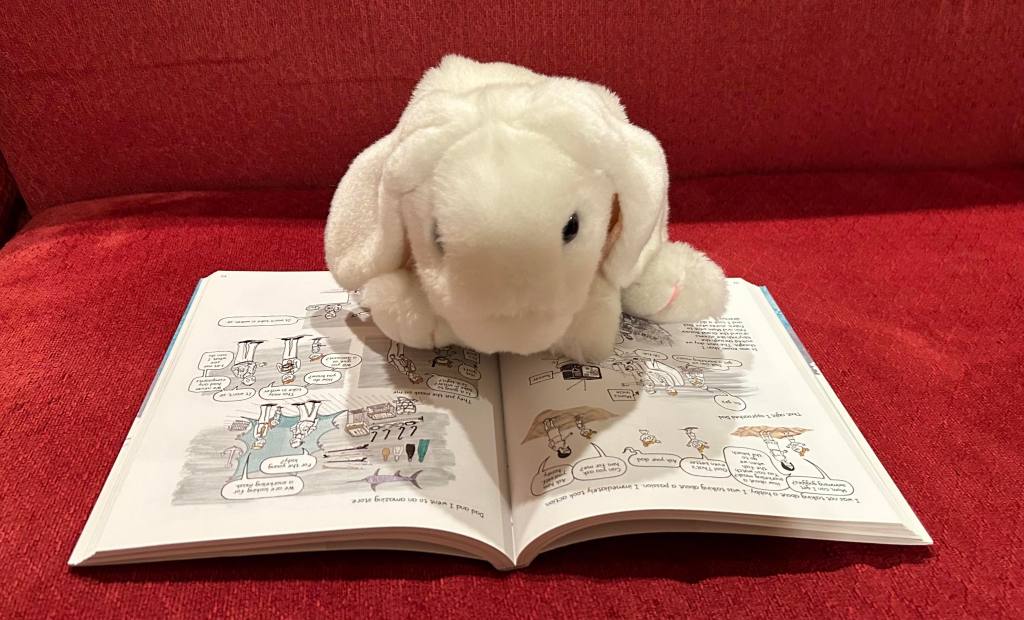
Marshmallow is reading Dare to Disappoint by Özge Samancı.

Marshmallow’s Review: Dare to Disappoint is an interesting and entertaining book. It describes a young person’s search for her own artistic and creative identity in the context of a loving but perhaps somewhat rigid family. It also offers insight as to what life was like for a young child in Turkey in the 1980s. It was especially interesting for me to see the many details of life in a different time and different place than what I have experienced so far.

I liked reading Dare to Disappoint. The author’s voice is down to earth and relatable. The plot and storyline of the book are easy to understand and follow. This is a graphic novel, and the illustrations are really cute, but also detailed and expressive. Color is sparse, but well distributed. Additionally, photos of 3-D objects are inserted and sort of interwoven with the author’s drawings. Today Samancı is a media artist who also teaches at a university. It was cool to read about her earlier life in this format and have the opportunity to learn about her path to finding her own artistic voice.

Though the illustrations are vivid and cute, and the author voice is friendly and accessible, Dare to Disappoint may not be appropriate for very young bunnies. My only concern is that at some point, the author is physically attacked and is almost sexually assaulted, which might be too scary for some younger readers. But other than that, I think that the book tells a beautiful and very personal story, and bunnies of all ages can appreciate the tale of an artist’s childhood and growing up into her own.

Marshmallow’s Rating: 100%. 

Marshmallow rates Dare to Disappoint by Özge Samancı 100%.

Marshmallow reviews Ashes by Laurie Halse Anderson

Marshmallow has already reviewed Chains and Forge, the first two books of Laurie Halse Anderson’s Seeds of America trilogy. Today she completes the trilogy by reviewing Ashes, the third and last book, first published in 2016.

Marshmallow reviews Ashes by Laurie Halse Anderson.

Marshmallow’s Quick Take: If you like historical fiction or emotional roller coasters, or if you have enjoyed reading the first two books of Laurie Halse Anderson’s Seeds of America trilogy, then this might be the book for you.

Marshmallow’s Summary (with Spoilers): This book starts a few years after the events of Forge. You might recall that it is the late 1700s (the time of the American Revolution), and Isabel is a runaway slave, who has been searching for her younger sister, Ruth. At age seven, Ruth was sold away and separated from her. Eventually, with her friend Curzon, Isabel escaped from her “owners” and set out to find her sister.

After many trials, hardships, and travels, Isabel and Curzon finally reach the area where Ruth might be living, in South Carolina. Isabel and Curzon’s friendship is in peril; they are both unsure of its future. The two have learned through several ordeals that, as former slaves, nowhere is safe for them. But after all of this, Isabel finds her sister living on a farm. Overjoyed, Isabel runs to her, only to find that her sister doesn’t recognize her.

We learn with Isabel that Ruth has been living with Mister Walter and Missus Serafina, an older couple who have raised her as their own. Isabel is grateful for their generosity but is heartbroken. When questioned further, Ruth admits to remembering Isabel but says that she is not her sister anymore, and that Isabel should go home.

Luckily, Mister Walter and Missus Serafina invite Isabel and Curzon to stay a while. There, they learn that the plantation that Ruth and the couple worked on was raided by Patriots and the owner left to go after them. After a second Patriot raid, many of the slaves on the plantation fled, but Mister Walter and Missus Serafina physically couldn’t run away. This is why Ruth stayed on the plantation. Another boy named Aberdeen tried to run away but was caught and brought back.

Isabel is still in shock from Ruth’s rejection of her when the plantation owner Prentiss returns. Mister Walter and Missus Serafina send Isabel, Curzon, Ruth, and Aberdeen away and tell them to run. Once again, Isabel is forced to confront a cruel world and must protect her sister from danger. 

Marshmallow is reading Ashes by Laurie Halse Anderson.

Marshmallow’s Review: Ashes makes a good ending to the Seeds of America trilogy. Like Chains, the first book of the series, it is narrated by Isabel. Ashes is a true emotional roller coaster, with ups and downs that keep you reading until the end.

The character development in this story is remarkable and adds to the depth of the plot of the book. Laurie Halse Anderson is very skilled at showing the external struggles faced by the characters and is very adept at weaving in the characters’ internal conflicts. We can see the development of Isabel’s feelings for Curzon change from pure friendship to romance, and the transition seems convincing.

The writing reflects the style of that period and accurately (I think) portrays life in that time. Also, just like she had done in the first two books, the author regularly includes quotes from real documents from the time of the Revolutionary War to provide some historical context. However, everything is still understandable and the book itself is very readable.

All in all, I appreciated the chance to read these three books and would recommend them wholeheartedly to other young bunnies interested in understanding the people and the events at the beginning of the United States as a nation.

Marshmallow’s Rating: 100%

Marshmallow rates Ashes by Laurie Halse Anderson 100%.

Marshmallow reviews Forge by Laurie Halse Anderson

A few weeks ago Marshmallow reviewed Chains by Laurie Halse Anderson, the first in the author’s Seeds of America trilogy. Today she is writing about the second book in the series: Forge, first published in 2010.

Marshmallow reviews Forge by Laurie Halse Anderson.

Marshmallow’s Quick Take: If you like historical fiction books or emotional roller coasters, or if you have enjoyed reading other books by Laurie Halse Anderson, then this might be the book for you.

Marshmallow’s Summary (with Spoilers): Curzon is a soldier, but some people don’t see him that way. He is a runaway slave during the American Revolution and has signed up to fight for the Patriots until the end of the war. Life for him is dangerous as he is posing as a freed man. If the wrong people find out the wrong things about him and his past, he would lose his newly gained freedom. Unfortunately, because of his skin color, some of his fellow soldiers do not treat him well. One in particular, named John Burns, is a constant menace and a thorn in Curzon’s side. 

Curzon is a character we met before in the first book of the trilogy, Chains. There he was serving as a slave for a Mister Bellingham, who would enlist Curzon’s help to further the Patriot cause. Then, Curzon met Isabel, the narrator of that book, who, together with her sister Ruth, was also a slave. Curzon and Isabel escaped together after Ruth was sold away by Isabel’s evil “owner” Mrs. Lockton. Afterwards, Isabel wanted to try to find Ruth, but Curzon suspected that she was dead. Isabel and Curzon eventually split, and Isabel would not stop looking for her sister. Curzon then enlisted in the Patriot Army. 

In this book, Curzon and the other soldiers in the Patriot Army must endure the dangers of the Valley Forge. They face starvation due to shortages in their supplies and the freezing cold that could steal their health, their limbs, and their lives. Curzon starts to make friends with some of the other soldiers, one being Ebenezer Woofruff. Ebenezer is trusting and has a kind nature, especially after Curzon saved his life (which led to Curzon’s enlistment). At Valley Forge, Curzon and his fellow soldiers struggle to build a hut or cottage to shelter in during the winter. The conditions are rough; their breakfast, lunch, and dinner consist only of water and fire cake, made of water and flour. But even in these harsh times, Curzon still thinks and worries a lot about Isabel. Time passes and he begins to miss her, even though he does not want to. 

Valley Forge is full of surprises and old acquaintances began to appear. Curzon’s old “master” Bellingham comes to Valley Forge with Isabel in tow as his slave. Bellingham practically enslaves Curzon once more, and he is separated from his friends. Isabel and Curzon are mutually unhappy with each other, but their situations are bad so they eventually come together and try to work together again to regain their freedom.

Marshmallow is reading Forge by Laurie Halse Anderson.

Marshmallow’s Review: I found Forge to be a very interesting and very well written addition to the Seeds of America trilogy. Narrated from the perspective of Curzon, this book in some ways complements the story of Chains while it continues it. I recommend having read the first book, but (unusually) I think Forge could be read and understood without it as well.

The author does a great job of setting up and developing the time period displayed in the books. The characters are all very human, and their suffering and emotional distress are very impactful to the reader. This book continues to deal with the atrocious practice of slavery and shows the impact that had on the slaves through these characters. The injustice and inequity of slavery and racism is important for people to remember, realize, and recognize as part of American history.

Reading Forge can be a very good way for people to learn about these times. I would highly recommend reading this book for the historical content and for the character development, plot, and overall story. 

Marshmallow’s Rating: 100%.

Marshmallow rates Forge by Laurie Halse Anderson 100%.