Marshmallow reviews Powerless by Lauren Roberts

Today Marshmallow reviews Powerless by Lauren Roberts, first published in 2023.

Marshmallow reviews Powerless by Lauren Roberts.

Marshmallow’s Quick Take: If you like fantasy books about romance or fighting against injustice, or if you just want to read an interesting book about adventure, then this is the book for you.

Marshmallow’s Summary (with Spoilers): Paedyn Gray is an Ordinary, even though she is definitely not ordinary. However, in Ilya, where there are only Elites, being an Ordinary is a crime. Many years ago, a deadly Plague swept the land. Many who survived were gifted powers; these made up the Elites. Elites pass on the status to their descendants, with Elite parents birthing Elite children with powers of their own. However, some who survived the Plague were not given powers. They and their children who are born without powers are Ordinaries. After another outbreak of a common illness, King Edric of Ilya decreed that Ordinaries were responsible and carrying some sort of disease, which is why they hadn’t been given powers. He claimed that Ordinaries suck away the power of Elites, stealing their gifts away. So all Ordinaries in Ilya were banished, killed, exiled to make Ilya stronger and the only, all-Elite kingdom. This was called the Purging, which is why Paedyn must be careful. Even now, Ordinaries and anyone caught helping them are killed or exiled to the desert (under the promise of mercy, of reaching an unreachable kingdom across it).

Paedyn’s mother died when she was young, so when Paedyn’s father, a Healer with magical healing powers, was killed, she fled her house and started living on the streets. Her father was stabbed through the chest, by the king himself, though she doesn’t know why. But before he died, he taught her how to survive by posing as a Psychic, a mundane magical ability that would keep her from being recognized as an Ordinary. On the streets, she is less traceable and lives with Adena, an Elite girl who loves sewing. Adena is a Phaser, meaning she can pass through objects and people (which is how she met Paedyn) if she wants. Adena sews clothes to sell using cloth and materials stolen by Paedyn.

One day, while looking for her next victim, Paedyn decides to rob a wealthy-looking Elite. She finds him intriguing and attractive but carries out the job anyways. Later, this man is attacked by a Silencer, a type of Elite whose power is to suppress the magic of other Elites and is persecuted in Ilya. Paedyn feels sorry for the stranger and saves him, which is quite easy for her since she is well trained in fighting and is not affected by the Silencer’s powers. Soon after, she learns that the stranger was Prince Kai Azer, future Enforcer for the king whose job is to eliminate all and any Ordinaries.

Paedyn is now dubbed the Silver Savior and is entered into the Sixth Purging Trials, a set of competitions designed in honor of the Purging to celebrate and show off the powers of the Elites. And while that’s certainly an issue given the fact that she has no powers, she is also starting to struggle with her growing attraction to Prince Kai (who is also competing). He also appears to reciprocate. But as it says on the book cover, she is hunted by him, the hunter. Now, Paedyn must fight battles on both fronts, the ones in the Trials and the one in her heart. Duh duh duh dun!!!

Marshmallow is reading Powerless by Lauren Roberts.

Marshmallow’s Review: I found Powerless to be a very interesting and intriguing book. I really enjoyed reading it, and I found the plot and the characters to be very well written and well developed. The reader definitely develops a sense of connection to the characters as the book goes on. I really liked how the author shows the perspectives of both of the main characters, Paedyn and Kai. Each chapter is narrated either by one of the two main characters which serves its purpose of showing the story from multiple views.

I think the author also did a very good job of creating a world that was foreign yet familiar at the same time. It is realistic and fantastic at the same time; the author gives the characters a sense of ability despite their challenges being unlike the ones that most people face today. The world discussed in this book is kind of dark, and genocide is a theme throughout: the Ordinaries are killed just because of the way they were born. But for readers who can handle more mature books, this is I think a very good book.

When I started to read Powerless, I had the sense that it would be similar to some other books that turned into intensely romance-oriented novels. And while the budding romantic relationship between Paedyn and Kai is a major part of the plot and the story, I was glad that it was not the only thing that was focused on throughout the book. The plot kept moving, and the romantic aspect stayed relevant all while keeping the focus on the trials the characters faced. There are a lot of scenes in which the two characters are in close contact and touch each other frequently; however, they do not ever actually start to have an official, romantic relationship. While this might seem confusing, let me explain. The two characters are attracted to each other, but they are both trying to stop themselves from falling in love with the other. They tantalize each other with touches, but there is no sexual activity. So in that aspect, it is not necessarily inappropriate for children.

Powerless is dramatic at times and comical at others. So in that sense, too, it is an entertaining read. However, I did find that there was a little bit too much violence for my taste, especially since the author includes very vivid descriptions of fighting, stabbing, gore, and blood. Moreover, I found the relationship between the two main characters to be a bit bizarre because of their desensitization to violence, though perhaps it makes sense; all the characters in the book seem to be somewhat desensitized to violence. and it is probably due to the harsh world they are living in, and in the case of many of the characters, due to the rough nature of their own upbringing. In any case, I feel personally that some descriptions of violent acts were a little too vivid, and that younger bunnies might be horrified or traumatized by the detailed descriptions. So I would recommend this book for bunnies over the age of fourteen.

I know that many readers are waiting for the sequel to this book to come out this summer. I myself am also excited because this book does end in a cliffhanger which made the ending quite unsatisfactory in my opinion. Overall, I think Powerless is a good book even though some parts are a little too graphic for me personally, and I am looking forward to reading the sequel and seeing the characters’ story continue to grow.

Marshmallow’s Rating: 95%

Marshmallow rates Powerless by Lauren Roberts 95%.

Marshmallow reviews The Hate U Give by Angie Thomas

Today Marshmallow reviews The Hate U Give by Angie Thomas, first published in 2017.

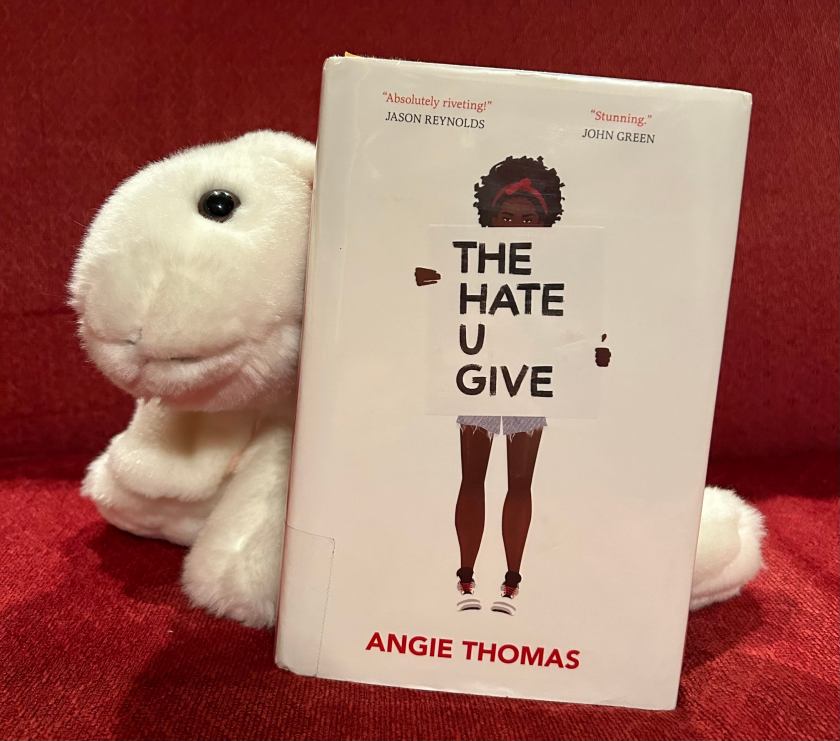
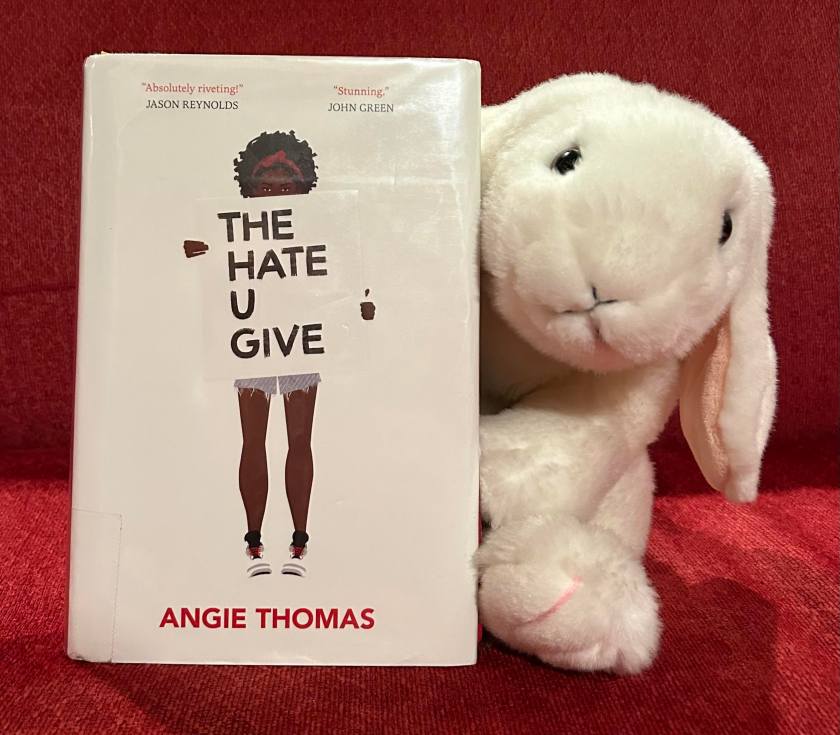
Marshmallow reviews The Hate U Give by Angie Thomas.

Marshmallow’s Quick Take: If you appreciate books about racial injustice, family, friendship, growing up against adversity, and police brutality, then this is the book for you.

Marshmallow’s Summary (with Spoilers): Starr Carter attends a fancy prep school that is mostly White and wealthy but comes from a neighborhood (called “The Garden”) that is mostly Black and poor. These two distinct worlds create two distinct Starrs, one for Williamson Prep and one for Garden Heights. But she still feels like she doesn’t quite fit in in either place. So at a party, she finds comfort catching up with her childhood best friend Khalil whom she hasn’t seen for a while. But when a gun is fired at the party, she and Khalil leave and then get pulled over for no apparent reason. Khalil is instructed to get out. He does. He briefly leans over to check if Starr is okay. Then Khalil is shot by a police officer and everything changes forever. The police officer claims he thought Khalil was reaching for a weapon which turned out to be a hair brush. Khalil’s death becomes the center of attention. Starr faces a choice between staying silent or speaking out and placing herself and her family in danger. 

Marshmallow is reading The Hate U Give by Angie Thomas.

Marshmallow’s Review: The Hate U Give by Angie Thomas is very well written, and though it is about very challenging themes (police brutality and racism), I could not stop reading it once I started. The story is told from Starr’s perspective and voice, and you get a first-hand look at her inner world as well as how she switches personalities and voices (see code-switching on Wikipedia) when she travels between her two worlds.

The title of the book is the beginning of the sentence whose initials spell THUG LIFE, an acronym created by Tupac Shakur and points to one of the important messages of the book: if you hate people from their birth just because they are black or poor or just different from you, if you give them hate from the time they are infants, it hurts everybody. Starr’s friend Khalil explains the quote right before his murder: “What society gives us as youth, it bites them in the [xxx] when we wild out.”

The book came out during the early years of the Black Lives Matter movement, and it was received well by critics and readers alike. There was even a movie adaptation (see the trailer here). The book also became controversial in some places, where people argued that the themes were too volatile and the language too vulgar. I did not find the language inappropriate given the context of the story, though it might be not acceptable for parents of very young bunnies.

But I think that more mature bunnies should definitely read the book. It is provocative, to say the least, but it tells a story that is unfortunately too familiar today from the inside, in the voice of one who was there when it happened.

Marshmallow’s Rating: 100%.

Marshmallow rates The Hate U Give by Angie Thomas 100%.

Marshmallow reviews We Should All Be Feminists by Chimamanda Ngozi Adichie

Today Marshmallow picked up a short little book from the book bunnies’ home library: We Should All Be Feminists by Chimamanda Ngozi Adichie, first published in 2014. Below she shares some of her thoughts on this little book.

Marshmallow reviews We Should All Be Feminists by Chimamanda Ngozi Adichie.

Marshmallow’s Quick Take: If you are feeling up for a short, non-fiction book with an important message, then this might be the book for you.

Marshmallow’s Summary (without Spoilers): I’d like to start off by saying that this book is adapted from Chimamanda Ngozi Adichie’s TEDx talk which is also titled “We should all be feminists”. I would recommend watching the video of her talk before or after reading this book.

In this book, Ngozi Adichie covers her experiences as a feminist. She explores what it means to be a feminist, how we can raise feminist children of both genders, and how we can strive towards a future where we are all feminists. 

The author starts off by talking about her first encounter with the word “feminist”. The first time she was called a feminist, the word “feminist” was something akin to terrorist, used as an insult and an accusation. However, as we follow her, we learn that feminism is nothing to be afraid of and that instead it should be something we all should strive for.

Ngozi Adichie points out something insightful in this book when she states that the word “feminist” is often associated with the idea of being un-feminine. Ngozi Adichie writes that she enjoys wearing high heels and shiny lip gloss, even though she is a feminist. The author emphasizes that being a feminist doesn’t mean that you are unfeminine; it simply means that you believe that men and women deserve equal rights and prospects in life. The author specifically examines the treatment of women and men in Nigeria, offering examples and anecdotes from her personal experience. Though her examples were mostly from Nigeria, she does allow us to recognize that many women around the world are often ignored and silenced. 

The author also talks about how men fit into feminism. She says that being a feminist doesn’t mean believing in female superiority; it means believing in female equality. Ngozi Adichie writes that ideas of masculinity also feed into the unjust sexism that exists in all cultures. Ngozi Adichie talks about how we must change the perspectives on gender, for both genders, for the sake of women and men. 

Marshmallow is reading We Should All Be Feminists by Chimamanda Ngozi Adichie.

Marshmallow’s Review: I really liked this book. I completely agreed with practically everything in this book and felt verified by some of her statements. As a female bunny, I think books like this are important for change, especially this book. This book is very short and concise. The writing style is fresh and engaging, easy to follow and easy to understand. Yet the simplicity is most successful because of the way the author is so persuasive.

We Should All Be Feminists is a great book to give to someone who might not recognize the issues that women still face today. This is a very important message for everyone because feminism isn’t about pushing men down at all. It’s about focusing on what we have in our brains, rather than what sex chromosomes we have. 

Overall, We Should All Be Feminists is very meaningful, easy to understand, and appropriate for all ages. I would recommend that everyone reads this book or at least watch the TEDx version of it

Marshmallow’s Rating: 100%

Marshmallow rates We Should All Be Feminists by Chimamanda Ngozi Adichie 100%.

Marshmallow reviews The Bluest Eye by Toni Morrison

Today Marshmallow reviews The Bluest Eye by Toni Morrison, first published in 1970. Sprinkles is taking notes and asking questions.

Marshmallow reviews The Bluest Eye by Toni Morrison.

Sprinkles: So Marshmallow, you always start your book reviews with what you call a quick overview. Can you give us one for this book, too?

Marshmallow: If you want to read about three young black girls growing up after the Great Depression and amidst internalized and externalized racism, then this is the book for you.

S: Okay, I think that is a good start. So tell us a bit more. Who are the three girls?

M: The main character is eleven-year-old Pecola Breedlove, and she is a foster sister to the other two girls, Claudia and Frieda MacTeer, who are nine and ten, and live with their parents. Pecola and Claudia are close, and a lot of the book is told from Claudia’s perspective. But we also have flashbacks and so on to events in Pecola’s life that Claudia could not have witnessed.

S: Okay, so tell me more. Why is the title The Bluest Eye?

M: Because Pecola wants to have the bluest eyes in the world. She thinks that she is ugly because a lot of people tell her she is, and she thinks that if she had blue eyes, she would be beautiful too.

S: I see. That must be very hard for a young girl of course.

M: That is not all that is hard in her life though. Her parents are both alive but they are not able to take good care of her. Her father is abusive and violent. Her mother does not support and protect her. The MacTeers on the other hand are a more supportive family for their children and Pecola, too, at least most of the time.

Marshmallow is reading The Bluest Eye by Toni Morrison.

S: I know this book has been banned in some school districts. Do you know why?

M: I think it is mainly because of two very sexually explicit scenes, which are also violent and abusive. And there are other parts where children are sexualized, and so on.

S: Hmm, I can see how those types of scenes would make a lot of people concerned about a book, especially for younger folks. How did you handle them?

M: I think the book is really hard to read, emotionally. When I was reading the book, I had to put it down several times. That is why it took me a really long time to read the book even though it is not very long and the author’s voice is fluid and captivating.

S: And yet you persisted and finished the book.

M: Yes, because I know it is an important book, and I know the author is trying to tell us something important.

S: What do you think she is trying to tell us?

M: I think she is trying to portray the chaos and the evil that results from racism. She says: “I felt compelled to write this mostly because in the 1960s, black male authors published powerful, aggressive, revolutionary fiction or nonfiction, and they had positive racially uplifting rhetoric with them that were stimulating and I thought they would skip over something and thought no one would remember that it wasn’t always beautiful.” So even though black people survived and often thrived despite the terrible oppression of racism they had to face, there were also people who did not survive, who were broken, and Toni Morrison wanted to make sure that we would not forget that.

S: I can see why you persevered Marshmallow. Sometimes we need to read difficult and heart-wrenching text to make sure we do not forget. But from what I am hearing you say, this book is probably not appropriate for young bunnies even though the main characters are young themselves.

M: Yes, definitely. I don’t think Caramel should read it yet for example. But for bunnies who are older and a bit more mature, it might be more appropriate.

S: You have read and reviewed Chains, Forge, and Ashes, the three books of the Seeds of America series, which were also about racism, or maybe more accurately, slavery. I think those books were also hard to read in some ways, but this one seems like it was a lot more challenging.

M: Yes. Possibly because in those books, even though there is a lot of pain and heartbreak, the main characters eventually overcome some of their challenges, and there is some sense of triumph, kind of like the writings Toni Morrison is referring to in the quote above. But in The Bluest Eye, both the life and the identity of Pecola are shattered. She does not survive her challenges. There is no redemption, only pain. Okay, there is some beauty too, in the book; there is solid love and affection, in the lives of Claudia and her family. But what happens to Pecola is traumatizing, and she does not survive the trauma.

S: I get that Marshmallow. Thank you for sharing your thoughts on this book. So do you have some last words to say about it?

M: I think this could be a good book to read for bunnies who are willing to face the full ugliness of racism and how it hurts people’s self-worth.

S: Thank you. So let us wrap this up then. What do you want to tell our readers?

M: Stay tuned for more amazing reviews from the book bunnies!
Marshmallow appreciated reading The Bluest Eye by Toni Morrison, though she thinks that it might be appropriate for only older bunnies.