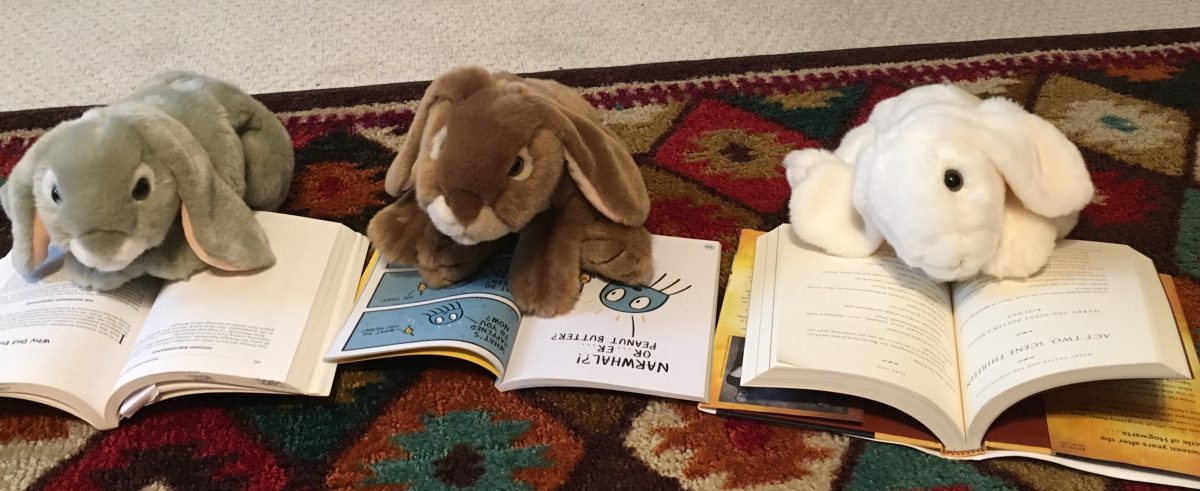
Marshmallow reviews It’s Not Easy Being a Bunny by Marilyn Sadler

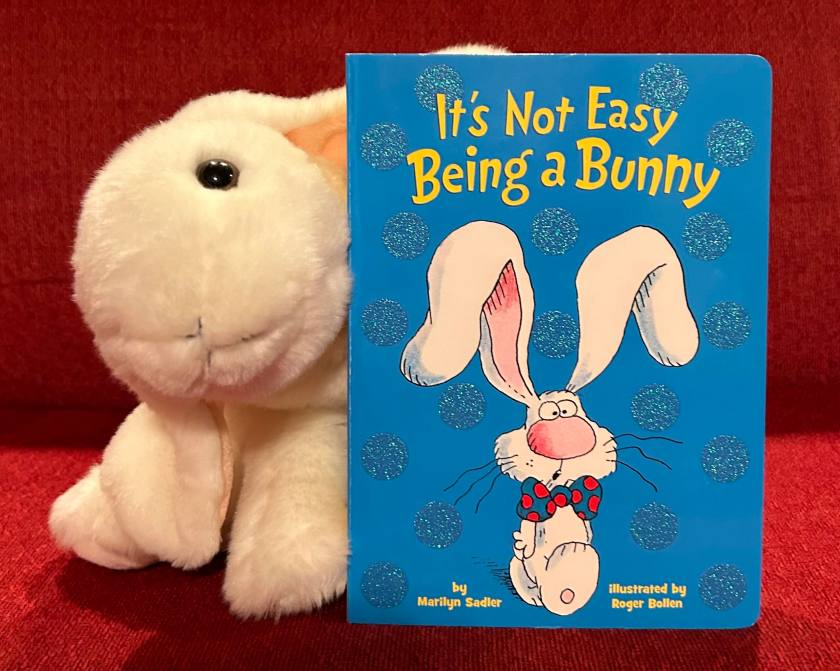
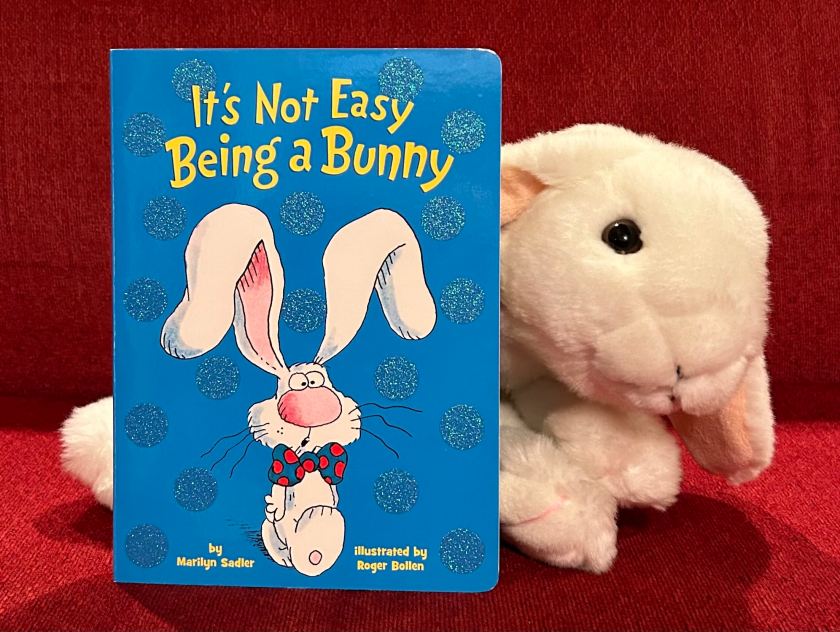
Tomorrow, many people around the world will celebrate Easter. Marshmallow wanted to commemorate this holiday with a cute book about bunnies, so today she is reviewing It’s Not Easy Being a Bunny, a little book written by Marilyn Sadler, illustrated by Roger Bollen, and originally published in 1983. Sprinkles is taking notes and asking questions.

 Marshmallow reviews It's Not Easy Being a Bunny, written by Marilyn Sadler and illustrated by Roger Bollen.
Marshmallow reviews It’s Not Easy Being a Bunny, written by Marilyn Sadler and illustrated by Roger Bollen.

Sprinkles: So Marshmallow, we are talking about a picture book today.

Marshmallow: Yes. I thought it would be appropriate given that this weekend a lot of people are talking about bunnies and egg hunts and such.

S: I agree. This is a sweet book, so why don’t you tell us what it is about?

M: First of all, I should say that the book is not about Easter at all. But it is a book about a bunny, a bunny named P.J. Funnybunny.

S: That is a funny name for a bunny.

M: Yes, it is not as cool as my name, but it is a funny one. It is definitely fun to say. It just rolls off your tongue.

S: Agreed. So tell us a bit more about P.J. Funnybunny.

M: P.J. is not very happy at the beginning of the book. He does not like the cooked carrots his mommy gives him. So he runs away from home to try and not be a bunny anymore.

S: Aw, that is so sad! A little bunny running away from home…

M: Let me just say that it does not work out great.

S: Well, how could it? But what do you mean? Does he get hurt?

M: No, not really. But he does meet some different animals and he tries to join them. But in the end, he decides that maybe being a bunny is not so bad.

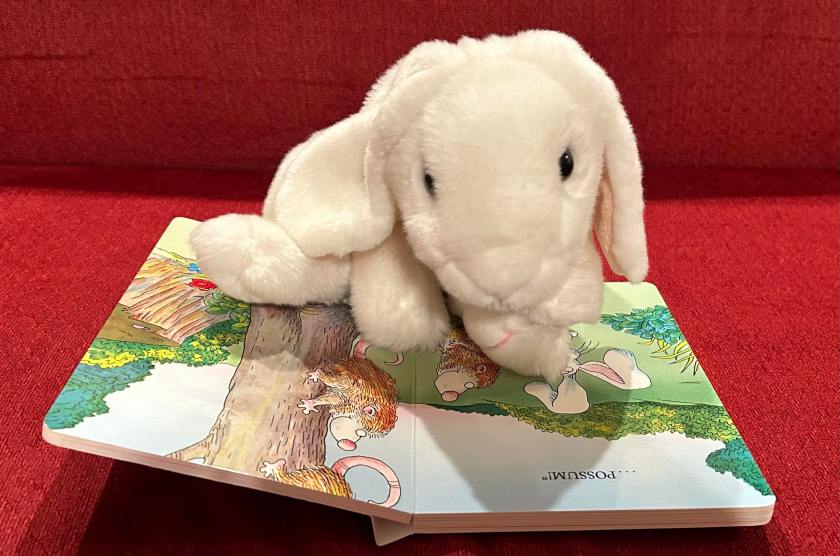
 Marshmallow is reading It's Not Easy Being a Bunny, written by Marilyn Sadler and illustrated by Roger Bollen.
Marshmallow is reading It’s Not Easy Being a Bunny, written by Marilyn Sadler and illustrated by Roger Bollen.

S: Do you like being a bunny Marshmallow?

M: Well, most of the time. I’m one of the lucky ones though. According to the Humane Society of the United States, “[m]ore than half the world’s wild rabbit species, such as South African riverine rabbits, are endangered or threatened. Domestic bunny species, like Angora or New Zealand White, are subject to the abuses of cosmetics testing, the pet trade and the fur industry.”

S: You are right Marshmallow. Sometimes it can be rough to be a bunny.

M: But at least P.J.’s story ends well. He figures out that he belongs with his family and goes back.

S: Yes, it is in the end a sweet story of coming back home and appreciating it more, maybe for the first time, right?

M: Yes. I think it would be really nice for little bunnies and their grownups to snuggle together and read this book.

S: I agree. I know you are all grown up and stuff, but maybe we can do that too?

M: I think I would like that.

S: Okay, then. Maybe this is a good time to wrap up this review. What would you like to tell our readers?

M: Stay tuned for more amazing reviews from the book bunnies!

Marshmallow recommends It's Not Easy Being a Bunny, written by Marilyn Sadler and illustrated by Roger Bollen, to all the little bunnies around the world and their grownups.
Marshmallow recommends It’s Not Easy Being a Bunny, written by Marilyn Sadler and illustrated by Roger Bollen, to all the little bunnies around the world and their grownups.

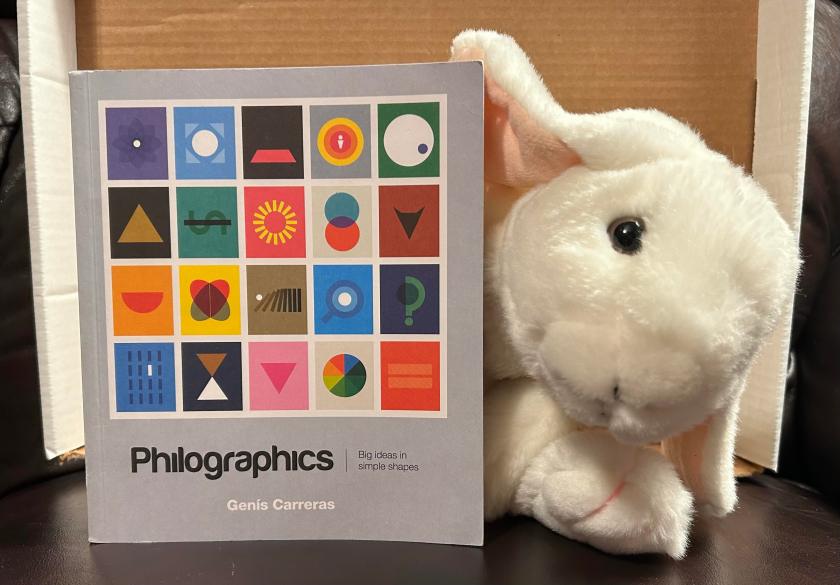
Marshmallow reviews Philographics: Big Ideas in Simple Shapes by Genís Carreras

As she is getting older, Marshmallow has been getting more and more interested in philosophical ideas. Today she reviews Philographics: Big Ideas in Simple Shapes, written by Genís Carreras and published in 2013. Sprinkles, who is also interested in the book, is asking questions and taking notes.

Marshmallow reviews Philographics: Big Ideas in Simple Shapes by Genís Carreras.

Sprinkles: So Marshmallow, I am so excited you wanted to review this book!

Marshmallow: Always happy to make you happy!

S: Thank you! Okay, so can you tell us a bit about what this book is about?

M: Well, the title is kind of self-explanatory. The book is about philosophy, more specifically about a hundred or so philosophical terms. The author of the book, or rather the artist Genís Carreras, uses two pages, side by side, for each term. Sort of reminded me of the book I recently reviewed about logical fallacies (An Illustrated Book of Bad Arguments by Ali Almossawi) in terms of the format.

S: I can definitely see that. So on each two-page spread, what do you see?

M: On the left page, there is a short, one-sentence definition of the term, apparently written by Chris Thomas, a friend of Carreras. And on the right side, there is a graphic depiction of the term, created by Carreras himself.

S: Oh, that kind of reminds me of a book Caramel reviewed way back: Opposites Abstract by Mo Willems.

M: Yes, you are right! But in that book there was no explanation, just a term on one side and a graphic on the other.

S: I guess that is why the Mo Willems book is more of a children’s book and this is not.

M: Yes, also this one has a lot of big ideas. The terms are all ordered in alphabetical order, and most of them are -isms. I mean, they are terms like feminism, optimism, realism, capitalism, nihilism, aestheticism, spiritualism, atomism, historicism, and so on.

S: Yes, this could be a really good dictionary of -isms.

M: Yes. But there are also some terms that don’t end with -ism that belong to philosophy. Like free will, extropy, dogma, and utopia.

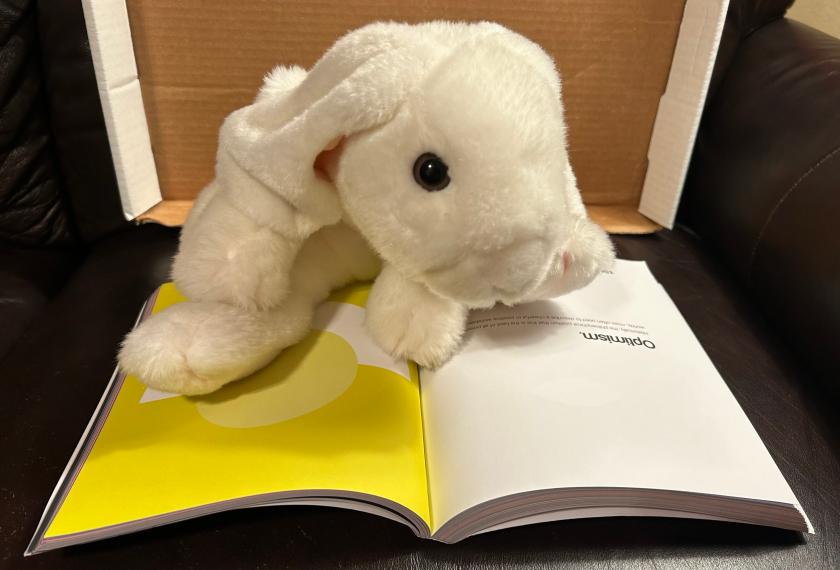
Marshmallow is reading Philographics: Big Ideas in Simple Shapes by Genís Carreras.

S: I think maybe the definition of realism (“the philosophical view that asserts that reality is fundamentally based on, and is shaped by, ideas and mental experience, rather than material forces”) is not quite accurate, but one mistake in such a neat book is not a big deal.

M: Yes, I can see how the book’s definition of realism is not quite in line with what Wikipedia or the Stanford Encyclopedia of Philosophy say. But other than that, I think we did not find anything else that sounded off.

S: Yes, the project is an awesome idea. And I think it is carried out quite superbly.

M: Yes, I totally think so. The graphics are so simple, and yet, they are most evocative. And I really like the use of bright colors in most of them.

S: Did you know that Carreras has a website where one can see many of the graphics from the book?

M: No! But we should definitely put a link to it!

S: Of course. Here it is: https://studiocarreras.com/philographics

M: All in all, I think this is a really neat book and it would be a great starting point if you are interested in big ideas. Carreras offers us a great way to get introduced to these big -isms and the connections between them.

S: How so?

M: At the bottom of most pages, there are some symbols that tell you what philosophical field the term belongs to. Like politics, religion, metaphysics, and ethics. And sometimes there are page numbers to send you to ideas that are directly related to the term on the page.

S: I see. That is really neat! And I agree that this book can be a neat guide to getting into philosophy.

M: Yep!

S: So how would you rate this book?

M: I’d rate it 100%.

S: Sounds good! So let us wrap this review up. What would you like to tell our readers?

M: Stay tuned for more amazing reviews from the book bunnies!

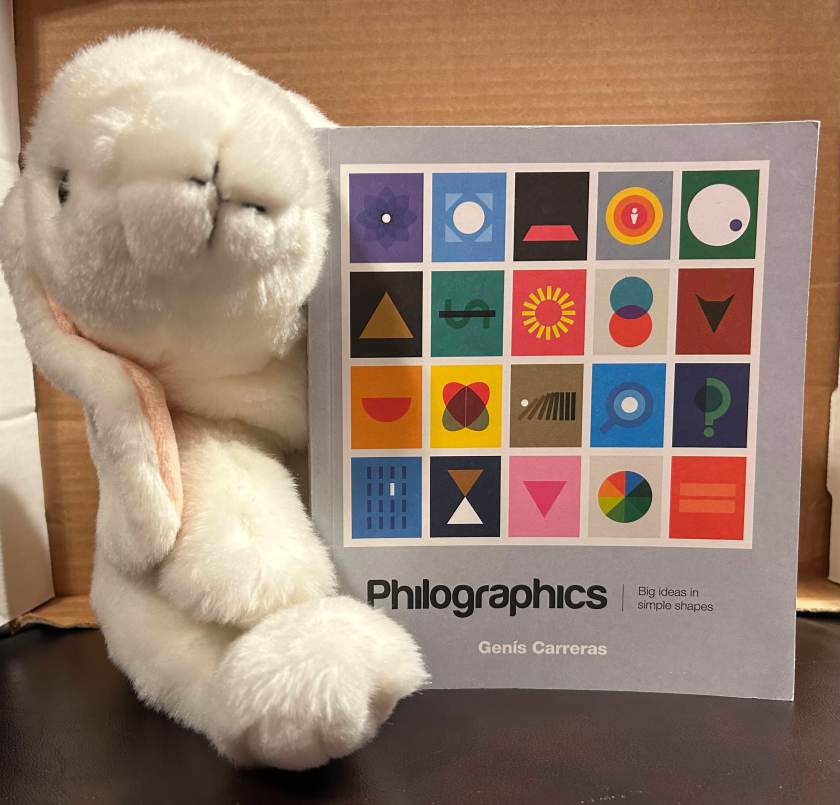
Marshmallow rates Philographics: Big Ideas in Simple Shapes by Genís Carreras 100%.

Marshmallow reviews All’s Faire in Middle School by Victoria Jamieson

The book bunnies are quite fond of Renaissance fairs and have been to a few in the last few years. So when Caramel brought home a library book about a young person growing up around these festivals, Marshmallow had to devour it, too. And today she is talking to Sprinkles about All’s Faire in Middle School by Victoria Jamieson, first published in 2017.

Marshmallow reviews All's Faire in Middle School by Victoria Jamieson.
Marshmallow reviews All’s Faire in Middle School by Victoria Jamieson.

Sprinkles: So Marshmallow, you just had to read this book!

Marshmallow: Yes! But I did wait until Caramel finished it first. You know, he was the one who brought it home, so it is only fair.

S: Agreed. So tell me a bit about the book.

M: It’s about a girl named Imogene whose parents work at a Renaissance Fair. She occasionally works there, too. The book starts with her being nervous about starting middle school. She has always been home-schooled before, so she is not sure what to expect.

S: I see. So why is she going to middle school then? Why is she not continuing with home-schooling?

M: I am not sure. I think she wants to go because she thinks it is a brave thing to do.

S: I see. So how does it go?

M: She is not sure how school works, so she has difficulty understanding what the rules are.

S: Can you be more specific? What kinds of rules?

M: There are some unsaid social rules about who hangs out with whom, and she does not know how to read any of the social cues.

S: Okay.

M: Then she makes friends with a group of girls who seem nice at first, but then they are actually kind of toxic.

S: This is reminding me of the movie Mean Girls. There is a new version of the movie too, but we only saw the original one from 2004.

M: Yes, actually it is kind of similar. The main character there was also home-schooled and had some trouble fitting in with the kids in her high school. And just like the main character there, Imogene also makes a huge mistake.

S: She is unkind to some people so she can fit in with the “cool” kids?

M: Kind of. But of course this is middle school, so it is a bit different than the movie.

Marshmallow is reading All's Faire in Middle School by Victoria Jamieson.
Marshmallow is reading All’s Faire in Middle School by Victoria Jamieson.

S: Okay, so tell me a bit about the graphics. Did you like the drawing of the main character?

M: Yes.

S: The color scheme kind of reminded me of some of the books you reviewed from Raina Telgemeier.

M: There are some similarities I think. But I do not think one artist was necessarily influenced by the other. I think they are both neat illustrators. They both manage to draw very expressive faces and bodies with only a few strokes of their pen.

S: Sounds like you liked the book!

M: Yes. I’d rate it 100%.

S: Wow! That is great! I am glad Caramel found this in his school library.

M: Me too.

S: Okay, let us wrap this up then. It is getting late. What would you like to tell our readers as we finish this up?

M: Stay tuned for more amazing reviews from the book bunnies!

Marshmallow rates All's Faire in Middle School by Victoria Jamieson 100%.
Marshmallow rates All’s Faire in Middle School by Victoria Jamieson 100%.

Marshmallow reviews National Parks of the U.S.A. by Kate Siber and Chris Turnham

Marshmallow loves everything beautiful, and today she picked a beautiful book to talk about: National Parks of the U.S.A., written by Kate Siber, illustrated by Chris Turnham, and first published in 2018. Sprinkles was intrigued by the book and therefore is asking questions and taking notes along the way.

Marshmallow reviews National Parks of the U.S.A., written by Kate Siber and illustrated by Chris Turnham.

Sprinkles: So Marshmallow, you picked a really beautiful book for today’s review. Can you tell us a bit about it?

Marshmallow: If you like the wilderness or at least you enjoy being outdoors, and especially if you are in the U.S.A. and want to know more about its many national parks, then this might be the book for you.

S: It also seems to be a great book for folks who might just want to look at a pretty book.

M: Yes, I agree. It is really a pretty book. Every page is beautifully illustrated. Even though the illustrations seem to be using a limited color palette, focusing mainly on oranges, browns, and greens, each page is distinct and well designed. The limited color scheme actually works really well.

S: Okay, so we both agree that this is a beautiful book to look at. So let us get to the content of the book next.

M: As you can tell from the title, the book is about the national parks in the U.S.A. They are organized more or less geographically. It goes from the east, to the central U.S., then to the Southwest, then to the Rocky Mountains, then to the West. And finally there is a section on Alaska and then the tropics. For each of the regions there is an introductory page or two, and then they focus on some specific parks from the region and talk about the geographic formations, and the flora and fauna found in there.

Marshmallow is reading National Parks of the U.S.A., written by Kate Siber and illustrated by Chris Turnham.

S: Did you find some parks that you want to visit some day?

M: Yes, several actually. We have not been to most of these yet. And I think it would be great if we could go to at least some of them.

S: True. Our country has so many beautiful national parks to visit. We have been to a few state parks but not to any of the national ones yet.

M: Maybe we can go on a rabbit-road trip and see some of them.

S: That would be lovely Marshmallow! Did you know that the idea of national parks is relatively new? The first one in the U.S. is the Yellowstone National Park, which only became a national park in 1872. And today many countries around the world have reserved land in similar ways.

M: I did not know that before we found that Wikipedia article; it is very informative. But my book is also very informative. For example did you know that glaciers are not “massive stationary blocks of ice”, but instead are “rivers of frozen water that flow down mountains”? I learned that when I was reading about the Glacier National Park.

S: That is cool!

M: And apparently rangers in the Badlands National Park say that “you have only 500,000 years to visit before the spires and the hills [of the park] wash away from rain and wind”.

S: Sounds like the author has a playful voice.

M: Yes. I really liked her voice. She is playful and friendly and makes the reader want to see all these places.

S: I’d say that is a successful book! How would you rate it?

M: I’d rate it 100%.

S: I knew it! Okay, this is a good time to wrap this up. What would you like to tell our readers?

M: Stay tuned for more amazing reviews from the book bunnies!

Marshmallow rates National Parks of the U.S.A., written by Kate Siber and illustrated by Chris Turnham, 100%.