Marshmallow reviews Night by Elie Wiesel

Today Marshmallow reviews Night by Elie Wiesel, first published in Yiddish in 1956 and in English in 1960. Wiesel won the Nobel Peace Prize in 1986 “for being a messenger to mankind: his message is one of peace, atonement and dignity”.

A small caveat: The book as well as the review below involve historical events that depict harsh realities. They may not be appropriate for younger readers.
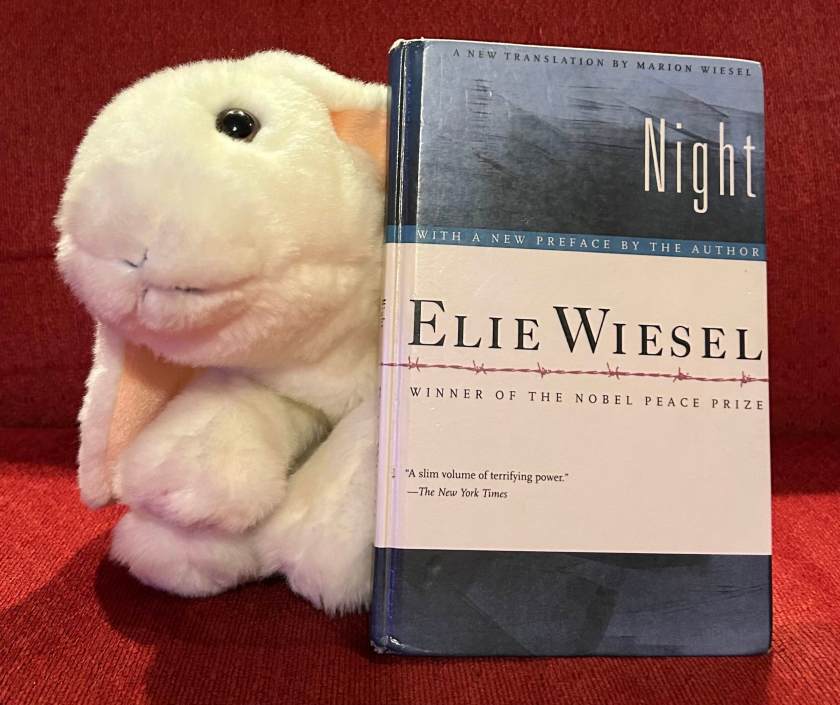
Marshmallow reviews Night by Elie Wiesel.

Marshmallow’s Quick Take: If you are a person of reasonable maturity and ability to process and handle important historical events, then this is the book for you.

Marshmallow’s Summary (with Spoilers): Elie Wiesel was a young Jewish boy in Romania during the Second World War. The book is more or less a memoir of his youth.

Elie is a young boy, extraordinarily devout at a remarkably young age, seeking out a religious mentor in Moishe the Beadle. It is from him that the town of Sighet—located in Transylvania—first hears of the Nazis’ proximity. Since Moishe is a foreign Jew, he is forced to leave first. But he luckily escapes the Nazis who leave him for dead due to his bleeding, shot leg. Moishe walks on foot an unbelievably long journey back to Sighet to warn the very people who look down on him of how dangerous the Nazis are. None of the residents believe him. Elie worries for his mentor, as many adults around him say the Beadle is mad.

Many of the Jews of Sighet do not believe that the Germans could reach them. Others believe that the war would end before Germany’s reach expanded far enough to affect them. It is heartbreaking to say that they are wrong. The Nazis show up on Sighet’s streets within a matter of days.

The Jews are first forced into ghettos, condemned to smaller slums as though they are not deserving of being able to choose where to live. Soon they are forced out of their homes, able to take only what they could carry. They are made to wait on scorching sidewalks and soon after chased towards cattle carts that take them to the concentration camps. Elie and his family, which includes his father Shloma, his mother Sarah, his two older sisters, and his seven-year-old younger sister Tzipora, are taken to Auschwitz. He loses his mother Sarah and Tzipora to the gas chambers and the Nazis on the first day, though he does not know it for certain until later. He and his father are forced into labor camps and the horror continues.

Wiesel’s suffering is conveyed through his own testimony in Night. He and so many others, millions of Jews, Gypsies, and other undesirables in the Nazis’ eyes, suffered so much as the hands of humans who were in all aspects but one the same. This story is one that everyone must read.
Marshmallow is reading Night by Elie Wiesel.

Marshmallow’s Review: This book is simply vital. I think everyone must read it once they are old enough to understand why we must remember. Elie Wiesel is one of the strongest humans to walk this Earth and he is also one of the wisest. Through this book, he passes on the story of the Nazi camps and their horrors designed to exterminate the Jews. He describes things that provoke a deep silence after reading, a deep silence that necessitates thought and great gratitude that one is not in such a situation. Wiesel is a hero by the virtue that he survived. But there are so many who did not and, for their sake and Wiesel’s, this story cannot be forgotten.

Night was assigned as reading in my English class and that is one of the best decisions a teacher can make. This story has impacted so many and Wiesel is truly one of the few people who can be described as a master of prose and a witness of humanity. In words, Wiesel has described the indescribable.

Thanks to Wiesel’s wife Marion who translated it into English for a larger audience, Night is written in simple and clear language, with few ornate embellishments. The horrific events make it seem so already, so Wiesel says things in a way that never makes the story seem unreal.

It is really remarkable and heartbreaking that Wiesel never viewed himself as exceptional. He wonders several times why he survived. He says he was never special or had any sort of skills or attributes that made him deserving of life. But everyone is deserving of life and yet so many were robbed of it. It is truly heartbreaking. Yet, his thoughts and perseverance, his selflessness and his determination (though these words have lost much of their weight and meaning through superfluous use) make him one of the most admirable human beings. He cared unwaveringly for his father though they were both suffering. He never stopped looking after him, even though Wiesel himself thought he failed in this. Wiesel was truly, indescribably a remarkable person with a profound impact. His book Night must be read.

Marshmallow’s Rating: 200%.
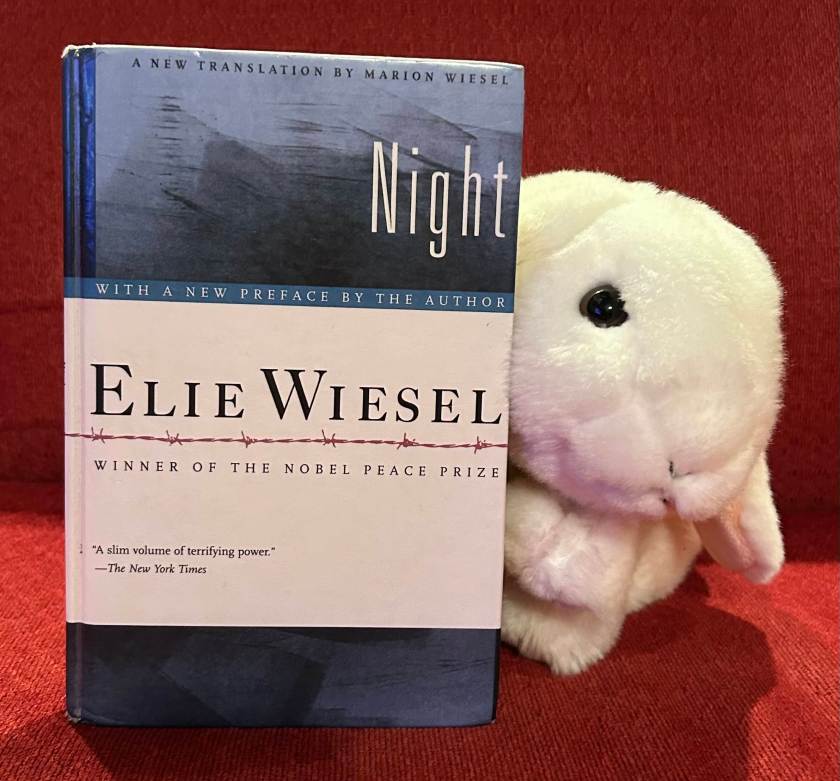
Marshmallow rates Night by Elie Wiesel 200%.

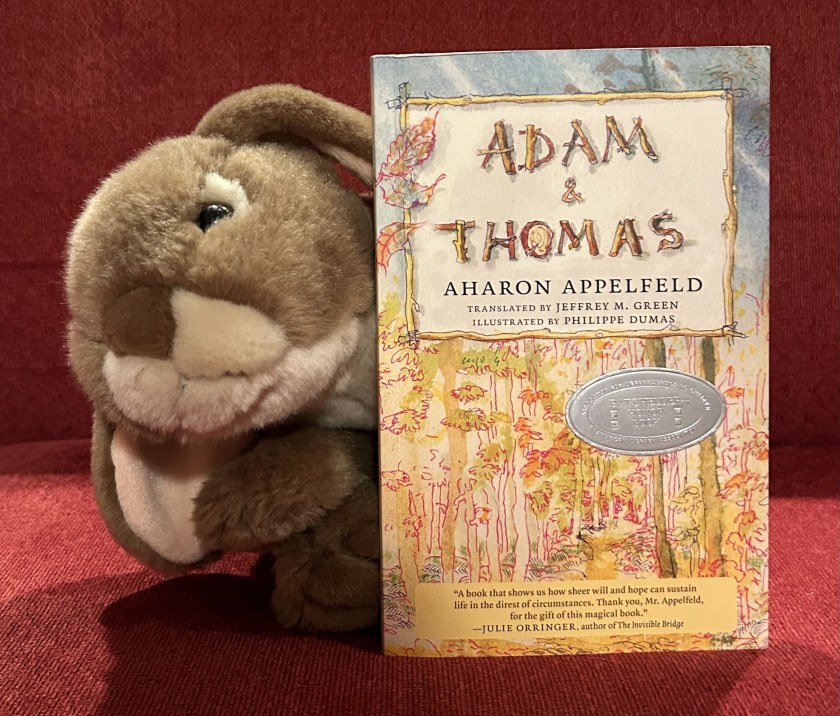
Caramel reviews Adam & Thomas by Aharon Appelfeld

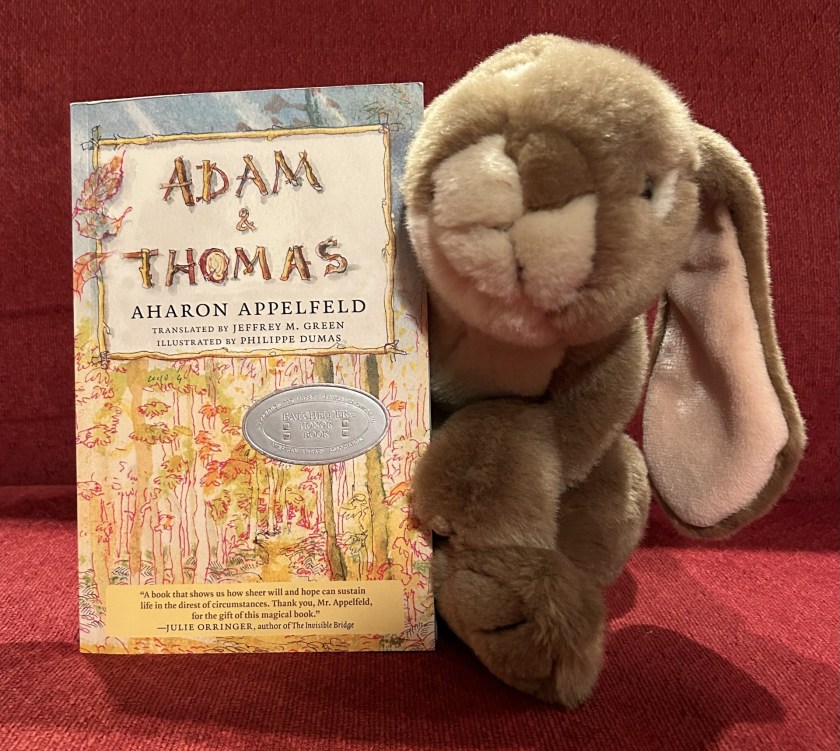
Today Caramel is talking to Sprinkles about Adam & Thomas, a book written originally in Hebrew in 2013 by Aharon Appelfeld, translated into English by Jeffrey M. Green, and illustrated by Philippe Dumas.

Caramel reviews Adam & Thomas, written by Aharon Appelfeld, translated into English by Jeffrey M. Green, and illustrated by Philippe Dumas.

Sprinkles: Let us talk a bit about this book Caramel. Maybe first start by telling us what it is about.

Caramel: It’s about two nine-year-old boys who escape one of the darkest times in human history. I mean, maybe the darkest time in modern history.

S: You are of course talking about World War II and the Holocaust, when millions of European Jews were systematically murdered by Nazi Germany and their collaborators.

C: Yes. And you know I did not really want to read this book because I knew it would be sad once I saw it was about that time.

S: Yes, I know. But I thought it was a good book and that you should probably read about that event anyways. After all, you just read The Donner Dinner Party and that was also about pretty harsh truths.

C: Yup. But I knew about the Holocaust. I did read Maus, too, even though Marshmallow was the one who reviewed it. And I did not like it because it is really really sad.

S: I know. But at least this book ends up in a more positive place, no?

C: Yes. There is that, at least. Not only do they survive the war hiding in the forest for years, but they even find their mothers after all that time.

S: Well, I guess we gave away the ending, but at least readers will know that things will get better in the end even when they re reading the darkest parts of the story. That there is hope.

C: Yes.

Caramel is reading Adam & Thomas, written by Aharon Appelfeld, translated into English by Jeffrey M. Green, and illustrated by Philippe Dumas.

S: Did you know this was a translation?

C: Yup. It says it on the cover page. And I know how to read.

S: Yes, of course. but sometimes people or even bunnies do not notice these things, so I thought I’d ask. So the author wrote this book in Hebrew, a language he learned only as a teenager. And he was apparently a pretty well-known author in Hebrew, and in English translation, and Jeffrey Green who translated this book was his standard translator.

C: I did not know any of that. But I think the English works perfectly well. I mean I thought it was a good book for young bunnies.

S: Yes, you are right. The sentences are simple and short. I think it is just right for young bunnies, even though the topic is a bit sensitive, and some younger bunnies might not be able to handle it.

C: Yes, I think so too. But the book is also a little long for really young bunnies. It has almost 150 pages!

S: But there are illustrations on almost every other page!

C: True. And they are really neat too.

S: Tell me more.

C: The illustrations are relatively simple and yet very detailed too. They are in color, and I liked looking at them.

S: I liked them too Caramel! So are you still upset with me for making you start reading this book?

C: No, not really. I think this is a good book with an interesting storyline, and it makes you feel like it might have actually happened. Like the characters are real people.

S: Apparently the author himself ran from a camp and lived in similar circumstances when he was about that age. So that might be why you found it so realistic, because it was real, at least to an extent.

C: Yes.

S: So maybe this is a good time to wrap up this review then. What would you like to tell our readers?

C: Stay tuned for more book bunny reviews!

Caramel appreciated reading Adam & Thomas, written by Aharon Appelfeld, translated into English by Jeffrey M. Green, and illustrated by Philippe Dumas, and thinks it is a good story to teach little bunnies about what happened to some young children during World War II.

Marshmallow reviews Maus: A Survivor’s Tale by Art Spiegelman

Today Marshmallow reviews the first volume of Maus: A Survival Tale, Art Spiegelman’s graphic novel first published in 1986. Sprinkles is taking notes and asking questions.

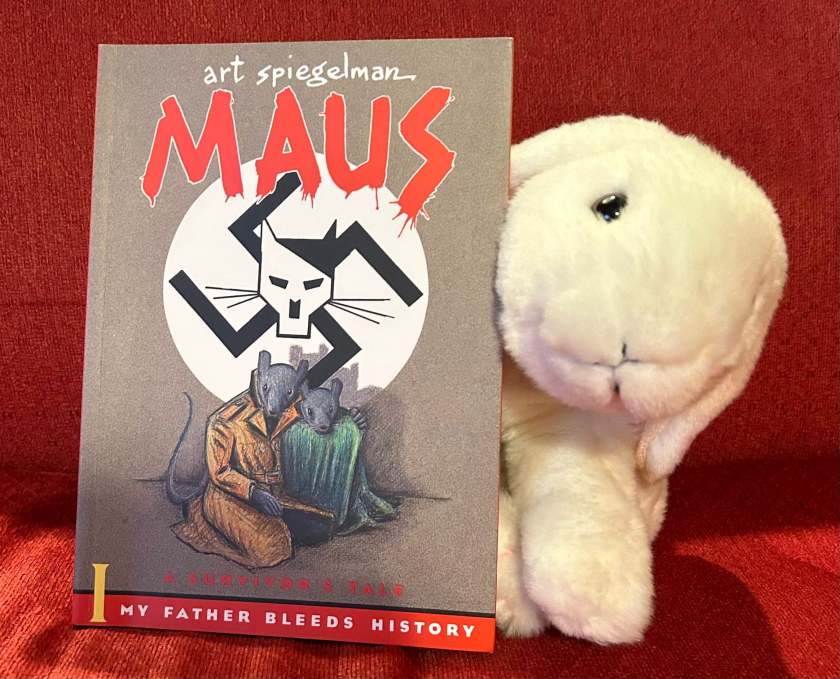
Marshmallow reviews Maus: A Survivor's Tale - I: My Father Bleeds History by Art Spiegelman.
Marshmallow reviews Maus: A Survivor’s Tale – I: My Father Bleeds History by Art Spiegelman.

Sprinkles: So Marshmallow, you chose to talk about a classic graphic novel today.

Marshmallow: Yes, we are talking about Maus: A Survivor’s Tale. This is in fact the first of two volumes, and Art Spiegelman published the second volume in 1991.

S: Okay, thanks for that important note. Wikipedia tells us that this is the first graphic novel that won a Pulitzer Prize. So I am glad you have read it and will talk with me about it.

M: I can see why it would get such an important prize. It is a very important book and it has a very important message.

S: Okay, so maybe it is about time to tell our readers what this book is about. They have already seen your photos with it, and they must be wondering.

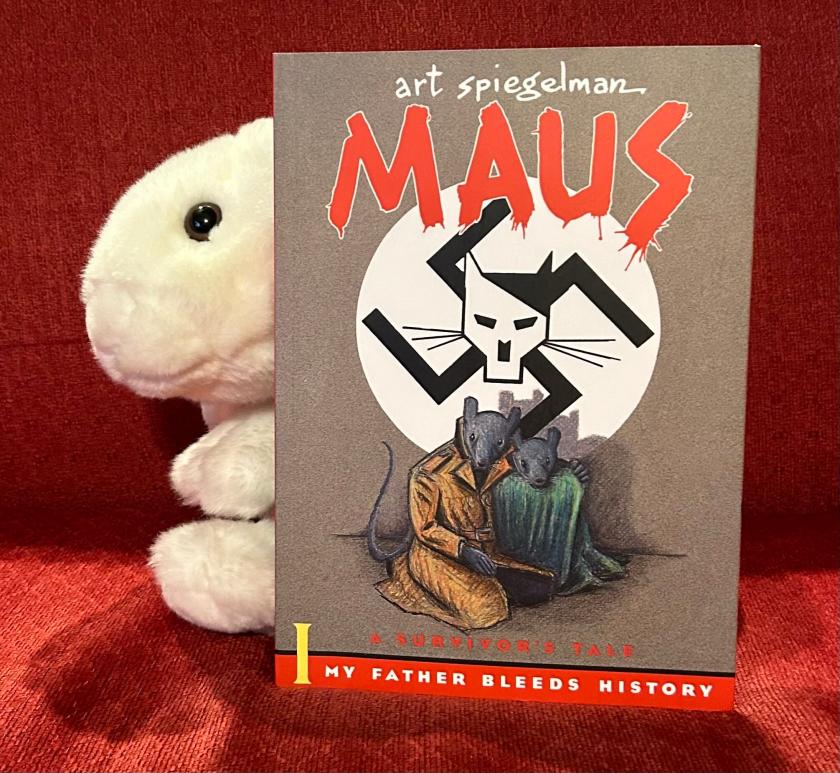
M: Yes, sure. The book is about the Holocaust, and the imagery in the front cover is basically describing the main metaphorical device used in the story.

S: How so?

M: This is a graphic novel, as we said before, and all characters are animals. There are mice, and those are supposed to be the Jews, and then there are cats. Those are the Nazi Germans. Then there are pigs, who are supposed to be the non-Jewish Poles. And as I said before, the story takes place around the time of the Second World War.

S: I see. When you tell me all this, I am thinking of how sometimes a cat could be playing with a mouse just to have fun and even kill it with no remorse even when it does not need to eat it. I can see how the cat-mouse-pig metaphor could work.

M: Yes. The story is basically about Vladek who is the author’s father, and his experiences before and during the war. Vladek lived in Poland before the war, and when Germany invaded Poland, he and his family continued to live there. For a while they try to survive but eventually they are sent to the Auschwitz concentration camp.

S: That sounds intense!

M: It is. There is also a second story line, which is more or less the present day, or rather around the time this book was first published. The main story is basically the author’s father’s story, and the second story line is about the author as a grownup trying to connect with his father.

Marshmallow is reading Maus: A Survivor's Tale - I: My Father Bleeds History by Art Spiegelman.
Marshmallow is reading Maus: A Survivor’s Tale – I: My Father Bleeds History by Art Spiegelman.

S: Okay, so now we know the main plot lines and so on, but tell me Marshmallow, how was it like reading such a tough story in graphic novel form?

M: I thought it worked really well. It was very easy to visualize things, even though the characters are mice and cats and so on, because they had already been visualized for you. The book and its visual nature show the undeniably horrific nature of the Holocaust. You fully feel the pain of the mice, and knowing that these events actually happened to people, it makes the whole book even more impactful.

S: I wonder if the harshness of the realities the book is depicting can be related to why some people want to ban this book from school libraries. Some people want us to forget and never talk about these historical events, I am not talking about those people. But even those who believe we should teach this history might think that these stories are too hard to share with young people.

M: I understand why you want us to emphasize that the themes and imagery of the book might be disturbing to very young readers. There is violence in the book. But I also think it is very important for young bunnies to know what happened. And this book does a very good job in telling exactly what happened. And maybe ironically, the use of animal characters allows you to end up seeing the humanity of the victims of the Holocaust very clearly.

S: You make a very good point Marshmallow.

M: Thank you. I also wanted to say the book reminded me of Animal Farm a bit because it shows the worst aspects of humanity under the guise of animals. The animal characters allow us to look at ourselves and see how terrible we truly are or can be. Since we are not seeing humans, we can see things more objectively.

S: That makes sense to me, too, Marshmallow. Okay, this is already a pretty long post. Before we wrap things up, can you tell me how you would rate this book?

M: I’d rate it 100%. It is a striking and impactful book. And I recommend it strongly. It is important for bunnies to understand the magnitude and the impact of these events.

S: Okay, thank you Marshmallow. So last words?

M: Stay tuned for more amazing reviews from the book bunnies!

Marshmallow rates Maus: A Survivor's Tale - I: My Father Bleeds History by Art Spiegelman 100%.
Marshmallow rates Maus: A Survivor’s Tale – I: My Father Bleeds History by Art Spiegelman 100%.