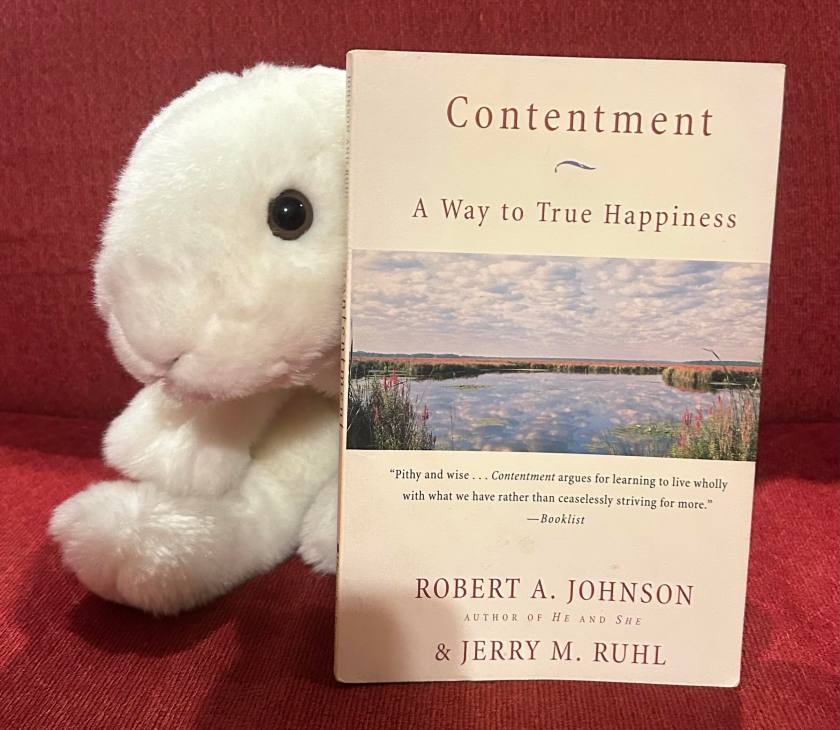
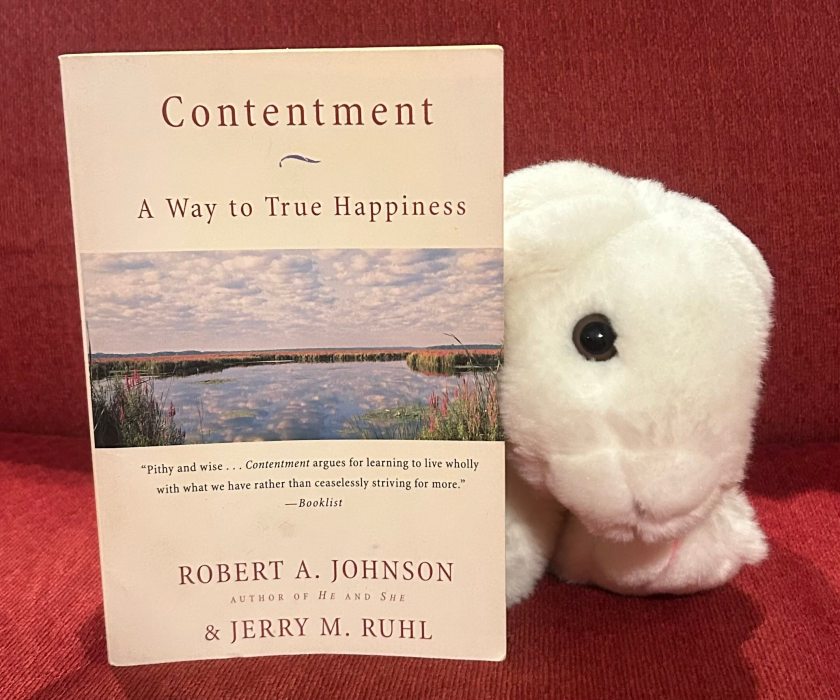
Today Marshmallow is reviewing Contentment: A Way to True Happiness by Robert A. Johnson and Jerry M. Ruhl, published originally in 1999. Sprinkles is taking notes and asking questions.
Sprinkles: So Marshmallow, I am excited to chat with you about a book again. We have not done that for a while.
Marshmallow: Yes! I’m excited to discuss this book with you; reading it was a fascinating experience that requires some unpacking.
S: Cool! I have read the book, too, and would love to talk with you about it. But it has been a while. So maybe it will be good for everyone if you give us a brief introduction to what it is all about.
M: Sure! Contentment is a book of approximately one hundred pages that describes the meaning of finding acceptance within yourself as a way of creating a sense of peace that is impenetrable by outside conditions. Essentially, through analyzing different stories (everything from Shakespeare to Buddhist teachings), the authors determine how the modern individual can regain the sense of calm that we imagine the premodern human to have.
S: So the book is really about what the title says it is about: how to be content. And the two authors base their argument on multiple sources. Somehow I remembered the book as focused on a Buddhist approach. But you are telling me that it is a bit wider scoped than that. That is neat!
M: Definitely! I particularly liked the authors’ analysis of King Lear. At the start, they mention that King Lear can be applied as a general metaphor for every individual in our discontented society. Allegedly, he models the mistakes that lead many to this unhappiness. I was initially a little skeptical of this claim because almost any wide, sweeping analogy has several misalignments. However, they did an excellent job of drawing the parallels between his actions and the minute decisions we make today that – in the long term – cause dissatisfaction.
S: That sounds interesting. So the authors first diagnose a problem: many people are unhappy and unsatisfied. Then they work to determine the root causes, and possible explanations. And then they suggest remedies. Does that sound like the outline of the book, more or less?
M: Well-said! They start by defining the problem, like you said. But they frame it as a mostly modern issue caused by ideas our society has developed over time. These include beliefs about productivity, success, ambition, social validation, etc. I find it a little simplistic to say that none of these issues / desires existed before modern day, but they are convincing in their argument: we are busier and ever in-motion nowadays and our souls are suffering as a result. They argue that there is the ego and the subconscious, which both exist as parts of the whole human. There is also a larger connectivity between all humans that should be channeled more frequently than the self. After explaining these more nebulous aspects, they follow King Lear’s story and point out the modern manifestations of his struggles. Then they show the steps that can be taken to avoid his mistakes.
S: So King Lear is not a one-off example; it is quite central to the book.
M: I would say that it is the most repeatedly-used story the authors incorporated. However, they also mention numerous other past and present-day anecdotes that add another layer of depth to the book.
S: I can see that the book is organized into four parts. Part I is “The Tragedy of Modern Disconent”. Part II is about King Lear and is called “ A Story for our Time”. Part III is “The Psychology of Contentment”. And the last part, “Simple Gifts of Contentment”, is a whole list of gifts. Can you help open that up a bit?
M: Yes, that can sound a little confusing. The last section is a list of concepts (forgiveness, care, etc.) – constants that already exist in daily life – that are actually gifts from the “divine” when you look closer. To specify what I mean by “divine,” the authors frequently reference the universe as a whole as being divine in a way. They do not clarify personal beliefs or argue for a certain religious worldview, but they assert that there is a sense of divinity in “what is.”
S: I see. I wonder if the way they are approaching the “divine” is in any way similar to the way Hubert Dreyfus and Sean Dorrance Kelly approach it in All Things Shining. But I know you have not read that book. Maybe you will, and maybe we will talk about that some time too.
M: Maybe.
S: But maybe in the meantime I should reread this book. You make a good case for it.
M: Yes, I found it really meaningful. I particularly liked how the authors described life as a partner dance between you and everything around you. You can either flow with changes or try to move against the choreography. I found that a very interesting perspective. Of course, I feel that not everything should be accepted, but it is worth being more accepting of everyday life in order to find true contentment.
S: Yes, I agree. So maybe this is a good place to wrap up this review. You often end your reviews with a rating. How would you rate Contentment?
M: I would give it a 100.5% because it was a very unique book that deserves a unique rating! I would highly recommend that every bunny takes some time out of their day to pause and read a text like this that reminds the reader of the value in accepting and really embracing all aspects of life.
S: That sounds great Marshmallow! Thank you for sharing this book with us. Finally what do you want to tell our readers as we wrap up this review?
M: Stay tuned for more amazing book reviews from the book bunnies!