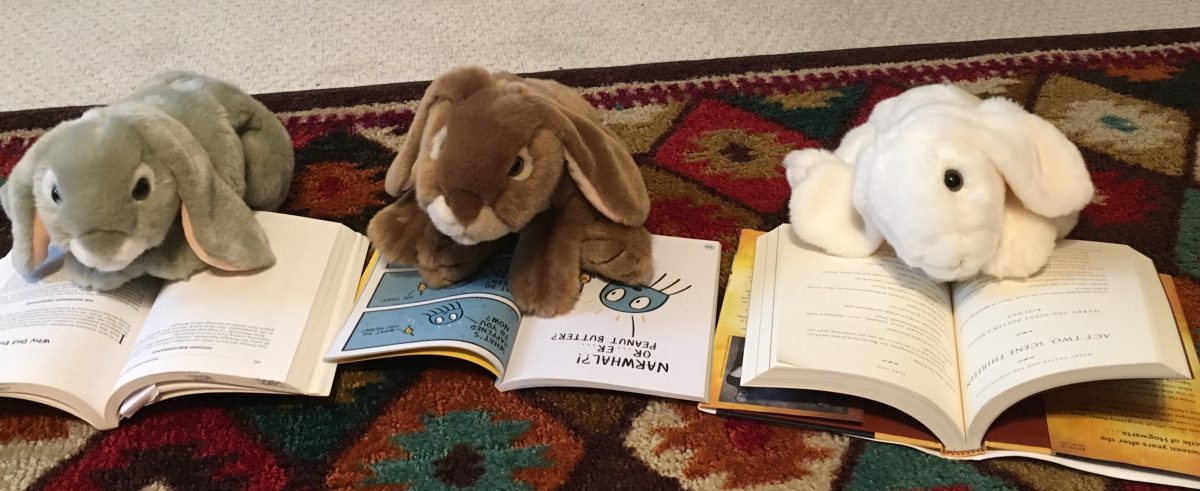
Caramel reviews Watership Down: The Graphic Novel by Richard Adams, James Sturm, and Joe Sutphin

Many years ago, over the course of a few days, the book bunnies listened all together as a family to an unabridged version of Watership Down, the 1972 classic by Richard Adams. Recently Caramel got his paws on a new (2023) graphic novel adaptation of the book by James Sturm and Joe Sutphin and read it over the course of a few hours. Today he is talking to Sprinkles about the book.

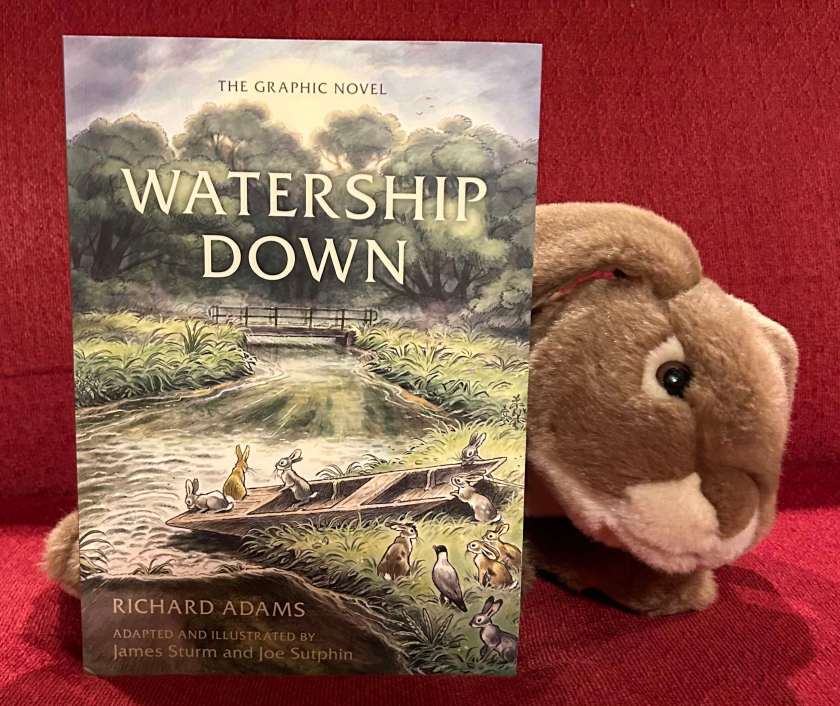
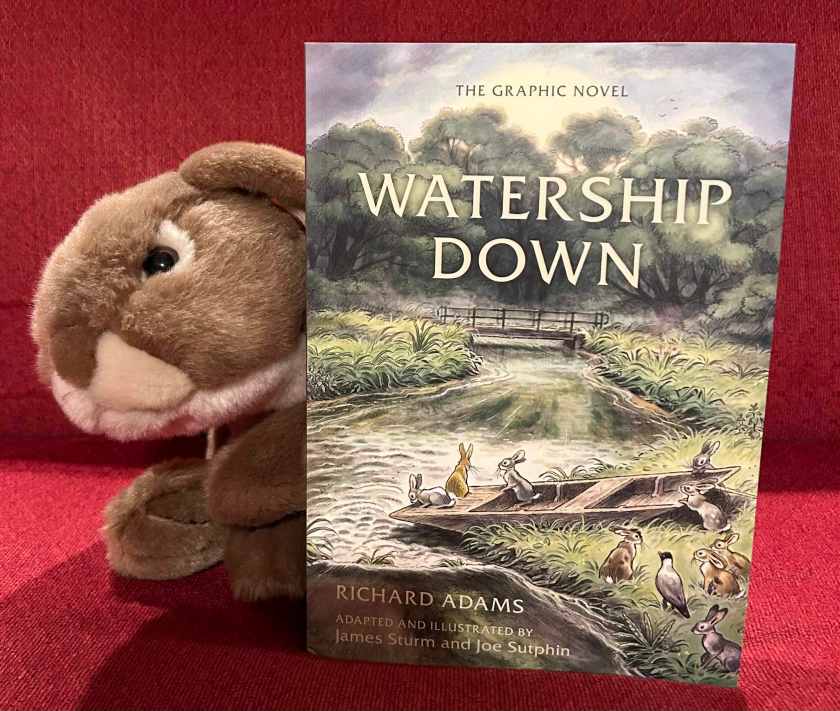
Caramel reviews Watership Down: The Graphic Novel, written by Richard Adams, adapted by James Sturm, and illustrated by Joe Sutphin.

Sprinkles: I remember how we listened to this whole story when you all were so much younger. So when I saw that there was a graphic novel adaptation, I knew you would want to read it. 

Caramel: Yes, I guess you were right! You know me well.

S: I think I do! Okay can you tell us a bit about the story?

C: Sure. In this book there are bunnies like us, but they are wild and are trying to escape from a great evil that was foretold by one of them named Fiver.

S: Oh, I think I remember Fiver. Isn’t he the dreamer one? Kind of like an oracle?

C: Yeah, kind of. He can see the future and warns the others of the dangers so they can survive.

S: Okay, so here is a group of rabbits living in a warren. That is, my dictionary tells me, a network of interconnecting rabbit burrows. And they are living a normal wild rabbit life. But then some great evil thing happens, is that it?

C: Yes, it is kind of like that. However not everyone believes Fiver, and so not all of them make it.

S: Well, I can see how not everyone would immediately believe some little bunny saying something terrible will happen, without evidence. But his brother believes him, right?

C: Yep, so Hazel, that is Fiver’s brother, gathers everyone who believes Fiver and they run. 

S: So they leave their warren and wander away, and try to find a new place to settle down at?

C: Yep. Along the way they find a different warren in which there are some not-so-nice bunnies who try to kill the main character bunnies, but thankfully the good bunnies make it out, and they get two new bunnies from that warren.

S: Cool! Okay, so Fiver is the dreamer, oracle bunny. Hazel is the main leader bunny. Are there other characters that you especially liked or remembered from when we listened to the book those many years ago?

C: Fiver is my favorite, I don’t know why but he is my favorite bunny in the book.

S: He is a gentle soul, as far as I remember. He is sensitive and kind. 

C: Yeah, but he can also see the future, and that is cool.

S: Yes, that is really cool, I agree. I do remember another character, Bigwig, I think. He is a fighter, and a good one too. 

C: Yeah, he is also really cool, but Fiver is still my favorite character. There is also a big bird who helps the bunnies occasionally, His name is Kehaar. 

S: That is cool! I liked that character, too. 

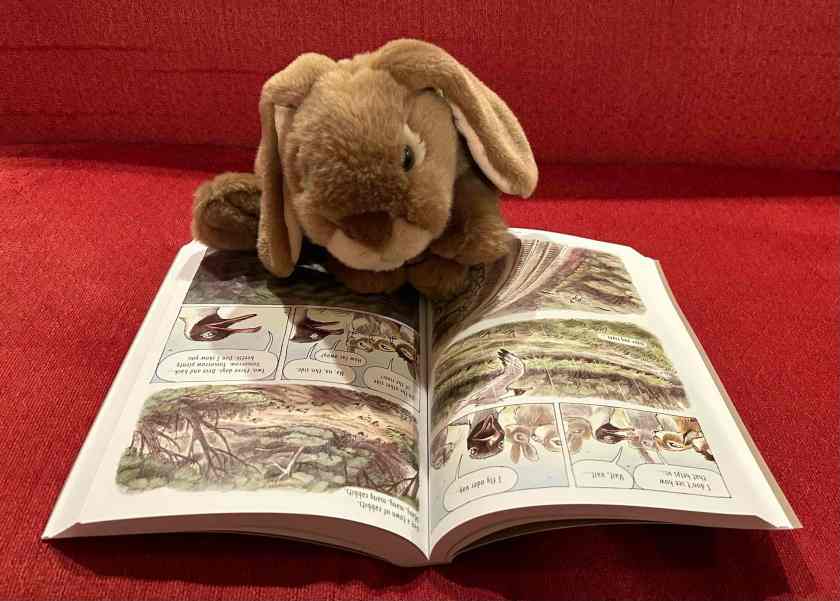
Caramel is reading Watership Down: The Graphic Novel, written by Richard Adams, adapted by James Sturm, and illustrated by Joe Sutphin.

S: Okay, so when we listened to this book many years ago, we had no images to attach to the main characters. But a graphic novel of course will have faces attached to each character. Did these work for you? Did you like the illustrations? Is the world of Fiver and Hazel how you had imagined it to be?

C: Yeah, it is a lot like what I thought. The bunnies are all very realistic looking, too, and exactly how I imagined them to be. 

S: That sounds great! I was just going to ask you if they were more cartoonish or more realistic. So this was perhaps the longest graphic novel you have ever read, right? 

C: Yep, it was 382 pages!

S: That is long for a graphic novel. But the original book is a very long one, too, so that makes sense. Anyways, did you know that the original book was banned in some places because it was too violent and there was a lot of brutality depicted explicitly? 

C: Oh no. I did not think it was too violent. 

S: Well, then again, you do like the Wings of Fire series and those are also kind of violent. So maybe your generation of bunnies is a bit more used to violence… 

C: No, I would hope not.

S: I see what you mean Caramel. Yes you are right, it is not a good thing to get used to violence. Maybe I should have said that you can handle some more violence. I think that especially when they made the animated movie in 1978, the movie started out looking like a typical Disney movie, with cute bunnies who speak and are living in this idyllic natural place, but then things get dark very fast, and terrible things happen, bunnies killing each other, getting killed by humans, and so on. So maybe it shocked people a lot more back then. 

C: Maybe. 

S: I also read that it was banned in China for a while because it depicted animals and humans as equals or at least somewhat on a similar level, and this was unacceptable. 

C: Hmm, they probably would not like Animal Farm either, then. Or us.

S: Yes, you have a point there Caramel. Bunnies talking about books would probably not be okay. Anyways, we are bunnies who love to read and talk about books. So let us get back to the book. So overall, did you enjoy this graphic novel?

C: Yes, greatly. And I recommend it to all young bunnies who like to read about other bunnies being heroic. 

S: Cool! Okay let us wrap this up then. What would you like to tell our readers?

C: Stay tuned for more book bunny reviews!

Caramel enjoyed reading Watership Down: The Graphic Novel, written by Richard Adams, adapted by James Sturm, and illustrated by Joe Sutphin, and recommends the book to all young bunnies who like to read about other bunnies being heroic.

Sprinkles reviews A Child’s Garden of Verses by Robert Louis Stevenson and Tasha Tudor

About a year ago, Sprinkles reviewed Stopping by Woods on a Snowy Evening, a book showcasing Robert Frost’s famous poem with beautiful illustrations by Susan Jeffers. Since then, she has been collecting poetry books suitable for young bunnies. Caramel reviewed one of those books (This is a Poem That Heals Fish, written originally in French by Jean-Pierre Siméon and illustrated by Olivier Tallec.) just a couple days ago. Today Sprinkles reviews another family favorite, A Child’s Garden of Verses, a beautiful collection of poems by Robert Louis Stevenson, first published in 1885. The edition Sprinkles is talking about was illustrated by Tasha Tudor and first published in 1981.

Sprinkles reviews A Child's Garden of Verses, a collection of children's poems written by Robert Louis Stevenson and illustrated by Tasha Tudor.
Sprinkles reviews A Child’s Garden of Verses, a collection of children’s poems written by Robert Louis Stevenson and illustrated by Tasha Tudor.

Many know Robert Louis Stevenson as the author of classics like Treasure Island (1883) and Strange Case of Dr Jekyll and Mr Hyde (1886). At the book bunnies household, he is better known as the person who wrote A Child’s Garden of Verses, a beautiful collection of children’s poems that we read out loud together. In the edition we have, there are beautiful and simply elegant illustrations on each page, that only add to the experience of reading these simple but evocative poems out loud.

There are one or two poems displayed on each page, and the illustrator accompanies them with topical imagery that takes us deep into the story unfolding in the poems. For example, the page that displays the poem “Pirate Story” is decorated with images of three children playing pirates. At the top center of the page they are sitting or standing on a makeshift boat in the middle of a garden with a swing, playing pirates. The cattle that show up in the third stanza show up at the bottom of the page as the three children flee with glee.

One of my favorites is the short poem “The Swing” which in only three stanzas of four lines each rhythmically and authentically captures the joy of swinging back and forth on a swing. Here is how it starts:

How do you like to go up on a swing
Up in the air so blue?
Oh, I do think it the pleasantest thing
Ever a child can do?
-Robert Louis Stevenson, "The Swing"

Another favorite “My Shadow” has its own Wikipedia page. Here is a stanza:

The funniest thing about him is the way he likes to grow—
Not at all like proper children, which is always very slow;
For he sometimes shoots up taller like an india-rubber ball,
And he sometimes gets so little that there’s none of him at all.
-Robert Louis Stevenson, "My Shadow"
Sprinkles is reading A Child's Garden of Verses, a collection of children's poems written by Robert Louis Stevenson and illustrated by Tasha Tudor.
Sprinkles is reading A Child’s Garden of Verses, a collection of children’s poems written by Robert Louis Stevenson and illustrated by Tasha Tudor.

A Child’s Garden of Verses collects together sixty four poems. First there are about forty poems, on topics ranging from rain to singing, from travel to bedtime. Then There is a collection of nine poems collected under the heading of “The Child Alone”. Stevenson seems to have been a rather sickly child (he dedicates the whole collection to his childhood nurse Allison Cunningham), and the poems in this section seem to be perhaps more personal than some of the others; you can hear the solitude of a child who had to remain alone and in bed for a lot of time. They are not unhappy poems, but rather, they explore a sick child’s healthy imagination and are quite fun to read. There is then a section titled “Garden Days” containing eight poems about nature and playing outside. Finally a section titled “Envoys” finds poems individually addressing Stevenson’s mother, his friends and other special people. The book ends with a poem addressed “To Any Reader” where the poet reminds us that grownups, like the poet himself, were all children once, and all children today will one day grow up:

As from the house your mother sees
you playing round the garden trees,
So you may see, if you will look,
Through the windows of this book,
Another child, far, far away,
And in another garden, play.
But do not think you can at all,
By knocking on the window, call
That child to hear you. He intent
Is all on his play-business bent.
He does not hear; he will not look,
Nor yet be lured out of this book.
For, long ago, the truth to say,
He has grown up and gone away,
And it is but a child of air
That lingers in the garden there.
-Robert Louis Stevenson, "To Any Reader"

As you can see from the examples I have already provided, poems in A Child’s Garden of Verses are mostly in simple poetic forms and simple rhyme. This makes these poems a lot of fun to read out loud with young ones, and their topics, all themes and topics relevant and familiar to young children, make them accessible.

The poems in A Child’s Garden of Verses were written more than 140 years ago and as such are now in public domain. So you can find the whole collection online; see, for example, this page or this page. But we read books not only to access the words from their creator but also to hold on to them in the most visceral way, in a book that can be held, touched, seen, smelled, and shared.

In short, books like A Child’s Garden of Verses can be great opportunities to add more poetry to your family time. I hope you will give this book a try!

Sprinkles encourages all bunnies young and old to read more poetry together; books like A Child's Garden of Verses, a collection of children's poems written by Robert Louis Stevenson and illustrated by Tasha Tudor, can be great opportunities to add more poetry to your family time.
Sprinkles encourages all bunnies young and old to read more poetry together; books like A Child’s Garden of Verses, a collection of children’s poems written by Robert Louis Stevenson and illustrated by Tasha Tudor, can be great opportunities to add more poetry to your family time.

Marshmallow reviews A Tale of Two Cities by Charles Dickens

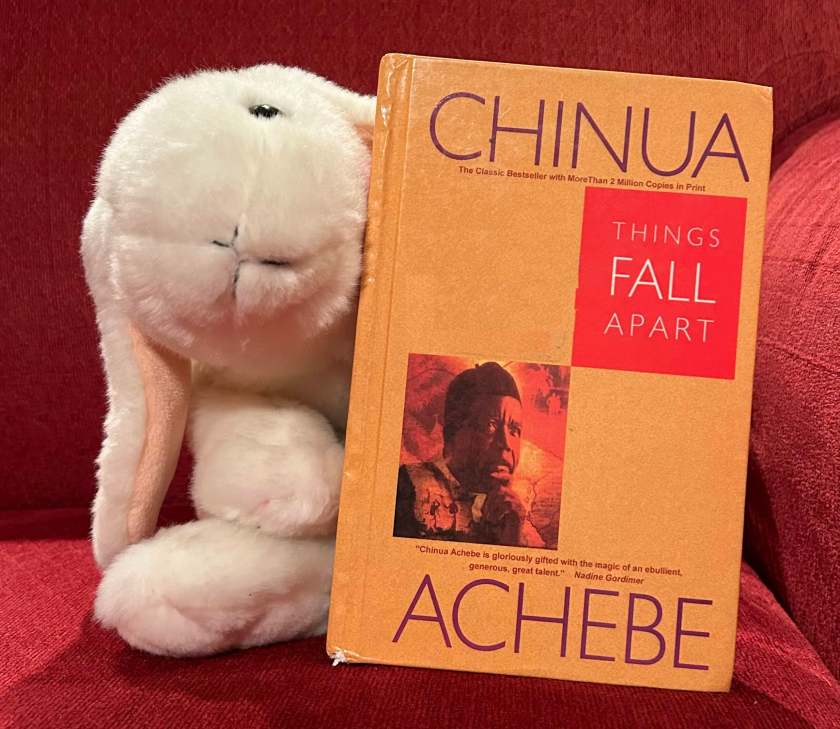
Marshmallow has been reading A Tale of Two Cities by Charles Dickens at school and so thought it would be a good idea to review it for the blog. Below are her thoughts on this classic from 1859.

Marshmallow reviews A Tale of Two Cities by Charles Dickens.

Marshmallow’s Quick Take: If you like historical fiction, famous books about the French Revolution, family, and fate, then this is the book for you!

Marshmallow’s Summary (with Spoilers): Set during the years 1775-1792 in London and Paris, this really is a tale of two cities. The book travels between London and Paris, with the French Revolution developing throughout and playing a major role in the storyline.

The book begins with the introduction of both places and the presentation of the plot: Lucie Manette, a seventeen year old French girl living in London, learns from a banker named Mr. Jarvis Lorry that her father Dr. Manette is alive after being imprisoned for eighteen years in the Bastille. She believed him to be dead, but after this shocking revelation, sets out with Mr. Lorry to Paris to find him. They discover that, upon his release, Dr. Manette was taken in by his old servant Monsieur Defarge and his wife Madame Defarge. We learn that Dr. Manette has been driven insane by his time in the Bastille, obsessively making shoes to cope. But Lucie’s love and faithful devotion begins to heal him back to himself. They all travel back to London, and he recovers over the next five years.

Then, in 1780 in London, another character named Charles Darnay is put on trial for treason against England (being a spy). Lucie and her father are called to testify against him. Two witnesses (both English spies) testify against him as well, but Lucie’s pity for Charles begins to sway the jury in his favor. After Sydney Carton, one of Charles’ defense lawyers, points out the striking resemblance between himself and his client, the verdict of not guilty is declared and Charles Darnay and both of his defense lawyers become close family friends of the Manettes and Mr. Lorry.

Sydney Carton is a drunken, unstable man who is subservient to the other defense lawyer. For reasons unknown, he seems to have given up on himself and his potential, wasting away his talents, believing that he is worthless and lacks any ability to be good. The other defense lawyer is Mr. Stryver, an overly-ambitious man whose only goal is furthering his own status in the world.

Mr. Stryver, Carton, and Charles Darnay all begin to fall in love with Lucie, but all in different ways and for different reasons. Mr. Stryver believes that she fulfills his social expectations for a wife and would be beneficial for his life goals, while Carton loves her for being the only person who believes that he has the possibility of good within him (when he himself doesn’t believe so). Mr. Stryver plans to propose, but decides not to after Mr. Lorry (in a very passive-aggressive fashion) tells him that he would be rejected. Carton confesses his love to Lucie (who cares for him in a motherly way), but tells her that he knows she cannot and should not love a man like him who has given up on everything: life, love, himself, and the world; he swears to protect her and everyone she loves when the time comes. But in the end, it is Charles Darnay who wins Lucie’s hand in marriage. He fell for her because of her compassion for him while on trial, her deep love and dedication to her father, and her beauty. After getting her father’s blessing, the two get married.

Charles wants to tell Dr. Manette his real last name before the marriage, but is told by Dr. Manette himself to wait till the wedding day. On that day, Charles in true honesty informs Dr. Manette that he is an Evrémonde, an aristocratic family from France. As a result, Dr. Manette relapses back into his old insanity right after the couple leaves for their honeymoon. Mr. Lorry helps Dr. Manette return to himself before the couple return and the breakdown is kept secret from Lucie.

In 1789, in France, the Defarges lead the famous Storming of the Bastille, and Monsieur Defarge finds a note written by Dr. Manette hidden in his old cell. The French Revolution is becoming increasingly bloody and aristocrats like Marquis St. Evrémonde (Charles’ uncle) are being slaughtered for their past insensitivity and cruelty towards the impoverished. One of the Marquis’ servants is put on trial and sends a letter to Charles (in London), asking for his help. After leaving letters of explanation, Charles secretly leaves his family in London to return to France. He is captured and put on trial, essentially for being an aristocrat, despite the fact that he denounced his family’s immoral behavior and fled from France to London to escape his name Evrémonde.

Mr. Lorry, on business in Paris, unexpectedly meets Lucie and Dr. Manette who came to France right when they read Charles’ letters. Dr. Manette, a former Bastille prisoner and thus a hero of the Revolution, uses his influence to get Charles a trial. But with the revolutionary bloodlust unquenchable, nothing can save Charles from La Guillotine, except for an act of true love. 

Marshmallow is reading A Tale of Two Cities by Charles Dickens.

Marshmallow’s Review: A Tale of Two Cities is an amazing book. It’s really hard to read in the beginning, but after the first couple of chapters, it gets pretty easy to understand. Dickens uses a lot of old language so it is difficult by today’s standards. But I’ve never read a book that has completely changed my view of the world to such an extent.

This book is amazingly written because its plot is touching and exciting, but it also shows the development and the impacts of the French Revolution, a chilling period of human history. Dickens shows us our fragility, through Dr. Manette’s insanity, and the violence that we create when others have wronged us. But Dickens also shows our graces: Lucie’s never-ending compassion, faith, love, kindness, and devotion to others.

I chose to read this book for an English unit, and I’m so glad I did because this book is absolutely beautiful; it is truly a masterpiece. The world the author shows us immerses you as you read and shows you glimmers of a past far behind. However, the past is sometimes the clearest mirror. Throughout this book, the most poignant message I uncovered was this: when destiny mercilessly takes what one loves, those who were hurt can lose their mercy too. This is how the frenzied violence of the French Revolution occurred: the horrific treatment of the lower classes by the elites made the Revolutionaries utterly empty of empathy for the aristocrats when La Guillotine (as they referred to it) descended. The world’s harshness hardens humanity which turns into (perhaps righteous) hatred, something we still see today.

This disturbing reality of human nature is so profoundly portrayed by Dickens that this story is uniquely compelling in a way like no other. A Tale of Two Cities really made me reflect on us and our society as a whole. When we break one another, the broken become capable of breaking others without feeling empathy and perhaps it’s not completely their fault. But if humanity is to become better, if we are to avoid another bloodbath like the French Revolution, if our world is to become brighter and more prosperous for all, we need to learn to fix each other’s humanity, not break one another apart till we become capable of inhumanity. I might just be a bunny, but this book makes it obvious for all. 

Marshmallow’s Rating: 110%.

Marshmallow rates A Tale of Two Cities by Charles Dickens 110%.

Marshmallow reviews Maus: A Survivor’s Tale by Art Spiegelman

Today Marshmallow reviews the first volume of Maus: A Survival Tale, Art Spiegelman’s graphic novel first published in 1986. Sprinkles is taking notes and asking questions.

Marshmallow reviews Maus: A Survivor's Tale - I: My Father Bleeds History by Art Spiegelman.
Marshmallow reviews Maus: A Survivor’s Tale – I: My Father Bleeds History by Art Spiegelman.

Sprinkles: So Marshmallow, you chose to talk about a classic graphic novel today.

Marshmallow: Yes, we are talking about Maus: A Survivor’s Tale. This is in fact the first of two volumes, and Art Spiegelman published the second volume in 1991.

S: Okay, thanks for that important note. Wikipedia tells us that this is the first graphic novel that won a Pulitzer Prize. So I am glad you have read it and will talk with me about it.

M: I can see why it would get such an important prize. It is a very important book and it has a very important message.

S: Okay, so maybe it is about time to tell our readers what this book is about. They have already seen your photos with it, and they must be wondering.

M: Yes, sure. The book is about the Holocaust, and the imagery in the front cover is basically describing the main metaphorical device used in the story.

S: How so?

M: This is a graphic novel, as we said before, and all characters are animals. There are mice, and those are supposed to be the Jews, and then there are cats. Those are the Nazi Germans. Then there are pigs, who are supposed to be the non-Jewish Poles. And as I said before, the story takes place around the time of the Second World War.

S: I see. When you tell me all this, I am thinking of how sometimes a cat could be playing with a mouse just to have fun and even kill it with no remorse even when it does not need to eat it. I can see how the cat-mouse-pig metaphor could work.

M: Yes. The story is basically about Vladek who is the author’s father, and his experiences before and during the war. Vladek lived in Poland before the war, and when Germany invaded Poland, he and his family continued to live there. For a while they try to survive but eventually they are sent to the Auschwitz concentration camp.

S: That sounds intense!

M: It is. There is also a second story line, which is more or less the present day, or rather around the time this book was first published. The main story is basically the author’s father’s story, and the second story line is about the author as a grownup trying to connect with his father.

Marshmallow is reading Maus: A Survivor's Tale - I: My Father Bleeds History by Art Spiegelman.
Marshmallow is reading Maus: A Survivor’s Tale – I: My Father Bleeds History by Art Spiegelman.

S: Okay, so now we know the main plot lines and so on, but tell me Marshmallow, how was it like reading such a tough story in graphic novel form?

M: I thought it worked really well. It was very easy to visualize things, even though the characters are mice and cats and so on, because they had already been visualized for you. The book and its visual nature show the undeniably horrific nature of the Holocaust. You fully feel the pain of the mice, and knowing that these events actually happened to people, it makes the whole book even more impactful.

S: I wonder if the harshness of the realities the book is depicting can be related to why some people want to ban this book from school libraries. Some people want us to forget and never talk about these historical events, I am not talking about those people. But even those who believe we should teach this history might think that these stories are too hard to share with young people.

M: I understand why you want us to emphasize that the themes and imagery of the book might be disturbing to very young readers. There is violence in the book. But I also think it is very important for young bunnies to know what happened. And this book does a very good job in telling exactly what happened. And maybe ironically, the use of animal characters allows you to end up seeing the humanity of the victims of the Holocaust very clearly.

S: You make a very good point Marshmallow.

M: Thank you. I also wanted to say the book reminded me of Animal Farm a bit because it shows the worst aspects of humanity under the guise of animals. The animal characters allow us to look at ourselves and see how terrible we truly are or can be. Since we are not seeing humans, we can see things more objectively.

S: That makes sense to me, too, Marshmallow. Okay, this is already a pretty long post. Before we wrap things up, can you tell me how you would rate this book?

M: I’d rate it 100%. It is a striking and impactful book. And I recommend it strongly. It is important for bunnies to understand the magnitude and the impact of these events.

S: Okay, thank you Marshmallow. So last words?

M: Stay tuned for more amazing reviews from the book bunnies!

Marshmallow rates Maus: A Survivor's Tale - I: My Father Bleeds History by Art Spiegelman 100%.
Marshmallow rates Maus: A Survivor’s Tale – I: My Father Bleeds History by Art Spiegelman 100%.