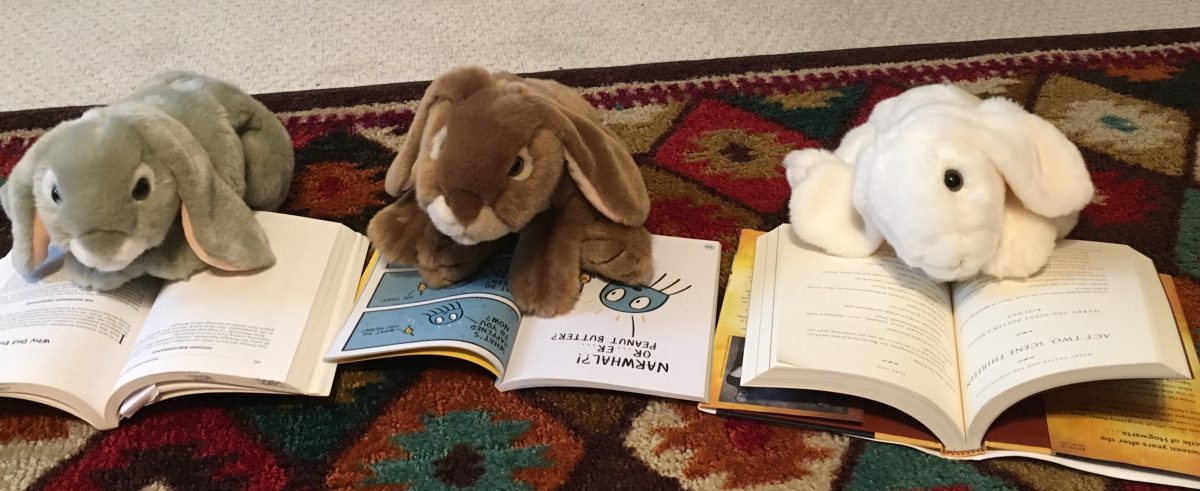
Marshmallow reviews Night by Elie Wiesel

Today Marshmallow reviews Night by Elie Wiesel, first published in Yiddish in 1956 and in English in 1960. Wiesel won the Nobel Peace Prize in 1986 “for being a messenger to mankind: his message is one of peace, atonement and dignity”.

A small caveat: The book as well as the review below involve historical events that depict harsh realities. They may not be appropriate for younger readers.

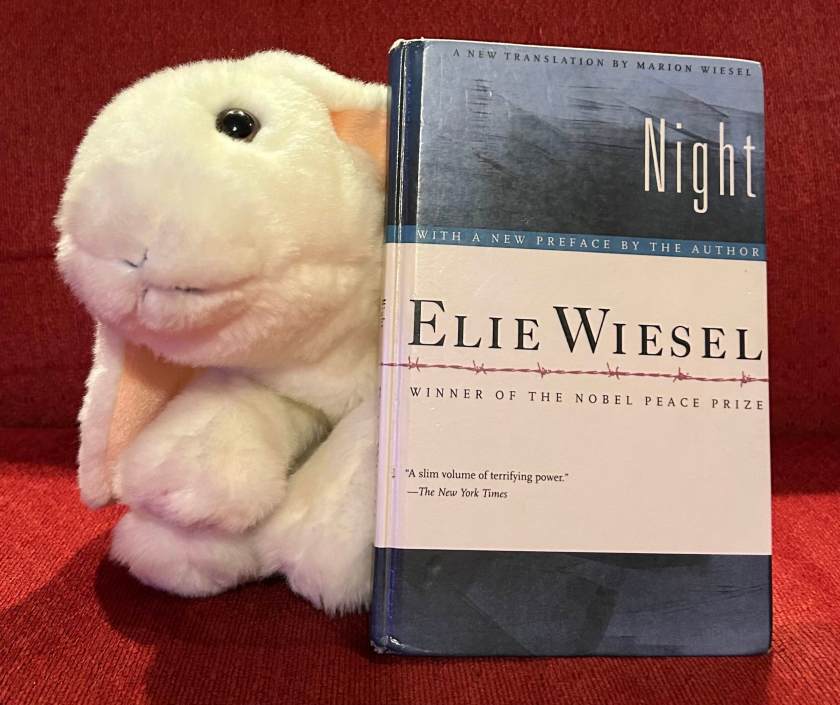
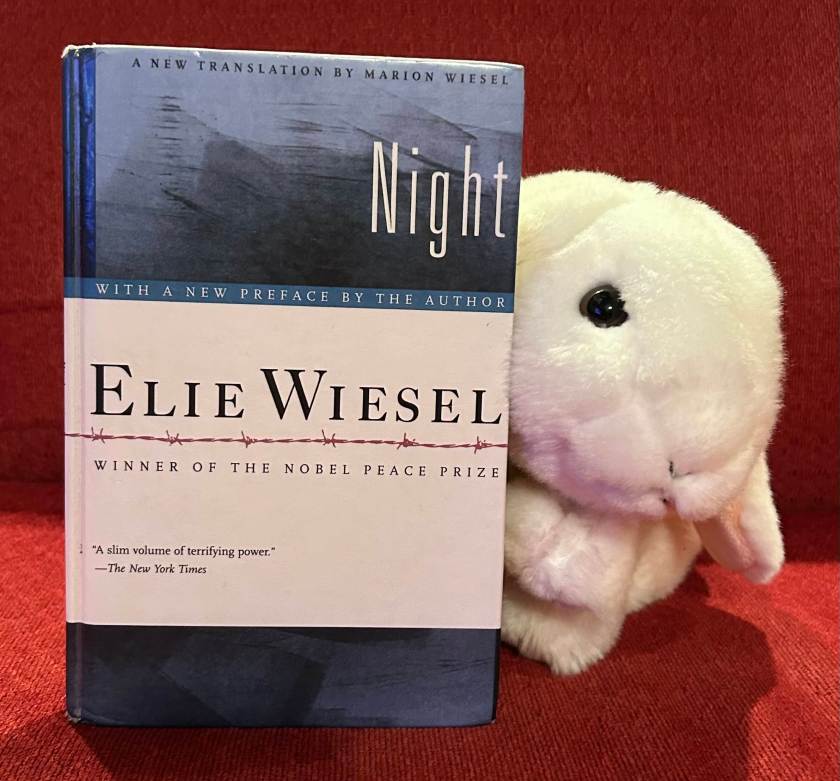
Marshmallow reviews Night by Elie Wiesel.

Marshmallow’s Quick Take: If you are a person of reasonable maturity and ability to process and handle important historical events, then this is the book for you.

Marshmallow’s Summary (with Spoilers): Elie Wiesel was a young Jewish boy in Romania during the Second World War. The book is more or less a memoir of his youth.

Elie is a young boy, extraordinarily devout at a remarkably young age, seeking out a religious mentor in Moishe the Beadle. It is from him that the town of Sighet—located in Transylvania—first hears of the Nazis’ proximity. Since Moishe is a foreign Jew, he is forced to leave first. But he luckily escapes the Nazis who leave him for dead due to his bleeding, shot leg. Moishe walks on foot an unbelievably long journey back to Sighet to warn the very people who look down on him of how dangerous the Nazis are. None of the residents believe him. Elie worries for his mentor, as many adults around him say the Beadle is mad.

Many of the Jews of Sighet do not believe that the Germans could reach them. Others believe that the war would end before Germany’s reach expanded far enough to affect them. It is heartbreaking to say that they are wrong. The Nazis show up on Sighet’s streets within a matter of days.

The Jews are first forced into ghettos, condemned to smaller slums as though they are not deserving of being able to choose where to live. Soon they are forced out of their homes, able to take only what they could carry. They are made to wait on scorching sidewalks and soon after chased towards cattle carts that take them to the concentration camps. Elie and his family, which includes his father Shloma, his mother Sarah, his two older sisters, and his seven-year-old younger sister Tzipora, are taken to Auschwitz. He loses his mother Sarah and Tzipora to the gas chambers and the Nazis on the first day, though he does not know it for certain until later. He and his father are forced into labor camps and the horror continues.

Wiesel’s suffering is conveyed through his own testimony in Night. He and so many others, millions of Jews, Gypsies, and other undesirables in the Nazis’ eyes, suffered so much as the hands of humans who were in all aspects but one the same. This story is one that everyone must read.

Marshmallow is reading Night by Elie Wiesel.

Marshmallow’s Review: This book is simply vital. I think everyone must read it once they are old enough to understand why we must remember. Elie Wiesel is one of the strongest humans to walk this Earth and he is also one of the wisest. Through this book, he passes on the story of the Nazi camps and their horrors designed to exterminate the Jews. He describes things that provoke a deep silence after reading, a deep silence that necessitates thought and great gratitude that one is not in such a situation. Wiesel is a hero by the virtue that he survived. But there are so many who did not and, for their sake and Wiesel’s, this story cannot be forgotten.

Night was assigned as reading in my English class and that is one of the best decisions a teacher can make. This story has impacted so many and Wiesel is truly one of the few people who can be described as a master of prose and a witness of humanity. In words, Wiesel has described the indescribable.

Thanks to Wiesel’s wife Marion who translated it into English for a larger audience, Night is written in simple and clear language, with few ornate embellishments. The horrific events make it seem so already, so Wiesel says things in a way that never makes the story seem unreal.

It is really remarkable and heartbreaking that Wiesel never viewed himself as exceptional. He wonders several times why he survived. He says he was never special or had any sort of skills or attributes that made him deserving of life. But everyone is deserving of life and yet so many were robbed of it. It is truly heartbreaking. Yet, his thoughts and perseverance, his selflessness and his determination (though these words have lost much of their weight and meaning through superfluous use) make him one of the most admirable human beings. He cared unwaveringly for his father though they were both suffering. He never stopped looking after him, even though Wiesel himself thought he failed in this. Wiesel was truly, indescribably a remarkable person with a profound impact. His book Night must be read.

Marshmallow’s Rating: 200%.

Marshmallow rates Night by Elie Wiesel 200%.

Sprinkles reviews Now We Are Six by A.A. Milne

Last week Sprinkles reviewed a sweet little poetry book written by A.A. Milne: When We Were Very Young. Today she reviews Now We Are Six, a sequel if there could be one for a poetry book. First published in 1927, this book was also illustrated by Ernest H. Shepard.

Sprinkles reviews Now We Are Six, written by A.A. Milne and illustrated by Ernest H. Shepard.

Last week I reviewed When We Were Very Young, written over a hundred years ago by A.A. Milne. Today I share with you some thoughts on another little poetry book by Milne that is almost a century old: Now We Are Six.

Now We Are Six is a perfect sequel to When We Were Very Young, and young bunnies who have enjoyed that book would definitely enjoy this book, too. In fact both Marshmallow and Caramel were gifted this book for their sixth birthdays. (Yes it was the same copy, which I think is fine. After all, Marshmallow had already graduated from being six years old when Caramel entered that age…) If you want to see what the book is like, you can see the contents in the Project Gutenberg page for the book here. But once again, I will say that the experience of holding a real copy of the book in your own hands (or paws!) is a lot more pleasant.

Before diving into the poems in the book, let me tell you that Milne’s introductions are really interesting. I am not sure the younger readers would appreciate them, but the adults reading the books definitely will. So please do not skip these; they are so fun to read!) In this introduction, we are also warned that Winnie the Pooh shows up in several of the poems. It is really neat to see Pooh’s evolution from the germ of an idea in one little poem in When We Were Very Little to a fully developed independent character who “walked through [the book] one day, looking for his friend Piglet, and sat down on some of the pages by mistake.”

Sprinkles is reading Now We Are Six, written by A.A. Milne and illustrated by Ernest H. Shepard.

Now the poems! There are thirty five in total. And some are indeed about Winnie the Pooh, or at least they include Pooh as one of the main actors. For example, the poem “Us Two” is about a little boy narrating his adventures and conversations with Pooh. But pooh also just happens to show up in the illustrations of poems that do not explicitly mention his name. For example “The Engineer” is about a train the narrator is trying to play with, and Pooh shows up in the illustrations waiting for a ticket and then the train itself. The little bear makes a similar appearance, that is, only in the illustrations, for the last poem of the book, “The End”, where the narrating child is excited to be six years old:

But now I am Six, I'm as clever as clever
So I think I'll be six now for ever and ever.

Another one of my favorite poems in this book is “Explained” where a little girl named Elizabeth Ann goes around trying to find out just “how God began”. the question remains unanswered for all those who are reading the poem, even though in the end Elizabeth Ann gets an answer that satisfies her.

Unlike When We Were Very Young, which seemed to be almost exclusively written for a little boy, there are quite a few little girls in this book, or possibly a single little girl, who is sometimes named Elizabeth Ann and sometimes Anne. This makes a lot of sense if you read that the book is dedicated to Anne Darlington, who was a friend of Christopher Robin, Milne’s son. The Darlingtons and the Milnes were family friends, and they seem to have hoped that their two children would perhaps eventually marry each another. But in any case, I believe that the book does benefit from having a little girl in it.

The poems are once more about play and daily life and friendship and big questions. There is also room for big feelings. For example, the very first poem, “Solitude”, reminds the reader that all children are persons of their own rights, and sometimes they too will need some space. And there are a handful of poems which are more fantastical. For example “The Knight Whose Armour Didn’t Squeak” tells the story of a knight, you guessed it, whose armor did not squeak. One day, this knight spots another one whose armor does not squeak and figures out a way to eliminate him from this competition.

The illustrations in the book are once more by Ernest Shepard and complement the book’s quirky and fun feel. All in all, this book is a joy to behold and a joy to read. I recommend it with much enthusiasm to anyone looking to find a poetry book to read or share with a young bunny!

Sprinkles recommends Now We Are Six, written by A.A. Milne and illustrated by Ernest H. Shepard, to anyone looking for a little poetry in their lives.

Sprinkles reviews When We Were Very Young by A.A. Milne

Today Sprinkles reviews a cute little poetry book, When We Were Very Young, written by A.A. Milne, illustrated by Ernest H. Shepard, and originally published in 1924.

Sprinkles reviews When We Were Very Young, written by A.A. Milne and illustrated by Ernest H. Shepard.

Today I am excited to share with the readers of the book bunnies blog a wonderful little book of poetry, written over a hundred years ago, in 1924. If you are curious, you can read the poems in their entirety here in the Project Gutenberg page for the book. But I have to say that holding the book in your hands (or, as in my case, in your paws) is a real pleasure. The illustrations by the estimable Ernest H. Shepard are simple and yet timeless.

A.A. Milne wrote the poems in this book for his son Christopher Robin, who was four at the time. In his introduction he tells us that these verses often should be read as if they are coming from the voice of Christopher Robin or another young child, and when you read them out loud, that is almost always the feeling you get. And so I can imagine a young bunny and an adult one who loves them sitting down to read a few of them at a time and having a really wonderful time together.

There are a total of forty-four poems in the book. Many of them reflect different aspects of a young child’s life or zero in on small moments that loom large. There is a poem about the pleasure of being in the rain with waterproof outerwear (“Happiness”), another about how the four different chairs in the nursery could be different places and make for fun adventures all on their own (“Nursery Chairs”), and yet another about the joys of simply being outside without a purpose to go any particular place (“Spring Morning”). Then there are more playful poems about made-up characters and their stories. There is for example a poem about an elephant who is friends with a lion who is friends with a goat who is friends with a snail (“The Four Friends”), another about a dormouse who loves geraniums and delphiniums but is prescribed by a doctor to grow chrysanthemums instead (“The Dormouse and the Doctor”), and yet another about an alchemist who after years of effort is still unable to get it quite right (“The Alchemist”).

Sprinkles is reading When We Were Very Young, written by A.A. Milne and illustrated by Ernest H. Shepard.

Two of my other favorites in the book were the one about rice pudding (unsurprisingly named “Rice Pudding”) and the one titled “Lines and Squares” about why you should stay in the squares and never step on the lines when walking on a sidewalk–for otherwise a bear will eat you!

And then there is the thirty-eighth poem, “Teddy Bear”, which starts with:

A bear, however hard he tries,
Grows tubby without exercise.
Our Teddy Bear is short and fat
Which is not to be wondered at;
He gets what exercise he can
By falling off the ottoman,
But generally seems to lack
The energy to clamber back

And then there are twelve more stanzas with similar rhyme and goofiness. The poem finishes in the way it started, but with a twist:

A bear, however hard he tries,
Grows tubby without exercise.
Our Teddy Bear is short and fat
Which is not to be wondered at.
But do you think it worries him
To know that he is far from slim?
No, just the other way about--
He's proud of being short and stout.

And thus we see the birth of a little creature who would eventually become the world’s most famous bear: Winnie the Pooh! Ernest Shepard was apparently thinking of the teddy bear his son had while drawing the illustrations for the poem. These illustrations and Christopher Robin’s own toys together led to A.A. Milne creating the Winnie the Pooh character in the stories in the next couple years.

But even if you are not intrigued by Winnie the Pooh or his origin story, the poems in this book are lovely. And they are such a pleasure to read! Their simple melodies and sweet themes would also make them wonderful candidates for reading out loud with a younger bunny in your life. In other words, as Marshmallow would put it: if you are searching for a neat book to read out loud with the young bunny in your life or if you are simply looking for a lovely poetry collection about the magic of childhood to bring a smile to your face and a bit of childlike joy into your heart, then this might be the book for you!

Sprinkles recommends When We Were Very Young, written by A.A. Milne and illustrated by Ernest H. Shepard, to all who love the littlest bunnies in their families and want to read poetry with them.

Marshmallow reviews Things Fall Apart by Chinua Achebe

As the first review of the book bunnies blog this new year, we present to you Marshmallow’s review of Chinua Achebe’s Things Fall Apart. First published in 1958, Achebe’s novel is a modern classic, and Marshmallow has read it in school.

Marshmallow reviews Things Fall Apart by Chinua Achebe.

Marshmallow’s Quick Take: If you like historical fiction books about colonialism in Africa or books that make you think or feel, then this is the book for you!

Marshmallow’s Summary (with Spoilers): Set in the Nigerian Ibo society during the 1890s, this book starts with the introduction of Okonkwo. Okonkwo is a highly-respected man in his village Umuofia. Through his victories in battle and his defeat of the Cat (a famous wrestler), Okonkwo is a powerful man. As a result (as is Ibo culture), he has three wives, many children, a successful farm, and on occasion drinks palm wine out of his first human skull. He is what is called a “strong man.” However, his success and strength is a result of fear. His drive to succeed is fueled by a fear of being similar to his father, who was a efulefu (or worthless man). Okonkwo’s father was lazy and debt-ridden; thus, Okonkwo compensates for his father’s failures by working obsessively. Luckily for Okonkwo, in Ibo society, a man is not judged by his father, but by his own merit. Eventually, his success seems cemented. Yet, he is still controlled by anxiety, fear, anger, and violence. His household, though it reflects the traditional Ibo setup of its time, is a model case of domestic abuse.

Meanwhile, a woman from Umuofia is killed in a neighboring village. To avoid war with the fear-inspiring Umuofia, this village sends a virgin girl and a young boy to compensate. For the purposes of the plot, the boy (named Ikemefuna) is most important. Umuofia doesn’t immediately decide what to do with the boy, taking several years to do so. During this, he is placed in Okonkwo’s household and soon becomes fast friends with Okonkwo’s son, Nwoye. Over time, Okonkwo starts to view Ikemefuna as a son. 

But when tragedy strikes, Okonkwo finds himself in a situation that pits his “strong man” facade against his heart. And as the book progresses, Okonkwo continually finds himself at odds with the changing village. The question is, how much more can he take before he falls apart?

Marshmallow is reading Things Fall Apart by Chinua Achebe.

Marshmallow’s Review: I think reading this book is an extremely important experience that all people and bunnies should have. Chinua Achebe–the author–wrote it in simple, easy to read English specifically so it would be accessible to all; this makes it a good book for all ages and levels of reading ability. But ultimately, this book is remarkably subtle and nuanced. The author’s tone is simple and unique, while startlingly complex at the same time. The plot evolves elegantly and the author creates compelling characters that make you need to see the storyline though. Additionally, Achebe successfully grapples with and portrays issues like colonialism, racism, and toxic masculinity. This book is incredible because of the insights it gives on such topics. It also shows the reader what (some) life and culture was like in Nigeria before colonialism.

Additionally, this book’s themes are philosophically, historically, psychologically, and culturally intriguing. Throughout, Achebe weaves in the concept of facades: facades of strength, of stability, of security, of trustworthiness, of happiness, of truth. Achebe’s work is remarkable, and the astute reader will recognize and appreciate the importance of such work.

Overall, I highly recommend this book to all because it’s imperative to understand what others in the world experience and experienced, especially in a world of such divided opinions and narrow perspectives. 

Marshmallow’s Rating: 100%.

Marshmallow rates Things Fall Apart by Chinua Achebe 100%.