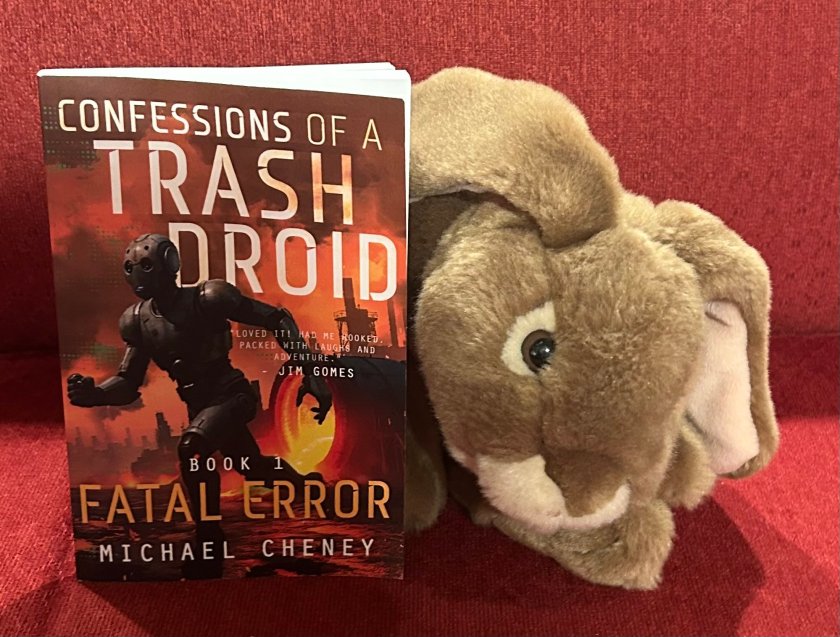
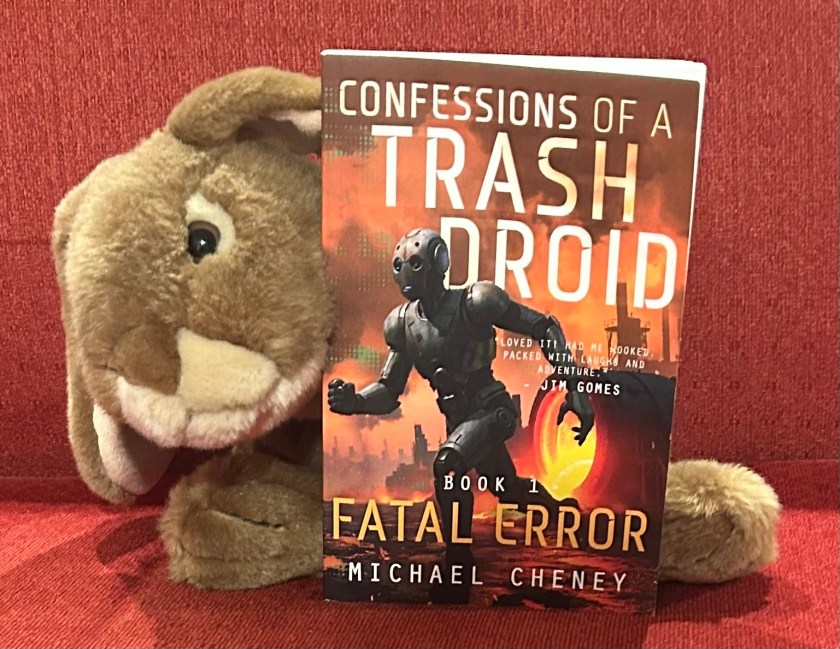
For his last post before our summer break, Caramel decided to review the first book in the Confessions of a Trash Droid series of Michael Cheney: Fatal Error first published in 2025. As usual, Sprinkles is taking notes and asking questions.
Caramel reviews Confessions of a Trash Droid: Fatal Error by Michael Cheney.
Sprinkles: So Caramel, tell us a bit about this book.
Caramel: This is a book about a robot. This robot is sentient and he does not really like humans.
S: How come?
C: He does think they are very useful or intelligent.
S: Hmm, one does not have to be useful or intelligent to be worthy of care and kindness, but okay. So why is he a trash droid? Does he collect trash? Or is he old and people want to discard him like trash?
C: The first more or less: he is a waste disposal robot.
S: Okay, so what happens to him?
C: So he is on a plane that crashes and he does nothing to save anyone. So the company that built him or is using him is mad because he is supposed to help humans.
S: So is that what the confessions part of the title is about?
C: Sort of. But also he has a strange error that causes him to black out and go violent and so on.
Caramel is reading Confessions of a Trash Droid: Fatal Error by Michael Cheney.
S: This reminds me a lot of Murderbot, at least in the TV series version, where he was having flashbacks or memory clips of himself going violent and being involved in a chaotic event.
C: Yeah, there are some parallels for sure.
S: Honestly when I first read the description of the book, I immediately thought of All Systems Red and Artificial Condition. So I thought you might enjoy it.
C: Yeah, I did enjoy it; it is pretty good. And yes, there are some similarities perhaps but this one is a little more of a misanthrope, you’d say, he is much more negative towards humans. And he is more robotic. Murderbot is a lot more human, his body is a lot more organic, and he looks like and can pass as a human. The trash droid looks very robotic. Also this one has a much much dirtier vocabulary. There is a bad word every few sentences. I mean it works, but maybe if a bunny’s parents don’t want them to read a book with bad words, this might not be right for them.
S: And I think this one has much shorter chapters.
C: Yeah, it is also a shorter book. So quite easy to read.
S: Okay, Caramel, I think this is a good time to wrap up our review.
C: Sure.
S: And this is your last review till August.
C: I love summer time!!!
S: Yes, summer is really nice. And we will take July off as usual. So what would you like to tell our readers?
C: Stay tuned for more book bunny reviews! There is one more post from Marshmallow and then there will be many more in August!
Caramel enjoyed reading Confessions of a Trash Droid: Fatal Error by Michael Cheney and is curious about the future books in the series.
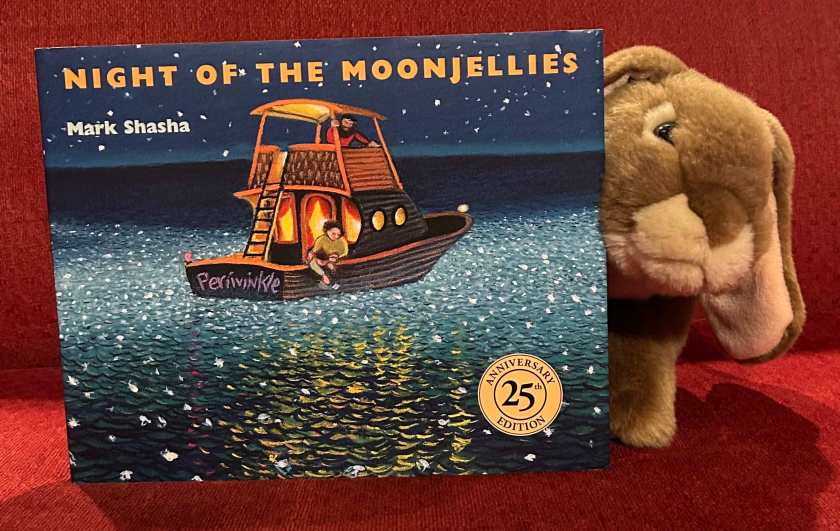
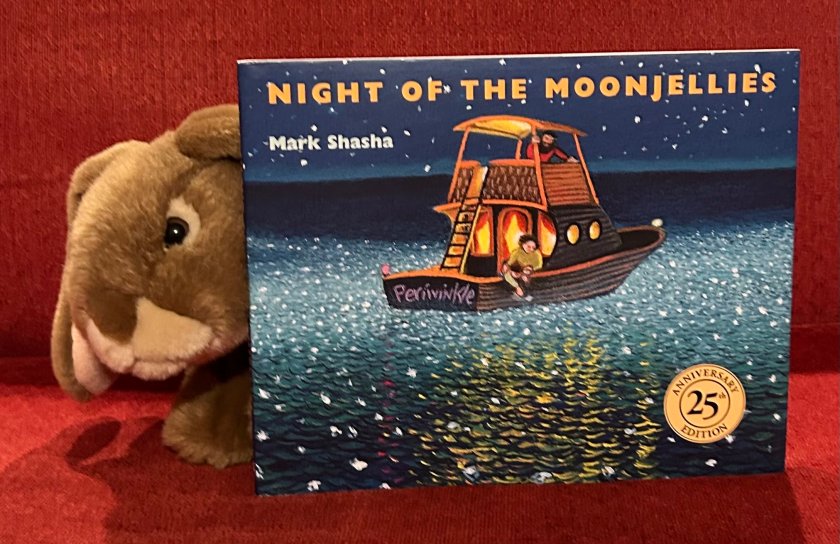
Today Caramel is reviewing a beautiful book by Mark Shasha: Night of the Moonjellies, originally published in 1992. As usual, Sprinkles is taking notes and asking questions.
Caramel reviews Night of the Moonjellies by Mark Shasha.
Sprinkles: So Caramel, for your last review before we take some time off for the summer, you chose to talk about this book.
Caramel: Well, you told me that summer officially starts on June 21 this year and told me we should talk about a summer book. I thought this would work well.
S: Yeah, this is a very nice picture book about the summer season.
C: Apparently, it is not even fully fiction! This book is about the author’s life. He is telling us things that have or might have happened when he was a kid.
S: Yeah, it might be a bit nostalgic then. Do you know what nostalgic means?
C: Yeah, it means a thing that evokes a sense of remembering a good thing?
S: Yeah, there is a feeling of sadness, about missing the past. The book is about a time that the author experienced as a child. So it is something he remembers fondly, from his past.
C: That makes sense. The book is about his family when he was growing up in Connecticut. His grandma, his uncle, his aunt, all his family are running a hot dog stand together, and he finds a moon jellyfish on the beach, and his grandma tells him to put it in a bag with water, so it doesn’t die. And then he tells us about his day. They make food for customers, and it is really busy.
S: And the boy is always helping out and kind of cheerful, right?
C: Yeah, he seems like a nice kid. And he seems like he really enjoys working together with his family and helping them out. All of them know what they need to do and they do it.
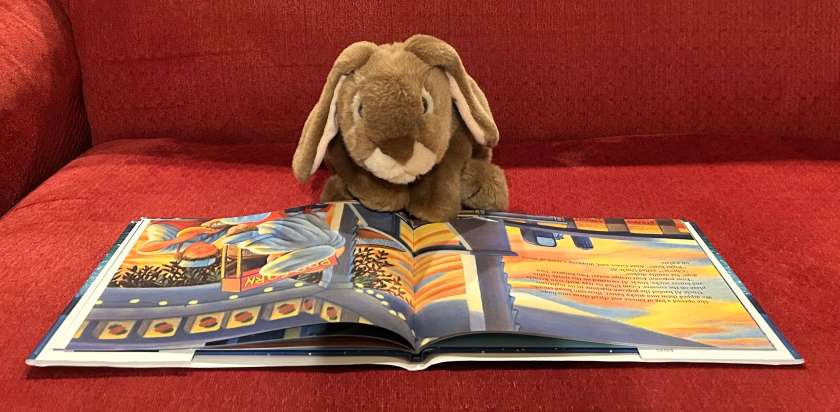
Caramel is reading Night of the Moonjellies by Mark Shasha.
S: Cool! But the book is titled “Night of the Moonjellies” so eventually we should get to the night, right?
C: Yeah, at night his grandma takes him on a kind fisherman’s boat, and they release the moon jellyfish, and they see the ocean glow from the jellies; they make the night sea sparkle and look so pretty.
S: Yes! I think that how the jellies came together to make the ocean so pretty is kind of like how the boy and his family worked all day together in harmony to make something good happen.
C: Yeah. I didn’t think of that, but it makes sense.
S: Kind of like, my family and I, together we make something neat, and the jellies, they make something neat with their families, too.
C: Yeah, I can see that. But I think even without making a connection like that, I am sure the sea must have looked awesome!
S: Yeah, one would probably not forget such a sight.
C: Yeah, if I saw such a thing, it would be so cool! I’d definitely remember it forever, too.
S: Do you remember something like that? Have you ever seen something in nature that awed you? That moved you so deeply?
C: No, I don’t think so, but it would have been cool.
S: Actually I remember you seeing something and being that awed. Some years ago, we were in Japan. We were so lucky to be there during the cherry blossom season. And you were a tiny little bunny, but your awe, your thrill, your joy were all so visible.
C: Oh, wait, I do remember that, how did I not remember that?
S: Well, maybe you were trying to think of experiences on the ocean. Or anything during the summer. The cherry blossoms were very much in the spring. And they were so beautiful! You definitely remember them now, right?
C: Yep. That’s why I think I didn’t come up with it immediately. But yeah, the cherry blossoms were so beautiful..
S: We don’t get to have too many such experiences. Sometimes beautiful things just happen and we don’t see them. We are too busy, too distracted. But when they do happen and you witness them, it is important to take note. I hope you will always remember the cherry blossoms.
C: Yeah, I will try. I’ll try to never forget.
S: Okay, Caramel, so do you think this is a good time to wrap up our review?
C: Sure.
S: So what do you want to say to our readers then?
C: Stay tuned for more book bunny reviews!
Caramel enjoyed reading Night of the Moonjellies by Mark Shasha and is totally ready for the summer!
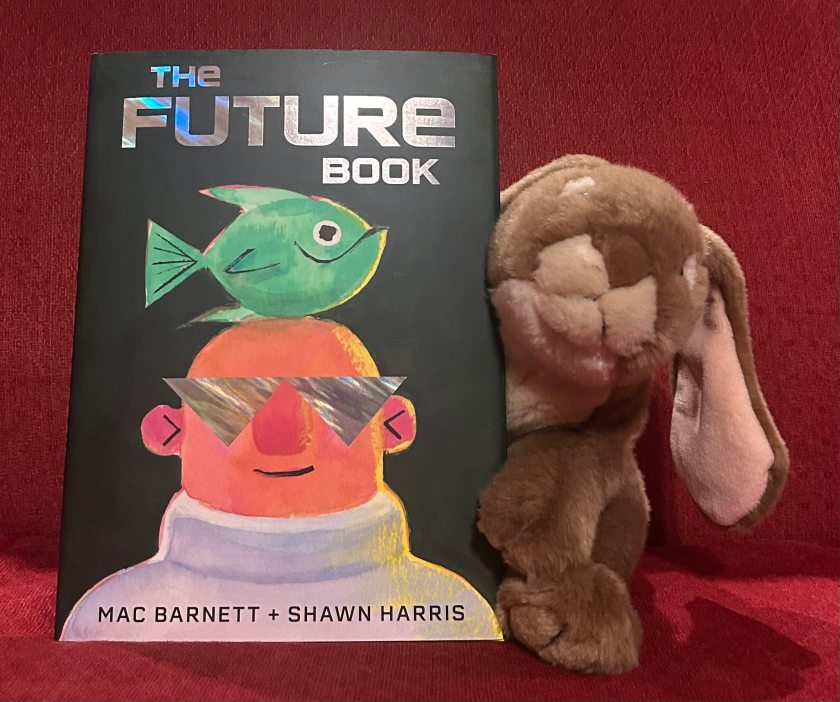
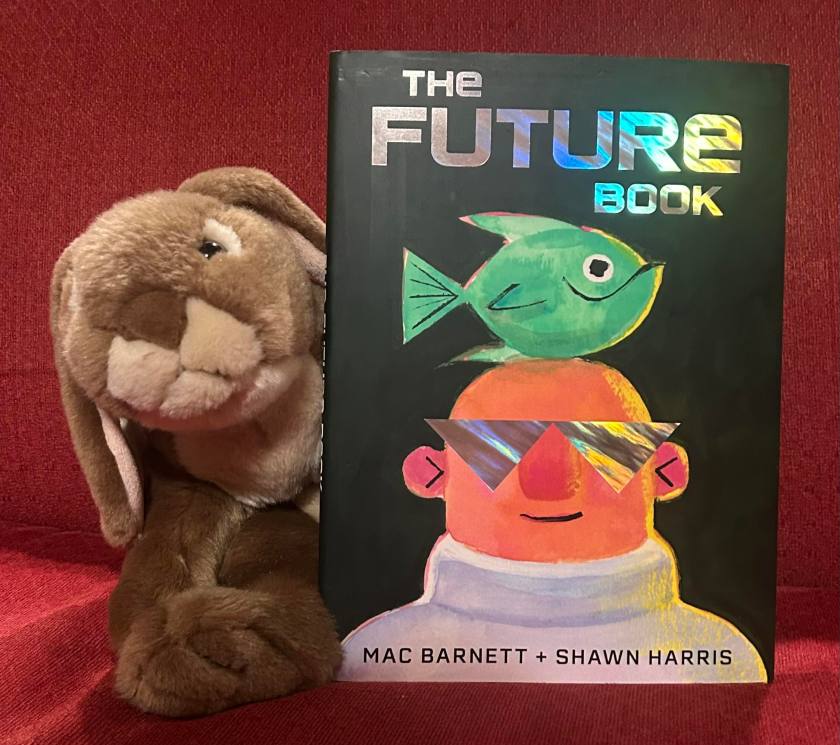
Today Caramel is reviewing a brand new picture book: The Future Book written by Mac Barnett, illustrated by Shawn Harris, and published in 2026. As usual Sprinkles is taking notes and asking questions.
Caramel reviews The Future Book by Mac Barnett and Shawn Harris.
Sprinkles: So Caramel, we are talking about a brand new picture book today, right?
Caramel: Yep. It is called The Future Book and it comes from the future!
S: What does that mean?
C: I don’t exactly know. But it claims that it knows what is going to happen in the future. And a bunch of weird stuff will happen apparently.
S: Okay, that sounds weird.
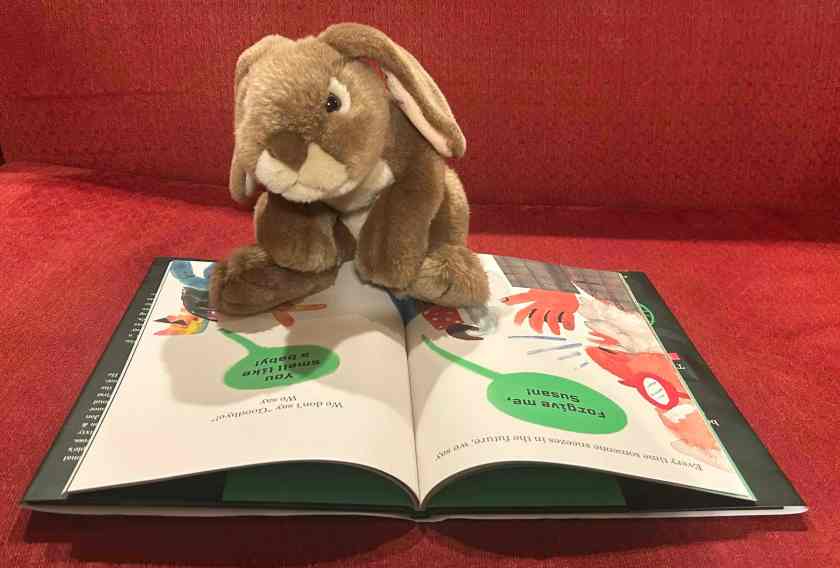
C: It is. But apparently the future will be pretty weird. For example people will put a fish on people’s heads instead of thanking them. And bananas will b e called apples and there will not be any more apples left so they won’t be called anything.
S: Oh, that would be sad. You love apples!
C: Yeah, I really like apples. So I hope the book is wrong and there will always be apples.
S: But if bananas will be the new apples, there will still be apples!
C: Sure, I guess you could say that. But I would still miss the round juicy red fruits…
S: I know, right? Anyways, so the book is basically saying a bunch of really wacky things will happen in the future, right?
C: Yeah, it is quite funny.
S: I did read it once too, and you are right it is quite funny. In a very absurd way.
Caramel is reading The Future Book by Mac Barnett and Shawn Harris.
C: I can see what you mean. That book is also pretty wacky. And it is a lot of fun to read out loud. Or at least to have your adult read it out loud to you so they have to say all kinds of silly things.
S: Yes! How about this one? Do you think it could be fun to read out loud?
C: Sure. It could be more fun to be read to though. I always like it when you read to me. And this could be fun if you read it to me.
S: Okay, maybe we should read it together after we are done with this review.
C: I could like that.
S: Okay, what else can you tell me about the book?
C: It is very colorful. And the drawings look like they were done by water coloring or something. I mean, there are not many black lines that make the boundaries of things. And there are a lot of speech bubbles. A lot of the book is people speaking, like how people in the future will speak, apparently. It is quite silly.
S: But in a fun way?
C: Yes, definitely. Silly in a fun way. And the sleeve of the book is also covered with silly writing which is supposed to be like what a future supermarket brochure would be like, using all the weird future words!
S: Yeah, you are right. That is very funny too. Okay, so do you think this is a reasonable time to wrap up this review?
C: Sure, why not? And you said you would read the book out loud to me after we’re done.
S: Yes, I will.
C: Okay, so let us wrap things up.
S: Okay, so what do you want to tell our readers Caramel?
C: Stay tuned for more book bunny reviews!
Caramel enjoyed reading The Future Book by Mac Barnett and Shawn Harris and is curious to see if the future will really turn out so wacky.
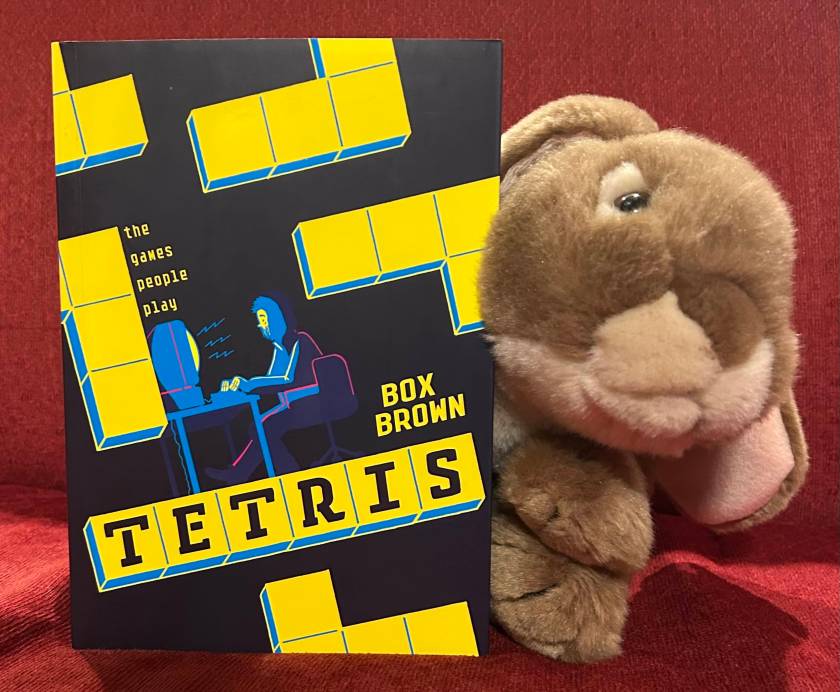
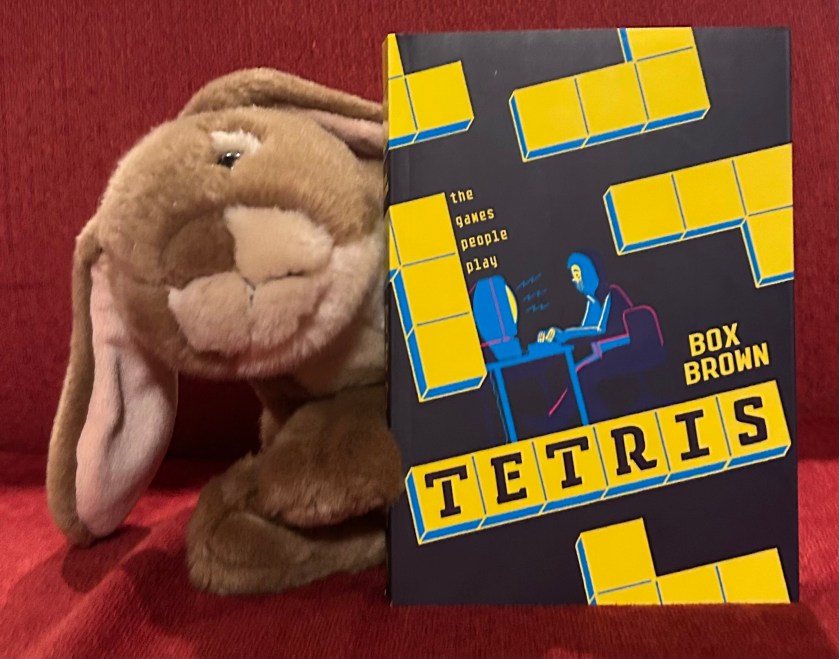
Today Caramel reviews Tetris: The Games People Play by Brian “Box” Brown, first published in 2016. As usual, Sprinkles is taking notes and asking questions.
Caramel reviews Tetris: The Games People Play by Brian “Box” Brown.
Sprinkles: Today we are talking about a graphic novel about my favorite computer game, the one and only, the classic: Tetris!
Caramel: Yay! This is, as you said, a comic book about Tetris and how it rose to popularity.
S: So it is not quite fiction then, right?
C: No, it’s more so a fictionalization of a real event, like the movie Oppenheimer.
S: That makes sense. I am very excited that you read this book because I really like Tetris. But I also am curious about the whole phenomenon it became. It was everywhere and people were almost addicted to it for a while.
C: Yeah, this comic book explains all of that. It is interesting to me because, you know, there are a lot of games today. It seems like when Tetris came out, it was a huge deal partially because there weren’t as many big games.
S: Now that’s not quite true, there were other video games, but I think it is probably true that Tetris is a class of its own. It was so popular and it just took over.
C: And it is such a simple idea. Blocks falling down and you are trying to place them in empty spaces just the right way so the pile won’t get too big.
S: Isn’t it interesting that my favorite computer game and yours both have blocks?
C: True, but my favorite game may have slightly better resolution.
S: Well, Tetris did not really need much resolution really. But you are right of course, Minecraft is so much more visually detailed, and of course you can build so many different things with blocks in Minecraft. It is a lot more sophisticated. But you know, that was part of the appeal of Tetris. It is so basic, so simple, but it is also very challenging.
C: True. It can get really hard. Especially when it gets faster and faster.
S: Yup. So tell me a bit more about the book.
C: The book starts with a strange scene about humans and play and art and entertainment. And about why people play. There are many pages about early games people played, and art about games and how games might be related to art too. Then there are a few pages about the founding of the Japanese company Nintendo. And we get into computer games eventually. But we do meet the coder who built Tetris very early on. It was a Russian programmer named Alexey Pajitnov. He thought about how when he was a little kid, he used to play with pentominoes, which are shapes made of five squares, and how it was difficult to place them in a box when he was done playing with them. Then eventually we get back to him, and we follow him through his life, as he develops and shares Tetris with the rest of the world. He moves to the United States and the game gets even more popular.
S: That sounds interesting! Quite a crash course in the history of games!
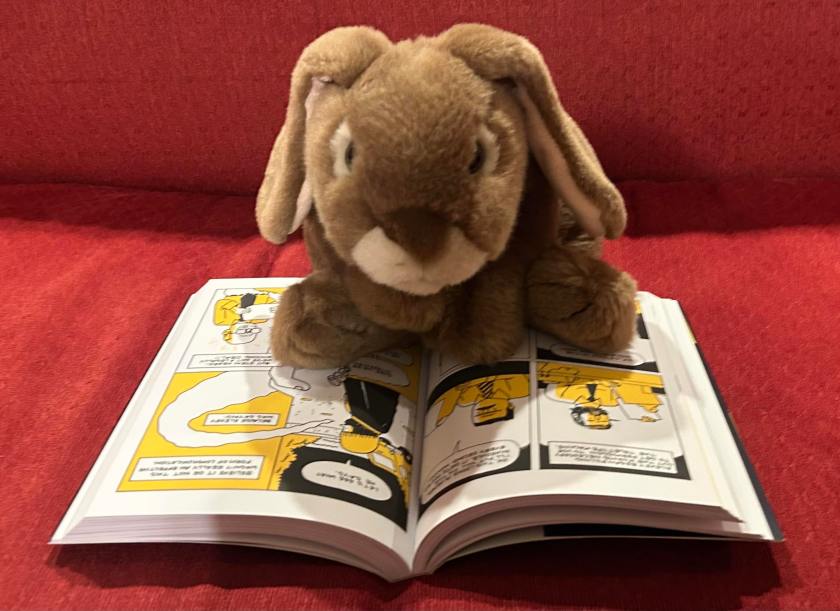
Caramel is reading Tetris: The Games People Play by Brian “Box” Brown.
S: Did you learn anything new from the book then?
C: Well, basically everything! I knew about the game, I have seen you play it even, but I didn’t know much else about it. I also did not know that other people liked the game as much as you do. It apparently became a really big deal. People started seeing Tetris tiles everywhere even when they were not playing and so on.
S: But I bet you can sympathize. Have you ever looked around you after playing Minecraft for a while and seeing cubic blocky things?
C: No! Because I am a normal bunny.
S: Well, hmm, that is interesting. Maybe the blocks in Minecraft are too different, there are too many different distinct shapes to make your brain go wacky like that.
C: Or … maybe I have never played Minecraft for too long. Maybe I should play more to see if I get to see things as Minecraft blocks?
S: Hmm, I don’t like that idea.
C: Oh, too bad. Because I really did like it.
S: Sure you did. Okay, let’s get back to the book. What did you think of the color scheme of the book?
C: It’s all black and white and yellow, yet the art is still detailed. It is really interesting. The game itself has a lot of color, though they are the main primary colors, but the author chose only these colors. I wonder why.
S: Yeah, that is an interesting observation, Caramel. The yellow adds color but also is not distracting. Maybe the Tetris colors would be a bit too distracting.
C: Maybe. The story was interesting though I was not expecting to learn about the games ancient Egyptians played when I began reading. I thought it would be only about Tetris.
S: But the book also has a subtitle.
C: True. The subtitle is “The Games People Play”. So I guess it makes sense that there could be more general stuff about games.
S: That part reminds me a bit of another book I read recently called Around the World in Eighty Games. I even reviewed it for a math journal.
C: That book looks interesting too. I bet it has a lot of games I don’t know about.
S: Well, you can borrow it whenever you like. I still have a copy.
C: Maybe I will.
S: Okay, Caramel, this seems to me like a good place to wrap up this review. It is after all a school night, again.
C: Yep.
S: What do you want to tell our readers?
C: Stay tuned for more book bunny reviews!
Caramel enjoyed reading Tetris: The Games People Play by Brian “Box” Brown and continues to wonder if it can provide him with any justification for more Minecraft time.