Caramel reviews Sugarbush Spring by Marsha Wilson Chall and Jim Daly

Today Caramel picked up a beautiful picture book originally published in 2000: Sugarbush Spring, written by Marsha Wilson Chall and illustrated by Jim Daly. As usual, Sprinkles is taking notes and asking questions.
Caramel reviews Sugarbush Spring, written by Marsha Wilson Chall and illustrated by Jim Daly.

Sprinkles: It is almost spring here, the spring equinox is tonight, and so today we are talking about a book about spring, right Caramel? 

Caramel: Yep. We are.

S: But this is a spring that is quite different from the ones we are used to here where we live, right? 

C: Yeah it is still snowy there and we almost never get much snow. 

S: I know, right? Seasons are different all around the world. And we are in the northern hemisphere, so when it is our spring, it is fall in the southern hemisphere. So even more different.

C: Yes, Sprinkles. You said it is almost spring here, and yet in Australia, for example, that is not correct. 

S: I know, right? It is pretty cool actually. That we live all around this planet, and we experience quite a lot of different things, and yet, we all experience seasons in some ways. So the spring in this book is what kind of a spring?

C: Well, there is still snow on the ground, but during the day it is above freezing.

S: That is quite different from where we are, right? Here, we almost never go below freezing. 

C: Yeah, it does not ever get too cold here, at all.

S: Yet, Marshmallow is always cold when it is just a bit cooler than usual. 

C: Yeah, it is very funny.

S: I think it is funny because I have lived in places which got a lot colder than here, but also she does not always think about wearing warmer clothes to keep warm. Then again, neither do you. You would go out with shorts and sandals every day if you had your way. 

C: That is not funny.

S: Okay, I see how things are. When it is Marshmallow, we can make fun of her, but when it is you, oh, it is not funny anymore?

C: Yep, it was only funny when it happened to Marshmallow.

S: Okay, let us not make fun of anyone then. I think people (and bunnies too of course) get used to where they have been living for a while, and so they notice the changes in the weather where they live even if they are not big changes in comparison to other places. So let us get back to Sugarbush Spring.

C: Yes, let’s. That way at least I won’t be insulted.

S: I was not trying to insult you; I was only teasing. I am sorry.

Caramel is reading Sugarbush Spring, written by Marsha Wilson Chall and illustrated by Jim Daly.

S: Okay, back to Sugarbush Spring. So this story must be about somewhere in the northeast of the United States, or maybe Canada, right? 

C: Yeah, they are making maple syrup, and it says that they are in Canada.

S: Cool! Tell me more. 

C: When it is time, when it is no longer freezing during the day, they go to a tree and they take some sap from the tree and make some maple syrup from it and at the end they make candy from the syrup. 

S: That is cool! Did you know that is how they make maple syrup?

C: Yes I did, but this book has lots of cool pictures showing exactly how they go through the full  process of making maple syrup. 

S: Of course, you are a little bunny who really knows a lot of things. But you are right, the pictures in this book are quite instructive. But they are not like textbook pictures. 

C: Yes, they are very colorful and they are relatively detailed and very pretty.

S: Also quite realistic. I mean they almost look like photos. 

C: Yeah. and it is fun to look at them. The details are neat. I especially liked how they made the candy in the end. 

S: Of course! Maple syrup candy must taste so good. I have never had one but I can imagine. 

C: I bet it tastes even better when you watch it being made. Hmm, now I want some maple syrup candy. 

S: Unfortunately we do not have any at home Caramel. And we do not have any maple trees to make maple syrup, either. 

C: I know it is kind of sad. But I guess that is why it is good we can find some of those things in the supermarket. Though I am not sure if I ever saw maple syrup candy at the store… Hmm… 

S: I am sure there is a benefit to having access to a sugar bush. According to Wikipedia, that means a collection of maple trees used to make maple syrup. 

C: Yeah, it sure would be cool. And I see now, that is why the book is called Sugarbush Spring. It is spring and they will make maple syrup from the sugar bush.

S: Good catch, Caramel! That makes total sense. 

C: Yep, I’m so smart, aren’t I?

S: Yes, you are! So maybe this is a good time to wrap up this review. If you were to summarize this book in three to five words, what would you say?

C: Hmm, let me think. Colorful springtime with maple syrup.

S: That works! So that is it then. What do you want to tell our readers?

C: Happy Spring Equinox! And stay tuned for more book bunny reviews!

Caramel enjoyed reading Sugarbush Spring, written by Marsha Wilson Chall and illustrated by Jim Daly, and recommends it to all little bunnies who are curious about spring time in other places, and all those who love maple syrup.

Caramel reviews The Misfits: A Royal Conundrum by Lisa Yee

Today Caramel reviews The Misfits: A Royal Conundrum, written by Lisa Yee. First published in 2024, The Misfits is illustrated by Dan Santat. As usual, Sprinkles is taking notes and asking questions.

Caramel reviews The Misfits: A Royal Conundrum, written by Lisa Yee and illustrated by Dan Santat.

Sprinkles: Caramel, today we are talking about The Misfits: A Royal Conundrum. So tell me a bit about it. 

Caramel: This book is about a group of kids that are slightly weird, but not that weird, they’re somewhere in the middle.

S: What do you mean?

C: They are scarily smart, but kind of not the smartest when it comes to social things. 

S: I see. Okay, and given the title, I am thinking they feel like they do not fit in with the regular kids. 

C: Yeah, they are a little different.

S: Okay, so they are a group of kids who are different. And are they now in a new school for different kids like themselves? Kind of like Harry Potter going to Hogwarts?

C: A little, Yes, so they are in this new school for other kids like themselves. And then they get into some unintentional trouble with an enemy that steals some very important gem. Then they are gathered together by some special teachers who train them as an anti-espionage and spy squad so that they can find the one who stole the gem. 

S: Wow! When you first started telling me about them, I thought maybe this book was kind of like The Unteachables by Gordon Korman, which Marshmallow reviewed a while back. But then you are telling me makes me think more about another book you reviewed yourself: N.E.R.D.S. by Michale Buckley.

C: Yep. And also all the Spy School books! And you know how much I love the Spy School books

S: Yes, yes, I do.

Caramel is reading The Misfits: A Royal Conundrum, written by Lisa Yee and illustrated by Dan Santat.

S: So all of that bodes well for this book, I am guessing. 

C: Yep! If I was Marshmallow, I would rate it 99% or 100%.

S: Okay, I am so glad you enjoyed this book. But tell me, what did you think of the illustrations? 

C: I liked them! They were very sketchbook-y, which I love!

S: They are drawn by Dan Santat! And you have already read and reviewed so many books by him! The Cookie Fiasco and Harold and Hog Pretend for Real! and The Aquanaut. You also reviewed Drawn Together, which was written by Minh Le and drawn by Dan Santat. That was a picture book but it was also a joint project, a collaboration between two people, like this book you are reviewing now. 

C: Well, for some reason I had not noticed that! But it sure explains why I loved these drawings so much! 

S: I think it does, too. Santat does have a particular style. His drawings look simple but they are very expressive. 

C: Yep.

S: So maybe this is a good place to wrap up this review. Would you recommend this book to other young bunnies? 

C: Yes, I definitely would.  It is a lot of fun to read. But also, everyone feels like they don’t belong sometimes, and then you read this book and feel that you are not alone. A lot of other people feel alone, too. And maybe one day you,too, will find your squad. 

S: True words Caramel! Okay, let us end here then. What would you like to tell our readers?

C: Stay tuned for more book bunny reviews!
Caramel loved reading The Misfits: A Royal Conundrum, written by Lisa Yee and illustrated by Dan Santat and recommends it to all young bunnies, especially those who sometimes feel like they just do not fit.

Caramel reviews The Giver by Lois Lowry

Today Caramel reviews a book he read in school: The Giver, by Lois Lowry. Published originally in 1993, the book has already become a classic, read by many students across the United States; it has also won the Newberry Medal in 1994. Sprinkles, who has not had the chance to read the book yet, is asking questions and taking notes.

Caramel reviews The Giver by Lois Lowry.

Sprinkles: So Caramel, today we are talking about The Giver, a book you have read and discussed in school over the course of a few weeks. 

Caramel: Yup. 

S: So let us start at the beginning. Can you tell our readers what the book is about?

C: Yes, sure. This book is about Jonas, a boy that lives in a community that controls the lives of those that live in the community.

S: I see. In what ways are they controlled? Can you give some examples?

C: They are not able to decide who they marry or choose their jobs. Even their death is controlled! The leaders get to choose who dies and when. They also choose the names of the newborn children. So the world of those who live in the community is very controlled, and they basically have no choice in anything.

S: Oh my goodness! When you first began with people not getting to choose who they marry or what their jobs should be, I was going to say that that has been the case in many societies throughout history, but then things got even more and more restrictive. No wonder this book is classified as a dystopian novel. Which according to my trusty dictionary means “an imagined state or society where there is great suffering or injustice.”

C: Yup, it sure does make sense, doesn’t it? But there is more. The people are also taking drugs to not have any emotions. Color is also taken from their lives, so at least they are not racist. But seriously, they are supposedly doing all this so everyone is equal, but it is pretty depressing.

S: Wow! That is really disturbing. Marshmallow had read and reviewed Brave New World where the people also had access to a drug called soma but there the drug was to just make them not feel bad things. That was also bad, of course, and it numbed them and made them more complacent, but forcing people not to have any emotions, and not to even see color, sounds really terrible.  

C: This is kind of a next level of control from Brave New World, even Nineteen Eighty-Four, I think. I mean I have not yet read those books, but from what Marshmallow wrote in her reviews, I have got a pretty good idea of what is going on.

S: Well, it seems you did understand them well enough. And of course you should read them at some point, too. But you are making a good comparison, Caramel. In Nineteen Eighty-Four, maybe there they do not mess with feelings in the same way; rather they break people who have attachments to other people and make them love the Big Brother only.  

C: In The Giver, too, they have a Big Brother-like leadership group. So for example, if you speak out against them once, you are “released.” Or injected with a deadly poison. The same happens with twins: one is kept, and the other is killed.

Caramel is reading The Giver by Lois Lowry.

S: Alright so in this dystopian world, what is going on? You told us the setting. Now tell us the plot, the events. 

C: Sure. So in the beginning, Jonas, the main character, starts to notice some weird things, For example, he starts to see some color. Like he has an apple and it for a moment becomes red. And then his friend Fiona is in color, too. But remember they could not see color before. 

S: It must be shocking to start seeing things in color if you had never seen color before. I remember the first color TV I saw, and I was so excited. But I could at least see color outside a TV screen before. 

C: Yep, it made him think that he was going crazy.

S: I bet! So then he starts asking questions and trying to understand what is going on with him and with his community and learns some really big secrets?

C: Hey, I was just going to say that! You stole my line Sprinkles.

S: Well, I have read my fair share of dystopian novels. 

C: That is probably true. I have not read as many books as you.

S: Well, you are still a very little bunny. And so you have many years to catch up. I bet you will catch up and pass me in just a few years… 

C: Maybe, just maybe.

S: Anyways, so what did you think? Did you enjoy reading this book?

C: Yep, it was a good book, except for chapters 11-13. I thought those were a bit too mushy, so I only skimmed through them. I am not sure I missed much.

S: I am guessing you are using mushy the same way Marshmallow uses it so some close romantic relationships were involved?

C; Yeah, but it really did get a bit too mushy for me.

S: Okay, I understand. So I would expect that there was some character development and such in those sections, so you probably did miss some things like that. But that’s alright. About the main setting and the story though, did things feel a bit too tense for you while you were reading it? Too depressing? It feels like it is a really oppressive world. 

C: Yeah, it is really oppressive. So I did not enjoy it like fun and games because it is about a very harsh world, but the story is very interesting, so I kept on reading. Also I had to read it. It was for school, remember? 

S: Yes, true that. But for example, do you think I should read the book, too? Do you think other young bunnies should read it? 

C: It is probably better suited, I suppose, for those bunnies that are not too young, but somewhere in the tweens or teens, everyone over ten or something should find it an interesting book, too. So yes, Sprinkles, you should definitely read it! 

S: Hmm, my last dystopian novels were the Hunger Games books that I read after Marshmallow recommended them. I guess I should look into this one, too. Did you know that there are apparently three other books from the same author that take place in the same world as The Giver? Do you think we should look into getting a copy of one of those for you? 

C: Maybe, but I think that this is kind of conclusive, and works really well as its own thing.

S: Oh, so no cliffhangers. That is great! And maybe you can take a break and look at some other worlds and stories for a bit. 

C: I’d like that. Maybe I will get to read a totally different type of book next week. We might at some point come back and revisit Jonas’s world though. I could like that, too. 

S: Sounds good. This might be a good place to wrap up this review Caramel. What do you want to tell our readers? 

C: Stay tuned for more book bunny reviews!
Caramel has enjoyed reading The Giver by Lois Lowry and is curious about the other books its author wrote as sequels.

Caramel reviews Adam & Thomas by Aharon Appelfeld

Today Caramel is talking to Sprinkles about Adam & Thomas, a book written originally in Hebrew in 2013 by Aharon Appelfeld, translated into English by Jeffrey M. Green, and illustrated by Philippe Dumas.

Caramel reviews Adam & Thomas, written by Aharon Appelfeld, translated into English by Jeffrey M. Green, and illustrated by Philippe Dumas.

Sprinkles: Let us talk a bit about this book Caramel. Maybe first start by telling us what it is about.

Caramel: It’s about two nine-year-old boys who escape one of the darkest times in human history. I mean, maybe the darkest time in modern history.

S: You are of course talking about World War II and the Holocaust, when millions of European Jews were systematically murdered by Nazi Germany and their collaborators.

C: Yes. And you know I did not really want to read this book because I knew it would be sad once I saw it was about that time.

S: Yes, I know. But I thought it was a good book and that you should probably read about that event anyways. After all, you just read The Donner Dinner Party and that was also about pretty harsh truths.

C: Yup. But I knew about the Holocaust. I did read Maus, too, even though Marshmallow was the one who reviewed it. And I did not like it because it is really really sad.

S: I know. But at least this book ends up in a more positive place, no?

C: Yes. There is that, at least. Not only do they survive the war hiding in the forest for years, but they even find their mothers after all that time.

S: Well, I guess we gave away the ending, but at least readers will know that things will get better in the end even when they re reading the darkest parts of the story. That there is hope.

C: Yes.

Caramel is reading Adam & Thomas, written by Aharon Appelfeld, translated into English by Jeffrey M. Green, and illustrated by Philippe Dumas.

S: Did you know this was a translation?

C: Yup. It says it on the cover page. And I know how to read.

S: Yes, of course. but sometimes people or even bunnies do not notice these things, so I thought I’d ask. So the author wrote this book in Hebrew, a language he learned only as a teenager. And he was apparently a pretty well-known author in Hebrew, and in English translation, and Jeffrey Green who translated this book was his standard translator.

C: I did not know any of that. But I think the English works perfectly well. I mean I thought it was a good book for young bunnies.

S: Yes, you are right. The sentences are simple and short. I think it is just right for young bunnies, even though the topic is a bit sensitive, and some younger bunnies might not be able to handle it.

C: Yes, I think so too. But the book is also a little long for really young bunnies. It has almost 150 pages!

S: But there are illustrations on almost every other page!

C: True. And they are really neat too.

S: Tell me more.

C: The illustrations are relatively simple and yet very detailed too. They are in color, and I liked looking at them.

S: I liked them too Caramel! So are you still upset with me for making you start reading this book?

C: No, not really. I think this is a good book with an interesting storyline, and it makes you feel like it might have actually happened. Like the characters are real people.

S: Apparently the author himself ran from a camp and lived in similar circumstances when he was about that age. So that might be why you found it so realistic, because it was real, at least to an extent.

C: Yes.

S: So maybe this is a good time to wrap up this review then. What would you like to tell our readers?

C: Stay tuned for more book bunny reviews!
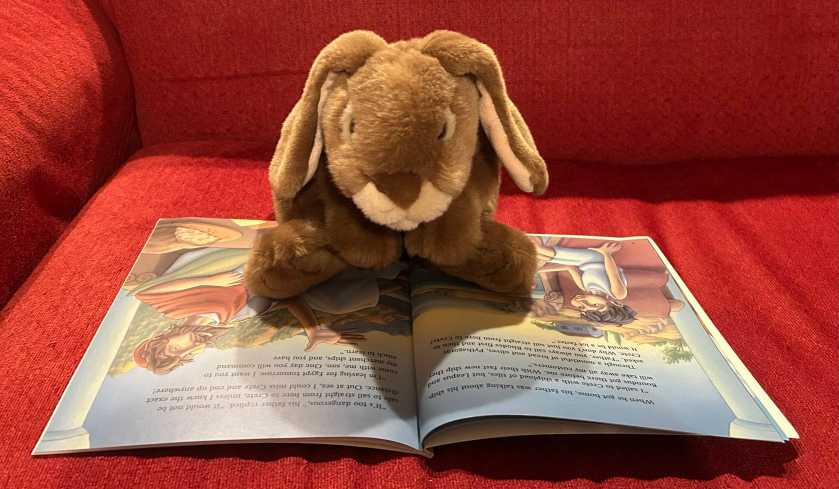
Caramel appreciated reading Adam & Thomas, written by Aharon Appelfeld, translated into English by Jeffrey M. Green, and illustrated by Philippe Dumas, and thinks it is a good story to teach little bunnies about what happened to some young children during World War II.