Marshmallow reviews Hotel Valhalla: Guide to the Norse Worlds by Rick Riordan

Marshmallow is clearly a Rick Riordan fan. Most recently she reviewed for the book bunnies blog the three books that make up the Magnus Chase and the Gods of Asgard series:  The Sword of SummerThe Hammer of Thor, and The Ship of the Dead. Today she writes about a companion book to the trilogy: Hotel Valhalla: Guide to the Norse Worlds.
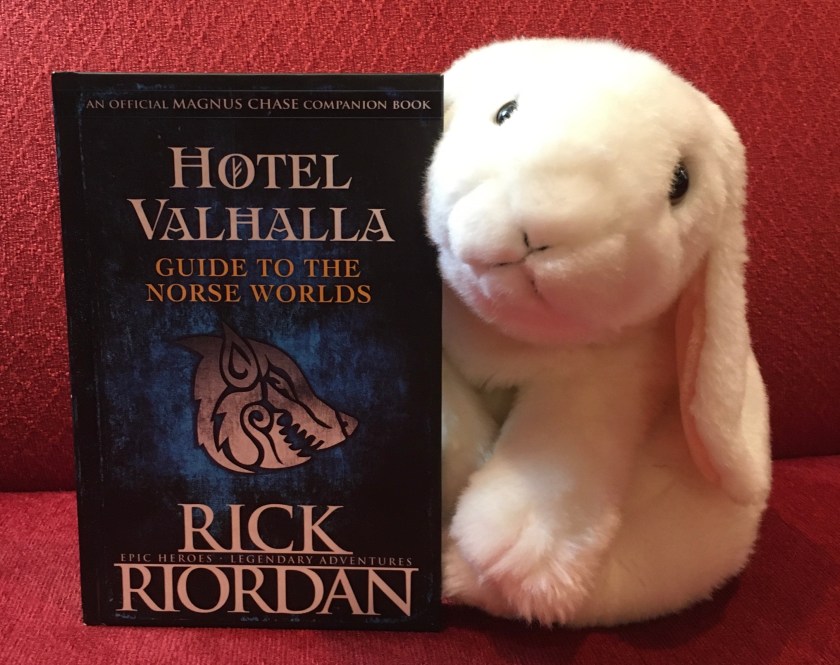
Marshmallow reviews Hotel Valhalla: Guide to the Norse Worlds by Rick Riordan.

Marshmallow’s Quick Take: If you like books about Norse mythology or enjoyed reading the Magnus Chase books by Rick Riordan, then this might be the book for you.

Marshmallow’s Summary (with Spoilers): In Hotel Valhalla: Guide to the Norse Worlds, characters from the Magnus Chase and the Gods of Asgard series, including several of the most prominent gods and goddesses, introduce readers to the nine worlds of Norse mythology and tell stories. All throughout, we learn new facts about Norse mythology in creative ways: there are advice columns, interviews, rap battles, and more.

The book starts off with an introduction to Hotel Valhalla, the place where einherjar (the chosen warriors of Odin) wait to fight in Ragnarok. The managers of the hotel introduce the Norse worlds (there’s nine!) to the readers, assumed to be incoming einherjar:

Dear Valued Guests,

On behalf of the staff, welcome to Hotel Valhalla. We recognize that there were other options for your afterlife. We thank you for the selfless sacrifice that landed you here among Odin’s chosen warriors instead of elsewhere.

Helgi, Manager of Hotel Valhalla since 749 C.E.

Some of the gods and goddesses we met in the Magnus Chase series tell us stories and cool facts about themselves and other things that make up Norse mythology. For example, there is an interview with Odin, the all-father. We met Odin before, in The Sword of Summer, and he was a little annoying, always trying to give PowerPoint presentations and sell his courses. The same character is in full display in the interview, but we also learn about some of his backstory. Then there is an advice column featuring Frigg, the wife of Odin, who while dispensing advice retells some old stories involving her and her family.

This book is divided into different sections. There is a section on gods and goddesses, one on mythical beings, and another on fantastic creatures. Also, at the end of the book, there is a glossary which tells you how to pronounce the words and names in Norse mythology. 
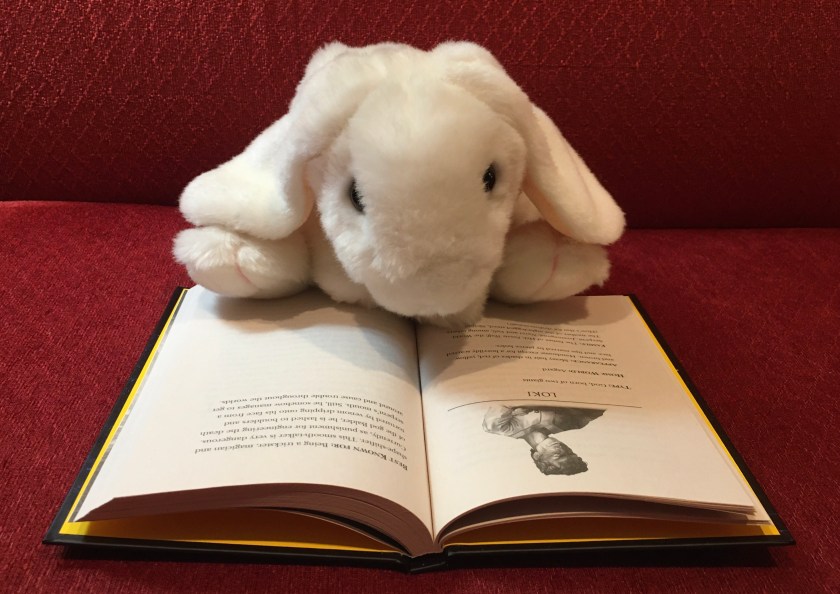
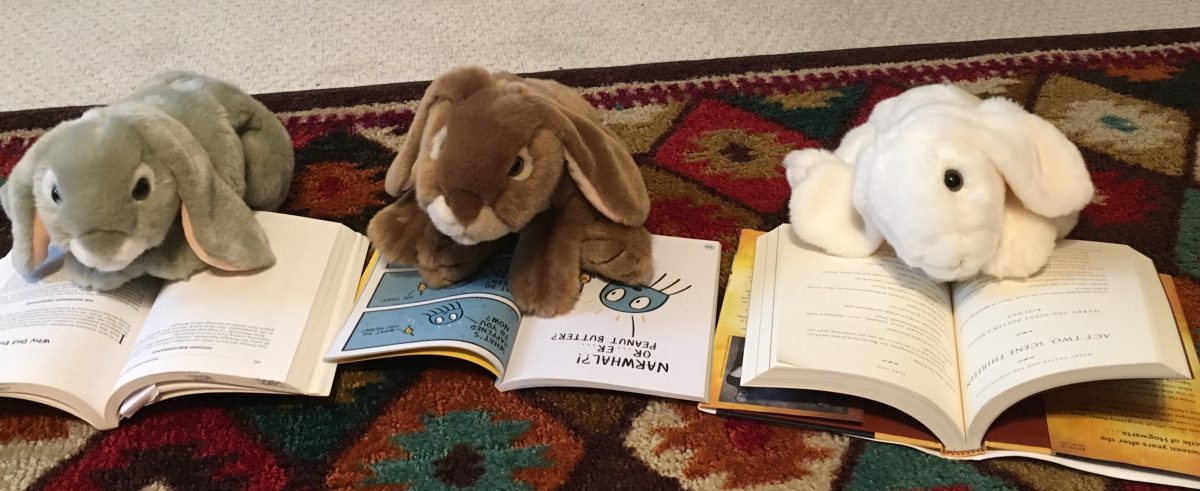
Marshmallow is reading Hotel Valhalla: Guide to the Norse Worlds by Rick Riordan.

Marshmallow’s Review: I think that this is a great complementary book to the Magnus Chase and the Gods of Asgard series. It helps explain some things that were mentioned in the series and adds context. Hotel Valhalla continues the tradition of companion books, similar to Fantastic Beasts and Where to Find Them, The Unofficial Ultimate Harry Potter Spellbook, and The Demigod Diaries, as well as Percy Jackson’s Greek Gods and Percy Jackson’s Greek Heroes. Just like how the first two complemented the Harry Potter universe, and the latter three complemented the world of Percy Jackson, I like how Hotel Valhalla complements the Magnus Chase and the Gods of Asgard series.

One thing that I really liked was that the author, Rick Riordan,  managed to find many different, unique ways to tell the stories in the book. There are many different formats. Some are interviews and others are just written in the first person from the perspective of some of the gods and goddesses. I particularly found the advice column one funny, as it reminded me of a book I recently read and reviewed: Dear Student by Elly Swartz.

Unfortunately, there are not too many images in Hotel Valhalla. There are just a few sketches to help us visualize some of the gods and goddesses, but all are black and white, and there is no color, unlike the full-color images in The Demigod Diaries. They are still pretty neat images though.

I think that Hotel Valhalla: Guide to the Norse Worlds is a great book to read before or after reading the Magnus Chase and the Gods of Asgard series. Reading it before might give you a platform, sufficient background to use. It is also perfectly enjoyable afterwards, when you want to revisit the world of Magnus Chase. You also learn a lot of new stories from Norse mythology. 

Marshmallow’s Rating: 95%.
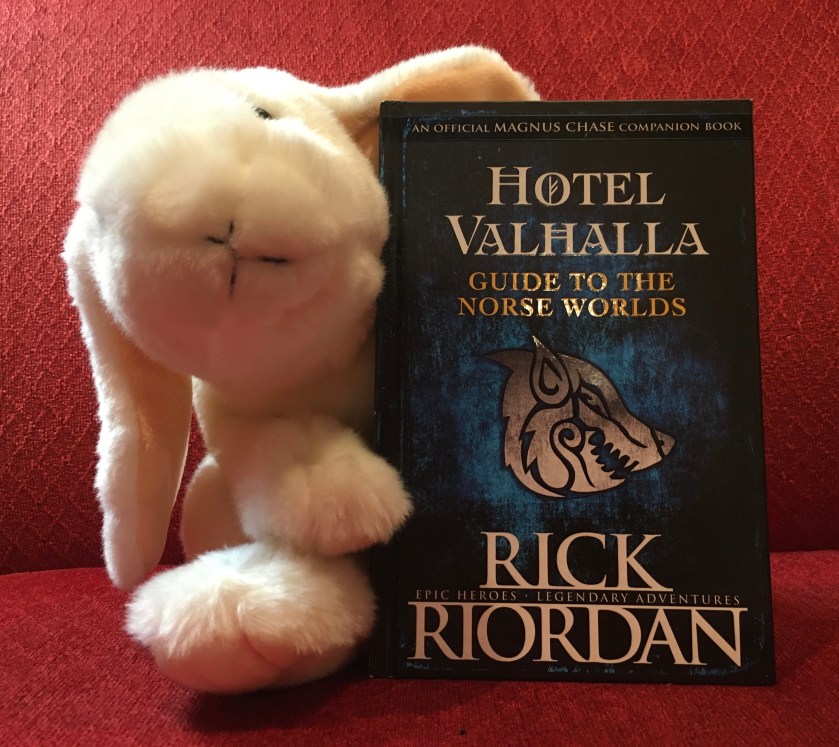
Marshmallow rates Hotel Valhalla: Guide to the Norse Worlds by Rick Riordan 95%.

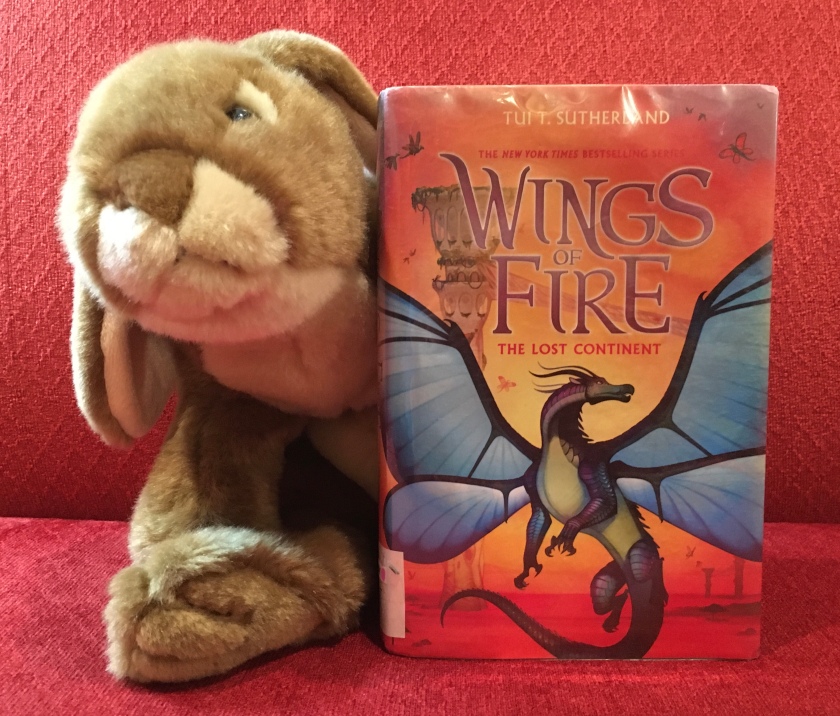
Caramel reviews The Lost Continent (Book Eleven of the Wings of Fire series) by Tui Sutherland

Caramel has been infatuated with the Wings of Fire series for a while now. He has already reviewed the graphic novelizations of the first five books for the book bunnies blog. You can check out his reviews of The Dragonet Prophecy,  The Lost Heir,  The Hidden KingdomThe Dark Secret, and The Brightest Night. But then he could not stop himself from wanting to read more. As the rest of the series has not been published in graphic novel form just yet, Caramel has been looking into the original series more carefully these days. Earlier this year he reviewed the first book The Dragonet Prophecy. And today he jumps ahead and talks about Book Eleven: The Lost Continent. As usual, Sprinkles is taking notes and asking followup questions.

Caramel reviews The Lost Continent (Book Eleven of Wings of Fire) by Tui Sutherland.

Sprinkles: So Caramel I know you really wanted to talk about this book. So let us do that.

Caramel: Okay. This is about a new continent on the same world that we were in in the first five books. That continent was called Pyrrhia. Apparently the first ten books are there. But this eleventh book takes us somewhere new. A new continent named Pantala.

S: So is Pantala the lost continent in the title?

C: Yes.

S: How is it lost?

C: Dragons in Pyrrhia and dragons from Pantala have not seen each other for thousands of years. So Pantala is kind of lost to Pyrrhia.

S: I see.

C: The dragons in Pantala are different. They have four wings instead of two, like the ones in Pyrrhia. They also don’t breathe fire or venom or ice, unlike the dragons in Pyrrhia. There are seven tribes of dragons in Pyrrhia: MudWings, SandWings, RainWings, SkyWings, IceWings, SeaWings, and NightWings. But in Pantala, there are only three: HiveWings, SilkWings, and LeafWings.

S: I see. Now I understand why you could jump right ahead and start reading this book before reading books 6-10.

C: Yes. But I do want to read those too. Some time. It’s just that it was easier to get my paws on this book. My school library had a copy.

S: I know. Aren’t school libraries awesome?

C: YES!!!

Caramel is reading The Lost Continent (Book Eleven of Wings of Fire) by Tui Sutherland.

S: Okay, so Wikipedia tells me that there are three different story arcs in the Wings of Fire series. The Dragonet Prophecy was the one involving the first five books. That ended with a view towards Jade Mountain, and the next five books belong to the Jade Mountain Prophecy arc. And then this book, The Lost Continent, starts a third arc, around the Lost Continent Prophecy. You told us what the Dragonet Prophecy was in your review of the very first book. Can you tell us what the Lost Continent Prophecy is?

C: Sure. Let me read it to you:

Turn your eyes, your wings, your fire
To the land across the sea
Where dragons are poisoned and dragons are dying
And no one can ever be free.

A secret lurks inside their eggs.
A secret hides within their book.
A secret buried far below
May save those brave enough to look.

Open your hearts, your minds, your wings
To the dragons who flee from the Hive.
Face a great evil with talons united
Or none of the tribes will survive.

The Lost Continent Prophecy

S: Oooh, that is interesting! What do you think it means?

C: I don’t know really. But I’m pretty sure the Hive and the talons united are talking about the HiveWings. They enslaved the SilkWing and most likely killed off the LeafWings. And it seems like the prophecy is telling the dragons of Pyrrhia to come save the oppressed dragons of Pantala.

S: Hmm, that will be neat. I can see why you might be so intrigued by these books. Okay, so tell me about some of the dragons in The Lost Continent. Are there some that you liked?

C: Yes. I liked Cricket and Luna. Cricket is a HiveWing, and Luna is a SilkWing. I also like Blue and SwordTail. They are both SilkWings. They are all friends. There is a queen, Queen Wasp, and she is the leader of all dragons of Pantala, and the four friends want to get rid of her, because she is evil. She can control the minds of all HiveWings, except for Cricket, and I don’t know why. But that is why I like Cricket.

S: That is interesting.

C: Also I want to explain something about SilkWings called flamesilk. SilkWing can make silk webs and even clothing and bridges with their silk. And some of them are mutated and their silk is red and glows and can sometimes burns things. That is called flamesilk. Queen Wasp uses their flamesilk to create light bulbs.

S: Very creative! This was a pretty big book too, and yet you read it twice already and are itching to read the next ones in the series. But I think it might be a good idea to slow down a bit and go back to the second arc before diving into the twelfth book. At least it seems like that might be prudent, from the things I am reading online.

C: I know. It seems that some dragons in Pyrrhia know about Pantala and that comes up in those books. But I am not sure I can wait!

S: You might have to. We will see. So coming back to The Lost Continent, what three words would you use if you wanted to describe the book?

C: Exciting, suspenseful, and intriguing.

S: Three good words Caramel. I can see you really liked this book. So let us wrap up this review so you can continue rereading it. What do you want to tell our readers?

C: Stay tuned for more book bunny reviews!

Caramel loved reading The Lost Continent (Book Eleven of Wings of Fire) by Tui Sutherland, and is itching to read more from this series.

Marshmallow reviews The Ship of the Dead (Book 3 of Magnus Chase and the Gods of Asgard series) by Rick Riordan

Marshmallow has reviewed  The Sword of Summer, the first book of Rick Riordan’s Magnus Chase and the Gods of Asgard series, as well as The Hammer of Thor, the second book in the series. Today she reviews The Ship of the Dead, the third and last book about the adventures of Magnus Chase, the dead son of Frey.

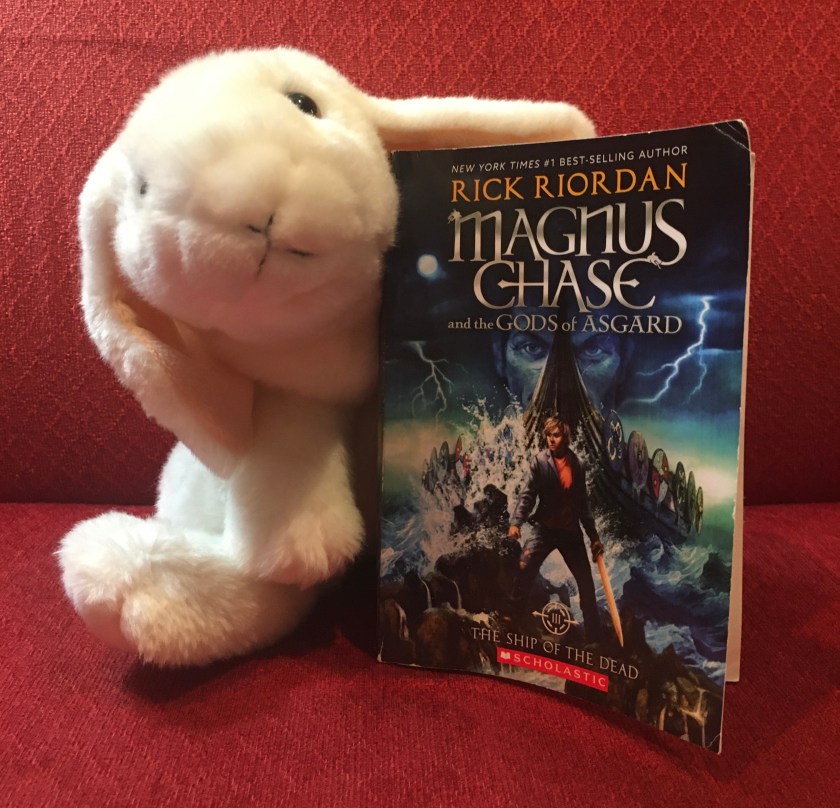
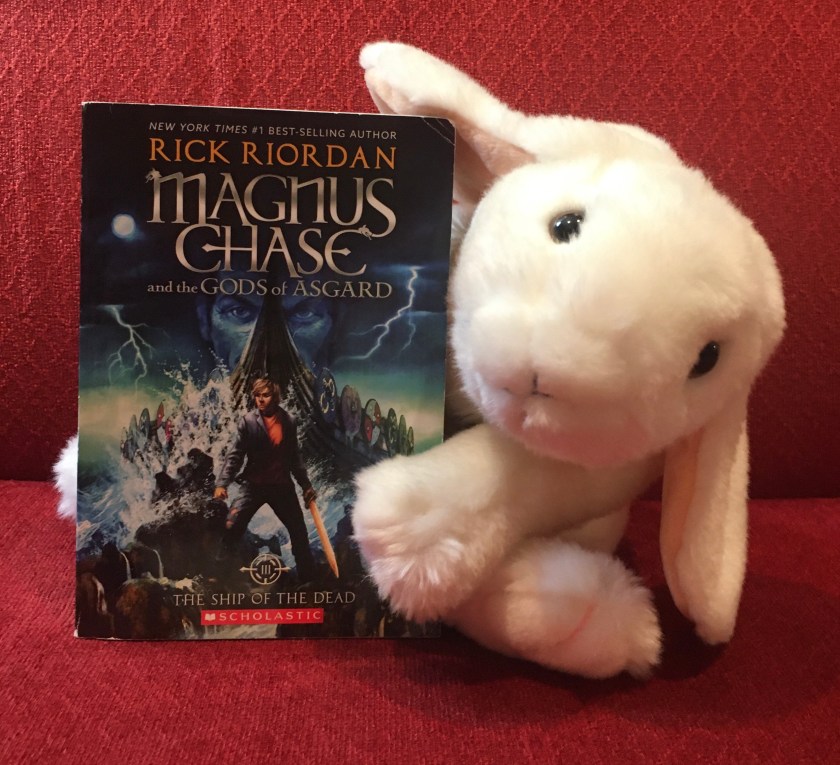
Marshmallow reviews The Ship of the Dead (Book 3 of Magnus Chase and the Gods of Asgard series) by Rick Riordan.

Marshmallow’s Quick Take: If you like books about Norse mythology, friendship, or other books by Rick Riordan, then this might be the book for you. 

Marshmallow’s Summary (with Spoilers): Magnus Chase, the son of Frey who recently became an einherji after dying, is preparing to embark on a journey with his friends/companions to save the world. Loki, the god of trickery, is trying to start Ragnarok, the destruction of the world according to Norse mythology. Magnus and his crew plan to sail on a boat given to them by Frey. They will travel to the farthest borders of Jotunheim, the home of the giants, and Niflheim, the world of ice, fog, and mist, to prevent Loki from starting Ragnarok by beating him in a flytiing, withthe help of Kvasir’s Mead, and capturing him in a magical nutshell, thus stopping Naglfar (the ship of human nails which is carrying monsters and undead to start Ragnarok) from sailing. (Yes, there are a lot of things to keep track of! But bear with me.)

On his ship Magnus Chase has brought seven companions. Samirah Al-Abbas is a Muslim Valkyrie. Hearthstone is a deaf/mute elf who works with rune-magic. Blitzen is a dwarf who is a master fashion adviser. Mallory Keen, Halfborn Gunderson, Alex Fierro, and Thomas Jefferson Jr. are all Magnus’s fellow einherjar. Mallory died in 1972 on the day that became known as Bloody Friday during the explosion of a bomb while she was trying to defuse it. Halfborn Gunderson lived in the time of the Vikings. Alex Fierro is a gender-fluid child of Loki who was living on the streets for two years before she died protecting another person. Thomas Jefferson Jr. was a Union soldier in the American Civil War who died fighting for freedom. 

In the previous two books, Magnus and his companions have traveled to many of the different Norse worlds. (There are nine in total.) In this final book of the series, Magnus and his friends need to travel between some of the remaining ones to find Kvansir’s Mead, the drink which will supposedly make him very poetic. Everyone believes this is his only hope to win his flyting fight with Loki. 

Marshmallow is reading The Ship of the Dead (Book 3 of Magnus Chase and the Gods of Asgard series) by Rick Riordan.

Marshmallow’s Review: The Ship of the Dead is a great book and a satisfying finale to Rick Riordan’s Magnus Chase and the Gods of Asgard series.

I thought that each of the characters developed throughout the series, and I liked that we finally got to learn more about and understand the pasts of some of Magnus’s companions. Their backgrounds were woven into real events in history (for some of them).

I also liked how Rick Riordan ties these books in with some of his other series. Several characters we’ve seen before appeared in this book. This third book starts with Percy Jackson, for example, trying to teach Magnus about sea-faring. It was also interesting to see what was happening in Magnus’s world when other things were happening in say *hint* *hint* Apollo’s/Lester’s world.

All in all, I thought that the ending of The Ship of the Dead made for a satisfying finale to the series. And I strongly recommend reading the full Magnus Chase and the Gods of Asgard series. 

To get the most out of this book, I strongly recommend that you read the previous two books in this series before getting into this one. It might even be a good idea to read all of the previous series, but that may not be fully necessary. It won’t make too much of a difference; you can still read the book without getting confused, there are only a few references that you can skip over. However, the previous series are amazing, so reading them would be a great experience! And why not get the whole picture of how the world could be full of these conflicting, overlapping, wildly imaginative mythologies all coexisting at the same time?

Marshmallow’s Rating: 100%.

Marshmallow rates The Ship of the Dead (Book 3 of Magnus Chase and the Gods of Asgard series) by Rick Riordan 100%.

Caramel reviews Opposites Abstract by Mo Willems

Caramel has been a Mo Willems fan forever. He has already reviewed a book from his Pigeon series, another from his Elephant and Piggie series, and yet another from his Unlimited Squirrels series for the book bunnies blog. When Sprinkles heard about a new book by Mo Willems offering a different kind of art, she wanted to see what Caramel would think of the book. Below is Caramel’s review of Opposites Abstract. As usual Sprinkles is taking notes and asking questions.

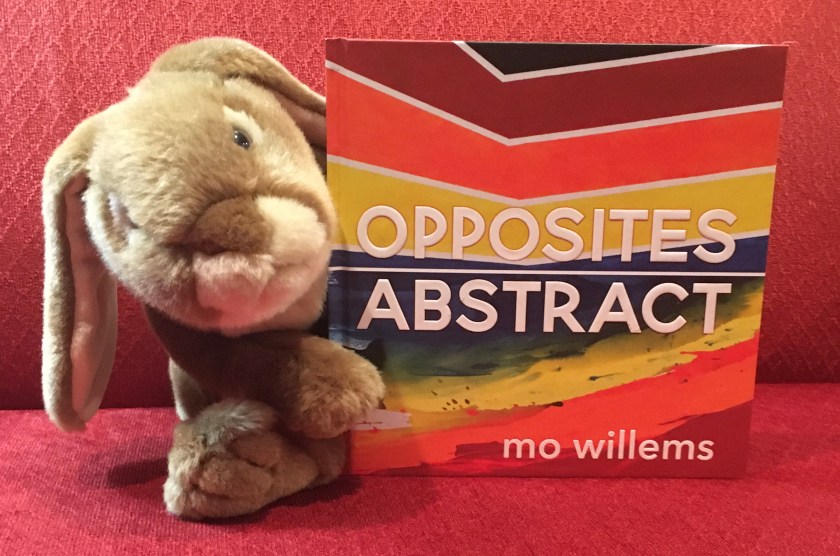
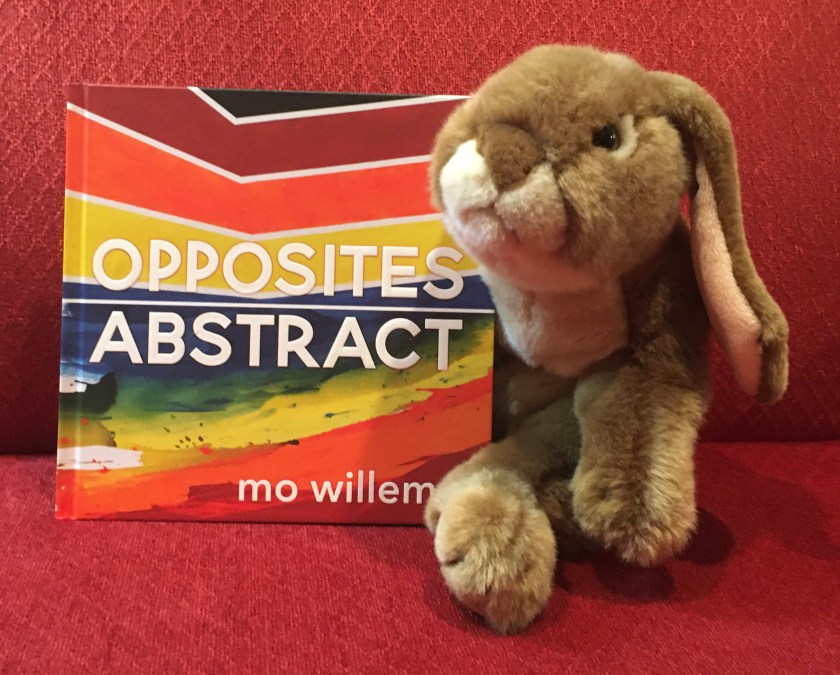
Caramel reviews Opposites Abstract by Mo Willems.

Sprinkles: So Caramel, I know you loved all the pigeon stories of Mo Willems, and you even reviewed one for our blog. Now Willems has written a book for baby bunnies and other young ones called Opposites Abstract. And you have read it just recently. Can you tell our readers a bit about the book? What is it about? How is it organized?

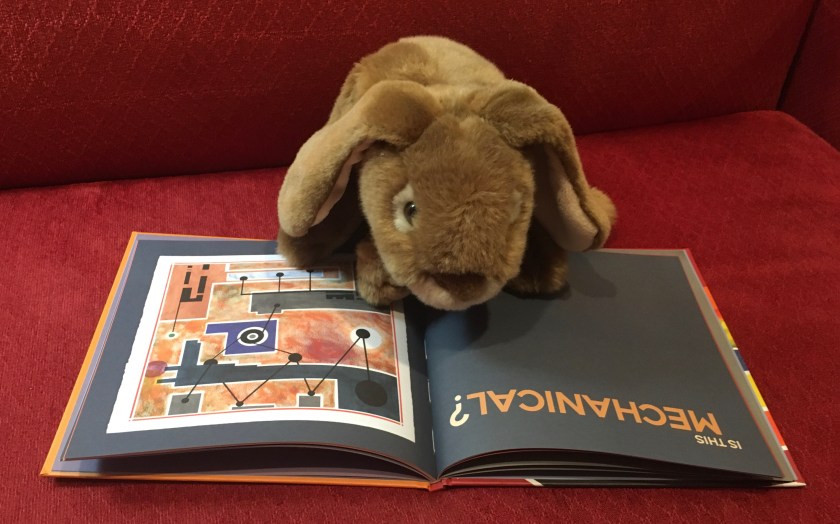
Caramel: It starts inside the front cover by saying “This is STARTING”, and in the end, on the very last page, it says “This is FINISHED”. All pages have either a picture or three words. The pictures are very colorful and the words are like this: “Is this DARK?” or “Is this MECHANICAL?” or “Is this SOFT?”

S: So it seems like one of those books you and I used to read together and look at the pages and learn about opposites.

C: Yes. I think that is the idea.

S: So what are some examples of opposites from the book?

C: I already told you about STARTING and FINISHED. Another was DARK and LIGHT. The opposite of MECHANICAL is ORGANIC, and the opposite of SOFT is HARD.

S: SOFT / HARD and DARK / LIGHT are quite standard in this kind of a book, but the STARTING / FINISHED one is a good one. I also did not see MECHANICAL / ORGANIC in this kind of book before.

C: There is more that is not that typical. There is the INDIVIDUAL and the GROUP. And INCLUSION and EXCLUSION.

S: Those are interesting choices. What kind of picture is drawn for the INDIVIDUAL and the GROUP?

C: The picture of the INDIVIDUAL is like an eye, a single circle, it could also be a head, or a little dandelion. And the GROUP has many many circles and they are all connected to one another.

S: I can see how that is an abstraction of the idea of a group of people, being connected to one another, and the other one is all alone, but also bigger and in the center. That is cool.

C: But some of the circles in the GROUP are bigger than the others, too. Maybe it is kind of like “all animals are equal but some animals are more equal”.

S: I see what you did! We should put a link to Marshmallow’s review of The Animal Farm here.

C: Yep.

Caramel is reading Opposites Abstract by Mo Willems.

S: I know you like mechanical things. What did you think of the picture for MECHANICAL?

C: It was interesting. There are pulleys, and a rectangular pulley system, and kind of looks like there is some mechanical production going on. Circles on the end of the pulleys and lights.

S: What is the opposite picture like then?

C: The opposite is ORGANIC. There are ovals, they look like cells or single-cell organisms.

S: So they look more alive and organic, I suppose.

C: Yep, and that is the word: ORGANIC. O-R-G-A-N-I-C.

S: That is neat! I am guessing you will not forget how to spell “organic” ever again. Anyways, what did you think of the pictures?

C: I think they are awesome. They are very colorful and they fit the word they are supposed to describe. Sometimes it takes me a while to think about them, but I do see them in the end.

S: I know, right? They are just ripe for discussion. So I can see an adult bunny reading this together with a young bunny and them talking about each picture together. There is a lot to open up.

C: Yes, you and I did talk a bunch about each picture. The word CALM reminded you of a book I reviewed before, and when you told me that, I remembered it was Albert’s Quiet Quest by Isabelle Arsenault. So much to think about and talk about!

S: So do you think other young bunnies would like to read this book with their adults?

C: YES!

S: Okay, so tell me your three words for the book and then we can wrap this up.

C: Colorful, wordless–

S: I guess you could say “sparse”.

C: Sparse works. And “opposites”. It is full of them!

S: I think that would work. So what do you want to tell our readers as we wrap up this review?

C: Stay tuned for more book bunny reviews!

Caramel loved reading Opposites Abstract by Mo Willems and will likely keep looking at its colorful pages for a lot more times in the coming weeks and months.