Caramel reviews This is a Poem That Heals Fish by Jean-Pierre Siméon and Olivier Tallec

Today Caramel talks to Sprinkles about a neat picture book about poems: This is a Poem that Heals Fish, originally written in French by Jean-Pierre Siméon and illustrated by Olivier Tallec. The version Caramel read was translated into English by Claudia Zoe Bedrick and originally published in 2007.
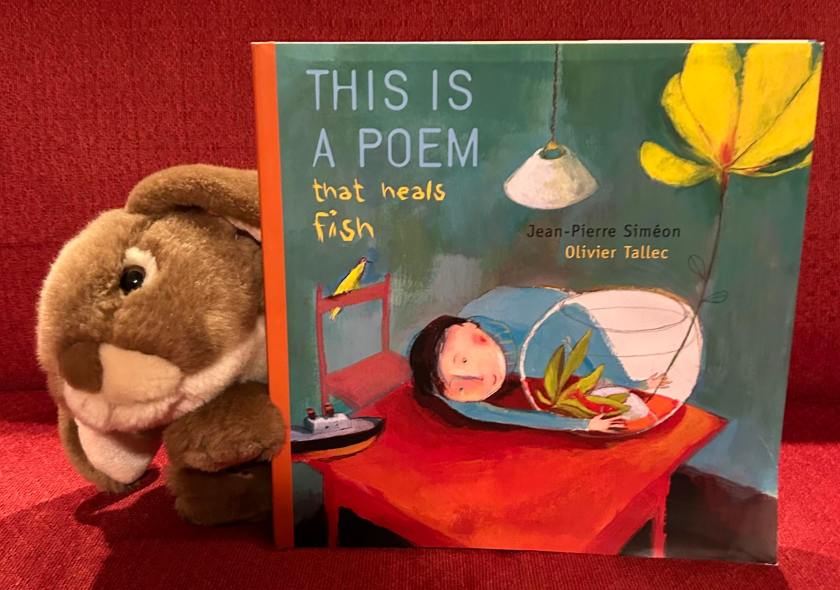
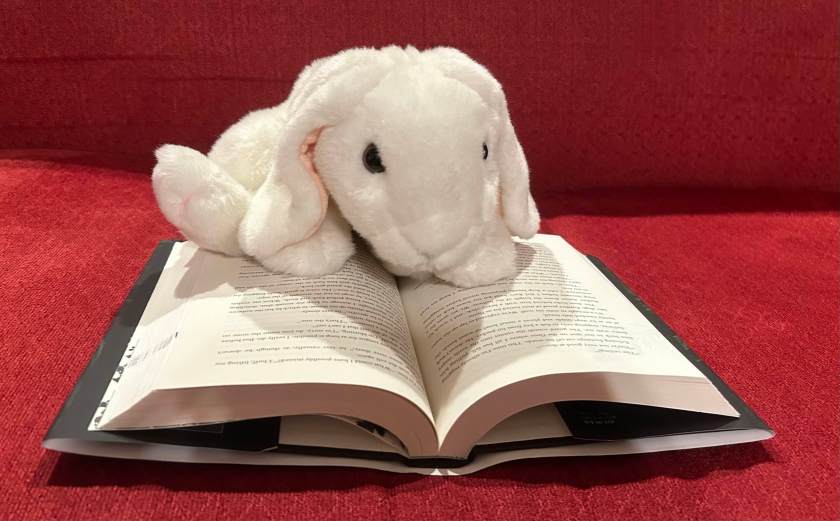
Caramel reviews This is a Poem That Heals Fish written by Jean-Pierre Siméon, illustrated by Olivier Tallec and translated by Claudia Zoe Bedrick.
Caramel reviews This is a Poem That Heals Fish, written by Jean-Pierre Siméon, illustrated by Olivier Tallec and translated by Claudia Zoe Bedrick.

Sprinkles: So, Caramel, you know that I will be reviewing a poetry book this weekend. Is that why you picked this book to review today?

Caramel: No, actually, I just thought it might be cool to review it.

S: That makes sense. I do think this is a really cool book. Also very pretty. 

C: Yep, that is what caught my attention.

S: So why don’t we begin at the beginning? Can you tell us what this book is about?

C: This book is about a kid named Arthur whose fish Leon is sick. Or maybe bored actually. Anyways Arthur asks his mom what to do and she tells him to give him a poem. 

S: And then off she goes to play tuba, right?

C: Yep, how did you know?

S:You know I read this book too Caramel! I actually first read about this book in a blog post about it and had to get one for us. The pictures and the words, they were all so beautiful. I am so glad you liked the pictures too. 

C: Oh, I had no idea, but yes, I do like the pictures a lot! 

S: So happy to hear that! Okay maybe we can get back to the story of Arthur and Leon. So does Arthur know what to do when his mom tells him to give the fish a poem?

C: Not really. So he asks everyone he knows what a poem is. And everyone tells him something different. 

S: Can you give an example or two of the kinds of answers he gets?

C: One of them says that it is when you are in love and have the sky in your mouth. And another says that a poem is words turned upside down and suddenly the world is new. And another person says it is the heartbeat of a stone. And so on.

S: Which one of them is your favorite? 

C: I have no idea. It is hard to pick one. They are all slightly different and all together make up a really good definition.  
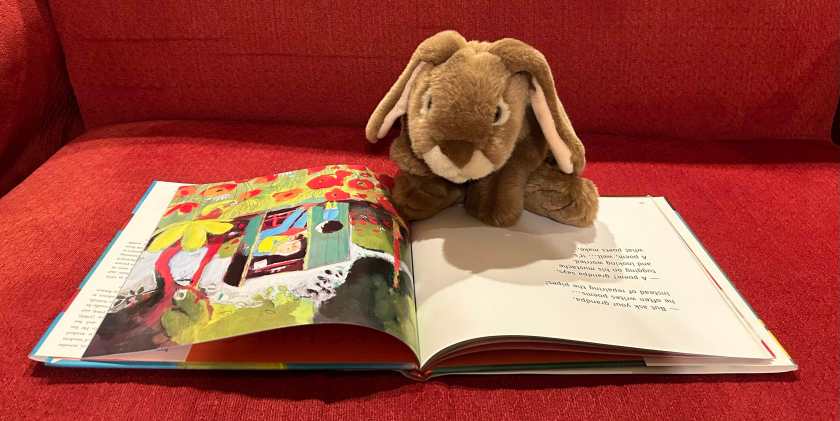
Caramel is reading This is a Poem That Heals Fish, written by Jean-Pierre Siméon, illustrated by Olivier Tallec and translated by Claudia Zoe Bedrick.

S: So how would you define a poem Caramel?

C: Hmm, I think it is a song of the heart. 

S: That is beautiful, Caramel! I love it! 

C: Why, thank you, I would like to think that that was very good of me.

S: Yes, I thought so. Anyways, I think this is the first poetry book you have reviewed for our blog. 

C: Not really. I know Marshmallow reviewed more books about poetry than me, but i also reviewed a poetry book. Remember Change Sings: A Children’s Anthem by Amanda Gorman and Loren Long? That was a good book to read and review, too.

S: Oh yes. That is true. And this weekend I hope to review a few more poetry books. But I am glad you chose to talk about this book today. And I love that you posed with one of my favorite pages in the book with the grandpa and the red poppies!

C: I am always gracious like that! 

S: Yes, you are! Okay, so before we wrap things up, tell us if Leon the fish gets to feel better at the end.

C: Yes! He does!  Arthur tells his fish Leon all that he learned about poetry. And Leon is no longer bored. He says his silence is his poetry. 

S: That is kind of cryptic but also beautiful. 

C: Yup, creepy, too, a bit though. 

S: I guess one could think that. In his silence there is a lot going on, lots of meanings in words unsaid. I choose to think of it as beautiful. 

C: Yeah, I suppose that is a better way of seeing it. And more poetic!

S: Yep! So okay, maybe it is time to wrap up this review. What would you like to tell our readers?

C: Stay tuned for more book bunny reviews!
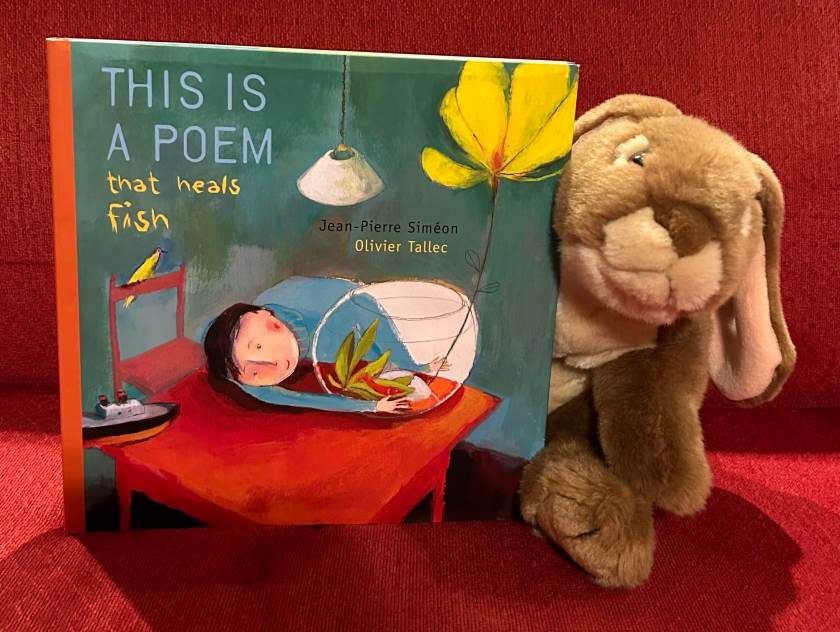
Caramel loved reading This is a Poem That Heals Fish, written by Jean-Pierre Siméon, illustrated by Olivier Tallec and translated by Claudia Zoe Bedrick, and sharing it with the readers of the book bunnies blog!

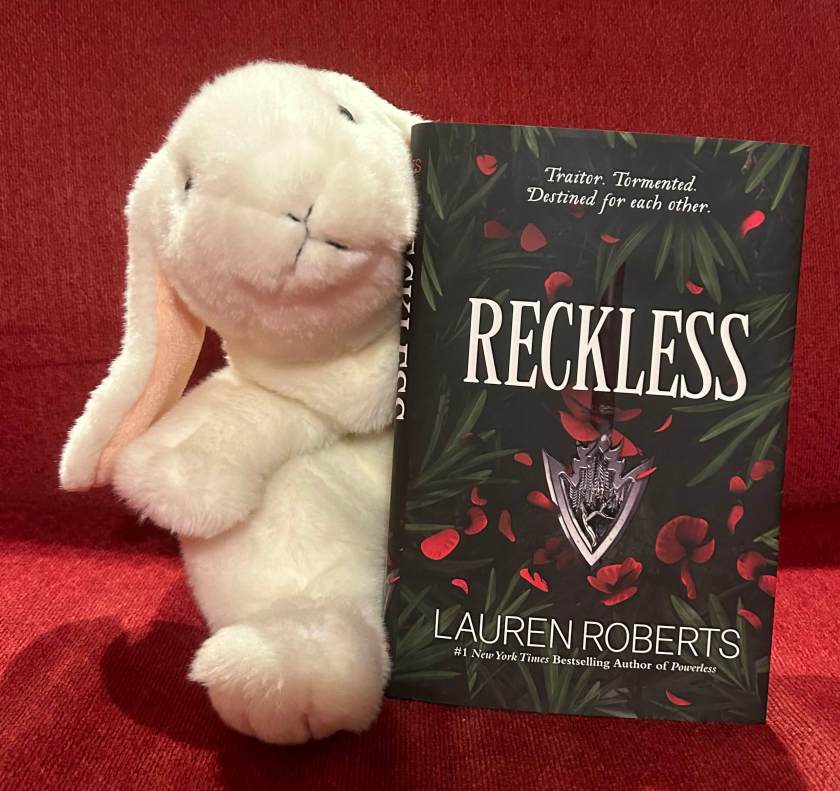
Marshmallow reviews Reckless by Lauren Roberts

A few months ago Marshmallow reviewed Powerless by Lauren Roberts. This week she reviews the sequel, Reckless, published in July 2024.

Marshmallow reviews Reckless by Lauren Roberts.

Marshmallow’s Quick Take: If you like fantasy books about family, friendship, and romance, then this is the book for you!

Marshmallow’s Summary (with Spoilers): Paedyn Gray killed the king of Ilya and is now, quite expectedly, on the run. Despite the fact that both of Ilya’s princes were falling for her, she is hunted by both: Kai (the ruthless Enforcer of Ilya, who carries out the king’s dirty work) and Kitt (the now-king). Paedyn herself was falling for Kai, but was also desperately trying to stop herself. Spoiler alert: she wasn’t and still isn’t winning. But despite their feelings towards her, Kai and Kitt are now bound by duty and blood to kill Paedyn for revenge and “justice”.

See, in Ilya, there are Elites (people who are born with special, magical powers) and there are Ordinaries (as the name suggests, people who are born without powers). Paedyn is an Ordinary who has been trying to disguise as a Elite her whole life; Ordinaries are hunted down and killed by… who else other than the Enforcer (Kai).

This way the author sets up what seems to be a tragedy waiting to happen between the hunted (Paedyn) and the hunter (Kai). In the first book, Paedyn joined a Resistance, a group that saves Ordinaries and fights to have Elites recognize them as equal. This has been a struggle because, according to the (now deceased) king, Ordinaries’ presence lessens the power of the Elites. Paedyn’s father was the founder of the Resistance, and he was killed by the king when she was very young, making her an orphan for the whole book. This leads to her, at the end of Powerless, killing the king in self defense (but also partially for revenge).

Since Ilya is no longer safe for her, Paedyn decides to leave for the nearby city of Dor; but to do so, she must cross the vast expanse of the Scorches, a massive, brutally parched desert. But before she can make it to the Scorches, Kai intercepts her. After learning that Paedyn was the one who killed his father, Kai gives her a head start because he knows he’ll need time to find the “courage” to kill her. This allows Paedyn to find refuge in her old house for a while, until Kai burns it down and keeps on chasing her. She evades him but is injured as she begins to traverse the desert. Eventually, she makes it to Dor. Unfortunately, Dor is full of enemies as well; Kitt has placed a bounty on her head and it’s not helping her out. But with her skill and finesse, she manages to keep a relatively low profile (as an anonymous underground fighter for illegal gambling purposes). But Kai still manages to track her down in Dor and forces her back into the open. As he begins to take her back to Ilya and presumably her death, their feelings begin to present problems. Kai must now choose between duty and love for his brother and love for Paedyn. And Paedyn is determined to keep fighting against him, to hate him till she dies. Once again though (spoiler alert!), she’s not winning.

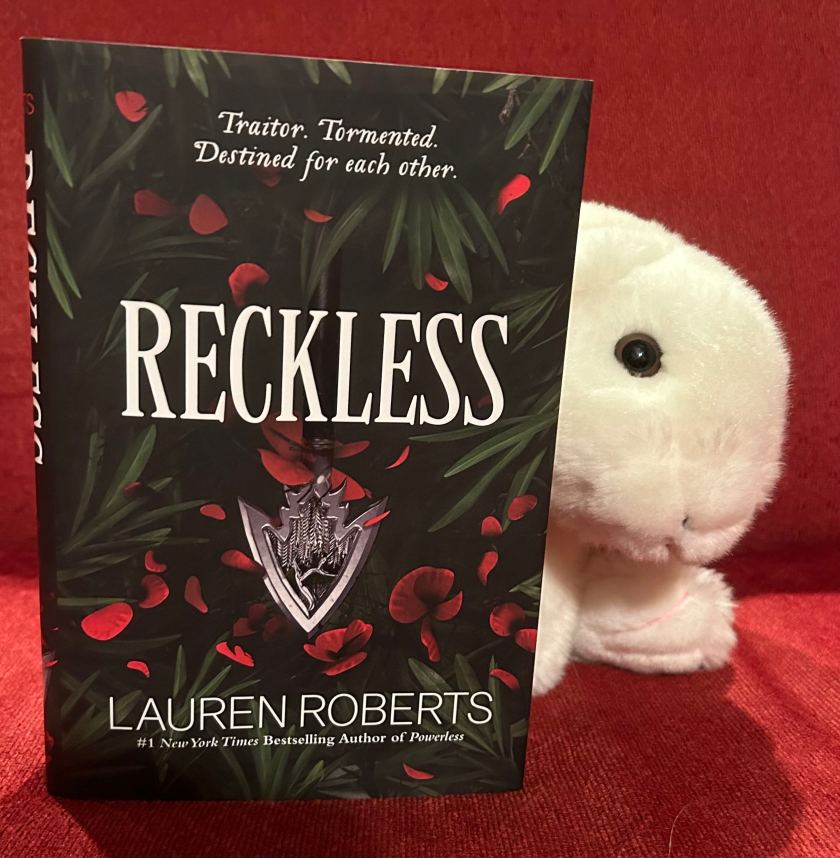
Marshmallow is reading Reckless by Lauren Roberts.

Marshmallow’s Review: I really liked Reckless. The plot and the world-building are both fantastic! But the thing that makes this story stand out to me among other Young Adult fantasy books is that the author maintains a nuanced balance between romance and fantasy.

Reckless has a very good storyline about revolution and fighting against injustice. And I really love reading about the world the author has created because it’s actually really interesting on its own as well. The romance plot line contributes to the story and pushes it forward, so I appreciated its existence. I also want to know what happens to the characters because they are well-written and very, very deep. Unfortunately, I’ll need to wait till next year when the third (and last?) book in the series will be published.

In many fantasy YA novels, I find that the promising, amazing story and fantasy world soon become overwhelmed by a relatively unnecessary romance or a passionate relationship that takes over too much of the plot (e.g.  Shatter Me,  Unravel Me, Ignite Me). This book struck the perfect balance for me; I think there is a very thin line between just a full-on fantasy for young adults and a romance that is perhaps better put in the adults section.

I really enjoyed reading Reckless as a whole and I think that this book is what fantasy YA should be like. I couldn’t put it down once I started reading it and I would fully recommend it to all fantasy-lovers!

Marshmallow’s Rating: 101%.

Marshmallow rates Reckless by Lauren Roberts 101%.

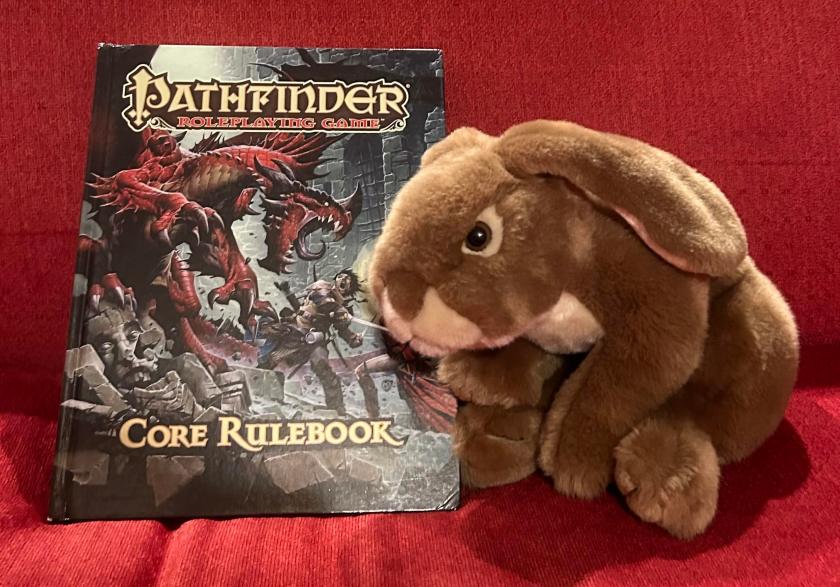
Caramel reviews Pathfinder Roleplaying Game: Core Rulebook

Last week Caramel reviewed Warhammer 40,000: Core Book, the core rule book for a tabletop game he is really keen on these days. Then he realized that he also could talk about his other favorite tabletop game, Dungeons & Dragons, and brought his rule book out. So today he is talking to Sprinkles about Pathfinder Roleplaying Game: Core Rulebook.

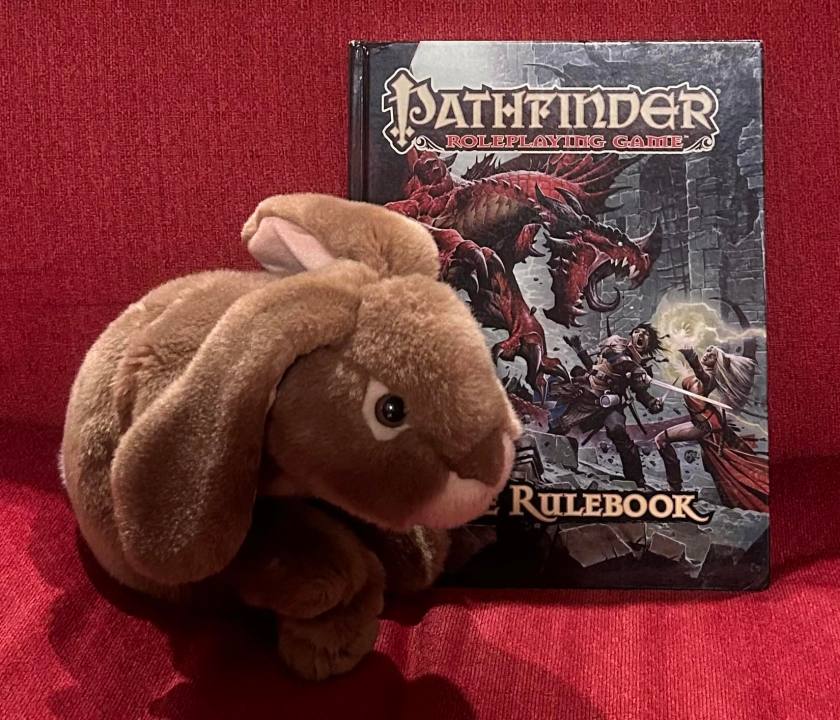
Caramel reviews Pathfinder Roleplaying Game: Core Rulebook.

Sprinkles: So, you found another rule book for another tabletop game. This one is about Pathfinder. And I am not sure everyone knows what that is. So why don’t you start by telling us something about the game?

Caramel: Sure, I suppose everyone knows about Dungeons & Dragons (D&D) but Pathfinder is a bit different from D&D. It is actually very similar to D&D version 3.5. However there are some slight differences in the character types, and I think there are some changes in the rules.

S: Okay, wait. So let us go back a bit. First there is the famous tabletop game Dungeons & Dragons. For any bunnies who might not know what that is, can we start by talking briefly about what that is?

C: Sure, good idea. D&D is also a role playing game, like Warhammer 40,000, which I talked about last week. However, instead of controlling an army, in D&D you control one person. And it is the same in Pathfinder.

S: Okay, so I looked them all up on Wikipedia, and it seems that both Warhammer and D&D are relatively old actually. D&D was first published in 1974, and Warhammer, the original game, was published in 1983. Pathfinder was first published in 2009 as a kind of a spinoff of the original D&D, or rather, the third edition of it. 

C: I had an idea that the Warhammer game was that old! I knew for example that the first Warhammer 40K miniatures were made out of metal because, according to Google, at the time “plastic molding technology was not advanced enough to produce the intricate details and durability needed for tabletop miniatures.”

S: That makes sense! So anyways, last time you talked about the general setting for the game when you were telling us about Warhammer 40K. Now is there a general setting for D&D or Pathfinder?

C: Kind of. It is kind of in a fairy tale time period, where they have firearms, but getting them is very hard. Most people have simpler weapons, like swords, slings, bows and arrows, and … war hammers! 

S: I see what you did there! Anyways, so this sounds like maybe the late middle ages, but there is more, right? I do hope there is indoor plumbing, because that I think is one of the most important benefits of modernity. 

C: I don’t think there is indoor plumbing; they use outhouses and chamber pots mostly.  

S: Hmm, not sure I’d like to live that way… But there is more, right? There is sorcery, and there are different kinds of beasts and types of humanoid characters?

C: Yes! There are elves, and sorcerers, and wizards, and bards, and so on. And there are all sorts of beasts. And as you can tell from the original name, there are dragons!

S: So it is a fantastical world, kind of like our own medieval times, but with some interesting extras! 

C: Yes. But actually there is a lot of freedom in the game. You can set up your own game to be in a world with more magic or less. You can have elves in your particular story or not. 

S: No wonder people do not get bored, and generations of bunnies have been playing it without running out of ideas. It sounds very versatile.

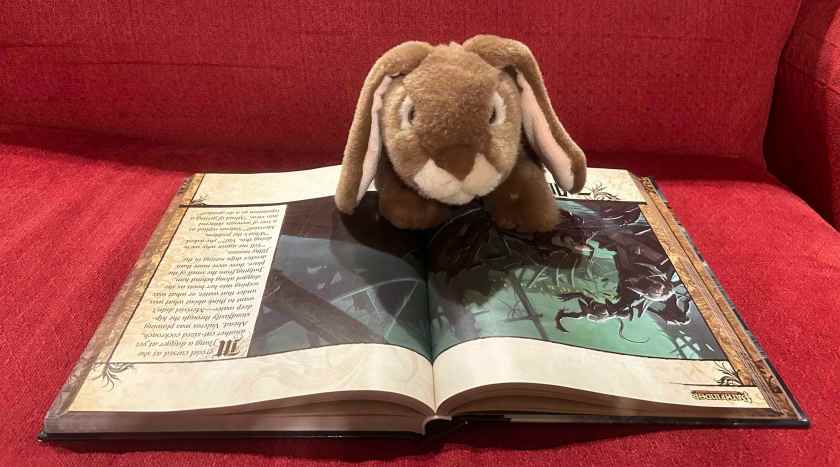
Caramel is reading Pathfinder Roleplaying Game: Core Rulebook.

S: Okay so now let us get back to the book. This is the standard book with rules of the game then?

C: Yes, it is.

S: So tell me what kinds of things there are in the book. 

C: There are parts on creating a character. Then there is a part on choosing a class, then skills, then feats, then equipment. Next is extra rules, combat, magic, spells, special classes. Then there is a section on how to be a GM, making NPCs, magic items, and a ton of appendices.

S: That is a lot! 

C: Well there are over five hundred pages!

S: And what is a GM?

C: A Game Master. It is the person who develops the main story and the setting, and acts out all the NPCs. And before you ask, those are the characters that are not played by any of the main players. NPC stands for Non-Player Character. So the PCs are the characters the players play. 

S: I see. So the GM is the main story teller in some sense.

C: Yes, but the players can and do make choices that change the GM’s original goals, I know from experience.

S: Well, that sounds more fun actually. And kind of like real life, where big and important people might have all these grand schemes, but then a little bunny comes along and does something differently, and the whole world is changed. 

C: Yeah, I suppose. When I play as a GM, sometimes my players can be frustrating when they choose to do totally off-the-wall things. But I have also been a frustrating character to my own GMs so I guess it can go both ways!

S: Yes, kind of like free will. You get to choose; within all the constraints, you still have a choice. I like that. And I bet that is one of the reasons why the game works so well. There might be standard storylines and GMs might have some creative ideas, but each game turns out to be totally different because the players decide to do some things differently and the world changes. Like the butterfly effect, like in chaos theory.

C: What is chaos theory?

S: Okay, we are veering off topic a bit but chaos theory is a field of mathematics where people study systems which are extremely sensitive to small changes and seem to behave chaotically but can still be described and explained mathematically. And the butterfly effect captures that idea: “the flap of a butterfly’s wings in Brazil can set off a tornado in Texas.” A while ago, I reviewed a couple books about famous mathematicians who worked in chaos theory for our blog. Maybe you can check those books out… 

C: Cool, maybe I will.

S: Okay, so the book seems chock-full of ideas and basic rules of playing this game. I think you have read it from beginning to end several times. I also saw you often opening a random page to read. And I have a feeling that you will keep using it for the foreseeable future. 

C: Yup. I like reading this book. I also really like looking at the pictures. They are pretty well drawn. 

S: Yes, I can see that. Maybe this is a good time to end the review. What would you like to tell our readers?

C: Stay tuned for more book bunny reviews!
Caramel expects he will continue reading Pathfinder Roleplaying Game: Core Rulebook for many years to come!

Marshmallow reviews Slow Productivity by Cal Newport

Last year Marshmallow reviewed two advice books by cal Newport directed towards students: How to Become a Straight-A Student and How to Be a High School Superstar. This week she got into Newport’s most recent book Slow Productivity, published in March 2024. Sprinkles enjoyed reading this book immensely, so she wanted to join Marshmallow in this review.

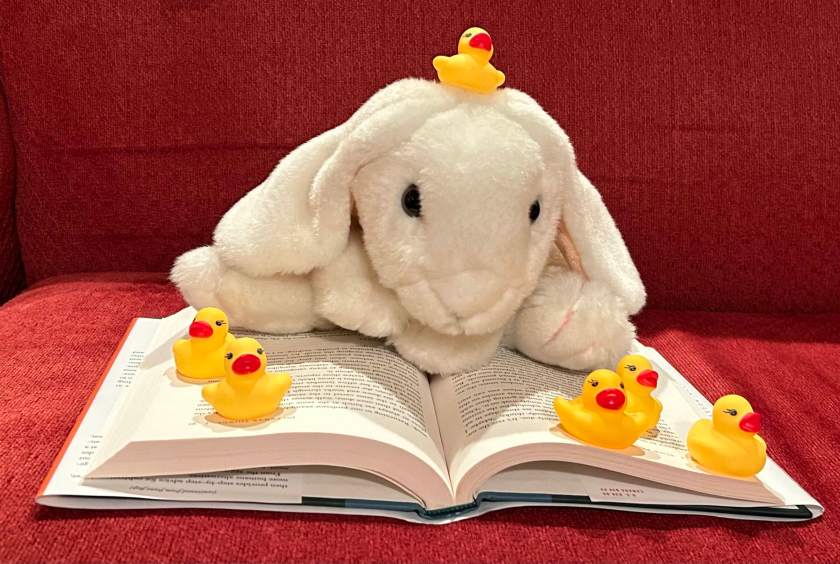
Marshmallow reviews Slow Productivity by Cal Newport while a friendly but slightly annoying little duckling observes.

Sprinkles: So Marshmallow, this is your third book by Cal Newport, isn’t it?

Marshmallow: Yes. I find him to present very thought-provoking ideas.

S: I find his books interesting as well. So we both read this one. It is titled Slow Productivity. I think he was inspired by the slow food movement, where you emphasize slowness and quality and community and local ingredients instead of mass-produced generic fast food. I also read a book a while back about slow teaching; it was also cool. So can you tell us briefly what Newport means by slow productivity? 

M: Slow productivity is the idea of decreasing your workload so you can increase the quality of your work to reach certain, specific goals all the while making sure you are living a sustainable life. 

S: That sounds like a very appealing goal. Tell us more. 

M: So his method, Newport promises, will decrease the familiar overwhelming anxiety and stress the modern knowledge worker experiences.

S: Wait, what is a knowledge worker? 

M: According to IBM, a knowledge worker is “a professional who generates value for the organization with their expertise, critical thinking and interpersonal skills.” So someone who uses computers for accounting, writes code to solve specific business problems, works as a professor, or is a freelance writer, or stuff like that. So unlike the previous Cal Newport books I’ve reviewed (which were intended to help students), Slow Productivity is aimed at adults who have already begun their careers.

S: Yes, I think so too. So I was surprised when you picked it up. But you seem to have enjoyed it, seeing how you have finished it already. 

M: Yes! I started reading it so that I could be prepared for when I grow up and have my own career. I think adults are always too stressed. I wanted to go into my career with ideas on how to be productive in a healthy manner that yields professional success. I also thought this book might still have principles and methods that could be helpful to me as a student.

S: That second part makes total sense, but the first part is really interesting and would probably be surprising for most folks. Especially if they do not know you well… I am sure you are one of only a few little bunnies your age who are thinking of reading about how to be a productive well-balanced adult! Okay so tell us a bit more about the book. How do we do this slow productivity thing?

M: Well, there are three principal ideas of slow productivity. And these are: do fewer things, work at a natural pace, and obsess over quality. The book utilizes a plethora of “case studies” (as Newport calls them) to prove the author’s suggestions and theories. From each of these examples, he synthesizes (or reiterates) the related slow productivity lesson. 

S: I think these are good principles for almost anyone. I mean, they are definitely meaningful for me as a working adult and parent, but also for you. You are now a busy kid going to school and doing a lot of extracurricular activities. And these principles seem to agree with the advice he gives students. Do not cram too many activities just to impress. Do fewer things but do those at such a high level that you will be impressive that way. 

M: Yes, I’ve recently seen this idea of his show up in the Atlantic under the name of a spike applicant (one who is exceptionally good at one thing.

Marshmallow is reading Slow Productivity by Cal Newport while the friendly but slightly annoying little duckling is joined by several others.

S: I remember a colleague who said, “Everyone talks about well-rounded students; what is wrong with a sharp knife?” I loved his analogy. I think this spike idea is similar. I mean not everyone is or needs to be a sharp knife, but we do need sharp knives, and they often find their niche. But I also think it makes sense for young bunnies to explore different types of activities to see what they enjoy and what they are good at. Those explorations provide a lot of insight and you can be surprised by what you end up liking and being good at. 

M: Yes. In this book though, Cal Newport focuses on maintaining a low, easy workload so you can finish larger goals over long periods of time and build your expertise in your field. 

S: That is a different life stage than the exploration stage I was talking about. Of course, his student advice is also about being selective with extracurricular activities, but one needs to figure out what they like and what they want to productively focus on. There is serendipity, some portion will always be about chance, but one also needs time to try out new things. At least that is what I think. But what do I know? I have not written any productivity books!

M: Well that’s okay! Cal Newport gives you the tips so you can focus on other things you like to do and how you can become a fuller person as a whole by managing your workload. In his book for high school students, he focuses on becoming a more interesting person for the sake of college applications (personal growth too I suppose, but primarily applications). In this book, he focuses more on the idea of growing yourself to be a more complete, content individual. I found his idea of pseudo-productivity being unnatural to be quite stimulating. Cal Newport’s books all have this underlying idea that the general consensus (whether in college apps or in careers) is bad because it has been unnaturally perverted towards pseudo-productivity, or doing things just to seem like you’re productive. His main mission is to convince you that this is not the correct way of things and that the situation can be improved by acting in a more natural, original way. 

S: Yes, I think that is a good way to put his message in these three books together. I too find his books always give me good ideas. And I am glad you appreciated this book too. 

M: Yes! I found his ideas to be very useful, even as a child bunny. 

S: This is already quite a long post. Shall we wrap it up?

M: Sure! In summary, I would really recommend this book for all adults who work in the knowledge sector. Even as a bunny in school, I can see that the current work system is set up in a way that is not sustainable for individuals and society as a whole. I hope the situation improves before I join the workforce for my sake. But for the sake of others, I hope this book is more widely read so more people can enjoy full lives with more success.

S: That is a nice sentiment! So how would you rate this book?

M: I would rate this book at 100%. I really liked it and I found it to be very helpful. Cal Newport’s methods are quite logical. 

S: That sounds just about right! Okay, what do you want to tell our readers as we wrap this up?

M: Stay tuned for more amazing reviews from the book bunnies!

Marshmallow rates Slow Productivity by Cal Newport 100% and hopes it will provide some cover, while the ducklings continue to amass.