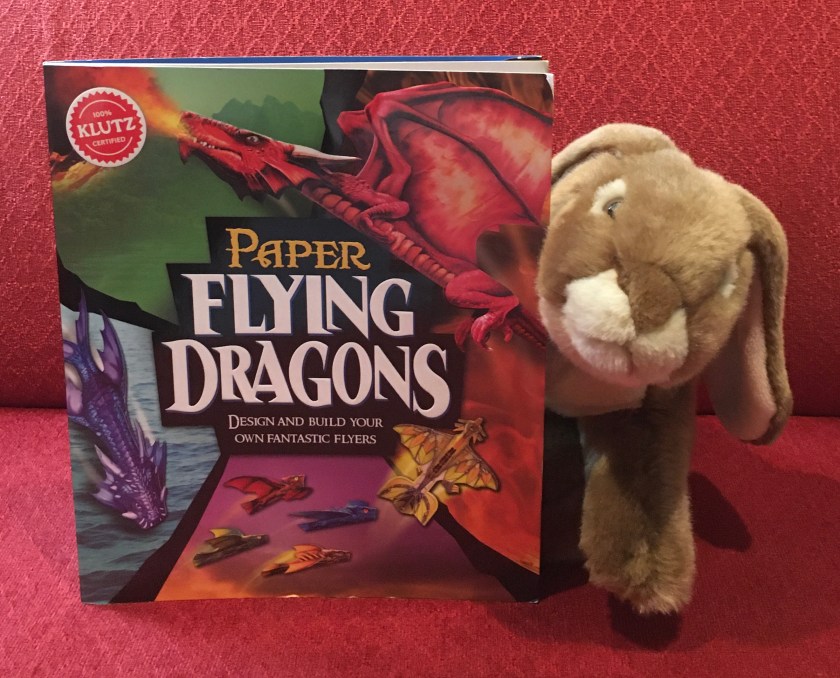
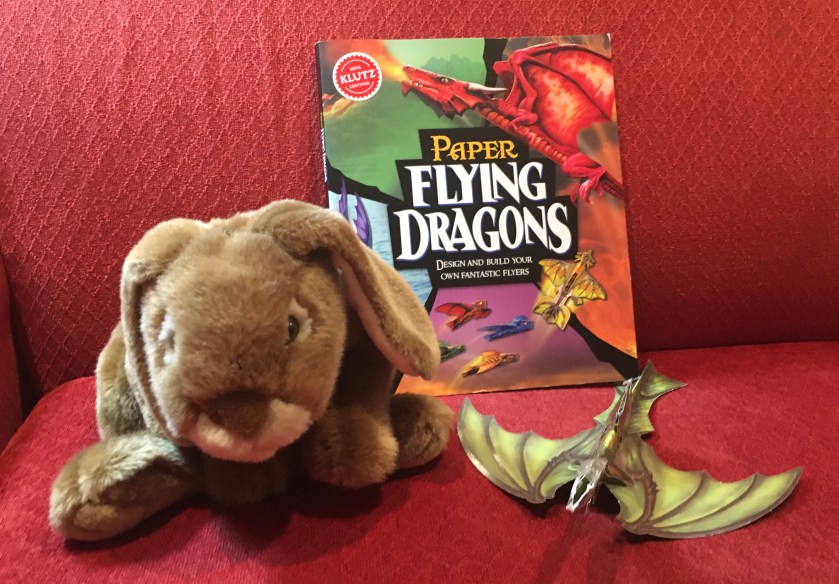
Readers of the book bunnies blog are probably well aware that Caramel is a fan of everything dragon. Today he talks about a book he recently got his paws on that allowed him to build his own paper dragons! Below he talks to Sprinkles about Paper Flying Dragons by Pat Murphy and the Scientists at Klutz Labs.
Caramel reviews Paper Flying Dragons by Pat Murphy.
Sprinkles: So Caramel, as usual, I will ask you to tell us a bit about this book.
Caramel: How about I read the introduction to you?
S: Okay go for it!
C: Here you go:
Dragons make terrible pets. For one thing, they can be a nasty fire hazard. For another, the airspace that a full-grown dragon needs for proper exercise is impossible to provide if you live within 120 miles of an airport. So this book provides the next best thing to a pet dragon: flying models of amazing dragons that you make from paper.
S: You are right Caramel, that does give us a pretty good explanation of what is in the book. So you get to make some paper dragons yourself using the pages of the book, right?
C: Yes, there are pages to make the Aoraki ice dragon, the Scarlet Patagonian Dragon, hatchlings of various mountain dragons, Cook’s Sea Dragon, and the Kalahari sun dragon, and the Huo Jien Thunder Dragon, which is a battle dragon. And finally there is a robo-dragon.
S: Wait, what is a battle dragon?
C: A dragon that is meant for battle. The book says they were domesticated more than two thousand years ago in China.
S: Um, I am not sure that is exactly true.
C: Yeah, I know they probably don’t exist. But when I am dreaming of having my own pet dragon and all I get instead is a paper flying thingie, I want to think of it as real.
S: I can understand that of course.
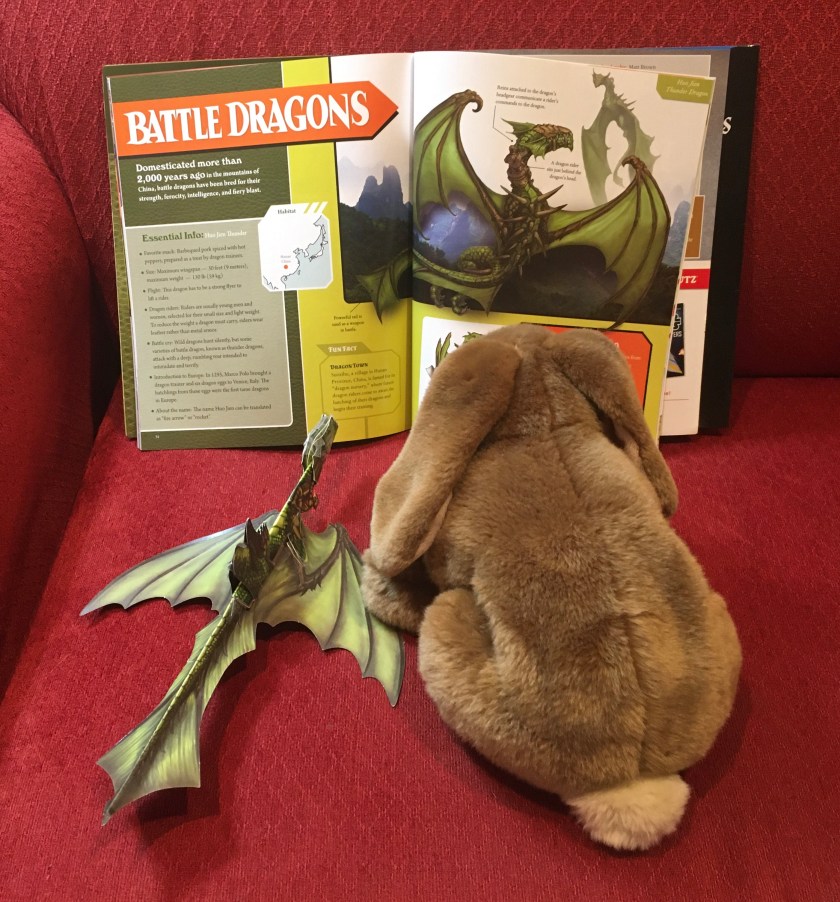
Caramel and his new friend Battle Dragon are reading about other battle dragons in Paper Flying Dragons by Pat Murphy.
S: So which dragons did you end up making so far?
C: I made both of the mountain dragons, the sea dragon, the battle dragon, the sun dragon, and two of the baby hatchling dragons.
S: That is a lot of dragons! Do they fly?
C: Some of them fly much better than others. I probably did not make the others very well. But the robo-dragon flies really well. And the battle dragon also flies pretty well.
S: So which is your favorite among the dragons you made?
C: I like them all equally. You say that to me and Marshmallow all the time. It would not be nice if I picked favorites.
S: I see. So I won’t push you further in this direction then. Here is another question for you: you have been playing with these dragons for a few days now. Are they sturdy enough for your bunny paws to be played with that many days in a row?
C: Yes! I did give them a day off today, so they could rest. All the flying must tire their wings.
S: You are a thoughtful bunny!
C: What can I say except you’re welcome?
S: I recognize that phrase, and the melody you sang it with! It’s Maui from Moana.
C: Yes, you got me.
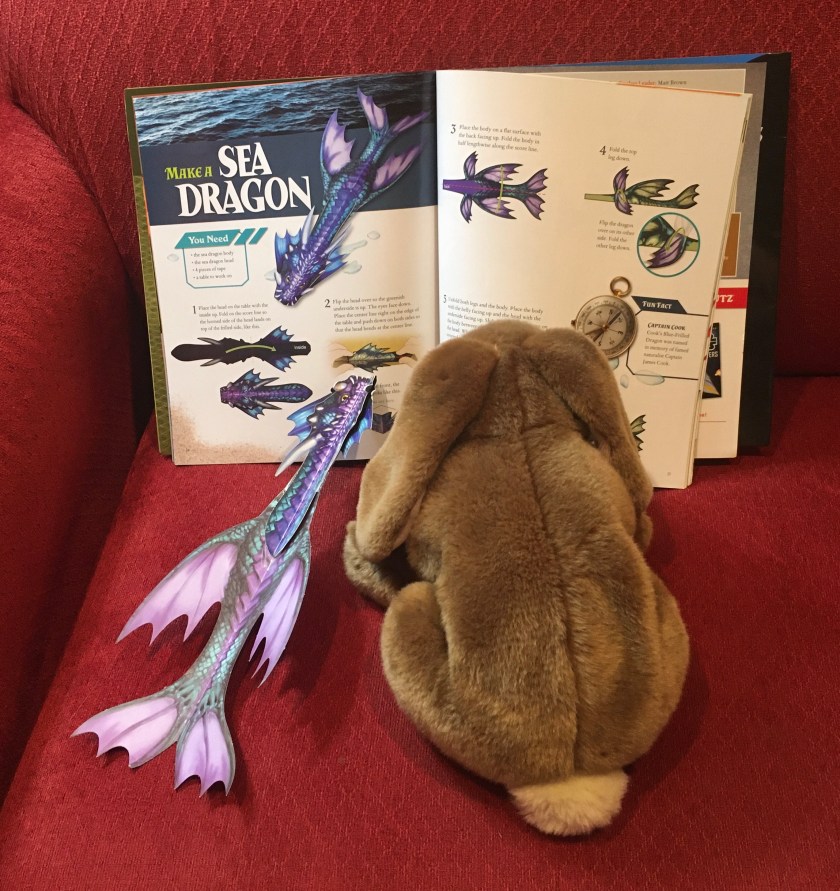
Caramel and his new friend Sea Dragon are reading about other sea dragons in Paper Flying Dragons by Pat Murphy.
S: So would you recommend this book to other bunnies?
C: Oh, yes, of course. Especially if they want to have flying dragons! There are twelve of them you can make, and then there is some text about each type of dragon. Apparently people all around the world have stories about different types of dragons. They are not like the dragons I read in the Wings of Fire or How to Train Your Dragon series, but they are a bit more real, more like the stories of dragons you’d hear before those books.
S: And you like that too, right?
C: Yes, I like those series, but I like these dragons a lot, too. They are from all over the world, there are dragons from China, from New Zealand, from the Kalahari desert, all around. It’s so awesome! And they can fly! That is even cooler!
S: So I can see you still have a couple more dragons to build, and you are keen to play with the ones you already have built. So let us wrap up this review. What would you like to tell our readers?
C: Get yourself a copy of this book and build your own dragons! And of course, stay tuned for more book bunny reviews!
Caramel and his new friend Battle Dragon enjoyed reading Paper Flying Dragons by Pat Murphy and are now ready for some flying.
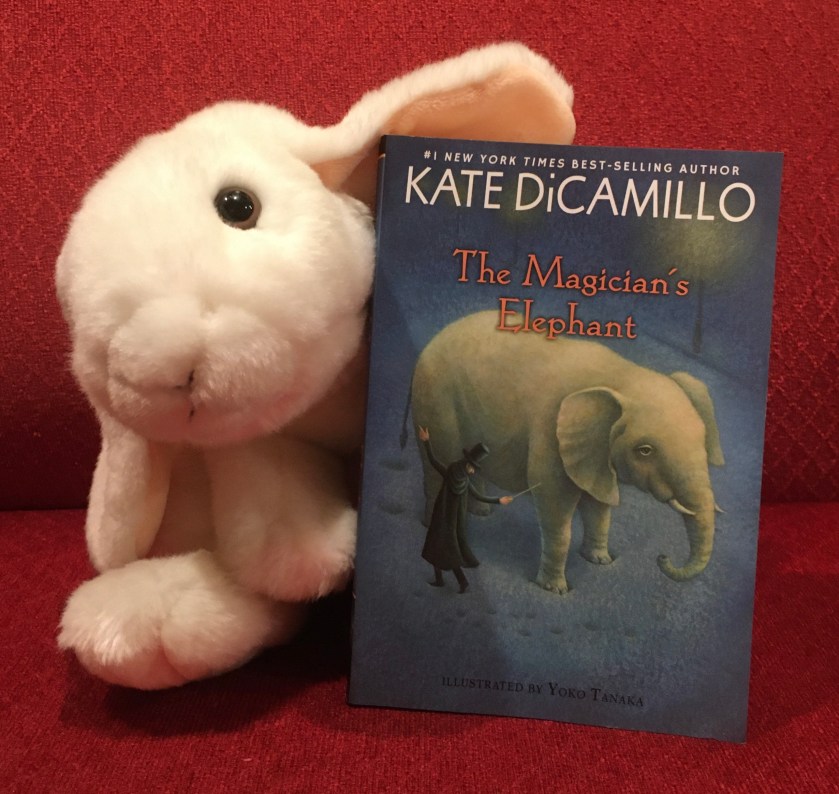
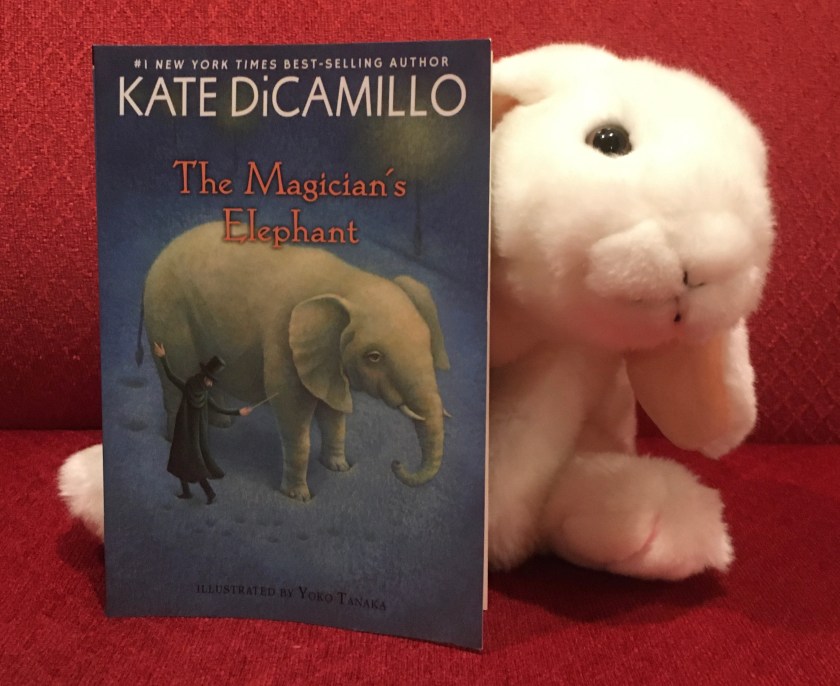
Marshmallow reviews The Magician’s Elephant by Kate DiCamillo.
Marshmallow’s Quick Take: If you like books about family, animals, or magic, then this might be the book for you.
Marshmallow’s Summary (with Spoilers): Peter Augustus Duchene lives in Baltese with his guardian, an elderly soldier named Vilna Lutz. Vilna Lutz is not particularly bad, but he is extremely obsessed with making Peter into a good soldier. Thus, Vilna Lutz is extremely strict. One day, when Vilna Lutz sends Peter to buy fish and bread, Peter meets a fortune teller. Instead of buying the fish and bread he was supposed to, he uses the money to ask the fortune teller a single question. (Since he is honorable, he decides that he will tell Vilna what he has done, which is very honorable.) Peter knows exactly what he will ask. His little sister, Adele, according to Vilna, was stillborn but Peter has his doubts. When he starts to ask the fortune teller his question, the fortune teller tells him that his sister is still alive. Extremely excited, Peter asks how to find her. The fortune teller mysteriously says, “Follow the elephant.” Puzzled over these words, Peter realizes that this means that Vilna or the fortune teller is lying, which shakes his foundations, because Lutz is a soldier, “good and true”.
Not very far away, a magician is performing at the Bliffendorf Opera House. He intends to summon a bouquet of lilies. Instead, this magician performs his greatest trick yet: he summons an elephant that crashes through the ceiling. This elephant lands on the legs of the woman the magician was trying to present the lilies to. She is crippled from that and the magician is arrested. The elephant is placed in a cage and then later bought by a rich noble woman to be displayed at her house.
The elephant is the talk of the town, and Peter hears about it and believes that it will lead him to his sister, Adele. When Peter questions Vilna about his sister’s supposed death, Vilna admits that she didn’t die. Vilna was a good friend of Peter’s father. Adele was not placed in his care because she was just a newborn when she was orphaned. This makes Peter more determined to find her.
Marshmallow is reading The Magician’s Elephant by Kate DiCamillo.
Marshmallow’s Review: I think that The Magician’s Elephant is an amazing book. I always enjoy reading Kate DiCamillo’s books; all of her books are touching and elegant. And this one is especially good. I specifically like how DiCamillo goes into the backstories of all the characters and ties them all together at the end.
The Magician’s Elephant is also a great family book. The main message is simple and perhaps not surprising: even during hard times, family should stick together. But the way DiCamillo tells the story makes all the difference. I listened to this book with my family as an audiobook, besides reading the paper version, too. In both versions, I really enjoyed reading this book. All in all, I think it is a necessary addition to the library of anyone who likes reading children’s literature.
Kate DiCamillo also inserts a bit of a magical touch into this book. The summoning of the elephant and the fortuneteller’s ability to see are both interesting additions of inserting magic into an otherwise realistic storyline, and they make up a major part of this book. All together these make The Magician’s Elephant a touching book that is both realistic and magical, somewhere between fairy tales and realistic fiction.
The version of the book I read was illustrated by Yoko Tanaka. Tanaka’s full-page illustrations were black and white and simple, but contributed to the general magical atmosphere of the story.
I will read this book again.
Marshmallow’s Rating: 100%.
Marshmallow rates The Magician’s Elephant by Kate DiCamillo 100%.
Today Caramel reviews the ninth book of Tui Sutherland’s Wings of Fire series: Talons of Power. As usual Sprinkles is taking notes and asking followup questions.
Caramel reviews Talons of Power (Book Nine of the Wings of Fire series) by Tui Sutherland.
Sprinkles: So we are in book nine. Tell us about it!
Caramel: This one is about Turtle, who is a SeaWing. He has a secret power which he does not want others to know about. He is an animus, that means he has magic.
S: What kind of magic?
C: He can enchant things. For example he made a bowl that multiplies things, kind of like a Star Trek replicator. But he doesn’t want others to know he can do this.
S: Do his friends know?
C: Yes actually all his friends know. But he does not want other dragons to know. Because he is afraid. And then Darkstalker, the evil dragon we met before, comes and tries to convince others that he has become a good dragon. And this is a lie, of course.
S: And Turtle knows this?
C: Yes, and he even made himself invisible to Darkstalker. Darkstalker cannot see him or remember him. He can’t even hear him.
S: Why?
C: Because he is scared. He is a scaredy cat, but for a good reason. Because Darkstalker is actually still evil and has terrible plans to take over the whole continent.
S: That sounds serious.
C: It is! And all the other dragons believe Darkstalker, so Turtle has to save the day himself.
S: Hmm, that is a good synopsis Caramel so let us leave the plot here before we go into spoiler territory.
C: Okay.
Caramel is reading Talons of Power (Book Nine of the Wings of Fire series) by Tui Sutherland.
S: So let us think more generally about the book. Turtle was a character we met before, but this is the book where he becomes the central character, right?
C: Yes.
S: Do you like him?
C: Yes. And actually I like him more now that I understand what is going on in his mind. And he is a good dragon, and his super secret power is really cool.
S: What would you do with that power if you had it Caramel?
C: Well, I am not sure I’d use it, because each time you use your super powers, it drains a part of your soul. It makes you less of yourself somehow.
S: Ooh, I did not know that! So maybe it makes sense that Turtle doesn’t want others to know he has super powers.
C: Yes I think so, too.
S: Okay, is that why Darkstalker is bad, because he keeps using his power?
C: No, he actually protected his soul because he learned how to. But his soul is not so nice, he was originally evil, so there is that.
S: Hmm, why can’t Turtle protect his soul?
C: Well, I guess he could, too, but he is still scared of using his powers.
S: I see. Then how about we move on? So what three words would you use to describe this book? How about we try to think of what distinguishes this book from the earlier ones?
C: There is more treachery in this one, so how about “treacherous”?
S: That is a good word! What else? You need two more ideas or ways to distinguish this one from the earlier eight books.
C: We knew the inner thoughts of almost everyone from the sixth book because Moonwatcher could read their thoughts. Everyone except Peril and Turtle. But Peril we learned about her thoughts in Escaping Peril, so only Turtle’s inner thoughts were unknown. Till this book.
S: Hmm, so is there a word that could help you capture this?
C: Revelation! This one reveals Turtle’s thoughts!
S: Yes! That is a neat word Caramel. I think a related descriptive adjective would be “revelatory”.
C: Okay, so my second word is “revelatory”.
S: How about your third word?
C: Well, I found it interesting that Turtle was afraid of becoming a hero.
S: Hmm, how about calling him a “reluctant hero” then?
C: Yes. I think that describes him well. Would that count?
S: Well, it is not quite a descriptor for the book, but let’s say it will do.
C: Yes, so can we wrap this up so I can move on to the tenth book?
S: I think we can Caramel.
C: Yay!
S: But before that, what will you tell our readers?
C: Stay tuned for more book bunny reviews!
Caramel loved reading Talons of Power (Book Nine of the Wings of Fire series) by Tui Sutherland, and can’t wait to dive next into the tenth book.
Today Marshmallow is reviewing The Inquisitor’s Tale: Or, The Three Magical Children and Their Holy Dog, the 2016 novel by Adam Gidwitz which won a Newberry Honor in 2017. (Coincidentally she had already reviewed the book that won the Newberry Medal that same year: The Girl Who Drank the Moon by Kelly Barnhill.) Following Marshmallow and her recommendation, Sprinkles also read the book, which offers a lot of food for thought, both for young bunnies and the not-so-young ones. The two bunnies discuss the book together below.
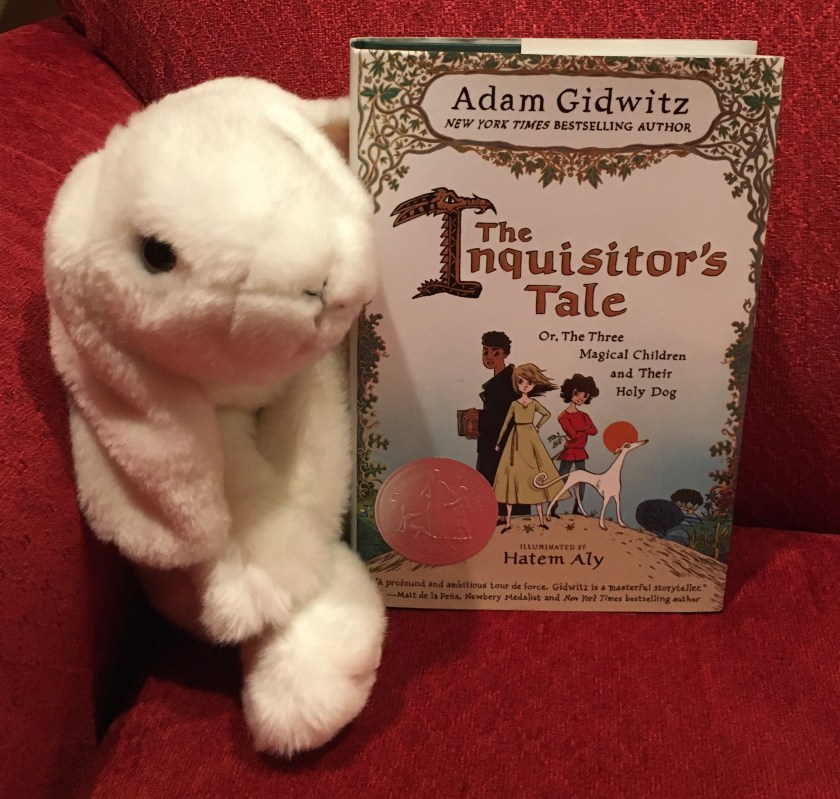
Marshmallow reviews The Inquisitor’s Tale: Or, The Three Magical Children and Their Holy Dog, written by Adam Gidwitz and illuminated by Hatem Aly.
Sprinkles: So Marshmallow, why don’t we start with a brief introduction to the book? What is the book about?
Marshmallow: This book is about three kids, named Jeanne, William, and Jacob, and their dog, named Gwenforte. The kids have superpowers. Jeanne has fits and can see the future when having them. William is tall and very very strong. And Jacob has the power to heal people, but at an uncanny level. Even the dog seems magical. She died and then many years later reappeared above the plot of land she was buried in.
S: The subtitle of the book sort of hints at this, right? Three magical children and their holy dog?
M: Yes. And they are living in France, in the middle ages.
S: Yes, the story starts in 1242, and there are a lot of historical facts and people who show up in the book.
M: Yes, for example the king is Louis IX, the ninth Louis, and we also get to meet his mother Blanche of Castille. They are both real people from the history of France.
S: So in some very real sense this is historical fiction, which according to Wikipedia is “a literary genre in which the plot takes place in a setting related to the past events, but is fictional”.
M: Yes, but if we want to talk about genre, I think we might also have to talk about magical realism. Remember, I reviewed two books that I thought fit this category before: Ikenga and Hurricane Child.
S: Why would you say that?
M: Because everything seems real and like things are in the real world, but every now and then some weirdly magical stuff happens. And some of the characters interpret them as magic, and some think they are miracles. But they are almost always extraordinary and supernatural.
S: Can you give an example?
M: Jeanne has visions of the future for example. And then there is a dragon whose fart causes things to burst into flames. And everyone acts as if dragons are real and the main issue is that this dragon’s fart is unexpectedly deadly.
S: Yes, there is a farting dragon, and I am sure Caramel would love to learn more about that. And you are right, I think. I’d agree that this book is somewhere between magical realism and historical fiction. In fact at the end of the book, there is a section where the author explains which parts of the book are real history, which storylines he took from legends and myths and other stories of medieval times, and which he himself totally made up. All together these all add up to make a really rich story, don’t you think?
M: Yes. And the book is written like a medieval manuscript. There are illustrations on most pages, and they are credited as “illuminations by Hatem Aly”. Illuminations are the decorative illustrations that were sprinkled here and there in medieval manuscripts. We learned about them in history class when learning about the middle ages.
S: I can see why the author and the illustrator and the publisher decided to call these illuminations, besides the historical connection. I think they are not just illustrations that would accompany the text and depict some event happening in there. Sometimes they do not seem to be directly related to the story at all.
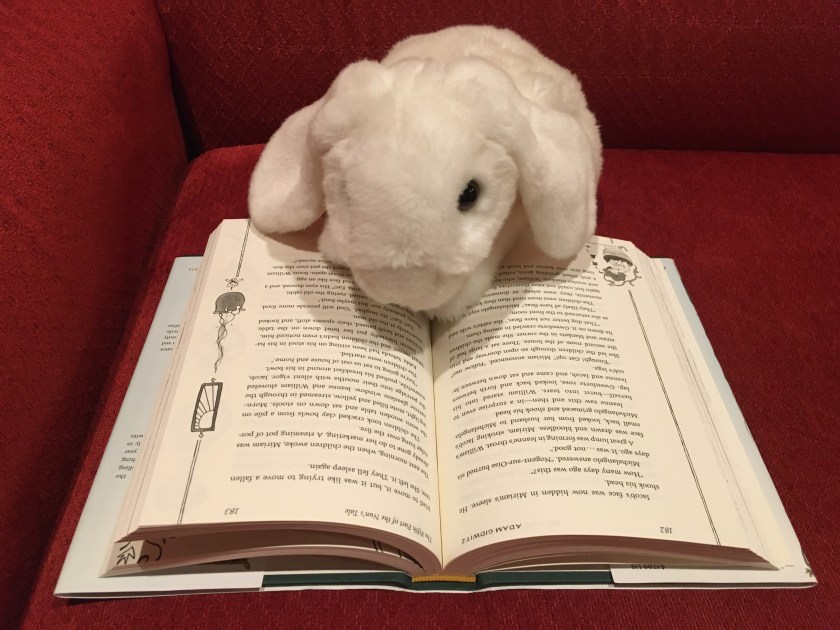
Marshmallow is reading The Inquisitor’s Tale: Or, The Three Magical Children and Their Holy Dog, written by Adam Gidwitz and illuminated by Hatem Aly.
S: So you read this book a while ago and really wanted me to read it, too, so we could discuss it. Can you tell me why?
M: Because this book, more than any other book I read or reviewed recently, talks about religion at length, and I wanted to think out loud about some of the themes that came up together with you.
S: You are right of course. The book talks a lot about religion. Europe of the thirteenth century was almost a Christian continent, and we see this in the characters and their world views very clearly throughout the book. And Jacob, one of the three magical children, is Jewish, and we also see the tension between his world and the world of the other characters involved. In fact one of the main challenges the children have to face involves the king’s decision to burn all copies of the Talmud in France so as to get rid of all non-Biblical wisdom available to the Jews. And this was actually a real event that happened. Some background can be found in this Wikipedia article about the Disputation of Paris. Did you know what the Talmud was before reading this book?
M: No, I did not. But reading this book made me curious. It seemed to be really important to the Jewish communities and it seemed like Louis IX was trying to destroy something sacred to and vital for them. Then I learned from the relevant Wikipedia article that the Talmud is a collection of writings of more than a thousand Jewish scholars that addresses all sorts of theological and philosophical issues as well as very practical ones, like how to live one’s life.
S: So the children set out to try and save the copies of the Talmud that would be burned. Why did they want to do that? Only Jacob is Jewish. How come the other children agreed too that this was an important thing to do?
M: Because it was centuries of knowledge and wisdom collected and cared for by generations of people. And of course it was not fair to the Jewish communities who had so cared for these volumes of books one generation after another.
S: Yes, there is a part of the book when the children realize how each book is written and illuminated by a person who dedicates years of their lives to this work. And I really liked this because, even though we have the publishing press today and books can be published much faster, a book is still the product of many years of hard work of many many people.
M: And I like books! I mean I can like some books more than others, but every book I read takes me to a different world! I would not want even the worst novel I read to be burnt. And these are not novels. They contain sacred wisdom of a whole people. It just seems pretty terrible.
S: Yes, and the children can see beyond their own differences of world views, their own religious backgrounds, to see the value of these books and the cruelty of burning them.
M: Of course they are kind of guided to this by Michelangelo of Bologna, “the red, fat, and wicked” priest who begins as their nemesis and ends up being their friend and mentor. And in the end he turns out to be–
S: Wait, let us not spoil that. That is revealed all the way at the end and we don’t want to spoil it for our readers.
M: Okay.
S: How about we instead talk about one of the big questions of all time that shows up in the book? The question of evil? The question of the reason and the justification of the existence of evil in a world created by a good God?
M: Yes. Some really bad things happen in the book, and at some point the children are so sad that they ask why God ever allows for such bad things to happen if He is good. And I think this is a really tough question. I don’t know how to answer it.
S: I think you are not alone Marshmallow. This is a big question for a lot of theologians and philosophers. What did you think of the answers offered in the book?
M: I’m not sure I totally understood them.
S: Well, the main Christian answer is, I think, captured in the Book of Job, and the drunk friar named Roger Bacon recites a part of that book to explain that the living are too small to understand the grand plans of God. What may seem like evil to us may not be. What we find wrong and bad may not be.
M: And then there is a troubadour (apparently that is a “a French medieval lyric poet composing and singing in Provençal in the 11th to 13th centuries, especially on the theme of courtly love”) who gives a different answer. He says God is a troubadour. I did not quite get that answer.
S: Yes, there is a part of the story when a troubadour sings The Song of Hildebrand, a story of a father and son who meet in battle. The father recognizes his son but cannot convince him that he is his father, so they go on and battle and it is all pretty bad and sad all around. And the troubadour sings this song and the song is sad, too, but it is also beautiful. And then he says that this is how our lives are. When we live them, it may be sad and ugly and terrible and we cannot make any sense of it. But all in all, there is a song that God is putting together and that song is beautiful. I think in a way this is the same answer as the answer from the Book of Job. While we are in the thick of things, going through the rollercoaster of life, we cannot appreciate the big picture. But the faithful believe that there is a meaning to it all, and it is known to God.
M: Hmm, I will have to think more about that.
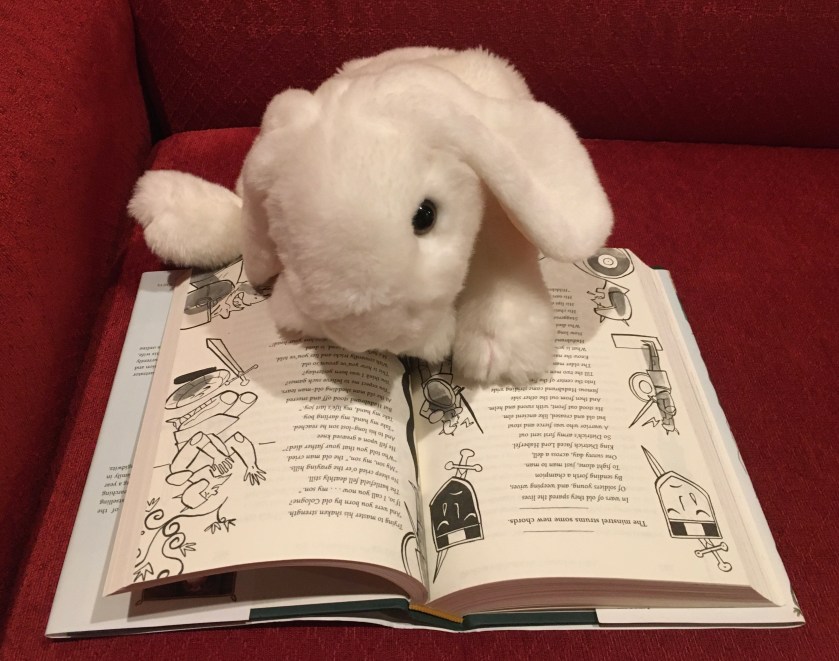
Marshmallow is reading The Song of Hildebrand in The Inquisitor’s Tale: Or, The Three Magical Children and Their Holy Dog, written by Adam Gidwitz and illuminated by Hatem Aly.
S: Okay, then let us get back to the form of the book. What can you tell us about the general organization of the book?
M: Well, there are twenty-seven chapters. Each of them is titled The Innkeeper’s Tale, the Nun’s Tale, and so on. Each is told through the perspective of someone else who knows a part of the story of the three children and their dog. And slowly, chapter by chapter, we get to learn their story as it unfolds. Also there is a main narrator, who is the “I” of the main story. And he is trying to learn about the children and what happened to them and so on.
S: So maybe it makes sense to also tell our readers that the story starts in an inn and the different people talking are all at that inn, taking turns, telling us the story of the children, in more or less chronological order.
M: Yes, I guess that would also be useful to know.
S: In that way the book resembles some medieval stories, in particular The Canterbury Tales and the earlier Decamoeron, which were each written as collections of tales told by a handful of characters one after another.
M: I did not know about those earlier books. But looking them up on Wikipedia, I see that they were both written in the middle ages, so it makes sense that the author chose this form. I like that!
S: Me too. It somehow gives the book an even more authentic feel.
M: Agreed.
S: Okay, Marshmallow, this is already a pretty long review. Let us try and wrap things up. Who is your favorite character?
M: I liked the children a lot. They are all good people. And they are also in some ways very realistic even though they have some strange super powers. They act like real children.
S: True. Which super power among the three would you have liked to have if you could choose?
M: Probably the healing power of Jacob. I think that would be really good, so I could help a lot of people.
S: Did you know the author would choose William’s strength? He says “Well, Jeanne has visions of the future. That could only screw you up psychologically. Jacob has the power to heal wounds—which just means I’d be running around like an EMT all day. William has incredible strength. That I would take.” (This is from a longer interview with the author, which you can find here.)
M: I guess I can understand that.
S: You have also read and reviewed A Tale Dark and Grimm, by the same author. Do you see any similarities between the two books?
M: That was a lot of fun to read but also kind of scary. This too has some scary things that happen. So maybe both would be more appropriate for older bunnies, like me, rather than Caramel.
S: I see. This one also engages with some pretty mature themes, so I agree that perhaps it is best for more mature readers, like you. So finally how would you rate this book Marshmallow?
M: I’d rate it 95%.
S: And what do you want to tell our readers as we wrap up this review?
M: Stay tuned for more amazing book reviews from the book bunnies!
Marshmallow enjoyed reading and discussing The Inquisitor’s Tale: Or, The Three Magical Children and Their Holy Dog, written by Adam Gidwitz and illuminated by Hatem Aly, and rates it 95%.



 BookBunnies