Marshmallow reviews There’s A Hair In My Dirt! A Worm’s Story by Gary Larson

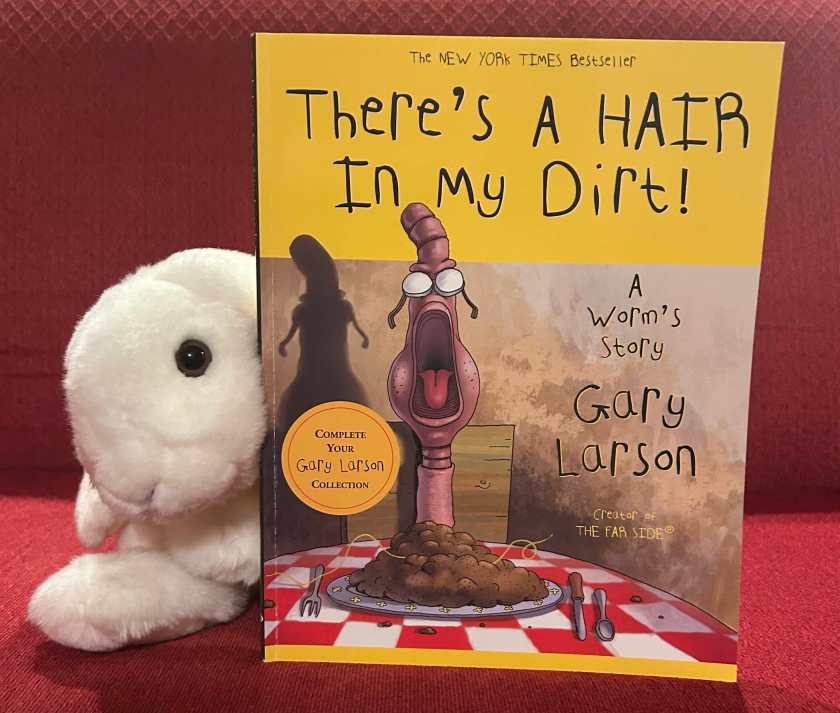
Today Marshmallow is reviewing There’s A Hair In My Dirt! A Worm’s Story by Gary Larson, first published in 1998. A fan of Larson’s The Far Side, Sprinkles is asking questions and taking notes.
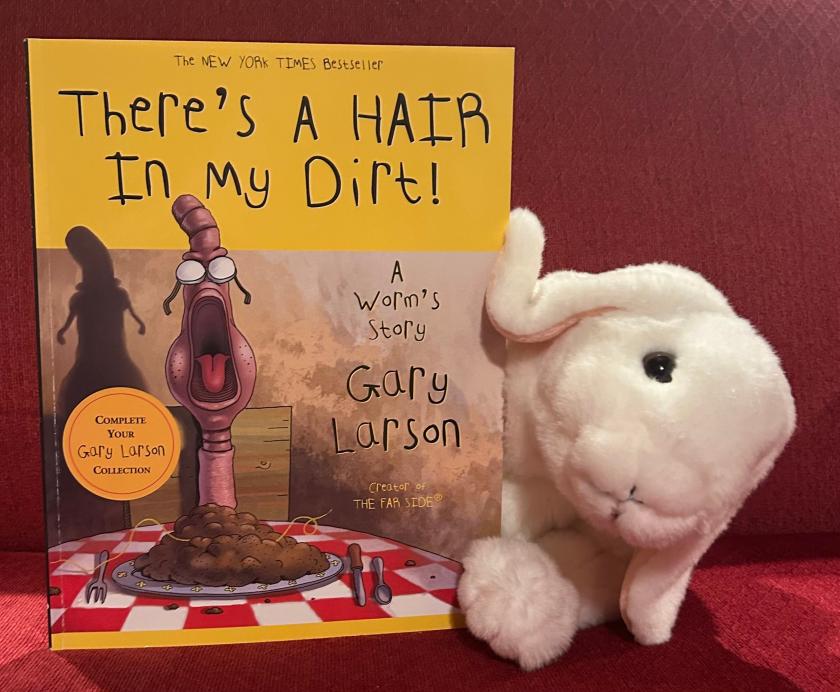
Marshmallow reviews There's A Hair In My Dirt! A Worm's Story by Gary Larson.
Marshmallow reviews There’s A Hair In My Dirt! A Worm’s Story by Gary Larson.

Sprinkles: So Marshmallow, tell us a bit about what you thought when you first saw this book.

Marshmallow: I felt very surprised that Gary Larson had written a children’s book. I really like his Far Side comics, and we have a collection of them at home –and maybe we should review them some time!

S: Yes, maybe we should some day. But you are right. Larson is most well-known for his Far Side cartoons. But then you read this book and realized that maybe it is not quite a children’s book, right?

M: Nope. Do not have your children read this book!

S: Wait! Really? I mean, it is a bit rough for younger bunnies, and it is quite long for them, too, at 64 page, but older bunnies like yourself can appreciate it, I thought.

M: Yeah, I guess so. But it is kind of dark and even morbid. Then again, it is kind of a fable, with some underlying messages, which are thought-provoking. You are right, I guess bunnies my age and the like might appreciate the book. But I was definitely surprised and was not expecting how dark it would get.
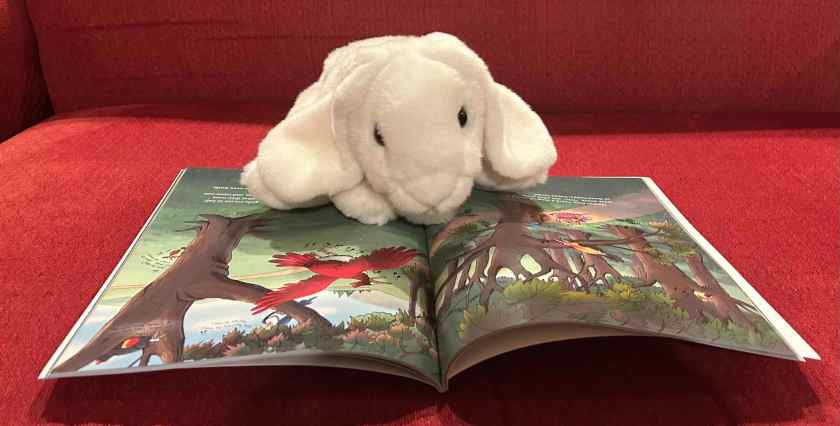
Marshmallow is reading There's A Hair In My Dirt! A Worm's Story by Gary Larson.
Marshmallow is reading There’s A Hair In My Dirt! A Worm’s Story by Gary Larson.

S: Okay, so maybe we should start from the beginning and tell our readers what the book is about.

M: Sure. This book is about a little earthworm who is eating his dirt dinner in his family’s hole in the ground. And he finds a hair in his dirt and starts complaining to his earthworm parents. He hates being an earthworm, he hates living underground. He hates not having legs and having to eat dirt. And so on.

S: Totally understandable of course.

M: Of course. But then his father starts to tell him a story about a girl named Harriet. And then the rest of the book is basically Harriet’s story. Harriet lives near a forest and goes through the forest one day, seeing all sorts of animals interacting with one another, and she always has a positive outlook, thinking about Nature admiringly and yet not really comprehending what is really going on around her.

S: Yes, the foreword for the book is written by the famous biologist Edward O. Wilson and he writes “The maiden, as you will see as the narrative unfolds, might have enjoyed her saunter better if she understood.”

M: And it is not just a matter of enjoying; it costs her dearly that she does not understand. It is a little disturbing actually, because Harriet loves Nature, or what she thinks it is. And she wants to help and she is trying to be a good steward of living things, but since she does not know how things are all connected, she ends up harming the forest and herself.

S: This reminds me of this song “We Are All Connected” which some people made by putting together a few words from four outstanding science communicators:

M: Yeah, I like that song!

S: But let us not go further into the story because I think we might be getting too close to giving away some of the plot. Tell me, Marshmallow, what did you think about the illustrations?

M: It is in full color, and obviously it is Gary Larson, so all characters are distinctive, and they have very evocative expressions. It is very amusing to study them actually. The topic is complicated and nuanced, that we are all connected, and that, as Edward O. Wilson puts it, “Life is tough!” But Gary Larson’s drawings are often hilarious and you can’t help but laugh on almost every single page. Or raise your eyebrows in a shocked and yet amused manner. The mother earthworm is wearing those cat-eye glasses!

S: I know, right? Each page is itself a Far Side comic, almost. But they are all telling a coherent story, and it is an important one.

M: I agree. I do not really love the last page, but I agree. The message is important. And no, if you get a hold of this book, please do not just turn it to the last page to see what I mean! It will work much better if you read the book in the proper way.

S: And I agree with you, Marshmallow. This is a thought provoking book, not as light reading as one might imagine, but definitely amusing to look at, too. So maybe this is a good place to wrap up our review. What do you think?

M: Sure. Let’s.

S: What would you like to tell our readers?

M: Stay tuned for more amazing reviews from the book bunnies!
Marshmallow rates There's A Hair In My Dirt! A Worm's Story by Gary Larson 100%.
Marshmallow rates There’s A Hair In My Dirt! A Worm’s Story by Gary Larson 100%.

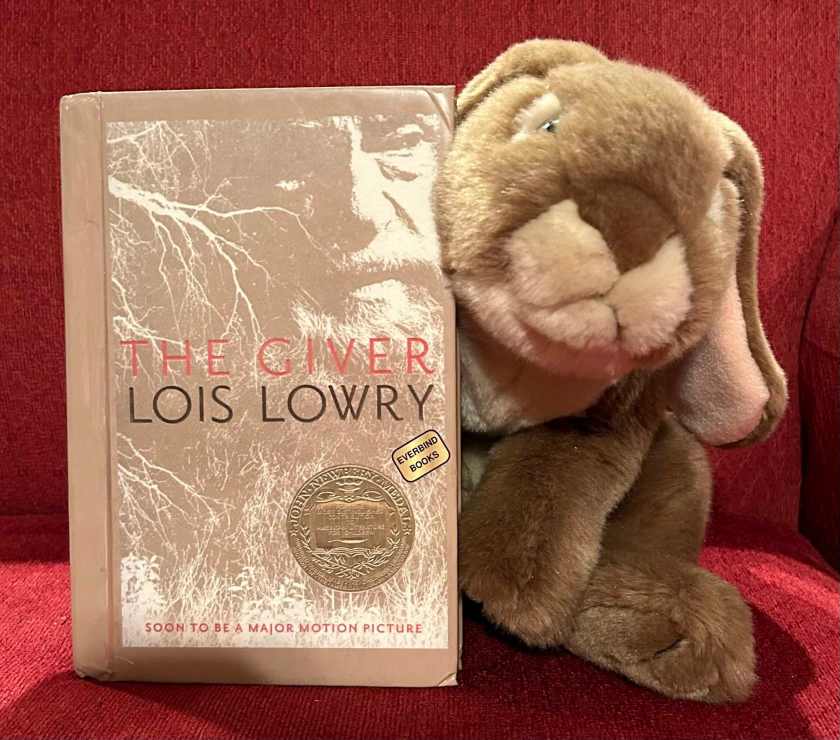
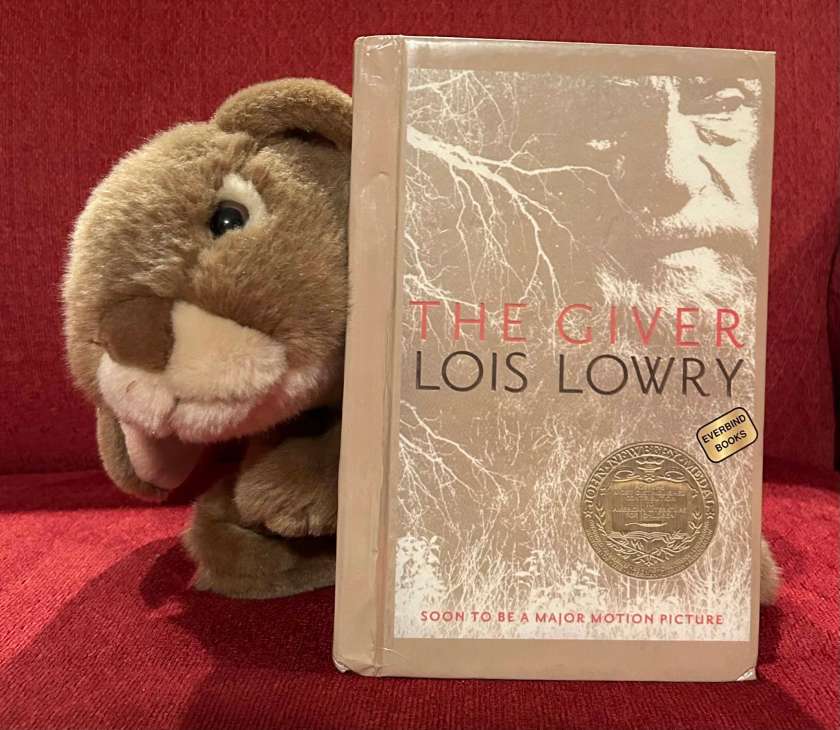
Caramel reviews The Giver by Lois Lowry

Today Caramel reviews a book he read in school: The Giver, by Lois Lowry. Published originally in 1993, the book has already become a classic, read by many students across the United States; it has also won the Newberry Medal in 1994. Sprinkles, who has not had the chance to read the book yet, is asking questions and taking notes.

Caramel reviews The Giver by Lois Lowry.

Sprinkles: So Caramel, today we are talking about The Giver, a book you have read and discussed in school over the course of a few weeks. 

Caramel: Yup. 

S: So let us start at the beginning. Can you tell our readers what the book is about?

C: Yes, sure. This book is about Jonas, a boy that lives in a community that controls the lives of those that live in the community.

S: I see. In what ways are they controlled? Can you give some examples?

C: They are not able to decide who they marry or choose their jobs. Even their death is controlled! The leaders get to choose who dies and when. They also choose the names of the newborn children. So the world of those who live in the community is very controlled, and they basically have no choice in anything.

S: Oh my goodness! When you first began with people not getting to choose who they marry or what their jobs should be, I was going to say that that has been the case in many societies throughout history, but then things got even more and more restrictive. No wonder this book is classified as a dystopian novel. Which according to my trusty dictionary means “an imagined state or society where there is great suffering or injustice.”

C: Yup, it sure does make sense, doesn’t it? But there is more. The people are also taking drugs to not have any emotions. Color is also taken from their lives, so at least they are not racist. But seriously, they are supposedly doing all this so everyone is equal, but it is pretty depressing.

S: Wow! That is really disturbing. Marshmallow had read and reviewed Brave New World where the people also had access to a drug called soma but there the drug was to just make them not feel bad things. That was also bad, of course, and it numbed them and made them more complacent, but forcing people not to have any emotions, and not to even see color, sounds really terrible.  

C: This is kind of a next level of control from Brave New World, even Nineteen Eighty-Four, I think. I mean I have not yet read those books, but from what Marshmallow wrote in her reviews, I have got a pretty good idea of what is going on.

S: Well, it seems you did understand them well enough. And of course you should read them at some point, too. But you are making a good comparison, Caramel. In Nineteen Eighty-Four, maybe there they do not mess with feelings in the same way; rather they break people who have attachments to other people and make them love the Big Brother only.  

C: In The Giver, too, they have a Big Brother-like leadership group. So for example, if you speak out against them once, you are “released.” Or injected with a deadly poison. The same happens with twins: one is kept, and the other is killed.

Caramel is reading The Giver by Lois Lowry.

S: Alright so in this dystopian world, what is going on? You told us the setting. Now tell us the plot, the events. 

C: Sure. So in the beginning, Jonas, the main character, starts to notice some weird things, For example, he starts to see some color. Like he has an apple and it for a moment becomes red. And then his friend Fiona is in color, too. But remember they could not see color before. 

S: It must be shocking to start seeing things in color if you had never seen color before. I remember the first color TV I saw, and I was so excited. But I could at least see color outside a TV screen before. 

C: Yep, it made him think that he was going crazy.

S: I bet! So then he starts asking questions and trying to understand what is going on with him and with his community and learns some really big secrets?

C: Hey, I was just going to say that! You stole my line Sprinkles.

S: Well, I have read my fair share of dystopian novels. 

C: That is probably true. I have not read as many books as you.

S: Well, you are still a very little bunny. And so you have many years to catch up. I bet you will catch up and pass me in just a few years… 

C: Maybe, just maybe.

S: Anyways, so what did you think? Did you enjoy reading this book?

C: Yep, it was a good book, except for chapters 11-13. I thought those were a bit too mushy, so I only skimmed through them. I am not sure I missed much.

S: I am guessing you are using mushy the same way Marshmallow uses it so some close romantic relationships were involved?

C; Yeah, but it really did get a bit too mushy for me.

S: Okay, I understand. So I would expect that there was some character development and such in those sections, so you probably did miss some things like that. But that’s alright. About the main setting and the story though, did things feel a bit too tense for you while you were reading it? Too depressing? It feels like it is a really oppressive world. 

C: Yeah, it is really oppressive. So I did not enjoy it like fun and games because it is about a very harsh world, but the story is very interesting, so I kept on reading. Also I had to read it. It was for school, remember? 

S: Yes, true that. But for example, do you think I should read the book, too? Do you think other young bunnies should read it? 

C: It is probably better suited, I suppose, for those bunnies that are not too young, but somewhere in the tweens or teens, everyone over ten or something should find it an interesting book, too. So yes, Sprinkles, you should definitely read it! 

S: Hmm, my last dystopian novels were the Hunger Games books that I read after Marshmallow recommended them. I guess I should look into this one, too. Did you know that there are apparently three other books from the same author that take place in the same world as The Giver? Do you think we should look into getting a copy of one of those for you? 

C: Maybe, but I think that this is kind of conclusive, and works really well as its own thing.

S: Oh, so no cliffhangers. That is great! And maybe you can take a break and look at some other worlds and stories for a bit. 

C: I’d like that. Maybe I will get to read a totally different type of book next week. We might at some point come back and revisit Jonas’s world though. I could like that, too. 

S: Sounds good. This might be a good place to wrap up this review Caramel. What do you want to tell our readers? 

C: Stay tuned for more book bunny reviews!

Caramel has enjoyed reading The Giver by Lois Lowry and is curious about the other books its author wrote as sequels.

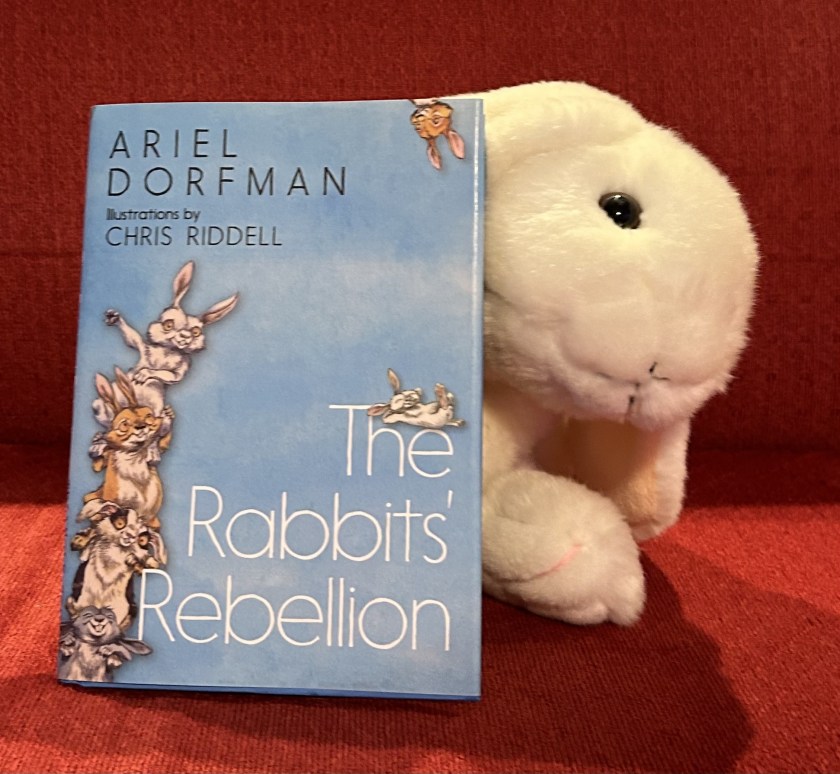
Marshmallow reviews The Rabbits’ Rebellion by Ariel Dorfman and Chris Riddell

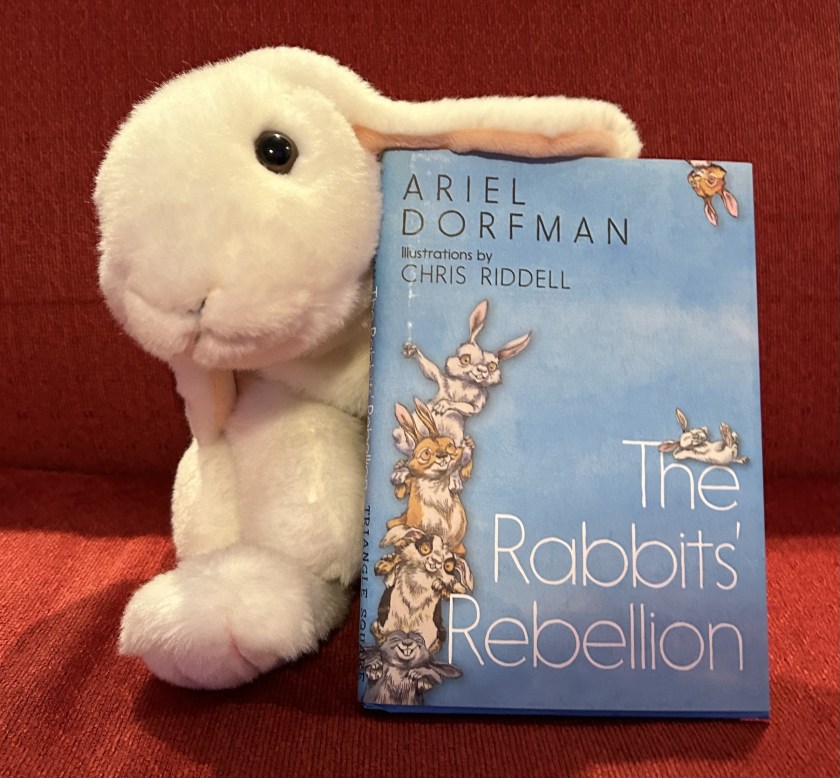
Today Marshmallow reviews a little book with a big message, first published in 2020: The Rabbits’ Rebellion, written by Ariel Dorfman and illustrated by Chris Riddell.

Marshmallow reviews The Rabbits' Rebellion, written by Ariel Dorfman and illustrated by Chris Riddell.
Marshmallow reviews The Rabbits’ Rebellion, written by Ariel Dorfman and illustrated by Chris Riddell.

Marshmallow’s Quick Take: If you like children’s books about animals and clever political commentary, then this is the book for you!

Marshmallow’s Summary (with Spoilers): When the wolves invade the land of the rabbits, the Wolf of all Wolves crowns himself king and begins to make some wild claims. First of all, he—feeling quite omnipotent that day—declares that rabbits don’t exist. He bans any reference to them in books (by personally crossing them all out) or in conversation. Unfortunately, birds can fly and report seeing some, which spread rumors that perhaps rabbits do exist.

The king then decides then, if (as his fox advisor says) “seeing is believing,” he’ll make his subjects see exactly what type of a ruler he is. So he commands an old monkey to take regal photos of him to be put up in every town square, every neighborhood, and in every house. He forces the birds to carry these posters, tying their feet to an “endless” cord to make sure they can’t escape. Naturally, the old monkey is terrified of the king and bends to his every whim and want. In other words, he says, too, that rabbits don’t exist. On the other hand (or paw!), the monkey’s daughter—with the fearlessness of innocence—knows that rabbits do exist even though her parents make sure to censor her whenever it becomes necessary.

But that’s just the beginning of the old monkey’s struggles. Every time he takes a photo of the wolf king, there is some hint of a rabbit in the background. When the king shatters the beavers’ dam (which took them three years to build), there are two rabbits sitting on the grass in front of the camera. When the king snarls in the most ‘majestic’ manner, a long, fuzzy ear shows up in the corner. This is most problematic because the monkey can’t show the king photos that go against his rule that rabbits don’t exist. So he doctors his photos after they develop, erasing any and every trace of rabbit hair, ears, or tails.

As the king becomes increasingly more controlling, more egotistical, and more tyrannical, the monkey must keep taking photos and editing them. Despite the king’s advisor tightening security around the photo shoots (he doesn’t want the king to know about the rabbits either—it would look bad on him), the rabbits persistently keep up their rebellious photo-bombing. But how could they, when they don’t exist?

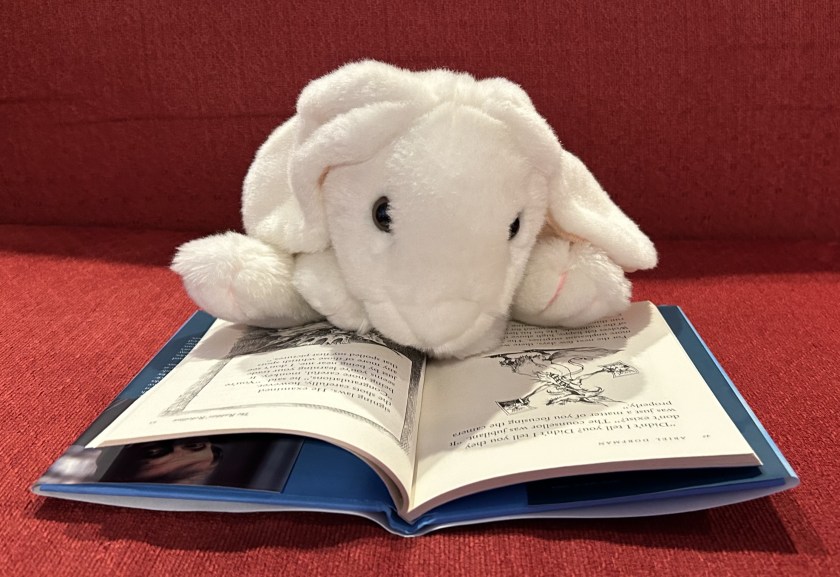
Marshmallow is reading The Rabbits' Rebellion, written by Ariel Dorfman and illustrated by Chris Riddell.
Marshmallow is reading The Rabbits’ Rebellion, written by Ariel Dorfman and illustrated by Chris Riddell.

Marshmallow’s Review: The Rabbits’ Rebellion is a really good book! It is written as a book for little children, and it reminds me of some Roald Dahl books I read earlier. Roald Dahl was unique in a way because his books could be read as childish tales, but they also touched on deeper topics. Likewise, the meaning of Dorfman’s book might not be understood by very young readers even though they would still enjoy reading about these mischievous rabbits who insist on existing! (Go, bunnies! Of course I cannot be too impartial here.)

At its core, The Rabbits’ Rebellion is about authoritarianism and dictatorship. The king’s suppression of truth, especially a truth that is so obvious, is in a way an almost comically extreme example of an Orwellian dystopia. In a way, this book is like Animal Farm or Nineteen Eighty-Four for young children. Except—spoiler alert—this one ends better than both of those books.

The Rabbits’ Rebellion is entertaining even if you don’t catch this theme. It is kind of like how one might enjoy reading parts of Animal Farm even without digging into the allegory. But Animal Farm ends at a quite depressing place for young bunnies to really enjoy it all the way to the end. Similarly, I learned that some parents have complained that the ending of The Rabbits’ Rebellion is too graphic to make it appropriate for a calm bedtime. So readers beware!

I found it interesting that the world of this book is so different yet also very similar to ours. There is no magic, but they do have cameras and books. Remember how in Maus the whole story only involved mice and a few other types of animals, but we could see our own world in it? Just in the same way, the differences and the similarities despite those differences help convey Dorfman’s message very clearly.

All in all, The Rabbits’ Rebellion has a really poignant yet simple plot and is a very thought-provoking book even though it is extremely short (only 63 pages). Written in large font and with really beautiful illustrations that evoke a serious, fairy-tale feel, it is quite easy to read, too. I think it could be a great way to introduce children to political thought and discussion. (I might reread Nineteen Eighty-Four as a result of reading The Rabbits’ Rebellion, because this book really reminded me of it.) Overall, I would definitely recommend this book to bunnies young and old, who both will find it entertaining (perhaps intellectually) and thought provoking. 

Marshmallow’s Rating: 100%.

Marshmallow rates The Rabbits' Rebellion, written by Ariel Dorfman and illustrated by Chris Riddell 100%.
Marshmallow rates The Rabbits’ Rebellion, written by Ariel Dorfman and illustrated by Chris Riddell 100%.

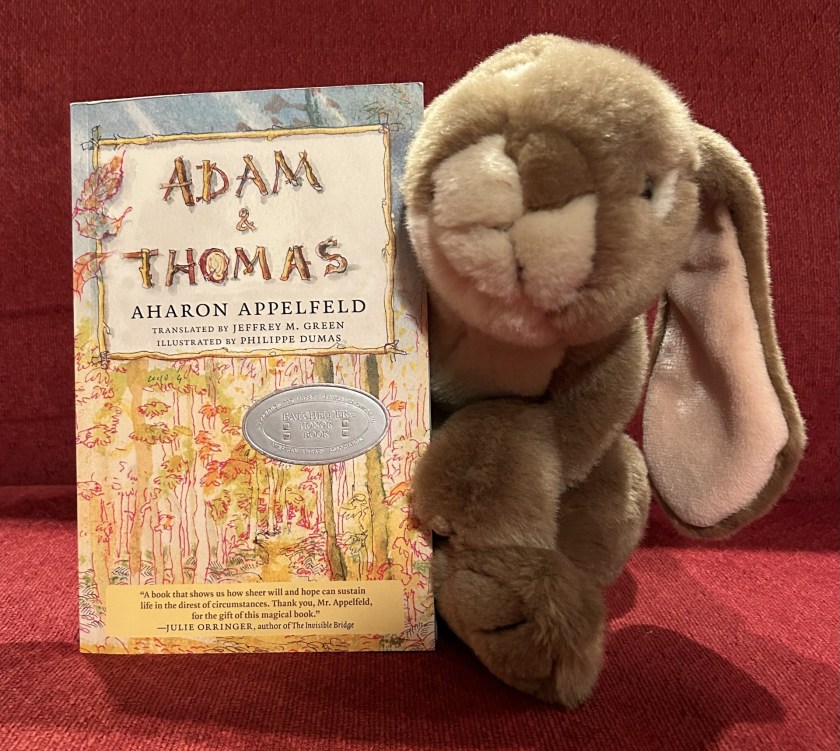
Caramel reviews Adam & Thomas by Aharon Appelfeld

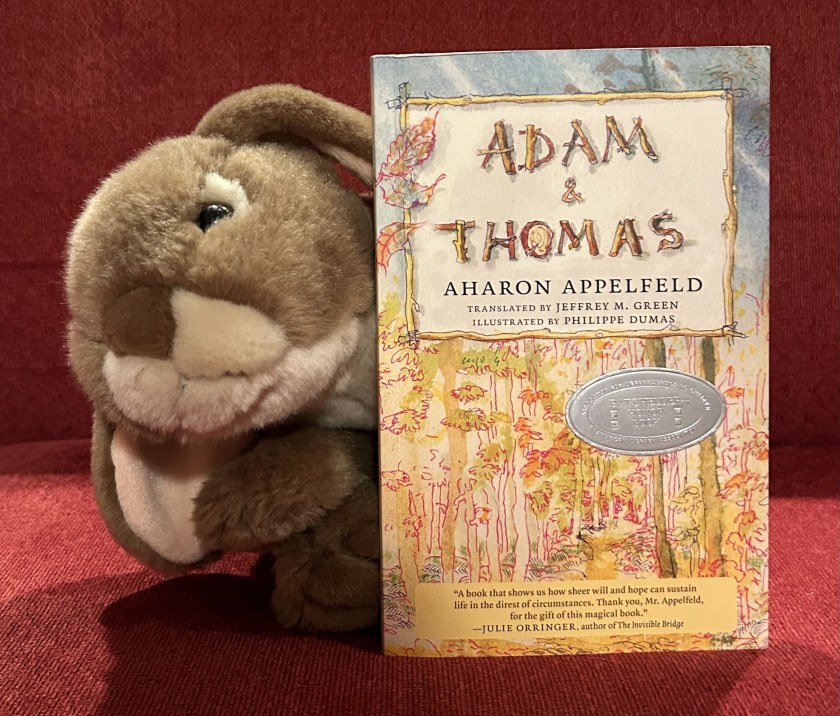
Today Caramel is talking to Sprinkles about Adam & Thomas, a book written originally in Hebrew in 2013 by Aharon Appelfeld, translated into English by Jeffrey M. Green, and illustrated by Philippe Dumas.

Caramel reviews Adam & Thomas, written by Aharon Appelfeld, translated into English by Jeffrey M. Green, and illustrated by Philippe Dumas.

Sprinkles: Let us talk a bit about this book Caramel. Maybe first start by telling us what it is about.

Caramel: It’s about two nine-year-old boys who escape one of the darkest times in human history. I mean, maybe the darkest time in modern history.

S: You are of course talking about World War II and the Holocaust, when millions of European Jews were systematically murdered by Nazi Germany and their collaborators.

C: Yes. And you know I did not really want to read this book because I knew it would be sad once I saw it was about that time.

S: Yes, I know. But I thought it was a good book and that you should probably read about that event anyways. After all, you just read The Donner Dinner Party and that was also about pretty harsh truths.

C: Yup. But I knew about the Holocaust. I did read Maus, too, even though Marshmallow was the one who reviewed it. And I did not like it because it is really really sad.

S: I know. But at least this book ends up in a more positive place, no?

C: Yes. There is that, at least. Not only do they survive the war hiding in the forest for years, but they even find their mothers after all that time.

S: Well, I guess we gave away the ending, but at least readers will know that things will get better in the end even when they re reading the darkest parts of the story. That there is hope.

C: Yes.

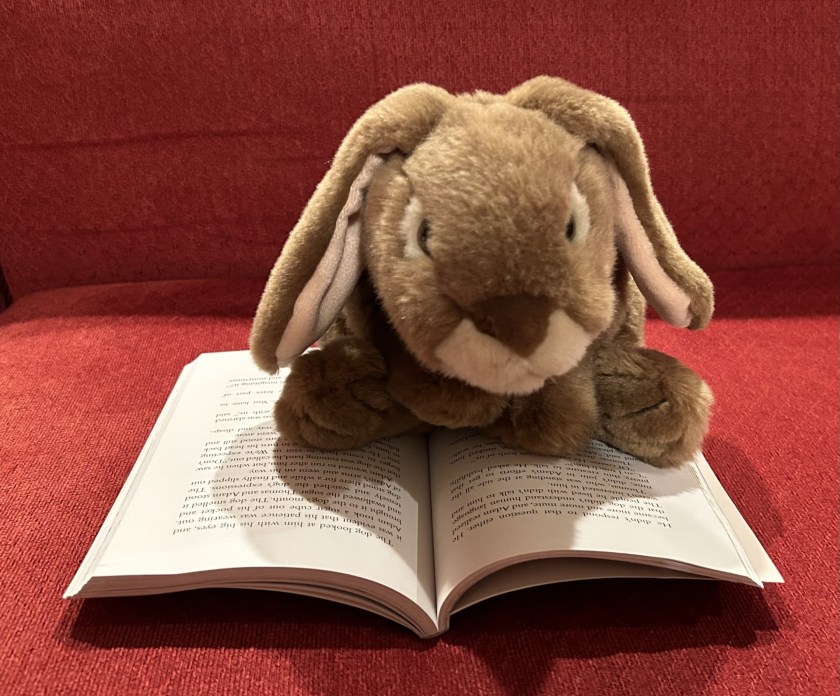
Caramel is reading Adam & Thomas, written by Aharon Appelfeld, translated into English by Jeffrey M. Green, and illustrated by Philippe Dumas.

S: Did you know this was a translation?

C: Yup. It says it on the cover page. And I know how to read.

S: Yes, of course. but sometimes people or even bunnies do not notice these things, so I thought I’d ask. So the author wrote this book in Hebrew, a language he learned only as a teenager. And he was apparently a pretty well-known author in Hebrew, and in English translation, and Jeffrey Green who translated this book was his standard translator.

C: I did not know any of that. But I think the English works perfectly well. I mean I thought it was a good book for young bunnies.

S: Yes, you are right. The sentences are simple and short. I think it is just right for young bunnies, even though the topic is a bit sensitive, and some younger bunnies might not be able to handle it.

C: Yes, I think so too. But the book is also a little long for really young bunnies. It has almost 150 pages!

S: But there are illustrations on almost every other page!

C: True. And they are really neat too.

S: Tell me more.

C: The illustrations are relatively simple and yet very detailed too. They are in color, and I liked looking at them.

S: I liked them too Caramel! So are you still upset with me for making you start reading this book?

C: No, not really. I think this is a good book with an interesting storyline, and it makes you feel like it might have actually happened. Like the characters are real people.

S: Apparently the author himself ran from a camp and lived in similar circumstances when he was about that age. So that might be why you found it so realistic, because it was real, at least to an extent.

C: Yes.

S: So maybe this is a good time to wrap up this review then. What would you like to tell our readers?

C: Stay tuned for more book bunny reviews!

Caramel appreciated reading Adam & Thomas, written by Aharon Appelfeld, translated into English by Jeffrey M. Green, and illustrated by Philippe Dumas, and thinks it is a good story to teach little bunnies about what happened to some young children during World War II.