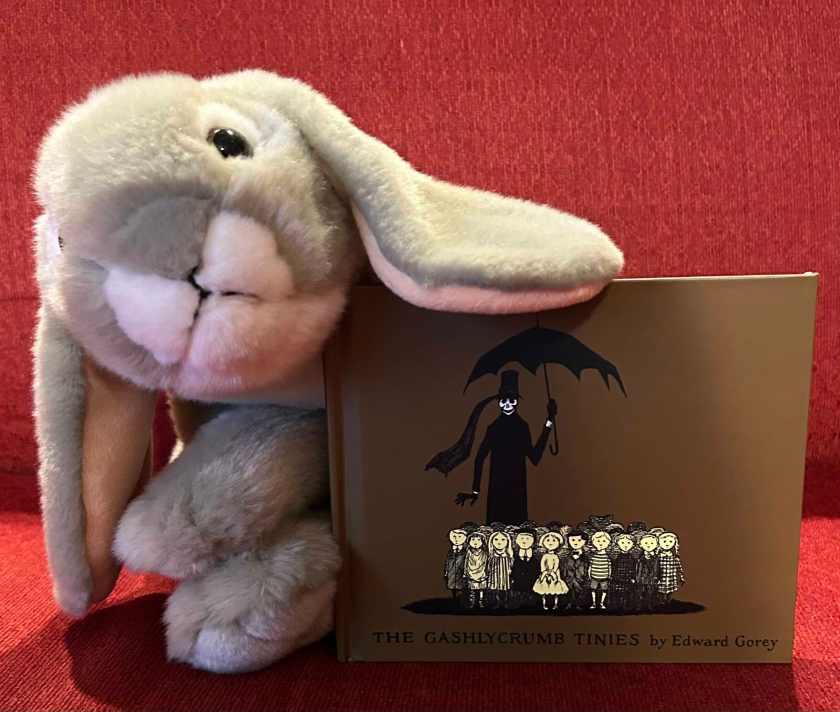
Today, to celebrate the spirit of Halloween, which was just yesterday, Sprinkles reviews The Gashlycrumb Tinies, or After the Outing by Edward Gorey, first published in 1963.
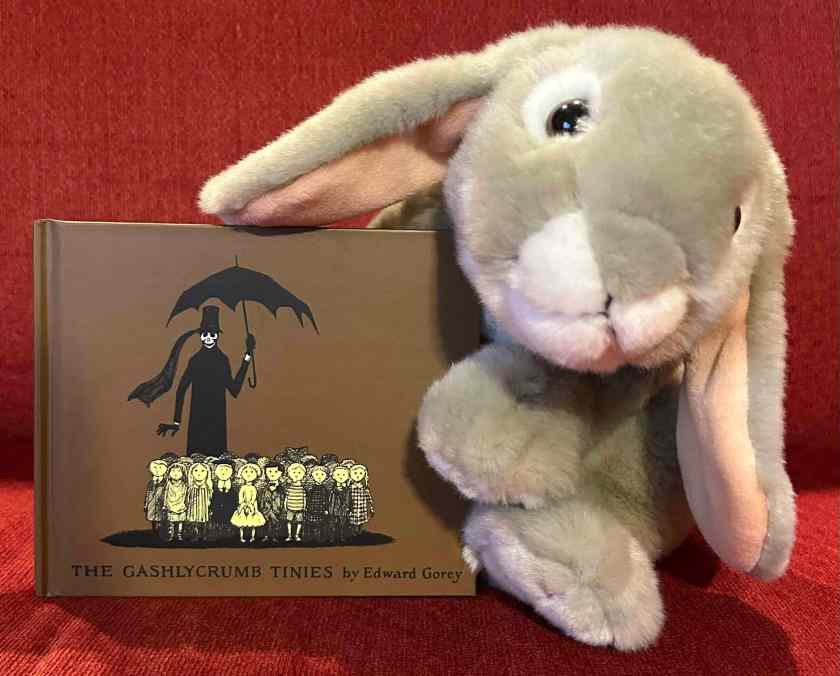
The Gashlycrumb Tinies is written in the guise of an alphabet book, a book that has a page for each letter of the English alphabet with one word per letter described by words and / or depicted by some images explaining the word. But this is not a very good book to be handed out to young bunnies to read on their own.
The book does indeed have a page dedicated to each letter and there is a simple rhyme that holds up through the whole text, but the content is a lot more disturbing than one might expect. As this review is meant for Halloween, readers might expect something spooky. And indeed, the book is basically a list of twenty six children’s names, one child per letter, and lists the varied morbid ways each has died.
So if that is not too weird for you, here is a snippet to give you a taste:
I is for IDA, who drowned in a lake
J is for JAMES who took lye by mistake
K is for KATE who was struck with an axe
L is for LEO who swallowed some tacks
You get the point, I presume.
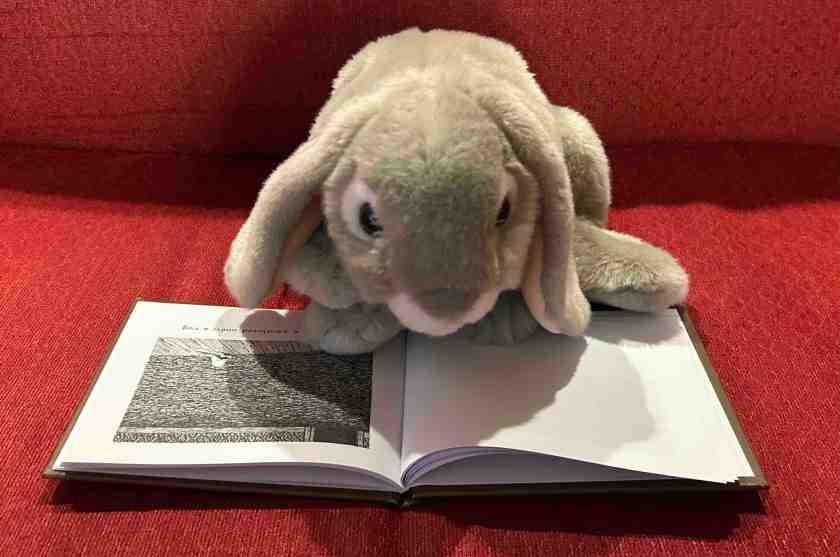
The book is the brainchild of the illustrious artist Edward Gorey, who was also the illustrator of Old Possum’s Book of Practical Cats by T.S. Eliot, which I read and reviewed a while ago. His art is textured, mostly dark, and very vivid. The children are always alone and so very small in the expansive space they are set in. One wants to pick them up and save them but of course that is impossible.
Gorey apparently said that the book was inspired by “those 19th-century cautionary tales, I guess, though my book is punishment without misbehavior”. Indeed all the illustrations accompanying the sentences about the untimely deaths of these poor young children are black-and-white, and have a somewhat eerie, old-fashioned feel to them. The image accompanying the “IDA” line I quoted above shows a dark but calm lake, a boat on the lake, and a little girl who is leaning over from the edge of the boat looking into the lake. The girl seems a bit unbalanced, and you might think that she might trip over, but you actually do not expect that will happen, because the image looks kind of serene. But then again you know, in this book, nothing goes right.
The book is probably not appropriate for the very young bunch, but it might be fun to read together with a young bunny with a morbid sense of humor. Otherwise it is best kept for a treasure for the parents or parents-to-be, who might be worrying non-stop about all the fanciful dangers little ones might face in this world. To awaken in them the reality that living itself is dangerous, the ways these little ones die are almost all kind of simple (except perhaps for poor Xerxes, who was “devoured by mice” and Neville who “died of ennui”). As such, the book is not even good as a cautionary tale for little ones; it simply is what it is: a morbid little book poking fun at our shock that at least some of us survive till adulthood. Why not take a look at it this Halloween to explore the absurdity of our fears and the unlikelihood of the survival of our species?