Caramel reviews Dungeon Crawler Carl by Matt Dinniman

For his first post after summer break, Caramel is talking to Sprinkles abut Dungeon Crawler Carl by Matt Dinniman, a book originally published in 2020. As usual Sprinkles is taking notes and asking questions.
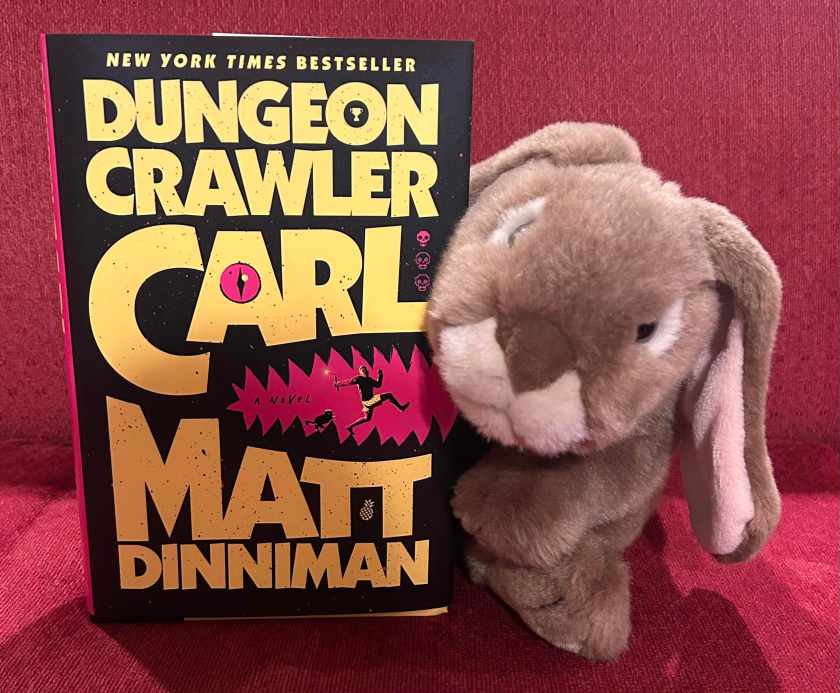
Caramel reviews Dungeon Crawler Carl by Matt Dinniman.

Sprinkles: So Caramel, this was a really long book, but you read it quite fast…

Caramel: Yes, I did. It was very captivating, almost like a dungeon you cannot get out of. Sorry that was a poor joke.

S: Well, it is not clear why that’s a joke, even, so maybe it would help if you told us a bit about the book first.

C: Good point. So the book is about a guy named Carl, as you can imagine, and the world has ended.

S: Wait, what do you mean?

C: Well, the book starts when Carl is in a dungeon. Then there is a flashback and we learn that the Earth was lost, due to some weird legal issue, kind of like in The Hitchhiker’s Guide to the Galaxy, actually. And so an alien corporation took over the planet and crushed every roof on the planet and almost everyone died.

S: That’s pretty bleak. At least The Hitchhiker’s Guide was funny.

C: Well, this is quite funny too, at times. But so the planet is taken and the remaining humans are given a chance to participate in a reality TV show that is a dungeon crawl. It is kind of a role playing game where the players have D&D-like skills and traits.

S: Oh I see, that is why Carl is a dungeon crawler, right?

C: Yep. And his partner is a cat named Princess Donut.

S: Wait, a cat?

C: Yes, she is a show cat, and through one of the weirdnesses of the show they are in, she can speak.

S: That is interesting!

C: Yes, very.
Caramel is reading Dungeon Crawler Carl by Matt Dinniman.

S: So the book is about Carl and Princess Donut going through the dungeon?

C: Not only them. The reality TV show is called Dungeon Crawler World: Earth. And apparently it is one of many this corporation has been running, in many different planets. And in the book there are many other crawlers that Carl and Princess Donut meet. In the beginning there were thirteen million who started. And then by the second chapter a couple million have been eliminated, and it goes like that.

S: That sounds cruel.

C: Yes, well, they took over the planet and they don’t seem to care about the living beings on it. More than 90% of the population just died during the takeover, and about twenty million or so humans remain. About thirteen million of these go to the dungeon for a chance to be free.

S: This is kind of like The Hunger Games and Dungeons & Dragons got together and had a terrible baby.

C: Oh yes, and also remember the Purging Trials from the Powerless books that Marshmallow reviewed. Put them all together and then mix…

S: It is a pretty bleak future.

C: Yes.

S: Was it not too depressing?

C: Not too much. After all I know it is fiction. And it is really funny sometimes. But maybe the very young bunnies should not read it. Still it is a good book.

S: And apparently there are quite a few sequels.

C: Which I will need to read…

S: Okay, we will see about that. So Caramel, maybe this is a good time to wrap up this review, what do you think?

C: Sure.

S: What do you want to tell our readers?

C: We are back! Stay tuned for more book bunny reviews!
Caramel enjoyed reading Dungeon Crawler Carl by Matt Dinniman and can't wait to get his paws on the second book.
Caramel enjoyed reading Dungeon Crawler Carl by Matt Dinniman and can’t wait to get his paws on the second book.

Caramel reviews Confessions of a Trash Droid: Fatal Error by Michael Cheney

For his last post before our summer break, Caramel decided to review the first book in the Confessions of a Trash Droid series of Michael Cheney: Fatal Error first published in 2025. As usual, Sprinkles is taking notes and asking questions.

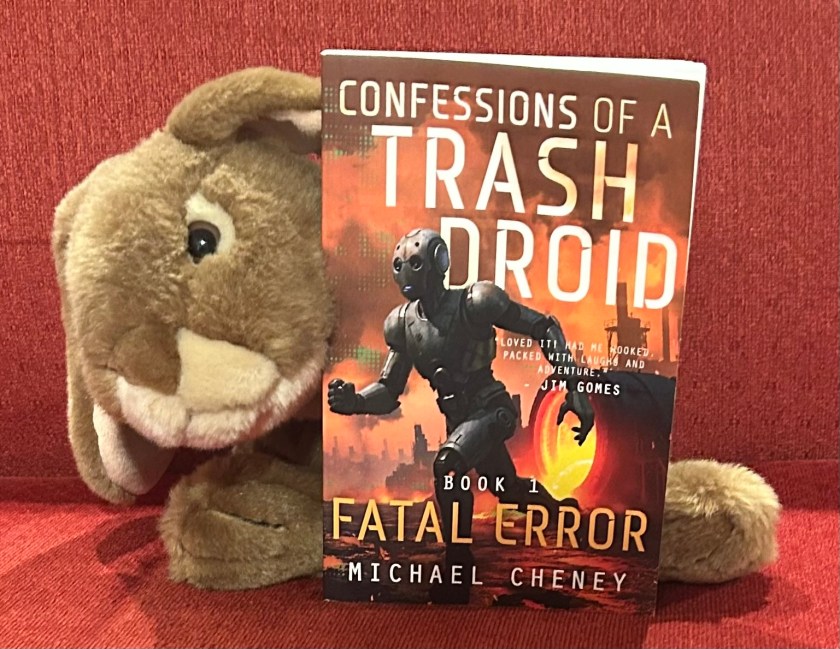
Caramel reviews Confessions of a Trash Droid: Fatal Error by Michael Cheney.

Sprinkles: So Caramel, tell us a bit about this book.

Caramel: This is a book about a robot. This robot is sentient and he does not really like humans.

S: How come?

C: He does think they are very useful or intelligent.

S: Hmm, one does not have to be useful or intelligent to be worthy of care and kindness, but okay. So why is he a trash droid? Does he collect trash? Or is he old and people want to discard him like trash?

C: The first more or less: he is a waste disposal robot.

S: Okay, so what happens to him?

C: So he is on a plane that crashes and he does nothing to save anyone. So the company that built him or is using him is mad because he is supposed to help humans.

S: So is that what the confessions part of the title is about?

C: Sort of. But also he has a strange error that causes him to black out and go violent and so on.

Caramel is reading Confessions of a Trash Droid: Fatal Error by Michael Cheney.

S: This reminds me a lot of Murderbot, at least in the TV series version, where he was having flashbacks or memory clips of himself going violent and being involved in a chaotic event.

C: Yeah, there are some parallels for sure.

S: Honestly when I first read the description of the book, I immediately thought of All Systems Red and Artificial Condition. So I thought you might enjoy it.

C: Yeah, I did enjoy it; it is pretty good. And yes, there are some similarities perhaps but this one is a little more of a misanthrope, you’d say, he is much more negative towards humans. And he is more robotic. Murderbot is a lot more human, his body is a lot more organic, and he looks like and can pass as a human. The trash droid looks very robotic. Also this one has a much much dirtier vocabulary. There is a bad word every few sentences. I mean it works, but maybe if a bunny’s parents don’t want them to read a book with bad words, this might not be right for them.

S: And I think this one has much shorter chapters.

C: Yeah, it is also a shorter book. So quite easy to read.

S: Okay, Caramel, I think this is a good time to wrap up our review. 

C: Sure. 

S: And this is your last review till August. 

C: I love summer time!!!

S: Yes, summer is really nice. And we will take July off as usual. So what would you like to tell our readers?

C: Stay tuned for more book bunny reviews! There is one more post from Marshmallow and then there will be many more in August!  
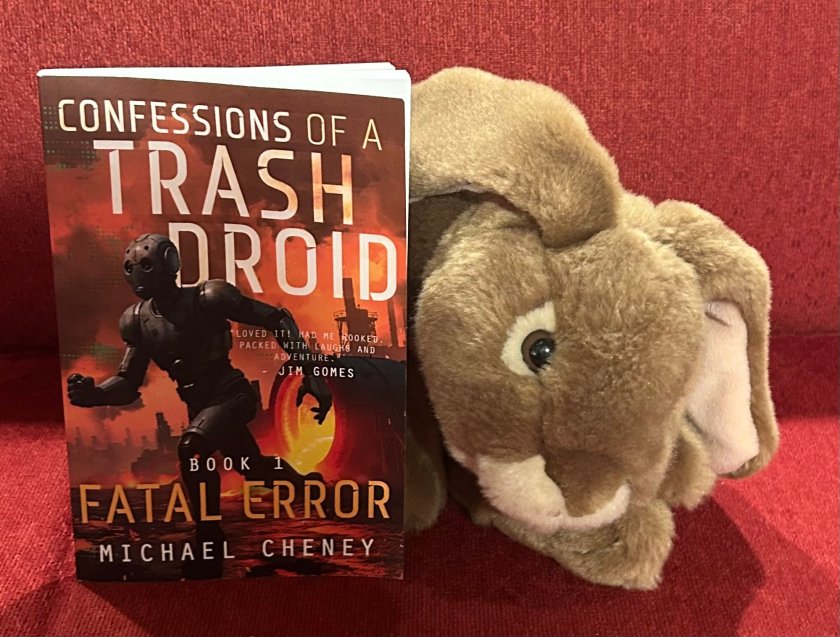
Caramel enjoyed reading Confessions of a Trash Droid: Fatal Error by Michael Cheney and is curious about the future books in the series.

Marshmallow reviews Gleanings by Neal Shusterman

Marshmallow has already read and reviewed Scythe, Thunderhead, and The Toll, the three books in Neal Shusterman’s Arc of a Scythe series. Today she is writing about Gleanings: Stories from the Arc of a Scythe, a collection of stories Shusterman published in 2022 that explores some of the lesser known features of the same story universe.

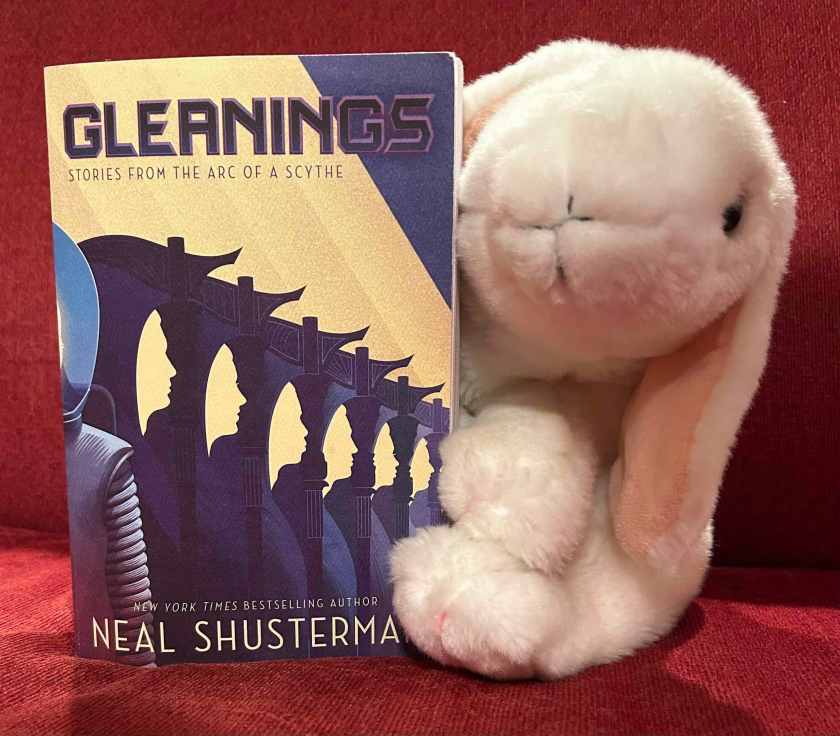
Marshmallow reviews Gleanings: Stories from the Arc of a Scythe by Neal Shusterman.

Marshmallow’s Quick Take: If you liked reading any of the books in the Arc of a Scythe trilogy, then this is the book for you!

Marshmallow’s Summary (with Spoilers): In the three original books about the world of scythes and the Thunderhead, Shusterman did an amazing job of creating an immersive story. But such tales have a tendency to leave the reader wanting more, which is exactly what happened to me at the end of the series. While the main plot lines were all resolved well, I still really wanted to read more about that world; the premise is simply intriguing (a post-mortality world full of fascinating technology and sheltered by a benevolent AI on the cusp of a new era of space expansion). Luckily, Shusterman was very nice and wrote this collection of stories, some in collaboration with other authors.

The first story–titled “Formidable”–goes to a period before the events in the Arc of a Scythe series took place. It elaborates on the rise of Scythe Marie Curie who is a major character with a past that is often mentioned with only sparing detail. In Gleanings, we finally learn more about her rise to fame as the scythe who set humanity free from its bureaucratic history. The next story is titled “Never Work with Animals” and introduces a new scythe, a new setting, and a new story but with one familiar face. “A Death of Many Colors” similarly shows another scythe and makes Shusterman’s fiction feel even more real by adding yet another thread to the tapestry he has been weaving.

By adding so many new stories about scythes, the Thunderhead, and their world, Shusterman creates an even more expansive setting. “Unsavory Row.” “The Mortal Canvas,” “The Persistence of Memory,” and “Perchance to Gleam” especially were stories that colored in so many new aspects of the sci-fi world and were so very detailed in that goal. “Unsavory Row” peeled back the word ‘unsavory’ and presented another perspective of what that label means to those labeled. My favorite story “The Mortal Canvas” teaches readers about the period right after immortality was achieved. “Perchance to Gleam” also explores another part of that world and its different culture (and thus the scythes’ different gleaning methods). In “A Martian Minute,” we learn what truly happened in Goddard’s mysterious past and “Cirri” and “A Dark Curtain Rises” reveal what happens after he is later defeated.

Questions you forgot you had are answered and the world of the Arc of a Scythe is broadened. Reading this book is a great way to continue the journey you started when you picked up the first book!

Marshmallow is reading Gleanings: Stories from the Arc of a Scythe by Neal Shusterman.

Marshmallow’s Review: I’d like to start by praising Shusterman’s fluid prose. I think part of what makes this book and the Arc of a Scythe books so good is his writing. I really only started appreciating it when I noticed some parts of some stories (the ones that were co-written with others) sounded a little different and sometimes a little less smooth. In general though, this book flows so clearly that you have no choice but to allow yourself to be swept forward with the story. All of the stories are fascinating and are deeply satisfying to read.

I find the world Shusterman describes to be extremely interesting and reading this book expanded my knowledge and understanding of it significantly. I particularly liked reading “The Mortal Canvas.” All of the stories are mostly related to the main series and are gratifying to read as an extension. They all make you think and compare between the texts. But “The Mortal Canvas” could also just be a stand alone story as well. I think you could read it without having read the previous books (though that might also go for all the others, just as long as you don’t mind having everything revealed to you). In this story, young students at an art school grapple with the disconnect between the only reality they’ve known (a world without death) and the past their teacher came from (a world where death took her husband and was a constant). This plot not only reveals more about that period of time, it also asks truly deep questions about mortality and what it means to us as creators, humans, and beings that exist at all. Reading “The Mortal Canvas” made me really think about life and what our purpose is. That sounds cliche, but it did. This ending line reveals just a fraction of the fascinating ideas inspired by this story:

‘She said her life was completed,’ […] ‘That’s something that none of us will ever experience. Even if we’re gleaned someday, it won’t be the same, because we weren’t born mortal. From this movement on, no one will ever know what it feels like to be complete’ […] she smiled through her tears–because they both knew that together they might just get one step closer to completion” (Shusterman 246-7).

I think this story has made me recognize how meaningful life is. While length is lovely, it is the depth of what you do with it that matters the most. Shusterman’s imaginary world offers opportunities to wrestle with what it means to be human when that length is luckily granted to all but that meaning is unluckily lost to most. In this aspect, I think this book and the series that came before it are truly masterpieces. These books are books that we should read alongside 1984 and Brave New World. While I would recommend waiting until you’re older than twelve, I would still suggest reading this book to all bunnies ready to recognize a literary jewel!

Marshmallow’s Rating: 100%.

Marshmallow rates Gleanings: Stories from the Arc of a Scythe by Neal Shusterman 100%.

Midnight reviews Foundation and Empire by Isaac Asimov

Late last year the mysterious and reclusive black bunny of the family, Midnight, decided to join in the book fun and reviewed Foundation by Isaac Asimov, the first book in Asimov’s Foundation trilogy. Today he is talking to Sprinkles about the second book in the series, Foundation and Empire, originally published in 1952.

Midnight reviews Foundation and Empire by Isaac Asimov.

Sprinkles: It is nice to have you back here for another book review, Midnight!

Midnight: It’s good to be invited back. A being such as myself needs to be invited across a threshold before entering. (Bares teeth.)

Sprinkles: No need to try to be menacing Midnight; we appreciate you without the fear factor.

Midnight: Hmm. Underestimate me at your peril.

Sprinkles: Okay, whatever. So last time you and I talked about Asimov’s Foundation. And today we are talking about the second book in the series: Foundation and Empire.

Midnight: Foundation and Empire is really two long stories put together in one volume.

Sprinkles: Like the first book, which was five stories put together, right?

Midnight: If you want to put words in my mouth, then I suppose so.

Sprinkles: Okay, then you can use your own words. Go ahead.

Midnight: As I was saying, there are two stories. The first story is called “The General”. It is about Bel Riose, an ambitious general of the Galactic Empire who wants to fight for the glory of the Empire. He wants to attack the Foundation, which is by now a serious galactic power itself.

Sprinkles: But Hari Seldon comes through for the Foundation once more, right?

Midnight: Yes. However, by this point in galactic history, Hari Seldon is long dead. But as this rabbit can tell you, the long dead may still pose a great danger to the unwary. (Bares teeth.)

Sprinkles: Midnight! Stop scaring our readers. Some of them are young.

Midnight: Some people say I overcompensate for my modest size. Anyway, I thought you did not want to provide too many spoilers in these reviews, so I was trying to be entertaining.

Sprinkles: Yes, you are right, maybe we should not go too deep into the plot. But I think it is an important setup for the second story …

Midnight: Yes, in some ways. The second story is called “The Mule” and it is about a new challenge for the Foundation that Seldon could not have predicted. Things get out of hand, and a small group of people from the Foundation heads out to look for the mythical Second Foundation in order to reclaim Seldon’s legacy.

Sprinkles: Yes, I think this is a good summary of the plot.

Midnight: Glad you approve.

Midnight is reading Foundation and Empire by Isaac Asimov.

Sprinkles: Anyways, maybe that is enough about the plot.

Midnight: Now what do we talk about?

Sprinkles: What else do you want to say about the book?

Midnight: Not much. I think I am not an Asimov fan. This book was better than the first book though. The characters were a bit more developed. The jumps in time were less drastic. The first book skipped around five different times or something. Here we have only the two, separated by about a century. So that allowed him to focus on the characters in each story a bit more.

Sprinkles: I did like the characters in this book a lot more actually. I also really liked the idea of the visi-sonor, the musical instrument the clown Magnifico played in the second part. It could combine sound and images and affect people’s emotions. It fit the storyline really well, too.

Midnight: True. Also, there is a twist at the end of “The Mule” which I had not expected, so that was successful.

Sprinkles: I did not catch it either. And I agree. It was good.

Midnight: I guess you will want to talk with me about the third book next.

Sprinkles: That would be great!

Midnight: I am not committing to it. I may take a break from Asimov for a while. No one commands Midnight.

Sprinkles: Sure, we can take a break from Asimov, I suppose. I would love to get back to it eventually, but maybe you will enjoy talking about some Tolkien next.

Midnight: That sounds great! I really enjoy watching science fiction, but somehow reading it is not my beverage of choice.

Sprinkles: Yes, you are more into fantasy. So maybe that is what we can talk about the next time you visit.

Midnight: No promises.

Sprinkles: Okay, Midnight. This is a good place as any to wrap up this review. So what will you say as your last words?

Midnight: Farewell, dear reader. Until such a time as the Black Bunny sees fit to reappear.

Midnight enjoyed reading Foundation and Empire by Isaac Asimov. He might even come back some day out of the shadow realm where he normally resides to pontificate about the next book in the series.