Midnight reviews Foundation by Isaac Asimov

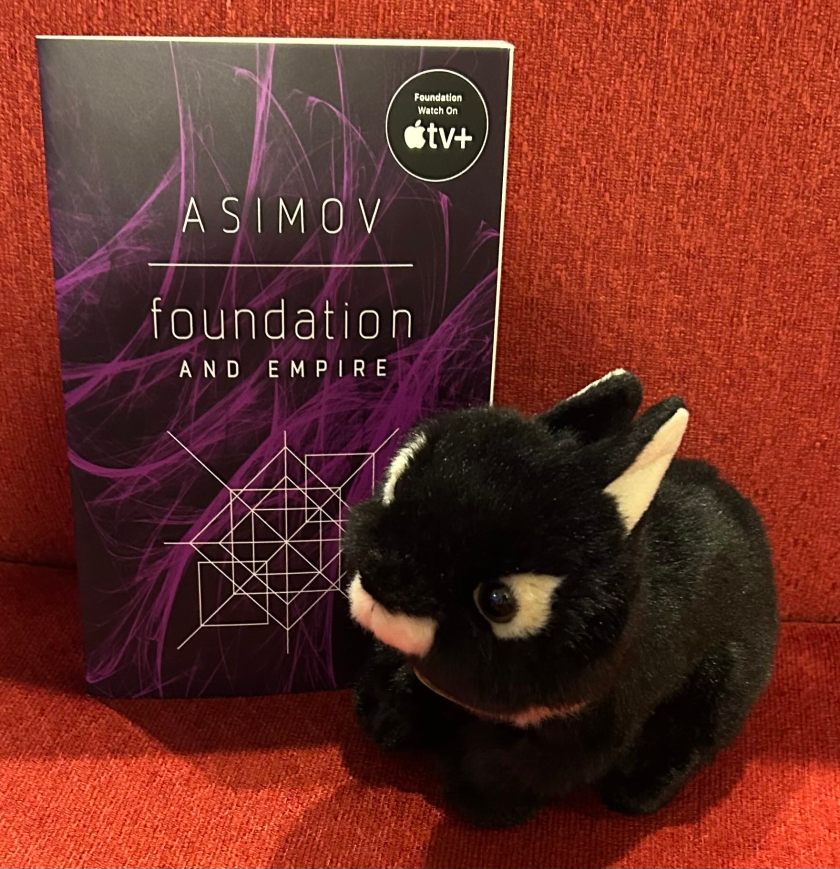
Today we have a surprise for you: The mysterious and reclusive black bunny of the family, Midnight, decided he wants to join in the book fun! So here follows the first book review by Midnight, where he talks to Sprinkles about Isaac Asimov’s classic Foundation, the first book of the famous Foundation trilogy, originally published as a stand-alone book in 1951.

Midnight reviews Foundation by Isaac Asimov.

Sprinkles: Midnight, I am so happy to welcome you to the book bunnies blog!

Midnight: It’s wonderful to be here. It’s certainly a thrill.

Sprinkles: So you chose Asimov’s Foundation as your first book. Can you tell us a bit about it?

Midnight: It’s almost like another bunny purchased it for me and suggested that I read it.

Sprinkles: Yes, that is true. I read it on my tablet via the Libby app, but then I thought you might enjoy it too.

Midnight: It is a short book about the decline and fall of the Galactic Empire.

Sprinkles: Wait, the Galactic Empire is something from Star Wars, no?

Midnight: Foundation predates Star Wars by several decades. It was written originally as a series of short stories in the 1940s, and published in science fiction magazines, until in 1951 Asimov put them together into a book. The first Star Wars movie came out in 1977.

Sprinkles: Okay, okay, of course you know the timeline really well. But then tell us a bit about this Galactic Empire. Are we talking about our own galaxy, the Milky Way?

Midnight: Yes, we are, and they keep talking about humans and no other aliens. And sadly no bunnies are mentioned. (But we can assume that they control everything from the shadows–as they do in the present.)

Sprinkles: Midnight, let us not scare our readers away with your schemes of world (or universe) domination. Let’s get back to the book. Okay, we are talking about a galactic empire in the Milky Way, so this is far into the future, right?

Midnight: Yes. The Galactic Empire has endured for about twelve thousand years and spans the entire galaxy. According to other Asimov books in the same universal timeline, the Empire was founded about ten thousand years into the future from now.

Sprinkles: That is way in the future! Kind of like Caramel’s WarHammer storyline, which was about forty thousand years into the future. That’s kind of cool!

Midnight: That’s not a question.

Sprinkles: Okay, I will try to phrase my words into questions. I did not read much about WarHammer, but I know it describes a rather dystopian future. The one Asimov describes is not as dismal, is it?

Midnight: True. The Galactic Empire seems modeled after the Roman Empire to some extent. It is ruled by a monarch from the imperial capital planet Trantor. But the empire is in a slow decline that is inexorable according to Hari Seldon, the main character in the first portion of the book.

Sprinkles: Yes, I remember the book is written in five separate sections, which must be the five stories that were published separately earlier. Seldon is the main character in the very first one, but he does appear in the later ones too, no?

Midnight: Yes, but it is probably more accurate to say his influence is felt in the later ones.

Sprinkles: Yes okay. Go on.

Midnight: So Seldon is a scholar of psychohistory, a discipline that uses mathematical tools to model psychology of large groups of people to make predictions about their collective behavior. If the sample sizes are large enough, Asimov suggests that predictions can be made with high degree of certainty. Seldon predicts the downfall of the Empire, and that the galaxy will go through a dark age that would last thirty thousand years.

Sprinkles: That would bring us to past 40K, the time of WarHammer! What an interesting coincidence! Anyways, psychohistory kind of sounds to me like using big data to predict, and we know that has worked pretty well in predicting people’s purchasing decisions and such, but it is not clear it would work for historical events. I guess that is why this is science fiction.

Midnight: Yes. And the book was written quite a bit before mathematicians began studying chaos theory, and Lorenz’s discovery of the butterfly effect in weather prediction.

Sprinkles: Yes, that is true too. Okay, coming back to this being fiction. Let us accept the premise of the book that Seldon has this theory that predicts the future of the Empire. Then what happens?

Midnight: Seldon starts a foundation on the planet Terminus, at the edge of the galaxy, recruiting a group of scholars, ostensibly to compile a great encyclopedia of all knowledge from which humanity will be able to restore the galaxy to some sense of civilization. According to the Seldon Plan, the Foundation would be able to shorten the dark age to only one thousand years.

Sprinkles: I see what you did there. The word “ostensibly” seems to have silently found its way into your sentence.

Midnight is reading Foundation by Isaac Asimov.

Sprinkles: Anyways, maybe this is enough about the plot of the book.

Midnight: Okay. What do I need to say now?

Sprinkles: Well, you can tell me what you thought of the book.

Midnight: The book takes place over many centuries, so a new cast of characters is introduced in each part of the book.

Sprinkles: The five main parts we mentioned earlier?

Midnight: Yes. But this means that characters do not necessarily have the same depth that they might in a conventional novel.

Sprinkles: Yeah, I can see that.

Midnight: And there is a lot of speaking about things as opposed to showing events take place. Asimov has a lot of big ideas, but when centuries pass every few pages, one does not feel quite as invested in the individual characters and one does not get too much of a sense of who they are as people. They are more vehicles to deliver context and story.

Sprinkles: I can see your Tolkien fan feelings coming out here. Tolkien spent a lifetime developing his world, and his characters are often much richer and deeper.

Midnight: Let’s compare this to the Silmarillion, which takes place over thousands of years and characters come in and out of the narrative over these vast time scales, kind of like in Foundation. I feel like I have a lot clearer sense of those characters than Asimov’s in this book.

Sprinkles: I have not read Silmarillion, but my guess is that Tolkien has a different style and different goals. He cares a lot more about his characters, while maybe Asimov is trying to tell us a possible future.

Midnight: I am not sure I’d say that. I think Tolkien is also retelling a vast history, and does not set out to write a character-driven drama. But somehow his characters are more complete people in my mind.

Sprinkles: Well, Midnight, then you will have to come back and review Silmarillion for us some day.

Midnight: Well, I don’t want to sound too negative about Foundation. I did find the ideas intriguing and read the next several books in the series. I found some of the characters in those books more compelling and three-dimensional.

Sprinkles: Okay, then, maybe you will also tell us about those books some day?

Midnight: Maybe. As a mysterious and reclusive bunny, I do not wish to commit to anything at this time.

Sprinkles: But that is alright. You have already shared with us some good thoughts on a classic, and that is already wonderful! I did like Foundation a lot myself, and it seems that you enjoyed it, too. So maybe this is a good place to wrap up your first review. What do you think?

Midnight: Sounds reasonable to me.

Sprinkles: The little bunnies I interview for the blog have their own closing phrases when they are ending their posts. What would you like to tell our readers as we wrap up yours?

Midnight: A bunny as sophisticated, as complicated, and as self-important as I, cannot be reduced to a simple catchphrase.

Sprinkles: I understand. But we do need to end this post. So what will you say as your last words?

Midnight: Farewell, dear reader. Until such a time as the Black Bunny sees fit to reappear.
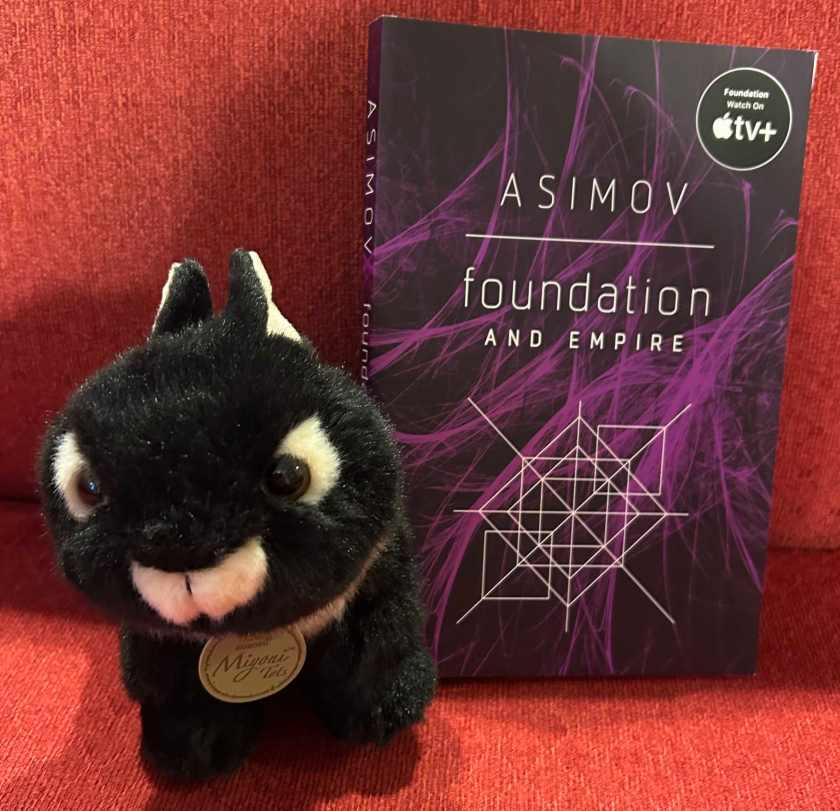
Midnight enjoyed reading Foundation by Isaac Asimov. He also enjoyed coming out of the shadow realm where he normally resides and pontificating about the book.

Caramel reviews Artificial Condition: The Murderbot Diaries by Martha Wells

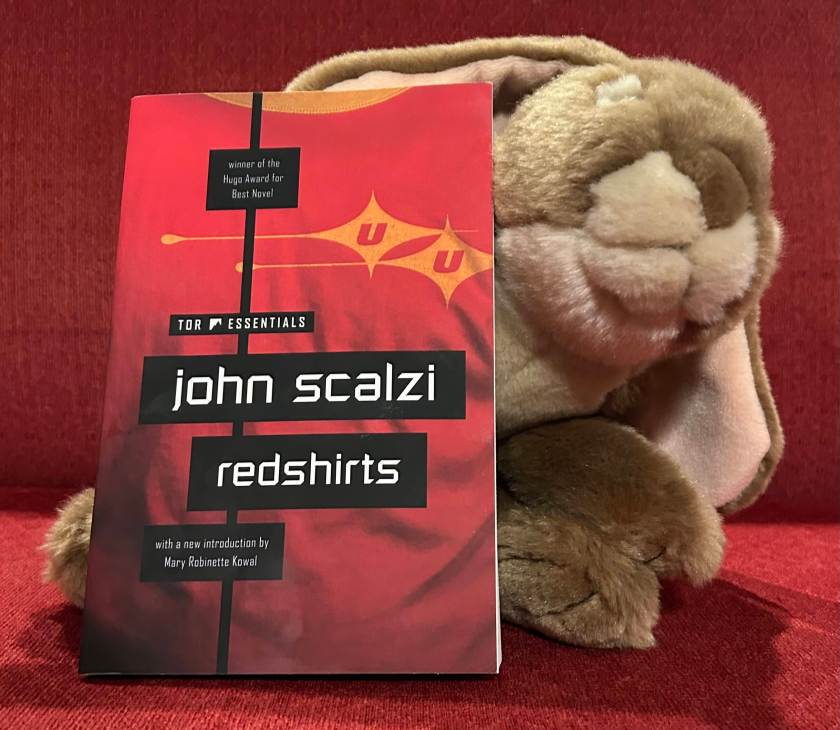
A few months ago, Caramel reviewed All Systems Red: The Murderbot Diaries by Martha Wells. Today he reviews Artificial Condition, the second book in the Murderbot Diaries saga, written originally in 2018. As usual, Sprinkles is taking notes and asking questions.

Caramel reviews Artificial Condition: The Murderbot Diaries by Martha Wells.

Sprinkles: So here we are ready to talk about a new Murderbot Diaries book. 

Caramel: Yeah, I like these books! This is the continuation of the first one, and I like it.

S: Okay, so maybe you can remind us a bit about what this is all about. Murderbot sounds kind of violent, like a technologically sophisticated and out-of-control killer robot. 

C: It is sort of true. The main character calls himself Murderbot, and he is definitely able to kill, he just sort of doesn’t.

S: Yes, I remember. He actually calls himself Murderbot kind of tongue in cheek, like a personal inside joke. He could kill everyone, but he just does not want to. Kind of. 

C: Yes, but he also is smart. He knows he is capable of killing humans, but also humans are very powerful and eventually they would capture him and melt him down. So even though humans sometimes really annoy him, he is kind of not going wild on a murderous rampage also because he does not want to die. 

S: We keep saying “he” and “die” and “wants” and so on, almost humanizing him. This is a cyborg, a part-organic, part-robot creature, who has hacked his own governing module, so he has about as much free will as the humans around him. 

C: Exactly. He has full control over his body and mind, and he enjoys watching soap operas instead of dealing with humans and killing things and so on. But he is a SecUnit, that means he is a security unit, his job is to defend the people who hire him, and so occasionally he has to fight. 

S: In the first book, he joined a group of scientists who were surveying a planet searching for anything useful or interesting. We even ended up watching the TV series they made out of that book. I think you enjoyed that a lot. 

C: Yes! I think it is more correct to say that we both enjoyed it. 

S: True. 

C: And this book takes over when that first book ended, and more or less where the first season of the TV show ends. Murderbot is now traveling on his own and he faces new enemies and makes new friends. 

S: That sounds cool! 

C: It is cool. There is a new character, a very powerful artificial intelligence, for example, and he is pretty cool. But he is annoying too, so Murderbot calls him ART in his mind. R and T stand for Research Transport, and A stands for a word I cannot say because I am a good little bunny who does not say bad words. (But don’t worry. There are not that many other bad words in the book.)

Caramel is reading Artificial Condition: The Murderbot Diaries by Martha Wells.

S: So it sounds like this book is quite fun too. Is it as fun as the first book? 

C: Yes, maybe more fun, he is now a security advisor. And he still loves to watch his soap operas, but he is also a lot more interested in doing things, helping people, solving problems, and so on. And he is still very funny. And he makes a lot of funny sideways comments.

S: That is wonderful, Caramel. You know I still have not read the first book. I did enjoy the TV series though. And talking to you about this book makes me want to go back to that first book and read it after all. So then I can also read this one. 

C: Can we maybe add the trailer?

S: We have included the trailer for the first season in your review of the first book. They do not seem to yet have the trailer for the second season, even though they apparently will have one. 

C: Oh, okay. At least maybe our readers can go and check out that first trailer. The show is funny, and a lot funnier than the trailer. 

S: Yes, the title “Murderbot” kind of turns off some people, but it is actually pretty funny and interesting. 

C: I can see why people might not like the name, but it is not really that violent most of the time. Though there are some violent scenes. After all it is a SecUnit and has to fight sometimes. 

S: Yes. Okay, maybe this is a good time to wrap up this review. 

C: Sure, I can always go back to reading!

S: Sounds like a good idea. But before that, what would you like to tell our readers?

C: Stay tuned for more book bunny reviews!

Caramel loved reading Artificial Condition: The Murderbot Diaries by Martha Wells and is looking to read many more books in this series in the coming weeks and months.

Caramel reviews Star Wars: Lost Stars by Claudia Gray

Today Caramel is reviewing a book recommended by a friend of the blog: Star Wars: Lost Stars, written by Claudia Gray and published in 2015. As usual, Sprinkles is taking notes and asking questions.

Caramel reviews Star Wars: Lost Stars by Claudia Gray.

Sprinkles: Finally we are talking about the space book you had promised us a couple weeks ago

Caramel: Yes, it’s a Star Wars book this time.

S: What do you mean by that? Is it about the movies? You reviewed three books like that: Ultimate Star Wars: New Edition, Star Wars Encyclopedia of Starfighters and Other Vehicles by Landry Q. Walker, and Star Wars: Complete Vehicles – New Edition. Or is it fiction about the Star Wars universe? 

C: All those were cool! But this one is fiction. 

S: Oh great! You have reviewed two fictional works about the Star Wars universe before: 5-Minute Star Wars Stories by LucasFilm Press and A Jedi You Will Be by Preeti Chhibber and Mike Deas. But according to Wikipedia, there are almost a million books about the Star Wars universe, and many of them, this one included, basically expand the universe with storylines touching the stories of the original three movies. 

C: Yep, maybe not a million, but a lot! And this is one of them. It is what they call a “young adult” book. I am young but pretty far from being an adult. 

S: Hmm, I can see it is a lot thicker than those two books you reviewed before and there are no illustrations or cute drawings. 

C: No, unfortunately, it’s more of a romance thingy.

S: I guess when they call books “young adult”, sometimes romance shows up. And I know illustrations are always cool, and especially for space and technology related books, they would be really helpful.

C: Yeah, I wish it had drawings, too.

S: But you have also read many books without illustrations. Almost all the Wings of Fire books for example, not counting the graphic novelizations. So sometimes the story will still carry you along, because words help you see things too. 

C: Yes, that is true. 

S: Okay, so tell us a bit about the story itself. I understand we are in the Star Wars universe and there is some romance. But there has to be a story. 

C: It’s about two people: a boy named Thane Kyrell and a girl named Ciena Ree. They live on an Imperial world. The boy is relatively rich and the girl is poorer. They become good friends and end up learning how to fly.

S: Okay, you will have to slow down for me a bit. An Imperial world, what do you mean by that?

C: It is a planet which is governed by the Galactic Empire. You remember the Galactic Empire from the movies?

S: Oh yes, I do. Okay, I cheated and looked it up: Wikipedia says that “[t]he book is set before, during, and after the events of the Star Wars original trilogy (A New Hope, The Empire Strikes Back and Return of the Jedi), in which the Galactic Empire has tightened its stranglehold on systems in the Outer Rim while the Rebel Alliance also grows in strength.”

C: Don’t cheat! You should read the book if you want to know that! But anyways, yes, that is correct. 

S: Okay, so we know the setting, kind of. But they learn to fly? You mean space ships? 

C: Yep, they fly space ships, mostly inside atmosphere ships. Then they get really good, and they sneak into a show of the empire, and grand moff Tarken is there. The moff finds them and can see that they have potential. They then sign up to join the Imperial Navy, also known as the space people. They are the people who fly the TIE fighters.

Caramel is reading Star Wars: Lost Stars by Claudia Gray.

S: Wait, you are going way too fast for me. What is a show of the empire? And what is a moff?

C: They sort of just show off their power and ships.

S: Oh, kind of like a military parade or an air show? 

C: Yeah, except more dictator-like.

S: Well, the empire is kind of authoritarian, so that adds up. Okay so what is a moff? Sounds like a military rank then. 

C: it’s some sort of important military leader

S: I see. Then what happens?

C: Well, basically they are split up and one stays with the Empire while the other one joins the rebels. 

S: Is that how it ends?

C: No, that is kind of in the middle. 

S: I see; that is good. At least we have not given away too many plot secrets. But it sounds like an interesting tension, of two friends who take different sides in a very big conflict. The romance is between the two of them, I am assuming?

C: Yes, it is.

S: But from all that you are telling me, the romance is there, but the story could work even if we just assumed they were two very good friends who are facing the dilemma of choosing different paths. 

C: Yep, and honestly I’d have preferred that. 

S: I know you and Marshmallow do not love romance. But for many readers, that sometimes adds just some extra flavor. But it seems to me the Star Wars backdrop is actually quite engaging too. 

C: Yes, but it is not really a backdrop. It is really like you are living in the time of the movies and the world is very real. 

S: Okay, then. That sounds good to me. Would you recommend it to other bunnies who like the Star Wars universe? 

C: Maybe bunnies older than elementary school because younger bunnies do not like the mushy stuff too much. 

S: I can’t imagine which younger bunnies you are talking about! 

C: Hmm, me neither. 

S: Okay, let us leave it there then. But the story was cool, no? 

C: Yeah, it was neat to learn about how they got into flying. And it was a story of love and betrayal. And that can be kind of epic, you know. And I always love to read about the Star Wars universe and the ships and such. It was cool for example that Thane and Ciena were flying TIE fighters and we have seen them in all the movies. 

S: Yes, I can see how that could be neat. Okay, so maybe this is a good place to end this review. What would you like to tell our readers? 

C: Stay tuned for more book bunny reviews!

Caramel enjoyed reading Star Wars: Lost Stars by Claudia Gray and is now looking through a whole pile of other Star Wars books to pick the one to read next.

Sprinkles reviews Flatland: A Journey of Many Dimensions – The Movie Edition by Edwin A. Abbott

Today Sprinkles reviews a 2008 edition of a unique classic: Flatland: A Journey of Many Dimensions – The Movie Edition, credited to “Edwin A. Abbott, with Thomas Banchoff and the Filmmakers of Flatland“.

Today Sprinkles reviews Flatland: A Journey of Many Dimensions - The Movie Edition by Edwin A. Abbott, with Thomas Banchoff and the Filmmakers of Flatland.
Today Sprinkles reviews Flatland: A Journey of Many Dimensions – The Movie Edition by Edwin A. Abbott, with Thomas Banchoff and the Filmmakers of Flatland.

Flatland: A Romance of Many Dimensions by Edwin A. Abbott was originally published in 1884. As Wikipedia tells us, this was a novella written by “A Square” who lived in a two-dimensional world called Flatland. The main plot of the book involved the Square meeting a Sphere, coming into Flatland and teaching him about the third dimension. The Square, his consciousness now widened, began to stipulate the existence of fourth and higher dimensions, which in turn confused the Sphere.

The book’s story is amusing, and for many young minds it could be a welcome introduction to the mathematics and philosophy of higher dimensions. The adults reading the book together with their young one would also appreciate the satire underneath it all. Abbott’s pointed comments about the second class status of women in Victorian England, on the other hand, can be comprehended by some of the young crowd. (In Flatland, men are two-dimensional — they are polygons of various types — but women are one-dimensional; they are very very pointy and have no depth.)

The bottom of the Wikipedia article on Flatland lists several online places where one can access the full text of Flatland, as it is now in public domain. (Here, for example, is the Project Gutenberg version.) But I wanted to review this particular 2008 edition of the book because it not only contains the full text but also has some information about the 2007 movie made based on it. As such there are many colorful illustrations in the book, and this might make it even more fun for a young bunny to look through and read along.

Sprinkles is reading Flatland: A Journey of Many Dimensions - The Movie Edition by Edwin A. Abbott, with Thomas Banchoff and the Filmmakers of Flatland.
Sprinkles is reading Flatland: A Journey of Many Dimensions – The Movie Edition by Edwin A. Abbott, with Thomas Banchoff and the Filmmakers of Flatland.

Abbott’s original novella is not too long, so it takes about half of this large-format book. The rest of the book is also worth reading however. There is a short introduction by the mathematician Thomas Banchoff at the beginning, which is worth reading to contextualize what is to come. Then the whole text of the classic Flatland follows. After that, the second part of the book starts. This section is titled “Flatland: The Movie” and includes three brief essays (“Finding Flatland” by producer Seth Caplan, “Imagining Flatland” by director Jeffrey Travis, and “The Visual Design of Flatland: the Movie” by director and animator Dano Johnson), lots of colorful images on high-quality paper, and then the screenplay of the whole film.

Trailer of Flatland: The Movie, from YouTube.

The movie is also worth watching, actually, and it seems to be available in a bunch of places, including YouTube. Apparently right around the same time, some other folks made a second movie based on Flatland, so sometimes people get confused, but the book I am talking about here and the trailer above are both related to the shorter movie voiced by actors like Martin SheenKristen Bell and Tony Hale.

All in all, I recommend Flatland very highly; you should read it and you should introduce all the bunnies around you to it. The 2008 edition here is a good place to start, but it is also fine if you choose the movie version first. I should note that the women are not one-dimensional in the movie: the Victorian satire tends to go on the back-burner there, and the math seems to come to the fore. Which is fine by me but your preferences might be different.

Sprinkles enjoyed reading Flatland: A Journey of Many Dimensions - The Movie Edition by Edwin A. Abbott, with Thomas Banchoff and the Filmmakers of Flatland, and recommends it to all bunnies young and old.
Sprinkles enjoyed reading Flatland: A Journey of Many Dimensions – The Movie Edition by Edwin A. Abbott, with Thomas Banchoff and the Filmmakers of Flatland, and recommends it to all bunnies young and old.