Last week Caramel reviewed Warhammer 40,000: Core Book, the core rule book for a tabletop game he is really keen on these days. Then he realized that he also could talk about his other favorite tabletop game, Dungeons & Dragons, and brought his rule book out. So today he is talking to Sprinkles about Pathfinder Roleplaying Game: Core Rulebook.
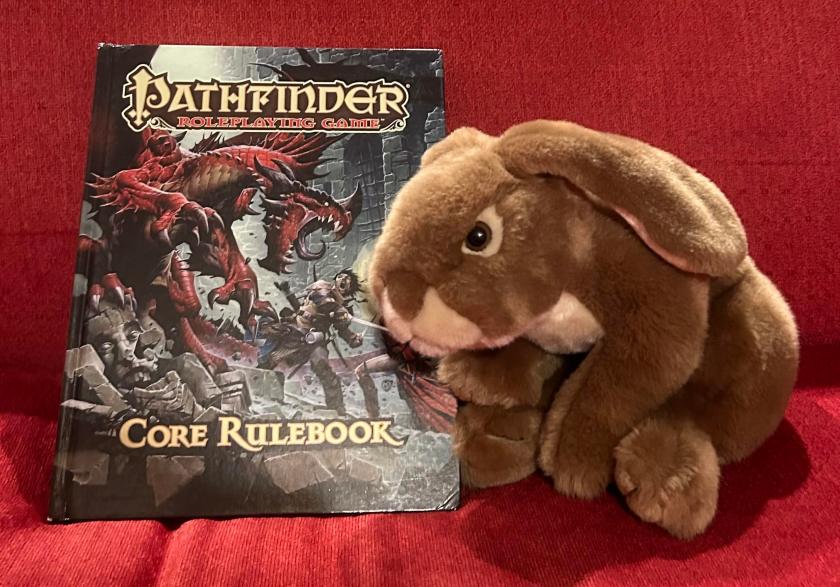
Sprinkles: So, you found another rule book for another tabletop game. This one is about Pathfinder. And I am not sure everyone knows what that is. So why don’t you start by telling us something about the game?
Caramel: Sure, I suppose everyone knows about Dungeons & Dragons (D&D) but Pathfinder is a bit different from D&D. It is actually very similar to D&D version 3.5. However there are some slight differences in the character types, and I think there are some changes in the rules.
S: Okay, wait. So let us go back a bit. First there is the famous tabletop game Dungeons & Dragons. For any bunnies who might not know what that is, can we start by talking briefly about what that is?
C: Sure, good idea. D&D is also a role playing game, like Warhammer 40,000, which I talked about last week. However, instead of controlling an army, in D&D you control one person. And it is the same in Pathfinder.
S: Okay, so I looked them all up on Wikipedia, and it seems that both Warhammer and D&D are relatively old actually. D&D was first published in 1974, and Warhammer, the original game, was published in 1983. Pathfinder was first published in 2009 as a kind of a spinoff of the original D&D, or rather, the third edition of it.
C: I had an idea that the Warhammer game was that old! I knew for example that the first Warhammer 40K miniatures were made out of metal because, according to Google, at the time “plastic molding technology was not advanced enough to produce the intricate details and durability needed for tabletop miniatures.”
S: That makes sense! So anyways, last time you talked about the general setting for the game when you were telling us about Warhammer 40K. Now is there a general setting for D&D or Pathfinder?
C: Kind of. It is kind of in a fairy tale time period, where they have firearms, but getting them is very hard. Most people have simpler weapons, like swords, slings, bows and arrows, and … war hammers!
S: I see what you did there! Anyways, so this sounds like maybe the late middle ages, but there is more, right? I do hope there is indoor plumbing, because that I think is one of the most important benefits of modernity.
C: I don’t think there is indoor plumbing; they use outhouses and chamber pots mostly.
S: Hmm, not sure I’d like to live that way… But there is more, right? There is sorcery, and there are different kinds of beasts and types of humanoid characters?
C: Yes! There are elves, and sorcerers, and wizards, and bards, and so on. And there are all sorts of beasts. And as you can tell from the original name, there are dragons!
S: So it is a fantastical world, kind of like our own medieval times, but with some interesting extras!
C: Yes. But actually there is a lot of freedom in the game. You can set up your own game to be in a world with more magic or less. You can have elves in your particular story or not.
S: No wonder people do not get bored, and generations of bunnies have been playing it without running out of ideas. It sounds very versatile.
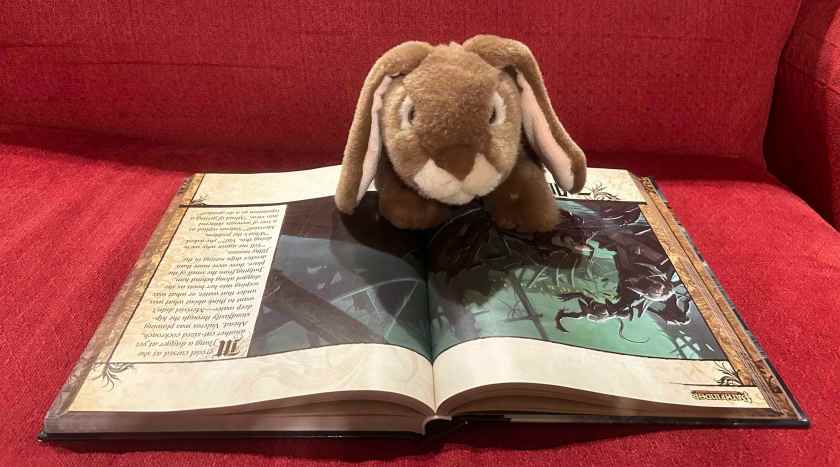
S: Okay so now let us get back to the book. This is the standard book with rules of the game then?
C: Yes, it is.
S: So tell me what kinds of things there are in the book.
C: There are parts on creating a character. Then there is a part on choosing a class, then skills, then feats, then equipment. Next is extra rules, combat, magic, spells, special classes. Then there is a section on how to be a GM, making NPCs, magic items, and a ton of appendices.
S: That is a lot!
C: Well there are over five hundred pages!
S: And what is a GM?
C: A Game Master. It is the person who develops the main story and the setting, and acts out all the NPCs. And before you ask, those are the characters that are not played by any of the main players. NPC stands for Non-Player Character. So the PCs are the characters the players play.
S: I see. So the GM is the main story teller in some sense.
C: Yes, but the players can and do make choices that change the GM’s original goals, I know from experience.
S: Well, that sounds more fun actually. And kind of like real life, where big and important people might have all these grand schemes, but then a little bunny comes along and does something differently, and the whole world is changed.
C: Yeah, I suppose. When I play as a GM, sometimes my players can be frustrating when they choose to do totally off-the-wall things. But I have also been a frustrating character to my own GMs so I guess it can go both ways!
S: Yes, kind of like free will. You get to choose; within all the constraints, you still have a choice. I like that. And I bet that is one of the reasons why the game works so well. There might be standard storylines and GMs might have some creative ideas, but each game turns out to be totally different because the players decide to do some things differently and the world changes. Like the butterfly effect, like in chaos theory.
C: What is chaos theory?
S: Okay, we are veering off topic a bit but chaos theory is a field of mathematics where people study systems which are extremely sensitive to small changes and seem to behave chaotically but can still be described and explained mathematically. And the butterfly effect captures that idea: “the flap of a butterfly’s wings in Brazil can set off a tornado in Texas.” A while ago, I reviewed a couple books about famous mathematicians who worked in chaos theory for our blog. Maybe you can check those books out…
C: Cool, maybe I will.
S: Okay, so the book seems chock-full of ideas and basic rules of playing this game. I think you have read it from beginning to end several times. I also saw you often opening a random page to read. And I have a feeling that you will keep using it for the foreseeable future.
C: Yup. I like reading this book. I also really like looking at the pictures. They are pretty well drawn.
S: Yes, I can see that. Maybe this is a good time to end the review. What would you like to tell our readers?
C: Stay tuned for more book bunny reviews!
 BookBunnies