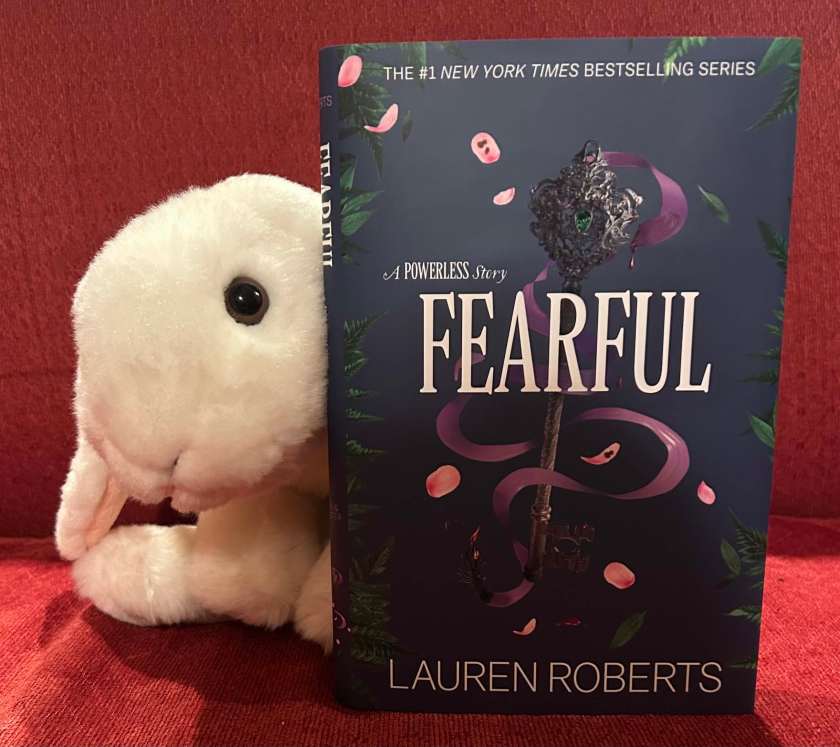
Marshmallow reviews North of Tomboy by Julie A. Swanson

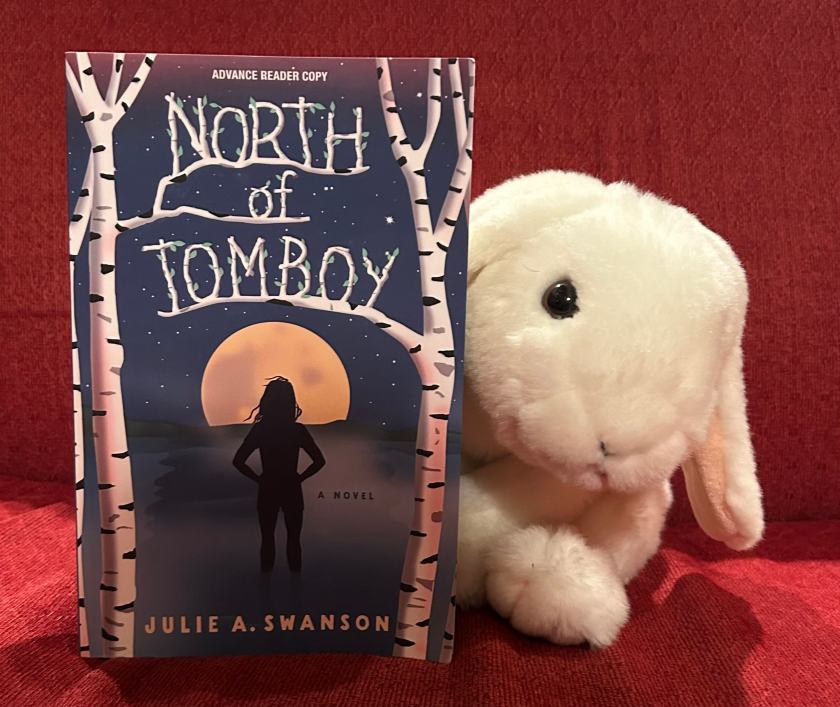
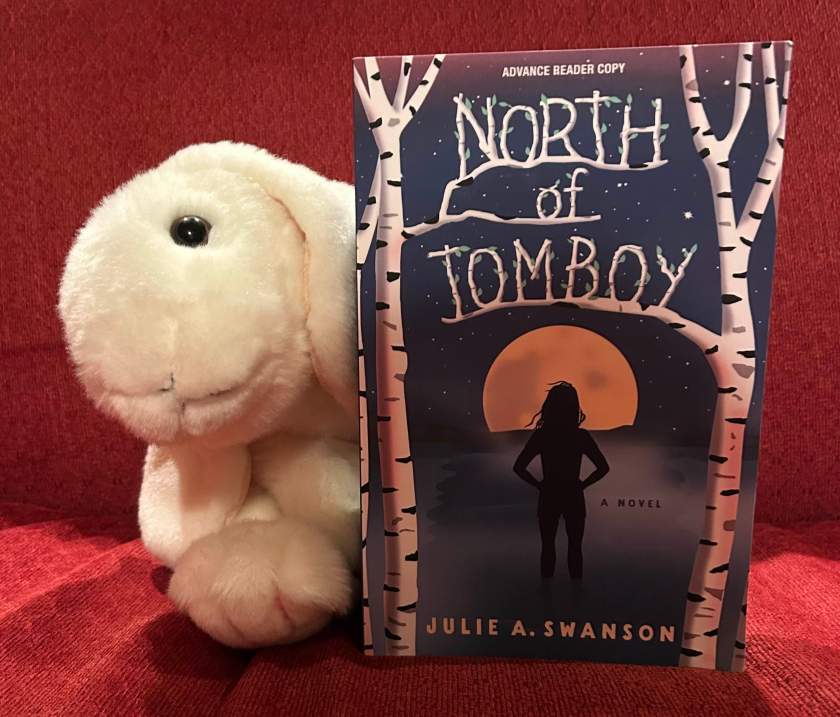
Today Marshmallow reviews North of Tomboy, a new book by Julie A Swanson, that is coming out this week.

The book bunnies received this book as an advance review copy.

Marshmallow reviews North of Tomboy by Julie A. Swanson.

Marshmallow’s Quick Take: If you like books about growing up and exploring your identity and gender, then this is the book for you!

Marshmallow’s Summary (with Spoilers): Jessica Jezowski is a nine-year-old girl, but she definitely doesn’t feel like one. She believes that God must have made her with both girl and boy parts, except for the defining part which he made with only girl parts. Jess lives in Leelanau County in Michigan with her parents, two brothers, and little sister in the very early 1970s. Her mother is very enthusiastic about things Jess feels are only for “girly girls.” She doesn’t like having long hair or wearing dresses because she feels like that prevents her from having any fun and it seems to actually cause her physical and emotional distress.

Jess loves her family, but she sometimes wishes they would stop treating her differently from her older brothers just because she is a girl. For example, she wishes they’d stop giving her baby girl dolls every year for Christmas. However, one year, she can’t bring herself to ignore or destroy the doll she is given (it is insinuated that the previous ones suffered unfortunate fates). She ends up feeling a sort of connection to the doll and cutting its hair. She names it Mickey and announces that it is a boy. She pretends that he is the family’s newly adopted son and animates him, giving him a charming Southern drawl. Using Mickey as a transparent veil of protection, Jess finds that she can be funnier, more confident, and more herself. Mickey, she finds, seems to be more loved than she is. Eventually though, she starts to feel like Mickey is taking over. Jess realizes that she needs to find who she is without hiding behind a doll. 

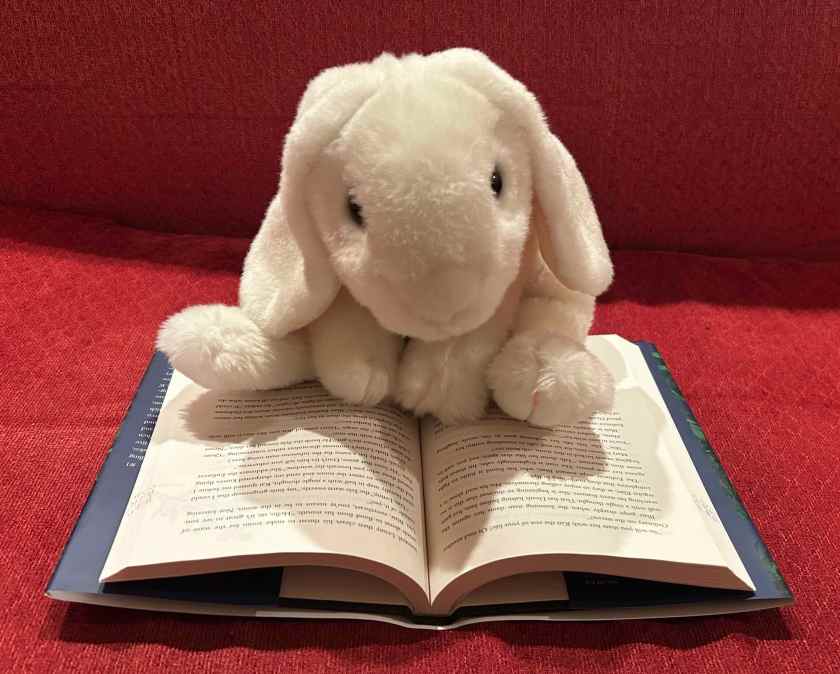
Marshmallow is reading North of Tomboy by Julie A. Swanson.

Marshmallow’s Review: This was a very interesting and eye-opening book. It introduced me to a way of life in a different time period in a different location that I had never experienced before. Swanson does a very good job immersing the reader in Michigan’s nature and scenery, and I really enjoyed learning about what it would be like to live in a place like Jess’s home in the past.

In the beginning of the book, I felt like the writing was a little different from most books I have read. The dialogue felt a little bit off. But then again Jess is supposed to be just nine years old and I have not been nine for quite some time now. (Yes, I am pretty mature for a bunny!) In any case, over time, the prose fell into place and the picture of Jess’s world felt more whole and realistic. Later on, the dialogue was exceptionally good and the characters in Jess’s family became extremely human.

I like how the book both romanticizes the Jezowski’s way of life, but also shows its dark parts. Jess’s father often loses his temper and ends up blaming his wife for things that are not her fault. I thought the way Swanson handled the dialogue concerning his behavior and the family’s responses felt extraordinarily real and nuanced.

North of Tomboy as a whole got progressively more and more nuanced as I read on. I was originally confused by Jess’s feelings in the beginning. It seemed like she just did not like girls or women and so did not want to be one. But I liked how, in the end, Jess realizes that she isn’t necessarily against being female; she just wants to be her own type of girl. This is a take that I found very interesting. At the start, I was confused about whether Jess would have wanted to transition to a different gender or not if this were possible during her time. But soon enough, I noticed that Jess herself is very sexist. She hates being a girl because she thinks girls are all stupid and weak and whiny. This is a result of her upbringing. I think, in other words, that the main character definitely has a lot of internalized misogyny which parent bunnies might wish to discuss with their children if they are reading the book together.

I liked how Jess found who she wanted to be in the end, but I would have preferred it if the book were more explicit in affirming that women do not have to be stupid and weak and whiny. I also liked that we also got to learn a lot about how Jess’s faith shaped her thoughts. It was very interesting to hear her internal dialogue, and the growth of her faith as she was trying to figure herself out was definitely a critical part of the story.

I would highly recommend North of Tomboy to all readers because it really shows the workings of people that many do not understand. Some might say this is a good book about people thinking about their gender, and I think that it is. But I would also say that this is a good book for a lot of other people to read, too, and not for reasons related to gender. I think this shows the way many families work and how some people are raised. It shows a way of life many are not familiar with. Learning about how Jess and her family live was eye-opening. North of Tomboy offers one perspective of what it’s like to be from a very rural, very religious, and rather conservative background. This is not something everyone understands, something I have never experienced. Of course, one book obviously does not and cannot represent the complete picture. But it shows that people whom some vilify are still very human. It is always important to remember that. Understanding where everyone comes from is crucial to making this world a better place for everyone.

Marshmallow’s Rating: 95%.

Marshmallow rates North of Tomboy by Julie A. Swanson 95%.

Marshmallow reviews An Unexpected Light by José Saramago

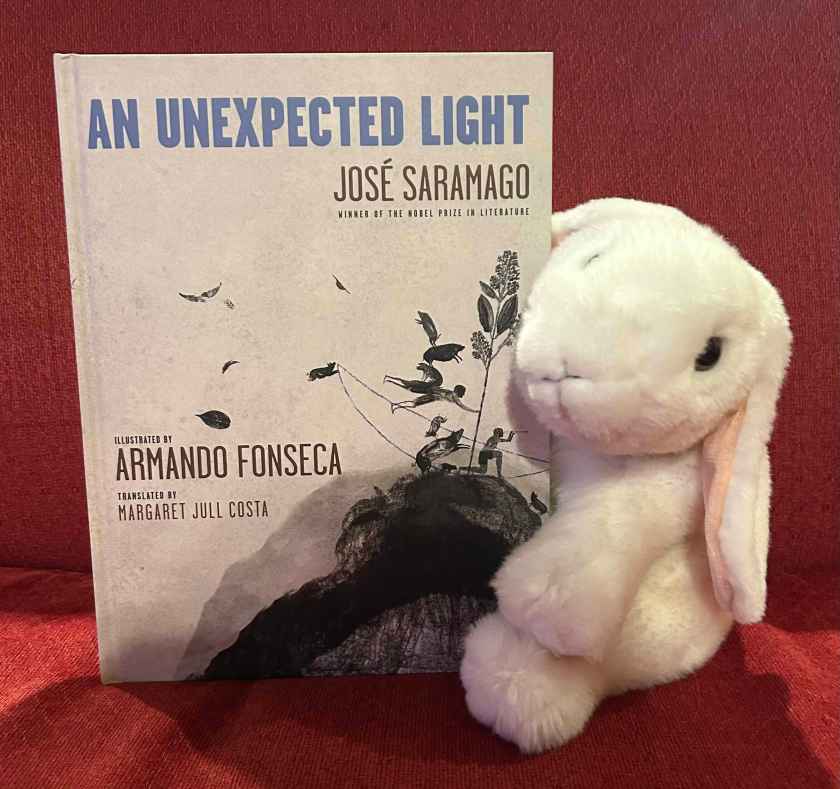
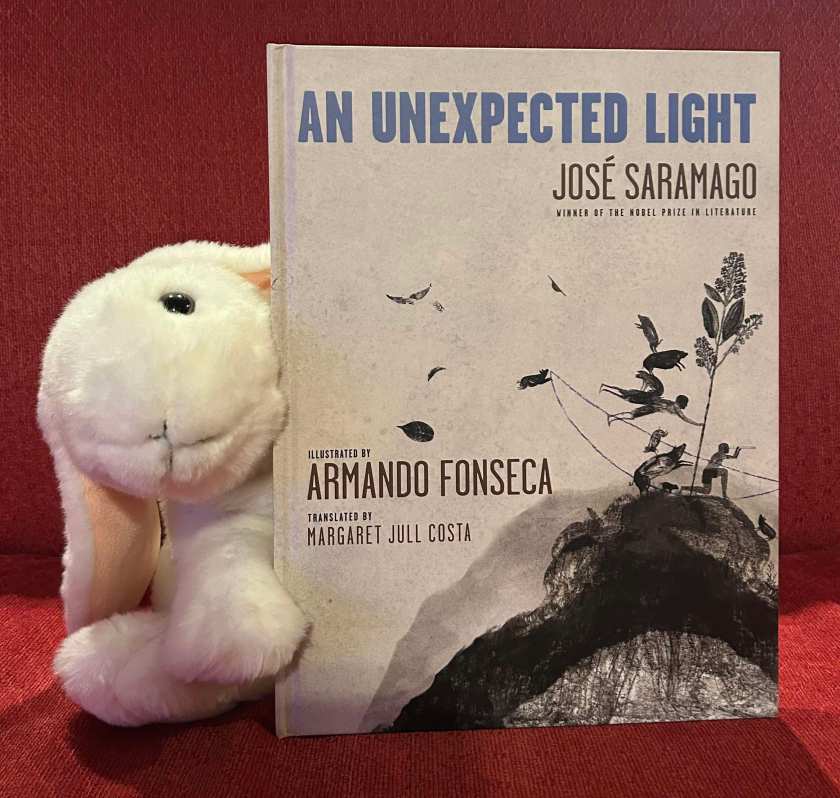
Earlier this summer, Caramel reviewed a neat picture book by the distinguished Portuguese author José Saramago. Today Marshmallow picks up where Caramel had left off, and reviews An Unexpected Light, another excerpt from Saramago’s book on his childhood memories. Illustrated by Armando Fonseca and translated by Margaret Jull Costa, An Unexpected Light was first published in English in August 2024. Readers can learn more about the book here.

Marshmallow reviews An Unexpected Light,  written by José Saramago, translated by Margaret Jull Costa, and illustrated by Armando Fonseca.
Marshmallow reviews An Unexpected Light, written by José Saramago, translated by Margaret Jull Costa, and illustrated by Armando Fonseca.

Marshmallow’s Quick Take: If you like books that are calming, thought-provoking, and subtly wonderful, then this is the book for you!

Marshmallow’s Summary (with Spoilers): José Saramago was born in Portugal, somewhere I have never been; yet, through this book, I feel like I know what it is like to be there. When he was twelve years old, Saramago went along with his youngest uncle to help him sell his grandparents’ pigs at a market in Santarém. They embarked on a journey that is beautifully understated. The author describes in quite simple terms what he and his uncle did, what happened, and where they were.

The story overall is quite simple. Yet, there is something profoundly special about it. You can tell when you open the book that there is something different in this book–-something that most other books cannot convey in more than Saramago’s meager twenty or so pages. The plot is not particularly convoluted as a result. But the experience is unique.

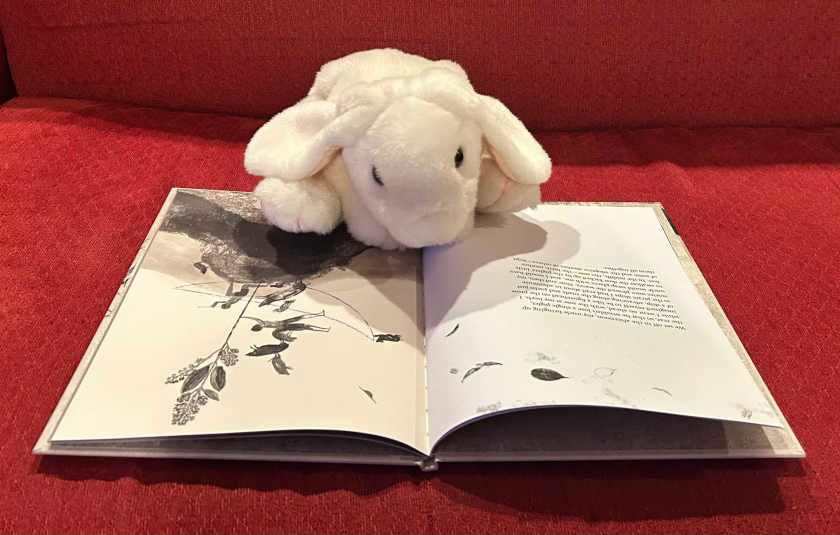
Marshmallow is reading An Unexpected Light,  written by José Saramago, translated by Margaret Jull Costa, and illustrated by Armando Fonseca.
Marshmallow is reading An Unexpected Light, written by José Saramago, translated by Margaret Jull Costa, and illustrated by Armando Fonseca.

Marshmallow’s Review: If reading this book has taught me one thing, it is that Saramago didn’t win a Nobel Prize for nothing. This is definitely a lot different from the picture books I’ve read. It is still short, has drawings, and relatively little text per page. But it nonetheless feels different. I don’t exactly know how to describe it, but I felt as though I had been transported to Portugal when I first read this book. The drawings are not complex but they convey shapes and people that your mind transforms into a living, breathing environment around you. I think maybe the illustrator chose a more minimalistic style to allow the eyes to spark the imagination which then builds a more detailed, immersive world on its own. This might in turn be inspired by Saramago’s style, which achieves the same effect.

I am still not exactly sure what the last couple of sentences in the book mean. Caramel reviewed another book by this author and used the term “quiet conviction.” I feel like the theme is different in this book, but the word “quiet” is still quite applicable. Saramago doesn’t use elaborate descriptions or fancy words. In fact, I did notice: he doesn’t seem to use quotation marks either. This is clearly a stylistic choice, which I found interesting. But the author and the book as a whole have a very understated feel throughout. I really liked that. 

I think authors generally don’t try to push their works to have a singular, trite meaning; leaving the interpretation up to the reader makes the work really what the reader wants it to be. In my opinion, this book is about slowing down, thinking, feeling, and admiring the world. Saramago watches everything with not much judgement in this book which makes the reader kind of slow down and calm down. I think this book shows me that the world and nature are awe-inspiring in a quiet way, a way that I think Saramago strove to emulate.

I had read this book earlier in the summer when Caramel was looking over the two books. Today, I had an experience that really made me think of this book again, in so subtle a way I didn’t really even notice it. I woke up early and was in a car for a while, groggy at the beginning. But I looked out the window and saw a sky that was indescribably beautiful. The sun was rising, making its daily ascent, but I was watching as if for the first time; perhaps it was the first time I really looked. It was truly awe-inspiring and wonderful. It made me realize how beautiful nature is, but in a way that is so encompassing that we don’t and maybe can’t recognize always. This book really gives you the time to slow down and recognize that there is beauty and the extraordinary in so many places that we consider ordinary. 

Marshmallow’s Rating: 10/10.

Marshmallow rates An Unexpected Light,  written by José Saramago, translated by Margaret Jull Costa, and illustrated by Armando Fonseca 10/10.
Marshmallow rates An Unexpected Light, written by José Saramago, translated by Margaret Jull Costa, and illustrated by Armando Fonseca 10/10.

Marshmallow reviews Information is Beautiful by David McCandless

In June, Marshmallow reviewed Beautiful News: Positive Trends, Uplifting Stats, Creative Solutions by David McCandless, a beautiful book full of inspiring and visually stimulating infographics. Today she reviews an earlier book by David McCandless: Information is Beautiful, originally published in 2009 and revised in 2012.

Marshmallow reviews Information is Beautiful by David McCandless.

Marshmallow’s Quick Take: If you like non-fictional books that are interesting and eye-opening, then this is the book for you!

Marshmallow’s Summary (with Spoilers): A few weeks ago, I reviewed another book by David McCandless called Beautiful News. This book is a little different though. The author explains in the introduction:

“I went for subjects that sprang from my own curiosity and ignorance […] So, that’s what this book is. Miscellaneous facts and ideas, interconnected visually. A visual miscellaneum. A series of experiments in making information approachable and beautiful.”

That pretty much sums up this book! Every page (like the other book) is full of vivid colors, smooth and sharp shapes, and fascinating data.

One of the pages that stood out to me most contained a colorful spiral of increasingly smaller circles; each circle contained a cause of death and the chance of it occurring to you. Essentially, as you read closer to the center of the spiral, you see rarer and rarer ways of dying which was definitely interesting, but also terrifying. For some reason it felt like one of those choose-your-own-way books but a Wednesday Addams edition.

Another, less morbid and more cheerful page announced the most popular U.S. girls’ names–the following spread was about the most popular boy names too. Unfortunately, I didn’t see Marshmallow at the top.

I did really like one page that shows the global map and then covers what is succinctly described as “Man’s Humanity to Man” (philanthropy, free education, and other great things!) For example, I liked how it highlighted some bloodless revolutions like the Serbian Bulldozer Revolution in 2000. Not all the details are given, but I did learn a little bit about some things I didn’t know anything about.

Marshmallow is reading Information is Beautiful by David McCandless. Here you see her viewing the two-page spread titled "The One Machine: Map of the Internet".
Marshmallow is reading Information is Beautiful by David McCandless. Here you see her viewing the two-page spread titled “The One Machine: Map of the Internet”.

Marshmallow’s Review: Information is Beautiful is simply a beautiful book. I loved how every page is extremely visually appealing. That is definitely a reason to read the book on its own. I’m sure it would be a really fun picturebook for small bunnies! I did think it was interesting how the cover of this one is grayish and definitely less colorful than that of the other book of McCandless that I had reviewed earlier. Beautiful News was more directed and had a more specific message: hope. Information is Beautiful, on the other hand, is more about exposing the reader to the good, the bad, and the ugly.

I really enjoy books that reveal the depth and complexity of the world we are living in—something that is so easy to miss when all our screens seem to promise an abundance of simplistic solutions to boredom. In particular, the book brings together a great many disparate topics, and that opens the door to a room for the light of curiosity to explore. Basically, if you are interested in learning more about a topic you see in this book, you can Google it, look it up on Wikipedia, and go from there. In other words, this book can really be viewed as a collection of random bits of information, but I think it randomness is one of its strengths: there is bound to be something interesting for any bunny who looks inside.  

I was a bit concerned about one of the displays called “Behind Every Great Man … Dictators’ Wives”. The display focused on the wives of the horrible dictators of the twentieth century, like Hitler, Stalin, Marcos, and so on. Honestly, I was disturbed by the title for the display, because these men were all terrible people. They themselves may have thought of themselves as great, but today historians would most likely not use that word, even in quotes.

But overall, I liked reading Information is Beautiful, and I appreciated the author’s goal to make information approachable and beautiful. But I must admit that I like McCandless’ other book a little more because it’s more uplifting. But this one is really fascinating in a different way, and I definitely recommend reading it!

Marshmallow’s Rating: 90%.

Marshmallow rates Information is Beautiful by David McCandless 90%.

Marshmallow reviews The Brief and Frightening Reign of Phil by George Saunders

Today Marshmallow reviews The Brief and Frightening Reign of Phil by George Saunders, published originally in 2005.

Marshmallow reviews The Brief and Frightening Reign of Phil by George Saunders.

Marshmallow’s Quick Take: If you like clever, thought-provoking books akin to those of George Orwell, then this is the book for you! 

Marshmallow’s Summary (with Spoilers): Set in a truly bizarre world, this story starts in Inner Horner which is a nation literally so small that only one of its seven citizens can fit in it at a time. What do the other six unfortunate Inner Hornerites have to do in the meantime? They basically sit in this tiny area called the Short-Term Residency Zone, located in Outer Horner. The Outer Hornerites naturally feel very superior in comparison to their miniscule neighbors. Suddenly, Inner Horner shrinks to be even smaller so that only one fourth of a citizen can inhabit the nation. This turns out to cause quite the issue with the Outer Horner Militia who feel that this constitutes an “Invasion in Progress” as they say.

While the militia deliberate on what course of action to take, Phil comes in and suggests taxing the Inner Hornites for every day that they infringe on Outer Horner. Phil is described as “a slightly bitter nobody” who fell in love with Carol–an Inner Hornite who fell in love with and married another Inner Hornite, much to Phil’s despair. With the birth of her child, Phil’s despondency contorted to more closely resemble anger. Utilizing his constituents’ naïveté and gullability, Phil convinces the Militia that the Inner Hornites are inferior to the Outer Hornites, something that confirms most of the Outer Hornites’ inner thoughts.

As the book progresses, the Inner Hornites are treated increasingly worse and worse as Phil rises from a nobody to the leader of Outer Horner. While the characters are not humans (they are all amalgamations of objects, biological parts, and machinery it seems), the plot draws a line definitively parallel to some of humanity’s worst times. 

Marshmallow is reading The Brief and Frightening Reign of Phil by George Saunders.

Marshmallow’s Review: This book was really bizarre. The world, the nations’ names, the characters are all just weird, but all this weirdness makes the book stand out even more in my opinion. There is not very much description of the surroundings other than it seems like Earth. There are trees and rivers and dirt and apparently a cafe in Outer Horner, but, other than that, not much else is given. The citizens are all described and drawn as being some sort of strange creatures, but none of them are the same. For example, the president of Outer Horner is described as “consisting of a jumble of bellies, white mustaches, military medals, and dignified double chins, all borne magnificently aloft on three thin wobbly legs.” Suffice it to say, they all look pretty unusual.

But the differences between us and them pretty much end there. Phil’s rise to power and the suppression of the Inner Hornites honestly follows the same course human history has too many times (this disturbingly reminded me of what I learned about pre-WWII Germany). I wonder if the weird descriptions of the characters represent some deeper analogy. The plot is intriguing and the ending was definitely very interesting.

I read The Brief and Frightening Reign of Phil in an hour and five minutes, so it’s definitely pretty short. There are some drawings that made me feel like this book is a little similar to The Phantom Tollbooth. Of course one also cannot help but think of Animal Farm, another short allegorical tale about the rise of tyranny.

Overall, The Brief and Frightening Reign of Phil was a fascinating book and I would recommend it to almost all ages. It is slightly amusing yet intriguing in a bizarre way that is hard to explain; the way to best understand what I mean is to read it!

Marshmallow’s Rating: 100%.

Marshmallow rates The Brief and Frightening Reign of Phil by George Saunders 100%.