Marshmallow reviews Fiske Guide To Colleges 2026 (42nd Edition) by Edward B. Fiske

For her last review before the book bunnies take off for the month of July, Marshmallow picked a book she has spent a lot of time with these past few weeks: The Fiske Guide To Colleges 2026 (42nd Edition) by Edward B. Fiske.

Marshmallow reviews Fiske Guide To Colleges 2026 (42nd Edition) by Edward B. Fiske.

Marshmallow’s Quick Take: If you are a high school student approaching the college application season, or if you are related to one, then this is the book for you!

Marshmallow’s Summary (with Spoilers): The Fiske Guide To Colleges 2026 is organized very well! It has a comprehensive table of contents at the start to lay out every opportunity for exploration it will give you in the pages to come. There is an Index by State and Country, an Index by Price, an Index by Average Debt, and The Best Buys of 2026. Those first couple pages contain enough valuable information alone to justify obtaining a copy of this book. But what really makes this more valuable than just lists alone is what lies below those lists.

The Introduction and the “Sizing Yourself Up” section remind you of what the college search is supposed to be about. Instead of hunting for the lowest sticker price or the greatest name recognition, the reader is encouraged to remember that there are infinitely more factors to take into account in what should be a search for the educational nursery that will hopefully prepare you for a successful future later on in life.

There is a handy-dandy survey you can take which helps you evaluate what it is you want in a college; this is very useful, and I am not just saying that because I love taking Buzzfeed quizzes! While taking that test, I realized that there are many more aspects to the admissions process to consider while making your list. If half of the schools on your list are not places you would actually like to be in, then you are likely making a mistake.

For those who are certain in their choices and the path they want, there is a section titled “A Guide for Preprofessionals.” There is also a page listing the schools with the strongest support for students with disabilities; this could be life changing for many. The next part is also similarly crucial. Each school has two to three pages describing what life is like for students on campus, from architectural style to weather to culture to food to average political affiliations.

Personally, I have found that finding a good fit has been very difficult for me. When most colleges are in different states and you can’t really visit most of the places on your list, getting a feel for the “vibe” of a place is pretty hard. But with this book, you can get a much better sense of what life could look like for you in different places. There is no doubt that the college applications process is a truly stressful time, but with this book you will definitely feel much more comfortable and informed as you look ahead into an uncertain future. 

Marshmallow is reading Fiske Guide To Colleges 2026 (42nd Edition) by Edward B. Fiske.

Marshmallow’s Review: I really, really appreciate Mr. Fiske and his team. I am very glad they took the time to write beautifully detailed entries for each school, not to mention the little information bars that go with each. Each entry has a box with the school’s website, location type, private / public designation, total enrollment, undergraduate count, male to female ratio, financial aid stats, Pell Grant stats, expense, student loan stats, average debt, applicant pool size, acceptance rate, enrollment rate, graduation rate, returning freshman rate, academics assessment, social life assessment, quality of life assessment, admissions info, and strong programs. I think this is the best way to learn more about schools besides visiting a place physically. Helpful indexes also help you break down how the book analyzes and ranks different parts to consider. I specifically, especially liked how the book emphasizes the social life and quality of life of different schools. Personally, I do not want to go to a school with too much of a Greek life focus and this has been one of the clearest ways for me to get a sense of different opportunities at different schools. There is also a box at the end of each entry for each school that tells you the details of how to apply to each individual school (such as their testing policy with the SAT and ACT).

Overall, The Fiske Guide To Colleges 2026 has been a really, really helpful resource for me. It has actually opened my eyes substantially to all the different opportunities and futures there are. I used to be a lot more narrow-minded in where I was going to apply, but I’ve definitely crossed off certain places and added new ones because I realized that I simply had not known enough about each school. Every place is uniquely perfect for someone and, with this book, you can feel much safer and much more confident while you search for your place in college.

A quick note for those looking into earlier editions of the book: I also had the chance to peruse the 2024 edition, and I did not see too many differences in coverage and content. So I was happy to get my paws on the latest edition, but other recent editions can also do the job if they are easier to access.

Marshmallow’s Rating: 100%.

Marshmallow rates Fiske Guide To Colleges 2026 (42nd Edition) by Edward B. Fiske 100%.

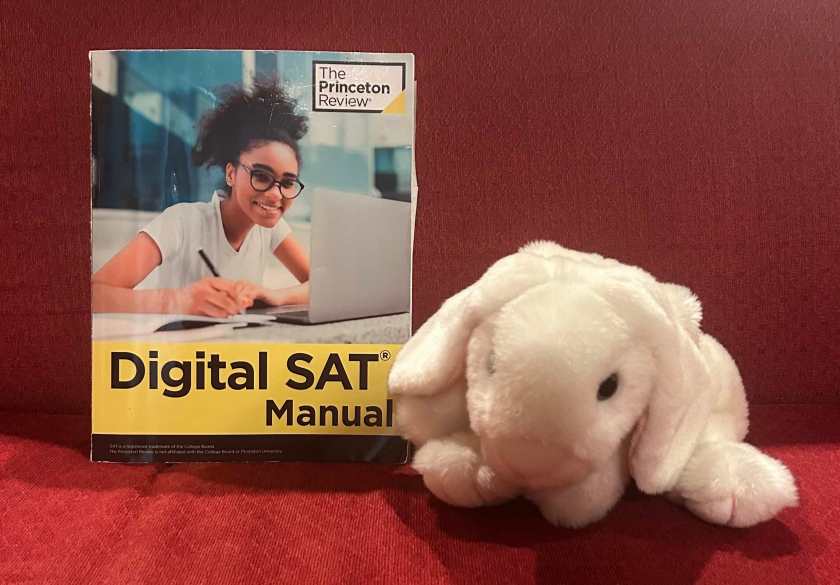
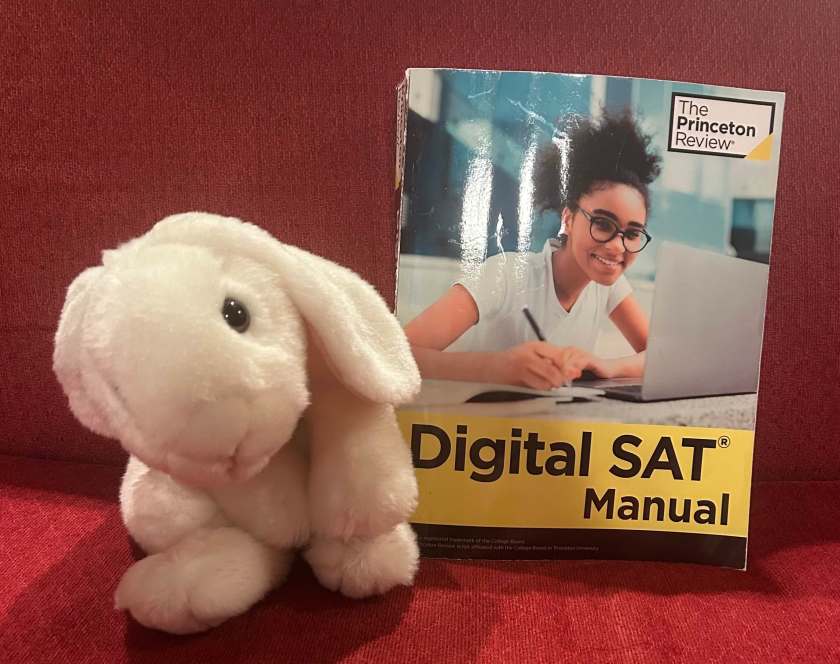
Marshmallow reviews Digital SAT Manual (Version 8.0) by The Princeton Review

Today, Marshmallow is doing something different. She is writing about Digital SAT Manual by The Princeton Review, a test preparation manual.

[This is not meant as an advertisement or customer review. We felt that even though Digital SAT Manual is a different kind of book than our usual fare, it is undeniable that Marshmallow has spent a lot of time with it in these past few months. She also felt strongly that she had something useful to say about it.]

Marshmallow reviews Digital SAT Manual (Version 8.0) by The Princeton Review.

Marshmallow’s Quick Take: If you are a student planning on taking the SAT, then this is the book for you!

Marshmallow’s Summary (with no Spoilers): The SAT (or what used to be called the Scholastic Aptitude Test) is a standardized test used in the United States for college admissions. There is a lot of hype about it and many many rumors and myths. But ultimately, it seems to me that the SAT is not a measure of intelligence, but rather a measure of how good you are at utilizing tricks and the nuances of the testing type. It does seem to gauge, up to some level, how well you will do in college; this is true. If your score is below a certain level, many colleges will deem you unfit for entrance. The way to increase your score is to study, not just the material, but also the test itself.

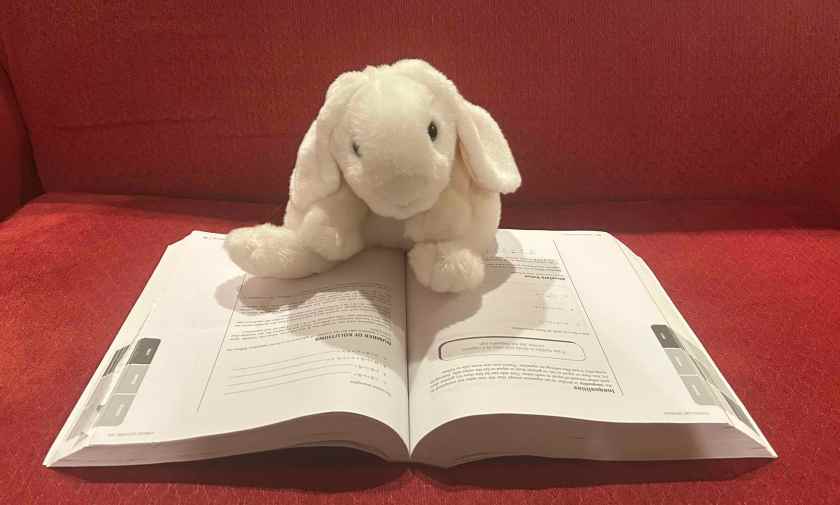
Enter the Digital SAT Manual! The book starts off with a description of the SAT and the logistical details. It shows what the test will look like and how long each module is. This helps the reader gain a sense of familiarity with the testing format, which helps create a calmer experience during the actual exam. Then the book starts actually going into the specific types of questions that appear on the test and the strategies for each type. Before reading this book, I did not know that there were different question types. I kind of figured that the questions were all randomly ordered and were all random types. It turns out, though, that there is a lot of rhyme and reason behind the SAT, which is crucial to learn when preparing for the test.  

Marshmallow is reading the Digital SAT Manual (Version 8.0) by The Princeton Review.

Marshmallow’s Review: It may be clear already that I’ve recently taken the SAT. These past few months, the SAT has definitely been a topic close to the forefront of my mind. With many colleges and universities going back to requiring standardized test scores for admission, the importance of the SAT has only escalated. The best way to feel prepared is to know what is on the test and how to deal with it when you come face-to-face with it.

In the United States, the SAT marks a major landmark in many students’ lives—a point after which they are closer than ever to their college dreams. Of course, many withhold the fact that you need to study for the SAT. Many high-scoring students claim to have gone into the test without so much as opening a study book. However, anyone who has taken an SAT and examined the way it works will tell you: it is a test that scores how good you are at taking tests. As a bunny who took a couple practice tests and used study books before taking the actual digital SAT, I can confidently say that it is next to impossible for someone to get an outstanding score with no study; it is perhaps possible to get between a 1450 and 1500 first try but, above that, one must have studied.

I found the Digital SAT Manual to be extremely useful and effective; it helped me go from the mid-1400s to the 1500s. I really liked how it explained everything and was very transparent about the nature of the test. It detailed the different question types and had step-by-step instructions on how to answer each category. The practice sections were extremely helpful in helping me solidify my ability to understand the processes the book was teaching me. I did not always follow through with all of the book’s steps though; I felt like some annotation steps were superfluous and spent more time than I needed to or had. I also was a little surprised by how fast the test goes by; I definitely needed to go faster when taking it as opposed to when I did practice problems (for reference, I would generally finish the problem sets early, but found myself running out of time on longer practice tests).

As a whole, though, the Digital SAT Manual is irreplaceable. It is easy to understand and very interactive. I would highly recommend this book to all students. But above all, I would advise that you study for the SAT; trust me, the high-scorers are studying—even if they say otherwise!

Marshmallow’s Rating: 100%.

Marshmallow rates the Digital SAT Manual (Version 8.0) by The Princeton Review 100%.