Marshmallow reviews The Tower of Nero (Book 5 of the Trials of Apollo Series) by Rick Riordan

Marshmallow has already reviewed the first four books in Rick Riordan’s Trials of Apollo series for the book bunnies blog. This week she reviews the fifth and final book, The Tower of Nero. Below she shares her thoughts on this epic end of Rick Riordan’s fifteen-book series about Greco-Roman gods and their children who live among us. 

For reference, Marshmallow has already reviewed:

You might also enjoy reading Caramel’s reviews of the graphic novel versions of the first two books of the first series: The Lightning Thief: The Graphic Novel and The Sea of Monsters: The Graphic Novel.
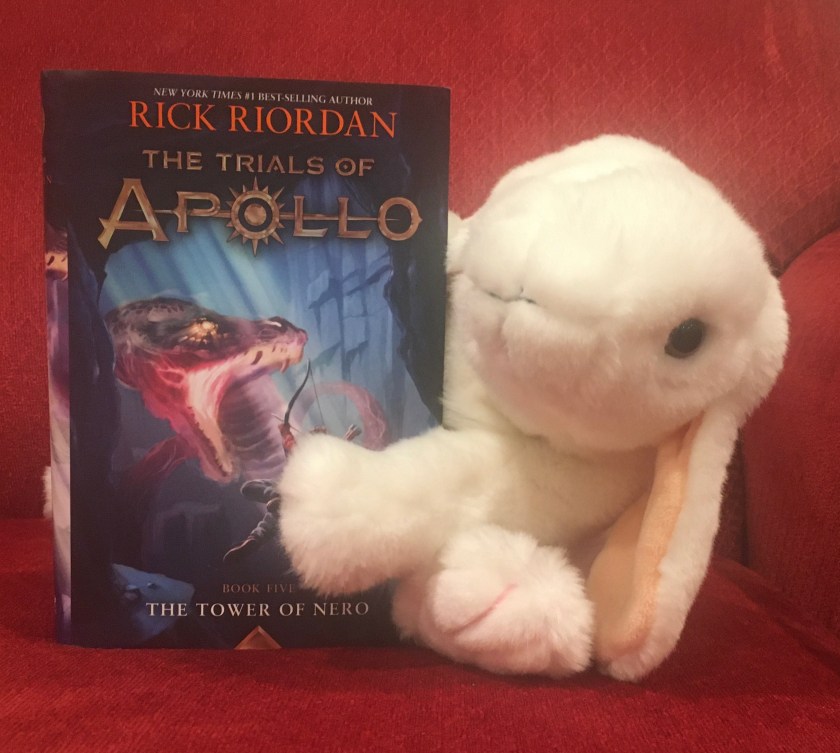
Marshmallow reviews The Tower of Nero (Book 5 of the Trials of Apollo Series) by Rick Riordan.

Marshmallow’s Quick Take: If you enjoyed reading the first four books of Rick Riordan’s Trials Of Apollo series, then this might be the book for you.

Marshmallow’s Summary (with Spoilers): Apollo has been stuck as a mortal for the last four books, and now he is coming to the end of his adventures on Earth. But he has a long list of enemies. He has been fighting the Triumvirate, three evil emperors from Rome’s past who have been trying to all become gods, as well as his archenemy Python. Python is a large and evil snake who has been Apollo’s enemy even when Apollo was a god.

The book starts with Apollo and his demigod master Meg returning to New York. You might recall that Meg is a daughter of Demeter, but she is a particularly strong one. She has unusual powers, even for a half-blood. She is able to summon a karpos, which apparently means “fruit” in Greek, but in this universe, it is a fruit or grain spirit. She names this karpos Peaches, because he is always saying “Peaches”. She can transport using plants and can make them grow faster.

On their way into New York, Apollo and Meg are attacked by Nero’s henchmen. We already know from the earlier books in the series that Nero is one of the main antagonists of the story, so you can guess that his people are not coming to greet Apollo. However, one of them, a Gaul woman named Luguselwa, turns out to be Meg’s trainer. Meg was one of the demigods that Nero had “adopted” and raised to be his minions. Luguselwa, Lu as Meg calls her, had been a role model for Meg.

Even though in the beginning it seems like Lu is on Nero’s side, she has a plan to help Apollo because she really cares for Meg. But they first need rest, so they stop by Percy Jackson’s home. (For Percy’s adventures, click here.) But Percy is not there. (However, his new baby sister is.) After staying with the Blofis-Jacksons for a little bit, Apollo, Meg, and Lu leave to go to Camp Half-Blood. At the camp, Apollo sees his half-brother Dionysus and his children. But they have to leave soon, and when they do, they go to find Rachel, who currently embodies the Oracle of Delphi. When they meet Rachel, they are faced by Tauri Sylvestre, which are basically monster cows.

Apollo and his friends will have to face the monster cows and more before they can finally hope to defeat Nero and Apollo’s archenemy Python.
Marshmallow is reading The Tower of Nero (Book 5 of the Trials of Apollo Series) by Rick Riordan.

Marshmallow’s Review: I really enjoyed reading The Tower Of Nero. I think that the plot of this book is very well-written, and it is a great finale for the whole series. The new characters are all amazing, they are realistic and relatable. As always, Apollo is a hilarious narrator, and he gets more and more likeable through the series.

This particular book of the series might be slightly scarier than the earlier books. There are some moments where the reader will probably get scared or grossed out, like Lu’s punishment. I’d say that most of Rick Riordan’s books are for ages 8 and up, so this one might be for 9 (or 10) and up.

The Tower of Nero can be a great read if you are reading it alone, but it is also great if you read it to someone else or someone reads it to you. I recommend it as a perfect ending for this fifteen-book saga.

Marshmallow’s Rating: 100%.
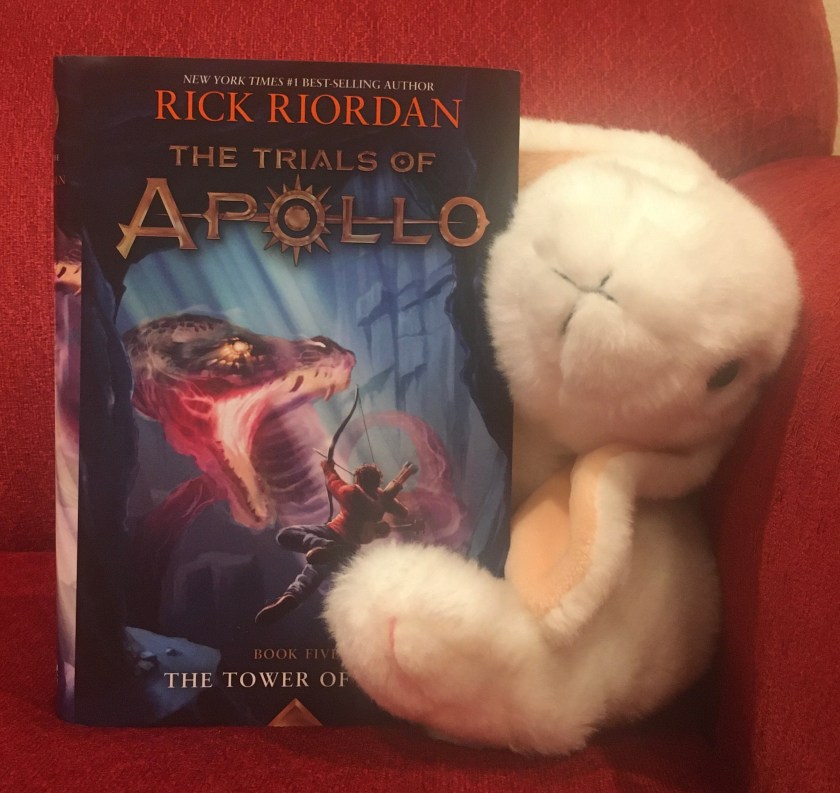
Marshmallow rates The Tower of Nero (Book 5 of the Trials of Apollo Series) by Rick Riordan 100%.

Marshmallow reviews Piecing Me Together by Renée Watson

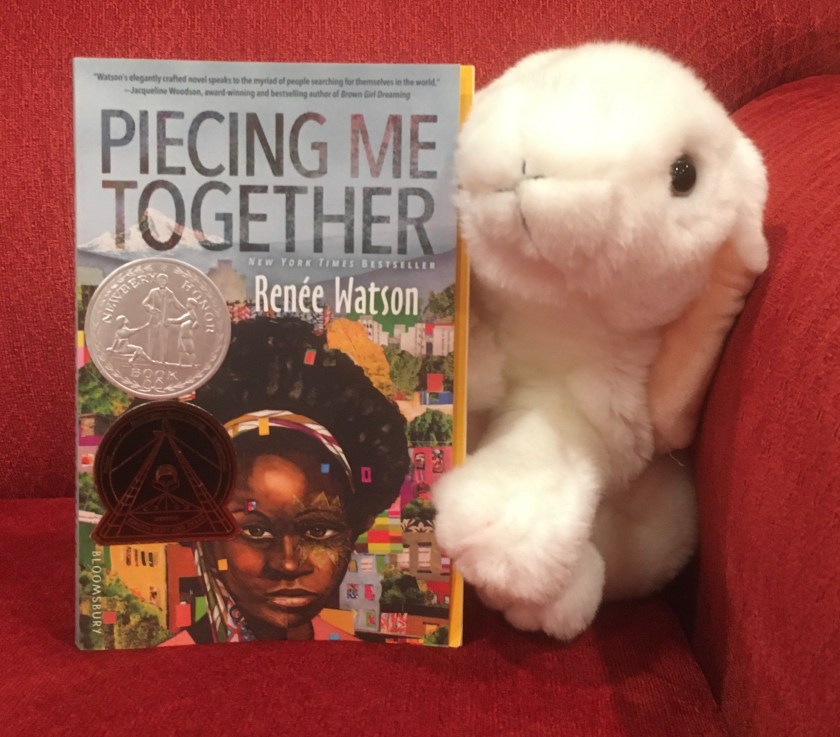
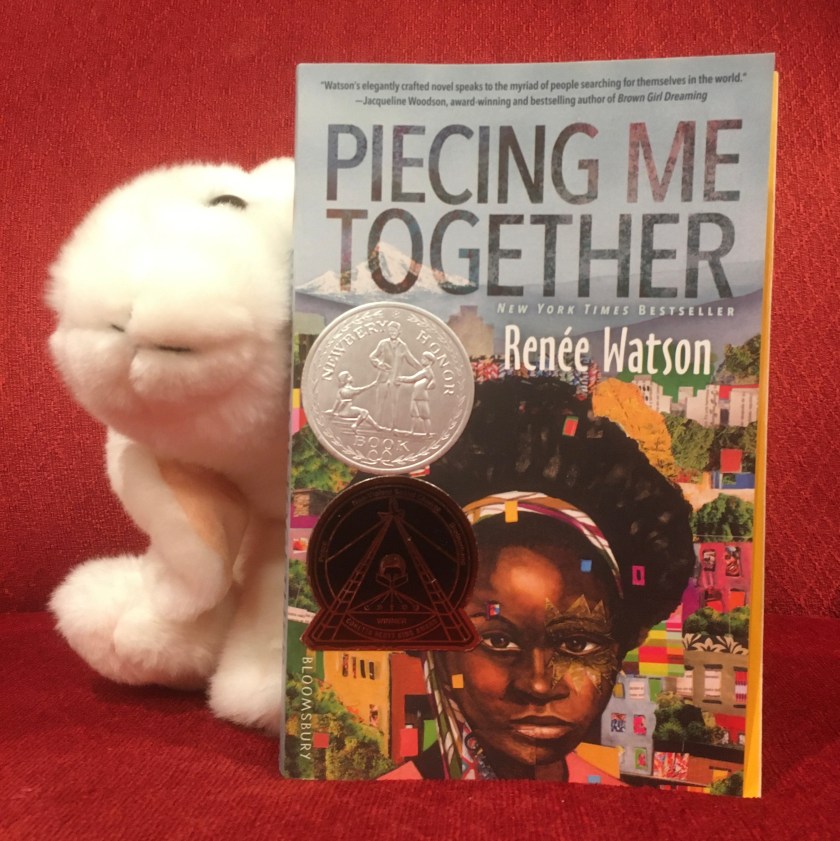
Today Marshmallow reviews Piecing Me Together by Renée Watson, published in 2017 and awarded a Newberry Honor in 2018.

Marshmallow reviews Piecing Me Together by Renée Watson.

Marshmallow’s Quick Take: If you like books about art or school, then this might be the book for you.

Marshmallow’s Summary (with Spoilers): Jade Butler has been taught that she needs to take every opportunity she is offered, which is why she is still going to St. Francis High School. St. Francis is a private school, and when Jade was accepted with a scholarship, she knew that it was an opportunity, so as her mother taught her, she took it. When the book starts, she has been at St. Francis for two years. But being at St. Francis also means being away from her old friends and almost everyone she knows. Jade has few friends at school and her art is one thing she takes strength from.

This year, Jade is hoping that she will be chosen to be one of the group of people who will get to go to Costa Rica, to study abroad. But she is told that she has, instead, been selected to participate in a program called Woman to Woman. In Woman to Woman, Jade is assigned a mentor, like all of the other girls in the program. The program is supposed to help girls with issues. However, Jade’s mentor, a woman named Maxine, does not show up to the first meeting of the Woman to Woman program. Jade finds herself wondering, will this new Woman to Woman program actually help?

Marshmallow is reading Piecing Me Together by Renée Watson.

Marshmallow’s Review: I really enjoyed reading Piecing Me Together, but I want to say that I would recommend that younger bunnies wait until they are a little older before reading this book. It has some mature topics, and parents might want to wait until the bunnies are older. I think that the age group I would recommend Piecing Me Together the most to would to 12-year-old bunnies and up. But if course, if a parent has read it and thinks that their child should read it, Piecing Me Together is a great book.

I think that the author, Renée Watson, is very successful in creating realistic characters. Even if you haven’t been in all of the situations that the characters are in, you can identify or relate with them. Not only are the characters realistic, the book shows some issues in realistic ways. For example at some point, a salesclerk asks if she can take Jade’s purse, so she can make sure that Jade is not stealing anything. The salesclerk claims it is store policy, but Jade sees that several white women in the store still have their bags. The salesclerk claims it is because her bag is larger than theirs, but her bag is not actually that much larger. Through Jade’s eyes, the reader witnesses several such instances of racism.

The book is written in 76 short chapters. Each starts with a word in Spanish and its English translation. Jade is learning Spanish at school, and the words connect to the themes of the chapters well.

Marshmallow’s Rating: 95%.

Marshmallow is reading Piecing Me Together by Renée Watson.
Marshmallow rates Piecing Me Together by Renée Watson 95%.

Marshmallow reviews Logicomix by Apostolos Doxiadis, Christos H. Papadimitriou, Alecos Papadatos, and Annie di Donna

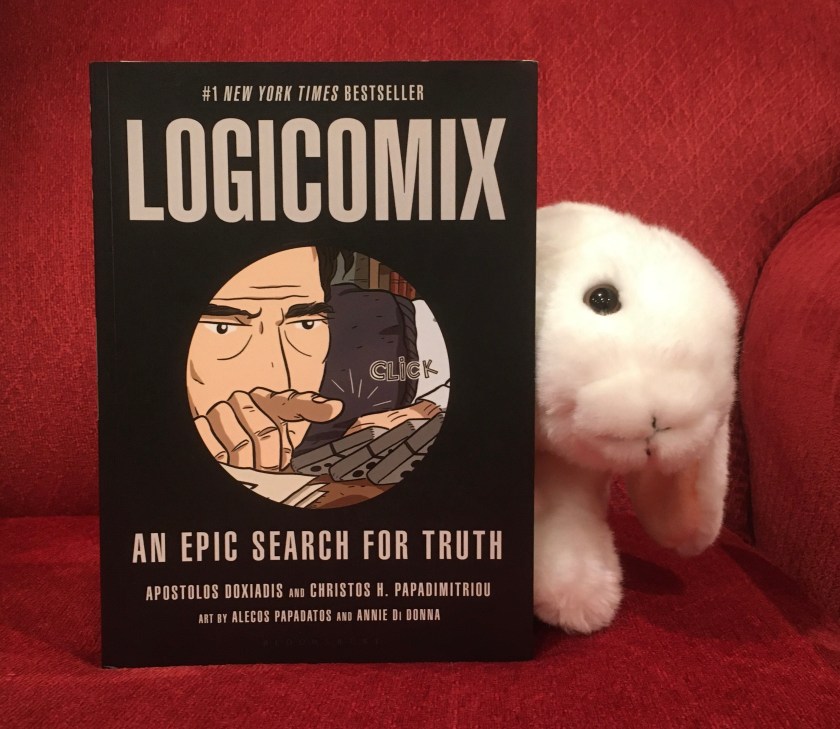
Marshmallow recently got her paws on Logicomix, a graphic novel telling of the first two-thirds of philosopher-mathematician Bertrand Russell‘s life, as it is intertwined with the story of the stormy events related to the philosophical foundations of mathematics that occurred in the early twentieth century. The book is most likely not intended for young readers, but Marshmallow found it interesting and wanted to review it for the book bunnies blog. Below is her conversation with Sprinkles about this book, written by Apostolos Doxiadis and Christos H. Papadimitriou, and illustrated by Alecos Papadatos and Annie di Donna.

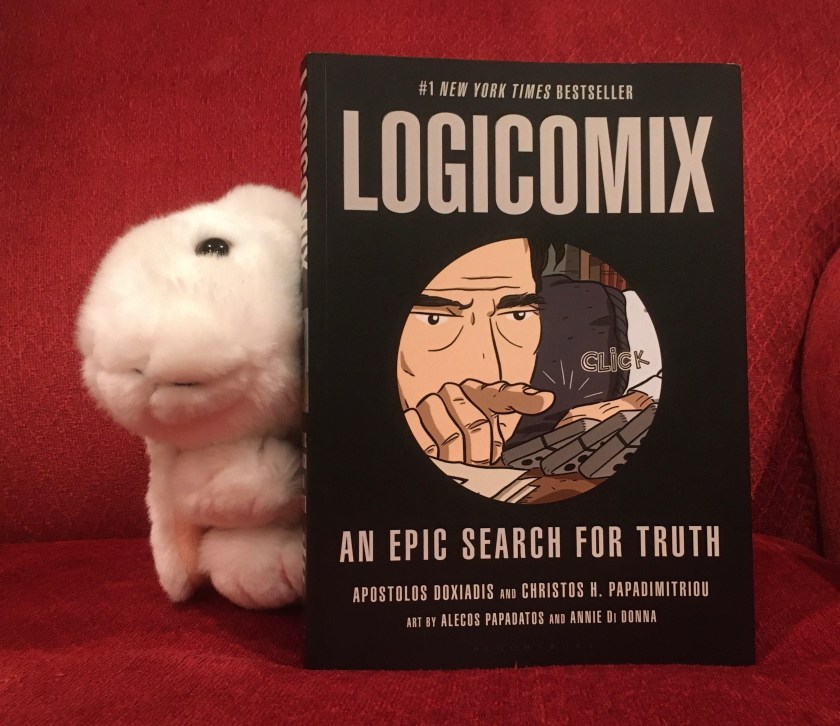
Marshmallow reviews Logicomix, written by Apostolos Doxiadis and Christos H. Papadimitriou, and illustrated by Alecos Papadatos and Annie di Donna.

Sprinkles: So Marshmallow, tell us a little about this book.

Marshmallow: The first thing I want to say is that this is not a children’s book. It’s not necessarily inappropriate for children, but some concepts might be confusing for young bunnies.

S: Why did you read it?

M: It looked interesting. It is a graphic novel and I like those.

S: I see. So tell us what it is about.

M: It’s about Bertrand Russell. He is a philosopher. Basically it is about his life.

S: And the book has a really intriguing subtitle: “An Epic Search for Truth”. How is that related to Russell?

M: I think it’s because he spent a lot of time thinking about what truth means, the true meaning of “true”.

S: Yes, Russell is a foundational figure for modern mathematical logic today. I find his story fascinating and I really liked this book myself when I read it. So what else do you want to tell us?

M: There are parts of the book where the two authors, the illustrators, and a researcher who is helping them with the project are talking among themselves. And there are the other parts where we basically follow Bertrand Russell give a speech about his life and his work in logic. The speech is supposed to be about “the role of logic in human affairs” and apparently Russell did not give any such speech.

S: But it probably makes a good plot device to tell us about his life, I guess.

M: Yes, I think it works.

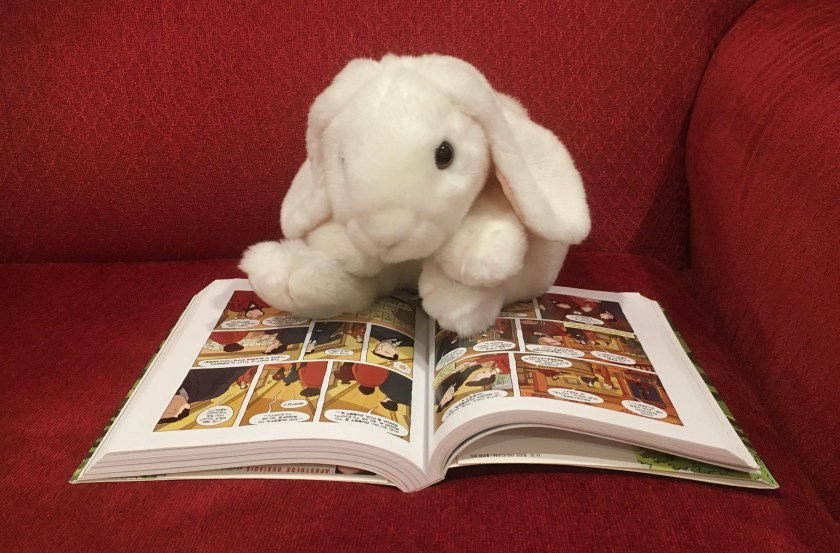
Marshmallow is reading Logicomix, written by Apostolos Doxiadis and Christos H. Papadimitriou, and illustrated by Alecos Papadatos and Annie di Donna.

S: So did you know about Bertrand Russell before reading this book?

M: No.

S: What do you think about him now, after having read it?

M: I think he is an interesting person. But according to this book review you showed me, not everything in the book is accurate.

S: Yes, I think the authors themselves say they took some artistic license with some of the facts. And that book review is a careful scholarly overview of the book that readers who might be curious about the accuracy of the text might check out. But let us get back to your reading of the book. What appealed to you most about this book?

M: Well, I liked the switch between the creators of the book and the subject of the book. It made things interesting. I also did not know about Russell and Wittgenstein and Gödel, and any of those philosophers, so I learned a lot.

S: And the book does cover a lot of ground in terms of the foundational debates of the early twentieth century. How did all that work out for you?

M: What do you mean by foundational debates?

S: I mean, the questions about the foundations of mathematics, of logic, of truth. How these folks were trying to understand why mathematics was true, how it worked, and so on.

M: I think some of that went over my head. But I did find it cool that people were thinking so hard about why math is true.

S: I know you find philosophical questions intriguing. The ones in this book are quite specific to math, it seems at first, but then if you think about it, we all want to know what is true, what makes something true, as opposed to false, fake news, or disinformation, or misinformation.

M: Yes. I did a project on all those this year. I used this website which talks about all the dangers of dihydrogen monoxide, and how it is everywhere, and how you should be very very afraid. But of course dihydrogen monoxide is just H2O, which is water!

S: Yes, I really liked your project! So we know it is sometimes hard to know what is true and what is not. And this book is about some philosophers who are trying to think about these questions very carefully and trying to see how to connect them to math.

M: Yes, I think that makes sense.

S: So I know you were not looking for philosophy or math when you started. Did all that overwhelm you when you were reading it?

M: No. I think they explained things in ways people could understand. I guess some things are a bit confusing, and I probably did miss some things, and maybe younger bunnies might not get any of the philosophical stuff, but it was interesting for me.

S: That’s great Marshmallow! And maybe you will come back to this book in a few years’ time if you are curious to dig deeper into the philosophical questions in it. I’m glad you read it!

M: Me too.

S: So as we wrap up this review, I’ll ask how you rate the book…

M: I rate this book 95%.

S: Sounds good! I know you always like to end our chats the way Caramel ends his reviews. So go ahead!

M: Stay tuned for more book bunny reviews!

Marshmallow has enjoyed reading Logicomix, written by Apostolos Doxiadis and Christos H. Papadimitriou, and illustrated by Alecos Papadatos and Annie di Donna and rates it 95%.

Marshmallow reviews Getting Things Done for Teens by David Allen, Mike Williams, and Mark Wallace

Marshmallow has always been a curious little bunny. She has always been eager to learn about the world as well as about how our minds work. Recently she got her paws on a book for teens, written by David Allen, the David Allen, of GTD fame, together with Mike Williams and Mark Wallace, about the way our minds work and about how to build a fulfilling life in a world full of distractions: Getting Things Done For Teens: Take Control of Your Life in a Distracting World. Though she is not yet a teen, Marshmallow found this book extremely interesting and eye-opening. Below is her review of this neat little book, perfect for teens and tweens as well as the adults in their lives.

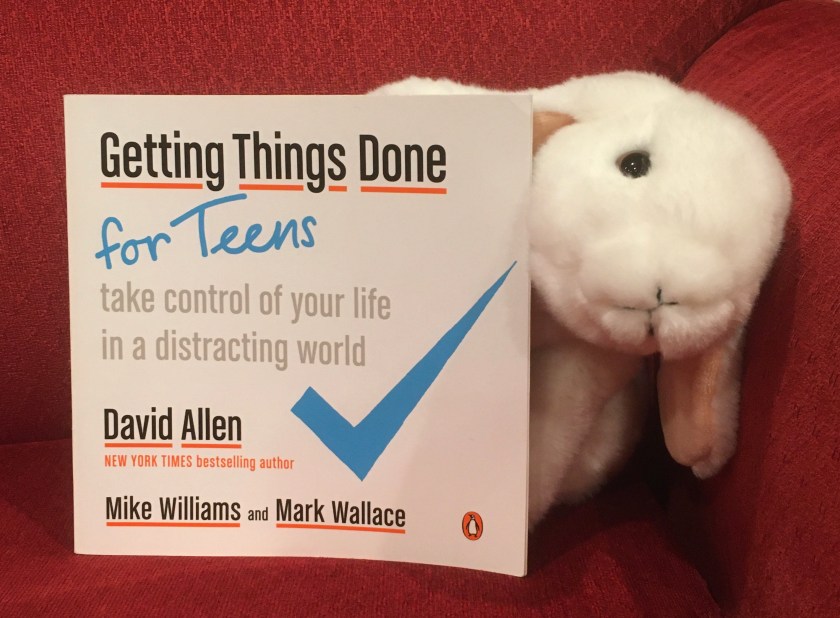
Marshmallow reviews Getting Things Done For Teens: Take Control of Your Life in a Distracting World, written by David Allen, Mike Williams, and Mark Wallace.

Marshmallow’s Quick Take: If you like how-to books or books about time management, organization, and self-improvement, or if you want to understand how your mind works and how to take control of your life, then this might just be the book for you.

Marshmallow’s Overview: Getting Things Done for Teens: Take Control of Your Life in a Distracting World is non-fiction, and it aims to teach the reader literally how to take control of their work and/or life. There are two main characters in the book: Cortland, an owl who represents the prefrontal cortex, and Myggy, a monkey who represents the amygdala. Like the prefrontal cortex, Cortland is slower and more thoughtful than Myggy. Myggy, on the other hand, is quick and makes decisions without a lot of thought. The book starts with an overview of how these two parts of the brain help us make decisions, and then introduces the basic features of the Getting Things Done perspective on living a life.

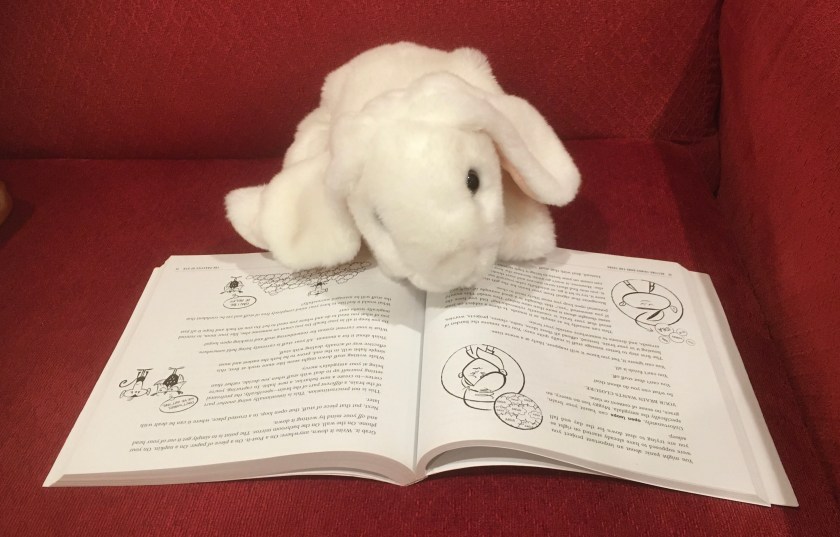
Marshmallow is reading Getting Things Done For Teens: Take Control of Your Life in a Distracting World, written by David Allen, Mike Williams, and Mark Wallace. Here she is looking at the page about "open loops", the things your mind feels like it needs to keep track of unless you resolve the issue about them or at least record them somewhere so you know you will get back to them later.
Marshmallow is reading Getting Things Done For Teens: Take Control of Your Life in a Distracting World, written by David Allen, Mike Williams, and Mark Wallace. Here she is looking at the page about what you need to do about “open loops”, the things your mind feels like it needs to keep track of unless you resolve the issue about them or at least record them somewhere so you know you will get back to them later.

The quick summary is that the book helps teenager bunnies organize their work and how to get their lives in order. It does this by teaching the reader how to deal with “stuff” in their minds. Some examples of “stuff” that one might need to deal with are classes, homework, bullying, college applications, and parent pressure.  

Marshmallow’s Review: This is a great book for bunnies that want to be better at organizing their life or work. There is a lot of information and useful advice packed into the book. But it does not get boring because the tone is light and humorous. Scenarios used to explain things are all realistic. There are helpful graphs, for example about stress and about things teens worry about. Also there are pictures on basically every other page. The illustrations of Cortland and Myggy, especially, are everywhere and keep reminding you of how your mind works in different ways.

There are also inspiring quotes sprinkled throughout. One of the quotes I really liked is:

“I don’t want other people to decide who I am. I want to decide that for myself.”

Emma Watson
Marshmallow is reading Getting Things Done For Teens: Take Control of Your Life in a Distracting World, written by David Allen, Mike Williams, and Mark Wallace. Here she is looking at the page about the "someday / maybe" list, a list that you can put things that you want to do some day but maybe it is not yet time to work towards them.
Marshmallow is reading Getting Things Done For Teens: Take Control of Your Life in a Distracting World, written by David Allen, Mike Williams, and Mark Wallace. Here she is looking at the page about the “someday / maybe” list, a list that you can put things that you want to do some day but maybe it is not yet time to work towards them.

Though Getting Things Done For Teens: Take Control of Your Life in a Distracting World has ideas that can be useful for everyone, I think it might be best for 9 and up. One of the reasons is because Myggy sometimes uses informal (and for some, inappropriate) words, but also because the methods might confuse younger bunnies. And younger bunnies might have fewer things that they can control in their lives and fewer things to have to worry about. In the other direction, Sprinkles told me that she thinks the book could help grownup bunnies, too. She thinks that this book does a great job explaining how the mind works and how this knowledge can help us organize our work so that our lives become much more manageable and enjoyable.

Marshmallow’s Rating: 100%.
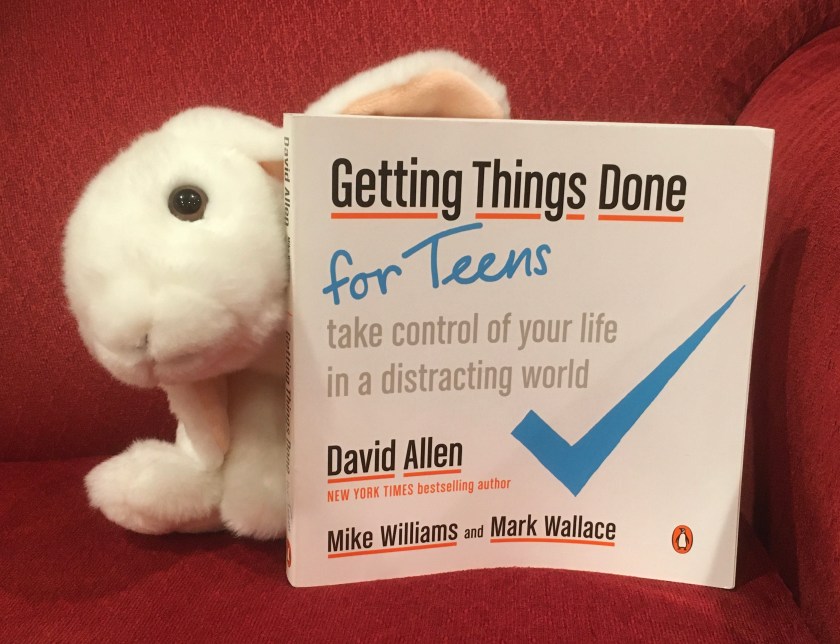
Marshmallow rated Getting Things Done For Teens: Take Control of Your Life in a Distracting World, written by David Allen, Mike Williams, and Mark Wallace 100%, and recommends it highly.