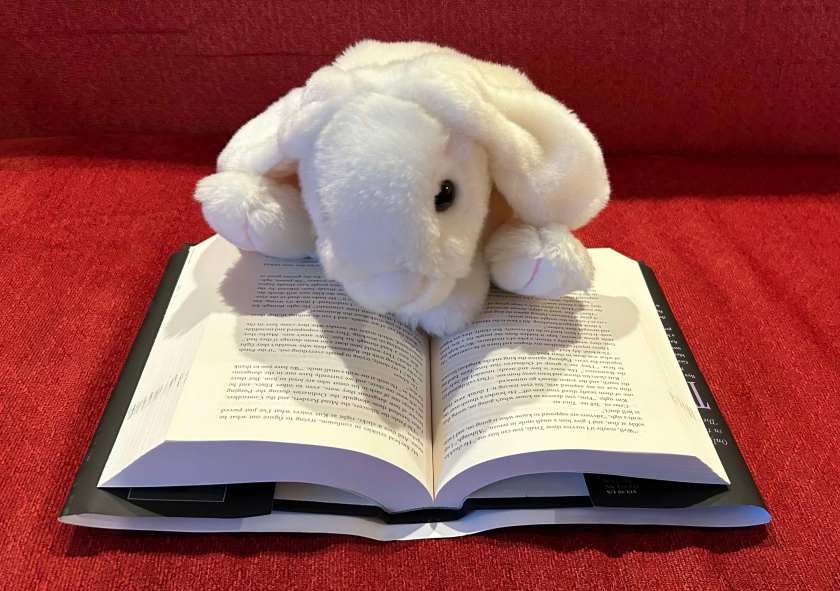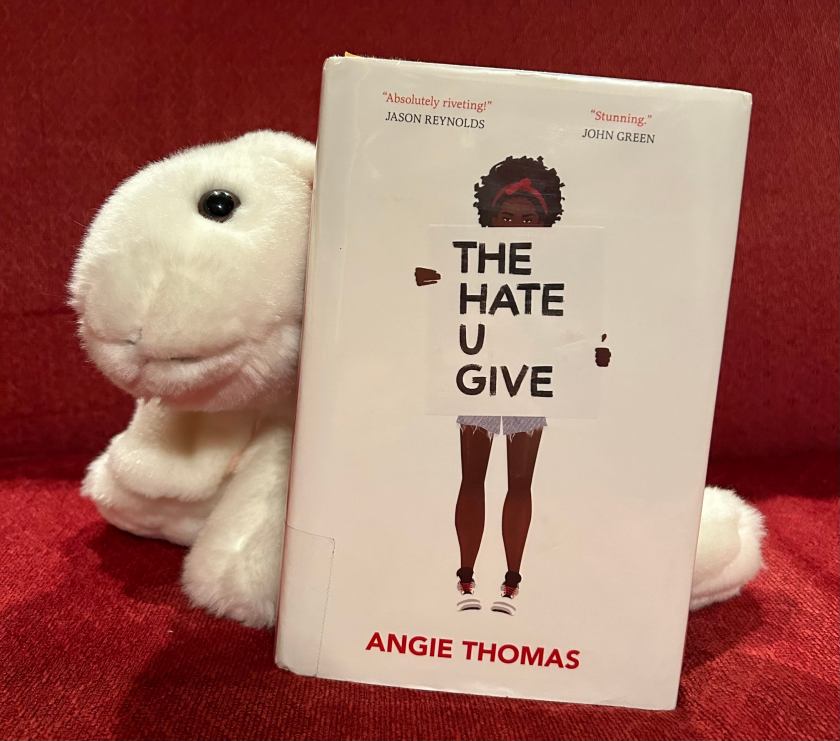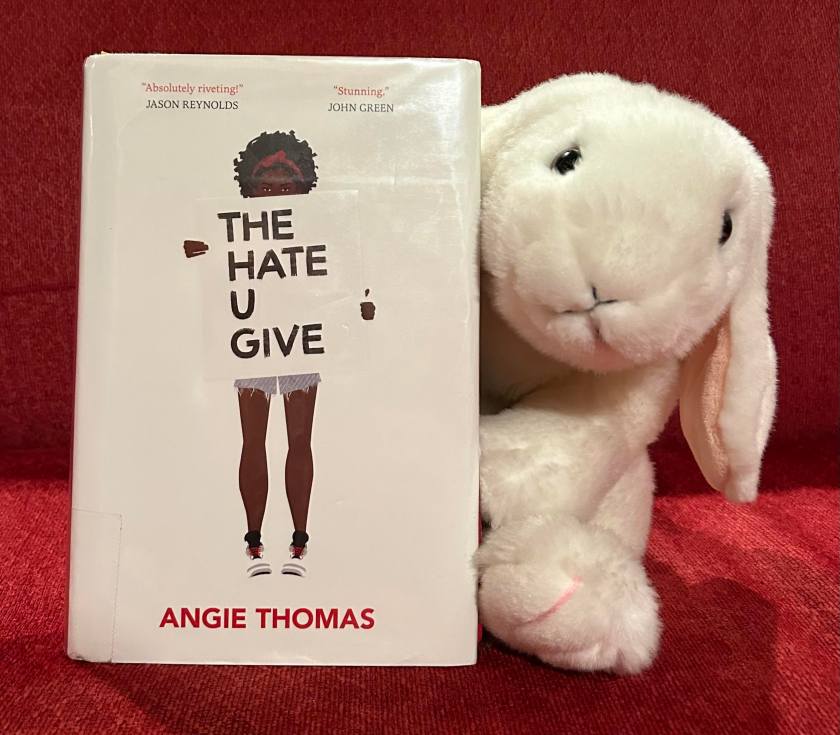
Today Marshmallow reviews The Hate U Give by Angie Thomas, first published in 2017.
Marshmallow reviews The Hate U Give by Angie Thomas.
Marshmallow’s Quick Take: If you appreciate books about racial injustice, family, friendship, growing up against adversity, and police brutality, then this is the book for you.
Marshmallow’s Summary (with Spoilers): Starr Carter attends a fancy prep school that is mostly White and wealthy but comes from a neighborhood (called “The Garden”) that is mostly Black and poor. These two distinct worlds create two distinct Starrs, one for Williamson Prep and one for Garden Heights. But she still feels like she doesn’t quite fit in in either place. So at a party, she finds comfort catching up with her childhood best friend Khalil whom she hasn’t seen for a while. But when a gun is fired at the party, she and Khalil leave and then get pulled over for no apparent reason. Khalil is instructed to get out. He does. He briefly leans over to check if Starr is okay. Then Khalil is shot by a police officer and everything changes forever. The police officer claims he thought Khalil was reaching for a weapon which turned out to be a hair brush. Khalil’s death becomes the center of attention. Starr faces a choice between staying silent or speaking out and placing herself and her family in danger.
Marshmallow is reading The Hate U Give by Angie Thomas.
Marshmallow’s Review: The Hate U Give by Angie Thomas is very well written, and though it is about very challenging themes (police brutality and racism), I could not stop reading it once I started. The story is told from Starr’s perspective and voice, and you get a first-hand look at her inner world as well as how she switches personalities and voices (see code-switching on Wikipedia) when she travels between her two worlds.
The title of the book is the beginning of the sentence whose initials spell THUG LIFE, an acronym created by Tupac Shakur and points to one of the important messages of the book: if you hate people from their birth just because they are black or poor or just different from you, if you give them hate from the time they are infants, it hurts everybody. Starr’s friend Khalil explains the quote right before his murder: “What society gives us as youth, it bites them in the [xxx] when we wild out.”
The book came out during the early years of the Black Lives Matter movement, and it was received well by critics and readers alike. There was even a movie adaptation (see the trailer here). The book also became controversial in some places, where people argued that the themes were too volatile and the language too vulgar. I did not find the language inappropriate given the context of the story, though it might be not acceptable for parents of very young bunnies.
But I think that more mature bunnies should definitely read the book. It is provocative, to say the least, but it tells a story that is unfortunately too familiar today from the inside, in the voice of one who was there when it happened.
Marshmallow’s Rating: 100%.
Marshmallow rates The Hate U Give by Angie Thomas 100%.
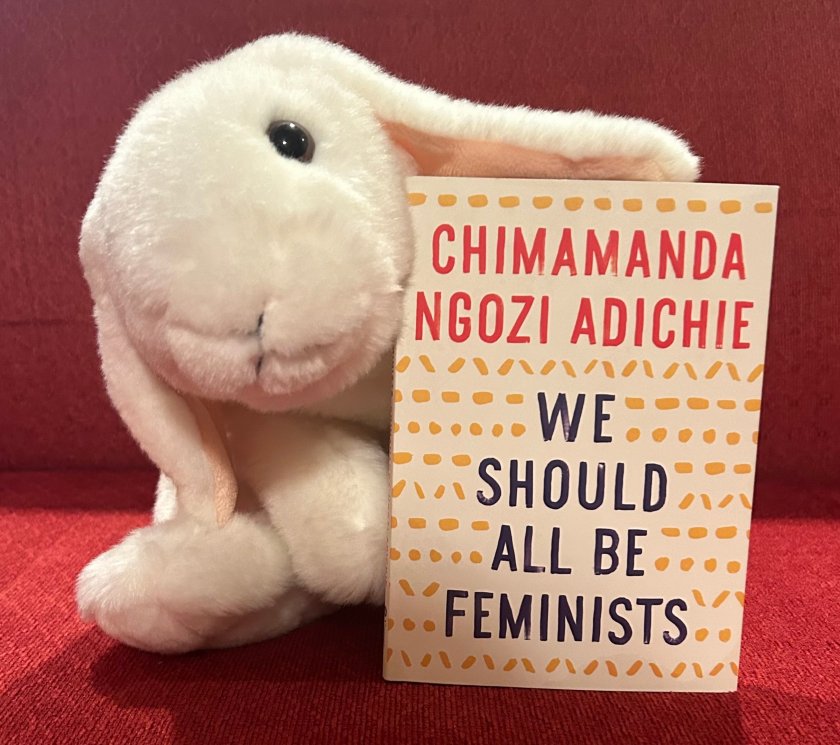
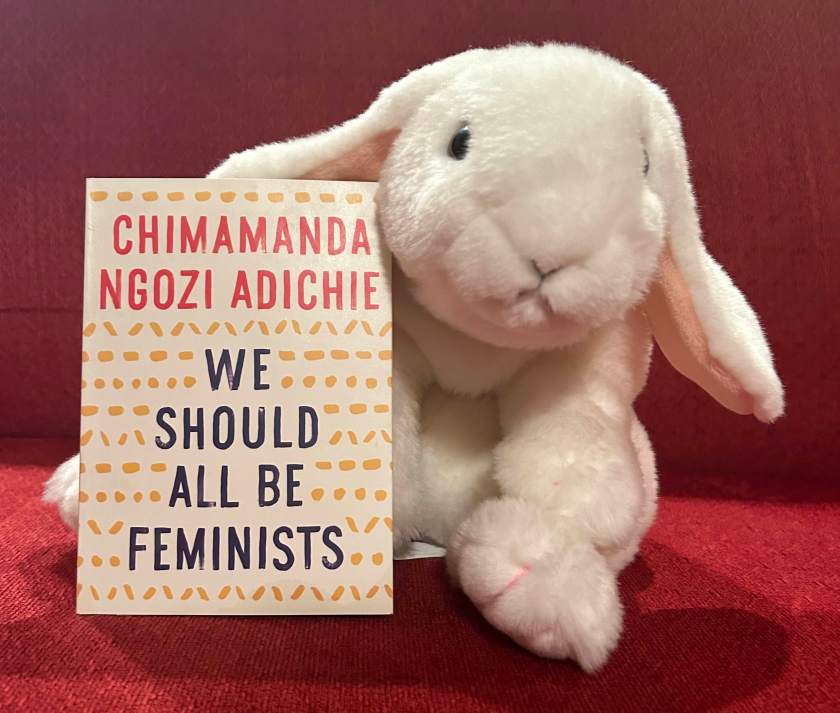
Today Marshmallow picked up a short little book from the book bunnies’ home library: We Should All Be Feminists by Chimamanda Ngozi Adichie, first published in 2014. Below she shares some of her thoughts on this little book.
Marshmallow reviews We Should All Be Feminists by Chimamanda Ngozi Adichie.
Marshmallow’s Quick Take: If you are feeling up for a short, non-fiction book with an important message, then this might be the book for you.
Marshmallow’s Summary (without Spoilers): I’d like to start off by saying that this book is adapted from Chimamanda Ngozi Adichie’s TEDx talk which is also titled “We should all be feminists”. I would recommend watching the video of her talk before or after reading this book.
In this book, Ngozi Adichie covers her experiences as a feminist. She explores what it means to be a feminist, how we can raise feminist children of both genders, and how we can strive towards a future where we are all feminists.
The author starts off by talking about her first encounter with the word “feminist”. The first time she was called a feminist, the word “feminist” was something akin to terrorist, used as an insult and an accusation. However, as we follow her, we learn that feminism is nothing to be afraid of and that instead it should be something we all should strive for.
Ngozi Adichie points out something insightful in this book when she states that the word “feminist” is often associated with the idea of being un-feminine. Ngozi Adichie writes that she enjoys wearing high heels and shiny lip gloss, even though she is a feminist. The author emphasizes that being a feminist doesn’t mean that you are unfeminine; it simply means that you believe that men and women deserve equal rights and prospects in life. The author specifically examines the treatment of women and men in Nigeria, offering examples and anecdotes from her personal experience. Though her examples were mostly from Nigeria, she does allow us to recognize that many women around the world are often ignored and silenced.
The author also talks about how men fit into feminism. She says that being a feminist doesn’t mean believing in female superiority; it means believing in female equality. Ngozi Adichie writes that ideas of masculinity also feed into the unjust sexism that exists in all cultures. Ngozi Adichie talks about how we must change the perspectives on gender, for both genders, for the sake of women and men.
Marshmallow is reading We Should All Be Feminists by Chimamanda Ngozi Adichie.
Marshmallow’s Review: I really liked this book. I completely agreed with practically everything in this book and felt verified by some of her statements. As a female bunny, I think books like this are important for change, especially this book. This book is very short and concise. The writing style is fresh and engaging, easy to follow and easy to understand. Yet the simplicity is most successful because of the way the author is so persuasive.
We Should All Be Feminists is a great book to give to someone who might not recognize the issues that women still face today. This is a very important message for everyone because feminism isn’t about pushing men down at all. It’s about focusing on what we have in our brains, rather than what sex chromosomes we have.
Overall, We Should All Be Feminists is very meaningful, easy to understand, and appropriate for all ages. I would recommend that everyone reads this book or at least watch the TEDx version of it.
Marshmallow’s Rating: 100%.
Marshmallow rates We Should All Be Feminists by Chimamanda Ngozi Adichie 100%.
Today Marshmallow reviews The Bluest Eye by Toni Morrison, first published in 1970. Sprinkles is taking notes and asking questions.
Marshmallow reviews The Bluest Eye by Toni Morrison.
Sprinkles: So Marshmallow, you always start your book reviews with what you call a quick overview. Can you give us one for this book, too?
Marshmallow: If you want to read about three young black girls growing up after the Great Depression and amidst internalized and externalized racism, then this is the book for you.
S: Okay, I think that is a good start. So tell us a bit more. Who are the three girls?
M: The main character is eleven-year-old Pecola Breedlove, and she is a foster sister to the other two girls, Claudia and Frieda MacTeer, who are nine and ten, and live with their parents. Pecola and Claudia are close, and a lot of the book is told from Claudia’s perspective. But we also have flashbacks and so on to events in Pecola’s life that Claudia could not have witnessed.
S: Okay, so tell me more. Why is the title The Bluest Eye?
M: Because Pecola wants to have the bluest eyes in the world. She thinks that she is ugly because a lot of people tell her she is, and she thinks that if she had blue eyes, she would be beautiful too.
S: I see. That must be very hard for a young girl of course.
M: That is not all that is hard in her life though. Her parents are both alive but they are not able to take good care of her. Her father is abusive and violent. Her mother does not support and protect her. The MacTeers on the other hand are a more supportive family for their children and Pecola, too, at least most of the time.
Marshmallow is reading The Bluest Eye by Toni Morrison.
S: I know this book has been banned in some school districts. Do you know why?
M: I think it is mainly because of two very sexually explicit scenes, which are also violent and abusive. And there are other parts where children are sexualized, and so on.
S: Hmm, I can see how those types of scenes would make a lot of people concerned about a book, especially for younger folks. How did you handle them?
M: I think the book is really hard to read, emotionally. When I was reading the book, I had to put it down several times. That is why it took me a really long time to read the book even though it is not very long and the author’s voice is fluid and captivating.
S: And yet you persisted and finished the book.
M: Yes, because I know it is an important book, and I know the author is trying to tell us something important.
S: What do you think she is trying to tell us?
M: I think she is trying to portray the chaos and the evil that results from racism. She says: “I felt compelled to write this mostly because in the 1960s, black male authors published powerful, aggressive, revolutionary fiction or nonfiction, and they had positive racially uplifting rhetoric with them that were stimulating and I thought they would skip over something and thought no one would remember that it wasn’t always beautiful.” So even though black people survived and often thrived despite the terrible oppression of racism they had to face, there were also people who did not survive, who were broken, and Toni Morrison wanted to make sure that we would not forget that.
S: I can see why you persevered Marshmallow. Sometimes we need to read difficult and heart-wrenching text to make sure we do not forget. But from what I am hearing you say, this book is probably not appropriate for young bunnies even though the main characters are young themselves.
M: Yes, definitely. I don’t think Caramel should read it yet for example. But for bunnies who are older and a bit more mature, it might be more appropriate.
S: You have read and reviewed Chains, Forge, and Ashes, the three books of the Seeds of America series, which were also about racism, or maybe more accurately, slavery. I think those books were also hard to read in some ways, but this one seems like it was a lot more challenging.
M: Yes. Possibly because in those books, even though there is a lot of pain and heartbreak, the main characters eventually overcome some of their challenges, and there is some sense of triumph, kind of like the writings Toni Morrison is referring to in the quote above. But in The Bluest Eye, both the life and the identity of Pecola are shattered. She does not survive her challenges. There is no redemption, only pain. Okay, there is some beauty too, in the book; there is solid love and affection, in the lives of Claudia and her family. But what happens to Pecola is traumatizing, and she does not survive the trauma.
S: I get that Marshmallow. Thank you for sharing your thoughts on this book. So do you have some last words to say about it?
M: I think this could be a good book to read for bunnies who are willing to face the full ugliness of racism and how it hurts people’s self-worth.
S: Thank you. So let us wrap this up then. What do you want to tell our readers?
M: Stay tuned for more amazing reviews from the book bunnies!
Marshmallow appreciated reading The Bluest Eye by Toni Morrison, though she thinks that it might be appropriate for only older bunnies.
Today Marshmallow reviews Little Fires Everywhere, a 2017 novel by Celeste Ng, which has been turned into a one-season TV series in 2020.
Marshmallow reviews Little Fires Everywhere by Celeste Ng.
Marshmallow’s Quick Take: If you like books about family (specifically the relationship between a mother and their children) and racial differences, then this is the book for you.
Marshmallow’s Summary (with Spoilers): Pearl Warren has lived her whole life moving from one place to another. Her mother Mia is a photographer, an artist who finishes one project, sells it, and then decides to move on. To support herself and Pearl, she works odd jobs at restaurants or shops. But after a close brush with Pearl’s pneumonia, Mia decides that a nomadic life isn’t good enough for her developing daughter who is missing out on a normal life. So they settle down in Shaker Heights, the first, fully planned community in America.
In Shaker Heights, the houses are all color coordinated and regulated to be perfectly in order. But it’s not just the houses that are picture perfect. Every person in Shaker Heights is born with a set plan: success, planned success at that. The epitome, the poster child of this planning approach is Elena Richardson. Born in Shaker Heights, she followed her plan to the smallest detail: high school, college, job, marriage, children. Now wealthy, living with a husband, four children, and two houses, she generously rents her extra house to those she feels deserve a better chance, a chance to live in Shaker Heights. Shaker Heights’ schools and environment is expensive but full of opportunity, a place that many wouldn’t be able to afford. So out of Mrs. Richardson’s generosity, Mia and Pearl are able to move into a house, permanently, Mia promises.
The Richardson family has four children, all of whom fascinate Pearl. The oldest daughter (a senior), Lexie, is confident and mature in a way Pearl wishes to be able to emulate. The oldest son (one year older than Pearl and a junior) is named Trip. Trip is athletic and very popular with girls, including Pearl. The younger son (a sophomore, the same age as Pearl) named Moody befriends Pearl and invites her to the fascinating Richardson house. The first three Richardson children match Elena’s plan, but the youngest child, Izzy (a freshman), doesn’t fit in and doesn’t seem to want to fit in. She is rebellious and contends with her mother to frustrate her. But when Izzy meets Mia and her art, she becomes almost obsessed with Pearl and her mother’s lifestyle.
In the opposite fashion, Pearl becomes obsessed with the Richardsons and their entrancing life. But with a growing, intensifying crush on Trip and a budding friendship with Lexie, her original friend in the Richardson family (Moody) becomes a little neglected. Eventually, Trip reciprocates her feelings and they engage in sexual relationships. Meanwhile, Lexie gets pregnant with her boyfriend. But in Shaker Heights, where greatness is a given, pregnancy is not tolerated in teenagers. So when she gets an abortion, out of embarrassment, she puts her name down as Pearl.
At the same time, Elena’s old friend Linda McCullough (who also returned to Shaker Heights after college) is having issues of her own. Mrs. McCullough and her husband have been trying to have children for fourteen years while Elena was giving birth to four children at one-year intervals. So when Mrs. McCullough is informed there is a baby they can adopt, she is overjoyed. The baby was dropped off at the fire station in a cardboard box with blankets. The baby’s mother is unknown and anonymous. So when her new baby’s first birthday (still during the adoption process) comes around, she invites her old friend Elena. Mia hears about the McCulloughs’ new baby and is shocked to realize that one of her coworkers at a Chinese restaurant is the baby’s mother. Bebe Chow is a Chinese immigrant whose boyfriend abandoned her after learning that she was pregnant. She worked to support her child, but, in a moment of desperation, she left her baby at the fire station. Afterwards, she desperately tried to get her baby back for a year. Now that she knows where her baby is, Bebe goes to the press, following Mia’s advice. This becomes a huge news story dividing people into camps, and the coverage eventually earns Bebe visitation rights and a lawyer.
The situation is very difficult. The McCulloughs genuinely love the baby with all of their hearts, especially after spending fourteen years waiting for one. However, Bebe really wants her baby now, having only left her due to extreme poverty and depression. Now, she has a more stable job and wants to take care of her baby. Also, her lawyer says that as a Chinese baby, Bebe’s baby won’t be connected to her heritage unless she is raised by her Chinese mother.
So in summary, Shaker Heights was perfectly planned, but with the arrival of Mia and Pearl, chaos ensues. Nothing will be the same again.
Marshmallow is reading Little Fires Everywhere by Celeste Ng.
Marshmallow’s Review: I really liked this book. I did have very high expectations; Celeste Ng’s other book, Our Missing Hearts, is one of my favorites ever. Celeste Ng’s writing is unique in a way I can’t describe with words. Something about her writing puts her on another level. She writes so simply, yet provides overwhelming detail: clear and concise. So I really wanted to read another book written by her.
And Little Fires Everywhere is definitely not a disappointment. The world the author creates is realistic yet retains an air of fantasy in a way. The storyline is unique and different from most books. Just like in Our Missing Hearts, Ng always gives convincing and deep backstories and context before extending the plot further.
The storyline is rich and complex, but easily understandable. There is some inappropriate content for younger bunnies. Underage characters do engage in sexual activity, however, there is no explicit, overly detailed scenes (unlike the, cough, Shatter Me series, cough cough 🤨). Teenage pregnancy is mentioned, as is abortion. The topic of motherhood and what it means to be a mother is a pervasive theme throughout the book. The relationship between parent and child is explored deeply through the lives of several different characters. The topics in the book (specifically the conflict between the McCulloughs and Bebe) are complicated and cannot be answered in a simple manner. The book also seems to have a message about the value and limitations of planning. Celeste Ng seems to imply that some parts of life cannot and should not be planned.
I think this was a fascinating, deep, and interesting book that had an impact on me, emotionally and intellectually. Of course, some content might make it better for older bunnies, perhaps 14 and up. And the ending, for me, was not satisfying, but it fit the style of Celeste Ng (which again, I don’t know how to describe). Overall, I would definitely recommend this book to all bunnies.
Marshmallow’s Rating: 100%.
Marshmallow rates Little Fires Everywhere by Celeste Ng 100%.