Marshmallow reviews The Illustrated Happiness Trap by Russ Harris and Bev Aisbett

Today Marshmallow wanted to talk to Sprinkles about The Illustrated Happiness Trap by Russ Harris and Bev Ausbett, first published in 2014.

Marshmallow reviews The Illustrated Happiness Trap by Russ Harris and Bev Aisbett.

Sprinkles: So Marshmallow this time you chose a book that is not really intended for a young audience.

Marshmallow: Yeah, I suppose.

S: This book is apparently an illustrated and abbreviated version of a more normal-sized book which could be considered a self-help book. And we have not really gone into the self-help book genre here much.

M: True. I did review a book about confidence, a book about time management for teenagers, and two books about how to be a good student. But we do not typically review self-help books, you are right.

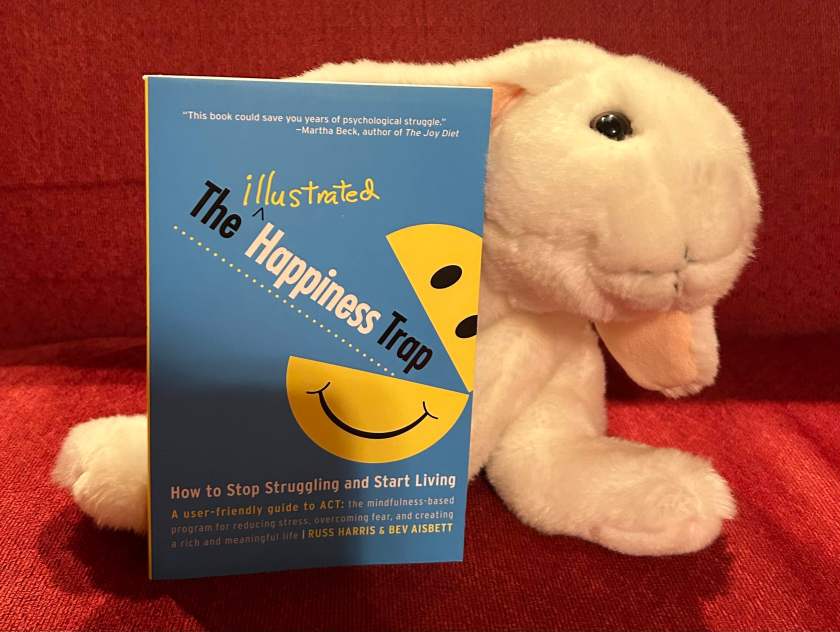
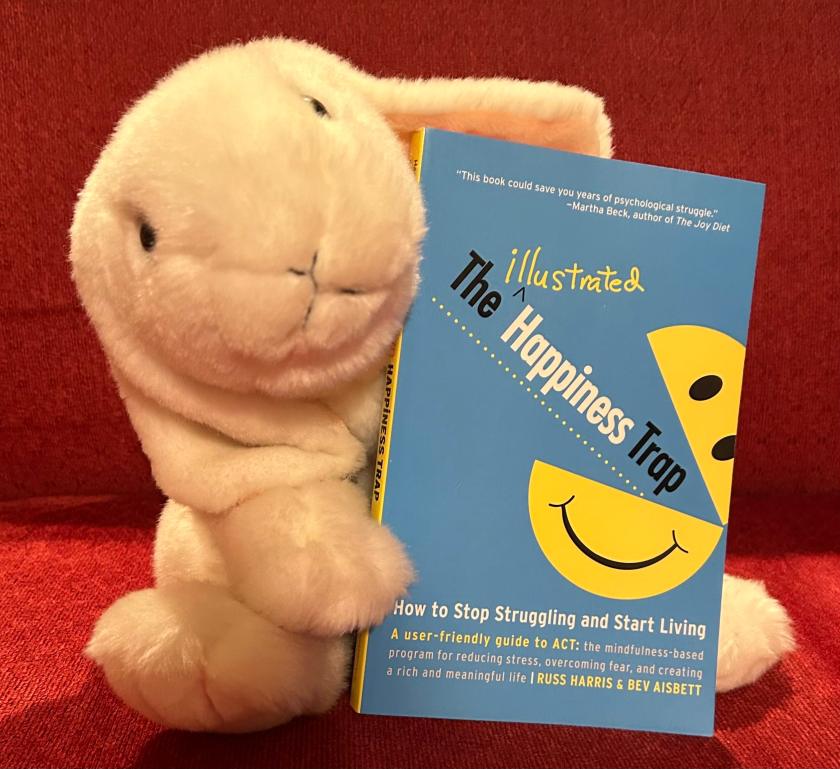
S: But I think the title and the cover page of this book are both very intriguing, aren’t they?

M: Yes, I like how it has a Pac-Man style half-split smiley face.

S: Yes, it is quite striking how the smiley who could represent authentic happiness, but also a fake version of it, is somehow split open with the title.

M: Yeah.

S: So I had only read a little bit of the book before you took it from me and I know you have finished reading it quite fast. I understand it is about happiness?

M: Yes, kind of. It is basically about how we should not be going after happiness as our goal in life.

S: Hmm, this reminds me of a very interesting young person in one of my classes who had said that they did not necessarily want happiness for their child. They wanted them to find purpose.

M: Yeah, it is kind of like that. The main goal of the book is to dispel the myth that happiness is the right goal for one’s life. The goal should instead be to figure out your values and live your life accordingly. Once you know your values, the goals you set for yourself should reflect those values and be feasible. And along the way, you are likely to be unhappy at times, and that is not a disaster.

S: I see. So the title is basically saying that the idea that you should always be happy is flawed.

M: Yes, and that pursuing the goal of living a life where you are always to be happy and have no negative feelings leads to only unhappiness.

S: I see. That makes sense to me. I also saw that the book mentions explicitly four myths. Can you tell us what they are?

M: Okay. So the first one is “Happiness is the natural state for human beings.” The second is “If you are not happy, you are defective.” The third is “To create a better life, we must get rid of negative feelings.” And the fourth one is “You should be able to control what you think and feel.”

S: I can see how the first three are wrong, if we accept the main thrust of the book. And I already did not believe some of them myself. Like there are sometimes very good reasons not to be happy. But the fourth one is hard for me to accept. It feels kind of disempowering.

M: I agree with you. But I think the idea behind their stance, which they call Acceptance and Commitment Therapy, is that basically you should accept your feelings and decide what to do with them in a productive manner. As you learn to do this better and more effectively, your emotional state can change, too, and improve, but that is not the main goal.

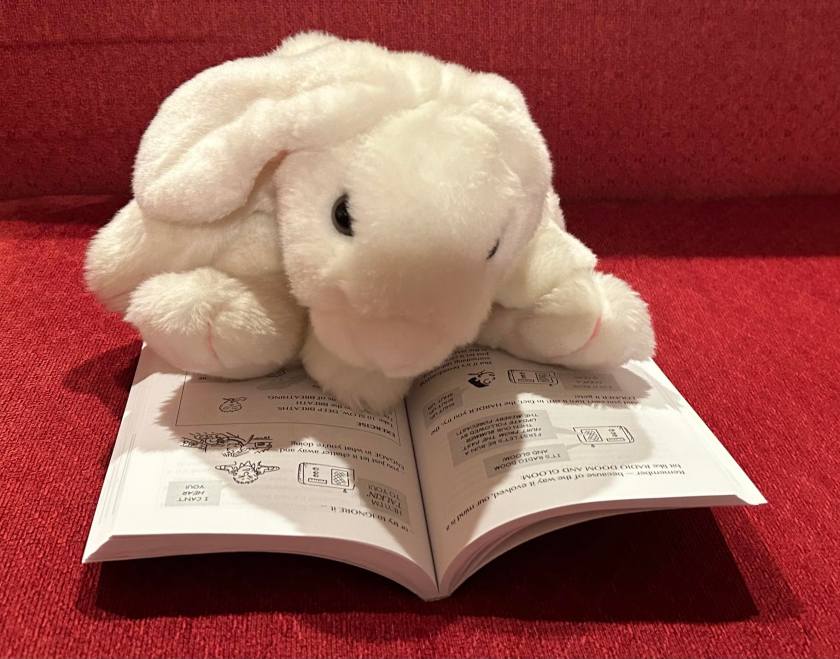
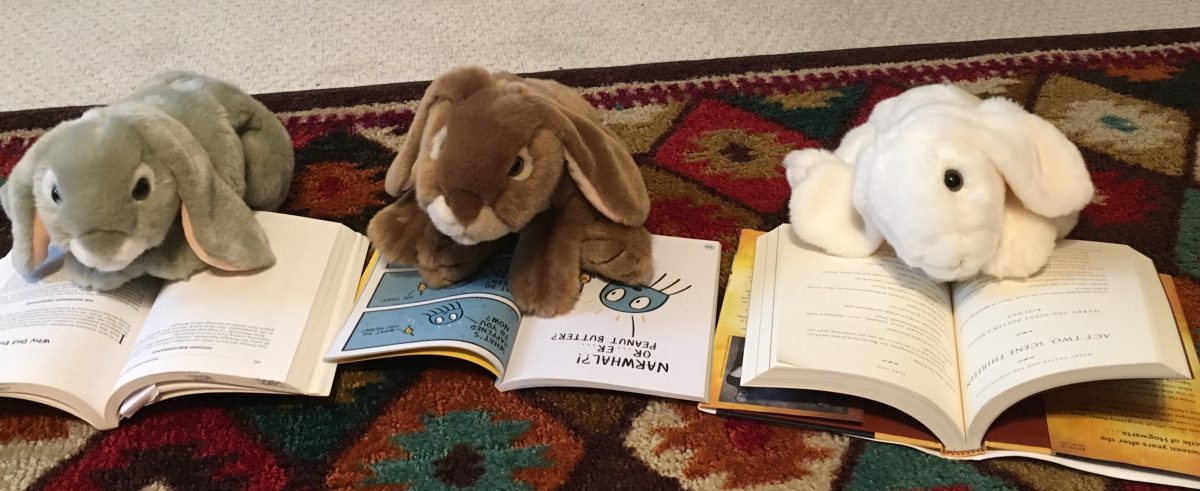
Marshmallow is reading The Illustrated Happiness Trap by Russ Harris and Bev Aisbett.

S: So Marshmallow, I think these are all rather hefty thoughts and a bit heavier than some of the things we read and talk about here in this blog.

M: True, but we have talked about all sorts of other heavy things like war and slavery and so on. So talking about mental health challenges should not be totally out of bounds, I think.

S: Oh I agree.

M: And we have talked about mindfulness before. Actually you and Caramel talked about a book about how breathing could be helpful. And then there were those two books about dragons and anger management.

S: True. And the topic is actually quite relevant to a lot of bunnies.

M: Yes,. sure, this is not really quite meant for little bunnies, but maybe a bunny around my age would be perfectly fine with it. And I think they could learn from it.

S: I am glad you found the book helpful.

M: I did. I found it resonating a bit with the Getting Things Done book I reviewed before. Both books say that figuring out your values and building your life around them is a good idea.

S: I can see how that could be helpful for teenagers who are looking to build their lives, preparing to grow up into adult bunnies. So if you were to rate the book then, what would you rate it?

M: I’d rate it 95%. I especially liked the illustrations and how they made the book so much easier and quicker to read. Because it is kind of stressful to read a book about mindfulness sometimes. I feel like I am losing time, but this book is so quick and you learn a lot.

S: Great! I will now take it from your paws then and finally get the chance to finish it myself. What would you like to tell our readers as we wrap up this review?

M: Stay tuned for more amazing reviews from the book bunnies!

Marshmallow rates The Illustrated Happiness Trap by Russ Harris and Bev Aisbett 95%.

Marshmallow reviews Beowulf: A Graphic Novel Adaptation by Gareth Hinds

Today Marshmallow is talking to Sprinkles about Beowulf: A Graphic Novel Adaptation, written and illustrated by Gareth Hinds and first published in 2007.

Marshmallow reviews Beowulf: A Graphic Novel Adaptation by Gareth Hinds.

Sprinkles: So Marshmallow, you read yet another graphic novel adaptation of yet another ancient story. Tell us a bit about this book.

Marshmallow: This book is about a hero named Beowulf. The story takes place within the world of Norse mythology. Beowulf is a strong warrior, who is the leader of a people called the Geats. There is a king named Hrothgar, who is the leader of the Danes, who decides to build a banquet hall that will be the greatest ever. Once this great hall is finished however, this monster from “an accursed race” called Grendel comes and eats everyone who is there at night. And then this happens for twelve winters.

S: Wait, so there is a monster who comes and eats the folks in the great hall at night. Then why don’t they leave the hall empty at night?

M: I do not really understand the logic there either. But that is what happens. So Grendel is a big threat to the Danes and their king. Until Beowulf comes and he says he will save them. And he fights Grendel and kills him.

S: So is that the whole story then?

M: No, this is only part one. Then Beowulf has to kill Grendel’s mother who is another monster, and then there is a dragon who comes, and Beowulf kills that too.

S: So the book is about three different heroic triumphs of Beowulf protecting or saving the Danes.

M: Almost but not quite. Those things kind of happen but there is more. Between the murder of Grendel’s mother and the dragon, Beowulf returns home and rules over his land for fifty years. And then the dragon comes and attacks the Geats. So Beowulf has to fight against the dragon. He manages to kill it but he is mortally wounded in the fight.

S: So he dies in the end?

M: Yes, but he seems quite at peace with it because he lived a long and valiant life and he saved his land and his people. And other people too.

S: You mean the Danes?

M: Right.

Marshmallow is reading Beowulf: A Graphic Novel Adaptation by Gareth Hinds.

S: So the original Beowulf story is very old.

M: Yes, not as old as the Iliad or the Odyssey, but the first known manuscript of the story is more than a thousand years old. But this graphic novel looks like it would fit right in with the genre. Especially if you like graphic novels which are very graphic.

S: Can you open that up a bit?

M: I mean the fights are depicted very explicitly. It is rather violent. For example, Beowulf rips off Grendel’s arm and Grendel is shown eating people and ripping off other people’s limbs and so on. It is really violent. I would definitely not recommend the book for little bunnies.

S: I looked at the book a bit and did see a lot of action and violence.

M: Yes. But I think most teenagers can handle it. And if they are trying to get the sense of the historic text, this could be very helpful. It is a very fast read. There is very limited amount of text, and there are many pages where there is no text whatsoever.

S: Hmm, that sounds interesting. It does seem like you appreciated reading the book.

M: Yes. I’d even rate it 95%. Honestly when I first began to read it, I thought that maybe the font of the text was a bit too fancy and could make it hard to read, but then I got used to it and could read it easily. I’d definitely recommend this book to bunnies curious to know the story of Beowulf.

S: That makes sense.

M: Did you know that J.R.R. Tolkien, the writer of the Lord of The Rings trilogy and The Hobbit, was a scholar who wrote a bunch about the original story Beowulf? He worked on a translation of it from Old English and even wrote about translating it.

S: I knew he was a scholar of ancient literature but I think I did not know he worked with Beowulf specifically. That is very interesting Marshmallow.

M: I thought so too.

S: Okay, then; this is probably enough for this review. What would you like to tell our readers as we wrap it up?

M: Stay tuned for more amazing reviews from the book bunnies!

Marshmallow rates Beowulf: A Graphic Novel Adaptation by Gareth Hinds 95%.

Marshmallow reviews The Iliad: A Graphic Novel Adaptation by Gareth Hinds

A few weeks ago Marshmallow read and reviewed The Odyssey: A Graphic Novel Adaptation by Gareth Hinds, a retelling of an iconic tale from the Ancient Greeks. Today she discusses with Sprinkles The Iliad: A Graphic Novel Adaptation, published nine years later, in 2019.

Marshmallow reviews The Iliad: A Graphic Novel Adaptation by Gareth Hinds.

Sprinkles: So Marshmallow, here we are, with yet another book about Greek mythology.

Marshmallow: Yes, this is the famous Iliad, also credited to the blind poet Homer, and it tells the story of the Trojan War, the war that is supposed to have happened before the events of The Odyssey. So yes, it is mythology but also kind of like history.

S: Yes, it does seem like in those times, history and myth got quite intimately intertwined. So tell us a bit about the main story. What is it really about?

M: Well, it starts with a Prologue explaining some historical facts about the Trojan War. And there we are told that the book (The Iliad) will not really be about the War itself, but mainly about the two main heroes, Achilles and King Agamemnon both fighting on the Achaean side.

S: Oh I see. So then tell us a bit about these two men and what is going on between them that deserves an epic poem.

M: Basically Agamemnon and Achilles are both fighting to help their common ally, Menelaus, whose wife Helen was kidnapped by Paris, the son of the Trojan king. Menelaus won Helen as his wife in what seems to me to be a primitive competition, and all his competitors swore to protect the eventual winner. So now Menelaus calls in all these people to help him get Helen back from Troy.

S: So Helen is supposed to be the reason for the Trojan War, according to this account, right?

M: Yes. That is the main idea, but of course there were a lot of other more political reasons, like control over trade routes. But it is of course more romantic to explain everything as a man fighting to get his wife back.

S: I can see that.

M: I think both the gods and the people are very petty in the whole story. The main story of the book is not even about the cause of the war. Achilles and Agamemnon, even though they are fighting on the same side, start fighting over spoils of war, and in particular a young woman. I would like to mention that Achilles claimed this woman after killing her husband, her brothers, and her parents.

S: Ugh. She seems to be seen mainly as a reward, as property. And it seems Helen is the same.

M: Yes, I was quite annoyed by that through the whole story really. They fight over her without really letting her decide who she wants to end up with. And she is not really too free either. She is kind of coerced into loving Paris by Aphrodite. She also did not like her husband much to start with, it seems like.

S: And from what you are telling me, it seems like it really did not matter what she felt or thought. From some versions of the story, I had understood her to have fallen in love with Paris, but yes, by Aphrodite’s nudging. Which is kind of coercive. Then again, she is the goddess of love, so how does anyone fall in love with anyone?

M: Hmm, I do not know. That is a good question. But in some stories Aphrodite makes people fall in love with inanimate objects or horrible people, so it is not always a natural love.

Marshmallow is reading The Iliad: A Graphic Novel Adaptation by Gareth Hinds.

S: Okay, so you had some misgivings about the story line, but overall what did you think?

M: Well, I liked it. I’d rate it 100% because it is an important and well-revered story of Western Civilization, and the book is well done. And we see very clearly the follies of war. There is also a lot of violence. So probably younger bunnies should not try to read this. Even though it is a graphic novel, it is a bit too graphic in that other meaning of the word.

S: I see.

M: It was also pretty important for me to read this and see how women were seen as rewards, as spoils of war, and as property.

S: It has been that way in many cultures, societies, and times, unfortunately.

M: I am happy that I am not living in those times.

S: Me, too. What else would you like to tell us?

M: It is really annoying how gods think of humans as their own playthings. Of course I also knew this from all the Percy Jackson books, but this is real war, and there are a lot of real people dying because of the gods’ interventions. Also the humans themselves are extremely violent. They take revenge, empathy and mercy are viewed as weakness. What they think is honor is too violent. It is a terrible terrible world. The only good person in the whole book seems to be Hector, and even he dies because he believes dying is honorable and his wife and son are left defenseless.

S: I see. Thank you for all your thoughts Marshmallow. Last but not the least, can you comment on the drawings?

M: Sure, the drawings are in the same style as those in The Odyssey, as you would expect. It is after all the same artist. I liked how especially in this book, the characters were quite distinct in how they were depicted. Apparently he worked the first letter of each character’s name into their armor, which is a neat idea, but it is a little difficult to see them sometimes. Overall, though, this was a good book to read as a graphic novel.

S: I can see that it would be important to be able to distinguish all those characters. There are so many! Anyways, this is probably a good time to end this review. What would you tell our readers Marshmallow?

M: Stay tuned for more amazing reviews from the book bunnies!

Marshmallow rates The Iliad: A Graphic Novel Adaptation by Gareth Hinds 100%.

Marshmallow reviews Guinness World Records 2024

Today Marshmallow dives deep into Guinness World Records 2024, an outstanding book of records updated for 2024, created by a huge team of editors, contributors, and consultants, all listed at the end of the book, and illustrated by Rod Hunt. Sprinkles is taking notes and asking questions.

Marshmallow reviews Guinness World Records 2024.

Sprinkles: So Marshmallow I know you have been a fan of Guinness World Record books for a while now. How did you enjoy reading this 2024 edition?

Marshmallow: It was really interesting. It definitely kept me busy for a long time.

S: So this is a book full of facts. So Caramel will love to get his paws on it too. But I know you have a thing for these records, so it made total sense when you grabbed the book first and did not put it down until you were done. Tell me some of your favorites.

M: Sure. The fastest average solve for a 3x3x3 Rubik’s cube is 4.86 seconds.

S: Cool! I know you once solved it in under 47 seconds and that was pretty impressive for a little bunny.

M: Not in comparison to this guy!

S: Well he has opposable thumbs, which help I am sure.

M: True. Okay, here is another record: this person in Germany has a collection of 11,062 penguin related items!

S: That sounds awesome! The book bunny family adores penguins!

M: But we definitely do not have eleven thousand penguin-related things!

S: I know! That is wild. What else have you got?

M: Well, apparently there is this Turkish-American guy who spent a total of two years and three hundred and fifty four days of rowing all by himself in the ocean.

S: That’s almost three years. I’d be so lonely. And so homesick.

M: Yes… Me too.

S: So that is a record I might not want to challenge. But I bet you could like to be able to solve the cube in under five seconds.

M: That could be nice.

S: Give me another record you might want to be able to break yourself.

M: Well, I am not sure. But the biggest doughnut in the world weighs 226 pounds, and it is pink and has sprinkles on it.

S: Hmm, I think we could like that.

Marshmallow is reading Guinness World Records 2024.

S: So tell me more about this book. I am thinking you have not really read it from cover to cover in that order, right?

M: Well, I think I read everything in it eventually, but yes, I skipped around a lot at first. And it is actually quite fun to do that. The pages are very colorful, and many of the facts are quite weird. For example, thirty-four couples got married under water on Valentine’s Day 2001 in Thailand. And there is apparently a guy who married more than twenty six times and has allegedly fathered 41 children. Wait, here is the Wikipedia page for the guy. I cannot understand why someone would marry so many times.

S: It is really strange. But I can see how this book could really be entertaining. And the records are organized in some fashion, right?

M: Well, there is a table of contents. For example there is a section on sports, art and media, science and technology, and so on. But did you know that they do not have records for some things because they could be unethical? Here is a Wikipedia page of discontinued records due to a range of ethical and moral issues. There are more details on the Guinness World Records policy page.

S: Wow! That is actually good to know. Thank you for sharing Marshmallow. So maybe this is a good time to end this review. How would you rate the book overall?

M: I’d rate it 100%. I love reading about these records!

S: That sounds wonderful Marshmallow. I’m glad we got a copy of this book then. What would you like to tell our readers as we wrap this up?

M: Stay tuned for more amazing reviews from the book bunnies!

Marshmallow rates Guinness World Records 2024 100%.