Caramel reviews Japanese Myths, Legends, and Folktales by Yuri Yasuda

Last summer Caramel read several books on Asian myths and legends. Today he is talking to Sprinkles about one of these: Japanese Myths, Legends and Folktales: Bilingual English and Japanese Edition, written by Yuri Yasuda, illustrated by Yoshinobu Sakakura and Eiichi Mitsui, and published in 2019.
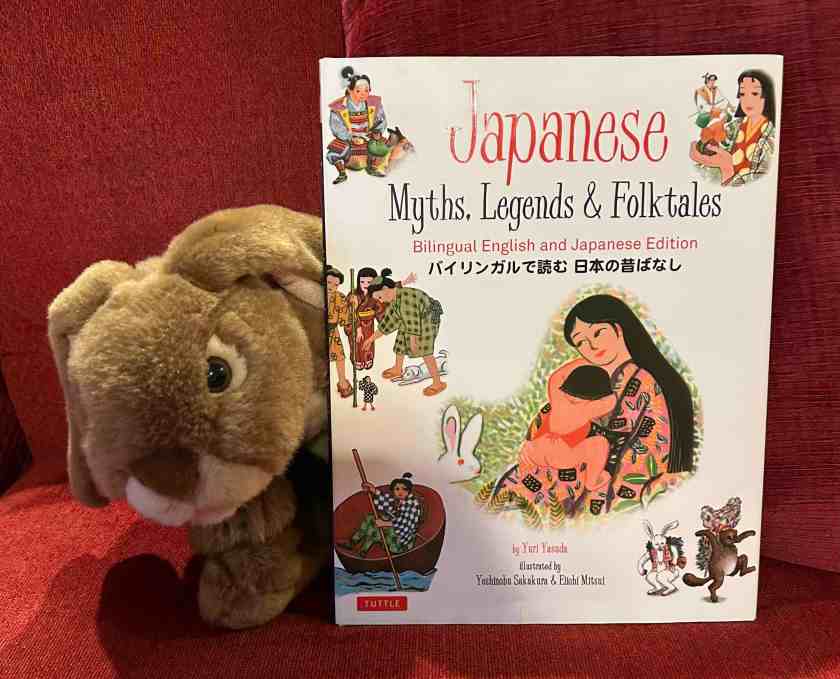
Caramel reviews Japanese Myths, Legends, and Folktales by Yuri Yasuda.

Sprinkles: So Caramel, this is one of your last reviews before we take off for the summer. What do you want to talk about today?

Caramel: It’s this book on Japanese myths and legends. I like all of the nice stories, and the pictures. The colors are nice.

S: You are right, there are a lot of illustrations in this book. Each page has at least one. And they are very stylized. That is, they all kind of fit in one style, they resemble one another in some ways. 

C: That makes sense though. It is all the same people who drew them. So it makes sense they would look like one another. 

S: True. 

C: And they are all very colorful and they use some really cool drawing  techniques!

S: That is a good observation Caramel! I agree with you! Now tell me a bit more about the stories.

C: There are twelve stories. Each of them takes about three to five pages, usually below ten. On each page there is a picture or two, and then the top of the page is in English. And in the second half of the page the story is in Japanese. 

S: Oh, part of the book is in Japanese then! I guess it makes sense: the book is subtitled “The Bilingual Edition” after all. 

C: Well, actually, it’s called, “Bilingual English and Japanese Edition”.

S: Thank you for the correction Caramel. That makes total sense. But you don’t know how to read in Japanese. Was that okay?

C: Well, I don’t know how to read in Japanese YET. But yes, it was more than okay. It was cool to see the difference in the writing. Japanese people use a different alphabet than us. Or rather three different writing systems. I looked it up. There is a long Wikipedia article about it. And we tried to learn a bit of Japanese last summer. It is hard but it is also a lot of fun. I loved using the brush pens! 

S: Yes, that was a lot of fun! And you are so right in saying that you don’t know it YET. You are still such a young bunny, maybe you will learn it at some point.

C: I hope so. I especially want to play more with the brush pens, mostly the pens.

S: Sounds like a plan to me!
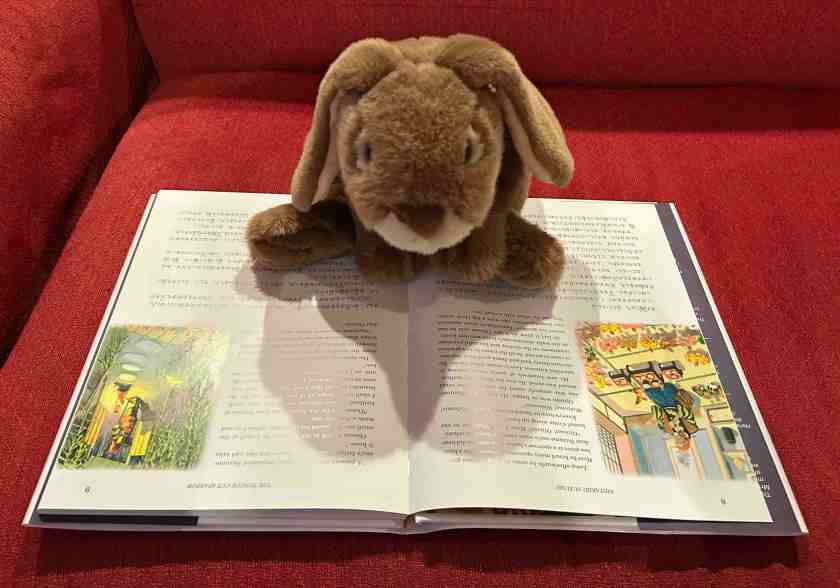
Caramel is reading Japanese Myths, Legends, and Folktales by Yuri Yasuda.

S: Okay, so let us get back to the stories. You said there are twelve of them. So tell us a bit about a couple of them. Maybe your favorites?

C: I liked the first one, “The Tongue-Cut Sparrow”. It’s about a kind old man who finds an injured sparrow and saves it. One day as he is out doing something, the sparrow eats the house flour, so the old man’s wife cuts the sparrow’s tongue off as punishment, and the sparrow flies off. Then on another day, the old man goes walking, and he meets the sparrow again. The old man was always kind to the bird, so the sparrow offers him some gifts. The old man takes the smaller gift and walks home to find that it has money. But his wife is not a nice person and she is greedy too so she gets upset that her husband did not get the bigger gift. So the next day she takes off to find the sparrow and asks for the bigger gift. The sparrow gives her the bigger gift and tells her not to open it until she is home. But she does open it before she gets home, and the demons inside the box attack her. Finally the old kind man finds her and saves her and the wife apologizes for being mean and unkind and they all forgive each other and live happily ever after. 

S: Hmm. What do you think the story means?

C: I think the moral of the story is that if you are given a gift, and told not to open it till home, then you should not open it till home. 

S: I can see how that could be one of the messages you get. Anything else?

C: You should not be selfish or greedy? And ask for the bigger gift? Bigger is not always better. 

S: That too could be a good lesson. 

C: Yes, and maybe being kind is always a good thing? The old man was kind to the bird and he was rewarded for it even though he was not being kind to get a reward. 

S: All true. Very good Caramel! I like these messages! And apparently this is a well-known story. There is even a Wikipedia article on it.

C: I am not surprised. The book is supposed to be about myths and legends, and those are probably all well known.   

S: You do have a good point there Caramel. Can you tell us the names of some of the other stories? 

C: Here is the full list: The Strong Boy, The Marriage of a Mouse, The Fisherman and the Tortoise, The Luminous Princess, The Peach Boy, The Kachi Kachi Mountain, The Old Man With Wens, The Old Man Who Made Trees Blossom,  The One-Inch Boy, The Lucky Cauldron, and The Monkey-and-Crab Fight. 

S: What is that last one about?

C: There is a crab who wants some peaches and asks for help from a monkey but the monkey cheats him and steals all the peaches.

S: So these stories are somewhat different from the fairy tales you grew up with, right? 

C: Yes very much so. There are lessons to learn in these too, but sometimes the lessons are a bit harder to see. 

S: Maybe because we did not grow up in Japan, the cultural context is not as transparent to us. 

C: Maybe. But I really liked these stories. They are all somewhat different but also very interesting. Kind of surprising and definitely fun to read. 

S: So I am guessing you would not mind it if other young bunnies read this book too?

C: Mind it? Of course not. In fact I would say they should read it. And maybe also look at the pictures and also the Japanese text below. I will learn how to read it one day, hopefully.

S: Sounds like a good goal, Caramel. Okay, this is a good time to wrap up this review. What do you want to tell our readers?

C: Stay tuned for more book bunny reviews!
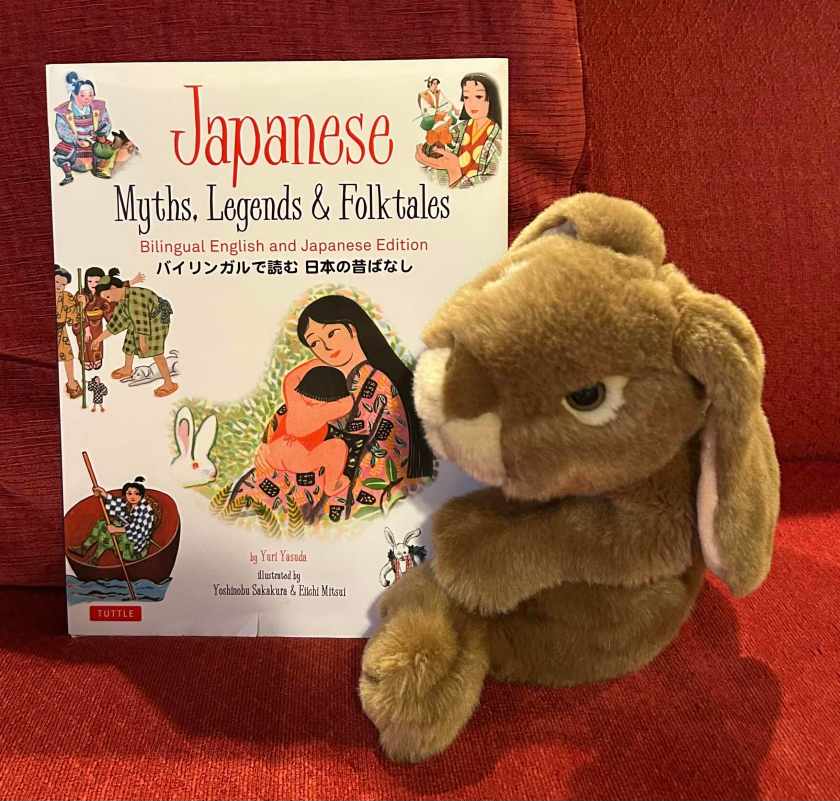
Caramel enjoyed reading Japanese Myths, Legends, and Folktales by Yuri Yasuda and recommends it to all curious little bunnies who want to learn about the many different stories young bunnies around the world grow up with.

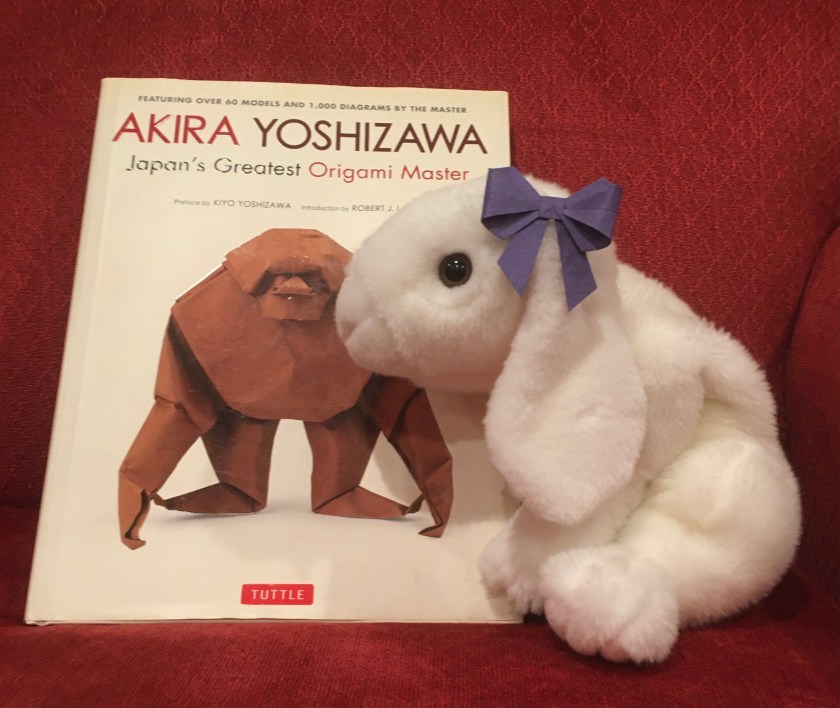
Marshmallow reviews Akira Yoshizawa: Japan’s Greatest Origami Master

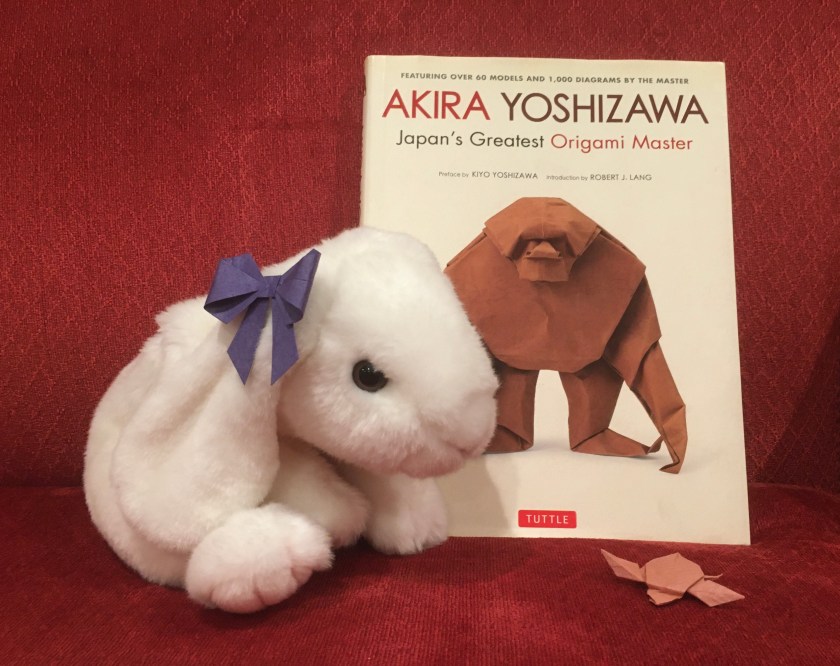
This week Marshmallow shares her thoughts on Akira Yoshizawa: Japan’s Greatest Origami Master, a beautiful book with “Texts, Original Diagrams, and Models” by Akira Yoshizawa, a preface by Kiyo Yoshizawa, and an introduction by Robert J. Lang. Accompanying her in this review is her little friend for the day: Turtle.

Marshmallow reviews Akira Yoshizawa: Japan’s Greatest Origami Master, with text, diagrams, and models by Akira Yoshizawa. Accompanying her is her little friend, Turtle.

Marshmallow’s Quick Take: If you like books that teach you how to do stuff, or if you ever wanted to see really cool origami models of all sorts of animals and things, then this might be the book for you. 

Marshmallow’s Summary (with Spoilers): This book does not tell a story. It teaches the reader how to make the origami pieces in the book, though the origami in this book is not easy. This is not a book for people who don’t know what origami is. 

Here is Wikipedia’s definition of origami:

“Origami (折り紙, Japanese pronunciation: [oɾiɡami] or [oɾiꜜɡami], from ori meaning “folding”, and kami meaning “paper” (kami changes to gami due to rendaku)) is the art of paper folding, which is often associated with Japanese culture. In modern usage, the word “origami” is used as an inclusive term for all folding practices, regardless of their culture of origin.”

In this book, there is a detailed introduction written by an American origami expert, Robert Lang, where readers can learn about Akira Yoshizawa and his origami work. In the next few pages of the book, there are many pictures of Mr. Yoshizawa and his incredible origami works. Then most of the rest of the book is made up of Yoshizawa’s models of different types of animals and things. For example, there are models for making origami rabbits, sea turtles, small birds, wild geese, angel fish, butterflies, flying carpets, children from Snowland, lighthouses, seesaws, planes, and all sort of other neat things. There are step-by-step instructions and folding directions for each of these.

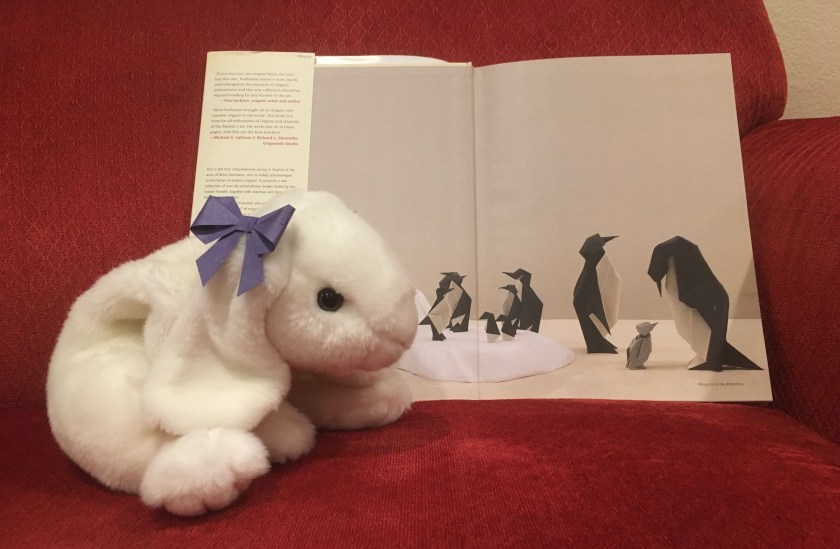
Marshmallow is pointing to the inside cover pages of Akira Yoshizawa: Japan’s Greatest Origami Master, with text, diagrams, and models by Akira Yoshizawa.

Marshmallow’s Review:  Reading Akiro Yoshizawa’s book, you can learn how to make some pretty complex pieces of origami. If you can’t or don’t want to try to make the origami, then you can just look at the pictures, which are in color and are very impressive. Mr. Yoshizawa’s origami animals and other origami are all very realistic.

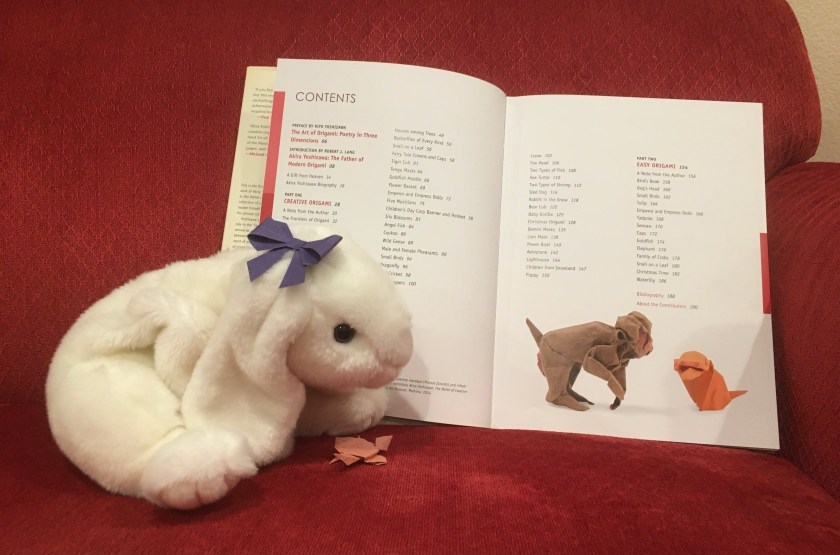
Marshmallow and Turtle are looking at the table of contents of Akira Yoshizawa: Japan’s Greatest Origami Master, with text, diagrams, and models by Akira Yoshizawa.

If you want to make the origami in the book you need to have origami paper, but there is a way that you can make square origami paper with normal paper. Still, real origami paper might make your origami look prettier.

Some of the pieces of origami in this book require cutting or glue or multiple pieces of paper to finish. And almost all the models are pretty hard to do. I was able to make only a few of them, mostly the simpler ones, but still I enjoyed looking through the more complex ones, too.  

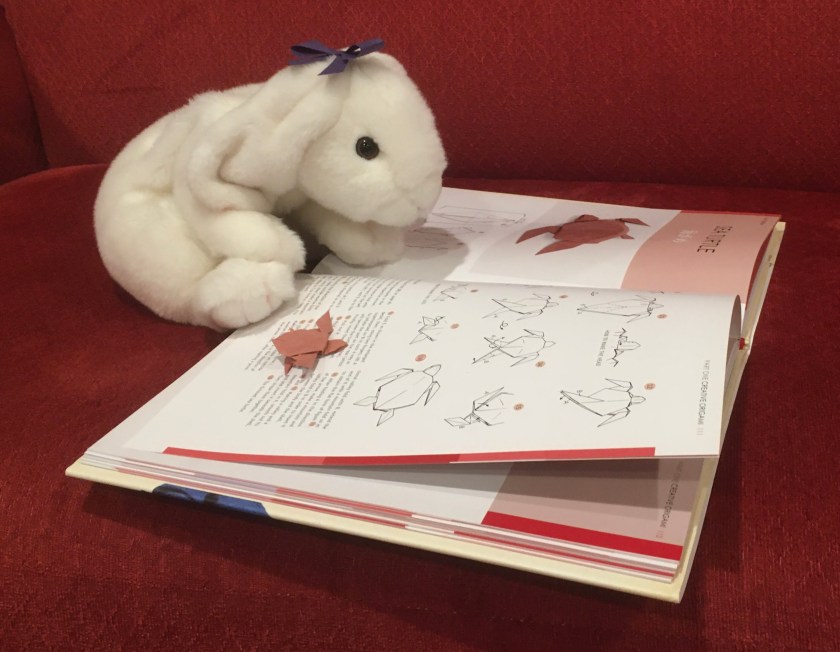
Marshmallow and Turtle are looking at the directions to make a sea turtle in Akira Yoshizawa: Japan’s Greatest Origami Master, with text, diagrams, and models by Akira Yoshizawa.

I think that this is a very good book for the whole bunny family; it can be read by many types of people. Younger bunnies will enjoy looking at the pictures, and older bunnies might want to try to make some of the origami pieces.

This book might also inspire the reader to go and try to learn more about origami, either about its history, or more about how to make more. (I know Caramel enjoys making samurai hats for example!) I really enjoyed trying to make the origami in this book, even when I couldn’t make it exactly the same as it was in the book.

Marshmallow’s Rating: 100%.

Marshmallow rates Akira Yoshizawa: Japan’s Greatest Origami Master, with text, diagrams, and models by Akira Yoshizawa, 100%.

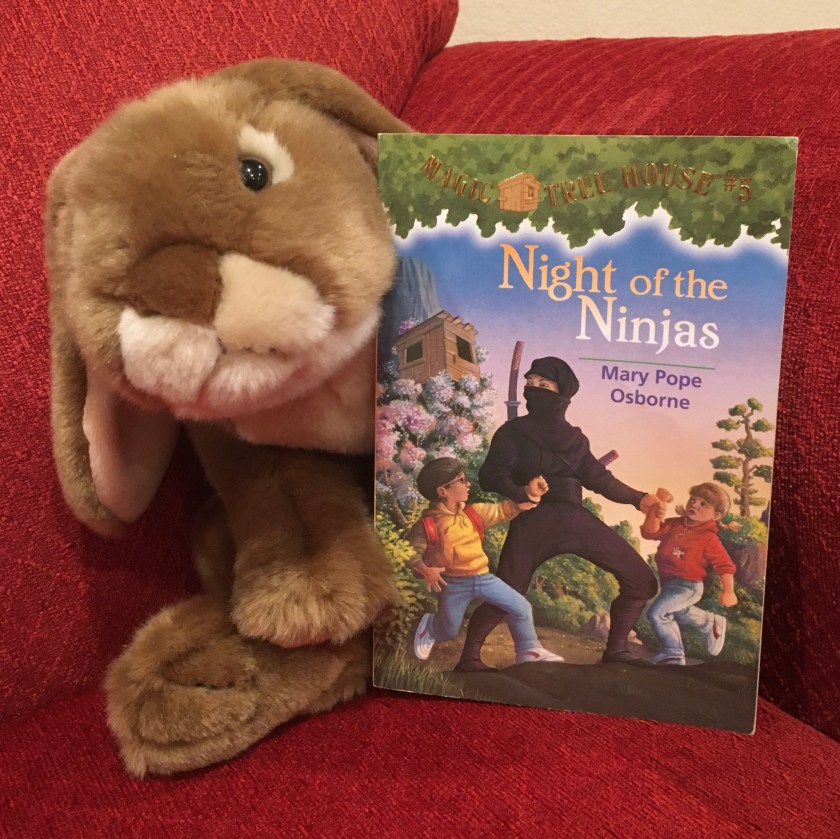
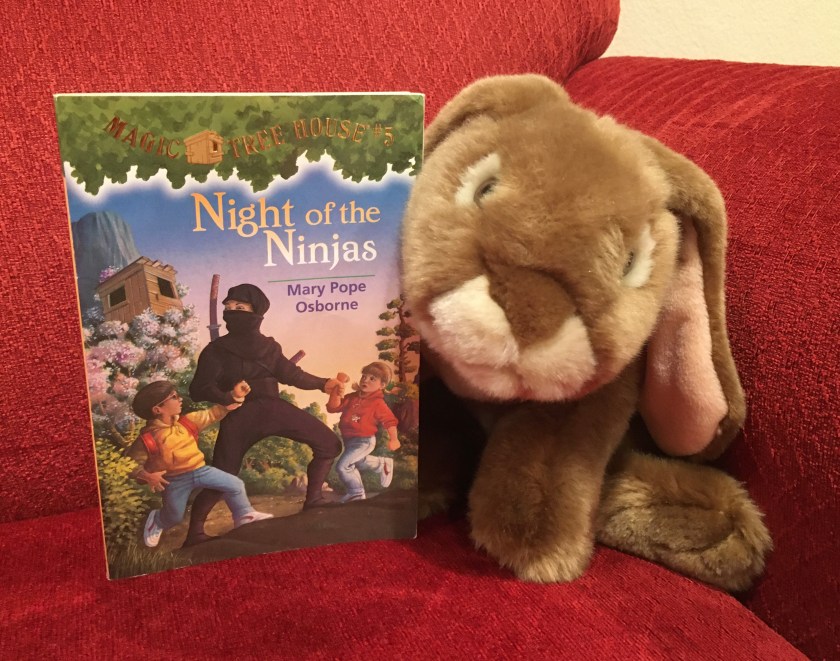
Caramel reviews Night of the Ninjas (Magic Tree House #5) by Mary Pope Osborne

A while ago Caramel reviewed a fact checker book from Mary Pope Osborne’s Magic Tree House series: Knights and Castles. Today he shares his thoughts on the fifth book of the main series: Night of the Ninjas. As usual Sprinkles is taking notes and asking followup questions.

Caramel reviews Night of the Ninjas (Magic Tree House #5) by Mary Pope Osborne.

Sprinkles: So tell us a bit about this book Caramel.

Caramel: It’s a book about ninjas. You probably already know that from the title.

S: That’s true. But how do the ninjas come into the story? Why don’t you start by telling us about the main idea of the magic tree house books?

C: They are about two siblings, Jack and Annie. They find a tree house in the woods near their home. They then find out that the tree house is magical.

S: How so?

C: There are many books in the tree house and when the kids look into one and wish they were in the place the book is talking about, they go there.

S: That is a neat idea! So the magic tree house takes them anywhere.

C: And any time too! So it is like the TARDIS of Doctor Who, a time machine and space travel machine. Except I don’t know if it goes into space. Oh wait, there is the eighth book, which is Midnight on the Moon, so they do go into space too.

S: That sounds exciting. And in this fifth book you wanted to talk about, they go to …

C: The time of the ninjas. And the samurai.

S: So that is in Japan, a few centuries ago probably, right?

C: Right. In an earlier book they even went to the time of the dinosaurs.

S: That’s cool! So in the time of the ninjas and the samurai, Jack and Annie have an adventure?

C: Yep. They are trying to help their friend Morgan Le Fay.

S: And you learn something about ninjas in this book too, right?

C: Yes, I learned the three ways of the ninja: Use nature. Be nature. Follow nature.

S: Hmm, those sound kind of cryptic. But the kids make good use of these three rules in the book, right?

C: Right.

S: There are some samurai in this book, besides the ninjas, right? You have read and reviewed a book about samurai before. How do the samurai in this book differ from the ones in your earlier reading?

C: Yes, in that book I learned that samurai are honorable warriors. But in this book, the samurai are the enemies of the ninja, who are helping Jack and Annie. So here, samurai are scarier. There is even a picture of a samurai on one of the first pages and he looks scary.

Caramel is looking at the page in Mary Pope Osborne's Night of the Ninjas (Magic Tree House #5) with the scary ninja picture.
Caramel is looking at the page in Mary Pope Osborne’s Night of the Ninjas (Magic Tree House #5) with the scary ninja picture.

S: Yes, I guess there are different ways to think about many historical events and groups of people. So did you enjoy reading about Jack and Annie’s adventures in old Japan?

C: Yes.

S: And we should probably continue reading the next few Magic Tree House books, right? I know Marshmallow really enjoyed reading them all.

C: Yes. I am going to read book 6 next: Afternoon on the Amazon.

S: Hmm, that sounds intriguing. But for now, we can stop here. What do you want to tell our readers?

C: Stay tuned for more book bunnies adventures!

Caramel enjoyed reading Night of the Ninjas (Magic Tree House #5) by Mary Pope Osborne, and would recommend it to all other young bunnies.

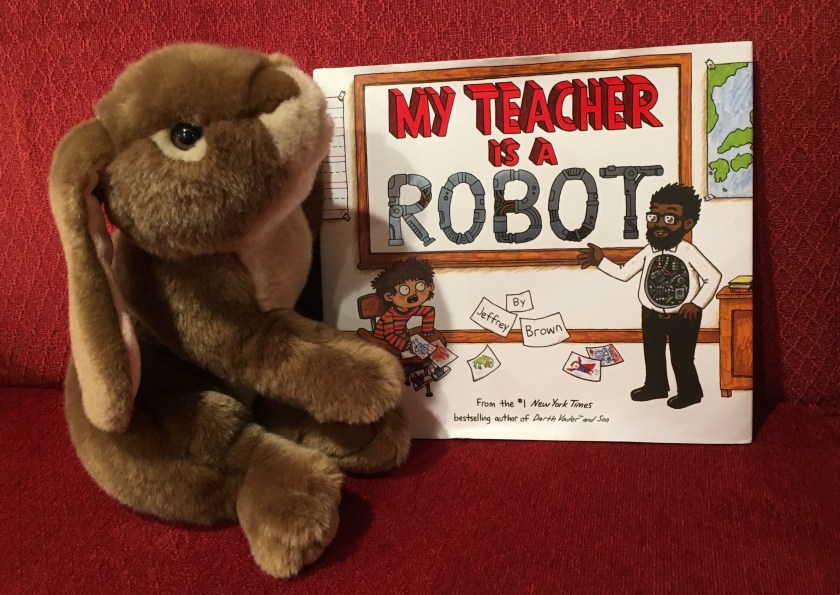
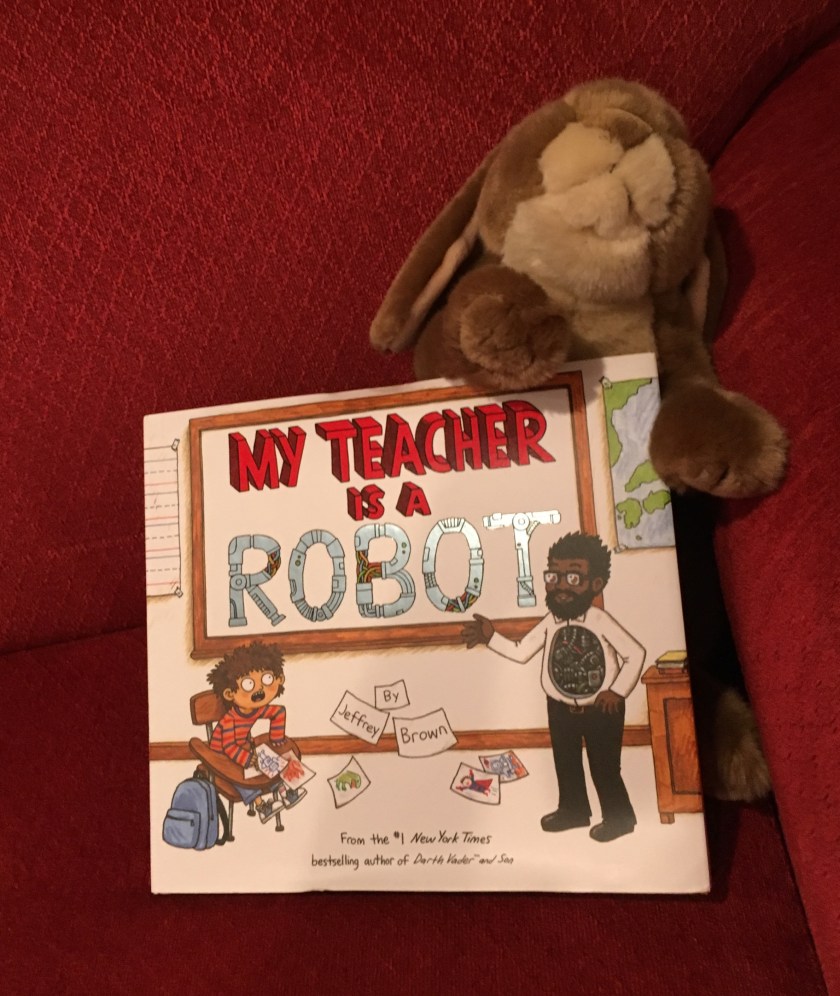
Caramel reviews My Teacher is a Robot by Jeffrey Brown

Caramel is going to have a new teacher this school year, and so Sprinkles thought he might find it amusing to read about a little boy who thinks his teacher is a robot. Below Caramel talks about his thoughts on My Teacher is a Robot by Jeffrey Brown. As usual Sprinkles is taking notes and asking followup questions.

Caramel reviews My Teacher is a Robot by Jeffrey Brown.

Sprinkles: I thought you might find this book about a little boy and his teacher amusing Caramel.

Caramel: Yes. I did find it fun to read. It was funny.

S: What is it about?

C: A little boy named Fred and his teacher Mr. Bailey.

S: So what happens to Fred and Mr. Bailey?

C: Fred keeps thinking that Mr. Bailey is a robot.

S: Why?

C: I don’t know.

S: Does Mr. Bailey look like a robot?

C: No but they can make robots that look like humans.

S: Ok, so what about Mr. Bailey makes Fred concerned?

C: I don’t know really.

S: I guess Fred likes to live in an imaginary world, doesn’t he?

C: Yes. This imaginary world is super duper funny. For example, when Mr. Bailey tells them it’s time for history, Fred gets excited and imagines the class pet gold fish is a pre-historic sea creature.

S: Yes, that part is exceptionally funny, right? When Mr. Bailey says history, Fred thinks maybe they’ll talk about dinosaurs. Do they?

C: No. They do the history of Japan.

S: You know some things about the history of Japan, don’t you Caramel?

C: Yep. I even reviewed a book about samurai on this blog.

S: Yes, that was a neat book and a neat review. So when they are talking about Japan, what happens to the classroom?

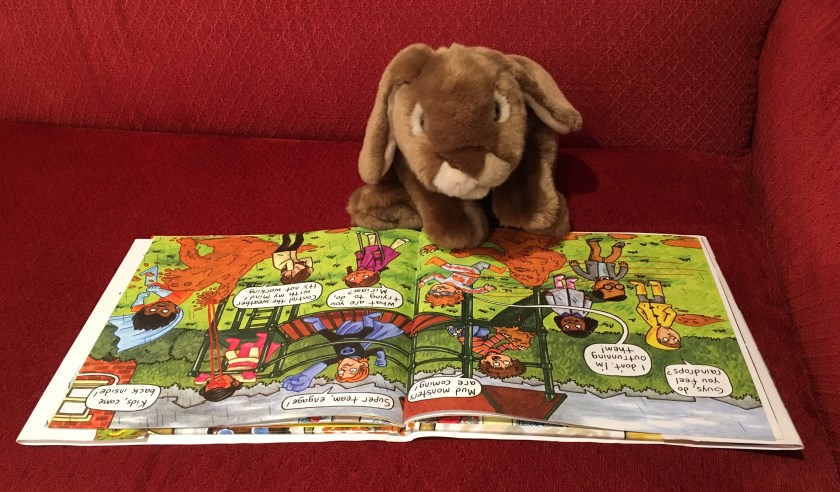
C: The kids do all sorts of things about Japan. Two of them do a tea ceremony. Then there is a cherry blossom tree and a samurai, and a sumo wrestler. Or at least a kid named Scooter who says:

Who wants to sumo wrestle?

S: And the whole room transforms, right? Do you think there is an actual cherry tree in the classroom?

C: No, I think it’s all stuff Fred is imagining.

S: Or maybe Fred and his classmates all together, right? There is a little girl (I think her name is Charlotte) sitting in the middle of a sand meditation garden. Do you think that that meditation garden is really in the classroom?

C: No. Of course not.

S: Do you think Charlotte is really riding a unicorn at the very end and the mud monsters are really attacking the kids when they’re in the playground?

C: No! They are all pretend. But they could actually have made the mud monsters themselves, right?

S: Yeah, that’s true.

Caramel is looking at one of the fun pages in My Teacher is a Robot where the kids are all in the school playground and are being attacked by the mud monsters.

S: So do you think Mr. Bailey is really a robot?

C: No. I don’t think so.

S: Well maybe that’s just another way Fred makes his life more interesting. If your teacher is a robot, then school becomes a bit more ….

C: Interesting! But I’m not sure I want my teacher to be a robot.

S: I’m quite sure you do not have to worry about that. You’re meeting your new teacher very soon, right?

C: Yes. I already know her name, but I don’t know much else about her.

S: Well, I think you at least know she’s not a robot.

C: Actually I don’t. Eek!

S: Ok, Caramel. How about we wrap up this review here and then you report back when you figure it all out and tell us if your new teacher is a robot or not?

C: Ok. Stay tuned for more book bunny adventures!

P.S. added August 29 2019: Caramel is happy to report that no, his new teacher is not a robot, and is in fact a really nice person.

Caramel enjoyed reading My Teacher is a Robot by Jeffrey Brown.