Caramel reviews Winter Turning (Book Seven of Wings of Fire) by Tui Sutherland and Mike Holmes

After reviewing Wings of Fire: A Guide to the Dragon World by Tui T. Sutherland last week, Caramel realized that he had not yet reviewed the graphic novel version of Winter Turning, the seventh book in Tui T. Sutherland’s Wings of Fire series even though he had read it right when it was published in January 2024. So to make up for this forgetfulness, today he is talking to Sprinkles about this book: Winter Turning: The Graphic Novel, written by Tui Sutherland, adapted by Barry Deutsch and Rachel Swirsky, with art work by Mike Holmes, and color by Maarta Laiho.

Caramel reviews Winter Turning: The Graphic Novel, by Tui Sutherland and Mike Holmes.

Sprinkles: So Caramel, I know you read this book all the way back in January; did you reread it before this review?

Caramel: Yes. In fact I am still rereading it.

S: I see. So you explained the plot of the book in quite some detail when you were reviewing the original.

C: Yep. And so maybe I do not have to go over it again.

S: Sure, our readers can go and check out that review, but let us try to make this one a bit self-contained. so why don’t you tell us just a little bit about the book? you do not have to go into too much detail. For that our readers can check out your review of the original book.

C: Well, this is about an IceWing named Winter, who is one of the students in Jade Academy. The dragonets from Jade Academy end up finding Queen Scarlet. They were searching for Hailstorm who is Winter’s brother, and they thought Hailstorm was taken by Scarlet. But it is not that simple. Hailstorm is under the influence of some magic which makes him almost worship Scarlet, so he is kind of staying willingly.

S: I see. Maybe this is a good recap that can get folks started with the book.

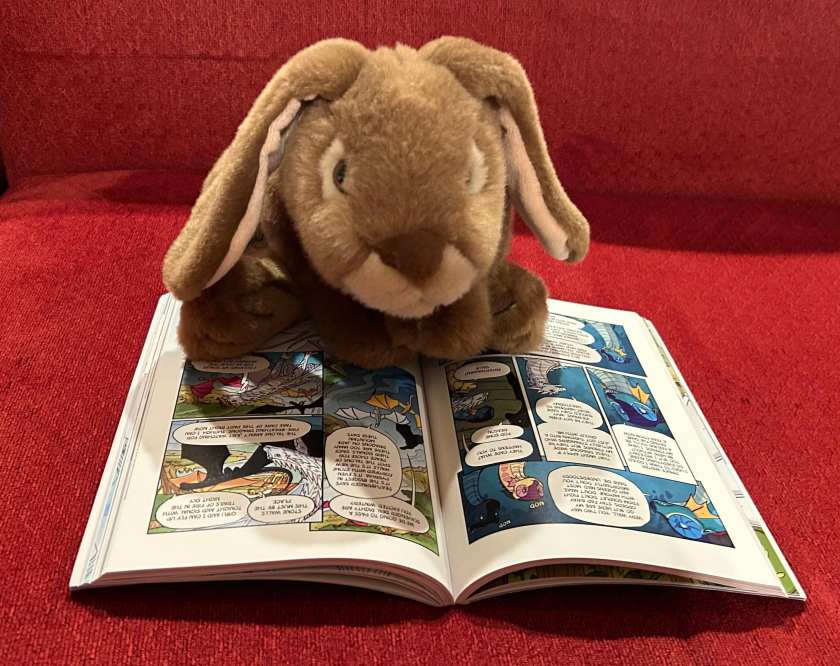
Caramel is reading Winter Turning: The Graphic Novel, by Tui Sutherland and Mike Holmes.

S: So tell me about the drawings. This is after all a graphic novel version of a full novel.

C: One word: amazing. I mean it is just the same crew who did the previous graphic novels, and so the drawings are familiar and they just work.

S: And I know you have read this book so much that it is already kind of worn out.

C: Kind of. But yes, I have read it a lot. And maybe we will eventually get the graphic novel versions of the eighth book, and then the ninth, and then the tenth, and I will get to read all of them!

S: Only if you promise you will review them too.

C: Of course.

S: Okay, so before we wrap up this review, can you describe this book in three to five words?

C: Sure. Colorful, hilarious, and adventurous.

S: Hilarious because your favorite character Qilbli is there?

C: Yes, I love how funny he is! But we have to wait all the way until book ten to have a whole book in his perspective.

S: That is alright though. I seem to recall it was worth the wait.

C: True, that book was awesome too, but also I don’t like waiting.

S: I know. Anyways, let us not make our readers wait further (did you see what I did there?) So what do you want to tell our readers?

C: Stay tuned for more book bunny reviews!

Caramel loved reading and rereading Winter Turning: The Graphic Novel, by Tui Sutherland and Mike Holmes, and encourages all fans of Wings of Fire to check it out.

Marshmallow reviews Sapiens – A Graphic History: The Birth of Humankind by Yuval Noah Harari, David Vandermeulen, and Daniel Casanave

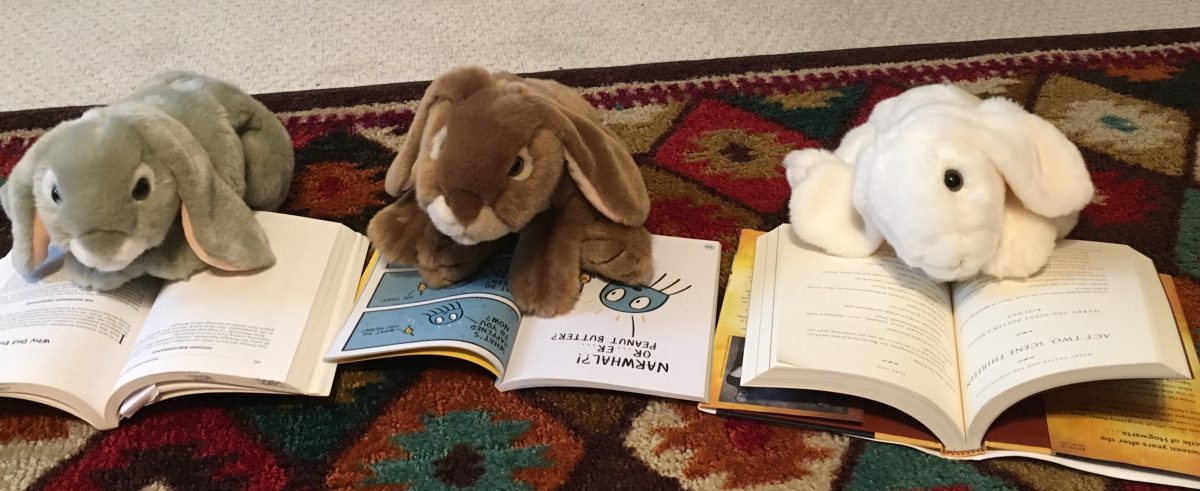
Today Marshmallow reviews Sapiens – A Graphic History: The Birth of Humankind, the first volume, published in 2020, of the multi-volume graphic novelization of Yuval Noah Harari’s 2011 book Sapiens – A Brief History of Humankind. Sprinkles is taking notes and asking questions.
Marshmallow reviews Sapiens - A Graphic History: The Birth of Humankind by Yuval Noah Harari, David Vandermeulen, and Daniel Casanave.
Marshmallow reviews Sapiens – A Graphic History: The Birth of Humankind by Yuval Noah Harari, David Vandermeulen, and Daniel Casanave.

Sprinkles: I know you enjoy graphic novels, just like Caramel does, so I was not too surprised when you decided to pick up this book.

Marshmallow: Yep, and I actually enjoyed reading it too. And I think that, if you like books that ask deep questions or investigate human history, then this is the book for you! 

S: Hmm, I see what you did there. You begin all your reviews with this kind of an invitation. I think it works well here too! So what is this book about?

M: It is basically about the entire history of humanity’s origins.

S: That sounds ambitious!

M: It is. So I think this will take him four or five volumes, but he is trying to tell in graphic novel form what he writes in his original book from 2011. It’s pretty novel I’d say.

S: I see. Tell me more.

M: So in this book, human evolution is portrayed as a reality TV show. And mass extinction becomes a crime investigation. We follow the author Yuval and his niece Zoe as they investigate the meaning of labels like “species” and “genus” with Professor Saraswati. Each character is drawn as a little caricature. Then we see Yuval and Zoe watching “The Greatest Show on Earth!”, or “Evolution!” This leads to an investigation of why and how the species of Homo Sapiens dominates the Earth today. After all, there were several other species in the human genus. 

S: I can see that you are using some big words, maybe from your biology class?

M: Well, not quite. The book uses them, so I think it makes sense for me to use them too.

S: Makes sense to me.

Marshmallow is reading Sapiens - A Graphic History: The Birth of Humankind by Yuval Noah Harari, David Vandermeulen, and Daniel Casanave.
Marshmallow is reading Sapiens – A Graphic History: The Birth of Humankind by Yuval Noah Harari, David Vandermeulen, and Daniel Casanave.

S: So I know that after reading this book, you also followed up with some reviews of it to see how it was received.

M: Yes. Because the author intends to share some possibly controversial ideas about the history of humanity, there was a lot I did not know about in the book, so it was really interesting to read. But I wanted to know if what he was saying was really correct. This is a graphic novel after all, and though some graphic novels have extensive footnotes and such, this one has none, and it has no references. So I wanted to check to see what others who know more about the topic thought.

S: So what did you find out?

M: Well, our readers can start by checking the Wikipedia article on the original book. The original book sold really well and got a lot of great reviews from well-known and highly regarded people. But it seems like some of the more scientific takes on the book are not as complimentary. A lot of them do like it actually, but there are some folks that say that there is not that much that is new in the book and whatever is new and original is not accurate.

S: I see. Now it is not terrible if there is nothing new for scientists, because no matter what they all know, their knowledge is not always accessible to the general audience.

M: Exactly. The graphic novel format is a really good way to reach a lot more people. So some apparently called it “infotainment,” but maybe that is actually not a terrible thing. I think the Lucy & Andy Neanderthal series that I read and reviewed is also kind of infotainment but I still found it extremely educational.

S: I agree with you there. Those books are a lot of fun and teach you a lot too.

M: Even our reviews are probably infotainment – fun yet informative, I hope. The accuracy concern is more difficult to dismiss though. Not being a scientist, I am not great at gauging that. So my advice for curious bunnies is to read this because it is a great story, and you will learn a lot, but still take it with a grain of salt, because if some parts of it feel really out there, maybe they are. So it might be worth double-checking things out on your own.

S: I think that is a very prudent and thoughtful recommendation, Marshmallow.

M: I’m a very prudent and thoughtful bunny. And now we are both using big words!

S: Yep, it must be this book!

M: We must be smarter or something! Maybe we are evolving.

S: Okay, okay, hold it there. Maybe this is a good place to end this review. So if you were to rate this book what would your rating be?

M: I really really enjoyed it, and I’d say 100% but then again the accuracy question makes me say 95%.

S: That’s fair. Okay, thanks for your neat review, Marshmallow. What would you like to tell our readers as we wrap it up?

M: Stay tuned for more amazing reviews from the book bunnies!

Marshmallow rates Sapiens - A Graphic History: The Birth of Humankind, by Yuval Noah Harari, David Vandermeulen, and Daniel Casanave, 95%.
Marshmallow rates Sapiens – A Graphic History: The Birth of Humankind, by Yuval Noah Harari, David Vandermeulen, and Daniel Casanave, 95%.

Caramel reviews Asterix Omnibus 1 by Rene Goscinny and Albert Uderzo

Today Caramel talks about Asterix Omnibus 1, written by Rene Goscinny and illustrated by Albert Uderzo, the 2011 edition that brings together the very first three adventures of Asterix the Gaul. As usual, Sprinkles is taking notes and asking questions.

Caramel reviews Asterix Omnibus 1, written by Rene Goscinny and illustrated by Albert Uderzo.

Sprinkles: So Caramel, you finally discovered our Asterix collection.

Caramel: Yes.

S: And it seems like you have enjoyed reading them.

C: Yes. That’s why I wanted to talk about this one today.

S: Okay, so let us start. What is this book in your paws?

C: This is a collection of three stories about Asterix the Gaul and his friends.

S: Okay, so maybe you can tell us a bit about Asterix.

C: He is a Gaul, living in the Roman times. Apparently his village is the only village in Gaul that is not yet captured by the Romans. And they keep driving the Romans mad by being independent and so on. In these three stories we also get to meet the people from the village. There is Asterix’s best friend Obelix, and there is the village chief, Vitalstatistics, and the village potion maker druid, Getafix.

S: Those are some ridiculous names! I am guessing they are not in the original French. Anyways, continue please.

C: Okay. So Getafix makes a magic potion that makes the person who drinks it very very strong, and that is how the village has been able to defend itself against the Romans. And Obelix is very strong always, because apparently he fell into the potion cauldron when he was a baby. Anyways, the three stories are about them having some fun adventures.

S: So this is supposed to be in the ancient past, right?

C: Yep. So apparently Gaul is a part of Europe which is today split between France, Belgium, and a bunch of other countries. Wikipedia says that Romans conquered most of Gaul by 52 BCE. So according to the Asterix books, though, they did not manage to conquer this one little village.

S: So this is around 50 BCE?

C: Yes, the first sentence is “The year is 50 BC.” But you could also tell probably because Julius Caesar is alive and leading the Romans. And apparently he died in 44 BCE.

S: That makes sense.

Caramel is reading Asterix Omnibus 1, written by Rene Goscinny and illustrated by Albert Uderzo.

S: So this is an omnibus, which, according to our trusted online dictionary, is “a volume containing several novels or other items previously published separately.” So which stories are in this one volume?

C: There are three. The first is called “Asterix the Gaul”. Then there is “Asterix and the Golden Sickle”. And finally “Asterix and the Goths”.

S: According to Wikipedia, these were first published in 1961, 1962, and 1963, respectively. That is a long time ago. Can you tell?

C: Not really. The stories all happen way back in time. And they are just as funny as they would be if they were written today. But I did read that some Asterix stories have issues with race. The way they represent people of African origin would be racist today, so those stories would probably not even be published.

S: That is a very sensitive issue Caramel. I am impressed that you took the time to learn about it and are sharing it with us.

C: At least those issues do not come up in these three stories. I mean, the Goths are pretty mean and sometimes stupid in the third story, and the Wikipedia article says that was because the authors had strong anti-German feelings because it was so soon after World War II. But that would not be racism even though it is still not a nice thing to do, stereotyping people like that.

S: You are right Caramel. Okay, let us move on to a lighter topic. I know my sister used to laugh out loud when reading these; did you find them funny too?

C: Yes. There is a funny thing on each page, and if you actually look carefully at the individual frames, there is a lot of other hilarious stuff happening, too. The characters are all funny themselves too.

S: They are all very caricaturish, actually. Some characters have huge noses, some are round like a ball, and so on. A lot of them have exaggerated features.

C: Yes, and that makes it funny. And the pictures are all very colorful.

S: I am getting the sense that you really enjoyed reading this book.

C: I did.

S: How would you describe it in three to five words?

C: Hilarious, cartoony, and Roman-ful.

S: Come on, those are not words!

C: Okay. Hilarious cartoons full of Romans. That’s five words!

S: Alright, that works. I think this is a good time to wrap up the review. What do you want to tell our readers?

C: Stay tuned for more book bunny reviews!

Caramel enjoyed reading Asterix Omnibus 1, written by Rene Goscinny and illustrated by Albert Uderzo, and recommends it to other bunnies who might enjoy reading about a stubborn village full of hilarious people standing up against the big Roman Empire.

Marshmallow reviews All’s Faire in Middle School by Victoria Jamieson

The book bunnies are quite fond of Renaissance fairs and have been to a few in the last few years. So when Caramel brought home a library book about a young person growing up around these festivals, Marshmallow had to devour it, too. And today she is talking to Sprinkles about All’s Faire in Middle School by Victoria Jamieson, first published in 2017.

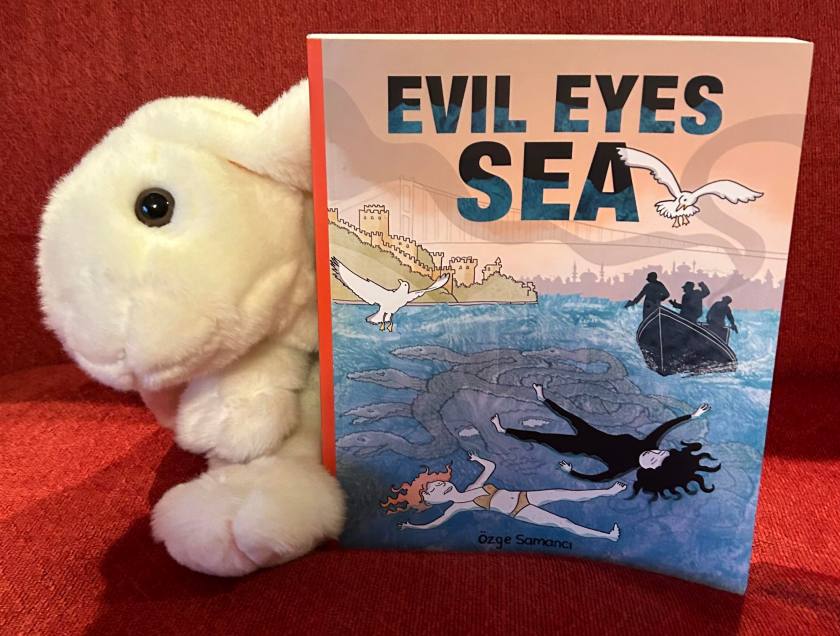
Marshmallow reviews All's Faire in Middle School by Victoria Jamieson.
Marshmallow reviews All’s Faire in Middle School by Victoria Jamieson.

Sprinkles: So Marshmallow, you just had to read this book!

Marshmallow: Yes! But I did wait until Caramel finished it first. You know, he was the one who brought it home, so it is only fair.

S: Agreed. So tell me a bit about the book.

M: It’s about a girl named Imogene whose parents work at a Renaissance Fair. She occasionally works there, too. The book starts with her being nervous about starting middle school. She has always been home-schooled before, so she is not sure what to expect.

S: I see. So why is she going to middle school then? Why is she not continuing with home-schooling?

M: I am not sure. I think she wants to go because she thinks it is a brave thing to do.

S: I see. So how does it go?

M: She is not sure how school works, so she has difficulty understanding what the rules are.

S: Can you be more specific? What kinds of rules?

M: There are some unsaid social rules about who hangs out with whom, and she does not know how to read any of the social cues.

S: Okay.

M: Then she makes friends with a group of girls who seem nice at first, but then they are actually kind of toxic.

S: This is reminding me of the movie Mean Girls. There is a new version of the movie too, but we only saw the original one from 2004.

M: Yes, actually it is kind of similar. The main character there was also home-schooled and had some trouble fitting in with the kids in her high school. And just like the main character there, Imogene also makes a huge mistake.

S: She is unkind to some people so she can fit in with the “cool” kids?

M: Kind of. But of course this is middle school, so it is a bit different than the movie.

Marshmallow is reading All's Faire in Middle School by Victoria Jamieson.
Marshmallow is reading All’s Faire in Middle School by Victoria Jamieson.

S: Okay, so tell me a bit about the graphics. Did you like the drawing of the main character?

M: Yes.

S: The color scheme kind of reminded me of some of the books you reviewed from Raina Telgemeier.

M: There are some similarities I think. But I do not think one artist was necessarily influenced by the other. I think they are both neat illustrators. They both manage to draw very expressive faces and bodies with only a few strokes of their pen.

S: Sounds like you liked the book!

M: Yes. I’d rate it 100%.

S: Wow! That is great! I am glad Caramel found this in his school library.

M: Me too.

S: Okay, let us wrap this up then. It is getting late. What would you like to tell our readers as we finish this up?

M: Stay tuned for more amazing reviews from the book bunnies!

Marshmallow rates All's Faire in Middle School by Victoria Jamieson 100%.
Marshmallow rates All’s Faire in Middle School by Victoria Jamieson 100%.