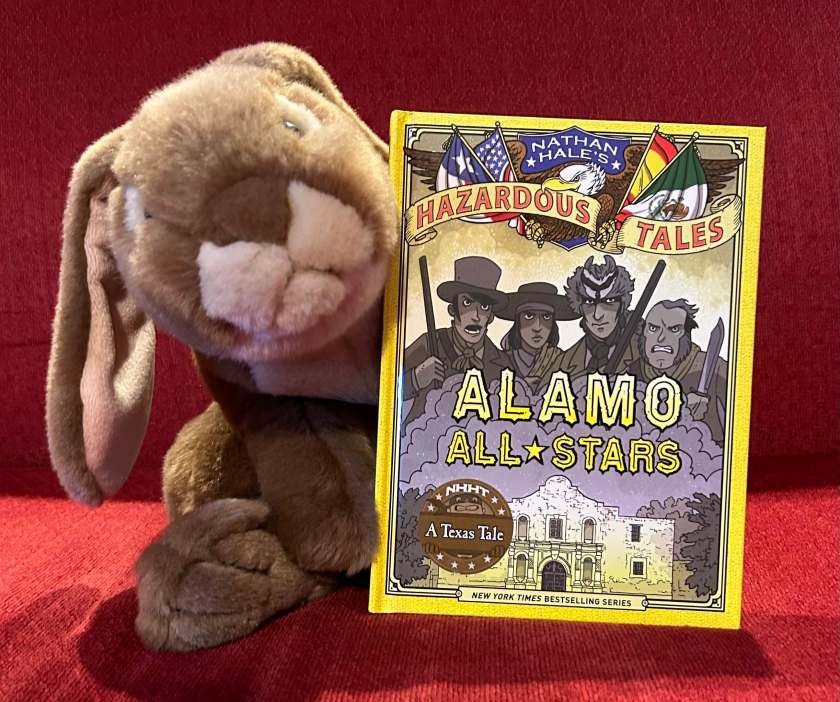
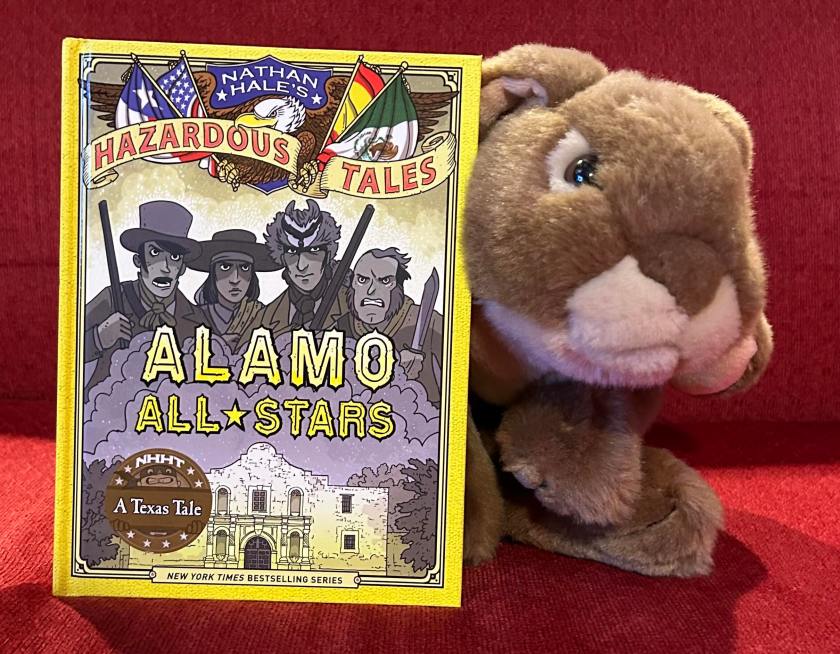
Today Caramel is talking to Sprinkles about Alamo All-Stars by Nathan Hale, published first in 2016. This is the sixth book in Nathan Hale’s Hazardous Tales series, and thankfully the sixth book Caramel happened to read from the series. (So finally these numberings match!)
Sprinkles: So here we are, talking about yet another Nathan Hale book.
Caramel: Yes! And this one is also a great book!
S: Oh, yes? So you have enjoyed reading about the Alamo? Isn’t that supposed to be a story of a big defeat?
C: Yes, but a very heroic one! And at the end of the book, the author ties things up by telling us how the U.S. in the end did win over Texas. So they lost Alamo first, but eventually they won it back. Kind of like losing the battle and winning the war.
S: I see. But it was also probably a heroic win for the other side, at least the stand at Alamo.
C: I suppose. You are right. All wars have at least two sides. When one side wins and celebrates, the other side is losing and facing great difficulties. So I like reading about wars and history, but it would be best if there were no wars. I think we can say that we have had enough wars. Maybe we do not need any more.
S: Such wise words from a little bunny…
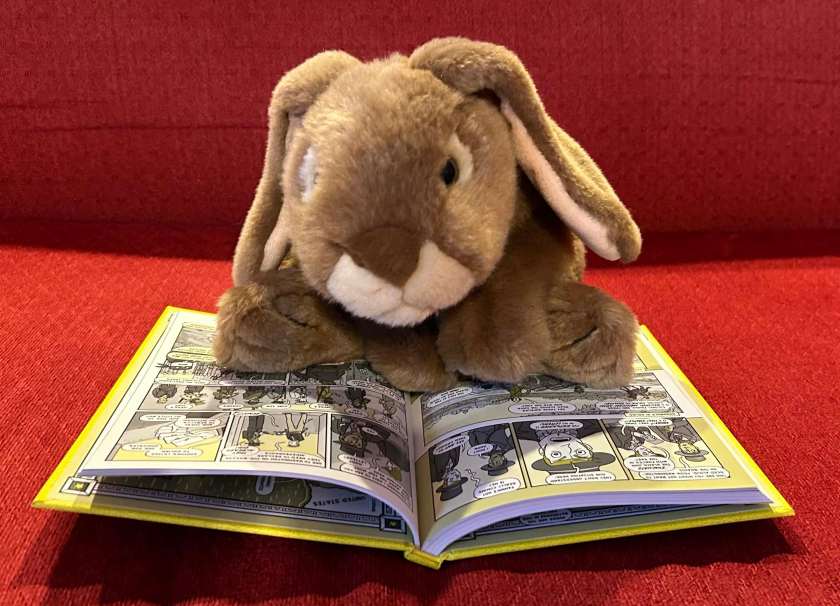
Caramel is reading Nathan Hale’s Hazardous Tales #6: Alamo All-Stars by Nathan Hale.
S: Okay, so this book is all yellow!
C: Yes, you said last time that each book has one thematic color, so maybe you were right. This is the yellow book. There are other colors in the book too, of course but yellow is a lot more visible in this book than the others.
S: Is there any humor in the book? I mean it is about war and death again, but …
C: Yes. At least there are some light-hearted moments. And it does not feel as heavy as Donner Dinner Party.
S: I think that can be arranged. But maybe we can take a short break for a bit.
C: What are you trying to tell me Sprinkles?
S: Me? Nothing. Maybe there are other books you could read for the next week or two.
C: Maybe. Or maybe not. I do like these books!
S: I know. But maybe we can try a few other books for a bit.
C: I see what you are doing. And I guess we will see what you find for me to read for next week.
S: I mean, I won’t force you.
C: Hmm.
S: Okay, maybe this is a good time to stop talking about this book and wrap this review up. What would you like to tell our readers?
C: Stay tuned for more book bunny reviews!
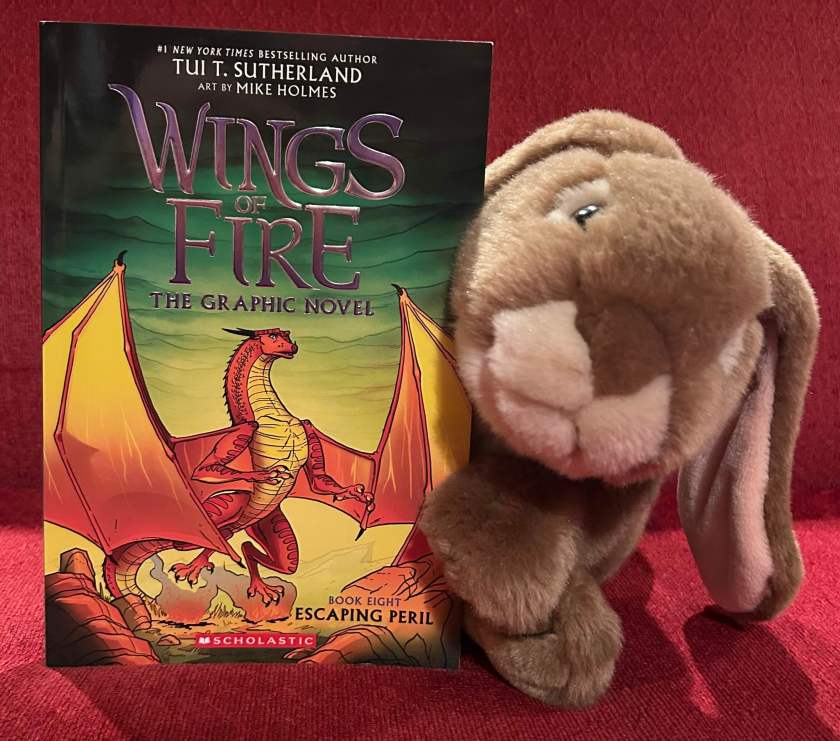
Caramel enjoyed reading Nathan Hale’s Hazardous Tales #6: Alamo All-Stars by Nathan Hale and looks forward to reading many more historical graphic novels in the near future.
Given the morbid nature of the historical events described (involving death and cannibalism), this review might not be appropriate for very young bunnies.
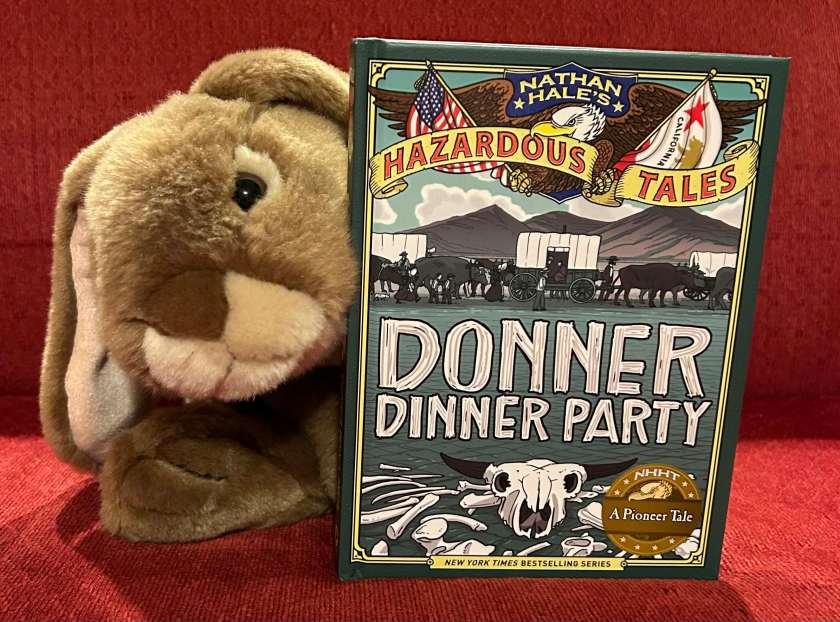
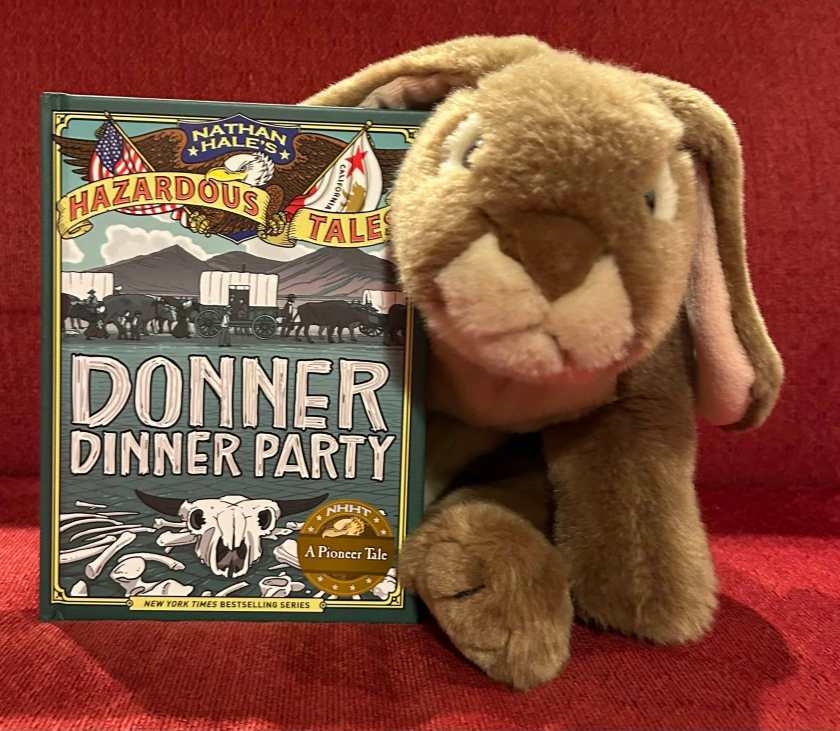
Caramel reviews Nathan Hale’s Hazardous Tales #5: Donner Dinner Party by Nathan Hale.
Sprinkles: So Caramel, it seems like it is once again time to talk about a Nathan Hale book.
Caramel: Yes! It is great that I can read another one of Nathan Hale’s Hazardous Tales.
S: I know you love these books! So tell me, what is this one about?
C: It is about the people going to California in 1846.
S: Oh, I see, so this is about the Donner party, going west toward California and getting lost?
C:Yes it is.
S: So the dinner party part is kind of poking fun at the rumors that some of them ended up eating others?
C: Yes, but it is not a very funny joke in terms of what it means. And it is not rumors; the Wikipedia article says they actually ate some of those who died because they were weaker, but they apparently also killed two Native American guides and ate them.
S: Caramel, that is awful!
C: Yep, and disturbing.
S: I mean, the other books you read in this series also had people dying, there were many wars and such, but this somehow feels a lot more morbid.
C: Yep, it does. But apparently history can be pretty terrible.
S: I can see that this book is making that quite clear.
C: Yep, it certainly did for me.
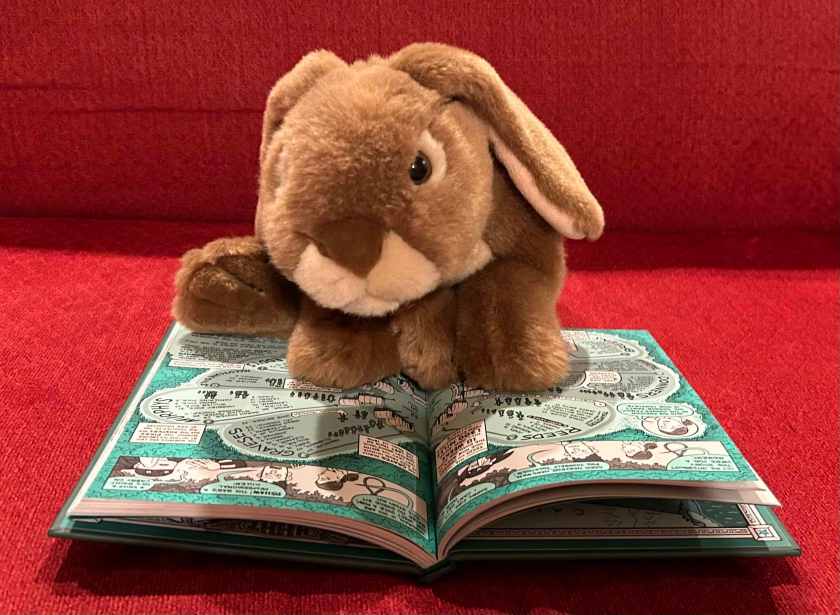
Caramel is reading Nathan Hale’s Hazardous Tales #5: Donner Dinner Party by Nathan Hale.
S: So was reading this book a bit more challenging then? The story is pretty disturbing.
C: Yeah, it was a little, but the scary parts are mainly on a couple pages, making them easy to skip.
S: And it seems like an important story, about how humans can get quite vicious and terrible when they are desperate.
C: Yeah humans are sometimes very mean to each other, which is not a good thing.
S: I mean when you read Watership Down, we saw there that bunnies can also be cruel to one another, but at least we would never eat each other. We are vegetarian.
C: And I guess I will have to remind you that Watership Down was fiction, Sprinkles. This book is about a real event!
S: I know I know. I was just trying to lighten up the mood, but it is pretty difficult. So let us talk about the book in general. I suppose you had heard of the Donner party before. Did you learn anything new while reading Donner Dinner Party?
C: Yep, that sometimes the people in the past, and sometimes now, can be very mean to others.
S: So true. And so sad… Okay, I will now shift gears because this is getting a bit too sad. It seems these books are in color but always only a couple colors show up on each two-page spread. Is that correct?
C: yep, this one had around 8 different colors total.
S: But only a couple of the colors showing up on one page, right?
C: Yep, at most maybe 2-3 colors on one page.
S: But it still seems to work well, right?
C: Yes, it feels colorful at least.
S: After this I think there are still a few more books in this series. Are you interested?
C: Yeah, I can’t imagine there will be too many more cannibal stories in there.
S: I agree. Okay, so let us wrap this up then. What would you like to tell our readers?
C: Stay tuned for more book bunny reviews!
Caramel appreciated reading Nathan Hale’s Hazardous Tales #5: Donner Dinner Party by Nathan Hale and is ready for another adventure.
[We were hoping to go through these books in order, but Caramel happened to first read a three-book sampler which was made up of the first, fourth, and the fifth books! So the numbering of these posts basically is mostly about the order Caramel is reading them in. Big Bad Ironclad, reviewed in today’s post, is the second ever book in the series, originally published in 2012. Readers can see the publication order of these books at this page created by Fulton County Library System.]
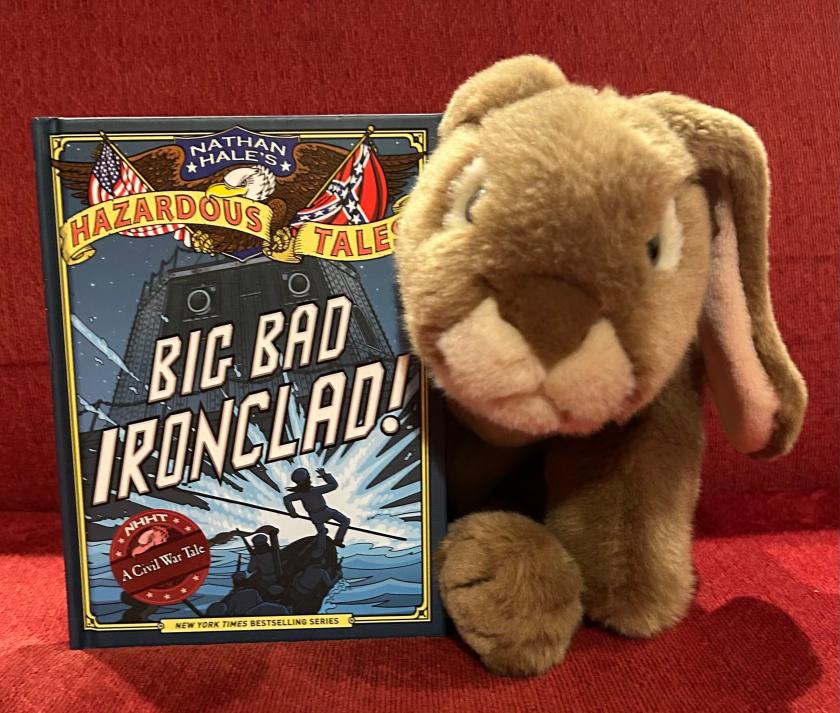
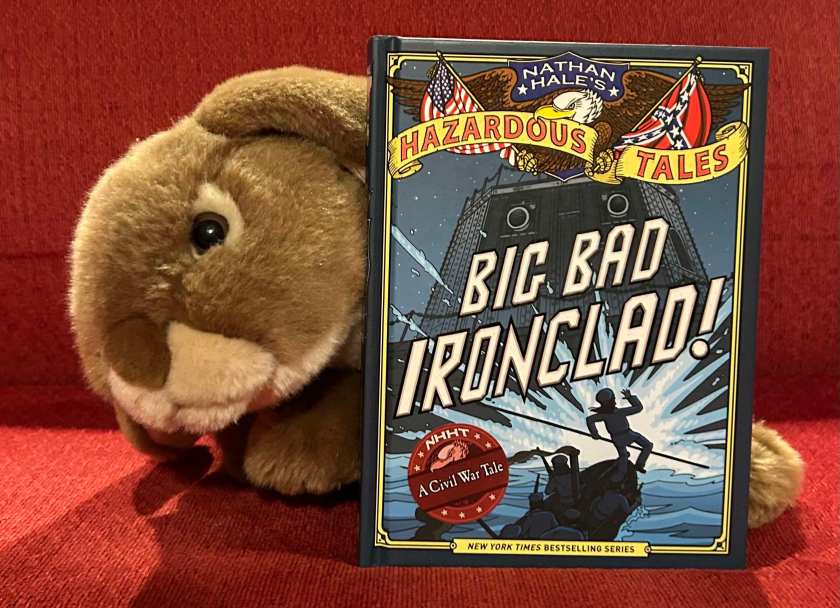
Caramel reviews Nathan Hale’s Hazardous Tales #4: Big Bad Ironclad by Nathan Hale.
Sprinkles: So Caramel, here we are again, and you chose to start off your 2025 reviews with yet another Nathan Hale book.
Caramel: Yes I have, and, what a book!
S: Hmm, I am guessing that means it is a good book?
C: yes, it certainly was.
S: So what is this one about? What time period are we in?
C: we are in the civil war, and it is about the ironclads, the first metal warships.
S: Oh yes, maybe we should remind our readers that these books are graphic novels that explore various time periods in the history of the United States. So this one is about the U.S. Civil War. Then we must be in the 1860s.
C: Yes, that is important to do, and it is the 1860s.
S: Okay, so tell me more about the ironclads.
C: They are older steam-powered warships that heavy iron plating is put over, like a jacket, allowing them to withstand cannons, and other guns of the time.
S: So kind of like an armor a warrior might put on. Underneath the iron are they made of wood then?
C: Yes, they are, in fact, made of wood under the iron.
S: Hmm, I guess it makes sense to try and armor the ships. But wouldn’t that make them too heavy? Wouldn’t they sink?
C: Well, yes and no. The iron is placed on the exact right places as to not make it too heavy, yet still provide ample protection from attack.
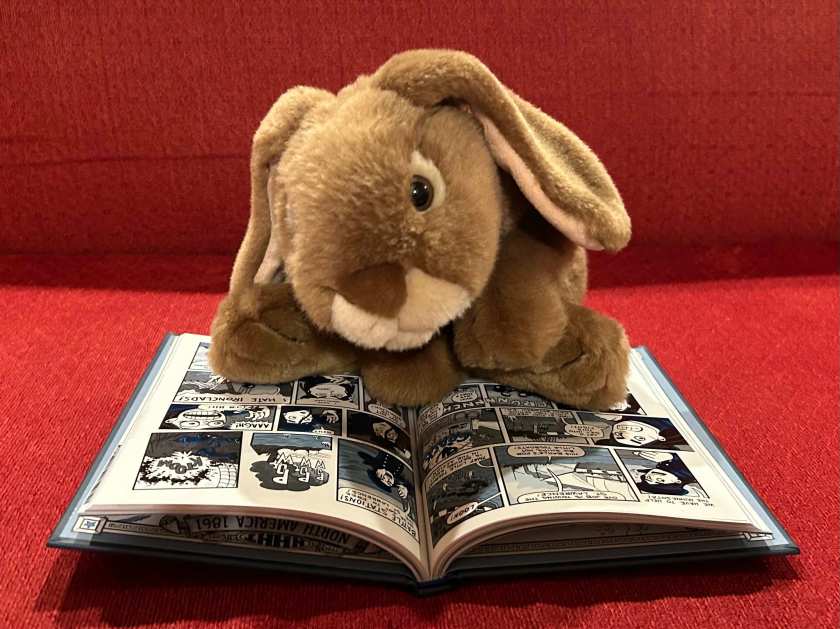
Caramel is reading Nathan Hale’s Hazardous Tales #4: Big Bad Ironclad by Nathan Hale.
S: Okay, so that looks like a story you would be interested in, you like warships and such, but it is after all a graphic novel. Are there any human characters in the book? And what is the human story told?
C: It is about the stories of the ironclads and those who fought against them and how they defeated the big, bad ironclad.
S: Oh, so the ironclads are kind of like the new scary weapons and the story is about how they could be defeated. Do we also learn about the people who designed and built the ironclads?
C: Yes, I suppose, but the story of how they are defeated is more central.
S: Do both sides have ironclads or only one side?
C: Well, both sides have ironclads, but the story is told mainly from the view of the Union, the North, so we learn about how they build their ironclad and defeat the ironclad from the South.
S: I see. So did you learn some new things while reading this book?
C: Yes, I did learn some new things; these books have so many facts! For example I learned that the Union built their own ironclad from the same inventor who made the peacemaker, a huge cannon which blew up and killed the president’s cabinet. They must have been desperate.
S: That is interesting! I had not heard about the peacemaker. Wikipedia has an article about the ship that it was installed on. So these books are factual but also fictional. Can you tell what is fact and what is fiction?
C: Yes, it is rather obvious as the narrator, Nathan Hale, says the real things that happen, like he says things like, ”this is not an accurate representation of this person,” or something like that.
S: I see. That is cool. So you learn stuff about the history of the United States and also enjoy reading a fun graphic novel. I am assuming of course that you have enjoyed reading this book?
C: Yes, it was great!
S: I am assuming we will hear about a lot more Nathan Hale books in the near future.
C: Yes, you will.
S: Can’t wait!
C: Well, you have to. At least till next week!
S: Okay, okay, yes, till next week. So as we wrap up this review, what do you want to tell our readers?
C: Stay tuned for more book bunny reviews!
Caramel loved reading Nathan Hale’s Hazardous Tales #4: Big Bad Ironclad by Nathan Hale and can’t wait to read the next book!
Many years ago, over the course of a few days, the book bunnies listened all together as a family to an unabridged version of Watership Down, the 1972 classic by Richard Adams. Recently Caramel got his paws on a new (2023) graphic novel adaptation of the book by James Sturm and Joe Sutphin and read it over the course of a few hours. Today he is talking to Sprinkles about the book.
Caramel reviews Watership Down: The Graphic Novel, written by Richard Adams, adapted by James Sturm, and illustrated by Joe Sutphin.
Sprinkles: I remember how we listened to this whole story when you all were so much younger. So when I saw that there was a graphic novel adaptation, I knew you would want to read it.
Caramel: Yes, I guess you were right! You know me well.
S: I think I do! Okay can you tell us a bit about the story?
C: Sure. In this book there are bunnies like us, but they are wild and are trying to escape from a great evil that was foretold by one of them named Fiver.
S: Oh, I think I remember Fiver. Isn’t he the dreamer one? Kind of like an oracle?
C: Yeah, kind of. He can see the future and warns the others of the dangers so they can survive.
S: Okay, so here is a group of rabbits living in a warren. That is, my dictionary tells me, a network of interconnecting rabbit burrows. And they are living a normal wild rabbit life. But then some great evil thing happens, is that it?
C: Yes, it is kind of like that. However not everyone believes Fiver, and so not all of them make it.
S: Well, I can see how not everyone would immediately believe some little bunny saying something terrible will happen, without evidence. But his brother believes him, right?
C: Yep, so Hazel, that is Fiver’s brother, gathers everyone who believes Fiver and they run.
S: So they leave their warren and wander away, and try to find a new place to settle down at?
C: Yep. Along the way they find a different warren in which there are some not-so-nice bunnies who try to kill the main character bunnies, but thankfully the good bunnies make it out, and they get two new bunnies from that warren.
S: Cool! Okay, so Fiver is the dreamer, oracle bunny. Hazel is the main leader bunny. Are there other characters that you especially liked or remembered from when we listened to the book those many years ago?
C: Fiver is my favorite, I don’t know why but he is my favorite bunny in the book.
S: He is a gentle soul, as far as I remember. He is sensitive and kind.
C: Yeah, but he can also see the future, and that is cool.
S: Yes, that is really cool, I agree. I do remember another character, Bigwig, I think. He is a fighter, and a good one too.
C: Yeah, he is also really cool, but Fiver is still my favorite character. There is also a big bird who helps the bunnies occasionally, His name is Kehaar.
S: That is cool! I liked that character, too.
Caramel is reading Watership Down: The Graphic Novel, written by Richard Adams, adapted by James Sturm, and illustrated by Joe Sutphin.
S: Okay, so when we listened to this book many years ago, we had no images to attach to the main characters. But a graphic novel of course will have faces attached to each character. Did these work for you? Did you like the illustrations? Is the world of Fiver and Hazel how you had imagined it to be?
C: Yeah, it is a lot like what I thought. The bunnies are all very realistic looking, too, and exactly how I imagined them to be.
S: That sounds great! I was just going to ask you if they were more cartoonish or more realistic. So this was perhaps the longest graphic novel you have ever read, right?
C: Yep, it was 382 pages!
S: That is long for a graphic novel. But the original book is a very long one, too, so that makes sense. Anyways, did you know that the original book was banned in some places because it was too violent and there was a lot of brutality depicted explicitly?
C: Oh no. I did not think it was too violent.
S: Well, then again, you do like the Wings of Fire series and those are also kind of violent. So maybe your generation of bunnies is a bit more used to violence…
C: No, I would hope not.
S: I see what you mean Caramel. Yes you are right, it is not a good thing to get used to violence. Maybe I should have said that you can handle some more violence. I think that especially when they made the animated movie in 1978, the movie started out looking like a typical Disney movie, with cute bunnies who speak and are living in this idyllic natural place, but then things get dark very fast, and terrible things happen, bunnies killing each other, getting killed by humans, and so on. So maybe it shocked people a lot more back then.
C: Maybe.
S: I also read that it was banned in China for a while because it depicted animals and humans as equals or at least somewhat on a similar level, and this was unacceptable.
C: Hmm, they probably would not like Animal Farm either, then. Or us.
S: Yes, you have a point there Caramel. Bunnies talking about books would probably not be okay. Anyways, we are bunnies who love to read and talk about books. So let us get back to the book. So overall, did you enjoy this graphic novel?
C: Yes, greatly. And I recommend it to all young bunnies who like to read about other bunnies being heroic.
S: Cool! Okay let us wrap this up then. What would you like to tell our readers?
C: Stay tuned for more book bunny reviews!
Caramel enjoyed reading Watership Down: The Graphic Novel, written by Richard Adams, adapted by James Sturm, and illustrated by Joe Sutphin, and recommends the book to all young bunnies who like to read about other bunnies being heroic.