Marshmallow reviews Maus: A Survivor’s Tale by Art Spiegelman

Today Marshmallow reviews the first volume of Maus: A Survival Tale, Art Spiegelman’s graphic novel first published in 1986. Sprinkles is taking notes and asking questions.

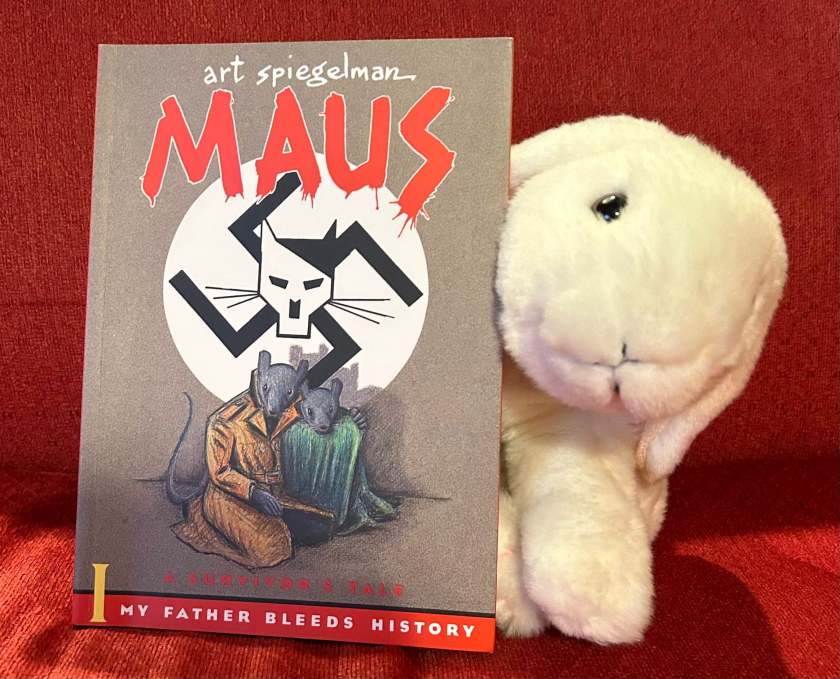
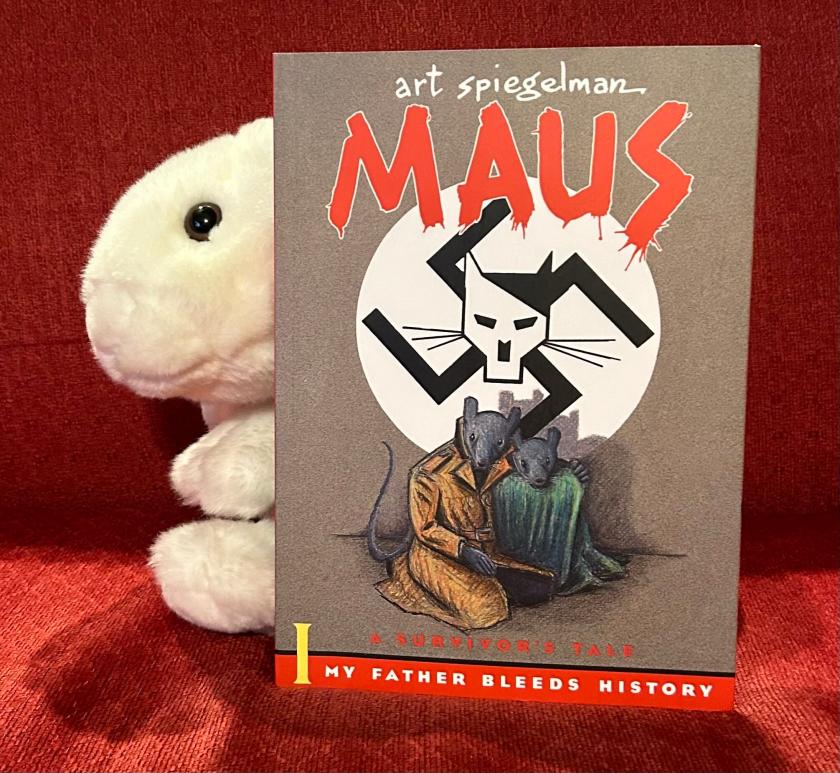
Marshmallow reviews Maus: A Survivor's Tale - I: My Father Bleeds History by Art Spiegelman.
Marshmallow reviews Maus: A Survivor’s Tale – I: My Father Bleeds History by Art Spiegelman.

Sprinkles: So Marshmallow, you chose to talk about a classic graphic novel today.

Marshmallow: Yes, we are talking about Maus: A Survivor’s Tale. This is in fact the first of two volumes, and Art Spiegelman published the second volume in 1991.

S: Okay, thanks for that important note. Wikipedia tells us that this is the first graphic novel that won a Pulitzer Prize. So I am glad you have read it and will talk with me about it.

M: I can see why it would get such an important prize. It is a very important book and it has a very important message.

S: Okay, so maybe it is about time to tell our readers what this book is about. They have already seen your photos with it, and they must be wondering.

M: Yes, sure. The book is about the Holocaust, and the imagery in the front cover is basically describing the main metaphorical device used in the story.

S: How so?

M: This is a graphic novel, as we said before, and all characters are animals. There are mice, and those are supposed to be the Jews, and then there are cats. Those are the Nazi Germans. Then there are pigs, who are supposed to be the non-Jewish Poles. And as I said before, the story takes place around the time of the Second World War.

S: I see. When you tell me all this, I am thinking of how sometimes a cat could be playing with a mouse just to have fun and even kill it with no remorse even when it does not need to eat it. I can see how the cat-mouse-pig metaphor could work.

M: Yes. The story is basically about Vladek who is the author’s father, and his experiences before and during the war. Vladek lived in Poland before the war, and when Germany invaded Poland, he and his family continued to live there. For a while they try to survive but eventually they are sent to the Auschwitz concentration camp.

S: That sounds intense!

M: It is. There is also a second story line, which is more or less the present day, or rather around the time this book was first published. The main story is basically the author’s father’s story, and the second story line is about the author as a grownup trying to connect with his father.

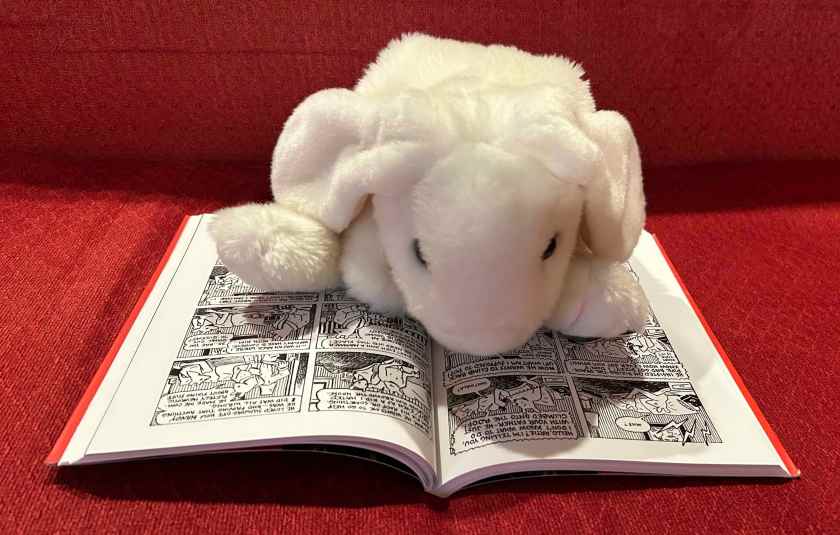
Marshmallow is reading Maus: A Survivor's Tale - I: My Father Bleeds History by Art Spiegelman.
Marshmallow is reading Maus: A Survivor’s Tale – I: My Father Bleeds History by Art Spiegelman.

S: Okay, so now we know the main plot lines and so on, but tell me Marshmallow, how was it like reading such a tough story in graphic novel form?

M: I thought it worked really well. It was very easy to visualize things, even though the characters are mice and cats and so on, because they had already been visualized for you. The book and its visual nature show the undeniably horrific nature of the Holocaust. You fully feel the pain of the mice, and knowing that these events actually happened to people, it makes the whole book even more impactful.

S: I wonder if the harshness of the realities the book is depicting can be related to why some people want to ban this book from school libraries. Some people want us to forget and never talk about these historical events, I am not talking about those people. But even those who believe we should teach this history might think that these stories are too hard to share with young people.

M: I understand why you want us to emphasize that the themes and imagery of the book might be disturbing to very young readers. There is violence in the book. But I also think it is very important for young bunnies to know what happened. And this book does a very good job in telling exactly what happened. And maybe ironically, the use of animal characters allows you to end up seeing the humanity of the victims of the Holocaust very clearly.

S: You make a very good point Marshmallow.

M: Thank you. I also wanted to say the book reminded me of Animal Farm a bit because it shows the worst aspects of humanity under the guise of animals. The animal characters allow us to look at ourselves and see how terrible we truly are or can be. Since we are not seeing humans, we can see things more objectively.

S: That makes sense to me, too, Marshmallow. Okay, this is already a pretty long post. Before we wrap things up, can you tell me how you would rate this book?

M: I’d rate it 100%. It is a striking and impactful book. And I recommend it strongly. It is important for bunnies to understand the magnitude and the impact of these events.

S: Okay, thank you Marshmallow. So last words?

M: Stay tuned for more amazing reviews from the book bunnies!

Marshmallow rates Maus: A Survivor's Tale - I: My Father Bleeds History by Art Spiegelman 100%.
Marshmallow rates Maus: A Survivor’s Tale – I: My Father Bleeds History by Art Spiegelman 100%.

Marshmallow reviews The Bluest Eye by Toni Morrison

Today Marshmallow reviews The Bluest Eye by Toni Morrison, first published in 1970. Sprinkles is taking notes and asking questions.

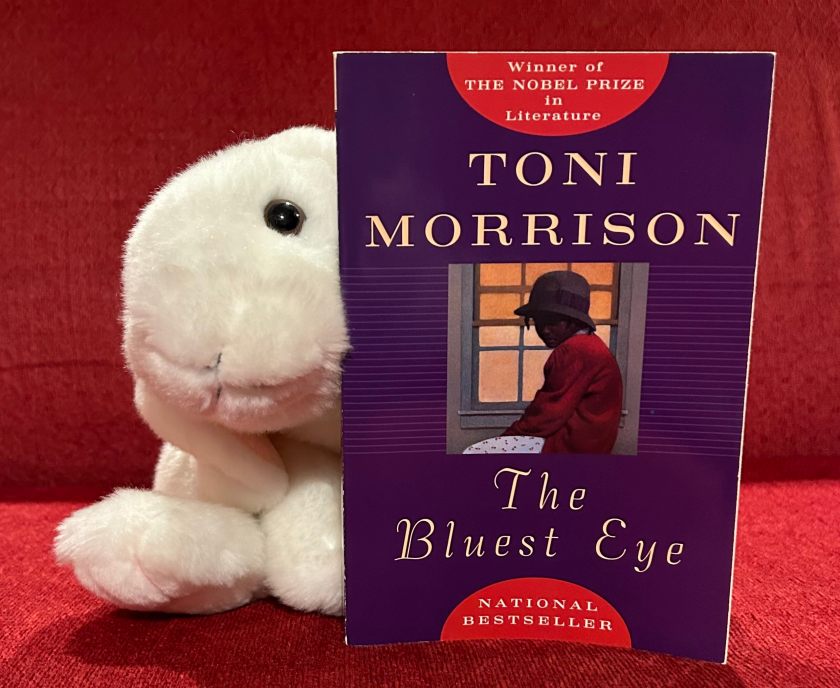
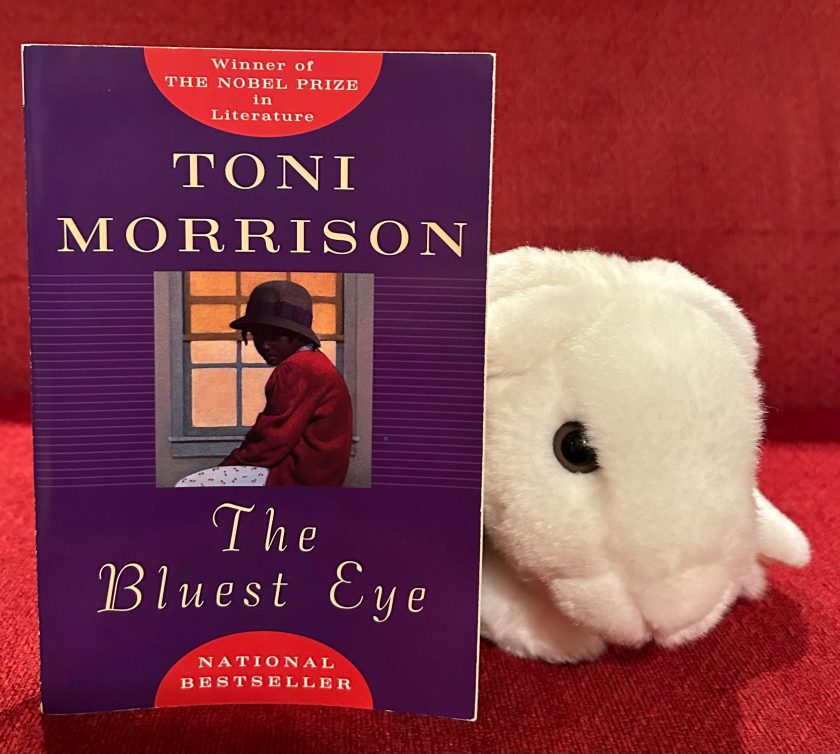
Marshmallow reviews The Bluest Eye by Toni Morrison.

Sprinkles: So Marshmallow, you always start your book reviews with what you call a quick overview. Can you give us one for this book, too?

Marshmallow: If you want to read about three young black girls growing up after the Great Depression and amidst internalized and externalized racism, then this is the book for you.

S: Okay, I think that is a good start. So tell us a bit more. Who are the three girls?

M: The main character is eleven-year-old Pecola Breedlove, and she is a foster sister to the other two girls, Claudia and Frieda MacTeer, who are nine and ten, and live with their parents. Pecola and Claudia are close, and a lot of the book is told from Claudia’s perspective. But we also have flashbacks and so on to events in Pecola’s life that Claudia could not have witnessed.

S: Okay, so tell me more. Why is the title The Bluest Eye?

M: Because Pecola wants to have the bluest eyes in the world. She thinks that she is ugly because a lot of people tell her she is, and she thinks that if she had blue eyes, she would be beautiful too.

S: I see. That must be very hard for a young girl of course.

M: That is not all that is hard in her life though. Her parents are both alive but they are not able to take good care of her. Her father is abusive and violent. Her mother does not support and protect her. The MacTeers on the other hand are a more supportive family for their children and Pecola, too, at least most of the time.

Marshmallow is reading The Bluest Eye by Toni Morrison.

S: I know this book has been banned in some school districts. Do you know why?

M: I think it is mainly because of two very sexually explicit scenes, which are also violent and abusive. And there are other parts where children are sexualized, and so on.

S: Hmm, I can see how those types of scenes would make a lot of people concerned about a book, especially for younger folks. How did you handle them?

M: I think the book is really hard to read, emotionally. When I was reading the book, I had to put it down several times. That is why it took me a really long time to read the book even though it is not very long and the author’s voice is fluid and captivating.

S: And yet you persisted and finished the book.

M: Yes, because I know it is an important book, and I know the author is trying to tell us something important.

S: What do you think she is trying to tell us?

M: I think she is trying to portray the chaos and the evil that results from racism. She says: “I felt compelled to write this mostly because in the 1960s, black male authors published powerful, aggressive, revolutionary fiction or nonfiction, and they had positive racially uplifting rhetoric with them that were stimulating and I thought they would skip over something and thought no one would remember that it wasn’t always beautiful.” So even though black people survived and often thrived despite the terrible oppression of racism they had to face, there were also people who did not survive, who were broken, and Toni Morrison wanted to make sure that we would not forget that.

S: I can see why you persevered Marshmallow. Sometimes we need to read difficult and heart-wrenching text to make sure we do not forget. But from what I am hearing you say, this book is probably not appropriate for young bunnies even though the main characters are young themselves.

M: Yes, definitely. I don’t think Caramel should read it yet for example. But for bunnies who are older and a bit more mature, it might be more appropriate.

S: You have read and reviewed Chains, Forge, and Ashes, the three books of the Seeds of America series, which were also about racism, or maybe more accurately, slavery. I think those books were also hard to read in some ways, but this one seems like it was a lot more challenging.

M: Yes. Possibly because in those books, even though there is a lot of pain and heartbreak, the main characters eventually overcome some of their challenges, and there is some sense of triumph, kind of like the writings Toni Morrison is referring to in the quote above. But in The Bluest Eye, both the life and the identity of Pecola are shattered. She does not survive her challenges. There is no redemption, only pain. Okay, there is some beauty too, in the book; there is solid love and affection, in the lives of Claudia and her family. But what happens to Pecola is traumatizing, and she does not survive the trauma.

S: I get that Marshmallow. Thank you for sharing your thoughts on this book. So do you have some last words to say about it?

M: I think this could be a good book to read for bunnies who are willing to face the full ugliness of racism and how it hurts people’s self-worth.

S: Thank you. So let us wrap this up then. What do you want to tell our readers?

M: Stay tuned for more amazing reviews from the book bunnies!

Marshmallow appreciated reading The Bluest Eye by Toni Morrison, though she thinks that it might be appropriate for only older bunnies.

Caramel reviews Homer Price by Robert McCloskey

Today Caramel reviews Homer Price, a book by Robert McCloskey first published in 1943. As usual, Sprinkles is taking notes and asking questions.

Caramel reviews Homer Price by Robert McCloskey.

Sprinkles: So Caramel, tell me about this book.

Caramel: This book is about a kid named Homer Price. Homer does many different things, like helping his uncle in the lunch room, which I think is essentially a restaurant, and building radios. This one is actually cool.

S: So Homer is a curious kid, and the book is about his adventures?

C: Yes. Or you could say his misadventures. A lot of unfortunate things happen. But in the end, he always comes out on top.

S: So you must like that, right? You like happy-ending books.

C: Yep. And Homer is a good kid. He is lucky but also pretty clever. And he likes to help other people.

S: Sounds a bit like you, Caramel.

C: Well, I don’t know how to build radios.

S: I bet you would like to give it a try.

C: Yes, I think I would.

S: Well, the summer is here, and school will be out soon, so maybe we can look into that.

C: I’d like that!

Caramel is reading Homer Price by Robert McCloskey.

S: Okay, so tell me a bit more about the book.

C: There are six chapters in the book. Homer has a different adventure in each. The chapter titles are “The Case of the Sensational Scent”, “The Case of the Cosmic Comic”, “The Doughnuts”, “Mystery Yarn”, “Nothing New Under the Sun (Hardly)”, and “Wheels of Progress”. I think I like “The Doughnuts” the most.

S: Tell me more.

C: I think it is the funniest part of the book. There is this machine that makes doughnuts, and something goes wrong, and it does not stop, so it keeps making doughnuts nonstop.

S: So there is an unending supply of doughnuts? That does not seem like a terrible situation!

C: I like donuts too, but I guess you could have too many doughnuts. Anyways eventually it stops, so they have to figure out a way to sell all the doughnuts.

S: What was funny about the chapter?

C: How they panic about the unstopping doughnut machine! That was very funny. And there are pictures here and there in the book. The ones in this chapter are pretty funny. And you can see the doughnuts all over the place!

S: I see. I thought you might also enjoy the Cosmic Comic one.

C: Yes, I did. In that chapter, Homer and his friend Freddy go to meet Freddy’s favorite comic book superhero. And hilarity ensues.

S: That is a funny way of saying things Caramel! But so the book sounds like it is light and light-hearted.

C: Yes.

S: You know that this book was written quite a while ago, right? Does it show its age?

C: Not really. I mean there are no computers and cell phones around but otherwise the stories just sound like they could happen today too. Though a $100-award back then would probably be much bigger than it is today. That is from “The Doughnuts”.

S: I see. Okay, so if you were to describe this book in three to five words …

C: Hilarious, timeless adventures of a clever little boy.

S: That will do! So let us wrap this up then. What would you like to tell our readers?

C: Stay tuned for more book bunny reviews!

Caramel enjoyed reading Homer Price by Robert McCloskey and learning about Homer's quirky adventures.
Caramel enjoyed reading Homer Price by Robert McCloskey and learning about Homer’s quirky adventures.

Caramel reviews The Red Balloon by Albert Lamorisse

Today Caramel reviews The Red Balloon by Albert Lamorisse, first published in 1956. As usual, Sprinkles is taking notes and asking questions.

Caramel reviews The Red Balloon by Albert Lamorisse.

Sprinkles: So Caramel, tell us a bit about The Red Balloon.

Caramel: The Red Balloon is a friendly balloon and becomes friends with a boy named Pascal. Pascal is lonely. He does not have brothers or sisters, and his mom does not want him to have any pets. It also seems like he does not have friends at school. But the Red Balloon becomes his friend. They go to places together, and the Red Balloon waits for him when he has to go inside.

S: That sounds fantastical, but also very sweet.

C: I think so too. Pascal needs a friend, so the Red Balloon becomes his friend. But then there are some mean boys who try to take the Red Balloon from Pascal, and they chase him, and they try to blow it up. It is really sad, and I got really mad at those boys.

S: You are right, they are mean, and they are jealous I think. Pascal has a really magical friend, and they cannot have it so they want to destroy it. Pretty terrible.

C: But at least the end of the book is not unhappy.

S: I agree. The book has some sad moments, but there are lots of very happy and sweet parts, and the end is very sweet, too.

C: Yes.

Caramel is reading The Red Balloon by Albert Lamorisse.

S: The book has lots of pictures, and they are almost all black and white, except the balloon, which is bright red. What did you think of that?

C: I liked it. It made the balloon even more special.

S: I agree. We also watched together the film the book is based on. What did you think of the film?

C: It was good. But watching it made me even angrier at the boys. They were so mean!

S: Yes. Pascal is so alone at the beginning and he is so happy when he makes friends with the Red Balloon, and then the boys come and try to take it away from him.

C: I guess, like you said, they were really jealous. I mean, I’d love to be friends with a balloon like that!

S: But you have real friends, too, Caramel. Pascal does not seem to have any. So he needs it so much more.

C: Good point. Hey, Sprinkles, do you think we could put a link to the movie here so our readers can watch it too, if they want?

S: Sure.

The Red Balloon – A boy makes friends with a seemingly sentient red balloon, and it begins to follow him. It follows him to the bus stop, to school, and to church. They play together in the streets of Paris and try to elude a gang of boys that wants to steal it. The Red Balloon (1956) Director: Albert Lamorisse. From YouTube.

C: Thank you. I think the movie is really nice too. It is not totally black and white, but the Red Balloon is the brightest thing in it, too.

S: Yes. I think it definitely adds to its magic. So all in all, did you like this book?

C: Yes. But now I am wondering what it would feel like to have my own balloon friends.

S: It would definitely be fun, I am sure. Especially if like in the end you had many many balloon friends!

C: Sprinkles, you are giving away the end!

S: Okay, you are right. I will not say more. Maybe this is a good time to wrap up this review anyways. What would you like to tell our readers?

C: Stay tuned for more book bunny reviews!

Caramel liked reading The Red Balloon by Albert Lamorisse and is now dreaming of traveling around the world hanging on a lot of friendly balloons.