Midnight reviews Foundation by Isaac Asimov

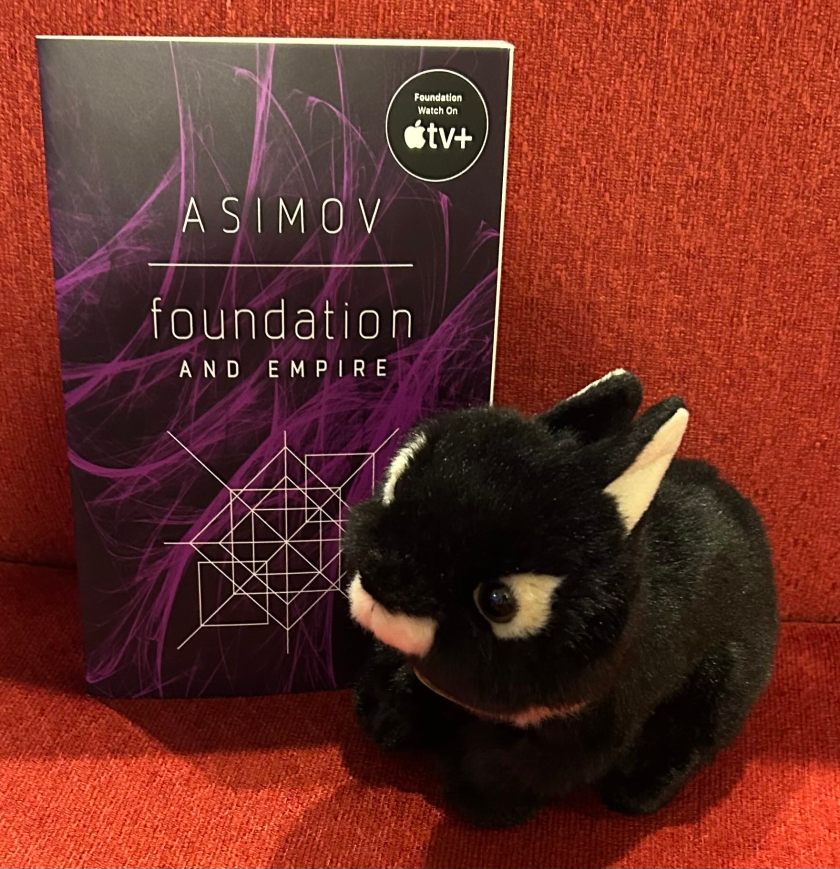
Today we have a surprise for you: The mysterious and reclusive black bunny of the family, Midnight, decided he wants to join in the book fun! So here follows the first book review by Midnight, where he talks to Sprinkles about Isaac Asimov’s classic Foundation, the first book of the famous Foundation trilogy, originally published as a stand-alone book in 1951.

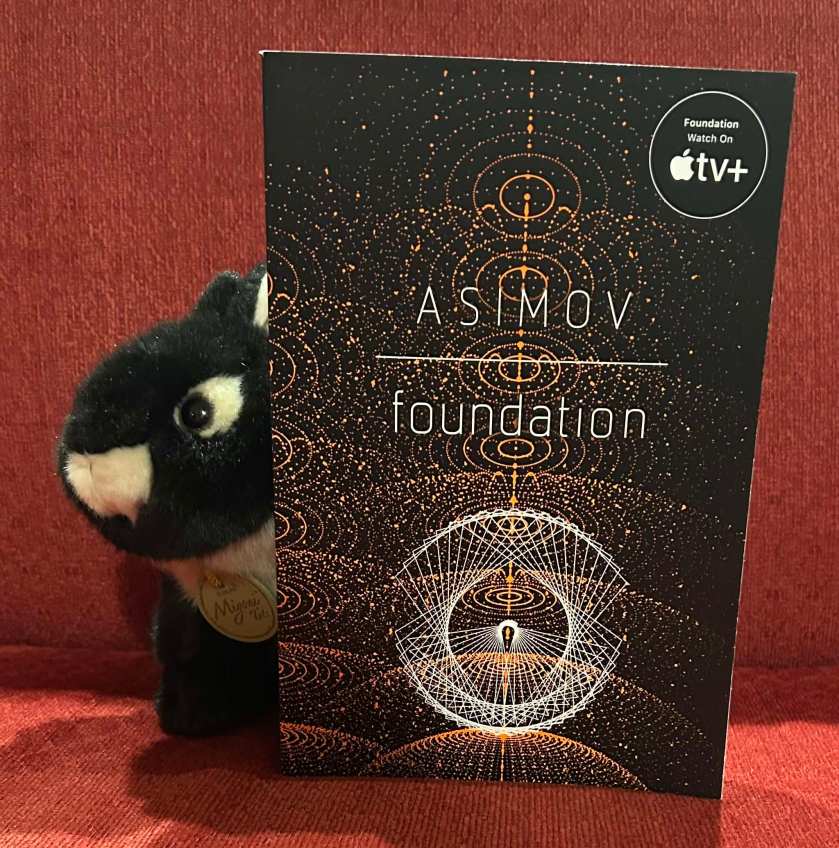
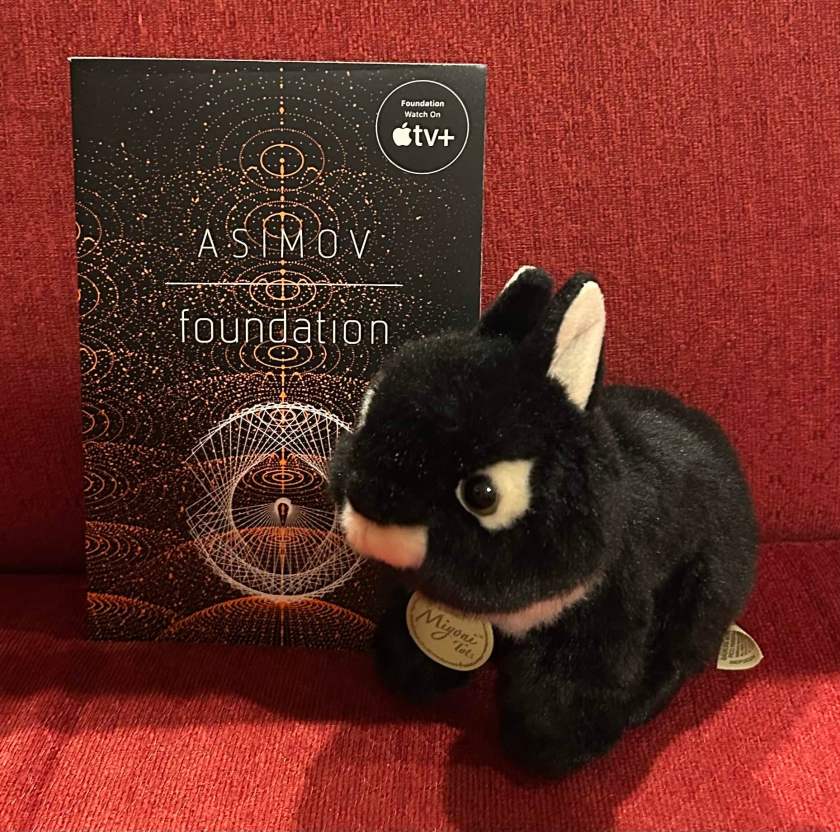
Midnight reviews Foundation by Isaac Asimov.

Sprinkles: Midnight, I am so happy to welcome you to the book bunnies blog!

Midnight: It’s wonderful to be here. It’s certainly a thrill.

Sprinkles: So you chose Asimov’s Foundation as your first book. Can you tell us a bit about it?

Midnight: It’s almost like another bunny purchased it for me and suggested that I read it.

Sprinkles: Yes, that is true. I read it on my tablet via the Libby app, but then I thought you might enjoy it too.

Midnight: It is a short book about the decline and fall of the Galactic Empire.

Sprinkles: Wait, the Galactic Empire is something from Star Wars, no?

Midnight: Foundation predates Star Wars by several decades. It was written originally as a series of short stories in the 1940s, and published in science fiction magazines, until in 1951 Asimov put them together into a book. The first Star Wars movie came out in 1977.

Sprinkles: Okay, okay, of course you know the timeline really well. But then tell us a bit about this Galactic Empire. Are we talking about our own galaxy, the Milky Way?

Midnight: Yes, we are, and they keep talking about humans and no other aliens. And sadly no bunnies are mentioned. (But we can assume that they control everything from the shadows–as they do in the present.)

Sprinkles: Midnight, let us not scare our readers away with your schemes of world (or universe) domination. Let’s get back to the book. Okay, we are talking about a galactic empire in the Milky Way, so this is far into the future, right?

Midnight: Yes. The Galactic Empire has endured for about twelve thousand years and spans the entire galaxy. According to other Asimov books in the same universal timeline, the Empire was founded about ten thousand years into the future from now.

Sprinkles: That is way in the future! Kind of like Caramel’s WarHammer storyline, which was about forty thousand years into the future. That’s kind of cool!

Midnight: That’s not a question.

Sprinkles: Okay, I will try to phrase my words into questions. I did not read much about WarHammer, but I know it describes a rather dystopian future. The one Asimov describes is not as dismal, is it?

Midnight: True. The Galactic Empire seems modeled after the Roman Empire to some extent. It is ruled by a monarch from the imperial capital planet Trantor. But the empire is in a slow decline that is inexorable according to Hari Seldon, the main character in the first portion of the book.

Sprinkles: Yes, I remember the book is written in five separate sections, which must be the five stories that were published separately earlier. Seldon is the main character in the very first one, but he does appear in the later ones too, no?

Midnight: Yes, but it is probably more accurate to say his influence is felt in the later ones.

Sprinkles: Yes okay. Go on.

Midnight: So Seldon is a scholar of psychohistory, a discipline that uses mathematical tools to model psychology of large groups of people to make predictions about their collective behavior. If the sample sizes are large enough, Asimov suggests that predictions can be made with high degree of certainty. Seldon predicts the downfall of the Empire, and that the galaxy will go through a dark age that would last thirty thousand years.

Sprinkles: That would bring us to past 40K, the time of WarHammer! What an interesting coincidence! Anyways, psychohistory kind of sounds to me like using big data to predict, and we know that has worked pretty well in predicting people’s purchasing decisions and such, but it is not clear it would work for historical events. I guess that is why this is science fiction.

Midnight: Yes. And the book was written quite a bit before mathematicians began studying chaos theory, and Lorenz’s discovery of the butterfly effect in weather prediction.

Sprinkles: Yes, that is true too. Okay, coming back to this being fiction. Let us accept the premise of the book that Seldon has this theory that predicts the future of the Empire. Then what happens?

Midnight: Seldon starts a foundation on the planet Terminus, at the edge of the galaxy, recruiting a group of scholars, ostensibly to compile a great encyclopedia of all knowledge from which humanity will be able to restore the galaxy to some sense of civilization. According to the Seldon Plan, the Foundation would be able to shorten the dark age to only one thousand years.

Sprinkles: I see what you did there. The word “ostensibly” seems to have silently found its way into your sentence.

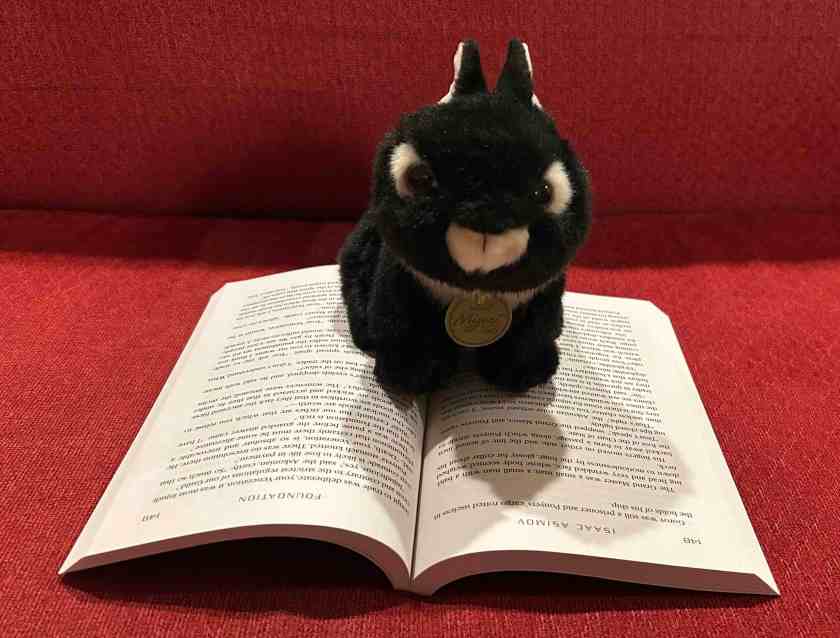
Midnight is reading Foundation by Isaac Asimov.

Sprinkles: Anyways, maybe this is enough about the plot of the book.

Midnight: Okay. What do I need to say now?

Sprinkles: Well, you can tell me what you thought of the book.

Midnight: The book takes place over many centuries, so a new cast of characters is introduced in each part of the book.

Sprinkles: The five main parts we mentioned earlier?

Midnight: Yes. But this means that characters do not necessarily have the same depth that they might in a conventional novel.

Sprinkles: Yeah, I can see that.

Midnight: And there is a lot of speaking about things as opposed to showing events take place. Asimov has a lot of big ideas, but when centuries pass every few pages, one does not feel quite as invested in the individual characters and one does not get too much of a sense of who they are as people. They are more vehicles to deliver context and story.

Sprinkles: I can see your Tolkien fan feelings coming out here. Tolkien spent a lifetime developing his world, and his characters are often much richer and deeper.

Midnight: Let’s compare this to the Silmarillion, which takes place over thousands of years and characters come in and out of the narrative over these vast time scales, kind of like in Foundation. I feel like I have a lot clearer sense of those characters than Asimov’s in this book.

Sprinkles: I have not read Silmarillion, but my guess is that Tolkien has a different style and different goals. He cares a lot more about his characters, while maybe Asimov is trying to tell us a possible future.

Midnight: I am not sure I’d say that. I think Tolkien is also retelling a vast history, and does not set out to write a character-driven drama. But somehow his characters are more complete people in my mind.

Sprinkles: Well, Midnight, then you will have to come back and review Silmarillion for us some day.

Midnight: Well, I don’t want to sound too negative about Foundation. I did find the ideas intriguing and read the next several books in the series. I found some of the characters in those books more compelling and three-dimensional.

Sprinkles: Okay, then, maybe you will also tell us about those books some day?

Midnight: Maybe. As a mysterious and reclusive bunny, I do not wish to commit to anything at this time.

Sprinkles: But that is alright. You have already shared with us some good thoughts on a classic, and that is already wonderful! I did like Foundation a lot myself, and it seems that you enjoyed it, too. So maybe this is a good place to wrap up your first review. What do you think?

Midnight: Sounds reasonable to me.

Sprinkles: The little bunnies I interview for the blog have their own closing phrases when they are ending their posts. What would you like to tell our readers as we wrap up yours?

Midnight: A bunny as sophisticated, as complicated, and as self-important as I, cannot be reduced to a simple catchphrase.

Sprinkles: I understand. But we do need to end this post. So what will you say as your last words?

Midnight: Farewell, dear reader. Until such a time as the Black Bunny sees fit to reappear.
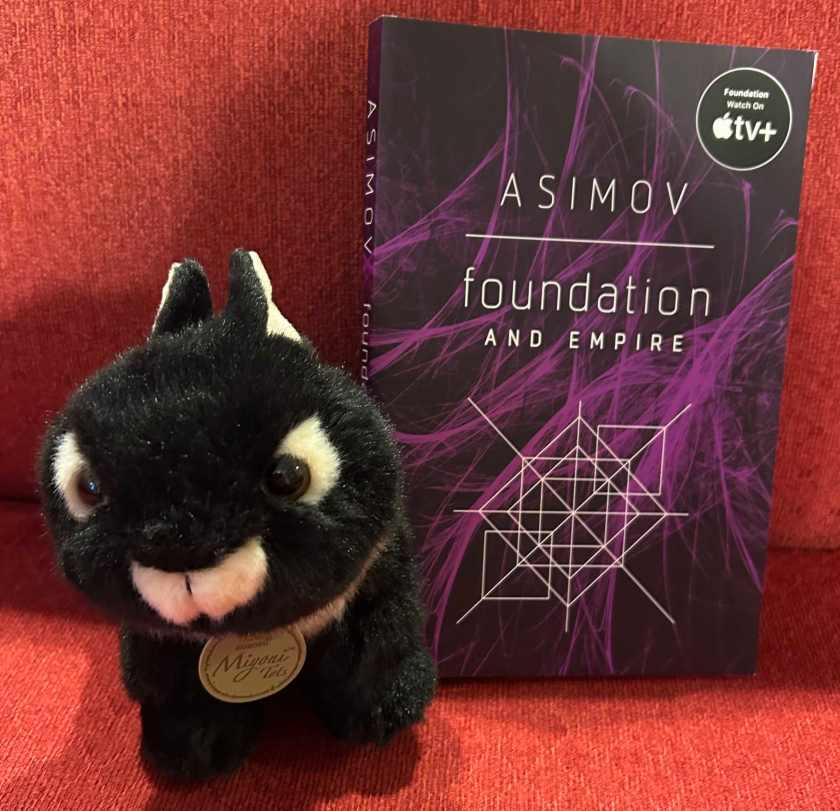
Midnight enjoyed reading Foundation by Isaac Asimov. He also enjoyed coming out of the shadow realm where he normally resides and pontificating about the book.

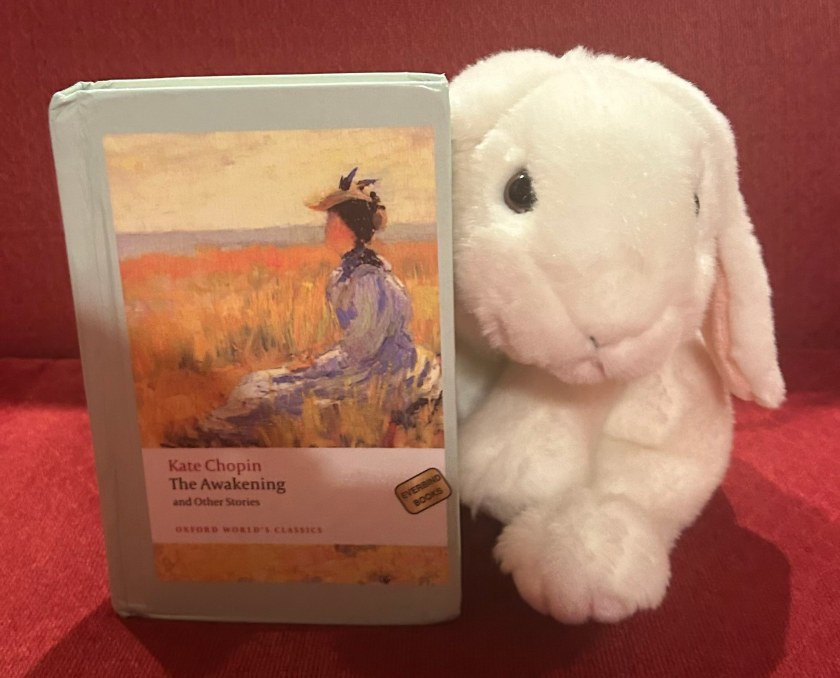
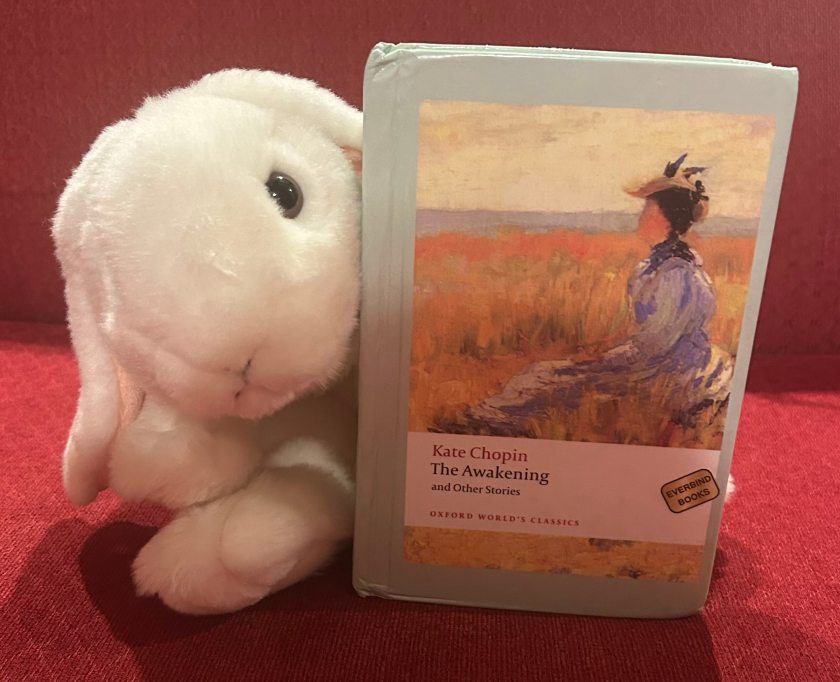
Marshmallow reviews The Awakening by Kate Chopin

Today Marshmallow reviews a classic novel originally published in 1899: Kate Chopin’s The Awakening.

Marshmallow reviews The Awakening by Kate Chopin.

Marshmallow’s Quick Take: If you like reading books that make you think and take you back in time, then this is the book for you!

Marshmallow’s Summary (with Spoilers): Edna Pontellier lives in New Orleans, Louisiana during the late nineteenth century. As she is originally from Kentucky, Edna has felt a little out of place ever since she married Mr. Pontellier (who was born into the Creole culture), moving to Louisiana to live with him. Edna spends her days as a “mother-woman” now, attending to the needs of her husband and two sons and running the domestic details of the Pontellier household; however, this is not enough to satisfy Edna.

The Pontelliers are fortunately very wealthy and the book introduces us to them during their trip to Grand Isle (near the Gulf of Mexico) during the summer. At Grand Isle, Edna realizes that she is truly unhappy when Mr. Pontellier berates her for neglecting their children (despite the fact that he was out the whole night at the pub). She breaks down in tears, but finds comfort in spending time with her friend Robert—who is the son of the woman who runs the resort the Pontelliers stay at. While Mr. Pontellier is regarded as the best husband Edna and her friends know, he is not particularly attentive. Still, he sends back sumptuous gifts while he is away, and he has never abused or assaulted Edna.

To me, it seems that Mr. Pontellier is the best husband one could hope for from the men of that time period; he is a very by-the-book gentleman, treating his wife in the most caring manner he knows how (though it is mostly materialistic and he does not offer much in the way of emotional support or attention). I do not blame Edna for feeling discontent though.

During their time at Grand Isle, Robert and Edna become closer and closer—to the point that Adéle Ratignolle (a very close friend of Edna’s) warns him to stay away from Edna lest they start to believe they could become more than friends. But it is already too late because Edna’s heart has already made its way to Robert. Adéle, who is the paragon of what an ideal woman would be, provides a stark contrast to Edna. Edna is not a bad wife, but she is far from matching Adéle’s doting adoration and care for Mr. Ratignolle and their children. Along with her budding love for Robert, Edna starts to feel as though maybe she is not cut out to fit this mother-woman role.

When the Pontelliers return to New Orleans, Edna starts to take up more room, rejecting the standards she tried so hard to fit herself in. When Mr. Pontellier goes on a business trip and the children go to stay with his mother, Edna decides to move to a small cottage they own, called the pigeon house. There, her agency and independence are kindled and eventually ignite an affair with a man named Alcée Arobin (there are no inappropriate scenes; Chopin only describes an occasional kiss).

One might ask why Alcée comes into the picture when Edna loves Robert. The unfortunate answer would be that Robert ran off to Mexico in pursuit of some business opportunity, though this was a thinly veiled attempt to distance himself from Edna and his feelings of attraction to her. Alcée (a lady’s man with a distinct pattern of chasing married women) provides the physical satisfaction that Edna was missing. But Edna does not feel any sense of love or emotional connection to him. Robert is the one she loved. When he returns, Edna’s life will be forever changed. 

Marshmallow is reading The Awakening by Kate Chopin.

Marshmallow’s Review: This was a fascinating book. I really enjoyed reading about what life was like back then, and I felt as though Chopin had actually transported me there to witness it. I will say that I found Edna’s treatment of some of the servants quite infuriating (she is not abusive, but definitely demeaning). Regardless, this book was worth the time I put into trying to understand it. Initially, much like my endeavors with A Tale of Two Cities, reading the first couple of chapters was grueling. But after I got accustomed to the writing style of the time period, it was relatively easy to read.

I read The Awakening in my English class, so I did do a deeper analysis of this book than I might have done otherwise. I noticed that the titular “Awakening” could represent one of many things (her rebellion, her sexual relationships, her artistic pursuits, etc.) or perhaps all of them together. There is also the consistent image of the sea. This motif serves to represent independence, death, freedom, life, rebirth, rebellion, and more. Really, anything can represent anything—it is all up to the reader what they get out of the book. I found this book to be a source of gratitude for me. I am really glad that Edna’s world of repression and dissatisfaction has been partially torn down over the years since this book’s publication. The idea of a mother-woman that so defined and constrained her life has loosened its grip on women today. 

The ending came as a bit of a shock to me. I was hoping for the resolution of the story to go one way and it went off a cliff in the other direction (metaphorically, I mean, due to the surprising nature of the end). I will not say much more. But I think the ending Chopin chose sends the most meaningful message and it is quite open to interpretation.

I wonder if it is possible that the whole story is a dream and that Edna imagines her whole affair with Alcée and the drama with Robert. She does have one part of the book where she starts imagining something and perhaps she never stopped? This is a bit of a stretch, but I find such mental investigations intriguing. 

I would also mention that this is a very psychologically interesting book as well. Chopin does an excellent job of showing Edna’s psyche and why she feels the way she does. The reader’s emotions follow the same arc as those of Edna’s. I was saddened to come to the end of the book. 

This particular edition of the novel contains many short stories by the author; however, I have not read them yet; so far I have only read The Awakening. That is the only one I can speak about in depth. But I can definitely say that I would highly recommend reading it to all!

Marshmallow’s Rating: 98%.

Marshmallow rates The Awakening by Kate Chopin 98%.

Marshmallow reviews Spooky Classics for Children: A Companion Reader, as told by Jim Weiss, and with Dramatizations by Chris Bauer

This week both of the younger book bunnies wanted to review spooky books to honor Halloween 2025. So on Wednesday, Caramel reviewed a cute picture book about a zombie and a brain. And today, Marshmallow reviews Spooky Classics for Children: A Companion Reader, as told by Jim Weiss, and with Dramatizations by Chris Bauer, which offers modern adaptations of three classic short stories.

Marshmallow reviews Spooky Classics for Children: A Companion Reader, as told by Jim Weiss, and with Dramatizations by Chris Bauer
Marshmallow reviews Spooky Classics for Children: A Companion Reader, as told by Jim Weiss, and with Dramatizations by Chris Bauer.

Marshmallow’s Quick Take: If you are looking for a fun book to read with your family during the fall season, then this is the book for you!

Marshmallow’s Summary (with Spoilers): This book is divided into several sections. The Preface introduces the stories and explains that the book can be used in three ways: listen, read, and speak. The first section has the stories laid out in a normal picture book-like fashion; this is Part I: Three Spooky Stories. The second section (Part II: Three Spooky Plays) provides scripts for each story and a guide for how to perform each one. 

The first story is called “The Canterville Ghost”, and it was originally written by Oscar Wilde and published in 1887. The story is set in Britain. The American Otis family (Mr. Otis is the American ambassador to Great Britain) moves into the Canterville Chase, a famous old ancestral castle. The catch is that the estate is haunted by the Canterville Ghost. Lord Canterville warns the Otis family of the haunting, but they do not believe in “mumbo-jumbo.” However, when the ghost’s existence becomes undeniable, they react in a relatively kind, well-mannered way. Eventually, the story ends happily—which I was initially not expecting! (Readers interested in the original Wilde version can check out this Project Gutenberg link.)

The second story is called “Dr. Heidegger’s Experiment” and was originally written by Nathaniel Hawthorne and published anonymously in 1837. The story is about five friends who are in their older years. Dr. Heidegger invites his four friends over to his house and offers them water from the Fountain of Youth. All four of his friends lived lives of sin and are full of regret. However, Dr. Heidegger himself does not drink the water; he merely wishes to see what happens when they do. They drink the water and age backwards, regaining their beauty and energy. However, they did not follow Dr. Heidegger’s advice to record for themselves some lessons learned before they drank the elixir, and so they do not remember the wisdom that they were supposed to have learned throughout their lives (though it is not that they forgot it, it is mostly that they did not gain it in the first place). The story ends with a clear message, and this story made me think a lot more than I was expecting to at the end. (Interested readers can check out this Project Gutenberg page for Twice-Told Tales, a collection that contains, among many others, the original story by Hawthorne.)

The third story is called “The Sending of Dana Da” and was originally written by Rudyard Kipling and published in 1888. The story is set in India a long time ago. A British man named Richard Evans meets a local wizard named Dana Da whom he treats generously. Dana Da offers the man help in return, asking him if he needs help in dealing with anyone he loves or hates. Evans eventually admits that he loathes a man named Everett Lone. Dana Da’s sending is a magical energy that he can shape into whatever he wishes; for this case, he shapes it into cats that appear in Lone’s life constantly (Lone hates cats). This magical story ends in a quaint way and wraps up the first section of the book nicely. (The original version by Kipling is somewhat different and may or may not be appropriate for young bunnies, so we will not link to it from here.)

Marshmallow is reading Spooky Classics for Children: A Companion Reader, as told by Jim Weiss, and with Dramatizations by Chris Bauer

Marshmallow’s Review: Overall, I would highly recommend this book! I really enjoyed listening to the audio recording that came with it, and it was a really great experience. Jim Weiss is a great voice actor! (We loved his readings of the Harry Potter books many years ago.) But even if you do not have access to the recordings, the text itself is really engaging on its own. This book is accessible and appropriate for all ages, so I think it would be really fun to read or listen to as a family. I liked the drawings, but I especially liked the writing style; I found it energetic, engaging, yet simple at the same time.

The stories were also surprisingly deep. The first story made me think a lot about generosity while the second made me think a LOT about wisdom, living life in a meaningful way, and appreciation. I also wondered a lot about youth and age afterwards. The third one teaches a lesson about logic and magic, but also friendship and kindness. I would explain more but I think that might give the ending away.

The second section with the screenplay versions of the stories adapted by Chris Bauer would also be a great help for theatre programs for little children. I can see it helping set up a great show for children to watch and / or perform in. Of course I could also see a family doing it among themselves, too, just for fun. There are a lot of useful suggestions for either scenario.

As a whole, this book was really enjoyable, and I would completely recommend it to everyone! I know this is a bit late, but it would also make for a perfect Halloween book!

Marshmallow’s Rating: 100%.

Marshmallow rates Spooky Classics for Children: A Companion Reader, as told by Jim Weiss, and with Dramatizations by Chris Bauer 100%.

Sprinkles reviews Flatland: A Journey of Many Dimensions – The Movie Edition by Edwin A. Abbott

Today Sprinkles reviews a 2008 edition of a unique classic: Flatland: A Journey of Many Dimensions – The Movie Edition, credited to “Edwin A. Abbott, with Thomas Banchoff and the Filmmakers of Flatland“.

Today Sprinkles reviews Flatland: A Journey of Many Dimensions - The Movie Edition by Edwin A. Abbott, with Thomas Banchoff and the Filmmakers of Flatland.
Today Sprinkles reviews Flatland: A Journey of Many Dimensions – The Movie Edition by Edwin A. Abbott, with Thomas Banchoff and the Filmmakers of Flatland.

Flatland: A Romance of Many Dimensions by Edwin A. Abbott was originally published in 1884. As Wikipedia tells us, this was a novella written by “A Square” who lived in a two-dimensional world called Flatland. The main plot of the book involved the Square meeting a Sphere, coming into Flatland and teaching him about the third dimension. The Square, his consciousness now widened, began to stipulate the existence of fourth and higher dimensions, which in turn confused the Sphere.

The book’s story is amusing, and for many young minds it could be a welcome introduction to the mathematics and philosophy of higher dimensions. The adults reading the book together with their young one would also appreciate the satire underneath it all. Abbott’s pointed comments about the second class status of women in Victorian England, on the other hand, can be comprehended by some of the young crowd. (In Flatland, men are two-dimensional — they are polygons of various types — but women are one-dimensional; they are very very pointy and have no depth.)

The bottom of the Wikipedia article on Flatland lists several online places where one can access the full text of Flatland, as it is now in public domain. (Here, for example, is the Project Gutenberg version.) But I wanted to review this particular 2008 edition of the book because it not only contains the full text but also has some information about the 2007 movie made based on it. As such there are many colorful illustrations in the book, and this might make it even more fun for a young bunny to look through and read along.

Sprinkles is reading Flatland: A Journey of Many Dimensions - The Movie Edition by Edwin A. Abbott, with Thomas Banchoff and the Filmmakers of Flatland.
Sprinkles is reading Flatland: A Journey of Many Dimensions – The Movie Edition by Edwin A. Abbott, with Thomas Banchoff and the Filmmakers of Flatland.

Abbott’s original novella is not too long, so it takes about half of this large-format book. The rest of the book is also worth reading however. There is a short introduction by the mathematician Thomas Banchoff at the beginning, which is worth reading to contextualize what is to come. Then the whole text of the classic Flatland follows. After that, the second part of the book starts. This section is titled “Flatland: The Movie” and includes three brief essays (“Finding Flatland” by producer Seth Caplan, “Imagining Flatland” by director Jeffrey Travis, and “The Visual Design of Flatland: the Movie” by director and animator Dano Johnson), lots of colorful images on high-quality paper, and then the screenplay of the whole film.

Trailer of Flatland: The Movie, from YouTube.

The movie is also worth watching, actually, and it seems to be available in a bunch of places, including YouTube. Apparently right around the same time, some other folks made a second movie based on Flatland, so sometimes people get confused, but the book I am talking about here and the trailer above are both related to the shorter movie voiced by actors like Martin SheenKristen Bell and Tony Hale.

All in all, I recommend Flatland very highly; you should read it and you should introduce all the bunnies around you to it. The 2008 edition here is a good place to start, but it is also fine if you choose the movie version first. I should note that the women are not one-dimensional in the movie: the Victorian satire tends to go on the back-burner there, and the math seems to come to the fore. Which is fine by me but your preferences might be different.

Sprinkles enjoyed reading Flatland: A Journey of Many Dimensions - The Movie Edition by Edwin A. Abbott, with Thomas Banchoff and the Filmmakers of Flatland, and recommends it to all bunnies young and old.
Sprinkles enjoyed reading Flatland: A Journey of Many Dimensions – The Movie Edition by Edwin A. Abbott, with Thomas Banchoff and the Filmmakers of Flatland, and recommends it to all bunnies young and old.