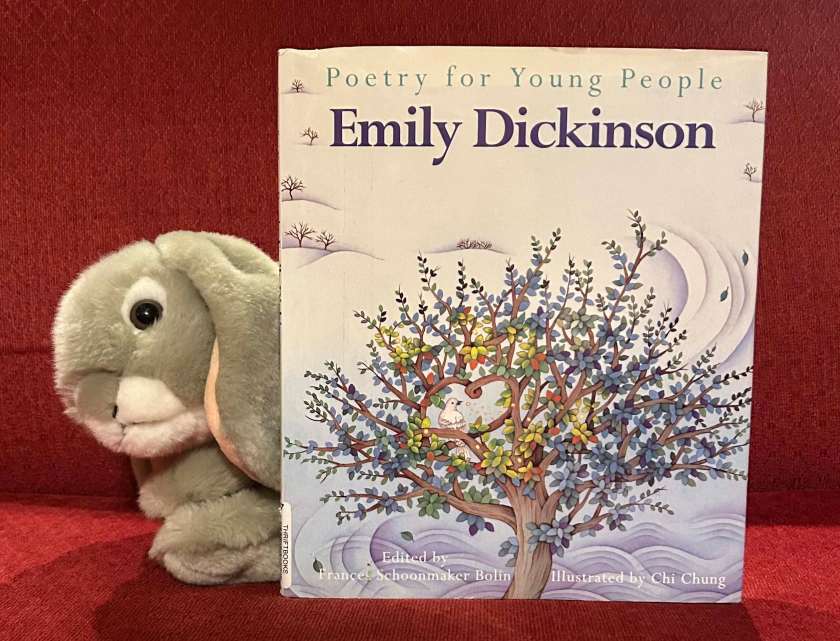
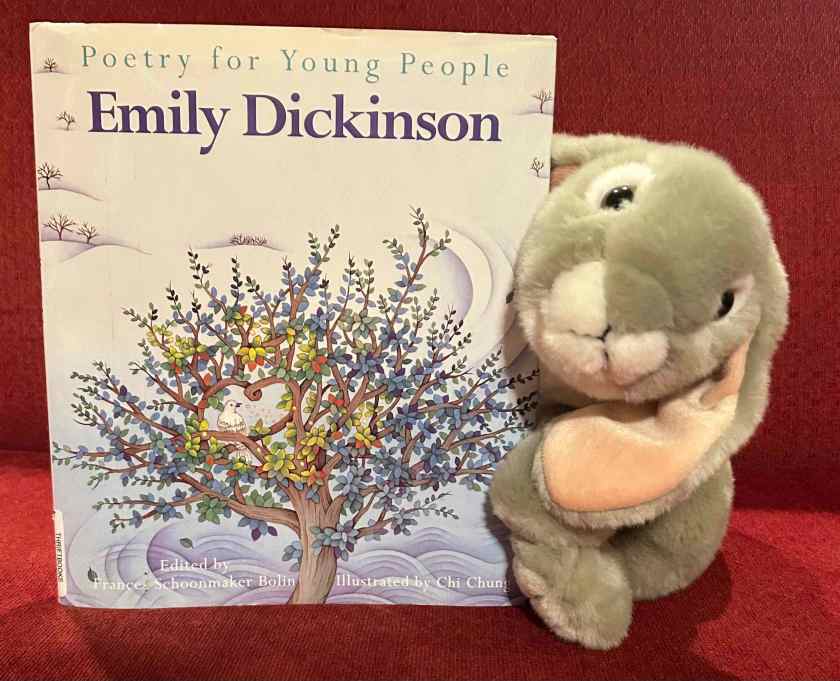
Marshmallow has been feverishly working on her college applications, so Sprinkles thought today would be a good opportunity for her to talk about a neat poetry book for young people edited by Frances Schoonmaker Bolin and illustrated by Chi Chung: Poetry for Young People: Emily Dickinson, published in 1994.
To make a prairie it takes a clover and one bee--
One clover, and a bee,
And revery.
The revery alone will do
If bees are few.
                    -Emily Dickinson
This is one of the little poems in this beautiful book; on page 36, it is accompanied by another poem and an illustration of a house on a prairie, a bee, and a butterfly (the butterfly appears in the other poem, together with a bee, who takes part in both). For those who need a dictionary, the book tells us that “revery” is “dreamy thinking; a state in which one imagines pleasant things.”
Poetry for Young People: Emily Dickinson is a lovely book that brings many of the most popular poems of a beloved American poet, Emily Dickinson (1830-1886). Readers of the Book Bunnies Blog may remember that I have previously reviewed a few poetry anthologies that contained poems by Dickinson among others, as well as Out Of Wonder: Celebrating Poets and Poetry by Kwame Alexander, Chris Colderley, and Marjory Wentworth, which was a collection of poems inspired by famous poems, among which Dickinson took her rightful place. But this current book is dedicated solely to Dickinson and as such brings us so much closer to this poet’s many worlds, the one she lived in and the several others she imagined into being.
The book begins with a four-page introduction to Dickinson’s life and life’s work. We learn among many things that only six of her poems were published in her lifetime, though after her death, people found that she had written over seventeen hundred poems! We also learn that she lived in her family home and more or less isolated herself from the rest of the world, especially as she grew older. But all the while she was creating worlds in her mind and describing them through her words. Indeed, she seems to have believed in the power of the word to created:
A word is dead
When it is said,
            Some say.
I say it just
Begins to live
            That day.
                    -Emily Dickinson
We find this poem at the end of the book, on page 47, together with another brief one:
In this short life
That only lasts an hour,
How much, how little
Is within our power!
                    -Emily Dickinson
These poems all seem simple, many are playful, and the rhyme structure is almost always the same. More generally, as we read in the introduction, most of Dickinson’s poems have stanzas of four lines, with the second and fourth lines ending with rhyming words. Most have two stanzas though some, like the ones I chose to share in this post so far, are shorter or longer. In each case, the English is clean, clear, and definitely not fancy. All these features make her poetry a great choice for parents to introduce young ones to the genre.
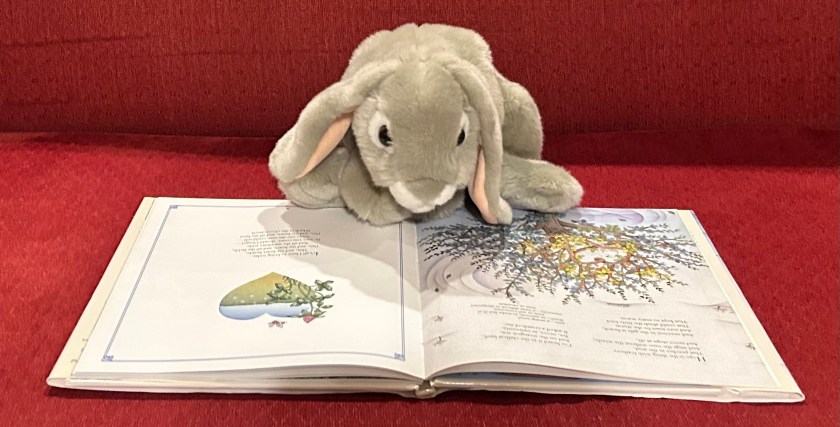
I can see a parent and a child reading these poems out loud together. The rhythm of her poems is almost always iambic (that is, stressed and unstressed syllables alternate), and this makes reading her poems out loud much more fun! Children can play with the beat and learn that poetry offers a lot more pattern and music than just through rhyme.
As I mentioned above, the editor, Frances Schoonmaker Bolin, included on some of the pages, definitions of words that may not be familiar to young readers. Though Dickinson wrote clearly and her language is close to our daily English, she did live almost two hundred years ago, and some of the words she used may not be in immediate reach of young readers today. So these little glossaries make the reading a lot more pleasant because, of course, one wants to understand all the words in order to understand and appreciate a poem!
The illustrations by Chi Chung are on each page and add color and whimsy to the book. Most pages have one poem on them, and the illustration is a simple but colorful image that offers just a little nudge for our own imagination to join Dickinson’s. Some pages have a couple poems presented together, and the image might have elements connecting to both. All in all, the illustrations add much more value to the book, and definitely will make the reading time more fun.
All in all, I found this book to be a great addition to a young person’s poetry library. Add it to A Child’s Garden of Verses by Robert Louis Stevenson and Tasha Tudor and the two lovely books by AA. Milne, and your little one will have a lovely place to venture into the land of poetry whenever they feel like it.